REVIEW 3 major objections 7 minor 2 cited by
CanonSwap: High-Fidelity and Consistent Video Face Swapping via Canonical Space Modulation
T0 review · 3 major / 7 minor · reviewed 2026-08-06 · deepseek-v4-flash
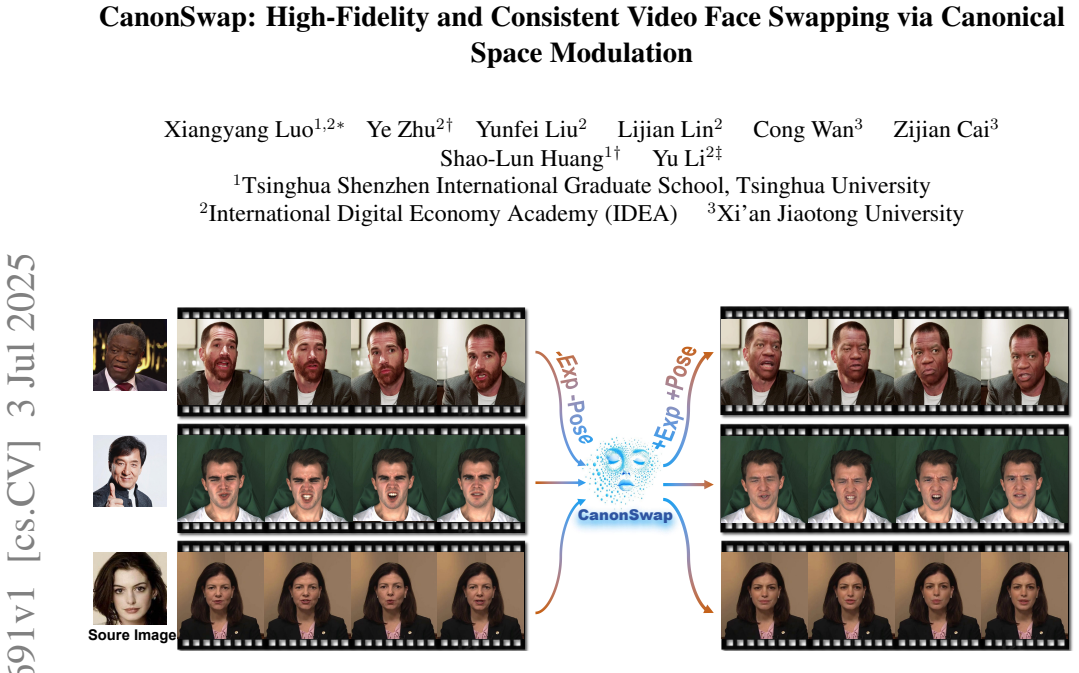
Pith's one-line read CanonSwap proposes swapping identity in a motion-free canonical space first, then restoring the target's own motion, so pose, expression, and lip-sync survive the swap.
desk verdict A solid, well-engineered face swapping paper whose main weakness is missing the video baselines it needs to support its consistency claim. read the letter →
The pith
A machine-rendered reading of the paper's core claim, the machinery that carries it, and where it could break.
The reading
What carries the argument
The machinery has two pieces. First, a canonical swap space is built by motion-guided warping: an implicit-keypoint motion extractor decomposes each frame as $X = X_c X_p + X_e + X_t$, where $X_c$ are canonical keypoints, $X_p$ pose rotation, $X_e$ expression, and $X_t$ translation, and from this produces the forward and inverse deformation fields $M_{o\to c}$ and $M_{c\to o}$. Swapping happens in the canonical space, and the inverse warp restores target motion. Second, Partial Identity Modulation (PIM) fuses a standard convolution branch with an identity-modulated, demodulated convolution branch using a predicted soft spatial mask $A$, so identity features from the source are injected only into facial regions. A light 3D U-Net refines the swapped canonical volume before warping back, and the training objective presses identity similarity in both canonical and original space while preserving pose and expression parameters.
What would settle it
Perform a round-trip test: warp many frames of one identity spanning large pose changes and exaggerated expressions into the canonical space, decode the canonical volume without any identity swap, and compare. If the decoded canonical face's geometry or texture varies systematically with the input pose or expression, motion has leaked into appearance and the decoupling assumption is false; a second check is whether pose or expression parameters recovered from canonical-space reconstructions track the original motion, which they should not if decoupling is exact.
Extended reading notes
Core claim
The paper's core claim is that the conflict between high-fidelity identity transfer and temporal consistency in video face swapping is caused by the coupling of appearance and motion, and that the conflict dissolves when swapping is performed in a canonical space. Concretely, a motion extractor moves each frame to a standardized face pose and expression, the source identity is modulated into that motion-free representation, and the inverse transformation restores the frame's original dynamics. The authors assert that because identity modulation never operates on motion variables, the output preserves the target's head pose, expression, and lip-sync by construction, and that the spatial mask in the Partial Identity Modulation module restricts changes to facial regions. Experiments on their VFS benchmark and on a standard face-video test set report the best identity similarity, lowest pose error, best lip-sync scores, and lowest video distance among compared methods.
Load-bearing premise
The load-bearing premise is that the motion extractor's canonical space fully removes motion, so a given identity maps to the same motion-free appearance regardless of pose or expression; if large poses or extreme expressions break that separation, identity modulation will disturb the target's dynamics just as swapping in the original space does.
Editorial extensions
If this is right
- Video face swaps can preserve the target's original head motion, blinks, and lip movements instead of replacing them with the source's, because motion is re-applied from the target after the swap.
- Temporal consistency can be achieved frame-by-frame with a warping backbone, without training or running a video diffusion model, which the paper shows is faster at inference than diffusion-based alternatives.
- The same canonical-space decomposition enables a second mode: replacing the target's expression with the source's during the warp-back step, so face swapping and facial animation live in one framework.
- Evaluation of video face swapping can go beyond global identity and image quality to measure gaze direction, eye-blink shape via Eye Aspect Ratio, lip-sync distance and confidence, optical-flow consistency, and Frechet Video Distance.
Reading between the lines
- Editorial inference: the same canonicalize-then-modulate-then-restore recipe could transfer other appearance attributes, such as makeup, age, or accessories, across video while keeping motion fixed, not just identity.
- Editorial inference: because the linear keypoint decomposition is inherited from talking-head synthesis, extreme out-of-plane rotations or nonrigid facial motions are the most likely failure region; a nonlinear warping estimator could be tested against this method on the same VFS metrics.
- Editorial inference: the proposed fine-grained metrics could be adopted as a standard protocol for video face swapping, and adding human perceptual studies would clarify whether the measured gains match viewer experience.
- Editorial inference: to isolate whether the canonical space or the masked modulation drives the gain, one could run the same PIM module directly on original frames and compare; the paper's ablation that omits warping begins this test.
Editorial analysis
A structured set of objections, weighed in public.
Referee Report
Summary. The paper proposes CanonSwap, a video face-swapping framework whose central idea is to warp each target frame into a canonical space using a pretrained motion extractor, perform identity transfer there with a Partial Identity Modulation (PIM) module that modulates only facial regions, and warp back to the original space. The authors argue that this decouples motion from appearance and thereby improves temporal consistency and dynamic attribute preservation. They introduce a VFS benchmark of 100 source-target pairs sampled from VFHQ, add fine-grained metrics including gaze, eye aspect ratio, LSE-D/C, temporal consistency, and FVD, and report quantitative and qualitative comparisons against six image-based GAN/diffusion face-swapping methods, plus ablations of the warping, mask, and refinement components.
Significance. If the results hold, the canonical-space approach is a conceptually clean and computationally cheaper alternative to video-diffusion-based face swapping, and the partial modulation idea is a sensible contribution to identity transfer. The paper also makes a useful effort to evaluate lip synchronization, eye dynamics, and temporal consistency, and the project page is public. However, the current evidence is insufficient: the most relevant video-specific baselines are not compared, the decoupling mechanism is inherited from a pretrained extractor without direct validation, and some of the newly introduced metrics are underspecified or misdescribed. The core idea is promising, but the claims of significant superiority over existing video face-swapping methods are not yet established.
major comments (3)
- [Section 5.1.2, Tables 1-2] The comparison set omits the three video-specific face-swapping methods (DynamicFace, VividFace, HiFiVFS) that Section 2.2 itself cites as the relevant state of the art for temporal consistency. Since the paper's central claim is superior temporal consistency and dynamic attribute preservation, quantitative evaluation against image-based GAN and diffusion baselines alone does not test that claim. Please add these baselines, or explicitly justify their exclusion, and report standard deviations or confidence intervals for all metrics, particularly on the 100-pair VFS benchmark, if the word "significantly" is to be used.
- [Section 3.1, Supplement C Eq. (12)] The motion/appearance decoupling mechanism is assumed rather than established. The canonical keypoints Xc are produced by a pretrained extractor, no loss in Eqs. (5)-(11) enforces that Xc is independent of pose and expression, and Eq. (7) simply treats the extractor's P and E outputs as reliable ground truth. The only direct validation, Supplement B Fig. 8, averages parsing maps over 10k frames; an averaged map can appear aligned even when individual frames retain substantial pose/expression jitter, and parsing alignment does not guarantee that the feature volumes being swapped are motion-free. Please provide per-frame evidence of decoupling (e.g., distributions of residual pose/expression in canonical space, or reconstruction error of X from Xc, Xp, Xe, Xt under large motions), or add a decoupling loss and retrain.
- [Sections 4 and 5.2.1] Several evaluation metrics introduced as contributions are not precisely defined. Temporal Consistency (TC) is described only as comparing optical flow fields between source and swapped videos, but the source is a single image and no equation, normalization, or implementation details are given. In addition, LSE-D is described as "the average deviation of lip landmarks from the ground truth," which does not match the standard SyncNet definition of LSE-D as a distance between audio and video embedding features. Please provide exact formulas, preprocessing steps, and code or pseudocode for all new metrics, since the paper's benchmarking contribution depends on their correctness.
minor comments (7)
- [Section 3.2, Supplement D] The text says that "Appendix D proves" faster convergence and mitigation of adversarial training, but Fig. 12 shows only anecdotal loss curves from what appears to be a single run; please report quantitative convergence statistics over multiple seeds or temper the claim.
- [Section 5.3, Fig. 5 caption] The caption reads "Quantitative results on the VFS benchmark" but shows qualitative images; it should read "Qualitative results."
- [Eq. (10)] The ground-truth mask AGT in Eq. (10) is never defined; please specify when such masks are available and how they are obtained during training.
- [Supplement F, Eq. (15)] In Eq. (15), the quantity X2 is undefined; it should almost certainly be X' from Eq. (14). Please correct this typo, as it makes the animation derivation confusing.
- [Supplement B] The text refers to a "CVF benchmark" in Supplement B, while the main text calls it the VFS benchmark; please unify the naming.
- [Throughout] There are several typos and grammatical errors, including "necessery" in Section 3, "swarping" in Section 5.4, "CanoSwap" for "CanonSwap," and "our project page are" in the abstract; a careful proofreading pass is needed.
- [Section 5.1.2] The paper states that the project page is public, but no code or metric implementation is linked; releasing the evaluation scripts and the VFS source-target pairs would substantially improve reproducibility.
Circularity Check
No significant circularity: the canonical-space mechanism is inherited from an external pretrained motion extractor and validated on held-out data; the only self-citation is a non-load-bearing evaluation model.
full rationale
The paper's central claim, that swapping in a canonical space decouples motion from appearance and thereby improves temporal consistency, is not forced by its own inputs. The canonical warp is adopted from the external Face vid2vid motion extractor [46] (Sec. 3.1: 'Inspired by [46]'; Supplement C, Eqs. 12-13), whose authors do not overlap with CanonSwap, so this is not a self-citation chain but a pretrained external component. The swapped identity is produced by the PIM module trained with identity, perceptual, and adversarial losses (Eqs. 5, 6, 9), and temporal, pose, and expression behavior is tested on held-out FF++ data and the VFS benchmark using standard metrics (ID similarity, pose, LSE-D, FVD). The VFS benchmark is self-introduced but independently sampled from VFHQ, and its metrics are not fitted to CanonSwap's outputs. The motion loss in Eq. 7 and the warp-back construction make pose and expression preservation largely definitional for a perfect warp, but the empirical question, whether the learned decoder and identity modulation preserve that motion, is still tested on unseen frames; this is a design property, not a fitted prediction. The only mild concern is self-citation: Ref [29] (TEASER), which shares authors with CanonSwap, is used to compute pose and expression accuracy in Tab. 1. However, [29] is an evaluation model only; it is not part of the training objective, no parameter is fitted to it, and it does not define the output, so it is not load-bearing. The weak validation of the canonical-space assumption (Supplement B, Fig. 8 averages parsing maps over 10k frames, and Eq. 12 is imported rather than re-derived) is an evidence gap about robustness, not a circular reduction. Therefore no load-bearing step reduces to its own input, and the circularity score is low.
Assumptions & free parameters
free parameters (1)
- Loss weights λid, λp, λmo, λr, λm =
10, 5, 5, 10, 1
assumptions (5)
- domain assumption Motion decomposition X = XcXp + Xe + Xt is a valid linear model of facial motion.
- domain assumption The Face vid2vid motion extractor [46] provides a consistent canonical space across frames.
- domain assumption Pretrained ArcFace identity model [11] measures identity similarity adequately.
- domain assumption VGGFace still images are sufficient training data for video-level temporal consistency.
- domain assumption The proposed metrics (EAR, LSE-D, LSE-C, TC) reflect perceptual video quality.
Cite this review
Pith. "Pith review of CanonSwap: High-Fidelity and Consistent Video Face Swapping via Canonical Space Modulation." pith.science (2026). https://pith.science/paper/5N2DGTK4
@misc{pith2026250702691,
  author       = {Pith},
  title        = {Pith review of: CanonSwap: High-Fidelity and Consistent Video Face Swapping via Canonical Space Modulation},
  year         = {2026},
  howpublished = {\url{https://pith.science/paper/5N2DGTK4}},
  note         = {Machine review of arXiv:2507.02691}
}
read the original abstract
Video face swapping aims to address two primary challenges: effectively transferring the source identity to the target video and accurately preserving the dynamic attributes of the target face, such as head poses, facial expressions, lip-sync, \etc. Existing methods mainly focus on achieving high-quality identity transfer but often fall short in maintaining the dynamic attributes of the target face, leading to inconsistent results. We attribute this issue to the inherent coupling of facial appearance and motion in videos. To address this, we propose CanonSwap, a novel video face-swapping framework that decouples motion information from appearance information. Specifically, CanonSwap first eliminates motion-related information, enabling identity modification within a unified canonical space. Subsequently, the swapped feature is reintegrated into the original video space, ensuring the preservation of the target face's dynamic attributes. To further achieve precise identity transfer with minimal artifacts and enhanced realism, we design a Partial Identity Modulation module that adaptively integrates source identity features using a spatial mask to restrict modifications to facial regions. Additionally, we introduce several fine-grained synchronization metrics to comprehensively evaluate the performance of video face swapping methods. Extensive experiments demonstrate that our method significantly outperforms existing approaches in terms of visual quality, temporal consistency, and identity preservation. Our project page are publicly available at https://luoxyhappy.github.io/CanonSwap/.
Figures


Figures from the paper (8 more)


Forward citations
Cited by 2 Pith papers
-
Preserving Source Video Realism: High-Fidelity Face Swapping for Cinematic Quality
LivingSwap is the first video reference-guided face swapping model that uses keyframe conditioning and temporal stitching to preserve source video realism with high fidelity across long sequences.
-
Adaptive Identity Anchoring: Closed-Loop Keyframe Placement for Synthetic Paired Supervision in Video Face Swapping
For video face swapping, adaptively adding swapped anchor frames at the moments of worst identity drift should make synthetic training pairs more faithful than the current first-and-last-frame-only scheme.
Reference graph
Works this paper leans on
-
[1]
Creating a photoreal digital actor: The digital emily project
Oleg Alexander, Mike Rogers, William Lambeth, Matt Chi- ang, and Paul Debevec. Creating a photoreal digital actor: The digital emily project. In 2009 Conference for Visual Me- dia Production, pages 176–187. IEEE, 2009. 1
work page 2009
-
[2]
Realistic and efficient face swapping: A unified approach with diffusion models
Sanoojan Baliah, Qinliang Lin, Shengcai Liao, Xiaodan Liang, and Muhammad Haris Khan. Realistic and efficient face swapping: A unified approach with diffusion models. arXiv preprint arXiv:2409.07269, 2024. 2, 6, 7
arXiv 2024
-
[3]
Face swapping: automatically replacing faces in photographs
Dmitri Bitouk, Neeraj Kumar, Samreen Dhillon, Peter Bel- humeur, and Shree K Nayar. Face swapping: automatically replacing faces in photographs. In ACM SIGGRAPH 2008 papers, pages 1–8. 2008. 2
work page 2008
-
[4]
Stable video diffusion: Scaling latent video diffusion models to large datasets
Andreas Blattmann, Tim Dockhorn, Sumith Kulal, Daniel Mendelevitch, Maciej Kilian, Dominik Lorenz, Yam Levi, Zion English, Vikram V oleti, Adam Letts, et al. Stable video diffusion: Scaling latent video diffusion models to large datasets. arXiv preprint arXiv:2311.15127, 2023. 3
arXiv 2023
-
[5]
Vggface2: A dataset for recognising faces across pose and age
Qiong Cao, Li Shen, Weidi Xie, Omkar M Parkhi, and An- drew Zisserman. Vggface2: A dataset for recognising faces across pose and age. In 2018 13th IEEE international con- ference on automatic face & gesture recognition (FG 2018), pages 67–74. IEEE, 2018. 6
work page 2018
-
[6]
Real-time eye blink detec- tion using facial landmarks
Jan Cech and Tereza Soukupova. Real-time eye blink detec- tion using facial landmarks. Cent. Mach. Perception, Dep. Cybern. Fac. Electr. Eng. Czech Tech. Univ. Prague , pages 1–8, 2016. 6
work page 2016
-
[7]
Simswap: An efficient framework for high fidelity face swapping
Renwang Chen, Xuanhong Chen, Bingbing Ni, and Yanhao Ge. Simswap: An efficient framework for high fidelity face swapping. In Proceedings of the 28th ACM International Conference on Multimedia, pages 2003–2011, 2020. 2, 5, 6, 7
work page 2003
-
[8]
Hifivfs: High fidelity video face swapping
Xu Chen, Keke He, Junwei Zhu, Yanhao Ge, Wei Li, and Chengjie Wang. Hifivfs: High fidelity video face swapping. arXiv preprint arXiv:2411.18293, 2024. 2, 3
arXiv 2024
Show all 58 references
-
[9]
Out of time: auto- mated lip sync in the wild
Joon Son Chung and Andrew Zisserman. Out of time: auto- mated lip sync in the wild. In Computer Vision–ACCV 2016 Workshops: ACCV 2016 International Workshops, Taipei, Taiwan, November 20-24, 2016, Revised Selected Papers, Part II 13, pages 251–263. Springer, 2017. 6
2016
-
[10]
My face my choice: Privacy enhancing deepfakes for social me- dia anonymization
Umur A Ciftci, Gokturk Yuksek, and Ilke Demir. My face my choice: Privacy enhancing deepfakes for social me- dia anonymization. In Proceedings of the IEEE/CVF Win- ter Conference on Applications of Computer Vision , pages 1369–1379, 2023. 1
2023
-
[11]
Arcface: Additive angular margin loss for deep face recognition
Jiankang Deng, Jia Guo, Niannan Xue, and Stefanos Zafeiriou. Arcface: Additive angular margin loss for deep face recognition. In Proceedings of the IEEE/CVF con- ference on computer vision and pattern recognition , pages 4690–4699, 2019. 5
2019
-
[12]
Disentangled and controllable face image genera- tion via 3d imitative-contrastive learning
Yu Deng, Jiaolong Yang, Dong Chen, Fang Wen, and Xin Tong. Disentangled and controllable face image genera- tion via 3d imitative-contrastive learning. In Proceedings of the IEEE/CVF conference on computer vision and pattern recognition, pages 5154–5163, 2020. 3
2020
-
[13]
Megaportraits: One-shot megapixel neural head avatars
Nikita Drobyshev, Jenya Chelishev, Taras Khakhulin, Alek- sei Ivakhnenko, Victor Lempitsky, and Egor Zakharov. Megaportraits: One-shot megapixel neural head avatars. In Proceedings of the 30th ACM International Conference on Multimedia, pages 2663–2671, 2022. 3
2022
-
[14]
Taming transformers for high-resolution image synthesis
Patrick Esser, Robin Rombach, and Bjorn Ommer. Taming transformers for high-resolution image synthesis. In Pro- ceedings of the IEEE/CVF conference on computer vision and pattern recognition, pages 12873–12883, 2021. 2
2021
-
[15]
Information bottleneck disentanglement for iden- tity swapping
Gege Gao, Huaibo Huang, Chaoyou Fu, Zhaoyang Li, and Ran He. Information bottleneck disentanglement for iden- tity swapping. In Proceedings of the IEEE/CVF Conference on Computer Vision and Pattern Recognition , pages 3404– 3413, 2021. 2
2021
-
[16]
3d guided fine-grained face manipulation
Zhenglin Geng, Chen Cao, and Sergey Tulyakov. 3d guided fine-grained face manipulation. In Proceedings of the IEEE/CVF conference on computer vision and pattern recognition, pages 9821–9830, 2019. 3
2019
-
[17]
Generative adversarial networks
Ian Goodfellow, Jean Pouget-Abadie, Mehdi Mirza, Bing Xu, David Warde-Farley, Sherjil Ozair, Aaron Courville, and Yoshua Bengio. Generative adversarial networks. Commu- nications of the ACM, 63(11):139–144, 2020. 2
2020
-
[18]
Animatediff: Animate your personalized text- to-image diffusion models without specific tuning
Yuwei Guo, Ceyuan Yang, Anyi Rao, Zhengyang Liang, Yaohui Wang, Yu Qiao, Maneesh Agrawala, Dahua Lin, and Bo Dai. Animatediff: Animate your personalized text- to-image diffusion models without specific tuning. arXiv preprint arXiv:2307.04725, 2023. 3
2023 arXiv
-
[19]
Marionette: Few-shot face reenact- ment preserving identity of unseen targets
Sungjoo Ha, Martin Kersner, Beomsu Kim, Seokjun Seo, and Dongyoung Kim. Marionette: Few-shot face reenact- ment preserving identity of unseen targets. InProceedings of the AAAI conference on artificial intelligence, pages 10893– 10900, 2020. 3
2020
-
[20]
Face-adapter for pre-trained diffusion models with fine- grained id and attribute control
Yue Han, Junwei Zhu, Keke He, Xu Chen, Yanhao Ge, Wei Li, Xiangtai Li, Jiangning Zhang, Chengjie Wang, and Yong Liu. Face-adapter for pre-trained diffusion models with fine- grained id and attribute control. In European Conference on Computer Vision, pages 20–36. Springer, 202...
2024
-
[21]
Animate anyone: Consistent and controllable image- to-video synthesis for character animation
Li Hu. Animate anyone: Consistent and controllable image- to-video synthesis for character animation. InProceedings of the IEEE/CVF Conference on Computer Vision and Pattern Recognition, pages 8153–8163, 2024. 3
2024
-
[22]
Arbitrary style transfer in real-time with adaptive instance normalization
Xun Huang and Serge Belongie. Arbitrary style transfer in real-time with adaptive instance normalization. In Proceed- ings of the IEEE international conference on computer vi- sion, pages 1501–1510, 2017. 2
2017
-
[23]
A style-based generator architecture for generative adversarial networks
Tero Karras, Samuli Laine, and Timo Aila. A style-based generator architecture for generative adversarial networks. In Proceedings of the IEEE/CVF conference on computer vi- sion and pattern recognition, pages 4401–4410, 2019. 2
2019
-
[24]
Analyzing and improv- ing the image quality of stylegan
Tero Karras, Samuli Laine, Miika Aittala, Janne Hellsten, Jaakko Lehtinen, and Timo Aila. Analyzing and improv- ing the image quality of stylegan. In Proceedings of the IEEE/CVF conference on computer vision and pattern recognition, pages 8110–8119, 2020. 4
2020
-
[25]
Diffface: Diffusion-based face swapping with facial guid- ance
Kihong Kim, Yunho Kim, Seokju Cho, Junyoung Seo, Jisu Nam, Kychul Lee, Seungryong Kim, and KwangHee Lee. Diffface: Diffusion-based face swapping with facial guid- ance. arXiv preprint arXiv:2212.13344, 2022. 2
2022 arXiv
-
[26]
Faceshifter: Towards high fidelity and occlusion aware face swapping
Lingzhi Li, Jianmin Bao, Hao Yang, Dong Chen, and Fang Wen. Faceshifter: Towards high fidelity and occlusion aware face swapping. CVPR, 2020. 2
2020
-
[27]
Freehand sketch generation from mechanical components
Zhichao Liao, Fengyuan Piao, Di Huang, Xinghui Li, Yue Ma, Pingfa Feng, Heming Fang, and Long Zeng. Freehand sketch generation from mechanical components. InProceed- ings of the 32nd ACM International Conference on Multime- dia, pages 6755–6764, 2024. 3
2024
-
[28]
Humanaesexpert: Advancing a multi-modality foundation model for human image aesthetic assessment
Zhichao Liao, Xiaokun Liu, Wenyu Qin, Qingyu Li, Qiulin Wang, Pengfei Wan, Di Zhang, Long Zeng, and Pingfa Feng. Humanaesexpert: Advancing a multi-modality foundation model for human image aesthetic assessment. arXiv preprint arXiv:2503.23907, 2025. 1
2025 arXiv
-
[29]
Teaser: Token enhanced spatial modeling for ex- pressions reconstruction
Yunfei Liu, Lei Zhu, Lijian Lin, Ye Zhu, Ailing Zhang, and Yu Li. Teaser: Token enhanced spatial modeling for ex- pressions reconstruction. arXiv preprint arXiv:2502.10982,
-
[30]
Fine-grained face swap- ping via regional gan inversion
Zhian Liu, Maomao Li, Yong Zhang, Cairong Wang, Qi Zhang, Jue Wang, and Yongwei Nie. Fine-grained face swap- ping via regional gan inversion. In 2023 IEEE/CVF Confer- ence on Computer Vision and Pattern Recognition (CVPR) , pages 8578–8587. IEEE, 2023. 2, 6, 7
2023
-
[31]
Codeswap: Symmetrically face swapping based on prior codebook
Xiangyang Luo, Xin Zhang, Yifan Xie, Xinyi Tong, Wei- jiang Yu, Heng Chang, Fei Ma, and Fei Richard Yu. Codeswap: Symmetrically face swapping based on prior codebook. In Proceedings of the 32nd ACM International Conference on Multimedia, pages 6910–6919, 2024. 2
2024
-
[32]
Swa- pitup: A face swap application for privacy protection
Sachit Mahajan, Ling-Jyh Chen, and Tzu-Chieh Tsai. Swa- pitup: A face swap application for privacy protection. In 2017 IEEE 31st international conference on advanced infor- mation networking and applications (AINA) , pages 46–50. IEEE, 2017. 2
2017
-
[33]
pagan: real-time avatars using dy- namic textures
Koki Nagano, Jaewoo Seo, Jun Xing, Lingyu Wei, Zimo Li, Shunsuke Saito, Aviral Agarwal, Jens Fursund, Hao Li, Richard Roberts, et al. pagan: real-time avatars using dy- namic textures. ACM Trans. Graph., 37(6):258, 2018. 3
2018
-
[34]
On face segmentation, face swapping, and face perception
Yuval Nirkin, Iacopo Masi, Anh Tran Tuan, Tal Hassner, and Gerard Medioni. On face segmentation, face swapping, and face perception. In2018 13th IEEE International Conference on Automatic Face & Gesture Recognition (FG 2018), pages 98–105. IEEE, 2018. 2
2018
-
[35]
FSGANv2: Improved subject agnostic face swapping and reenactment
Yuval Nirkin, Yosi Keller, and Tal Hassner. FSGANv2: Improved subject agnostic face swapping and reenactment. IEEE, 2022. 2, 3, 6, 7
2022
-
[36]
Make a face: Towards arbitrary high fidelity face manipu- lation
Shengju Qian, Kwan-Yee Lin, Wayne Wu, Yangxiaokang Liu, Quan Wang, Fumin Shen, Chen Qian, and Ran He. Make a face: Towards arbitrary high fidelity face manipu- lation. In Proceedings of the IEEE/CVF international con- ference on computer vision, pages 10033–10042, 2019. 3
2019
-
[37]
High-resolution image synthesis with latent diffusion models
Robin Rombach, Andreas Blattmann, Dominik Lorenz, Patrick Esser, and Bj ¨orn Ommer. High-resolution image synthesis with latent diffusion models. In Proceedings of the IEEE/CVF conference on computer vision and pattern recognition, pages 10684–10695, 2022. 3
2022
-
[38]
U- net: Convolutional networks for biomedical image segmen- tation
Olaf Ronneberger, Philipp Fischer, and Thomas Brox. U- net: Convolutional networks for biomedical image segmen- tation. In Medical image computing and computer-assisted intervention–MICCAI 2015: 18th international conference, Munich, Germany, October 5-9, 2015, proceedings, pa...
2015
-
[39]
Faceforen- sics++: Learning to detect manipulated facial images
Andreas Rossler, Davide Cozzolino, Luisa Verdoliva, Chris- tian Riess, Justus Thies, and Matthias Nießner. Faceforen- sics++: Learning to detect manipulated facial images. In Proceedings of the IEEE/CVF international conference on computer vision, pages 1–11, 2019. 6
2019
-
[40]
Vividface: A diffusion-based hybrid frame- work for high-fidelity video face swapping
Hao Shao, Shulun Wang, Yang Zhou, Guanglu Song, Dailan He, Shuo Qin, Zhuofan Zong, Bingqi Ma, Yu Liu, and Hongsheng Li. Vividface: A diffusion-based hybrid frame- work for high-fidelity video face swapping. arXiv preprint arXiv:2412.11279, 2024. 2, 3
2024 arXiv
-
[41]
Blendface: Re-designing identity encoders for face- swapping
Kaede Shiohara, Xingchao Yang, and Takafumi Take- tomi. Blendface: Re-designing identity encoders for face- swapping. In Proceedings of the IEEE/CVF International Conference on Computer Vision (ICCV), pages 7634–7644,
-
[42]
First order motion model for image animation
Aliaksandr Siarohin, St ´ephane Lathuili`ere, Sergey Tulyakov, Elisa Ricci, and Nicu Sebe. First order motion model for image animation. Advances in neural information processing systems, 32, 2019. 3
2019
-
[43]
Attention is all you need
Ashish Vaswani, Noam Shazeer, Niki Parmar, Jakob Uszko- reit, Llion Jones, Aidan N Gomez, Łukasz Kaiser, and Illia Polosukhin. Attention is all you need. Advances in neural information processing systems, 30, 2017. 3
2017
-
[44]
Dy- namicface: High-quality and consistent video face swap- ping using composable 3d facial priors
Runqi Wang, Sijie Xu, Tianyao He, Yang Chen, Wei Zhu, Dejia Song, Nemo Chen, Xu Tang, and Yao Hu. Dy- namicface: High-quality and consistent video face swap- ping using composable 3d facial priors. arXiv preprint arXiv:2501.08553, 2025. 2, 3
2025 arXiv
-
[45]
Disco: Disentangled control for realistic human dance generation
Tan Wang, Linjie Li, Kevin Lin, Yuanhao Zhai, Chung- Ching Lin, Zhengyuan Yang, Hanwang Zhang, Zicheng Liu, and Lijuan Wang. Disco: Disentangled control for realistic human dance generation. In Proceedings of the IEEE/CVF Conference on Computer Vision and Pattern Recognition ,...
2024
-
[46]
One-shot free-view neural talking-head synthesis for video conferenc- ing
Ting-Chun Wang, Arun Mallya, and Ming-Yu Liu. One-shot free-view neural talking-head synthesis for video conferenc- ing. In Proceedings of the IEEE/CVF conference on com- puter vision and pattern recognition , pages 10039–10049,
-
[47]
Anytalk: Multi-modal driven multi-domain talk- ing head generation
Yu Wang, Yunfei Liu, Fa-Ting Hong, Meng Cao, Lijian Lin, and Yu Li. Anytalk: Multi-modal driven multi-domain talk- ing head generation. In Proceedings of the AAAI Conference on Artificial Intelligence, pages 8105–8113, 2025. 3
2025
-
[48]
Spf-portrait: Towards pure portrait customization with semantic pollution-free fine-tuning
Xiaole Xian, Zhichao Liao, Qingyu Li, Wenyu Qin, Pengfei Wan, Weicheng Xie, Long Zeng, Linlin Shen, and Pingfa Feng. Spf-portrait: Towards pure portrait customization with semantic pollution-free fine-tuning. arXiv preprint arXiv:2504.00396, 2025. 3
2025 arXiv
-
[49]
Vfhq: A high-quality dataset and bench- mark for video face super-resolution
Liangbin Xie, Xintao Wang, Honglun Zhang, Chao Dong, and Ying Shan. Vfhq: A high-quality dataset and bench- mark for video face super-resolution. In Proceedings of the IEEE/CVF Conference on Computer Vision and Pattern Recognition, pages 657–666, 2022. 6
2022
-
[50]
High-resolution face swapping via latent semantics disentanglement
Yangyang Xu, Bailin Deng, Junle Wang, Yanqing Jing, Jia Pan, and Shengfeng He. High-resolution face swapping via latent semantics disentanglement. In Proceedings of the IEEE/CVF Conference on Computer Vision and Pattern Recognition, pages 7642–7651, 2022. 2
2022
-
[51]
Styleswap: Style-based generator empow- ers robust face swapping
Zhiliang Xu, Hang Zhou, Zhibin Hong, Ziwei Liu, Jiaming Liu, Zhizhi Guo, Junyu Han, Jingtuo Liu, Errui Ding, and Jingdong Wang. Styleswap: Style-based generator empow- ers robust face swapping. In European Conference on Com- puter Vision, pages 661–677. Springer, 2022. 2
2022
-
[52]
Human motion video genera- tion: A survey
Haiwei Xue, Xiangyang Luo, Zhanghao Hu, Xin Zhang, Xunzhi Xiang, Yuqin Dai, Jianzhuang Liu, Zhensong Zhang, Minglei Li, Jian Yang, et al. Human motion video genera- tion: A survey. Authorea Preprints, 2024. 3
2024
-
[53]
The unreasonable effectiveness of deep features as a perceptual metric
Richard Zhang, Phillip Isola, Alexei A Efros, Eli Shecht- man, and Oliver Wang. The unreasonable effectiveness of deep features as a perceptual metric. In Proceedings of the IEEE conference on computer vision and pattern recogni- tion, pages 586–595, 2018. 5
2018
-
[54]
Accurate 3d face recon- struction with facial component tokens
Tianke Zhang, Xuangeng Chu, Yunfei Liu, Lijian Lin, Zhendong Yang, Zhengzhuo Xu, Chengkun Cao, Fei Yu, Changyin Zhou, Chun Yuan, et al. Accurate 3d face recon- struction with facial component tokens. In Proceedings of the IEEE/CVF international conference on computer vision, p...
2023
-
[55]
Thin-plate spline motion model for image animation
Jian Zhao and Hui Zhang. Thin-plate spline motion model for image animation. In Proceedings of the IEEE/CVF Con- ference on Computer Vision and Pattern Recognition, pages 3657–3666, 2022. 3
2022
-
[56]
Diffswap: High-fidelity and con- trollable face swapping via 3d-aware masked diffusion
Wenliang Zhao, Yongming Rao, Weikang Shi, Zuyan Liu, Jie Zhou, and Jiwen Lu. Diffswap: High-fidelity and con- trollable face swapping via 3d-aware masked diffusion. In Proceedings of the IEEE/CVF Conference on Computer Vi- sion and Pattern Recognition, pages 8568–8577, 2023. 2, 6, 7
2023
-
[57]
One shot face swapping on megapixels
Yuhao Zhu, Qi Li, Jian Wang, Cheng-Zhong Xu, and Zhenan Sun. One shot face swapping on megapixels. In Proceedings of the IEEE/CVF Conference on Computer Vision and Pat- tern Recognition (CVPR), pages 4834–4844, 2021. 2
2021
-
[58]
Stableswap: Stable face swapping in a shared and controllable latent space
Yixuan Zhu, Wenliang Zhao, Yansong Tang, Yongming Rao, Jie Zhou, and Jiwen Lu. Stableswap: Stable face swapping in a shared and controllable latent space. IEEE Transactions on Multimedia, 2024. 2 CanonSwap: High-Fidelity and Consistent Video Face Swapping via Canonical Space M...
2024
Reviewed August 6, 2026 · model on record in the stance chip above.
Discussion (0). Sign in to comment.