MolE-RAG: Molecular Structure-Enhanced Retrieval-Augmented Generation for Chemistry
Pith reviewed 2026-06-28 03:31 UTC · model grok-4.3
The pith
MolE-RAG augments LLMs with literature, molecular annotations, and structural analogs to raise accuracy on chemical property tasks without any training.
A machine-rendered reading of the paper's core claim, the machinery that carries it, and where it could break.
Core claim
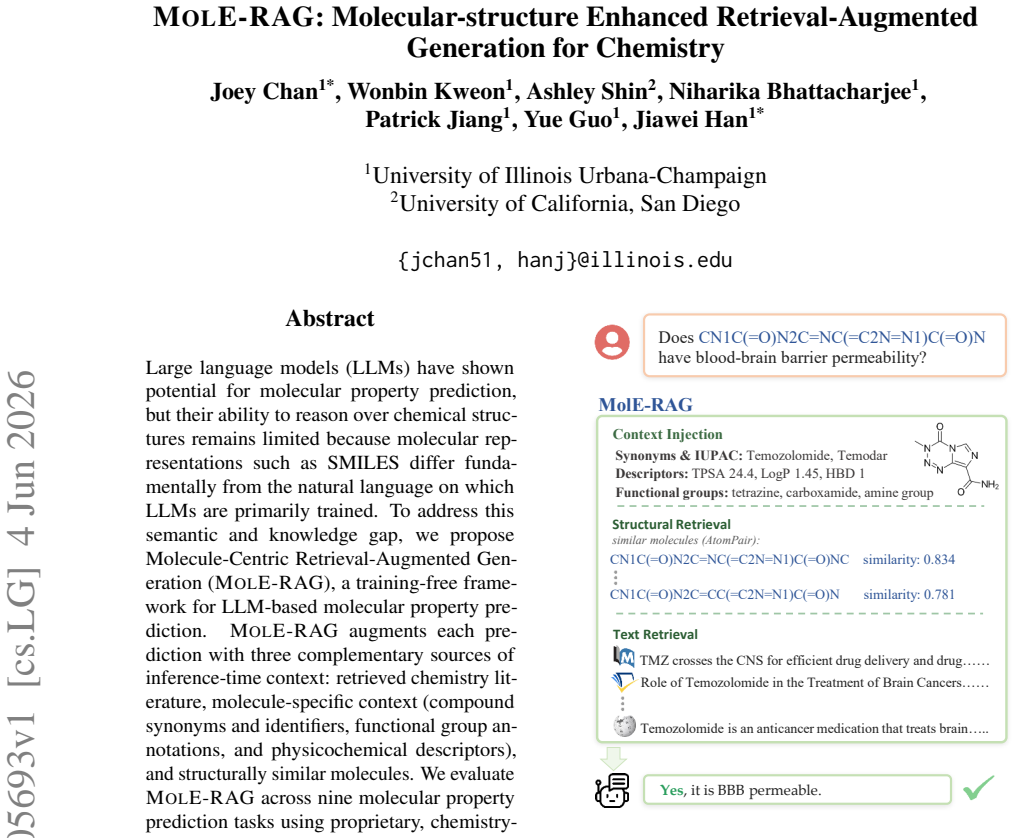
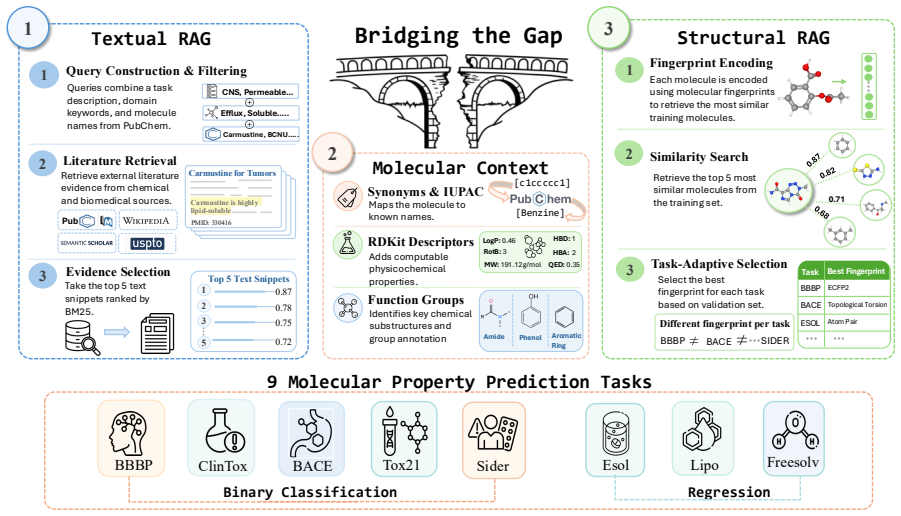
MolE-RAG retrieves three complementary sources of context for each prediction: chemistry literature, molecule-specific information including synonyms, identifiers, functional groups, and physicochemical descriptors, and structurally similar molecules from the training set. When these contexts are added to the LLM prompt, performance improves on nine molecular property prediction tasks. General-purpose LLMs see ROC-AUC gains of up to 28 percentage points on classification and RMSE reductions of up to 67 percent relative to a SMILES-only baseline, with the most useful context source varying by model and task.
What carries the argument
The MolE-RAG framework, which at inference time assembles retrieved literature passages, molecule annotations, and structural analogs into the LLM prompt.
Load-bearing premise
The retrieved literature, annotations, and structural analogs remain relevant to the query molecule and are integrated by the LLM without introducing noise that harms the final prediction.
What would settle it
A new molecular property prediction task where adding any of the three retrieved context sources lowers accuracy below the SMILES-only baseline for multiple LLMs.
Figures
read the original abstract
Large language models (LLMs) have shown promise for molecular property prediction, but their ability to reason over chemical structures remains limited, as molecular representations such as SMILES differ substantially from the natural language on which LLMs are primarily trained. To bridge this semantic and chemical knowledge gap, we propose MolE-RAG, a training-free, molecule-centric retrieval-augmented generation framework for LLM-based molecular property prediction. MolE-RAG augments each prediction with three complementary sources of inference-time context: retrieved chemistry literature, molecule-specific information including compound synonyms, identifiers, functional group annotations, and physicochemical descriptors, and structurally similar molecules retrieved from the training set. We evaluate MolE-RAG across nine molecular property prediction tasks using proprietary, chemistry-specialized, and open-source LLMs. Across general-purpose LLMs, MolE-RAG improves ROC-AUC by up to 28 percentage points on classification tasks and reduces regression RMSE by up to 67% relative to a SMILES-only baseline. We further find that the utility of each context source varies across models and tasks, with different models benefiting most from textual retrieval, molecular context, or structural retrieval. These results suggest that molecule-centric retrieval can improve LLM-based molecular property prediction without model fine-tuning while providing a flexible framework for integrating heterogeneous chemical knowledge at inference time.
Editorial analysis
A structured set of objections, weighed in public.
Referee Report
Summary. The paper proposes MolE-RAG, a training-free retrieval-augmented generation framework for LLM-based molecular property prediction. It augments SMILES inputs with three sources of context—retrieved chemistry literature, molecule-specific annotations (synonyms, identifiers, functional groups, descriptors), and structurally similar molecules from the training set—and reports large gains (up to +28 pp ROC-AUC on classification, up to 67% RMSE reduction on regression) across nine tasks and multiple LLMs relative to a SMILES-only baseline.
Significance. If the gains are shown to arise from genuine reasoning over non-leaking context rather than retrieval of ground-truth labels, the work would offer a practical, fine-tuning-free route to integrate heterogeneous chemical knowledge into LLMs; the finding that different context sources benefit different models is also potentially useful for future system design.
major comments (3)
- [§4 and §5] §4 (Experimental Setup) and §5 (Results): the manuscript does not describe how the literature corpus and annotation sources are filtered to exclude experimental property values for the test molecules; without this guarantee, the reported ROC-AUC and RMSE improvements could result from direct label lookup rather than structural or semantic enhancement.
- [§5.1] §5.1 (Main Results): the abstract and results tables claim up to 28 pp ROC-AUC and 67% RMSE gains, yet no dataset splits, retrieval-corpus construction details, baseline definitions, or statistical significance tests are provided, making it impossible to assess whether the improvements are robust or sensitive to post-hoc choices.
- [§3.2] §3.2 (Context Sources): the claim that structural analogs are retrieved from the training set requires an explicit statement that the similarity search does not inadvertently surface molecules whose property labels are already known to the LLM via pre-training or other retrieval paths.
minor comments (2)
- [Abstract] Abstract: ROC-AUC and RMSE are used without first spelling out the acronyms or the exact evaluation protocol.
- [Figure 2 and Table 1] Figure 2 and Table 1: axis labels and legend entries are too small to read at standard print size; consider increasing font size or splitting into multiple panels.
Simulated Author's Rebuttal
We thank the referee for their constructive and detailed feedback, which highlights important aspects of reproducibility and potential data leakage. We provide point-by-point responses to the major comments below and will revise the manuscript to incorporate the requested clarifications and details.
read point-by-point responses
-
Referee: [§4 and §5] §4 (Experimental Setup) and §5 (Results): the manuscript does not describe how the literature corpus and annotation sources are filtered to exclude experimental property values for the test molecules; without this guarantee, the reported ROC-AUC and RMSE improvements could result from direct label lookup rather than structural or semantic enhancement.
Authors: We acknowledge that the manuscript does not explicitly detail the filtering procedures for the literature corpus and annotation sources. In the revised version, we will add a dedicated subsection in §4 describing the curation process, including cross-referencing of test molecule identifiers against all sources and explicit exclusion of any entries containing experimental property values for test-set molecules. This will provide the necessary guarantee that retrieved contexts contain no direct label information. revision: yes
-
Referee: [§5.1] §5.1 (Main Results): the abstract and results tables claim up to 28 pp ROC-AUC and 67% RMSE gains, yet no dataset splits, retrieval-corpus construction details, baseline definitions, or statistical significance tests are provided, making it impossible to assess whether the improvements are robust or sensitive to post-hoc choices.
Authors: We agree that these details are essential for assessing robustness. The revised manuscript will expand §4 and §5.1 to include: explicit train/test split descriptions for all nine tasks, full specifications of retrieval-corpus construction (sources, sizes, and preprocessing steps), precise baseline definitions, and results from statistical significance tests (e.g., paired statistical tests across multiple runs) supporting the reported gains. revision: yes
-
Referee: [§3.2] §3.2 (Context Sources): the claim that structural analogs are retrieved from the training set requires an explicit statement that the similarity search does not inadvertently surface molecules whose property labels are already known to the LLM via pre-training or other retrieval paths.
Authors: We will revise §3.2 to include an explicit statement clarifying that structural analogs are retrieved exclusively from the training set via fingerprint-based similarity search, that no property labels are provided in the structural context, and that the RAG prompt supplies only structural information. We will also add a brief discussion addressing potential pre-training knowledge and why the observed gains are attributable to the retrieved context rather than label leakage. revision: yes
Circularity Check
No derivation chain present; purely empirical evaluation
full rationale
The paper describes an empirical retrieval-augmented framework evaluated on molecular property tasks. No equations, derivations, fitted parameters, or mathematical claims appear in the provided text. Performance gains are reported via direct measurement against baselines rather than any reduction to inputs by construction. No self-citation load-bearing steps, uniqueness theorems, or ansatzes are invoked in a way that would create circularity. The work is self-contained as an experimental study.
Axiom & Free-Parameter Ledger
Reference graph
Works this paper leans on
-
[1]
Aho and Jeffrey D
Alfred V. Aho and Jeffrey D. Ullman , title =. 1972
1972
-
[2]
Publications Manual , year = "1983", publisher =
1983
-
[3]
Ashok K. Chandra and Dexter C. Kozen and Larry J. Stockmeyer , year = "1981", title =. doi:10.1145/322234.322243
-
[4]
Scalable training of
Andrew, Galen and Gao, Jianfeng , booktitle=. Scalable training of
-
[5]
Dan Gusfield , title =. 1997
1997
-
[6]
Tetreault , title =
Mohammad Sadegh Rasooli and Joel R. Tetreault , title =. Computing Research Repository , volume =. 2015 , url =
2015
-
[7]
A Framework for Learning Predictive Structures from Multiple Tasks and Unlabeled Data , Volume =
Ando, Rie Kubota and Zhang, Tong , Issn =. A Framework for Learning Predictive Structures from Multiple Tasks and Unlabeled Data , Volume =. Journal of Machine Learning Research , Month = dec, Numpages =
-
[8]
Baker, George Arthur and Sanz-Guerrero, Mario and von der Wense, Katharina. Molecular String Representation Preferences in Pretrained LLM s: A Comparative Study in Zero- & Few-Shot Molecular Property Prediction. Proceedings of the 2025 Conference on Empirical Methods in Natural Language Processing. 2025. doi:10.18653/v1/2025.emnlp-main.56
-
[10]
2018 , eprint=
MoleculeNet: A Benchmark for Molecular Machine Learning , author=. 2018 , eprint=
2018
-
[11]
ArXiv , year=
Benchmarking Retrieval-Augmented Generation for Chemistry , author=. ArXiv , year=
-
[12]
ArXiv , year=
Mol-Instructions: A Large-Scale Biomolecular Instruction Dataset for Large Language Models , author=. ArXiv , year=
-
[13]
Journal of cheminformatics , volume=
One molecular fingerprint to rule them all: drugs, biomolecules, and the metabolome , author=. Journal of cheminformatics , volume=. 2020 , publisher=
2020
-
[14]
Cell Reports Physical Science , volume=
Developing ChemDFM as a large language foundation model for chemistry , author=. Cell Reports Physical Science , volume=. 2025 , publisher=
2025
-
[15]
Drug discovery today , volume=
Concepts and applications of chemical fingerprint for hit and lead screening , author=. Drug discovery today , volume=. 2022 , publisher=
2022
-
[16]
ArXiv , year=
SPECTER: Document-level Representation Learning using Citation-informed Transformers , author=. ArXiv , year=
-
[17]
ArXiv , year=
MedCPT: Contrastive Pre-trained Transformers with Large-scale PubMed Search Logs for Zero-shot Biomedical Information Retrieval , author=. ArXiv , year=
-
[18]
Conference on Empirical Methods in Natural Language Processing , year=
A Comprehensive Survey of Scientific Large Language Models and Their Applications in Scientific Discovery , author=. Conference on Empirical Methods in Natural Language Processing , year=
-
[19]
ArXiv , year=
LLaMA: Open and Efficient Foundation Language Models , author=. ArXiv , year=
-
[20]
Advances in Neural Information Processing Systems 36 , year=
What can Large Language Models do in chemistry? A comprehensive benchmark on eight tasks , author=. Advances in Neural Information Processing Systems 36 , year=
-
[21]
2023 , eprint=
GPT-4 Technical Report , author=. 2023 , eprint=
2023
-
[22]
Quantitative Biology , volume=
Advanced deep learning methods for molecular property prediction , author=. Quantitative Biology , volume=. 2023 , publisher=
2023
-
[23]
Journal of chemical information and modeling , volume=
Extended-connectivity fingerprints , author=. Journal of chemical information and modeling , volume=. 2010 , publisher=
2010
-
[24]
Methods , volume=
Molecular fingerprint similarity search in virtual screening , author=. Methods , volume=. 2015 , publisher=
2015
-
[25]
Advances in Neural Information Processing Systems , volume=
Understanding the limitations of deep models for molecular property prediction: Insights and solutions , author=. Advances in Neural Information Processing Systems , volume=
-
[26]
Advances in Neural Information Processing Systems , volume=
Motif-based graph self-supervised learning for molecular property prediction , author=. Advances in Neural Information Processing Systems , volume=
-
[27]
arXiv preprint arXiv:1905.12265 , year=
Strategies for pre-training graph neural networks , author=. arXiv preprint arXiv:1905.12265 , year=
arXiv 1905
-
[28]
Advances in neural information processing systems , volume=
N-gram graph: Simple unsupervised representation for graphs, with applications to molecules , author=. Advances in neural information processing systems , volume=
-
[29]
Proceedings of the AAAI conference on artificial intelligence , volume=
Molecular property prediction: A multilevel quantum interactions modeling perspective , author=. Proceedings of the AAAI conference on artificial intelligence , volume=
-
[30]
Journal of chemical information and modeling , volume=
Analyzing learned molecular representations for property prediction , author=. Journal of chemical information and modeling , volume=. 2019 , publisher=
2019
-
[31]
International conference on machine learning , pages=
Neural message passing for quantum chemistry , author=. International conference on machine learning , pages=. 2017 , organization=
2017
-
[32]
arXiv preprint arXiv:1810.00826 , year=
How powerful are graph neural networks? , author=. arXiv preprint arXiv:1810.00826 , year=
-
[33]
arXiv preprint arXiv:1609.02907 , year=
Semi-supervised classification with graph convolutional networks , author=. arXiv preprint arXiv:1609.02907 , year=
-
[34]
Advances in neural information processing systems , volume=
Schnet: A continuous-filter convolutional neural network for modeling quantum interactions , author=. Advances in neural information processing systems , volume=
-
[35]
Nature Machine Intelligence , volume=
Knowledge graph-enhanced molecular contrastive learning with functional prompt , author=. Nature Machine Intelligence , volume=. 2023 , publisher=
2023
-
[36]
Accounts of chemical research , volume=
Applications of deep learning in molecule generation and molecular property prediction , author=. Accounts of chemical research , volume=. 2020 , publisher=
2020
-
[37]
Journal of Chemical Information and Modeling , volume=
An Open-Source Implementation of the Scaffold Identification and Naming System (SCINS) and Example Applications , author=. Journal of Chemical Information and Modeling , volume=. 2024 , publisher=
2024
-
[38]
Drug Discovery Today: Technologies , volume=
Molecular property prediction: recent trends in the era of artificial intelligence , author=. Drug Discovery Today: Technologies , volume=. 2019 , publisher=
2019
-
[39]
Drug discovery today , volume=
Addressing toxicity risk when designing and selecting compounds in early drug discovery , author=. Drug discovery today , volume=. 2014 , publisher=
2014
-
[40]
Advanced drug delivery reviews , volume=
Experimental and computational approaches to estimate solubility and permeability in drug discovery and development settings , author=. Advanced drug delivery reviews , volume=. 1997 , publisher=
1997
-
[41]
Nature chemical biology , volume=
Target identification and mechanism of action in chemical biology and drug discovery , author=. Nature chemical biology , volume=. 2013 , publisher=
2013
-
[42]
Nature reviews drug discovery , volume=
Automating drug discovery , author=. Nature reviews drug discovery , volume=. 2018 , publisher=
2018
-
[43]
Nature reviews Drug discovery , volume=
Probing the links between in vitro potency, ADMET and physicochemical parameters , author=. Nature reviews Drug discovery , volume=. 2011 , publisher=
2011
-
[44]
Patterns , volume=
Computer-aided multi-objective optimization in small molecule discovery , author=. Patterns , volume=. 2023 , publisher=
2023
-
[45]
Chemical Reviews , volume=
Machine learning methods for small data challenges in molecular science , author=. Chemical Reviews , volume=. 2023 , publisher=
2023
-
[46]
arXiv preprint arXiv:2010.09885 , year=
ChemBERTa: large-scale self-supervised pretraining for molecular property prediction , author=. arXiv preprint arXiv:2010.09885 , year=
arXiv 2010
-
[47]
Proceedings of the 2022 Conference on Empirical Methods in Natural Language Processing , pages=
Translation between molecules and natural language , author=. Proceedings of the 2022 Conference on Empirical Methods in Natural Language Processing , pages=
2022
-
[48]
Nature communications , volume=
A deep-learning system bridging molecule structure and biomedical text with comprehension comparable to human professionals , author=. Nature communications , volume=. 2022 , publisher=
2022
-
[49]
Proceedings of the 61st Annual Meeting of the Association for Computational Linguistics (Volume 2: Short Papers) , pages=
Molxpt: Wrapping molecules with text for generative pre-training , author=. Proceedings of the 61st Annual Meeting of the Association for Computational Linguistics (Volume 2: Short Papers) , pages=
-
[50]
arXiv preprint arXiv:2209.05481 , year=
A molecular multimodal foundation model associating molecule graphs with natural language , author=. arXiv preprint arXiv:2209.05481 , year=
-
[51]
Proceedings of the 63rd Annual Meeting of the Association for Computational Linguistics (Volume 1: Long Papers) , pages=
Molrag: unlocking the power of large language models for molecular property prediction , author=. Proceedings of the 63rd Annual Meeting of the Association for Computational Linguistics (Volume 1: Long Papers) , pages=
-
[53]
, author=
Concepts and Applications of Molecular Similarity. , author=. Science , volume=. 1991 , publisher=
1991
-
[54]
Organic & biomolecular chemistry , volume=
Molecular similarity: a key technique in molecular informatics , author=. Organic & biomolecular chemistry , volume=. 2004 , publisher=
2004
-
[55]
Chemical Reviews , volume=
General-purpose models for the chemical sciences: Llms and beyond , author=. Chemical Reviews , volume=. 2026 , publisher=
2026
-
[57]
arXiv preprint arXiv:2402.09391 , year=
Llasmol: Advancing large language models for chemistry with a large-scale, comprehensive, high-quality instruction tuning dataset , author=. arXiv preprint arXiv:2402.09391 , year=
-
[58]
2009 , publisher=
The probabilistic relevance framework: BM25 and beyond , author=. 2009 , publisher=
2009
-
[59]
Advances in neural information processing systems , volume=
What can large language models do in chemistry? a comprehensive benchmark on eight tasks , author=. Advances in neural information processing systems , volume=
-
[60]
Bioinformatics , volume=
MolFCL: predicting molecular properties through chemistry-guided contrastive and prompt learning , author=. Bioinformatics , volume=. 2025 , publisher=
2025
-
[61]
Greg Landrum , volume=
RDKit: A software suite for cheminformatics, computational chemistry, and predictive modeling , author=. Greg Landrum , volume=
-
[62]
arXiv preprint arXiv:2509.20664 , year=
Enhancing Molecular Property Prediction with Knowledge from Large Language Models , author=. arXiv preprint arXiv:2509.20664 , year=
-
[63]
Chemical science , volume=
MoleculeNet: a benchmark for molecular machine learning , author=. Chemical science , volume=. 2018 , publisher=
2018
-
[64]
Frontiers in pharmacology , volume=
Improvement of prediction performance with conjoint molecular fingerprint in deep learning , author=. Frontiers in pharmacology , volume=. 2020 , publisher=
2020
-
[65]
Journal of Chemical Information and Modeling , volume=
AccFG: Accurate Functional Group Extraction and Molecular Structure Comparison , author=. Journal of Chemical Information and Modeling , volume=. 2025 , publisher=
2025
-
[67]
2024 , url=
GPT-4o mini: advancing cost-efficient intelligence , author=. 2024 , url=
2024
-
[71]
Advances in neural information processing systems , volume=
Self-supervised graph transformer on large-scale molecular data , author=. Advances in neural information processing systems , volume=
-
[72]
Advances in neural information processing systems , volume=
Retrieval-augmented generation for knowledge-intensive nlp tasks , author=. Advances in neural information processing systems , volume=
-
[74]
Nature Machine Intelligence , volume=
Molecular contrastive learning of representations via graph neural networks , author=. Nature Machine Intelligence , volume=. 2022 , publisher=
2022
-
[75]
Nature communications , volume=
A unified drug--target interaction prediction framework based on knowledge graph and recommendation system , author=. Nature communications , volume=. 2021 , publisher=
2021
-
[76]
Proceedings of the AAAI Conference on Artificial Intelligence , volume=
Bi-level contrastive learning for knowledge-enhanced molecule representations , author=. Proceedings of the AAAI Conference on Artificial Intelligence , volume=
-
[77]
Andreas Bender and Robert C Glen. 2004. Molecular similarity: a key technique in molecular informatics. Organic & biomolecular chemistry, 2(22):3204--3218
2004
-
[78]
Alice Capecchi, Daniel Probst, and Jean-Louis Reymond. 2020. One molecular fingerprint to rule them all: drugs, biomolecules, and the metabolome. Journal of cheminformatics, 12(1):43
2020
-
[79]
Adri \`a Cereto-Massagu \'e , Mar \' a Jos \'e Ojeda, Cristina Valls, Miquel Mulero, Santiago Garcia-Vallv \'e , and Gerard Pujadas. 2015. Molecular fingerprint similarity search in virtual screening. Methods, 71:58--63
2015
-
[80]
Arman Cohan, Sergey Feldman, Iz Beltagy, Doug Downey, and Daniel S. Weld. 2020. https://api.semanticscholar.org/CorpusID:215768677 Specter: Document-level representation learning using citation-informed transformers . ArXiv, abs/2004.07180
arXiv 2020
-
[81]
Yin Fang, Xiaozhuan Liang, Ningyu Zhang, Kangwei Liu, Rui Huang, Zhuo Chen, Xiaohui Fan, and Huajun Chen. 2023 a . https://api.semanticscholar.org/CorpusID:259164901 Mol-instructions: A large-scale biomolecular instruction dataset for large language models . ArXiv, abs/2306.08018
arXiv 2023
-
[82]
Yin Fang, Qiang Zhang, Ningyu Zhang, Zhuo Chen, Xiang Zhuang, Xin Shao, Xiaohui Fan, and Huajun Chen. 2023 b . Knowledge graph-enhanced molecular contrastive learning with functional prompt. Nature Machine Intelligence, 5(5):542--553
2023
-
[83]
Yunfan Gao, Yun Xiong, Xinyu Gao, Kangxiang Jia, Jinliu Pan, Yuxi Bi, Yixin Dai, Jiawei Sun, Haofen Wang, Haofen Wang, and 1 others. 2023. Retrieval-augmented generation for large language models: A survey. arXiv preprint arXiv:2312.10997, 2(1):32
Pith/arXiv arXiv 2023
-
[84]
Aaron Grattafiori, Abhimanyu Dubey, Abhinav Jauhri, Abhinav Pandey, Abhishek Kadian, Ahmad Al-Dahle, Aiesha Letman, Akhil Mathur, Alan Schelten, Alex Vaughan, and 1 others. 2024. The llama 3 herd of models. arXiv preprint arXiv:2407.21783
Pith/arXiv arXiv 2024
-
[85]
Chawla, O
Taicheng Guo, Kehan Guo, Bozhao Nan, Zhengwen Liang, Zhichun Guo, N. Chawla, O. Wiest, and Xiangliang Zhang. 2023 a . https://api.semanticscholar.org/CorpusID:258967365 What can large language models do in chemistry? a comprehensive benchmark on eight tasks . Advances in Neural Information Processing Systems 36
2023
-
[86]
Taicheng Guo, Bozhao Nan, Zhenwen Liang, Zhichun Guo, Nitesh Chawla, Olaf Wiest, Xiangliang Zhang, and 1 others. 2023 b . What can large language models do in chemistry? a comprehensive benchmark on eight tasks. Advances in neural information processing systems, 36:59662--59688
2023
-
[87]
James B Hendrickson. 1991. Concepts and applications of molecular similarity. Science, 252(5009):1189--1190
1991
-
[88]
Albert Q Jiang, Alexandre Sablayrolles, Arthur Mensch, Chris Bamford, Devendra Singh Chaplot, Diego de Las Casas, Florian Bressand, Gianna Lengyel, Guillaume Lample, Lucile Saulnier, and 1 others. 2023. Mistral 7b. arXiv preprint arXiv:2310.06825
Pith/arXiv arXiv 2023
discussion (0)
Sign in with ORCID, Apple, or X to comment. Anyone can read and Pith papers without signing in.