REVIEW 4 major objections 5 minor 33 references
Finding Singularities in Gravitational Lensing
T0 review · 4 major / 5 minor · reviewed 2026-08-14 · deepseek-v4-flash
Pith's one-line read The paper claims that all stable and unstable caustic singularities of a strong gravitational lens can be extracted automatically from the lensing potential and summarized in a single 'singularity map' of the image plane.
desk verdict A useful methods paper that adapts known singularity-detection machinery to gravitational lensing, with a genuinely interesting singularity-map proposal; the numerical validation is thinner than the central claim requires, but the paper deserves a serious referee. read the letter →
The pith
A machine-rendered reading of the paper's core claim, the machinery that carries it, and where it could break.
The reading
What carries the argument
The carrying object is the deformation tensor $A(x) = \delta_{ij} - (D_{ds}/D_s)\psi_{ij}$ of the lens mapping, reduced to its eigenvalues and eigenvectors on a grid. An A3-line is the set of points where $n_\lambda \cdot \nabla \lambda = 0$, meaning the eigenvector is tangent to its eigenvalue contour; A4 points are extrema of the eigenvalue along an A3-line that are not true local maxima of the field; and D4 points are intersections of the two curves where the diagonal components of the deformation tensor are equal and the off-diagonal shear vanishes. The algorithms compute first and second derivatives of the input potential by finite differences, trace the A3-lines, flag A4 candidates by eigenvalue maxima, and classify D4 points by the number of A3-lines converging there and the sign of $s_D$. This machinery converts the abstract catastrophe-theory classification into a concrete map in the lens plane.
What would settle it
A deep, high-resolution observation of Abell 697 targeting the predicted swallowtail region at $z_s \approx 0.67$ and the predicted fifth image of system 1: if no four-image swallowtail arc or fifth image appears where the singularity map places them, the map of this cluster is falsified. On synthetic lenses, checking the one-component elliptical model for exactly two A3-lines and two hyperbolic umbilics with positions set by core radius would settle whether the detector itself is complete.
Extended reading notes
Core claim
The central claim is that every meaningful singularity of the lens mapping can be read off from the deformation tensor and its eigenvalue and eigenvector fields. In the image plane, A3-lines mark where the gradient of an eigenvalue is orthogonal to the corresponding eigenvector; these are the lines on which cusps appear at some source redshift. A4 (swallowtail) points occur where the eigenvector is tangent to an A3-line, i.e., where the eigenvalue has a local maximum along that line, and D4 (umbilic) points occur where the shear vanishes and the two eigenvalues coincide, with hyperbolic or elliptic classification set by the sign of the cubic discriminant $s_D$. The authors show by construction that these features exist in elliptical lens models, that their positions shift and disappear under external shear with characteristic tolerances, and that in Abell 697 the singularity map yields the observed image system plus a predicted fifth image. The paper thus proposes the singularity map as a redshift-independent, compact representation that captures all configurations a given lens can produce.
Load-bearing premise
The Abell 697 demonstration assumes the input mass model is a faithful representation of the real cluster potential: if that model is wrong in the relevant regions, the predicted singularities, the reproduced images, and the predicted fifth image do not correspond to the actual cluster.
Editorial extensions
If this is right
- A single singularity map lists, for a given lens model, all source redshifts at which unstable singularities occur, so no separate caustic computation per source plane is needed.
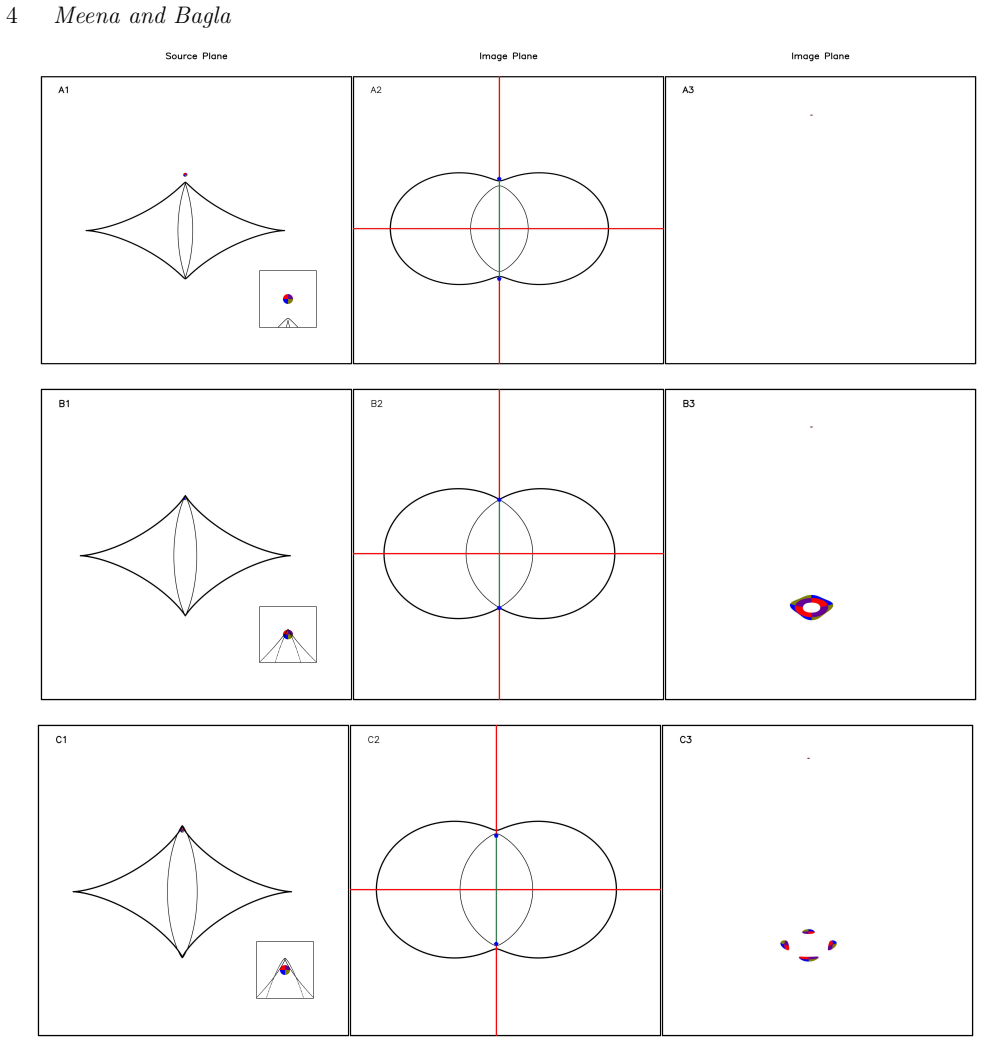
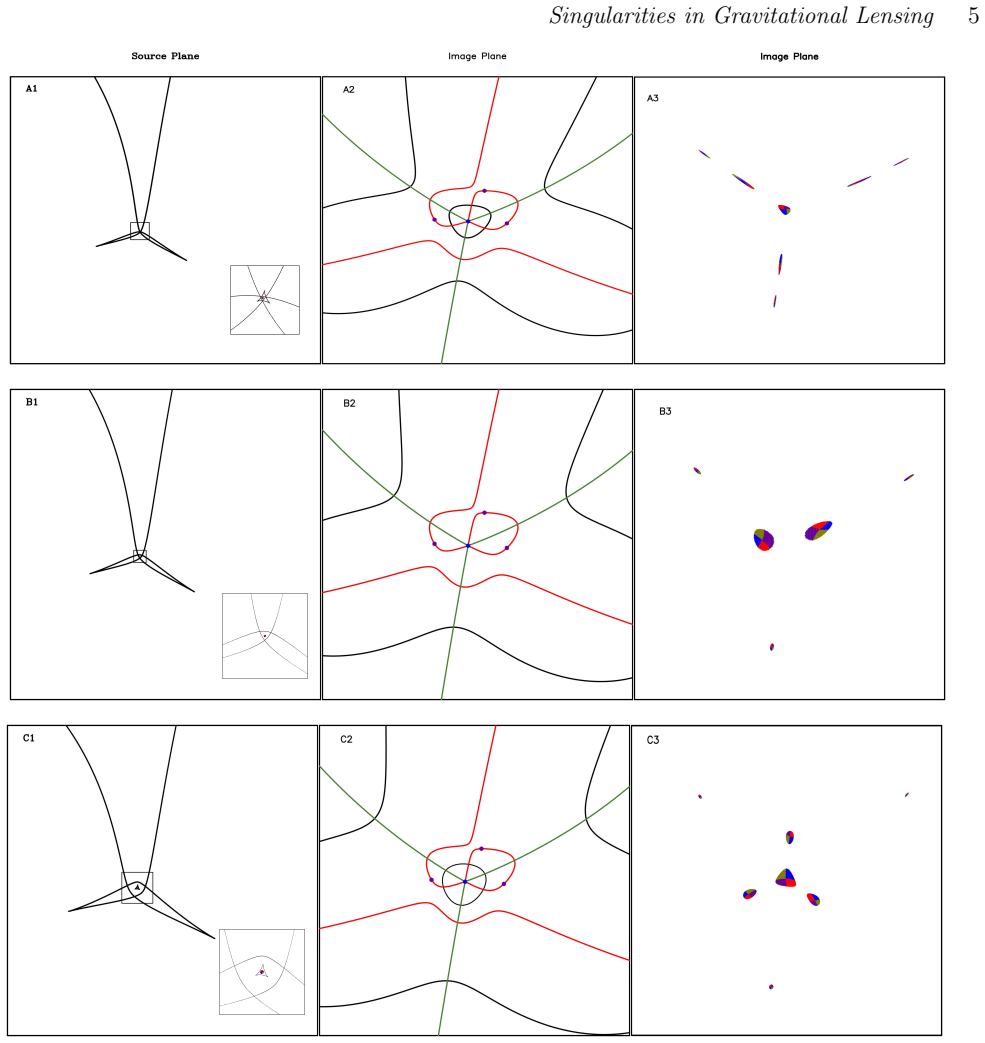
- The characteristic image forms (four-image swallowtail arc, ring or cross at hyperbolic umbilic, Y-shaped seven-image configuration at elliptic umbilic) give observers recognizable signatures to identify these singularities in real lenses.
- Magnification around swallowtails falls as $r^{-3/4}$ and around umbilics as $r^{-1}$, steeper than folds and cusps, so these regions are prime targets for finding very faint high-redshift sources.
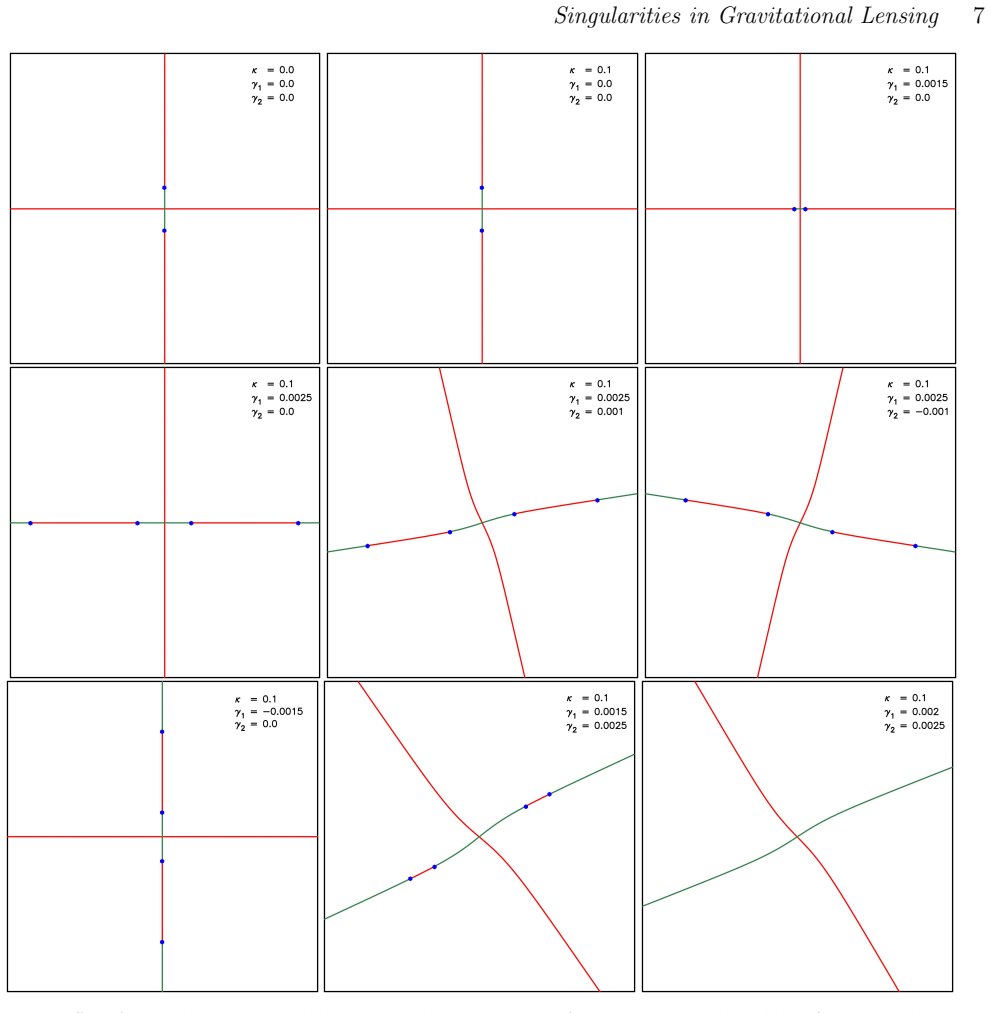
- Instability of these singularities under external shear (survival up to about $10^{-3}$ for hyperbolic umbilics, $10^{-4}$ for swallowtails, and $10^{-5}$ for elliptic umbilics) means their presence or absence can constrain substructure and environment of the lens.
- In Abell 697 the map reproduces the observed system 1 and predicts a fifth image hidden by the central galaxy, a prediction that can be checked with deeper observations.
Reading between the lines
- One extension the authors do not pursue: the same singularity map could serve as a feature vector for automated comparison of lens models against observed image configurations, since each singularity type leaves a distinct image signature.
- The predicted fifth image in Abell 697, if confirmed, would simultaneously validate the input mass model and demonstrate that singularity maps can find images missed by conventional ray tracing.
- The stability thresholds under shear suggest a statistical test: counting unstable singularities across a survey of strong lenses could probe the typical amplitude of environmental shear, because high-shear environments should suppress elliptic umbilics first.
- Because the singularity map is redshift-independent, it can be precomputed once per lens model and used to plan multi-band observations at specific redshifts where a singularity becomes critical.
Signed reviews
Editorial analysis
A structured set of objections, weighed in public.
Referee Report
Summary. The paper develops and applies numerical algorithms that take a lensing potential as input and detect the unstable singularities of the lens map: A3-lines (cusp lines) and A4 (swallowtail) and D4 (umbilic) point singularities. After reviewing the deformation-tensor formulation of lensing singularities and the definitions in Eqs. (10) and (11), the authors describe a finite-difference implementation on a uniform grid, test it on one- and two-component elliptical lenses, study survival under external shear, and apply it to the RELICS model of Abell 697, reporting reproduction of the four observed images of system 1 plus a predicted fifth image. They propose the 'singularity map' as a compact representation of a lens.
Significance. The proposed singularity map is a genuinely useful concept: if the algorithms are reliable, the map condenses the potentially complex caustic structure of a lens into a single image-plane diagram, and the catalog of characteristic image formations (Figures 1-3) provides a practical basis for identifying unstable singularities in surveys. The mathematical framework is standard catastrophe theory, and the implementation is anchored by independent analytical expectations for simple lenses and by an externally determined cluster model for Abell 697, so the demonstration is not circular. The main limitations are that the numerical method is not sufficiently specified or quantitatively validated, and the real-lens application does not address uncertainties; these are fixable within the scope of the paper.
major comments (4)
- [§4, Eq. (10)] The description of the algorithm omits the numerical parameters that are load-bearing for the claim that 'all' singularities are located: grid spacing, finite-difference stencil and order, threshold or tolerance for accepting zeros of nλ·∇λ, and the ordering and interpolation scheme used to construct A3-lines and to locate maxima along them. Without these details, and without a convergence test showing that the number and positions of A3-lines, A4 points, and D4 points are stable as the grid is refined, the central claim cannot be assessed. This is especially relevant for the 440x440 pixel Abell 697 grid, where third derivatives of a reconstructed potential will be noisy.
- [§5.1] The validation on the one-component elliptical lens is qualitative only: the text states that the lens has two A3-lines and two hyperbolic umbilics, but no comparison is made with the expected singularities from Blandford & Narayan (1986), nor are the measured positions of the A3-lines or umbilics reported. Because this is the main controlled test of the detector, the absence of a quantitative benchmark leaves open the possibility of missed or spurious singularities. Please add a table comparing the detected singularities to the analytic census as a function of grid resolution.
- [§5.4 and Figure 6] The Abell 697 application is presented as a successful test, including the reproduction of system 1 and the prediction of a fifth image, but the inference does not propagate the uncertainties of the adopted RELICS/Cibirka et al. (2018) mass model and does not distinguish physical small-scale structure in the singularity map from numerical artifacts arising from finite differencing of a pixelized potential. A resolution study, for example recomputing the singularity map on coarser and finer grids or with a smoothed potential, is needed before the fifth-image prediction can be regarded as robust.
- [§4 and §3.3] The algorithm is said to classify D4 points by counting the number of converging A3-lines, but the paper does not specify how this counting is performed at points where the deformation tensor has degenerate eigenvalues and eigenvectors are formally undefined, nor does it report the discriminant sD of Eq. (11) for the detected points. Since the hyperbolic/elliptic distinction is one of the paper's end products, this classification step needs to be made explicit and checked against Eq. (11).
minor comments (5)
- [§4] Typographical error in the algorithm list: 'CALUCLATE extrema' should be 'CALCULATE extrema'.
- [§5.4] The statement 'the critical redshift for this pair is higher than the 1.1' is unclear; please specify the reference redshift and which pair of singularities is meant.
- [§5.3] The quoted stability thresholds (10^-3, 10^-4, 10^-5 for hyperbolic umbilic, swallowtail, and elliptic umbilic) are stated without giving the procedure, lens parameters, or error bars used to obtain them; a table or figure showing the survival/non-survival region in parameter space would make these claims reproducible.
- [Figures 1-3] The source positions, caustics, and critical curves are difficult to distinguish because labels are small and some panels lack axis units; larger fonts and consistent color legends would help.
- [References] The reference list entry 'Orban de Xivry, G., Marshall, P. 2009' is inconsistent with the in-text citation 'Xivry et. al. 2009'; please standardize the author name formatting.
Circularity Check
No significant circularity: the singularity-detection algorithm applies standard mathematical definitions to an input lensing potential, with validation against independent analytical results and an external cluster model.
full rationale
The paper's central claim is that, given a lensing potential, the implemented algorithms locate A3-lines and A4/D4 point singularities by evaluating the defining conditions: Eq. (10) for A3-lines and Eq. (11) for classifying umbilics. This is a direct computation from the input, not a prediction that is equivalent to the input by construction. Validation for the one-component elliptical lens is referenced against the independent analytical treatment of Blandford & Narayan (1986), and the Abell 697 demonstration uses the external RELICS/Cibirka et al. mass model rather than a model fitted inside this paper. The reproduction of system 1 images is explicitly described as choosing the source position 'in such a way so that it can reproduce the image formation for system 1', and is therefore a consistency check rather than an independent prediction being sold as a discovery. The only self-citation, Bagla (2001), is invoked for the origin of the algorithms ('We use algorithms described briefly in that work'), but the present paper develops and tests them independently, so the self-citation is not load-bearing for the central claim. No fitted parameter is renamed as a prediction, no uniqueness theorem from the authors is imported, and no ansatz is smuggled in via citation. The absence of detailed grid-resolution and threshold specifications is a reproducibility concern, not a circularity concern, because it does not make the derivation reduce to its own inputs.
Assumptions & free parameters
free parameters (3)
- Core radius r0 (one-component elliptical lens) =
not specified in text (hand-picked)
- Ellipticity and strength of the one-component lens (ε, ψ0) =
not specified (hand-picked)
- Two-component lens parameters (positions, orientation, core radii, ellipticities) =
randomly picked (stated in §5.2)
assumptions (4)
- standard math Catastrophe theory classification of stable (fold, cusp) and unstable (swallowtail, umbilic) singularities of smooth maps applies to the gravitational lens equation.
- domain assumption A3-lines are located by nλ·∇λ = 0 (eq. 10), and A4/D4 points by tangency of the eigenvector to the A3-line and by equality of eigenvalues, respectively.
- domain assumption The deformation tensor A(x)=δ_ij-(Dds/Ds)ψ_ij, computed from the projected lensing potential, determines the full singularity structure in the image plane for all source redshifts.
- domain assumption The RELICS mass model for Abell 697 from Cibirka et al. (2018) is an adequate representation of the cluster for locating singularities.
Cite this review
Pith. "Pith review of Finding Singularities in Gravitational Lensing." pith.science (2026). https://pith.science/paper/5NBRFBQ5
@misc{pith2026190801158,
  author       = {Pith},
  title        = {Pith review of: Finding Singularities in Gravitational Lensing},
  year         = {2026},
  howpublished = {\url{https://pith.science/paper/5NBRFBQ5}},
  note         = {Machine review of arXiv:1908.01158}
}
read the original abstract
The number of strong lens systems is expected to increase significantly in ongoing and upcoming surveys. With an increase in the total number of such systems we expect to discover many configurations that correspond to unstable caustics. In such cases, the instability can be used to our advantage for constraining the lens model. We have implemented algorithms for detection of different types of singularities in gravitational lensing. We test our approach on a variety of lens models and then go on to apply it to the inferred mass distribution for Abell 697 as an example application. We propose to represent lenses using A3-lines and singular points (A4 and D4) in the image plane. We propose this as a compact representation of complex lens systems that can capture all the details in a single snapshot.
Figures

Figures from the paper (3 more)


Reference graph
Works this paper leans on
-
[1]
Abdelsalam, H. M., Saha, P., Williams, L. L. R. 1998, MNRAS, 294, 734
work page 1998
-
[2]
AbdelSalam, H. M., Saha P., Williams L. L. R., 1998, AJ, 116, 1541
work page 1998
-
[3]
Akeson R., et al., 2019, arXiv, arXiv:1902.05569
arXiv 2019
-
[4]
& Zeldovich Y.B., 1982, Geophys
Arnold V.I., Shandarin S.F. & Zeldovich Y.B., 1982, Geophys. Astrophys. Fluid Dynamics 20, 111
work page 1982
-
[5]
Atek H., Richard J., Kneib J.-P., Schaerer D., 2018, MNRAS, 479, 5184
work page 2018
-
[6]
Bagla J. S., 2001, in Brainerd T. G., Kochanek C. S., eds, ASP Conf. Ser. Vol. 237, Gravitational Lensing: Recent Progress and Future Goals. Astron. Soc. Pac., San Francisco, p. 77
work page 2001
- [7]
- [8]
Show all 33 references
-
[9]
D., Kochanek C
Blandford R. D., Kochanek C. S., Kovner I., Narayan R., 1989, Sci, 245, 824
1989
-
[10]
Cibirka N., et al., 2018, ApJ, 863, 145
2018
-
[11]
Coe D., et al., 2013, ApJ, 762, 32
2013
-
[12]
Coe D., et al., 2019, arXiv e-prints, arXiv:1903.02002
2019 arXiv
-
[13]
Dark Energy Survey Collaboration, et al., 2016, MNRAS, 460, 1270
2016
-
[14]
M., 2019, MNRAS.tmp, 1298
Davies A., Serjeant S., Bromley J. M., 2019, MNRAS.tmp, 1298
2019
-
[15]
Ebeling H., Stockmann M., Richard J., Zabl J., Brammer G., Toft S., Man A., 2018, ApJ, 852, L7
2018
-
[16]
P., et al., 2006, SSRv, 123, 485
Gardner J. P., et al., 2006, SSRv, 123, 485
2006
-
[17]
Gilmore I., 1981, Catastrophe theory for scientists and engineers, Wiley, New York
1981
-
[18]
F., van de Weygaert R., 2014, MNRAS, 437, 3442
Hidding J., Shandarin S. F., van de Weygaert R., 2014, MNRAS, 437, 3442
2014
-
[19]
Ivezi \'c Z ., et al., 2008, arXiv e-prints, arXiv:0805.2366
2008 arXiv
-
[20]
& Fort B., 1992, ApJ 400, 41
Kassiola A., Kovner I. & Fort B., 1992, ApJ 400, 41
1992
-
[21]
Kneib J.-P., Natarajan P., 2011, A&ARv, 19, 47
2011
-
[22]
Laureijs R., 2009, arXiv e-prints, arXiv:0912.0914
2009 arXiv
-
[23]
J., McLure R
McLeod D. J., McLure R. J., Dunlop J. S., Robertson B. E., Ellis R. S., Targett T. A., 2015, MNRAS, 450, 3032
2015
-
[24]
Nityananda R., 1990, LNP, 1, LNP...360
1990
-
[25]
2009, MNRAS, 399, 2
Orban de Xivry, G., Marshall, P. 2009, MNRAS, 399, 2
2009
-
[26]
O., Levine H., Wambsganss J., 2001, in Petters A
Petters A. O., Levine H., Wambsganss J., 2001, in Petters A. O., Levine H., Wambsganss J., eds, Progress in Mathematical Physics. Vol. 21. Singularity Theory and Gravitational Lensing. Birkh\"auser, Boston
2001
-
[27]
PostonT., Stewart I., 1978, Catastrophe Theory and its application, Pitman, New York
1978
-
[28]
Saha, P., Williams, L. L. R. 1997, MNRAS, 292, 148
1997
-
[29]
2000, AJ, 120, 1654
Saha, P. 2000, AJ, 120, 1654
2000
-
[30]
E., 1992, Gravitational Lenses
Schneider P., Ehlers J., Falco E. E., 1992, Gravitational Lenses. Springer- Verlag, Berlin
1992
-
[31]
H., Halkola A., 2010, A&A, 524, A94
Suyu S. H., Halkola A., 2010, A&A, 524, A94
2010
-
[32]
J., Swinbank A
Yuan T.-T., Kewley L. J., Swinbank A. M., Richard J., 2012, ApJ, 759, 66
2012
-
[33]
Zheng W., et al., 2012, Nature, 489, 406
2012
Reviewed August 14, 2026 · model on record in the stance chip above.
Discussion (0). Continue with ORCID to comment.