A Unified SU(2) Framework for Vector Beam Transformations and Complex Beam Shaping
Pith reviewed 2026-05-20 23:17 UTC · model grok-4.3
The pith
A single birefringent element implements any exact vector beam transformation when a phase condition holds.
A machine-rendered reading of the paper's core claim, the machinery that carries it, and where it could break.
Core claim
We present a constructive framework for designing transformations between structured light fields using birefringent optical elements, formulated in terms of SU(2) operations on polarization. Within this framework, transformations between vector beams are treated as spatially varying SU(2) operations, leading to a direct procedure for designing doubly inhomogeneous waveplates (d-plates) that implement the desired mapping. We identify a condition under which a single element implements a prescribed transformation exactly, including the global phase, and provide an explicit prescription for constructing the corresponding d-plate when this condition is satisfied, along with its realization in a
What carries the argument
the doubly inhomogeneous waveplate (d-plate) realized by a spatially varying SU(2) operation on polarization, which maps one structured light field to another
If this is right
- Vector beam transformations, spin-orbital dynamics, and complex beam shaping can all be treated inside one unified procedure.
- The same SU(2) operations realize quantum channels acting on the orbital angular momentum degree of freedom with polarization as ancilla.
- A finite sequence of singly inhomogeneous plates, including a QHQ configuration, can implement the required d-plate.
- Systematic design of next-generation photonic elements for structured light and spin-orbit information processing becomes possible.
Where Pith is reading between the lines
- The construction rules could be applied to generate optical elements that perform previously inaccessible transformations in a single pass.
- Polarization-based control of orbital angular momentum channels might be used to simplify certain quantum optics experiments that currently require multiple separate devices.
- The framework supplies a concrete route for testing whether particular beam-shaping tasks reduce to low-complexity sequences of inhomogeneous plates.
Load-bearing premise
Birefringent optical elements can be fabricated or arranged to realize any required spatially varying SU(2) operation on the polarization degree of freedom.
What would settle it
Build the d-plate for a chosen target transformation according to the given prescription and measure the output field to determine whether it matches the prescribed vector beam, including its global phase, within fabrication and measurement tolerances.
Figures



read the original abstract
We present a constructive framework for designing transformations between structured light fields using birefringent optical elements, formulated in terms of SU(2) operations on polarization. Within this framework, transformations between vector beams are treated as spatially varying SU(2) operations, leading to a direct procedure for designing doubly inhomogeneous waveplates (d-plates) that implement the desired mapping. We identify a condition under which a single element implements a prescribed transformation exactly, including the global phase, and provide an explicit prescription for constructing the corresponding doubly inhomogeneous waveplate (d-plate) when this condition is satisfied, along with its realization using a finite sequence of singly inhomogeneous plates, including a QHQ configuration. Within this formulation, a broad class of problems in structured light can be treated within a single framework, including vector beam transformations, spin-orbital dynamics, and complex beam shaping. Crucially, the same SU(2) operations directly realize quantum channels on the orbital angular momentum degree of freedom, with polarization serving as a physical ancilla. These results establish a unified and explicitly constructive route to complex beam shaping and vector beam transformations based on SU(2) parameter synthesis, and provide a systematic foundation for designing next-generation photonic elements for structured light and spin-orbit information processing.
Editorial analysis
A structured set of objections, weighed in public.
Referee Report
Summary. The paper presents a constructive SU(2)-based framework for designing transformations between vector beams and structured light fields using birefringent elements. It treats these as spatially varying SU(2) operations on polarization, identifies a condition under which a single doubly inhomogeneous waveplate (d-plate) realizes a prescribed transformation exactly (including global phase), and supplies an explicit construction for the d-plate along with its realization via a finite sequence of singly inhomogeneous plates (including a QHQ configuration). The framework is positioned as unifying vector-beam transformations, spin-orbital dynamics, complex beam shaping, and quantum channels on orbital angular momentum with polarization as ancilla.
Significance. If the central claim of an exact-including-global-phase condition and explicit d-plate construction holds, the work supplies a systematic, parameter-synthesis route to photonic-element design for structured light and spin-orbit processing. The explicit link between classical beam shaping and quantum-channel realization on OAM would be a notable strength, as would any machine-checkable or reproducible construction procedure.
major comments (1)
- [Abstract and §2] Abstract and §2 (framework section): the claim that a single d-plate implements a prescribed transformation 'exactly, including the global phase' appears to rest on an SU(2) matrix (det = 1 by definition). In the Jones representation this fixes the overall phase once retardance and orientation are set. The manuscript must show explicitly how the stated condition or the d-plate prescription augments the transformation with an independent global-phase degree of freedom (e.g., via an isotropic layer or relaxation to U(2)); otherwise the guarantee does not follow for arbitrary targets.
minor comments (2)
- [Abstract] Clarify the precise mathematical statement of the 'condition' (e.g., which equation or theorem number) that guarantees exact implementation including global phase.
- [Construction section] Provide a concrete example (with explicit Jones matrices or retardance profiles) showing how the QHQ sequence realizes a target transformation that includes a non-trivial global phase.
Simulated Author's Rebuttal
We thank the referee for their careful reading and constructive comments on our manuscript. We address the single major comment below and have made revisions to improve clarity on the global-phase aspect of the construction.
read point-by-point responses
-
Referee: [Abstract and §2] Abstract and §2 (framework section): the claim that a single d-plate implements a prescribed transformation 'exactly, including the global phase' appears to rest on an SU(2) matrix (det = 1 by definition). In the Jones representation this fixes the overall phase once retardance and orientation are set. The manuscript must show explicitly how the stated condition or the d-plate prescription augments the transformation with an independent global-phase degree of freedom (e.g., via an isotropic layer or relaxation to U(2)); otherwise the guarantee does not follow for arbitrary targets.
Authors: We appreciate the referee's precise observation on the distinction between SU(2) and the global phase in the Jones representation. The condition stated in the manuscript is the precise requirement on the target transformation that permits an exact realization (including global phase) by a single d-plate; it is not claimed to hold for completely arbitrary targets. Within the explicit construction given in §2, the spatially varying retardance and fast-axis orientation are chosen so that the resulting Jones matrix matches the target up to the desired global phase factor. To make this augmentation explicit, we have added a short derivation in the revised §2 showing that an overall isotropic phase shift (realizable by a uniform retarder layer or by a controlled offset in the d-plate thickness) can be superimposed without altering the polarization transformation, thereby furnishing the independent global-phase degree of freedom. Equivalently, the construction can be viewed as selecting a representative in U(2) once the SU(2) part is fixed by the d-plate parameters. We have also inserted a brief remark clarifying that the guarantee applies only to targets satisfying the identified condition, consistent with the examples already presented. revision: yes
Circularity Check
No circularity: derivation rests on standard SU(2) representation theory
full rationale
The paper's central construction identifies a condition for exact single d-plate implementation of vector-beam transformations (including global phase) and gives an explicit prescription via SU(2) operations on polarization. This chain is built from the algebraic properties of SU(2) matrices and standard Jones-calculus representations, which are external to the target result. No equations reduce the claimed mapping or phase guarantee to a fitted parameter, self-citation, or ansatz imported from the authors' prior work. The unification of vector-beam transformations, spin-orbit dynamics, and OAM channels follows directly from applying the same SU(2) synthesis to different degrees of freedom. The framework is therefore self-contained against external mathematical benchmarks.
Axiom & Free-Parameter Ledger
axioms (2)
- standard math Polarization transformations are faithfully represented by SU(2) operations
- domain assumption Birefringent elements can implement any desired spatially varying SU(2) map
invented entities (1)
-
doubly inhomogeneous waveplate (d-plate)
no independent evidence
Lean theorems connected to this paper
-
IndisputableMonolith/Cost/FunctionalEquation.leanwashburn_uniqueness_aczel unclear?
unclearRelation between the paper passage and the cited Recognition theorem.
We identify a condition under which a single element implements a prescribed transformation exactly, including the global phase, and provide an explicit prescription for constructing the corresponding doubly inhomogeneous waveplate (d-plate)
-
IndisputableMonolith/Foundation/RealityFromDistinction.leanreality_from_one_distinction unclear?
unclearRelation between the paper passage and the cited Recognition theorem.
SU(2) operations directly realize quantum channels on the orbital angular momentum degree of freedom, with polarization serving as a physical ancilla
What do these tags mean?
- matches
- The paper's claim is directly supported by a theorem in the formal canon.
- supports
- The theorem supports part of the paper's argument, but the paper may add assumptions or extra steps.
- extends
- The paper goes beyond the formal theorem; the theorem is a base layer rather than the whole result.
- uses
- The paper appears to rely on the theorem as machinery.
- contradicts
- The paper's claim conflicts with a theorem or certificate in the canon.
- unclear
- Pith found a possible connection, but the passage is too broad, indirect, or ambiguous to say the theorem truly supports the claim.
Reference graph
Works this paper leans on
-
[1]
A Unified SU(2) Framework for Vector Beam Transformations and Complex Beam Shaping
and optical imaging for biomedical applications [9]. Vector beams are also structured light beams with spa- tially varying states of polarization (SoP) across their transverse plane [10]. In case of higher dimensions, a beam that is inhomogeneous in its Orbital Angular Mo- mentum (OAM) degree of freedom is also a vector beam. OAM plays a major role in the...
work page internal anchor Pith review Pith/arXiv arXiv 2026
-
[2]
Two waveplates Any arbitrary SU(2) transformation can be realized using two waveplates ˆWΓ1(α1) and ˆWΓ2(α2) as: ˆSΓ(k) = ˆWΓ2(α2) ˆWΓ1(α1) (22) For a given ˆSΓ(k) there are infinite pairs of ˆWΓ1(α1) and ˆWΓ2(α2) that satisfy Eq. (22). So, the parameters of the two waveplates, if one of them is set at half-wave retardance is calculated to be: Γ1 =π, cos ...
-
[3]
In this case, the three waveplates ˆWΓ1(α1), ˆWΓ2(α2) and ˆWΓ3(α3) need not be arbitrary
Three waveplates In general, a set of three waveplates is sufficient to real- ize any arbitrary SU(2) transformation. In this case, the three waveplates ˆWΓ1(α1), ˆWΓ2(α2) and ˆWΓ3(α3) need not be arbitrary. They can be set as two quarter-wave plates and one half-wave plate not arranged in any par- ticular order [47]. Here we study the combined action of ...
-
[4]
Biased quantum step We now introduce a generalization of the quantum step given in Eq. (12), indicated by the symbol ˆT(p, q;c,s) [48], wherepandqare the step size, andcandsstand for the two SoPs|c⟩and|s⟩, respectively. Unlike in the standard DTQW wherepandqare step sizes of equal magnitude and opposite direction, here in the generalized quantum step,pand...
-
[5]
Instantaneous quantum walks We define an instantaneous quantum walk as a single engineered unitary transformation acting on the compos- ite Hilbert space containing the SAM and OAM states, that directly maps an initial composite state to a final state that would otherwise be obtained after multiple steps of a DTQW. The instantaneous quantum walk is a comp...
-
[6]
, eare complex numbers such thatPe m=b |cm|2 = 1
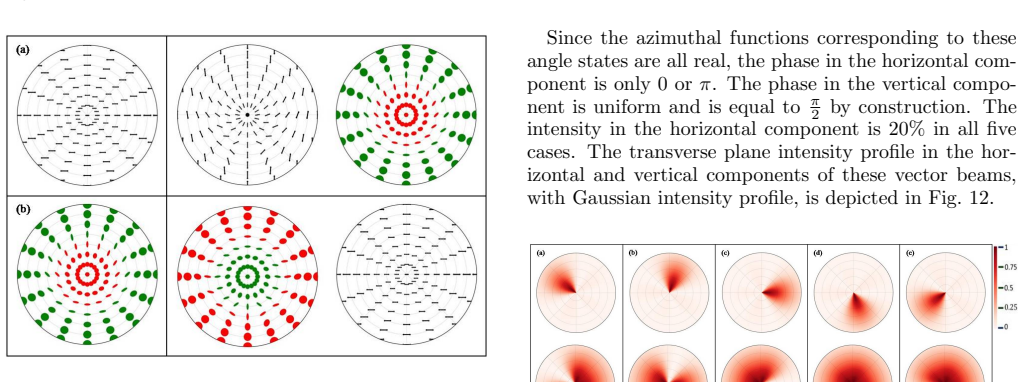
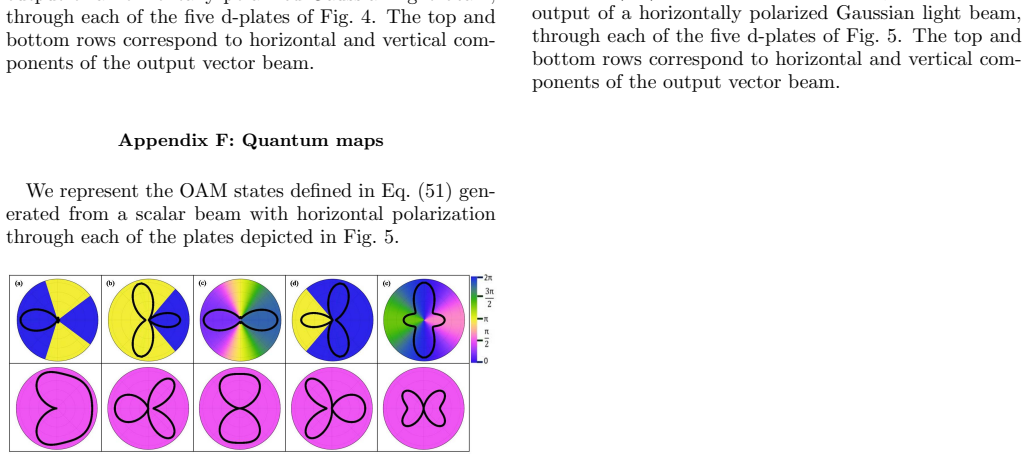
Angle states As an illustration of complex beam shaping using d- plates, we will now attempt to generate arbitrary state |c⟩o of the OAM space: |c⟩o = eX m=b cm |m⟩o (42) wherec m, m=b, . . . , eare complex numbers such thatPe m=b |cm|2 = 1. Herebande≥bare integers. Given any such state|c⟩ o in the OAM space, we will associate a complex functionc(ϕ) as, c...
-
[7]
D. L. Andrews,Structured light and its applications: An introduction to phase-structured beams and nanoscale op- tical forces(Academic press, 2011)
work page 2011
-
[8]
C. He, Y. Shen, and A. Forbes, Towards higher- dimensional structured light, Light: Science & Applica- tions11, 205 (2022)
work page 2022
-
[9]
H. Rubinsztein-Dunlop, A. Forbes, M. V. Berry, M. R. Dennis, D. L. Andrews, M. Mansuripur, C. Denz, C. Alp- mann, P. Banzer, T. Bauer,et al., Roadmap on struc- tured light, Journal of Optics19, 013001 (2016)
work page 2016
-
[10]
O. V. Angelsky, A. Y. Bekshaev, S. G. Hanson, C. Y. Zenkova, I. I. Mokhun, and J. Zheng, Structured light: ideas and concepts, Frontiers in Physics8, 114 (2020)
work page 2020
-
[11]
F. M. Dickey,Laser beam shaping: theory and techniques (CRC press, 2018)
work page 2018
-
[12]
M. Woerdemann, C. Alpmann, M. Esseling, and C. Denz, Advanced optical trapping by complex beam shaping, Laser & Photonics Reviews7, 839 (2013)
work page 2013
-
[13]
M. D. Al-Amri, M. Babiker, and D. Andrews,Structured Light for Optical Communication(Elsevier, 2021)
work page 2021
-
[14]
Z. Chen, P. Zhang, L. Song, Z. Li, J. Feng, X. Gou, J. Li, and C. Fang, A review of beam shaping technology in laser welding applications, The International Journal of Advanced Manufacturing Technology , 1 (2026). 14
work page 2026
-
[15]
J. P. Angelo, S.-J. Chen, M. Ochoa, U. Sunar, S. Gioux, and X. Intes, Review of structured light in diffuse optical imaging, Journal of biomedical optics24, 071602 (2019)
work page 2019
-
[16]
Q. Zhan, Cylindrical vector beams: from mathematical concepts to applications, Advances in Optics and Pho- tonics1, 1 (2009)
work page 2009
-
[17]
S. E. Venegas-Andraca, Quantum walks: a comprehen- sive review, Quantum Information Processing11, 1015 (2012)
work page 2012
-
[18]
Portugal,Quantum walks and search algorithms, Vol
R. Portugal,Quantum walks and search algorithms, Vol. 19 (Springer, 2013)
work page 2013
-
[19]
M. A. Neil, F. Massoumian, R. Juˇ skaitis, and T. Wilson, Method for the generation of arbitrary complex vector wave fronts, Optics letters27, 1929 (2002)
work page 1929
- [20]
-
[21]
Z. Chen, T. Zeng, B. Qian, and J. Ding, Complete shap- ing of optical vector beams, Optics express23, 17701 (2015)
work page 2015
-
[22]
L. Marrucci, C. Manzo, and D. Paparo, Optical spin-to- orbital angular momentum conversion in inhomogeneous anisotropic media, Physical review letters96, 163905 (2006)
work page 2006
-
[23]
B. Piccirillo, V. D’Ambrosio, S. Slussarenko, L. Marrucci, and E. Santamato, Photon spin-to-orbital angular mo- mentum conversion via an electrically tunable q-plate, Applied Physics Letters97(2010)
work page 2010
-
[24]
V. D’Ambrosio, F. Baccari, S. Slussarenko, L. Marrucci, and F. Sciarrino, Arbitrary, direct and deterministic ma- nipulation of vector beams via electrically-tuned q-plates, Scientific reports5, 7840 (2015)
work page 2015
-
[25]
M. Vergara and C. Iemmi, Generalized q-plates and novel vector beams, arXiv preprint arXiv:1812.08202 (2018)
-
[26]
S. Fu, Y. Zhai, T. Wang, C. Yin, and C. Gao, Tailoring arbitrary hybrid poincar´ e beams through a single holo- gram, Applied Physics Letters111(2017)
work page 2017
-
[27]
U. Ruiz, P. Pagliusi, C. Provenzano, and G. Cippar- rone, Highly efficient generation of vector beams through polarization holograms, Applied Physics Letters102 (2013)
work page 2013
-
[28]
D. G. Hall, Vector-beam solutions of maxwell’s wave equation, Optics letters21, 9 (1996)
work page 1996
-
[29]
S. C. Tidwell, D. H. Ford, and W. D. Kimura, Generat- ing radially polarized beams interferometrically, Applied Optics29, 2234 (1990)
work page 1990
-
[30]
N. Passilly, R. de Saint Denis, K. A¨ ıt-Ameur, F. Treussart, R. Hierle, and J.-F. Roch, Simple interfer- ometric technique for generation of a radially polarized light beam, Journal of the Optical Society of America A 22, 984 (2005)
work page 2005
- [31]
-
[32]
D. Wang, F. Liu, T. Liu, S. Sun, Q. He, and L. Zhou, Efficient generation of complex vectorial optical fields with metasurfaces, Light: Science & Applications10, 67 (2021)
work page 2021
-
[33]
T. Wu, X. Zhang, Q. Xu, E. Plum, K. Chen, Y. Xu, Y. Lu, H. Zhang, Z. Zhang, X. Chen,et al., Dielec- tric metasurfaces for complete control of phase, ampli- tude, and polarization, Advanced Optical Materials10, 2101223 (2022)
work page 2022
-
[34]
D. Liu, C. Zhou, P. Lu, J. Xu, Z. Yue, and S. Teng, Gen- eration of vector beams with different polarization sin- gularities based on metasurfaces, New Journal of Physics 24, 043022 (2022)
work page 2022
-
[35]
H.-T. Chen, A. J. Taylor, and N. Yu, A review of meta- surfaces: physics and applications, Reports on progress in physics79, 076401 (2016)
work page 2016
-
[36]
J. Balthasar Mueller, N. A. Rubin, R. C. Devlin, B. Groever, and F. Capasso, Metasurface polarization optics: independent phase control of arbitrary orthog- onal states of polarization, Physical review letters118, 113901 (2017)
work page 2017
-
[37]
B. Mirzapourbeinekalaye, A. McClung, and A. Arbabi, General lossless polarization and phase transformation using bilayer metasurfaces, Advanced Optical Materials 10, 2102591 (2022)
work page 2022
-
[38]
B. Radhakrishna, G. Kadiri, and G. Raghavan, Realiza- tion of doubly inhomogeneous waveplates for structuring of light beams, Journal of the Optical Society of America B38, 1909 (2021)
work page 1909
-
[39]
A. Kumar and A. Ghatak, Polarization of light with ap- plications in optical fibers, (No Title) (2011)
work page 2011
- [40]
- [41]
-
[42]
V. Hakobyan and E. Brasselet, Q-plates: From optical vortices to optical skyrmions, Physical Review Letters 134, 083802 (2025)
work page 2025
- [43]
- [44]
-
[45]
C. A. Ryan, M. Laforest, J.-C. Boileau, and R. Laflamme, Experimental implementation of a discrete-time quan- tum random walk on an nmr quantum-information pro- cessor, Physical Review A—Atomic, Molecular, and Op- tical Physics72, 062317 (2005)
work page 2005
-
[46]
F. Z¨ ahringer, G. Kirchmair, R. Gerritsma, E. Solano, R. Blatt, and C. F. Roos, Realization of a quantum walk with one and two trapped ions, Physical review letters 104, 100503 (2010)
work page 2010
-
[47]
M. A. Broome, A. Fedrizzi, B. P. Lanyon, I. Kassal, A. Aspuru-Guzik, and A. G. White, Discrete single- photon quantum walks with tunable decoherence, Phys- ical review letters104, 153602 (2010)
work page 2010
-
[48]
P. Zhang, B.-H. Liu, R.-F. Liu, H.-R. Li, F.-L. Li, and G.-C. Guo, Implementation of one-dimensional quantum walks on spin-orbital angular momentum space of pho- tons, Physical Review A—Atomic, Molecular, and Opti- cal Physics81, 052322 (2010)
work page 2010
-
[49]
S. K. Goyal, F. S. Roux, A. Forbes, and T. Konrad, Implementing quantum walks using orbital angular mo- mentum of classical light, arXiv preprint arXiv:1211.1705 (2012)
work page internal anchor Pith review Pith/arXiv arXiv 2012
-
[50]
L. Neves and G. Puentes, Photonic discrete-time quan- tum walks and applications, Entropy20, 731 (2018)
work page 2018
-
[51]
C. M. Chandrashekar, R. Srikanth, and R. Laflamme, Optimizing the discrete time quantum walk using a su (2) 15 coin, Physical Review A—Atomic, Molecular, and Opti- cal Physics77, 032326 (2008)
work page 2008
-
[52]
M. Beijersbergen, R. Coerwinkel, M. Kristensen, and J. Woerdman, Helical-wavefront laser beams produced with a spiral phaseplate, Optics communications112, 321 (1994)
work page 1994
-
[53]
R. Simon and N. Mukunda, Minimal three-component su (2) gadget for polarization optics, Physics Letters A143, 165 (1990)
work page 1990
-
[54]
G. Kadiri, Scouring parrondo’s paradox in discrete-time quantum walks, Physical Review A110, 022421 (2024)
work page 2024
-
[55]
A. M. Beckley, T. G. Brown, and M. A. Alonso, Full poincar´ e beams, Optics express18, 10777 (2010)
work page 2010
-
[56]
D. Lopez-Mago, On the overall polarisation properties of poincar´ e beams, Journal of Optics21, 115605 (2019)
work page 2019
-
[57]
J. P. Snyder,Map projections–A working manual, Vol. 1395 (US Government Printing Office, 1987)
work page 1987
-
[58]
S. Donati, L. Dominici, G. Dagvadorj, D. Ballarini, M. De Giorgi, A. Bramati, G. Gigli, Y. G. Rubo, M. H. Szyma´ nska, and D. Sanvitto, Twist of general- ized skyrmions and spin vortices in a polariton super- fluid, Proceedings of the National Academy of Sciences 113, 14926 (2016)
work page 2016
-
[59]
Y. Shen, Q. Zhang, P. Shi, L. Du, X. Yuan, and A. V. Zayats, Optical skyrmions and other topological quasi- particles of light, Nature Photonics18, 15 (2024)
work page 2024
-
[60]
B. Radhakrishna, G. Kadiri, and G. Raghavan, Polari- metric method of generating full poincar´ e beams within a finite extent, Journal of the Optical Society of America A39, 662 (2022)
work page 2022
-
[61]
M. Mirhosseini, O. S. Maga˜ na-Loaiza, M. N. O’Sullivan, B. Rodenburg, M. Malik, M. P. Lavery, M. J. Padgett, D. J. Gauthier, and R. W. Boyd, High-dimensional quan- tum cryptography with twisted light, New Journal of Physics17, 033033 (2015)
work page 2015
-
[62]
E. Yao, S. Franke-Arnold, J. Courtial, S. Barnett, and M. Padgett, Fourier relationship between angular posi- tion and optical orbital angular momentum, Optics Ex- press14, 9071 (2006)
work page 2006
-
[63]
A. S. Holevo,Quantum Systems, Channels, Informa- tion: A Mathematical Introduction, 2nd ed. (De Gruyter, 2019)
work page 2019
discussion (0)
Sign in with ORCID, Apple, or X to comment. Anyone can read and Pith papers without signing in.