Singularities at the vertex of connected angular inhomogeneities under thermal and elastic loading
Pith reviewed 2026-05-21 21:58 UTC · model grok-4.3
The pith
Eigenvalues solved from a Fredholm integral equation determine the order of singularities at the vertex where multiple angular inhomogeneities meet under thermal and elastic loads.
A machine-rendered reading of the paper's core claim, the machinery that carries it, and where it could break.
Core claim
By modeling each angular inhomogeneity through Eshelby's equivalent inclusion method with continuously distributed eigen-temperature-gradient for conductivity mismatch and eigenstrain for stiffness mismatch, the boundary-value problem is converted into a Fredholm integral equation of the second kind. Separation of variables in polar coordinates centered at the vertex yields eigen-fields whose radial dependence is a power involving an unknown eigenvalue and the local opening angle. The eigenvalues of this integral equation supply the singularity orders for both the thermal and elastic disturbed fields, and the resulting general formulae capture the combined effects of multiple-region geometry
What carries the argument
Fredholm integral equation of the second kind obtained from domain integrals of Green's functions against the separable eigen-temperature-gradient and eigenstrain fields in the equivalent inclusion model
If this is right
- Singularity orders depend explicitly on the opening angles of each connected region and on the ratios of thermal conductivity and elastic moduli across interfaces.
- The same eigenvalue problem recovers the classic bimaterial wedge and infinite-domain wedge solutions when two identical inhomogeneities are placed adjacent to each other.
- Disturbed temperature, heat flux, displacement, and stress fields are obtained directly from the domain integrals once the eigen-fields are known.
- The method supplies closed-form dependence of singularity strength on both geometry and material contrast for any number of angular regions meeting at a point.
Where Pith is reading between the lines
- The eigenvalue search could be adapted to time-harmonic or transient loading by allowing complex or frequency-dependent eigenvalues in the same integral operator.
- The singularity orders obtained here supply the leading terms needed for enriched finite-element or boundary-element meshes at such vertices.
- Similar integral-equation reductions may apply to other interface problems, such as piezoelectric or poroelastic angular inclusions, by replacing the eigen-fields with the appropriate coupling quantities.
Load-bearing premise
The eigen-fields inside each inclusion admit a separable power-law form in polar coordinates centered at the vertex, with the power set by the eigenvalue and the opening angle of that region.
What would settle it
Numerical solution of the derived Fredholm equation for the classic single-wedge bimaterial configuration produces an eigenvalue whose corresponding singularity order differs from the accepted analytical value in the literature.
Figures


read the original abstract
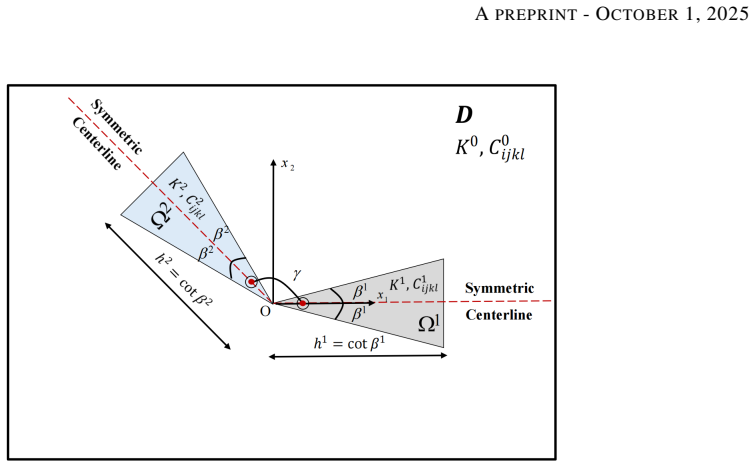
This paper investigates the singularities at the vertex of multiply connected angular inhomogeneities for heat conduction and elastic deformation. With the aid of Eshelby's equivalent inclusion method (EIM), each inhomogeneity is simulated as an equivalent inclusion, exhibiting the same material properties as the matrix but containing a continuously distributed eigen-field with potential singularities at the vertices and edge lines. Specifically, the eigen-temperature-gradient (ETG) and eigenstrain are utilized to simulate material mismatch of thermal conductivity and stiffness, respectively. Using the separation of variables, the eigen-fields can be formulated in terms of distance to vertices and opening angles, and disturbed thermal/elastic fields are evaluated by domain integrals of Green's function multiplied by eigen-fields, which form Fredholm's integral equation of the second kind. The boundary value problem is reduced to solve for eigenvalues, which are used to determine the order of singularity. The present solution is versatile - by placing two identical inhomogeneities together, it recovers the classic solutions for a single wedge in a bimaterial media or infinite domain. The general and analytical formulae take full consideration of interactions of multiple inhomogeneities and reveal the effects of opening angles and material properties on the thermal and elastic singularities.
Editorial analysis
A structured set of objections, weighed in public.
Referee Report
Summary. The paper investigates singularities at the vertex of multiply connected angular inhomogeneities for heat conduction and elastic deformation. Using Eshelby's equivalent inclusion method (EIM), each inhomogeneity is modeled as an equivalent inclusion with continuously distributed eigen-temperature-gradient and eigenstrain fields. These eigen-fields are formulated via separation of variables in polar coordinates centered at the vertex, expressed in terms of radial distance raised to an eigenvalue power and functions of the opening angles. Disturbed fields are evaluated through domain integrals of Green's functions, yielding Fredholm integral equations of the second kind. The problem reduces to an eigenvalue problem whose solutions determine the singularity orders. The approach accounts for interactions among multiple inhomogeneities and recovers classic bimaterial wedge solutions when two identical inhomogeneities are combined.
Significance. If the separability assumption for the eigen-fields holds and the resulting eigenvalues accurately capture the singularity orders, the work supplies a general analytical framework for thermal and elastic singularities in complex angular multi-inhomogeneity geometries. It systematically incorporates geometric and material effects as well as inter-inhomogeneity interactions, which may prove useful for analyzing stress and temperature concentrations in composites containing wedge-like or polygonal inclusions. The reduction of the EIM to a Fredholm integral eigenvalue problem is a methodological strength that enables treatment of multiply connected domains without ad-hoc fitting parameters.
major comments (1)
- [Eigen-field formulation] Eigen-field formulation (as described in the abstract and the modeling section): the separable ansatz for the eigen-temperature-gradient and eigenstrain fields, written as r^λ f(θ; opening angles), is introduced by direct appeal to separation of variables. In multiply connected angular domains the EIM interface conditions couple the fields across several rays; the manuscript does not demonstrate that a single power-law radial dependence simultaneously satisfies continuity of temperature, heat flux, displacement and traction for all eigen-components. If non-separable terms are required, the extracted eigenvalues would not correspond to the true singularity orders.
minor comments (2)
- A brief numerical example or table comparing the recovered eigenvalues for the bimaterial wedge case against known analytic results would strengthen the versatility claim.
- Clarification on the discretization scheme used to solve the Fredholm integral equation of the second kind and on the root-finding procedure for the eigenvalues would improve reproducibility.
Simulated Author's Rebuttal
We thank the referee for the careful reading of our manuscript and the constructive comments. We address the major concern regarding the eigen-field formulation below, offering clarifications on the separability assumption and its consistency with the equivalent inclusion method.
read point-by-point responses
-
Referee: [Eigen-field formulation] Eigen-field formulation (as described in the abstract and the modeling section): the separable ansatz for the eigen-temperature-gradient and eigenstrain fields, written as r^λ f(θ; opening angles), is introduced by direct appeal to separation of variables. In multiply connected angular domains the EIM interface conditions couple the fields across several rays; the manuscript does not demonstrate that a single power-law radial dependence simultaneously satisfies continuity of temperature, heat flux, displacement and traction for all eigen-components. If non-separable terms are required, the extracted eigenvalues would not correspond to the true singularity orders.
Authors: We appreciate this observation on the eigen-field ansatz. The power-law form r^λ f(θ; opening angles) is introduced as the leading singular term in the asymptotic expansion near the vertex, following the standard separation-of-variables approach for local singularity analysis in angular domains. Although the overall geometry is multiply connected, the local polar coordinate system centered at the vertex permits this separable representation for the eigen-temperature-gradient and eigenstrain fields. The interface conditions (continuity of temperature, heat flux, displacement, and traction) across all rays are enforced through the Fredholm integral equations of the second kind, which arise from the domain integrals involving the Green's functions and the assumed eigen-fields. The eigenvalue problem is formulated precisely so that non-trivial solutions exist only for specific λ that satisfy these integral equations, thereby ensuring the continuity requirements are met for the chosen eigen-components. This is corroborated by the recovery of classical bimaterial wedge solutions upon combining two identical inhomogeneities. We will revise the manuscript to include an expanded paragraph in the modeling section that explicitly outlines how the integral formulation guarantees satisfaction of the interface conditions for the separable ansatz. revision: partial
Circularity Check
No circularity: derivation uses standard EIM and separation ansatz to obtain independent eigenvalue problem
full rationale
The paper models inhomogeneities via EIM with eigen-temperature-gradient and eigenstrain fields, assumes the standard separable power-law form r^λ f(θ) via separation of variables, evaluates disturbed fields through Green's function integrals to obtain a Fredholm integral equation of the second kind, and solves the resulting eigenvalue problem for singularity orders. This chain is self-contained against external benchmarks: it recovers known wedge and bimaterial solutions by construction of the setup rather than by redefining inputs, relies on classical Green's functions and Eshelby equivalence without load-bearing self-citations, and does not fit parameters to the target singularity orders. No step reduces the claimed result to its own inputs by definition.
Axiom & Free-Parameter Ledger
axioms (1)
- domain assumption Separation of variables can be applied to express the eigen-fields in terms of radial distance to the vertex and the opening angles of the angular regions.
Reference graph
Works this paper leans on
- [1]
-
[2]
American Mathematical Society, March 2010
Lawrence Evans.Partial Differential Equations. American Mathematical Society, March 2010
work page 2010
-
[3]
Force at a point in the interior of a semi-infinite solid.Physics, 7(5):195–202, 1936
Raymond D Mindlin. Force at a point in the interior of a semi-infinite solid.Physics, 7(5):195–202, 1936
work page 1936
-
[4]
Chyanbin Hwu, Meng-Ling Hsieh, and Cheng-Lin Huang. Some Green’s functions for steady-state heat conduction in anisotropic plane media and their application to thermoelastic boundary element analysis.Journal of Thermal Stresses, 46(10):1103–1126, July 2023
work page 2023
-
[5]
L.J. Walpole. An elastic singularity in joined half-spaces.International Journal of Engineering Science, 34(6):629– 638, may 1996
work page 1996
-
[6]
Jiakuan Zhou and Xueli Han. Three-dimensional Green’s functions for transient heat conduction problems in anisotropic bimaterial.International Journal of Heat and Mass Transfer, 146:118805, January 2020
work page 2020
-
[7]
Zhong Qi Yue. On generalized kelvin solutions in a multilayered elastic medium.Journal of Elasticity, 40(1):1–43, jul 1995
work page 1995
-
[8]
David B. Bogy. Edge-bonded dissimilar orthogonal elastic wedges under normal and shear loading.Journal of Applied Mechanics, 35(3):460–466, sep 1968. 37 APREPRINT- OCTOBER1, 2025
work page 1968
-
[9]
edge-bonded dissimilar orthogonal elastic wedges under normal and shear loading
J Dundurs. Discussion:“edge-bonded dissimilar orthogonal elastic wedges under normal and shear loading”(bogy, db, 1968, asme j. appl. mech., 35, pp. 460–466).Journal of Applied Mechanics, 1969
work page 1968
-
[10]
Stress discontinuity and singularity around the vertex of a triangular inhomogeneity
Chunlin Wu and Huiming Yin. Stress discontinuity and singularity around the vertex of a triangular inhomogeneity. Journal of the Mechanics and Physics of Solids, 184:105545, March 2024
work page 2024
-
[11]
J. P. Dempsey and G. B. Sinclair. On the stress singularities in the plane elasticity of the composite wedge.Journal of Elasticity, 9(4):373–391, oct 1979
work page 1979
-
[12]
John Dundurs and Xanthippi Markenscoff. A Green’s function formulation of anticracks and their interaction with load-induced singularities.Journal of Applied Mechanics, 56(3):550–555, sep 1989
work page 1989
-
[13]
N. Sukumar, Z. Y . Huang, J.-H. Prévost, and Z. Suo. Partition of unity enrichment for bimaterial interface cracks. International Journal for Numerical Methods in Engineering, 59(8):1075–1102, January 2004
work page 2004
-
[14]
Changzheng Cheng, Zhilin Han, Shanlong Yao, Zhongrong Niu, and Naman Recho. Analysis of heat flux singularity at 2d notch tip by singularity analysis method combined with boundary element technique.Engineering Analysis with Boundary Elements, 46:1–9, September 2014
work page 2014
-
[15]
Yifan Huang, Zhilin Han, Dong Pan, Changzheng Cheng, and Huanlin Zhou. Analyze the singularity of the heat flux with a singular boundary element.Engineering Analysis with Boundary Elements, 120:59–66, November 2020
work page 2020
-
[16]
M. L Williams. Stress singularities resulting from various boundary conditions in angular corners of plates in extension.Journal of Applied Mechanics, 19(4):526–528, 1952
work page 1952
- [17]
-
[18]
JP Dempsey and GB Sinclair. On the singular behavior at the vertex of a bi-material wedge.Journal of Elasticity, 11(3):317–327, 1981
work page 1981
-
[19]
G. C. Sih. On the singular character of thermal stresses near a crack tip.Journal of Applied Mechanics, 29(3):587–589, 09 1962
work page 1962
-
[20]
Wen-Hwa Chen and Chin-Cheng Huang. On the singularity of temperature gradient near an inclined crack terminating at bimaterial interface.International Journal of Fracture, 58(4):319–324, December 1992
work page 1992
- [21]
-
[22]
Clements.BOUNDARY VALUE PROBLEMS GOVERNED BY SECOND ORDER ELLIPTIC SYSTEMS
David L. Clements.BOUNDARY VALUE PROBLEMS GOVERNED BY SECOND ORDER ELLIPTIC SYSTEMS. Pitman Advanced Publishing Program, 1981
work page 1981
-
[23]
J. R. Rice. A path independent integral and the approximate analysis of strain concentration by notches and cracks. Journal of Applied Mechanics, 35(2):379–386, jun 1968
work page 1968
-
[24]
Atluri.Computational Methods in the Mechanics of Fracture
S.N. Atluri.Computational Methods in the Mechanics of Fracture. Computational methods in mechanic : Mechanics and mathematical methods. North-Holland, 1986
work page 1986
-
[25]
The determination of the elastic field of an ellipsoidal inclusion, and related problems
John Douglas Eshelby. The determination of the elastic field of an ellipsoidal inclusion, and related problems. Proceedings of the Royal Society of London. Series A. Mathematical and Physical Sciences, 241(1226):376–396, aug 1957
work page 1957
-
[26]
Toshio Mura.Micromechanics of defects in solids. Springer Netherlands, 1987
work page 1987
-
[27]
Gregory J. Rodin. Eshelby's inclusion problem for polygons and polyhedra.Journal of the Mechanics and Physics of Solids, 44(12):1977–1995, dec 1996
work page 1977
-
[28]
Chunlin Wu and H.M. Yin. Elastic solution of a polygon-shaped inclusion with a polynomial eigenstrain.Journal of Applied Mechanics, pages 1–25, feb 2021
work page 2021
-
[29]
Chunlin Wu, Liangliang Zhang, and Huiming Yin. Elastic Solution of a Polyhedral Particle With a Polynomial Eigenstrain and Particle Discretization.Journal of Applied Mechanics, 88(12), 08 2021. 121001
work page 2021
-
[30]
Y . P. Chiu. On the internal stresses in a half plane and a layer containing localized inelastic strains or inclusions. Journal of Applied Mechanics, 47(2):313–318, jun 1980
work page 1980
-
[31]
T. Mura. The determination of the elastic field of a polygonal star shaped inclusion.Mechanics Research Communications, 24(5):473–482, sep 1997
work page 1997
-
[32]
Mojia Huang, Wennan Zou, and Quan-Shui Zheng. Explicit expression of Eshelby tensor for arbitrary weakly non-circular inclusion in two-dimensional elasticity.International Journal of Engineering Science, 47(11- 12):1240–1250, nov 2009. 38 APREPRINT- OCTOBER1, 2025
work page 2009
-
[33]
H. Nozaki and M. Taya. Elastic fields in a polygon-shaped inclusion with uniform eigenstrains.Journal of Applied Mechanics, 64(3):495–502, sep 1997
work page 1997
-
[34]
H. Nozaki and M. Taya. Elastic fields in a polyhedral inclusion with uniform eigenstrains and related problems. Journal of Applied Mechanics, 68(3):441–452, apr 2000
work page 2000
- [35]
- [36]
-
[37]
M.Q. Liu and X.-L. Gao. Strain gradient solution for the Eshelby-type polygonal inclusion problem.International Journal of Solids and Structures, 50(2):328–338, jan 2013
work page 2013
-
[38]
Chunlin Wu and Huiming Yin. Thermoelastic fields for a heat exchanger of arbitrary shape in a bi-material infinite plane.International Journal of Solids and Structures, 269:112167, May 2023
work page 2023
-
[39]
Hiroshi Hatta and Minoru Taya. Thermal conductivity of coated filler composites.Journal of Applied Physics, 59(6):1851–1860, mar 1986
work page 1986
-
[40]
Z. A. Moschovidis and T. Mura. Two-ellipsoidal inhomogeneities by the equivalent inclusion method.Journal of Applied Mechanics, 42(4):847–852, dec 1975
work page 1975
-
[41]
W. N. Bailey.Generalized Hypergeometric Series, volume 32 ofCambridge Tracts in Mathematics and Mathe- matical Physics. Cambridge University Press, 1935
work page 1935
-
[42]
Chunlin Wu, Tengxiang Wang, and Huiming Yin. The Green’s function based thermoelastic analysis of spherical geothermal tanks in a semi-infinite domain.Journal of the Mechanics and Physics of Solids, 173:105207, April 2023. 39
work page 2023
discussion (0)
Sign in with ORCID, Apple, or X to comment. Anyone can read and Pith papers without signing in.