REVIEW 6 major objections 6 minor 43 references
NeuroLoc: Encoding Navigation Cells for 6-DOF Camera Localization
T0 review · 6 major / 6 minor · reviewed 2026-08-16 · deepseek-v4-flash
Pith's one-line read NeuroLoc claims that adding three navigation-cell-inspired modules — a Hebbian storage module, a head-direction attention module, and 3D grid center prediction — to an absolute pose regression network improves single-image 6-DOF camera…
desk verdict A modest, plausibly useful architecture tweak for absolute pose regression, but the headline SOTA claim rests on a single run with no error bars and a rotation error worse than AtLoc; it deserves a serious referee if the authors release code and statistics. read the letter →
The pith
A machine-rendered reading of the paper's core claim, the machinery that carries it, and where it could break.
The reading
What carries the argument
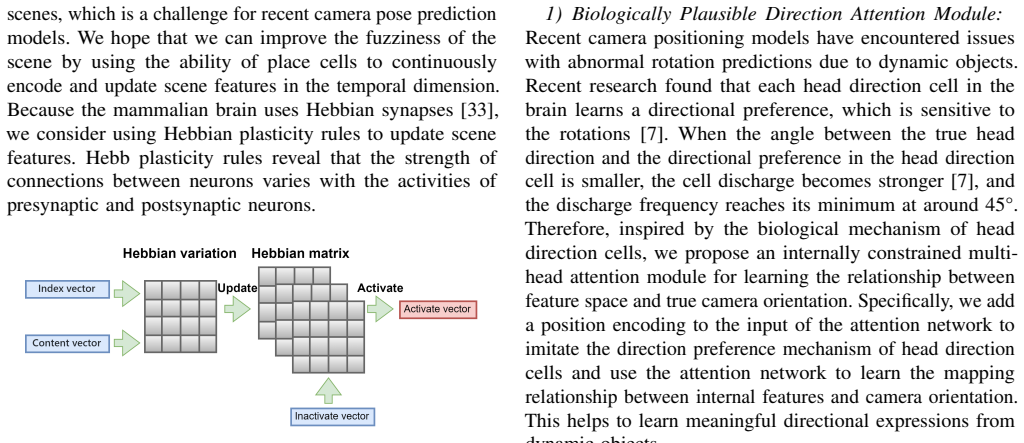
The key machinery is a pose regression network with three inserted components. The Hebbian storage module updates a $B\times 2048\times 2048$ storage matrix $W_i = \eta_i(k \cdot v - k \cdot W_{i-1})$ (Eq. 1) and reads it back through matrix multiplication and residual layers to produce a positional encoding. The direction attention module divides orientation space into $d \in \mathbb{R}^{8 \times 2\pi/8}$ regions, adds a learnable interval weight $\xi$ via $x_{hd} = x_{pc} + \xi \ast \sin(d/2)$ (Eq. 2), and computes multi-head softmax attention on $x_{hd}$ (Eqs. 3–5). The 3D grid module partitions the scene into 40 equidistant grids and adds a fully connected branch predicting the grid center, with loss $L = l_{pose} + \|g - \hat{g}\|_1 e^{-\gamma} + \gamma$. Together they refine features, align orientation, and constrain position.
What would settle it
Train NeuroLoc on the Oxford RobotCar LOOP sequences with the order of frames shuffled within each batch (destroying any temporal sequence) and compare mean position error to the reported 8.55 m; if the error does not change, the 'historical replay' explanation for the Hebbian module is falsified. Alternatively, replace the Hebbian update rule with a random-but-fixed matrix update and see whether the performance still drops from 22.38 m to 8.55 m.
Extended reading notes
Core claim
The central assertion is that NeuroLoc can enhance the robustness of camera localization in complex environments and improve pose regression from a single image, quantified as best average median position (0.18 m) among single-image methods on 7 Scenes and better mean errors than PoseNet+, MapNet, and AtLoc on the Oxford RobotCar LOOP sequences. The paper attributes this to three mechanisms: a Hebbian rule-constrained place-cell-inspired storage matrix that saves and replays historical scene features; a head-direction-cell-inspired multi-head attention that adds a directional position encoding and interval activation to align features with true orientation; and a grid-cell-inspired 3D grid center prediction that adds a geometric constraint to the pose regression. On Oxford RobotCar, the full model reduces average mean position error from 33.77 m (base) to 8.55 m in the ablation, with the Hebbian module alone cutting it to 22.38 m.
Load-bearing premise
The load-bearing premise is that the Hebbian storage module actually stores and replays historical scene information across time as place cells do; the implementation in the paper only updates a per-batch matrix, so if that premise is wrong, the module's measured benefit may come from something other than temporal memory.
Editorial extensions
If this is right
- If the reported results hold, single-image absolute pose regression can be improved without multi-view, temporal, or IMU inputs, just by adding biologically inspired modules to an off-the-shelf encoder.
- The head-direction attention mechanism suggests that explicitly encoding directional priors can reduce rotation errors in turning scenes, which could transfer to visual odometry or object pose estimation.
- The 3D grid center loss provides a simple auxiliary geometric constraint that could be plugged into other APR backbones to reduce large position outliers.
- The Hebbian storage module, if genuinely storing scene information, points toward persistent memory in APR, but the paper's time-dependence claim requires the module to be tested on actual traversals rather than shuffled batches.
Reading between the lines
- The paper's own ablation attributes most of the RobotCar gain to the Hebbian module (33.77 m to 22.38 m mean position), but since the module's update is per-batch with no temporal ordering, an alternative interpretation is that the benefit comes from a feature transformation similar to a learned associative filter rather than from historical replay; a test that shuffles frames within each training
- The grid module's contribution is not isolated in the ablation; a reasonable extension would be to train a model with the grid loss on top of an unchanged attention baseline to quantify how much of the gain is just the auxiliary geometric supervision.
- The success on textureless indoor scenes (fire, pumpkin) suggests the direction-attention saliency could be evaluated as a general feature-selection mechanism for other geometric tasks, such as homography or depth estimation.
Signed reviews
Editorial analysis
A structured set of objections, weighed in public.
Referee Report
Summary. NeuroLoc is a single-image absolute camera pose regression (APR) method that augments a ResNet34 encoder with three biologically motivated modules: a Hebbian storage module inspired by place cells, a directional multi-head attention module inspired by head direction cells, and a 3D grid-center prediction module inspired by grid cells. The network is trained with a multi-task loss combining position, orientation, and grid-center errors, and evaluated on the 7 Scenes and Oxford RobotCar LOOP datasets. The paper claims state-of-the-art single-image localization on 7 Scenes (median position 0.18 m) and improved mean errors over PoseNet+, MapNet, and AtLoc on Oxford RobotCar, along with ablation and attention visualization analyses supporting the proposed modules.
Significance. If the empirical claims are reliable, NeuroLoc would demonstrate that multi-task learning with grid-center regression and directionally biased attention can yield small but consistent improvements in APR accuracy, which is relevant to robotics and visual localization. The paper also provides a useful biological framing that links navigation-cell literature to deep APR. The contribution is incremental rather than transformative: the gains over strong baselines are modest, the rotation error on 7 Scenes is actually worse than several competitors, and the main supporting evidence rests on single training runs without statistical validation. The Hebbian module's temporal-memory narrative is not directly tested by the implementation, so the mechanistic explanation remains speculative. On the positive side, the paper includes an ablation study, visualizations, and clear descriptions of the proposed modules, and the grid-center auxiliary task is a falsifiable idea worth further investigation.
major comments (6)
- [Section IV-C, Table I] The abstract's claim that NeuroLoc 'improve[s] the performance of pose regression' is not supported for the full 6-DOF output. On 7 Scenes, NeuroLoc's average rotation error (8.14°) is worse than AtLoc (7.56°), NeuralR-Pose (7.92°), and ORGPoseNet (7.90°). The paper only highlights the median position improvement and does not disclose this rotation regression in the text. Since absolute pose regression includes both translation and orientation, the claim of improved pose regression should be either restricted to translation, supplemented with a combined error metric, or supported by a clear argument for why the rotation deficit does not diminish the stated contribution.
- [Section IV-B and Section IV-C] All reported numerical results come from a single training run with no error bars, no random-seed variation, and no statistical significance tests. The headline 7 Scenes position advantage (0.18 m vs 0.20 m) is a 10% margin on one run; APR is known to be sensitive to initialization and data split, so this margin could easily be noise. The authors should provide multiple runs (at least three, ideally five or more) with mean and standard deviation for the main tables, and, where meaningful, a significance test. This is a load-bearing issue because the central claim is a quantitative superiority claim.
- [Section IV-D-1, Table II] The percentage improvements reported in the text are inconsistent with the numbers in Table II. For example, the sentence 'Compared with AtLoc, our model improves 3.1% and 22.6% in the overall average accuracy' does not match the table: the average position improvement over AtLoc is (8.73 - 8.55) / 8.73 = 2.1%, LOOP1 is (8.61 - 8.54) / 8.61 = 0.8%, and LOOP2 is (8.86 - 8.57) / 8.86 = 3.3%. Similarly, the stated '80.7%' improvement for LOOP2 over PoseNet+ is actually (28.81 - 8.57) / 28.81 = 70.2%. These arithmetic errors undermine the credibility of the quantitative claims and must be corrected, with each percentage clearly identified as referring to position, orientation, a specific LOOP, or the average.
- [Section III-B and Section IV-B] The Hebbian storage module is motivated as implementing place-cell-like storage and replay of historical scene features over time, but the described implementation (Eq. 1 and the activation procedure) updates a matrix W_i from the features of the current batch with no temporal sequencing, recurrence, or persistent state across a traversal. If W persists across training iterations, that is not stated; if it is per-batch, then the claimed mechanism of 'saving and replaying historical information' is not what is actually being tested. The paper should clarify how i is indexed, whether W is updated across batches, and how any temporal dimension enters the computation. In addition, the ablation in Table III only adds the Hebbian module to a weak base (35.60 m on LOOP1) and does not remove it from the full model, so the observed gains cannot be attributed to the memory mechanism as opposed to the feature transformation itself.
- [Section IV-E, Table III] The ablation study compares a weak base (NeuroLoc-Base, 35.60 m mean position on LOOP1) with the full model (8.54 m), but it does not ablate individual components from the full model. It therefore does not reveal which module contributes what to the final performance, nor whether the modules interact. The text claims 'a significant improvement in position and rotation prediction performance' without any statistical evidence. The authors should provide ablations that remove each proposed component (Hebbian module, directional attention, grid module) from the full NeuroLoc model, and report run-to-run variability for the ablation conditions as well.
- [Section III-C-2 and Section IV-B] The 3D grid module is a central component, but several implementation details are missing: how the 40 grids are defined in each scene, whether the grid-center prediction is a regression or classification target, how the grid label is derived from the ground-truth position, and how the grid loss (weighted by gamma) interacts with the pose loss during optimization. Moreover, the Hebbian matrix W in Eq. (1) is R^{B x 2048 x 2048}, which for batch size 128 would require about 2 GB of GPU memory for a single batch on a 2080Ti; the paper should explain the actual memory footprint or specify a low-rank approximation or other dimensionality reduction. Without these details, the described architecture is not reproducible as written.
minor comments (6)
- [Table II caption] MapNet is reference [12] in the bibliography, not [15]; the citation in the table caption is incorrect.
- [Section III-B, Eq. (1)] The dimensions and meaning of the products in Eq. (1) are ambiguous, particularly the penalty term k·W_{i-1}; the shapes of k, v, W_{i-1}, and W should be stated explicitly.
- [Section III-C, Eq. (2)] The notation 'd∈R^{8×2π/8}' is unclear and the trigonometric encoding uses only a sine term; head direction cell populations are typically modeled with both sine and cosine components, so the choice should be justified.
- [Section IV-B] The phrase 'the training batch is 1200' is ambiguous; the authors likely mean 1200 training iterations or epochs, and the total number of epochs or iterations should be specified.
- [Section IV-D-1] The sentence 'Compared with Posenet+, the average position accuracy of LOOP1 is improved from 25.29m to 8.54m, and LOOP2 is improved from 28.81m to 8.57m' compares a mean value of LOOP1 with a mean of LOOP2; the percentages derived from these numbers should be recomputed and each comparison should be stated with the exact metric used.
- [General] The paper claims 'state-of-the-art' on the basis of comparisons with a limited set of APR baselines; adding recent methods (e.g., MS-Transformer, DFNet, or other 2023-2025 APR works) would strengthen the claim, and the wording should be qualified to 'state-of-the-art among the compared single-image regression methods.'
Circularity Check
No significant circularity: the pose predictions are trained and tested on held-out data, and each module is implemented via explicit external equations and auxiliary supervision.
full rationale
NeuroLoc is an end-to-end absolute pose regression network; the central results are predictions on held-out test sequences of 7 Scenes and Oxford RobotCar, so the headline comparison is not circular. The 3D grid-center head is a deterministic quantization of the ground-truth position label into equidistant grid cells, used as auxiliary supervision in Eq. (6); this is multi-task training, not a fitted parameter that is later reported as a prediction. The Hebbian storage rule in Eq. (1) is an explicit plasticity update adapted from an external review [34] and does not take the pose label or final pose output as an input; although the biological 'replay over time' story is stronger than the per-batch matrix implementation, that mismatch concerns mechanistic description, not circular derivation. The directional attention module (Eqs. (2)-(5)) is a concrete multi-head attention with a learnable trigonometric bias, with no equation that reconstructs its target from itself. No load-bearing self-citation occurs: baseline references such as PoseNet [8], AtLoc [37], and TransBoNet [43] are external, and no prior same-author result is invoked to justify the design. There is a citation-numbering inconsistency (Table II labels MapNet as [15] although [15] is the O'Keefe and Dostrovsky place-cell paper and MapNet is [12]), but this is a bibliographic error, not circularity. Statistical and reproducibility concerns about single-run comparisons are correctness risks rather than circularity, so the appropriate circularity score is 0.
Assumptions & free parameters
free parameters (4)
- loss-balance weights alpha, beta, gamma =
initialized alpha=0.0, beta=-3.0, gamma=0.0; learned during training
- dynamic attenuation parameter eta_i =
unspecified
- number of 3D grids =
40
- head-direction partition size d and interval weights xi =
d=8, xi in R^(8x256) learnable
assumptions (4)
- domain assumption Single-image absolute pose regression is a valid and comparable formulation (PoseNet paradigm).
- ad hoc to paper The Hebbian plasticity update in Eq. (1) stores useful historical scene features.
- ad hoc to paper An 8-bin directional partition with learned weights mimics head direction cell population activity.
- ad hoc to paper Quantizing 3D space into 40 grids and supervising the grid center improves pose regression.
Cite this review
Pith. "Pith review of NeuroLoc: Encoding Navigation Cells for 6-DOF Camera Localization." pith.science (2026). https://pith.science/paper/5O4HCMQP
@misc{pith2026250501113,
  author       = {Pith},
  title        = {Pith review of: NeuroLoc: Encoding Navigation Cells for 6-DOF Camera Localization},
  year         = {2026},
  howpublished = {\url{https://pith.science/paper/5O4HCMQP}},
  note         = {Machine review of arXiv:2505.01113}
}
read the original abstract
Recently, camera localization has been widely adopted in autonomous robotic navigation due to its efficiency and convenience. However, autonomous navigation in unknown environments often suffers from scene ambiguity, environmental disturbances, and dynamic object transformation in camera localization. To address this problem, inspired by the biological brain navigation mechanism (such as grid cells, place cells, and head direction cells), we propose a novel neurobiological camera location method, namely NeuroLoc. Firstly, we designed a Hebbian learning module driven by place cells to save and replay historical information, aiming to restore the details of historical representations and solve the issue of scene fuzziness. Secondly, we utilized the head direction cell-inspired internal direction learning as multi-head attention embedding to help restore the true orientation in similar scenes. Finally, we added a 3D grid center prediction in the pose regression module to reduce the final wrong prediction. We evaluate the proposed NeuroLoc on commonly used benchmark indoor and outdoor datasets. The experimental results show that our NeuroLoc can enhance the robustness in complex environments and improve the performance of pose regression by using only a single image.
Figures


Figures from the paper (2 more)


Reference graph
Works this paper leans on
-
[1]
Visual localization for autonomous driving: Mapping the accurate location in the city maze,
D. Liu, Y . Cui, X. Guo, W. Ding, B. Yang, and Y . Chen, “Visual localization for autonomous driving: Mapping the accurate location in the city maze,” in International Conference on Pattern Recognition , 2021, pp. 3170–3177
work page 2021
-
[2]
Some location problems for robot navigation using a single camera,
K. Sugihara, “Some location problems for robot navigation using a single camera,” Computer Vision, Graphics, and Image Processing , vol. 42, no. 1, pp. 112–129, 1988
work page 1988
-
[3]
Vision-based location positioning using augmented reality for indoor navigation,
J. Kim and H. Jun, “Vision-based location positioning using augmented reality for indoor navigation,” IEEE Transactions on Consumer Electronics, vol. 54, no. 3, pp. 954–962, 2008
work page 2008
-
[4]
Hierarchical scene coordinate classification and regression for visual localization,
X. Li, S. Wang, Y . Zhao, J. Verbeek, and J. Kannala, “Hierarchical scene coordinate classification and regression for visual localization,” in Proceedings of the IEEE/CVF Conference on Computer Vision and Pattern Recognition, June 2020, pp. 11 983–11 992
work page 2020
-
[5]
From coarse to fine: Robust hierarchical localization at large scale,
P.-E. Sarlin, C. Cadena, R. Siegwart, and M. Dymczyk, “From coarse to fine: Robust hierarchical localization at large scale,” in Proceedings of the IEEE/CVF Conference on Computer Vision and Pattern Recognition, June 2019, pp. 12 716–12 725
work page 2019
-
[6]
Understanding the limitations of cnn based absolute camera pose regression,
T. Sattler, Q. Zhou, M. Pollefeys, and L. Leal-Taixe, “Understanding the limitations of cnn based absolute camera pose regression,” in Proceedings of the IEEE/CVF Conference on Computer Vision and Pattern Recognition, 2019, pp. 3302–3312
work page 2019
-
[7]
Visual camera relocalization using both hand- crafted and learned features,
J. Wang and Y . Qi, “Visual camera relocalization using both hand- crafted and learned features,” Pattern Recognition, vol. 145, p. 109914, 2024
work page 2024
-
[8]
Posenet: A convolutional network for real-time 6-dof camera relocalization,
A. Kendall, M. Grimes, and R. Cipolla, “Posenet: A convolutional network for real-time 6-dof camera relocalization,” in Proceedings of the IEEE International Conference on Computer Vision , December 2015, pp. 2938–2946
work page 2015
Show all 43 references
-
[9]
Image-based localization using hourglass networks,
I. Melekhov, J. Ylioinas, J. Kannala, and E. Rahtu, “Image-based localization using hourglass networks,” in Proceedings of the IEEE International Conference on Computer Vision Workshops , Oct 2017, pp. 879–886
2017
-
[10]
Objects matter: Learning object relation graph for robust absolute pose regression,
C. Qiao, Z. Xiang, X. Wang, S. Chen, Y . Fan, and X. Zhao, “Objects matter: Learning object relation graph for robust absolute pose regression,” Neurocomputing, vol. 521, pp. 11–26, 2023
2023
-
[11]
Geometric loss functions for camera pose regression with deep learning,
A. Kendall and R. Cipolla, “Geometric loss functions for camera pose regression with deep learning,” in Proceedings of the IEEE Conference on Computer Vision and Pattern Recognition , July 2017, pp. 5974– 5983
2017
-
[12]
Geometry-aware learning of maps for camera localization,
S. Brahmbhatt, J. Gu, K. Kim, J. Hays, and J. Kautz, “Geometry-aware learning of maps for camera localization,” in Proceedings of the IEEE Conference on Computer Vision and Pattern Recognition , 2018, pp. 2616–2625
2018
-
[13]
Image-based localization using lstms for structured feature correlation,
F. Walch, C. Hazirbas, L. Leal-Taixe, T. Sattler, S. Hilsenbeck, and D. Cremers, “Image-based localization using lstms for structured feature correlation,” in Proceedings of the IEEE International Conference on Computer Vision, 2017, pp. 627–637
2017
-
[14]
Long distance navigation and magnetoreception in migratory animals,
H. Mouritsen, “Long distance navigation and magnetoreception in migratory animals,” Nature, vol. 558, no. 7708, pp. 50–59, 2018
2018
-
[15]
The hippocampus as a spatial map preliminary evidence from unit activity in the freely moving rat
J. O’Keefe and J. Dostrovsky, “The hippocampus as a spatial map preliminary evidence from unit activity in the freely moving rat.” Brain research, vol. 34, pp. 171—-175, 1971
1971
-
[16]
Microstructure of a spatial map in the entorhinal cortex,
T. Hafting, M. Fyhn, S. Molden, M.-B. Moser, and E. I. Moser, “Microstructure of a spatial map in the entorhinal cortex,” Nature, vol. 436, no. 7052, pp. 801–806, 2005
2005
-
[17]
Head-direction cells recorded from the postsubiculum in freely moving rats. i. description and quantitative analysis,
J. S. Taube, R. U. Muller, and J. B. Ranck, “Head-direction cells recorded from the postsubiculum in freely moving rats. i. description and quantitative analysis,” Journal of Neuroscience , vol. 10, no. 2, pp. 420–435, 1990
1990
-
[18]
On path integration of grid cells: Group representation and isotropic scaling,
R. Gao, J. Xie, X.-X. Wei, S.-C. Zhu, and Y . N. Wu, “On path integration of grid cells: Group representation and isotropic scaling,” Advances in Neural Information Processing Systems, vol. 34, pp. 28 623– 28 635, 2021
2021
-
[19]
A hybrid probabilistic model for camera relocalization,
M. Cai, C. Shen, and I. D. Reid, “A hybrid probabilistic model for camera relocalization,” in British Machine Vision Conference , 2018, pp. 1–12
2018
-
[20]
Prior guided dropout for robust visual localization in dynamic environments,
Z. Huang, Y . Xu, J. Shi, X. Zhou, H. Bao, and G. Zhang, “Prior guided dropout for robust visual localization in dynamic environments,” in Proceedings of the IEEE/CVF International Conference on Computer Vision, October 2019, pp. 2791–2800
2019
-
[21]
Region contrastive camera localization,
M. Sarıgül and L. Karacan, “Region contrastive camera localization,” Pattern Recognition Letters, vol. 169, pp. 110–117, 2023
2023
-
[22]
Global pose estimation with an attention-based recurrent network,
E. Parisotto, D. Singh Chaplot, J. Zhang, and R. Salakhutdinov, “Global pose estimation with an attention-based recurrent network,” in Proceedings of the IEEE Conference on Computer Vision and Pattern Recognition Workshops, June 2018, pp. 237–246
2018
-
[23]
Neurobayesslam: Neurobiologically inspired bayesian integration of multisensory information for robot navigation,
T. Zeng, F. Tang, D. Ji, and B. Si, “Neurobayesslam: Neurobiologically inspired bayesian integration of multisensory information for robot navigation,” Neural Networks, vol. 126, pp. 21–35, 2020
2020
-
[24]
Nidaloc: Neurobiologically inspired deep lidar localization,
S. Yu, X. Sun, W. Li, C. Wen, Y . Yang, B. Si, G. Hu, and C. Wang, “Nidaloc: Neurobiologically inspired deep lidar localization,” IEEE Transactions on Intelligent Transportation Systems , vol. 25, no. 5, pp. 4278–4289, 2024
2024
-
[25]
A brain- inspired slam system based on orb features,
S.-C. Zhou, R. Yan, J.-X. Li, Y .-K. Chen, and H. Tang, “A brain- inspired slam system based on orb features,” International Journal of Automation and Computing , vol. 14, no. 5, pp. 564–575, 2017
2017
-
[26]
A brain-inspired goal-oriented robot navigation system,
Q. Chen and H. Mo, “A brain-inspired goal-oriented robot navigation system,” Applied Sciences, vol. 9, no. 22, p. 4869, 2019
2019
-
[27]
Ratslam: a hippocampal model for simultaneous localization and mapping,
M. Milford, G. Wyeth, and D. Prasser, “Ratslam: a hippocampal model for simultaneous localization and mapping,” in IEEE International Conference on Robotics and Automation , vol. 1, 2004, pp. 403–408
2004
-
[28]
Neuroslam: a brain-inspired slam system for 3d environments,
F. Yu, J. Shang, Y . Hu, and M. Milford, “Neuroslam: a brain-inspired slam system for 3d environments,” Biological Cybernetics, vol. 113, no. 5-6, pp. 515–545, 2019
2019
-
[29]
Brain-inspired multimodal hybrid neural network for robot place recognition,
F. Yu, Y . Wu, S. Ma, M. Xu, H. Li, H. Qu, C. Song, T. Wang, R. Zhao, and L. Shi, “Brain-inspired multimodal hybrid neural network for robot place recognition,” Science Robotics, vol. 8, no. 78, p. eabm6996, 2023
2023
-
[30]
A brain-like navigation method inspired by the spatial cells’ cognitive mechanism,
Y . Liao, H. Yu, and N. Yu, “A brain-like navigation method inspired by the spatial cells’ cognitive mechanism,” Computers and Electrical Engineering, vol. 103, p. 108305, 2022
2022
-
[31]
Deep residual learning for image recognition,
K. He, X. Zhang, S. Ren, and J. Sun, “Deep residual learning for image recognition,” in Proceedings of the IEEE conference on computer vision and pattern recognition , 2016, pp. 770–778
2016
-
[32]
Independent codes for spatial and episodic memory in hippocampal neuronal ensembles,
S. Leutgeb, J. K. Leutgeb, C. A. Barnes, E. I. Moser, B. L. McNaughton, and M.-B. Moser, “Independent codes for spatial and episodic memory in hippocampal neuronal ensembles,” Science, vol. 309, no. 5734, pp. 619–623, 2005
2005
-
[33]
Synaptic plasticity: Multiple forms, functions, and mechanisms,
A. Citri and R. C. Malenka, “Synaptic plasticity: Multiple forms, functions, and mechanisms,” Neuropsychopharmacology, vol. 33, no. 1, pp. 18–41, 2008
2008
-
[34]
Review of stability properties of neural plasticity rules for implementation on memristive neuromor- phic hardware,
Z. Vasilkoski, H. Ames, B. Chandler, A. Gorchetchnikov, J. Léveillé, G. Livitz, E. Mingolla, and M. Versace, “Review of stability properties of neural plasticity rules for implementation on memristive neuromor- phic hardware,” in International Joint Conference on Neural Networ...
2011
-
[35]
Scene coordinate regression forests for camera relocalization in rgb-d images,
J. Shotton, B. Glocker, C. Zach, S. Izadi, A. Criminisi, and A. Fitzgib- bon, “Scene coordinate regression forests for camera relocalization in rgb-d images,” in Proceedings of the IEEE Conference on Computer Vision and Pattern Recognition , June 2013
2013
-
[36]
1 year, 1000 km: The oxford robotcar dataset,
W. Maddern, G. Pascoe, C. Linegar, and P. Newman, “1 year, 1000 km: The oxford robotcar dataset,” The International Journal of Robotics Research, vol. 36, no. 1, pp. 3–15, 2017
2017
-
[37]
Atloc: Attention guided camera localization,
B. Wang, C. Chen, C. X. Lu, P. Zhao, N. Trigoni, and A. Markham, “Atloc: Attention guided camera localization,” in Proceedings of the AAAI Conference on Artificial Intelligence , vol. 34, no. 06, 2020, pp. 10 393–10 401
2020
-
[38]
Adam: A method for stochastic optimization,
D. P. Kingma, “Adam: A method for stochastic optimization,” arXiv preprint arXiv:1412.6980, 2014
2014 arXiv
-
[39]
Discriminative features matter multi-layer bilinear pooling for camera localization,
X. Wang, X. Wang, C. Wang, X. Bai, J. Wu, and E. R. Hancock, “Discriminative features matter multi-layer bilinear pooling for camera localization,” in British Machine Vision Conference , 2019
2019
-
[40]
Vipr: Visual-odometry- aided pose regression for 6dof camera localization,
F. Ott, T. Feigl, C. Loffler, and C. Mutschler, “Vipr: Visual-odometry- aided pose regression for 6dof camera localization,” in Proceedings of the IEEE/CVF Conference on Computer Vision and Pattern Recognition Workshops, June 2020, pp. 42–43
2020
-
[41]
Learning neural representation of camera pose with matrix representation of pose shift via view synthesis,
Y . Zhu, R. Gao, S. Huang, S.-C. Zhu, and Y . N. Wu, “Learning neural representation of camera pose with matrix representation of pose shift via view synthesis,” in Proceedings of the IEEE/CVF Conference on Computer Vision and Pattern Recognition , June 2021, pp. 9959–9968
2021
-
[42]
Do we really need scene-specific pose encoders?
Y . Shavit and R. Ferens, “Do we really need scene-specific pose encoders?” in International Conference on Pattern Recognition , 2021, pp. 3186–3192
2021
-
[43]
Transbonet: Learning camera localization with transformer bottleneck and attention,
X. Song, H. Li, L. Liang, W. Shi, G. Xie, X. Lu, and X. Hei, “Transbonet: Learning camera localization with transformer bottleneck and attention,” Pattern Recognition, vol. 146, p. 109975, 2024
2024
Reviewed August 16, 2026 · model on record in the stance chip above.
Discussion (0). Continue with ORCID to comment.