REVIEW 3 major objections 6 minor 36 references
Transition between ground states in square anisotropic artificial colloidal ice
T0 review · 3 major / 6 minor · reviewed 2026-07-31 · grok-4.5
Pith's one-line read Fast rotation of the driving field reaches a defect-free anti-ice ground state in colloidal ice; slow rotation traps a partially ordered metastable state.
desk verdict Solid ACI simulation with a real counterintuitive rate effect; the fast pathway is clean, the “ergodicity breaking” language is ahead of the protocol. read the letter →
The pith
A machine-rendered reading of the paper's core claim, the machinery that carries it, and where it could break.
The reading
What carries the argument
The continuous field-rotation protocol B(t) = B[sin(ωt)x̂ + cos(ωt)ẑ] that sweeps the dipolar magic angle and thereby the attractive/repulsive landscape; the order parameter κ and the half-particle flip fraction νp that diagnose whether the system follows the optimal synchronized pathway.
What would settle it
After the same slow rotation to in-plane field, hold B fixed and continue the dynamics (or use enhanced sampling) for times much longer than the rotation duration; if the partially ordered configurations anneal into a clean 4-in/4-out crystal, the ergodicity-breaking claim fails.
Extended reading notes
Core claim
Under continuous rotation of the external field from the z-axis into the plane, square artificial colloidal ice reaches the 4-in/4-out anti-ice-rule ground state only for sufficiently fast angular rates, via a coordinated diffusionless transformation that flips all horizontal (or all vertical) traps and none of the others. Slow rotation instead breaks ergodicity on accessible timescales and freezes the system in a partially ordered metastable mixture dominated by charge-±2 vertices, even though the equilibrium target is the fully charged anti-ice crystal.
Load-bearing premise
That finite-time overdamped trajectories ending when the field finishes rotating are enough to call the slow-rate trapped states true ergodicity breaking rather than unfinished relaxation under a still-changing landscape.
Editorial extensions
If this is right
- Final ACI configurations under rotating-field drive are protocol-dependent, not fixed by the endpoint field alone.
- Fast rotation offers a practical route to prepare defect-free anti-ice-rule crystals without large-scale diffusion.
- Slow continuous ramps of interaction anisotropy can induce kinetic arrest even when the target state is the ground state.
- The optimal ice-to-anti-ice path is a collective flip of one entire trap orientation (all horizontal or all vertical).
- Three regimes appear in (ω, B) space: anti-ice ground state, quiescent retention of the initial ice rule, and a low-frequency partially ordered pocket that widens with field strength.
Reading between the lines
- The same counterintuitive fast-better-than-slow ordering may appear in other frustrated lattices whenever a continuous drive sweeps an interaction through a magic-angle threshold.
- Optical-microscopy experiments on existing microfabricated colloidal-ice chips could test the reported ~0.2 rad/s threshold and the synchronized half-flip pathway directly.
- The partially ordered pocket may be better classified as protocol-dependent kinetic arrest or glass-like dynamics than as ordinary finite-barrier metastability.
- Holding the field fixed after slow rotation, or adding weak quenched disorder in hill heights, would map how robust the arrested states are against ordinary thermal annealing.
Signed reviews
Editorial analysis
A structured set of objections, weighed in public.
Referee Report
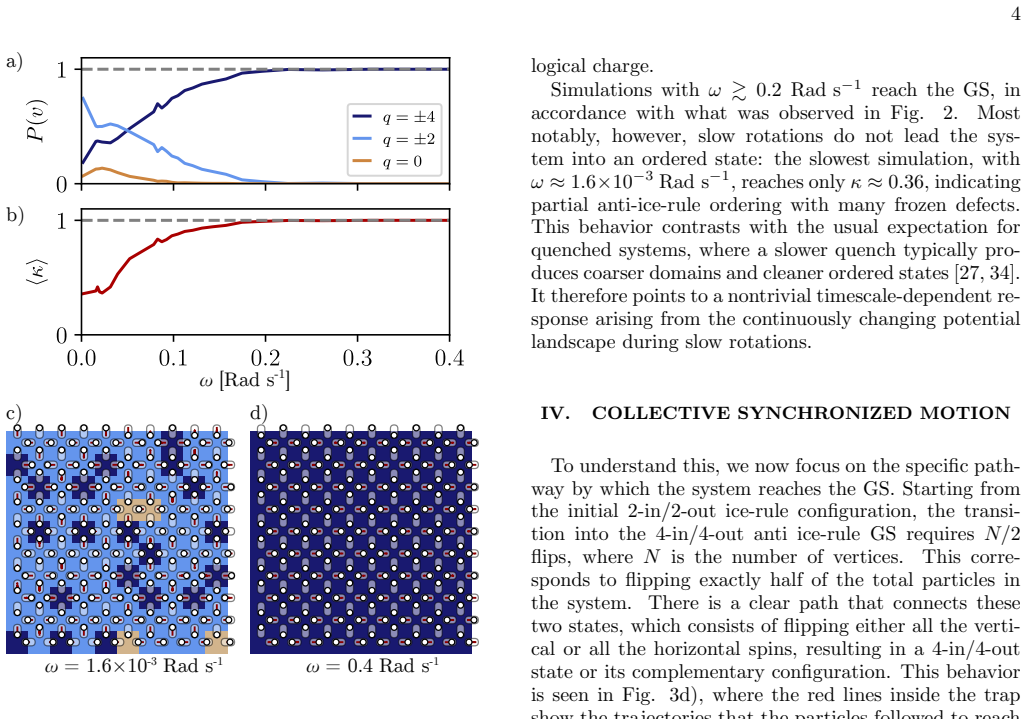
Summary. The authors simulate a square artificial colloidal ice (ACI) of paramagnetic colloids in double-well traps under a magnetic field rotated continuously from out-of-plane (z) to in-plane (x), using overdamped molecular dynamics with parameters matched to prior experiments. In equilibrium this rotation carries the system from the 2-in/2-out ice-rule state to the 4-in/4-out anti-ice-rule charge crystal. The central finding is a strong dependence of the final state on the rotation rate ω: for ω ≳ 0.2 rad/s the system reaches the defect-free anti-ice-rule ground state via a synchronized, diffusionless transformation in which exactly half the particles (all horizontal traps) flip, with the flipped fraction ν_p saturating at 1/2 and the charge order parameter κ → 1; at slow rates (down to ω ≈ 1.6×10⁻³ rad/s) the system instead ends in a partially ordered state (κ ≈ 0.36) dominated by q = ±2 vertices, which the authors describe as a breakdown of ergodicity. A (ω, B) phase diagram with ground-state, quiescent, and partially ordered regions is presented (Fig. 6).
Significance. If the results hold, the paper reports a genuinely counterintuitive dynamical phenomenon — slower driving producing worse ordering, inverting the usual quench/coarsening intuition — in an experimentally accessible colloidal system. The fast-rotation half of the result is well supported: the geometric pathway (flip all horizontal or all vertical traps) is derived cleanly, and the trajectory-level evidence (ν_p saturating at exactly 1/2, Fig. 4; sharp fluctuation-free Δν_p peaks, Fig. 5; κ → 1, Fig. 3b) is coherent and internally consistent. The model is stated with full numerical parameters (Eqs. 1–4) matching a realized experiment, so the work amounts to a falsifiable prediction for the ACI platform of Ref. 19. The magic-angle analysis (Eq. 5, θ_th = 35.26°) and the observation of sub-threshold type-III vertex dynamics driven by anisotropic repulsion plus thermal noise are nice mechanistic contributions. The result is a dynamical outcome of a stated Hamiltonian and protocol, not a fitted or normalized quantity, which strengthens its credibility.
major comments (3)
- [Abstract; §V (final paragraph); §VI] The claim that 'ergodicity breaks down' at slow rotation rates is not established by the evidence presented. The protocol (Eq. 4) stops at ωt = π/2 and the state is read from the last frame; §V explicitly states that 'the subsequent evolution at constant field is not included in the protocol' and that the partially ordered region exists 'at least within the accessible simulation times.' A partially ordered configuration with κ ≈ 0.36 at the end of a ~654 s ramp is equally consistent with (a) ordinary slow relaxation toward the 4-in/4-out GS, (b) kinetic arrest with a finite but long relaxation time, or (c) genuine ergodicity breaking, and nothing in Figs. 2–6 distinguishes these. This is load-bearing because the ergodicity claim is the headline of the abstract. A concrete, feasible fix: run the slowest-ω case (e.g. ω = 1.6×10⁻³ rad/s, B = 20 mT) with a constant-field hold at θ = π/2 afte
- [§III, Fig. 3a/b; §V, Fig. 6] No ensemble statistics are reported anywhere in the paper. Fig. 3a/b and the regime boundaries in Fig. 6 appear to be based on single trajectories per (ω, B) point on a modest 10×10 lattice (~100 vertices). Given that the partially ordered regime is characterized by 'frozen defects' and history dependence, run-to-run variability is precisely the quantity that determines whether the ω ≈ 0.2 rad/s boundary in Fig. 3b and the region boundaries in Fig. 6 are sharp features or single-realization accidents. The authors should state the number of independent noise realizations per point and add error bars (or at least report the spread in κ and in the final vertex fractions). This is particularly important because the paper's central dichotomy (fast → GS, slow → partial order) is drawn from the same data.
- [§IV, Fig. 4; Fig. 5 inset] The definition of ν_p needs tightening to support the 'exactly half the particles flip' claim. The text says a particle counts as crossed if it crosses the hill center opposite its initial position, and that rapid fluctuations around the center 'do not keep adding to the fraction' — but it is not stated whether ν_p is cumulative over distinct particles (each particle counted at most once) or a net count. Since the slow regime shows particles oscillating around the hill, the saturation of ν_p 'well above 1/2' in that regime depends sensitively on this convention. Please define the estimator precisely. Relatedly, the Δθ extraction in the Fig. 5 inset (moving-average envelope of |Δν_p| above 'a small fixed fraction of its maximum') should specify the smoothing window and threshold fraction, since ∆θ is used quantitatively to compare fast and slow regimes.
minor comments (6)
- [Abstract and throughout] Typo: 'difussionless' (abstract, §I, §IV, §VI) should be 'diffusionless.' Units are written inconsistently as 'Rad s−1' (Figs. 2–5, §III) and 'rad/s'; please standardize.
- [§III, Fig. 3 caption] The caption of Fig. 3 states '(c) fast rotation, (d) slow rotation,' but the main text in §III describes the slow-rotation configuration as Fig. 3c and the fast-rotation ground state as Fig. 3d. One of the two is mislabeled; please reconcile.
- [§IV, second paragraph] The text refers to 'Fig. 3 b) and c)' when discussing the separate motion of horizontal and vertical particles; this should be Fig. 4b and 4c.
- [§III, Eq. (6)] κ is defined with signed q_ij and the alternating factor (−1)^{i+j}, so for the antiferromagnetic 4-in/4-out state κ = +1 by construction; the text's reference to '|κ|' being maximized is then redundant/confusing. Please clarify whether the complementary (all-vertical-flip) GS gives κ = +1 or −1, since both are said to be reached.
- [§II, Eq. (1)] The symbol ξ is used for the diffusion constant and γ = k_BT/ξ for the drag; this is the Einstein relation but the notation is nonstandard (ξ usually denotes a friction). A brief note would help. Also state whether periodic or open boundary conditions are used on the 10×10 lattice, as this affects vertex counting near edges.
- [General] No code or data availability statement is given. Given that the results are pure simulation, depositing the MD code and the trajectory data underlying Figs. 2–6 would substantially strengthen reproducibility.
Circularity Check
No significant circularity: rate-dependent final states are observed MD outcomes under a stated drive and Hamiltonian, not quantities forced by definition, fit, or self-citation.
full rationale
The central claims—that fast field rotation yields a defect-free 4-in/4-out state via synchronized half-system flips (ν_p → 1/2) while slow rotation leaves a partially ordered state with lower κ—are readouts of overdamped molecular-dynamics trajectories under Eqs. (1)–(4), not predictions constructed from fitted targets. The charge order parameter κ (Eq. 6) and vertex fractions P(v) are diagnostics computed after the fact; they are not inputs that force the reported ω dependence. Background self-citations (Refs. 34–35) supply the trap potential and the known anisotropic ground-state energetics, which is ordinary reuse of prior methodology and does not make the continuous-rotation pathway or the counterintuitive slow-is-worse outcome true by construction. There is no uniqueness theorem, no fitted parameter renamed as a prediction, and no self-definitional loop between premise and result. Any weakness in the strong “ergodicity breaks down” language is a finite-horizon / protocol limitation (simulations stop at θ=π/2), not circularity. Score 0.
Assumptions & free parameters
free parameters (3)
- Trap stiffnesses k_trap, k_hill and hill height h =
k_trap=0.1 pN/nm, h=4 pN·nm
- Diffusion constant ξ (drag) =
0.125 µm²/s
- Field magnitudes B and angular rates ω scanned =
crossover ω≳0.2 rad/s at B=20 mT
assumptions (5)
- domain assumption Overdamped Langevin dynamics with pairwise magnetic dipole–dipole interactions and no many-body magnetization corrections adequately describe the colloidal ice.
- domain assumption All traps are identical bistable potentials with the same hill height and no quenched disorder.
- domain assumption The equilibrium ground state under in-plane field is the 4-in/4-out anti-ice-rule charge crystal.
- ad hoc to paper Stopping the protocol at ωt=π/2 and reading the last frame is a valid probe of the driven transition (no mandatory post-rotation anneal).
- standard math Standard stochastic calculus / fluctuation–dissipation for η_i at T=300 K.
Cite this review
Pith. "Pith review of Transition between ground states in square anisotropic artificial colloidal ice." pith.science (2026). https://pith.science/paper/5OCULI7V
@misc{pith2026260725050,
  author       = {Pith},
  title        = {Pith review of: Transition between ground states in square anisotropic artificial colloidal ice},
  year         = {2026},
  howpublished = {\url{https://pith.science/paper/5OCULI7V}},
  note         = {Machine review of arXiv:2607.25050}
}
abstract
In Artificial Colloidal Ice (ACI), paramagnetic colloidal particles are confined in double-well traps and interact via repulsive, isotropic, magnetic dipole-dipole interactions that can be controlled by an external magnetic field. In this paper, we dynamically introduce anisotropic interactions to ACI by rotating the external magnetic field, which, in equilibrium, makes the system go from a charge-free 2-in, 2-out ice rule state, to a charged 4-in, 4-out state. We observe a strong dependence of the final configuration on the field's rotation rate $\omega$: at high angular velocity, the system achieves a defect free final state via a difussionless transformation from the initial ground state. However, counterintuitively, at slow rotation rates, ergodicity breaks down, trapping the system in a partially ordered metastable state.
Figures


Figures from the paper (2 more)


Reference graph
Works this paper leans on
-
[1]
Ortiz-Ambriz, C
A. Ortiz-Ambriz, C. Nisoli, C. Reichhardt, C. J. O. Re- ichhardt, and P. Tierno,Colloquium: Ice rule and emer- gent frustration in particle ice and beyond, Rev. Mod. Phys.91, 041003 (2019)
2019
-
[2]
Nisoli, R
C. Nisoli, R. Moessner, and P. Schiffer,Colloquium: Ar- tificial spin ice: Designing and imaging magnetic frustra- tion, Rev. Mod. Phys.85, 1473 (2013)
2013
-
[3]
R. F. Wang, C. Nisoli, R. S. Freitas, J. Li, W. McConville, B. J. Cooley, M. S. Lund, N. Samarth, C. Leighton, V. H. Crespi, and P. Schiffer, Artificial ‘spin ice’ in a geometri- cally frustrated lattice of nanoscale ferromagnetic islands, Nature439, 303 (2006)
2006
-
[4]
S. H. Skjærvø, C. H. Marrows, R. L. Stamps, and L. J. Heyderman, Advances in artificial spin ice, Nat Rev Phys 2, 13 (2019)
2019
-
[5]
A. May, M. Saccone, A. Van Den Berg, J. Askey, M. Hunt, and S. Ladak, Magnetic charge propagation upon a 3D artificial spin-ice, Nat Commun12, 3217 (2021)
2021
-
[6]
Drisko, T
J. Drisko, T. Marsh, and J. Cumings, Topological frustra- tion of artificial spin ice, Nat Commun8, 14009 (2017)
2017
-
[7]
Wang, Z.-L
Y.-L. Wang, Z.-L. Xiao, A. Snezhko, J. Xu, L. E. Ocola, R. Divan, J. E. Pearson, G. W. Crabtree, and W.-K. Kwok, Rewritable artificial magnetic charge ice, Science 352, 962 (2016)
2016
-
[8]
Gilbert, G.-W
I. Gilbert, G.-W. Chern, B. Fore, Y. Lao, S. Zhang, C. Nisoli, and P. Schiffer, Direct visualization of mem- ory effects in artificial spin ice, Phys. Rev. B92, 104417 (2015)
2015
Show all 36 references
-
[9]
Gilbert, G.-W
I. Gilbert, G.-W. Chern, S. Zhang, L. O’Brien, B. Fore, C. Nisoli, and P. Schiffer, Emergent ice rule and magnetic charge screening from vertex frustration in artificial spin ice, Nature Phys10, 670 (2014)
2014
-
[10]
Zhang, I
S. Zhang, I. Gilbert, C. Nisoli, G.-W. Chern, M. J. Er- ickson, L. O’Brien, C. Leighton, P. E. Lammert, V. H. Crespi, and P. Schiffer, Crystallites of magnetic charges in artificial spin ice, Nature500, 553 (2013)
2013
-
[11]
Saccone, F
M. Saccone, F. Caravelli, K. Hofhuis, S. Dhuey, A. Scholl, C. Nisoli, and A. Farhan, Real-space observation of er- godicity transitions in artificial spin ice, Nat Commun 14, 5674 (2023)
2023
-
[12]
Arava, N
H. Arava, N. Leo, D. Schildknecht, J. Cui, J. Vijayaku- mar, P. M. Derlet, A. Kleibert, and L. J. Heyderman, Engineering Relaxation Pathways in Building Blocks of Artificial Spin Ice for Computation, Phys. Rev. Applied 11, 054086 (2019)
2019
-
[13]
Y. Lao, F. Caravelli, M. Sheikh, J. Sklenar, D. Gardeaza- bal, J. D. Watts, A. M. Albrecht, A. Scholl, K. Dahmen, C. Nisoli, and P. Schiffer, Classical topological order in the kinetics of artificial spin ice, Nature Phys14, 723 (2018)
2018
-
[14]
S. A. Morley, D. Alba Venero, J. M. Porro, S. T. Ri- ley, A. Stein, P. Steadman, R. L. Stamps, S. Langridge, and C. H. Marrows, Vogel-Fulcher-Tammann freezing of a thermally fluctuating artificial spin ice probed by x- ray photon correlation spectroscopy, Phys. Rev. B95, 104422 (2017)
2017
-
[15]
Kapaklis, U
V. Kapaklis, U. B. Arnalds, A. Farhan, R. V. Chopdekar, A. Balan, A. Scholl, L. J. Heyderman, and B. Hj¨ orvarsson, Thermal fluctuations in artificial spin ice, Nature Nanotech9, 514 (2014)
2014
-
[16]
Rougemaille, F
N. Rougemaille, F. Montaigne, B. Canals, A. Dulu- ard, D. Lacour, M. Hehn, R. Belkhou, O. Fruchart, S. El Moussaoui, A. Bendounan, and F. Maccherozzi, Ar- tificial Kagome Arrays of Nanomagnets: A Frozen Dipo- lar Spin Ice, Phys. Rev. Lett.106, 057209 (2011)
2011
-
[17]
Nisoli, Unexpected Phenomenology in Particle-Based Ice Absent in Magnetic Spin Ice, Phys
C. Nisoli, Unexpected Phenomenology in Particle-Based Ice Absent in Magnetic Spin Ice, Phys. Rev. Lett.120, 167205 (2018)
2018
-
[18]
Lib´ al, C
A. Lib´ al, C. Reichhardt, and C. J. O. Reichhardt, Real- izing Colloidal Artificial Ice on Arrays of Optical Traps, Phys. Rev. Lett.97, 228302 (2006)
2006
-
[19]
Ortiz-Ambriz and P
A. Ortiz-Ambriz and P. Tierno, Engineering of frustra- tion in colloidal artificial ices realized on microfeatured grooved lattices, Nat. Commun.7, 10575 (2016)
2016
-
[20]
Nisoli, Dumping topological charges on neighbors: Ice manifolds for colloids and vortices, New J
C. Nisoli, Dumping topological charges on neighbors: Ice manifolds for colloids and vortices, New J. Phys.16, 113049 (2014)
2014
-
[21]
Rodr ´ ıguez-Gallo, A
C. Rodr ´ ıguez-Gallo, A. Ortiz-Ambriz, and P. Tierno, De- generacy and hysteresis in a bidisperse colloidal ice, Phys. Rev. Research3, 043023 (2021)
2021
-
[22]
Rodr ´ ıguez-Gallo, A
C. Rodr ´ ıguez-Gallo, A. Ortiz-Ambriz, C. Nisoli, and P. Tierno, Ice rule breakdown and frustrated antiferro- toroidicity in an artificial colloidal Cairo ice, New J. Phys. 25, 103007 (2023)
2023
-
[23]
Lib´ al, D
A. Lib´ al, D. Y. Lee, A. Ortiz-Ambriz, C. Reichhardt, C. J. O. Reichhardt, P. Tierno, and C. Nisoli, Ice rule fragility via topological charge transfer in artificial col- loidal ice, Nat Commun9, 4146 (2018)
2018
-
[24]
Rodr ´ ıguez-Gallo, A
C. Rodr ´ ıguez-Gallo, A. Ortiz-Ambriz, C. Nisoli, and P. Tierno, Geometrical control of topological charge transfer in Shakti-Cairo colloidal ice, Commun Phys6, 113 (2023)
2023
-
[25]
Lib´ al, C
A. Lib´ al, C. Nisoli, C. J. O. Reichhardt, and C. Re- ichhardt, Inner Phases of Colloidal Hexagonal Spin Ice, Phys. Rev. Lett.120, 027204 (2018)
2018
-
[26]
Le Cunuder, I
A. Le Cunuder, I. Fr´ erot, A. Ortiz-Ambriz, and P. Tierno, Competing orders in colloidal kagome ice: Importance of the in-trap motion of the particles, Phys. Rev. B99, 140405 (2019)
2019
-
[27]
Libal, A
A. Libal, A. del Campo, C. Nisoli, C. Reichhardt, and C. J. O. Reichhardt, Quenched Dynamics of Artificial Spin Ice: Coarsening versus Kibble-Zurek, Phys. Rev. Research2, 033433 (2020), arXiv:1908.05328
2020 arXiv
-
[28]
E. C. O˘ guz, A. Ortiz-Ambriz, H. Shem-Tov, E. Babi` a- Soler, P. Tierno, and Y. Shokef, Topology Restricts Quasidegeneracy in Sheared Square Colloidal Ice, Phys. Rev. Lett.124, 238003 (2020)
2020
-
[29]
Lib´ al, C
A. Lib´ al, C. J. O. Reichhardt, and C. Reichhardt, Doped colloidal artificial spin ice, New J. Phys.17, 103010 (2015)
2015
-
[30]
Ostinato and P
M. Ostinato and P. Tierno, Tracking topological defects in a plasma state of a quenched colloidal ice, Phys. Rev. B111, 014414 (2025). 8
2025
-
[31]
Lib´ al, C
A. Lib´ al, C. Reichhardt, and C. J. Olson Reichhardt, Hysteresis and return-point memory in colloidal artificial spin ice systems, Phys. Rev. E86, 021406 (2012)
2012
-
[32]
Lib´ al, C
A. Lib´ al, C. Nisoli, C. Reichhardt, and C. J. O. Reich- hardt, Dynamic Control of Topological Defects in Artifi- cial Colloidal Ice, Sci Rep7, 651 (2017)
2017
-
[33]
Baillou, M
R. Baillou, M. Terkel, C. Nisoli, and P. Tierno, Emergent charge crystallization and frustration in a particle anti- spin Ice (2026), arXiv:2603.29389 [cond-mat]
2026
-
[34]
L. G. Alanis-Cant´ u and A. Ortiz-Ambriz, Anisotropic in- teractions induce dynamical spin freezing in artificial col- loidal ice, Physical Review Research8, 033051 (2026)
2026
-
[35]
Rodr ´ ıguez-Gallo, A
C. Rodr ´ ıguez-Gallo, A. Ortiz-Ambriz, and P. Tierno, Topological Boundary Constraints in Artificial Colloidal Ice, Phys. Rev. Lett.126, 188001 (2021)
2021
-
[36]
No´ e, S
F. No´ e, S. Olsson, J. K¨ ohler, and H. Wu, Boltzmann gen- erators: Sampling equilibrium states of many-body sys- tems with deep learning, Science365, eaaw1147 (2019)
2019
Reviewed July 31, 2026 · model on record in the stance chip above.
Discussion (0). Continue with ORCID to comment.