REVIEW 3 major objections 6 minor 24 references
Parallel Quantum Computing Emulation
T0 review · 3 major / 6 minor · reviewed 2026-08-14 · deepseek-v4-flash
Pith's one-line read This paper claims that running $M=2^m$ parallel analog signals adds $m$ spatial qubits to a frequency-based quantum emulator, so each doubling of signal count adds one qubit without increasing gate time, and controlled gates across…
desk verdict Spatial encoding math is a real extension, but the paper's own swap-based implementation makes spatial gate time grow linearly with M, undercutting the headline speedup claim. read the letter →
The pith
A machine-rendered reading of the paper's core claim, the machinery that carries it, and where it could break.
The reading
What carries the argument
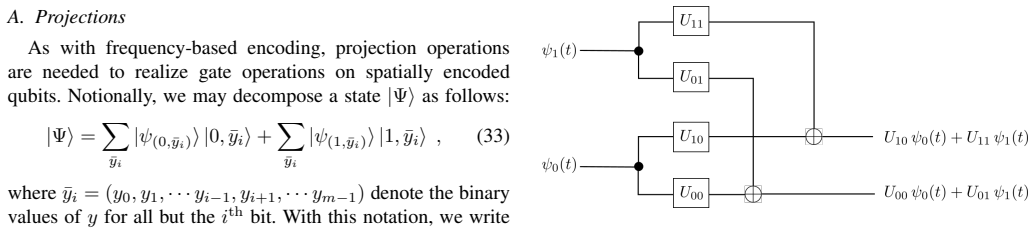
The load-bearing object is the spatial-encoding vector: $M=2^m$ parallel complex signals, one per spatial basis vector, each carrying $N=2^n$ frequency amplitudes $\alpha_{x,y}$. A spatial qubit is addressed by a switch network that reorders the $M$ signals using up to $M/2-1$ staged swaps per addressed qubit, splits and copies them, applies the $2\times2$ gate matrix through controlled complex scalar multipliers, and recombines the pairs. Controlled two-qubit gates across encodings combine frequency-domain comb filters with these spatial switches and, for time qubits, delay lines, yielding arbitrary gates on the combined $n+m+\ell$-qubit Hilbert space while the clock period stays set by the lowest frequency qubit and is independent of $m$.
What would settle it
Build a four-channel ($M=4$, two spatial qubits) prototype, use a controlled-NOT between a frequency and a spatial qubit to prepare a Bell state, and measure the four output complex amplitudes; if fidelity falls well below one as $M$ grows, or if per-gate time scales with $M$ instead of staying fixed, the central claim fails. A numerical check would simulate the staged-swap network with realistic switch phase errors and see whether error per gate grows with $M$.
Extended reading notes
Core claim
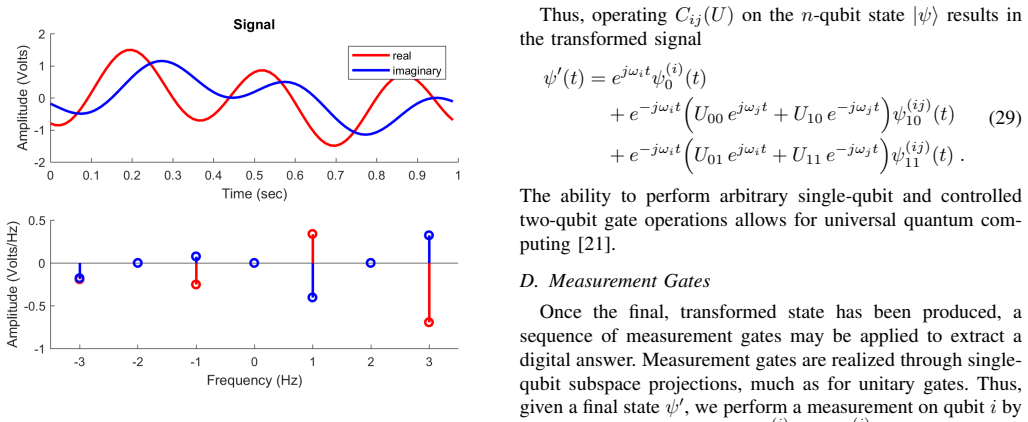
The paper's central claim is that the frequency-based classical quantum emulator can be parallelized without sacrificing gate speed by treating a vector of $M=2^m$ complex signals as a tensor product of $n$ frequency qubits and $m$ spatial qubits. The state is $\Psi(t)=\sum_{y=0}^{M-1}\psi_y(t)e_y$, where each $\psi_y(t)=\sum_{x=0}^{N-1}\alpha_{x,y}\phi_x(t)$ is a frequency-encoded $n$-qubit signal and the inner product sums over channels. Projections onto spatial-qubit subspaces use switches and staged swaps; single-qubit gates on a spatial qubit mix the corresponding paired signals, while gates on a frequency qubit act identically on every channel. The paper constructs controlled-$U$ operations for a frequency control on a spatial target, a spatial control on a frequency target, two spatial qubits, and time qubits, and argues that this suffices for arbitrary unitaries and fully entangled states across encodings. Time-based encoding enters as a third tensor factor through shift operators $S_z$, adding qubits without extra bandwidth but at the cost of longer gate times, with proposed use in error correction or communication.
Load-bearing premise
The construction assumes ideal analog hardware: switches, delay lines, complex multipliers, and signal splitters must preserve complex amplitudes with sufficient phase coherence and noise immunity across all $M$ parallel channels, since any non-negligible synchronization or component error degrades the emulated quantum state and the claimed speedup.
Editorial extensions
If this is right
- With $M=2^m$ parallel signals, each doubling of $M$ adds one fully entangleable spatial qubit without increasing per-gate time, so 1024 channels in a 1 MHz to 1 GHz band emulate 20 qubits at picosecond-scale effective gates.
- Because controlled two-qubit gates can act between frequency, spatial, and time encodings, arbitrary unitaries and fully entangled states over all $M\times N\times L$ amplitudes are in principle realizable.
- For unstructured search, the subspace-projection method counts solutions in time linear in $n$, and spatial encoding multiplies the number of qubits without slowing the gate clock.
- Time-based encoding adds qubits through $L=2^\ell$ signal trains and shift operators but gives no gate-speed advantage, so its stated value lies in fault-tolerant or noisy-channel applications.
- The speed advantage depends on cross-channel entanglement: $M$ independent separable signals would only give a factor-$m$ speedup, while fully entangled spatial and frequency qubits give a factor-$M$ speedup.
Reading between the lines
- An unstated implication is that other independent signal dimensions, such as polarization or orbital-angular-momentum modes, could be added as further tensor factors, provided a controlled gate can be built between the new dimension and frequency or spatial qubits.
- Because the switch network needs $O(M)$ staged swaps per addressed spatial qubit, physical control complexity grows exponentially with $m$; a cost model would reveal whether the logical speedup survives engineering overhead at large channel counts.
- If the hybrid analog-digital dynamic-range scheme works, the practical qubit limit shifts from signal count to noise floor and phase stability, which would make the device useful for testing algorithms against noiseless quantum states.
Signed reviews
Editorial analysis
A structured set of objections, weighed in public.
Referee Report
Summary. The paper proposes extending a classical analog-signal emulation of quantum computing from a single frequency-encoded signal to M=2^m parallel signals, where the index of the wire carries 'spatial' qubits. It defines vector-valued signals, projections, and single- and two-qubit gate operations for frequency, spatial, and mixed frequency-spatial encodings, and sketches a similar extension to time-bin encoding. The central claim is that each doubling of the number of parallel signals adds one spatial qubit without increasing gate time, allowing large entangled states to be emulated with speedups over digital processors (for example, factor of five orders of magnitude for M=1024 in the 1 MHz to 1 GHz band). The paper's final section discusses practical challenges including switch complexity and dynamic range.
Significance. The mathematical formulation of spatial encoding and its entangling gates is original and largely internally consistent; the controlled operations between frequency and spatial qubits are nontrivial and presented in useful detail. However, the paper's headline advantage—that spatial qubits 'incur no sacrifice in gate speed'—is contradicted by the paper's own implementation accounting, which requires O(M) sequential switch stages per spatial gate. The quantitative speedup claims are asserted by reference to the authors' earlier work without an independent derivation or a timing model. No hardware results or noise analysis are provided. If the timing issue is resolved with a credible implementation, the scheme could be a valuable approach for classical quantum emulation; as it stands, the main performance claim is not supported.
major comments (3)
- [Sec. III-A and Sec. V] The central claim that spatial encoding adds qubits 'with the same gate time required for processing frequency-encoded signals' (Abstract) and 'incurs no sacrifice in gate speed' (Sec. I) is contradicted by the paper's own implementation. Section III-A states that a spatial projection is done 'through a sequence of pairwise swaps,' with 'up to M/2−1 stages of swaps' for each spatial qubit, and Section V requires a three-stage process of reordering, gate application, and inverse reordering. Thus a single-qubit spatial gate has latency at least on the order of M/2 sequential switch stages before the gate operation itself; for the paper's M=1024 example this is roughly 1024 switch stages, not the constant gate time claimed. This scaling directly undermines the speedup claims in Sec. VI. The authors should provide a detailed timing model that includes switch settling times and control overhead, or substantially revise the speedup claims.
- [Sec. VI and Sec. I] The quantitative speedup figures ('two orders of magnitude' in Sec. I, 'five orders of magnitude' in Sec. VI) are attributed to Refs. [17] and [24], both authored by the same research group, yet no derivation or independent analysis is given in the present manuscript. In light of the swap-overhead issue raised above, these numbers cannot be taken as substantive support. The paper should either derive the speedup from an explicit gate-time model for the proposed parallel architecture or clearly state that these are expected values from the earlier single-frequency studies, not demonstrated for spatial encoding.
- [Sec. IV-C] The abstract and Sec. I claim that the approach extends to time-based qubits and that they can be mutually entangled with frequency- and spatial-qubits, but the two-qubit gate construction for time-based encoding is explicitly omitted ('The details will be omitted here'). Because universal quantum computation requires two-qubit gates, this omission leaves the claim of universality across all three encodings incomplete. At minimum, a sketch of the controlled operation between, say, a spatial qubit and a time qubit should be provided to support the statement that fully entangled states across all encodings can be obtained.
minor comments (6)
- [Abstract] The phrase 'Single quit gate operations' should read 'Single-qubit gate operations'.
- [Eq. (11)] In the decomposition ψ(t)=e^{jω_i t}ψ_0^{(i)}(t)+e^{-jω_i t}ψ_0^{(i)}(t), the second term should involve ψ_1^{(i)}(t), not ψ_0^{(i)}(t).
- [Eqs. (15) and (16)] The partial projection states in the definitions of Π_{10}^{(ij)} and Π_{11}^{(ij)} appear to be mislabeled: the right-hand sides should be |ψ_{10}^{(ij)}⟩ and |ψ_{11}^{(ij)}⟩, respectively, rather than the ψ_{00} and ψ_{01} states shown.
- [Eq. (29)] In the third term of the transformed signal, the expression 'U01 e^{jω_i t} + U11 e^{-jω_j t}' should likely be 'U01 e^{jω_j t} + U11 e^{-jω_j t}', since U is acting on qubit j.
- [Sec. V] The phrase 'amplitude modulated signals' should be 'amplitude-modulated signals' to match standard terminology.
- [References] Reference [10] (Boixo et al.) lists the year as 1998 for a Nature Physics article; this is presumably 2018, and the volume/pages should be checked against the published paper.
Circularity Check
Core gate construction is self-contained; advertised speedup rests on same-team citations and ignores the paper's own O(M) swap count.
-
self citation load bearing
[Section I (Introduction) and Section VI (Applications), citing Refs. [17] and [24]]
"In accordance with Ref. [17], this would imply a speedup by up to five orders of magnitude over a modern digital processor. ... Operating in the frequency range of 1 MHz to 1 GHz (corresponding to a mere 10 qubits using frequency encoding), this scaling advantage can provide a speed up of two orders of magnitude against a modern digital processor operating serially [17]."
The five- and two-orders-of-magnitude speedup figures are not derived from measurements or benchmarks in this paper; they are imported from Refs. [17] and [24], whose author sets overlap with the present paper (La Cour, Lanham, Ostrove). The new spatial-encoding construction is not used to recompute these numbers. Moreover, the 'same gate time' premise on which the speedup rests is contradicted by Sec. III-A and Sec. V, where spatial projection requires up to M/2-1 staged swaps plus an undo stage. The performance claim therefore reduces to a self-citation chain plus an unsupported gate-time assumption, while the gate-operation algebra itself remains independent.
full rationale
No definitional circularity is present in the central encoding and gate derivations. Sec. III defines the spatial index y = (y0..y_{m-1}) as m additional qubits and verifies single- and two-qubit operations by direct substitution into tensor-product formulas; Sec. IV does the same for time shifts using shift operators. These derivations do not assume the conclusions. The self-citations [15] and [16] supply the prior frequency-encoding machinery, which is cited background rather than a way of importing the new result. What keeps the score above zero is that the advertised speedup (Abstract, Sec. I, Sec. VI) is explicitly imported from same-team Refs. [17] and [24] rather than independently benchmarked. Separately, a non-circular correctness risk exists: the claim of 'same gate time' and 'no sacrifice in gate speed' is in tension with the paper's own O(M) staged-swap count in Secs. III-A and V, but that is an inconsistency in resource accounting, not a circularity of the derivation. The formal construction of gates between frequency, spatial, and time qubits is self-contained and does not reduce to its inputs by construction.
Assumptions & free parameters
free parameters (1)
- operating frequency band =
1 MHz to 1 GHz (example)
assumptions (5)
- standard math Finite-dimensional Hilbert space and unitary gate operations are standard linear algebra.
- domain assumption Complex amplitudes can be represented exactly by analog signal amplitudes.
- domain assumption Ideal analog arithmetic: complex multiplication and addition are exact, noiseless, and can be performed at scale.
- domain assumption Switches and delay lines realize projections and sorting without loss or timing error.
- domain assumption A synchronized phase reference exists across all M parallel signals.
Cite this review
Pith. "Pith review of Parallel Quantum Computing Emulation." pith.science (2026). https://pith.science/paper/5OICGAR6
@misc{pith2026190806445,
  author       = {Pith},
  title        = {Pith review of: Parallel Quantum Computing Emulation},
  year         = {2026},
  howpublished = {\url{https://pith.science/paper/5OICGAR6}},
  note         = {Machine review of arXiv:1908.06445}
}
read the original abstract
Quantum computers provide a fundamentally new computing paradigm that promises to revolutionize our ability to solve broad classes of problems. Surprisingly, the basic mathematical structures of gate-based quantum computing, such as unitary operations on a finite-dimensional Hilbert space, are not unique to quantum systems but may be found in certain classical systems as well. Previously, it has been shown that one can represent an arbitrary multi-qubit quantum state in terms of classical analog signals using nested quadrature amplitude modulated signals. Furthermore, using digitally controlled analog electronics one may manipulate these signals to perform quantum gate operations and thereby execute quantum algorithms. The computational capacity of a single signal is, however, limited by the required bandwidth, which scales exponentially with the number of qubits when represented using frequency-based encoding. To overcome this limitation, we introduce a method to extend this approach to multiple parallel signals. Doing so allows a larger quantum state to be emulated with the same gate time required for processing frequency-encoded signals. In the proposed representation, each doubling of the number of signals corresponds to an additional qubit in the spatial domain. Single quit gate operations are similarly extended so as to operate on qubits represented using either frequency-based or spatial encoding schemes. Furthermore, we describe a method to perform gate operations between pairs of qubits represented using frequency or spatial encoding or between frequency-based and spatially encoded qubits. Finally, we describe how this approach may be extended to represent qubits in the time domain as well.
Figures

Figures from the paper (1 more)

Reference graph
Works this paper leans on
-
[17]
Using quantum emulation for advanced computation,
B. R. L. Cour, G. E. Ott, and S. A. Lanham, “Using quantum emulation for advanced computation,” in 2017 IEEE Custom Integrated Circuits Conference (CICC), 2017
work page 2017
-
[24]
B. R. L. Cour and C. I. Ostrove, “Subspace projection method for unstructured searches with noisy quantum oracles using a signal-based quantum emulation device,” Quantum Information Processing , vol. 16, p. 7, 2017
work page 2017
-
[1]
Simulating physics with computers,
R. Feynman, “Simulating physics with computers,” International Jour- nal of Theoretical Physics , vol. 21, no. 6/7, pp. 467–488, 1982
work page 1982
-
[2]
Quantum theory, the Church-Turing principle and the universal quantum computer,
D. Deutsch, “Quantum theory, the Church-Turing principle and the universal quantum computer,” Proceedings of the Royal Society of London, Series A , vol. 400, no. 1818, pp. 97–117, 1985
work page 1985
-
[3]
N. D. Mermin, Quantum Computer Science , 1st ed. Cambridge University Press, 2007
work page 2007
-
[4]
Algorithms for quantum computation: discrete logarithms and factoring,
P. W. Shor, “Algorithms for quantum computation: discrete logarithms and factoring,” in 35th Annual Symposium on F oundations of Computer Science, 1994 Proceedings , 1994, pp. 124–134
work page 1994
-
[5]
Quantum mechanics helps in searching for a needle in a haystack,
L. K. Grover, “Quantum mechanics helps in searching for a needle in a haystack,” Physical Review Letters , vol. 79, pp. 325–328, 1997
work page 1997
-
[6]
M. A. Nielsen and I. L. Chuang, Quantum Computation and Quantum Information. Cambridge: Cambridge University Press, 2000
work page 2000
Show all 24 references
-
[7]
Joos et al., Decoherence and the Appearance of a Classical World in Quantum Theory , 2nd ed
E. Joos et al., Decoherence and the Appearance of a Classical World in Quantum Theory , 2nd ed. Berlin Heidelberg: Springer-Verlag, 2003
2003
-
[8]
Demonstration of a small programmable quantum computer with atomic qubits,
S. Debnath, N. M. Linke, C. Figgatt, K. A. Landsman, K. Wright, and C. Monroe, “Demonstration of a small programmable quantum computer with atomic qubits,” Nature, vol. 536, p. 63, 2016
2016
-
[9]
Superconducting quantum circuits at the surface code threshold for fault tolerance,
R. Barends et al., “Superconducting quantum circuits at the surface code threshold for fault tolerance,” Nature, vol. 508, p. 500, 2014
2014
-
[10]
Characterizing quantum supremacy in near-term de- vices,
S. Boixo et al. , “Characterizing quantum supremacy in near-term de- vices,” Nature Physics, vol. 14, pp. 595–600, 1998
1998
-
[11]
A classical analogy of entanglement,
R. J. C. Spreeuw, “A classical analogy of entanglement,” F oundations of Physics , vol. 28, no. 3, pp. 361–374, 1998
1998
-
[12]
Classical wave-optics analogy of quantum-information process- ing,
——, “Classical wave-optics analogy of quantum-information process- ing,” Physical Review A , vol. 63, p. 062302, 2001
2001
-
[13]
Dragoman and M
D. Dragoman and M. Dragoman, Quantum-Classical Analogies. Berlin: Springer-Verlag, 2004
2004
-
[14]
Quantum computing with analog circuits: Hilbert space com- puting,
L. Kish, “Quantum computing with analog circuits: Hilbert space com- puting,” in Smart Electronics, MEMS, BioMEMS, and Nanotechnology . SPIE, March 2003, keynote talk
2003
-
[15]
Signal-based classical emulation of a universal quantum computer,
B. R. L. Cour and G. E. Ott, “Signal-based classical emulation of a universal quantum computer,” New Journal of Physics , vol. 17, p. 053017, 2015
2015
-
[16]
Classical emulation of a quantum computer,
B. R. L. Cour, C. I. Ostrove, G. E. Ott, M. J. Starkey, and G. R. Wilson, “Classical emulation of a quantum computer,” International Journal of Quantum Information , vol. 14, p. 1640004, 2016
2016
-
[18]
Linear optical quantum computing in a single spatial mode,
P. C. Humphreys et al. , “Linear optical quantum computing in a single spatial mode,” Physical Review Letters , vol. 111, p. 150501, 2013
2013
-
[19]
Coherent ultrafast measurement of time-bin encoded photons,
J. M. Donohue, M. Agnew, J. Lavoie, and K. J. Resch, “Coherent ultrafast measurement of time-bin encoded photons,” Physical Review Letters, vol. 111, p. 153602, 2013
2013
-
[20]
On the role of entanglement in quantum- computational speed-up,
R. Jozsa and N. Linden, “On the role of entanglement in quantum- computational speed-up,” Proceedings of the Royal Society of London , vol. 459, pp. 2011–2032, 2003
2011
-
[21]
Two-bit gates are universal for quantum computa- tion,
D. P. DiVincenzo, “Two-bit gates are universal for quantum computa- tion,” Physical Review A , vol. 51, pp. 1015–1022, 1995
1995
-
[22]
Space-division demultiplexing in orbital-angular- momentum-based MIMO radio systems,
M. Oldoni et al. , “Space-division demultiplexing in orbital-angular- momentum-based MIMO radio systems,” IEEE Transactions on Anten- nas and Propagation
-
[23]
A mixed signal (analog-digital) integrator design,
M. D. Bryant, S. Yan, R. Tsang, B. Fernandez, and K. K. Kumar, “A mixed signal (analog-digital) integrator design,” IEEE Transactions on Circuits and Systems , vol. 59, p. 1409, 2012
2012
Reviewed August 14, 2026 · model on record in the stance chip above.
Discussion (0). Continue with ORCID to comment.