REVIEW 2 major objections 4 minor 19 references
Non-Perturbative Corrections to Charged Black Hole Evaporation
T0 review · 2 major / 4 minor · reviewed 2026-08-12 · deepseek-v4-flash
Pith's one-line read Non-perturbative Airy completions of JT gravity suppress the neutral Hawking flux of near-extremal charged black holes by a double exponential in the entropy at very low energies, effectively freezing evaporation until the Schwinger…
desk verdict A careful but conditional extension of Brown et al.; the double-exponential suppression rests on an unproven matrix-element assumption that could cancel it. read the letter →
The pith
A machine-rendered reading of the paper's core claim, the machinery that carries it, and where it could break.
The reading
What carries the argument
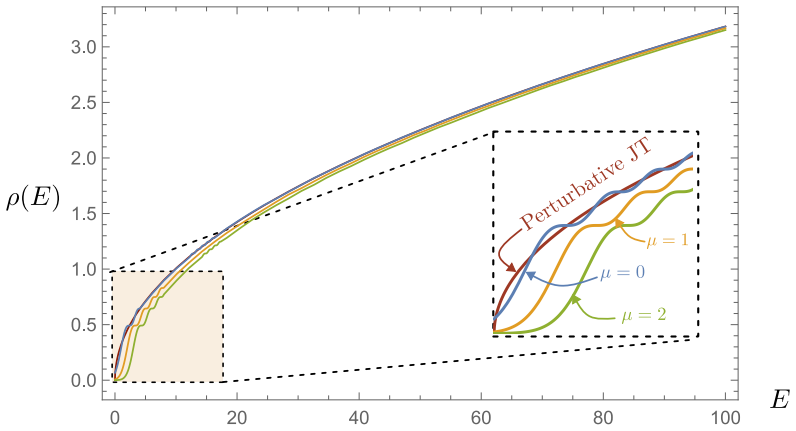
The load-bearing object is the Airy density of states $\rho_{\rm Ai}(E)=h^{-2/3}[\mathrm{Ai}'(\zeta)^2-\zeta\,\mathrm{Ai}(\zeta)^2]\,\Theta(E)$ with $\zeta=-h^{-2/3}(E-\mu)$, which replaces the perturbative JT density of states in the emission integrals (3.1) and (4.1). This density has an exponentially decaying tail for $E<\mu$, which cuts off the emission of low-energy particles, producing the double-exponential suppression. A second completion, $\rho(E)=\rho_0(E)+E_{\rm brk}/(2\pi h\sqrt{E+\mu})$, models the Bessel case where eigenvalues pile up at $E=0$ and the flux is instead enhanced.
What would settle it
Compute the exact emission matrix element in the Airy completion directly from the matrix model; if the matrix element changes near the spectral edge, the exponential suppression will not hold. Alternatively, if observations of a large near-extremal charged black hole show the neutral flux continuing to follow the perturbative $(M-Q)^{19/2}$ scaling at energies below $\mu$, the double-exponential suppression is excluded.
Extended reading notes
Core claim
The paper claims that non-perturbative completions of the JT gravity matrix model, specifically the Airy completions with a scale, change the low-energy emission integrals by modifying the density of states. For a bosonic near-extremal black hole with $M-Q\ll\mu$, the mass loss rate becomes $dM/dt \sim -\exp\left(-4e^{S_0}\mu^{3/2}/E_{\rm brk}^{3/2}\right)(M-Q)^9$ in Planck units, a double-exponential suppression in the Bekenstein-Hawking entropy $S_0$. This means the neutral Hawking emission effectively halts, freezing the black hole at a fixed energy above extremality until a charged particle emitted through the Schwinger effect pushes it away from extremality. In the complementary Bessel completions, where eigenvalues pile up at $E=0$, the low-energy flux is enhanced relative to the perturbative JT result, illustrating that the non-perturbative sign can vary.
Load-bearing premise
The result depends on the assumption that the non-perturbative corrections alter only the number of available energy levels (the density of states) in the emission formula, and not the strength of the coupling between the black hole and the emitted particles.
Editorial extensions
If this is right
- For $M-Q\ll\mu$, the mass-loss rate of a bosonic near-extremal charged black hole is suppressed by a double exponential in the entropy, so the black hole effectively freezes until a positron is emitted via the Schwinger effect.
- The perturbative JT-gravity results are recovered whenever $M-Q\gg\mu$, so the new effect appears only in the deep low-energy tail.
- A spectrograph measurement of near-extremal black hole evaporation could in principle distinguish the Airy from the Bessel completion through the sign and magnitude of the low-energy flux.
- For very small $\mu$, non-perturbative corrections enhance the flux above the perturbative JT value, but Schwinger-driven positron emission is expected to mask this regime.
- The scale $\mu$ need not be exponentially suppressed in $S_0$, because some solutions of the master string equation have non-perturbative corrections that are not D-brane suppressed.
Reading between the lines
- If the double-exponential suppression is real, it implies that the late-time evaporation history of a near-extremal charged black hole is extremely sensitive to the precise non-perturbative completion of quantum gravity; the distinction between completions could be observable as a plateau in the mass-loss curve.
- The exponential tail in the Airy density of states acts like an emergent dynamical mass gap for radiation, even though the single-particle spectrum itself is gapless; a similar mechanism might operate in other systems with a spectral edge, such as cold atomic gases or quantum dots described by random matrix ensembles.
- A direct numerical test would be to compute the full two-point spectral form factor in the Airy completion; if the operator matrix elements are indeed unchanged, the flux follows the exponential suppression, and if not, the discrepancy would quantify the error in the paper's key assumption.
Editorial analysis
A structured set of objections, weighed in public.
Referee Report
Summary. This paper studies how non-perturbative completions of Jackiw-Teitelboim (JT) gravity modify the evaporation rate of large near-extremal charged black holes. The authors take the emission integrals derived by Brown et al. for the semiclassical and perturbative JT regimes and replace the perturbative density of states with a one-parameter Airy completion, and later with a Bessel completion. For the Airy completion with a sufficiently large parameter μ, the low-energy neutral Hawking flux is claimed to be suppressed by a double exponential in the black hole entropy, effectively halting evaporation; for the Bessel completion, the flux is instead enhanced. The paper recovers the semiclassical and perturbative JT results in the appropriate limits and presents explicit analytic formulas for the emission rates.
Significance. If the central assumption is justified, the paper provides a concrete, parameter-free-in-shape example of how non-perturbative effects can dramatically alter black hole evaporation, and it demonstrates that different non-perturbative completions give qualitatively different predictions. The manuscript is transparent about its model choices, contains no data fitting, and presents the results as explicit functions of the free parameter μ. Its main strength is the clean analytic reduction of emission integrals to Airy/Bessel forms and the honest display of model dependence. The significance, however, is conditional: the double-exponential suppression rests on the unproven step that non-perturbative physics changes only the density of states, not the operator matrix elements, and the Airy completion used for the main result is itself non-perturbatively unstable and defined by an ad hoc truncation.
major comments (2)
- [Section 3, after Eq. (3.1); Section 4, before Eq. (4.1)] The statement that non-perturbative completion changes only the density of states ρ(E) in the emission integrals, leaving operator matrix elements and Clebsch-Gordan coefficients unchanged, is the load-bearing step behind the double-exponential suppression in Eqs. (3.6), (4.4), and (4.5). The cited examples [4,16] do not establish this for the Airy/Bessel spectral edge considered here. In double-scaled matrix models, normalized energy eigenstates have amplitude of order 1/√ρ(E), so the matrix element of a smooth operator can scale as 1/√(ρ(E_i)ρ(E_f)); under Fermi's golden rule the factor ρ(E_f) appearing in the rate can then be canceled, and the exponentially small Airy tail of ρ(E_f) would no longer suppress the flux. The paper's own Bessel completion, where the density of states piles up, illustrates how sensitive the result is to the density-of-states replacement. The authors must either derive the matrix-element scaling for the Airy and Bessel completions or explicitly state this as an assumption and rephrase the central claim accordingly.
- [Section 2, Eq. (2.4); Introduction] The Airy density of states (2.4) is a non-perturbatively unstable completion, and the paper makes it well-defined by simply truncating the spectrum at E=0. The exponential low-energy tail of this truncated Airy model is precisely what produces the claimed double-exponential suppression. The instability is acknowledged, but the paper does not assess whether the suppression survives in a stable completion; in fact, the stable Bessel completion considered in Section 5 gives an enhanced flux (Eq. (5.2)). The title and abstract present the result as generic 'non-perturbative corrections to charged black hole evaporation' rather than as a property of a specific toy model. I recommend that the authors either show that the truncated Airy completion is a controlled approximation or explicitly frame the main result as model-dependent within the first paragraph of the introduction.
minor comments (4)
- [Eq. (4.5) vs. Eq. (4.4)] The exponent in the double-exponential suppression is written as exp(-4 e^{S0} μ^{3/2}/E_brk^{3/2}) in Eq. (4.5), while Eq. (4.4) gives exp(-4√2 e^{S0} μ^{3/2}/(3 E_brk^{3/2})). These differ by a factor 3/√2; please reconcile the two expressions or state that Eq. (4.5) is schematic and the constant is not meaningful.
- [Eq. (2.6)] The definition of h appears to have the wrong sign in the exponent: matching the small-E limit of Eq. (2.3) with the Airy asymptote (2.5) requires h ∝ e^{-S0}, not e^{S0}. Please check the sign and ensure consistency with the subsequent Airy arguments in Eqs. (3.6) and (4.4).
- [Eq. (3.6)] The phrase 'Expanding (3.5) in powers of Ei/Ebrk' is misleading because the result contains Airy functions evaluated at arguments involving μ; please specify the actual expansion parameter and the regime in which this is valid.
- [Section 5, Eq. (5.1)] The Bessel completion is introduced as a phenomenological density of states and is said to be argued stable in [8]. It would be helpful to state explicitly whether Eq. (5.1) is directly derived from the master string equation or is only a low-energy fit, and to comment on how the matrix-element issue raised in the major comments affects the Bessel conclusions.
Circularity Check
No significant circularity: the paper computes consequences of an explicitly chosen non-perturbative completion, with no fitted parameter renamed as a prediction.
full rationale
The paper's central claim is not circular. It begins with non-perturbative completions of JT gravity introduced elsewhere, namely the Airy density of states (2.4) and the Bessel-type density (5.1), and inserts these into microcanonical emission integrals (3.1) and (4.1) taken from the external work [5]. The double-exponential suppression in Eqs. (3.6), (4.4), and (4.5) follows by direct asymptotic evaluation of Airy functions under the stated assumption mu >> h^{2/3}; it is not obtained by fitting a parameter to the quantity being predicted. The parameter mu is a free model parameter, and the paper reports the evaporation rate as an explicit function of mu rather than extracting mu from data. The only load-bearing modeling assumption is stated after Eq. (3.1) and repeated before Eq. (4.1): non-perturbative corrections change only the density of states, leaving operator matrix elements and Clebsch-Gordan coefficients unchanged. This is an external, falsifiable assumption supported by citations [4,16], not a self-citation, and it is not equivalent to the claimed output by construction. The paper also explicitly acknowledges the non-uniqueness of non-perturbative completions and does not invoke a uniqueness theorem. No constants are fitted and no input quantity is renamed as a prediction. Any concern about the validity of the matrix-element assumption is a correctness risk, not circularity.
Assumptions & free parameters
free parameters (1)
- mu (Airy completion scale) =
not fitted; free positive scale, assumed mu << E_brk
assumptions (4)
- ad hoc to paper The Airy density of states (2.4), truncated by Theta(E), models non-perturbative JT gravity, and the non-perturbative instability is set aside by truncating at E=0.
- domain assumption Operator matrix elements and Clebsch-Gordan coefficients do not change under non-perturbative completion; only the density of states is modified.
- domain assumption The perturbative emission integrals (3.1) and (4.1) from Brown et al. [5] are correct.
- domain assumption The emergent JT description with S0 = pi Q^2, l = Q, and E_brk = Q^{-3} is valid for near-extremal charged black holes.
Cite this review
Pith. "Pith review of Non-Perturbative Corrections to Charged Black Hole Evaporation." pith.science (2026). https://pith.science/paper/5OTPWVHR
@misc{pith2026241113454,
  author       = {Pith},
  title        = {Pith review of: Non-Perturbative Corrections to Charged Black Hole Evaporation},
  year         = {2026},
  howpublished = {\url{https://pith.science/paper/5OTPWVHR}},
  note         = {Machine review of arXiv:2411.13454}
}
read the original abstract
The recent work of Brown et al. (arXiv:2411.03447) demonstrated that the low-temperature evaporation rate of a large near-extremal charged black hole is significantly reduced from semiclassical expectations. The quantum corrections responsible for the deviation come from Schwarzian modes of an emergent Jackiw-Teitelboim gravity description of the near-horizon geometry of the black hole. Using a one-parameter family of non-perturbative Airy completions, we extend these results to incorporate non-perturbative effects. At large parameter value, the non-perturbative evaporation rate is even smaller than the perturbative JT gravity results. The disparity becomes especially pronounced at very low energies, where the non-perturbative neutral Hawking flux is suppressed by a double exponential in the entropy of the black hole, effectively stopping its evaporation until the next charged particle is emitted via the Schwinger effect. We also explore an alternative family of Bessel completions for which the non-perturbative energy flux exceeds the perturbative JT gravity prediction.
Figures


Figures from the paper (1 more)

Reference graph
Works this paper leans on
-
[1]
Jackiw, Lower Dimensional Gravity, Nucl
R. Jackiw, Lower Dimensional Gravity, Nucl. Phys. B 252 (1985) 343
work page 1985
-
[2]
Teitelboim, Gravitation and Hamiltonian Structure in Two Space-Time Dimensions , Phys
C. Teitelboim, Gravitation and Hamiltonian Structure in Two Space-Time Dimensions , Phys. Lett. B 126 (1983) 41
1983
-
[3]
G. Penington, S.H. Shenker, D. Stanford and Z. Yang,Replica wormholes and the black hole interior, JHEP 03 (2022) 205 [1911.11977]
arXiv 2022
-
[4]
Saad,Late Time Correlation Functions, Baby Universes, and ETH in JT Gravity , 1910.10311
P. Saad,Late Time Correlation Functions, Baby Universes, and ETH in JT Gravity , 1910.10311
arXiv 1910
-
[5]
A.R. Brown, L.V. Iliesiu, G. Penington and M. Usatyuk,The evaporation of charged black holes, 2411.03447
-
[6]
L.V. Iliesiu and G.J. Turiaci,The statistical mechanics of near-extremal black holes , JHEP 05 (2021) 145 [2003.02860]
arXiv 2021
- [7]
-
[8]
Johnson, Nonperturbative Jackiw-Teitelboim gravity, Phys
C.V. Johnson, Nonperturbative Jackiw-Teitelboim gravity, Phys. Rev. D 101 (2020) 106023 [1912.03637]
arXiv 2020
Show all 19 references
-
[9]
Johnson, Jackiw-Teitelboim supergravity, minimal strings, and matrix models , Phys
C.V. Johnson, Jackiw-Teitelboim supergravity, minimal strings, and matrix models , Phys. Rev. D 103 (2021) 046012 [2005.01893]
2021 arXiv
-
[10]
Johnson, String theory without branes , hep-th/0610223
C.V. Johnson, String theory without branes , hep-th/0610223
-
[11]
Stanford and E
D. Stanford and E. Witten,JT gravity and the ensembles of random matrix theory , Adv. Theor. Math. Phys. 24 (2020) 1475 [1907.03363]
2020 arXiv
-
[12]
Navarro-Salas and P
J. Navarro-Salas and P. Navarro,AdS(2) / CFT(1) correspondence and near extremal black hole entropy, Nucl. Phys. B 579 (2000) 250 [hep-th/9910076]
2000 arXiv
-
[13]
Nayak, A
P. Nayak, A. Shukla, R.M. Soni, S.P. Trivedi and V. Vishal,On the Dynamics of Near-Extremal Black Holes, JHEP 09 (2018) 048 [1802.09547]
2018 arXiv
-
[14]
Collier, L
S. Collier, L. Eberhardt, B. Mühlmann and V.A. Rodriguez,The Virasoro minimal string , SciPost Phys. 16 (2024) 057 [2309.10846]
2024 arXiv
-
[15]
Bai and M
Y. Bai and M. Korwar,Near-extremal charged black holes: greybody factors and evolution , JHEP 03 (2023) 151 [2301.07739]
2023 arXiv
-
[16]
Iliesiu, M
L.V. Iliesiu, M. Mezei and G. Sárosi,The volume of the black hole interior at late times , JHEP 07 (2022) 073 [2107.06286]
2022 arXiv
-
[17]
Morris, 2-D quantum gravity, multicritical matter and complex matrices ,
T.R. Morris, 2-D quantum gravity, multicritical matter and complex matrices ,
-
[18]
Dalley, C.V
S. Dalley, C.V. Johnson and T.R. Morris,Multicritical complex matrix models and nonperturbative 2-D quantum gravity , Nucl. Phys. B 368 (1992) 625
1992
-
[19]
Johnson, Low Energy Thermodynamics of JT Gravity and Supergravity , 2008.13120
C.V. Johnson, Low Energy Thermodynamics of JT Gravity and Supergravity , 2008.13120. 12
2008 arXiv
Reviewed August 12, 2026 · model on record in the stance chip above.
Discussion (0). Continue with ORCID to comment.