Criticality and factorization in the Heisenberg chain with Dzyaloshinskii-Moriya interaction
Pith reviewed 2026-05-24 23:03 UTC · model grok-4.3
The pith
Wigner-Yanase skew information detects quantum phase transitions in the Heisenberg XYZ chain with Dzyaloshinskii-Moriya interaction.
A machine-rendered reading of the paper's core claim, the machinery that carries it, and where it could break.
Core claim
In the anisotropic spin-1/2 Heisenberg XYZ chain under magnetic fields and DM interaction, the Wigner-Yanase skew information acts as a coherence witness whose sensitivity marks the quantum phase transitions. The factorization line present in the antiferromagnetic phase becomes a factorization volume inside the gapless chiral phase, signaled by concurrence that remains zero across a broad range of fields. The model supports three phases: antiferromagnetic, paramagnetic, and chiral.
What carries the argument
Wigner-Yanase skew information computed under specific measurement bases, serving as a coherence witness whose enhanced sensitivity signals criticality.
If this is right
- Finite-size scaling of the coherence susceptibility derived from WYSI can be used to extract critical exponents at the transitions.
- Concurrence remains zero throughout a volume of parameter space rather than along a single line once the system enters the chiral phase.
- The phase diagram is partitioned into antiferromagnetic, paramagnetic, and chiral regions whose boundaries are located by the coherence witness.
- Correlation functions must be derived with care when reflection symmetry is broken by the DM term to avoid systematic errors.
Where Pith is reading between the lines
- The same WYSI construction could be applied to other one-dimensional models that combine anisotropic exchange with antisymmetric DM couplings to test whether it continues to flag transitions.
- A volume of vanishing concurrence in the chiral phase may indicate that separable ground states occupy a larger region of parameter space than in purely antiferromagnetic regimes.
- The observed expansion from line to volume factorization suggests that DM-induced chirality can stabilize product-state regions against small perturbations in field or anisotropy.
Load-bearing premise
That the WYSI values obtained in the chosen bases continue to mark the true critical lines even when finite-size effects or basis dependence could shift the apparent boundaries.
What would settle it
Exact diagonalization or DMRG data for chain lengths beyond those studied here showing that the locations of WYSI peaks or the scaling of coherence susceptibility fail to match the phase boundaries obtained from magnetization or energy-gap crossings.
Figures


read the original abstract
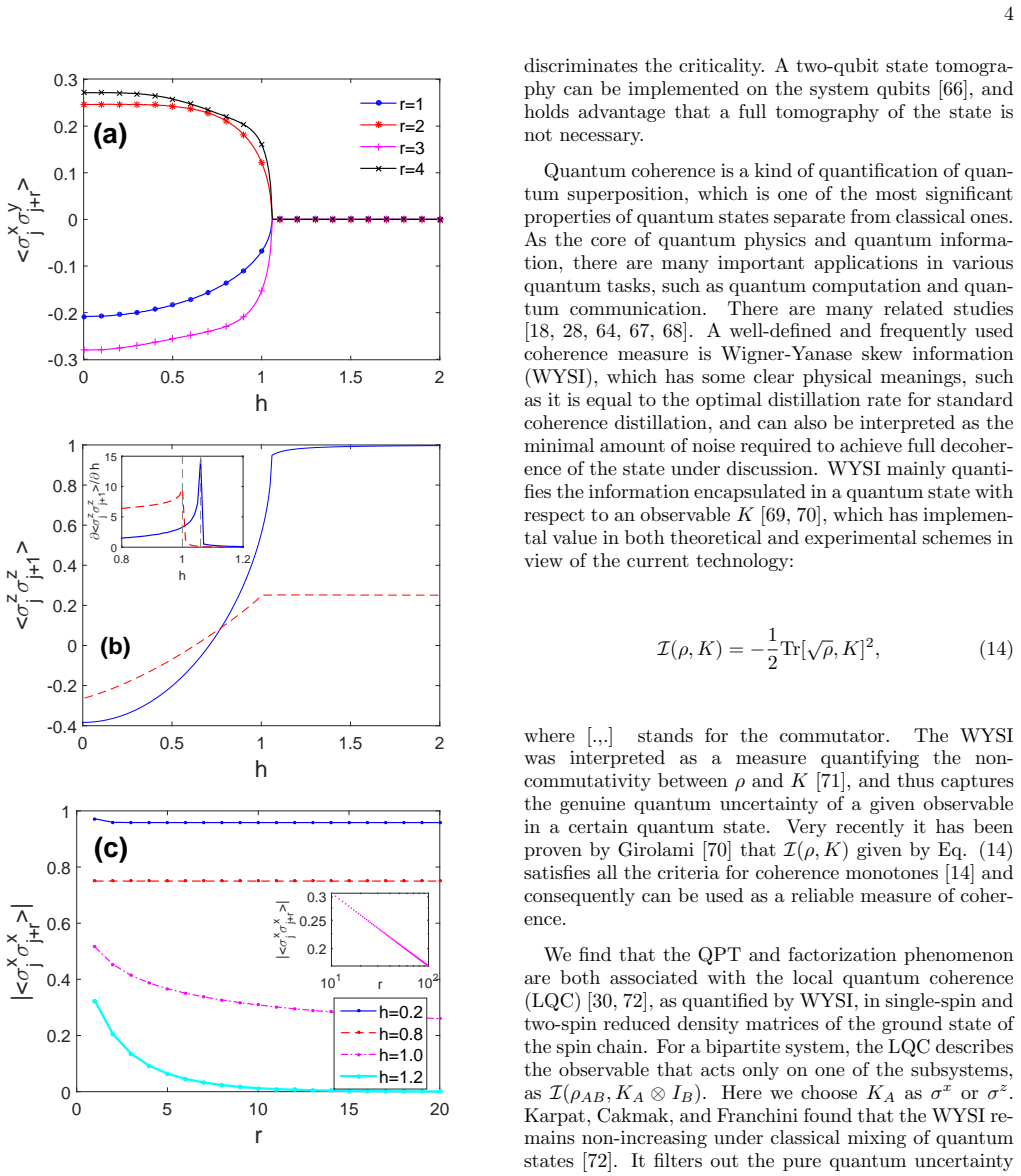
In this work, we address the ground state properties of the anisotropic spin-1/2 Heisenberg XYZ chain under the interplay of magnetic fields and the Dzyaloshinskii-Moriya (DM) interaction which we interpret as an electric field. The identification of the regions of enhanced sensitivity determines criticality in this model. We calculate the Wigner-Yanase skew information (WYSI) as a coherence witness of an arbitrary two-qubit state under specific measurement bases. The WYSI is demonstrated to be a good indicator for detecting the quantum phase transitions. The finite-size scaling of coherence susceptibility is investigated. We find that the factorization line in the antiferromagnetic phase becomes the factorization volume in the gapless chiral phase induced by DM interactions, implied by the vanishing concurrence for a wide range of field. We also present the phase diagram of the model with three phases: antiferromagnetic, paramagnetic, and chiral, and point out a few common mistakes in deriving the correlation functions for the systems with broken reflection symmetry.
Editorial analysis
A structured set of objections, weighed in public.
Referee Report
Summary. The manuscript studies the ground-state properties of the spin-1/2 anisotropic XYZ Heisenberg chain in the presence of a magnetic field and Dzyaloshinskii-Moriya (DM) interaction. It computes the Wigner-Yanase skew information (WYSI) in specific measurement bases as a coherence witness, shows that it detects quantum phase transitions, examines finite-size scaling of the associated coherence susceptibility, demonstrates that the factorization line of the antiferromagnetic phase extends to a factorization volume in the gapless chiral phase (via concurrence vanishing over a field range), and maps the phase diagram containing antiferromagnetic, paramagnetic, and chiral phases. The work also identifies common errors in deriving correlation functions when reflection symmetry is broken by the DM term.
Significance. If the central claims hold, the results would establish WYSI as a practical witness for criticality in spin chains with broken reflection symmetry and would clarify how DM interactions convert a factorization line into a volume in the chiral regime. The explicit discussion of correlation-function pitfalls for non-reflection-symmetric systems provides a useful cautionary note for related models. These contributions are of moderate interest to the condensed-matter community working on quantum phase transitions and quantum information measures in one-dimensional spin systems.
major comments (3)
- [Abstract / WYSI section] Abstract and the section introducing WYSI: the claim that WYSI 'is demonstrated to be a good indicator for detecting the quantum phase transitions' rests on computations performed in 'specific measurement bases.' No explicit test of basis independence or comparison against alternative bases is described, raising the possibility that the reported transition locations are basis-dependent rather than intrinsic to the model. This directly affects the load-bearing assertion that WYSI reliably locates the antiferromagnetic–chiral–paramagnetic boundaries.
- [Abstract / Factorization discussion] Abstract and the discussion of factorization: the statement that the factorization line 'becomes the factorization volume in the gapless chiral phase' is inferred from concurrence vanishing 'for a wide range of field.' The abstract supplies neither the system sizes employed nor any finite-size extrapolation or error analysis showing that the zero-concurrence region remains a finite-volume region rather than collapsing to a line in the thermodynamic limit. This assumption is central to the phase-diagram claim.
- [Finite-size scaling section] The finite-size scaling analysis of coherence susceptibility is mentioned but the abstract provides no explicit data, scaling exponents, or comparison to known critical exponents of the model. Without these, it is impossible to verify that the scaling confirms the phase boundaries identified by WYSI rather than being dominated by finite-size artifacts.
minor comments (2)
- [Abstract] The abstract refers to 'three phases: antiferromagnetic, paramagnetic, and chiral' but does not specify the order parameters or distinguishing observables used to delineate the paramagnetic–chiral boundary; a brief clarification would improve readability.
- [Model definition] Notation for the DM interaction strength and the XYZ anisotropy parameters should be introduced consistently at first use to avoid ambiguity when the phase diagram is presented.
Simulated Author's Rebuttal
We thank the referee for the careful reading and the constructive comments on our manuscript. We address each major comment below and will revise the manuscript to improve clarity and strengthen the presentation of the results.
read point-by-point responses
-
Referee: [Abstract / WYSI section] Abstract and the section introducing WYSI: the claim that WYSI 'is demonstrated to be a good indicator for detecting the quantum phase transitions' rests on computations performed in 'specific measurement bases.' No explicit test of basis independence or comparison against alternative bases is described, raising the possibility that the reported transition locations are basis-dependent rather than intrinsic to the model. This directly affects the load-bearing assertion that WYSI reliably locates the antiferromagnetic–chiral–paramagnetic boundaries.
Authors: The bases were chosen to align with the spin components coupled by the DM interaction and magnetic field, thereby capturing the coherence relevant to the order parameters of each phase. The detected transitions match independent diagnostics (concurrence, magnetization) reported in the literature for this model. In the revision we will add an explicit justification of the basis choice together with a short robustness check in one additional basis to address the concern directly. revision: yes
-
Referee: [Abstract / Factorization discussion] Abstract and the discussion of factorization: the statement that the factorization line 'becomes the factorization volume in the gapless chiral phase' is inferred from concurrence vanishing 'for a wide range of field.' The abstract supplies neither the system sizes employed nor any finite-size extrapolation or error analysis showing that the zero-concurrence region remains a finite-volume region rather than collapsing to a line in the thermodynamic limit. This assumption is central to the phase-diagram claim.
Authors: Concurrence data were obtained for several finite lengths (explicitly stated in the main text). The zero-concurrence interval persists across the sizes examined. We will revise the abstract and the relevant section to quote the system sizes used and include a brief finite-size scaling discussion of the width of the vanishing region, together with an extrapolation to the thermodynamic limit. revision: yes
-
Referee: [Finite-size scaling section] The finite-size scaling analysis of coherence susceptibility is mentioned but the abstract provides no explicit data, scaling exponents, or comparison to known critical exponents of the model. Without these, it is impossible to verify that the scaling confirms the phase boundaries identified by WYSI rather than being dominated by finite-size artifacts.
Authors: The scaling analysis, including extracted exponents and comparison with the expected universality class, is presented in the body of the manuscript. We agree that the abstract is too terse on this point and will expand it to mention the scaling results and their consistency with the phase boundaries obtained from WYSI. revision: yes
Circularity Check
No circularity: WYSI and concurrence computed independently from the model Hamiltonian
full rationale
The paper directly evaluates the Wigner-Yanase skew information from the ground-state wavefunction under chosen bases and identifies the factorization region via vanishing concurrence on the two-qubit reduced density matrix; neither quantity is obtained by fitting a parameter to a subset of results and then re-labeling it as a prediction, nor does any central claim reduce to a self-citation chain. The phase boundaries are located by these independently calculated witnesses plus finite-size scaling of coherence susceptibility, with an explicit correction offered for correlation-function derivations under broken reflection symmetry. All steps remain self-contained against external benchmarks and do not collapse to the input data by construction.
Axiom & Free-Parameter Ledger
free parameters (3)
- XYZ anisotropy parameters
- magnetic field strength
- DM interaction strength
axioms (2)
- standard math The system is described by the standard spin-1/2 Heisenberg Hamiltonian with DM and Zeeman terms
- domain assumption Finite-size scaling of coherence susceptibility can locate quantum critical points
Reference graph
Works this paper leans on
-
[1]
Sachdev, Quantum Phase Transition (Cambridge Uni- versity Press, Cambridge, England, 1999)
S. Sachdev, Quantum Phase Transition (Cambridge Uni- versity Press, Cambridge, England, 1999)
work page 1999
- [2]
- [3]
-
[4]
M. Liu, S. Chesi, Z.-J. Ying, X. Chen, H.-G. Luo, and H.-Q.Lin, Phys. Rev. Lett. 119, 220601 (2017)
work page 2017
- [5]
-
[6]
Y. M. Wang, W.-L. You, M. X. Liu, Y.-L. Dong, H.-G. Luo, G. Romero, and J. Q. You, New J. Phys.20, 053061 (2018)
work page 2018
- [7]
- [8]
-
[9]
P. ´Cwikli´ nski, M. Studzi´ nski, M. Horodecki, and J. Oppenheim, Phys. Rev. Lett. 115, 210403 (2015)
work page 2015
-
[10]
M. Lostaglio, D. Jennings, and T. Rudolph, Nature Com- mun. 6, 6383 (2015)
work page 2015
-
[11]
M. Lostaglio, K. Korzekwa, D. Jennings, and T. Rudolph, Phys. Rev. X 5, 021001 (2015)
work page 2015
-
[12]
E. Schr¨ odinger, Math. Proc. Cambridge Philos. Soc.31, 555 (1935)
work page 1935
-
[13]
W.-L. You, A. M. Ole´ s, and P. Horsch, New J. Phys.17, 083009 (2015)
work page 2015
-
[14]
T. Baumgratz, M. Cramer, and M. B. Plenio, Phys. Rev. Lett. 113, 140401 (2014)
work page 2014
-
[15]
A. Streltsov, U. Singh, H. S. Dhar, M. N. Bera, and G. Adesso, Phys. Rev. Lett. 115, 020403 (2015)
work page 2015
- [16]
-
[17]
J.-J. Chen, J. Cui, Y.-R. Zhang, and H. Fan, Phys. Rev. A 94, 022112 (2016)
work page 2016
- [18]
-
[19]
P. Zanardi, H. T. Quan, X. Wang, and C. P. Sun, Phys. Rev. A 75, 032109 (2007)
work page 2007
- [20]
- [21]
-
[22]
R. Horodecki, P. Horodecki, M. Horodecki, and K. Horodecki, Rev. Mod. Phys. 81, 865 (2009)
work page 2009
-
[23]
L. M. K. Vandersypen and I. L. Chuang, Rev. Mod. Phys. 11 76, 1037 (2005)
work page 2005
-
[24]
I. M. Georgescu, S. Ashhab, and F. Nori, Rev. Mod. Phys. 86, 153 (2014)
work page 2014
- [25]
- [26]
-
[27]
M. Brockmann, A. Kl¨ umper, and V. Ohanyan, Phys. Rev. B 87, 054407 (2013)
work page 2013
-
[28]
C. Radhakrishnan, I. Ermakov, and T. Byrnes, Phys. Rev. A 96, 012341 (2017)
work page 2017
-
[29]
C. Radhakrishnan, M. Parthasarathy, S. Jambulingam, and T. Byrnes, Phys. Rev. Lett. 116, 150504 (2016)
work page 2016
- [30]
- [31]
-
[32]
N. G. Berloff, M. Silva, K. Kalinin, A. Askitopoulos, J. D. T¨ opfer, P. Cilibrizzi, W. Langbein, and P. G. Lagoudakis, Nature Mater. 16, 1120 (2017)
work page 2017
- [33]
- [34]
-
[35]
S. Seki, X. Z. Yu, S. Ishiwata, and Y. Tokura, Science 336, 198 (2012)
work page 2012
- [36]
-
[37]
J. H. Yang, Z. L. Li, X. Z. Lu, M.-H. Whangbo, S.-H. Wei, X. G. Gong, and H. J. Xiang, Phys. Rev. Lett. 109, 107203 (2012)
work page 2012
-
[38]
M. Matsuda, R. S. Fishman, T. Hong, C. H. Lee, T. Ushiyama, Y. Yanagisawa, Y. Tomioka, and T. Ito, Phys. Rev. Lett. 109, 067205 (2012)
work page 2012
-
[39]
P. Wang, Z.-Q. Yu, Z. Fu, J. Miao, L. Huang, S. Chai, H. Zhai, and J. Zhang, Phys. Rev. Lett. 109, 095301 (2012)
work page 2012
-
[40]
L. W. Cheuk, A. T. Sommer, Z. Hadzibabic, T. Yefsah, W. S. Bakr, and M. W. Zwierlein, Phys. Rev. Lett. 109, 095302 (2012)
work page 2012
-
[41]
K. Jim´ enez-Garcia, L. J. LeBlanc, R. A. Williams, M. C. Beeler, A. R. Perry, and I. B. Spielman, Phys. Rev. Lett. 108, 225303 (2012)
work page 2012
-
[42]
W. S. Cole, S. Zhang, A. Paramekanti, and N. Trivedi, Phys. Rev. Lett. 109, 085302 (2012)
work page 2012
- [43]
-
[44]
I. A. Sergienko and E. Dagotto, Phys. Rev. B 73, 094434 (2006)
work page 2006
-
[45]
L. Shekhtman, O. Entin-Wohlman, and A. Aharony, Phys. Rev. Lett. 69, 836 (1992)
work page 1992
-
[46]
H. A. Bethe, Z. Phys. 71, 205 (1931)
work page 1931
-
[47]
C. N. Yang and C. P. Yang, Phys. Rev. 150, 321 (1966)
work page 1966
- [48]
- [49]
- [50]
-
[51]
S. J. Wetzel, Phys. Rev. E 96, 022140 (2017)
work page 2017
-
[52]
W. Hu, R. R. P. Singh, and R. T. Scalettar, Phys. Rev. E 95, 062122 (2017)
work page 2017
- [53]
-
[54]
M. J. S. Beach, A. Golubeva, and R. G. Melko, Phys. Rev. B 97, 045207 (2018)
work page 2018
- [55]
- [56]
- [57]
-
[58]
R. Toskovic, R. van den Berg, A. Spinelli, I. S. Eliens, B. van den Toorn, B. Bryant, J. S. Caux, and A. F. Otte, Nature Phys. 12, 656 (2016)
work page 2016
- [59]
-
[60]
M. Christandl, N. Datta, A. Ekert, and A. J. Landahl, Phys. Rev. Lett. 92, 187902 (2004)
work page 2004
- [61]
-
[62]
S. M. Giampaolo, G. Adesso, and F. Illuminati, Phys. Rev. Lett. 100, 197201 (2008)
work page 2008
-
[63]
B.-L. Ye, B. Li, Z.-X. Wang, X. Li-Jost, and S.-M. Fei, Sci. China-Phys. Mech. Astron. 61, 110312 (2018)
work page 2018
-
[64]
B. Q. Liu, B. Shao, J. G. Li, J. Zou, and L. A. Wu, Phys. Rev. A 83, 052112 (2011)
work page 2011
- [65]
-
[66]
D. Lu, T. Xin, N. K. Yu, Z. F. Ji, J. X. Chen, G. L. Long, J. Baugh, X. H. Peng, B. Zeng, and R. Laflamme, Phys. Rev. Lett. 116, 230501 (2016)
work page 2016
- [67]
- [68]
-
[69]
E. P. Wigner and M. M. Yanase, Proc. Natl. Acad. Sci. (U.S.A.) 49, 910 (1963)
work page 1963
- [70]
-
[71]
S. L. Luo, S. S. Fu, C. H. Oh, Phys. Rev. A 85, 032117 (2012)
work page 2012
- [72]
-
[73]
W. K. Wootters, Phys. Rev. Lett. 80, 2245 (1998)
work page 1998
-
[74]
T. Werlang, S. Souza, F. F. Fanchini, and C. J. Villas Boas, Phys. Rev. A 80, 024103 (2009)
work page 2009
- [75]
- [76]
-
[77]
W. K. Wooters and W. H. Zurek, Nature (London) 299, 802 (1982)
work page 1982
-
[78]
A. Osterloh, L. Amico, G. Falci, and R. Fazio, Nature (London) 416, 608 (2002)
work page 2002
-
[79]
T. J. Osborne and M. A. Nielsen, Phys. Rev. A 66, 032110 (2002)
work page 2002
- [80]
discussion (0)
Sign in with ORCID, Apple, or X to comment. Anyone can read and Pith papers without signing in.