REVIEW 4 major objections 6 minor 20 references
Semi-Supervised Video Salient Object Detection Using Pseudo-Labels
T0 review · 4 major / 6 minor · reviewed 2026-08-14 · deepseek-v4-flash
Pith's one-line read With only 20% of frames labeled, a video saliency detector trained on pseudo-labels beats fully supervised methods on three benchmarks.
desk verdict First pseudo-label semi-supervised video saliency paper with a sensible flow-guided generator, but the headline 'beats full supervision' is not architecture-controlled and needs same-backbone full-GT baselines before it can be taken at face value. read the letter →
The pith
A machine-rendered reading of the paper's core claim, the machinery that carries it, and where it could break.
The reading
What carries the argument
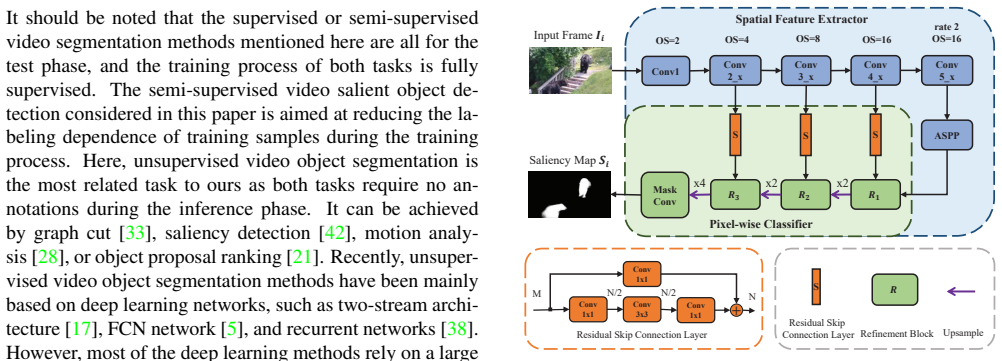
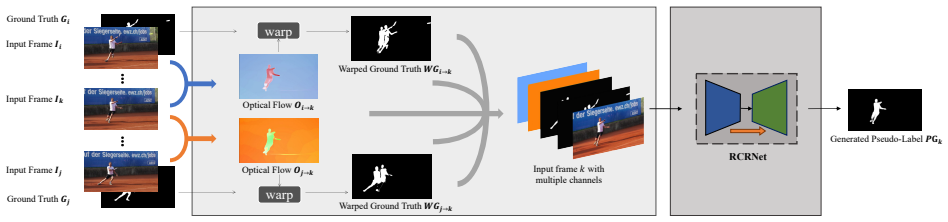
The load-bearing machinery is the flow-guided pseudo-label generator (FGPLG), built on the same residual-connected refinement network RCRNet used in the detector. FGPLG takes an unlabeled frame, uses off-the-shelf FlowNet 2.0 to estimate optical flow from the nearest labeled frames on both sides, warps their ground-truth masks to the target frame, and concatenates these warped masks and flow magnitudes with the RGB image to form a seven-channel input. A modified RCRNet then outputs the pseudo-label PGk = Nseg(Nfeat(I+k)), and these pseudo-labels supervise the final RCRNet+NER detector. The detector itself couples RCRNet with a non-locally enhanced recurrent module: two non-local blocks around a bidirectional ConvGRU stack, which enforces spatiotemporal coherence across the clip.
What would settle it
Compute per-pixel IoU between generated pseudo-labels and true labels on a held-out subset of VOS/DAVIS/FBMS, stratified by optical-flow magnitude and occlusion; then retrain the detector on the 20% real labels alone, on real plus pseudo-labels, and on 100% real labels. If the pseudo-label-trained model does not beat full supervision once label errors are accounted for, or if its advantage disappears on clips where pseudo-labels are wrong, the central claim is refuted.
Extended reading notes
Core claim
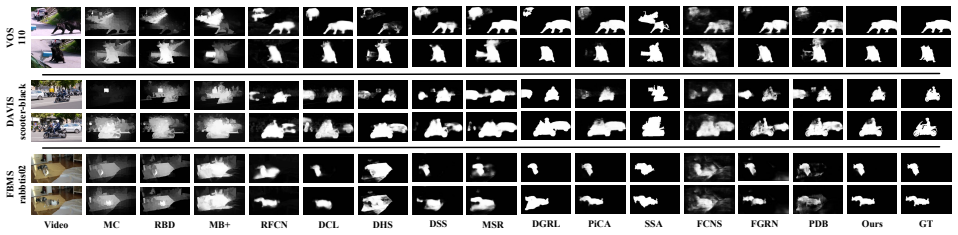
The central discovery is that pseudo-labels generated by propagating sparse manual annotations along optical flow, then refined by a network, can serve as effective training supervision and push a semi-supervised detector above fully supervised state of the art. For an unlabeled frame Ik, the generator computes optical flow from neighboring labeled frames i and j, warps their ground-truth masks Gi and Gj to Ik, and feeds a seven-channel input—RGB, the two warped masks, and the two flow magnitudes—into a modified RCRNet to produce pseudo-label PGk. The final detector, RCRNet+NER, is trained jointly on true and pseudo-labels. The paper reports that with 20% ground truth and 20% pseudo-labels it reaches maxF 0.856 on VOS, 0.859 on DAVIS, and 0.861 on FBMS, improving on the previous best fully supervised method by 15.52%, 1.18%, and 4.62% respectively.
Load-bearing premise
The gain rests on the assumption that pseudo-labels generated by warping sparse ground truth along optical flow and refining through a network are accurate enough to supervise the final detector, a premise the paper does not directly measure against true labels.
Editorial extensions
If this is right
- Training video saliency detectors requires only sparse manual annotation; about 20% of frames suffice to beat dense supervision on VOS, DAVIS, and FBMS.
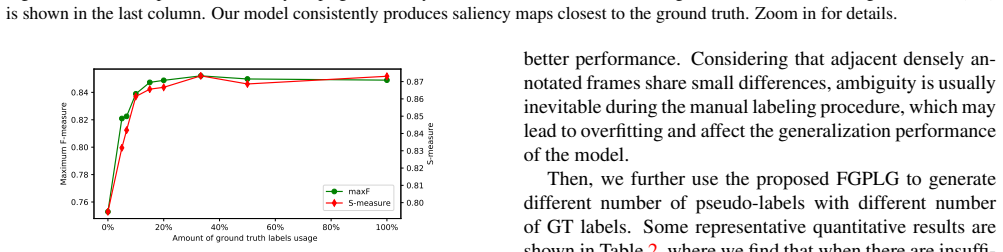
- Dense annotation can be counterproductive: the paper attributes the gain partly to avoiding label ambiguity in densely labeled frames, where adjacent annotations disagree.
- The same semi-supervised detector, without any fine-tuning, outperforms six unsupervised video object segmentation methods on DAVIS and FBMS.
- The pipeline stays practical: training takes about 10 hours on a single GPU and inference runs at roughly 27 fps.
Reading between the lines
- A direct stress test the authors do not report: evaluate pseudo-label accuracy against true labels on frames with occlusions, fast motion, or camera cuts; if the detector still improves when pseudo-labels are demonstrably wrong there, the gain may come from regularization rather than label fidelity.
- The same flow-warp-and-refine recipe could in principle cut annotation cost for other dense video prediction tasks, such as video instance segmentation or depth estimation, whenever the target signal is smooth enough along optical flow.
- An adaptive keyframe selection strategy—choosing where to put the 20% annotations rather than fixed-interval sampling—would likely push the method further; the paper itself names this as future work.
- Because the detector is trained on pseudo-labels that smooth over small interframe differences, it may inherit a bias toward temporally stable but slightly under-segmented boundaries; measuring boundary precision on fast-moving objects would reveal this cost.
Signed reviews
Editorial analysis
A structured set of objections, weighed in public.
Referee Report
Summary. This paper addresses semi-supervised video salient object detection. The authors propose the RCRNet architecture (a ResNet-50-based spatial feature extractor with an ASPP module and a pixel-wise classifier built from three refinement blocks with residual skip connections), extend it with a non-locally enhanced recurrent (NER) module (two non-local blocks around a bidirectional ConvGRU stack) for spatiotemporal modeling, and introduce a flow-guided pseudo-label generation (FGPLG) method: given an unlabeled target frame between two sparsely labeled frames, FGPLG warps adjacent ground-truth masks along FlowNet 2.0 optical flow to the target and feeds the target RGB frame, both warped masks, and both flow magnitudes (seven input channels) to a second RCRNet, whose output serves as the pseudo-label. The final RCRNet+NER is trained jointly on 20% of the video ground-truth masks plus 20% pseudo-labels and is evaluated on VOS, DAVIS, and FBMS against 16 methods with four metrics; the paper claims it outperforms all fully supervised baselines on all three benchmarks and also reports competitive unsupervised video object segmentation results on DAVIS and FBMS.
Significance. The contribution is potentially significant: if the headline claims survive controlled comparison, the paper would show that flow-guided label propagation plus learned refinement can replace roughly 80% of dense video annotations at state-of-the-art accuracy, and the FGPLG design (warped GT plus flow magnitude as auxiliary input channels to a refinement network) is a sensible idea with clean ablations. The empirical effort is substantial: comparisons against 16 methods on three benchmarks with maxF, S-measure, weighted F-measure, and MAE, plus ablations of every NER submodule (Table 3) and every FGPLG input channel (Table 4). The ablations are internally consistent and support the effectiveness of both proposed modules, and the observation that pseudo-labels help at matched ground-truth budgets (Table 2: 1/5 vs 0/5 at 20% GT; 6/20 and 7/20 vs 0/20 at 5% GT) is a genuine and interesting finding. The main weaknesses are that the headline attribution of the gains to semi-supervision is not architecture-controlled on DAVIS and FBMS, and the headline configuration is selected on the VOS test set; both are fixable with additional experiments.
major comments (4)
- [Sec. 4.3; Tables 1 and 2] The headline claim that the 20%-label model 'greatly outperforms all the state-of-the-art fully supervised methods' is not architecture-controlled. On VOS, the same RCRNet+NER trained with 100% GT (Table 2, column '0/1') already reaches maxF 0.849, compared with 0.861 for the '1/5' semi-supervised setting; the model's large margin over PDB (0.741) is therefore mostly attributable to the RCRNet+NER architecture and its fully supervised image-saliency pretraining, not to label efficiency. For DAVIS and FBMS, no same-architecture 100%-GT baseline is reported, so the claim in Section 4.3 that the semi-supervised model outperforms the best fully supervised method does not establish that semi-supervision rather than the architecture is responsible. Please report, for all three benchmarks, the same RCRNet+NER trained on the same combined training set with (a) 100% GT, (b) 20% GT and no pseudo-labels ('0/5'), and (c) 20% GT plus 20% pseudo-labels ('1/5'); these three numbers would directly quantify the contribution of pseudo-labels and of the reduced label budget.
- [Sec. 4.4; Table 2 and supplemental Table 2] The configuration used for the external comparisons, one GT plus one pseudo-label every five frames, is selected after a sweep of 24 (m, l) configurations, all evaluated on the VOS test set, and the best result (maxF 0.861) is adopted as the headline. Because the reported advantage of the pseudo-label setting over full supervision is small on VOS (0.012 maxF and 0.001 S-measure over column '0/1'), test-set-based selection could materially inflate the headline comparison. The authors should either select the m/l setting on a held-out validation split or report how the DAVIS and FBMS results vary across the top few configurations, and should discuss the sensitivity of the claimed 20%-label advantage to this choice.
- [Sec. 4.2; Abstract and Sec. 1 contribution list] The 'approximately 20% ground truth labels' claim refers only to the video segmentation masks used in the final training stage. The spatial feature extractor of RCRNet is first pretrained on the fully annotated image saliency datasets MSRA-B and HKU-IS, and this pretrained model seeds both FGPLG and RCRNet+NER, so the total pixel-level supervision used by the pipeline is well above 20% of a full annotation budget. The claim should be explicitly scoped to video labels, the annotation budget of the image pretraining stage should be stated, and ideally an ablation should bound the contribution of that pretraining (for example, by training the '1/5' model without the image-saliency pretraining). Without this, the phrase 'using only approximately 20% ground truth labels for training' is misleading about the total supervision consumed.
- [Sec. 3.3, Eq. (4); Sec. 4.2] No direct evaluation of pseudo-label quality is provided. The FGPLG output PG_k is asserted to be a 'reasonable and precise' label and Section 3.3 claims the generator can produce 'pseudo-labels of very high quality,' but the manuscript does not measure the agreement between FGPLG outputs and held-out annotated keyframes, nor does it analyze failure modes such as occlusions, fast motion, or objects entering and leaving the scene. The indirect evidence in Table 4 (pseudo-labels raise maxF from 0.821 to 0.847 at 5% GT) supports the mechanism, but a direct quality measure (for example, maxF or IoU of generated pseudo-labels versus withheld GT keyframes as a function of the interval l) would make the load-bearing premise transparent and would indicate how label error propagates into the final model.
minor comments (6)
- [Sec. 4.1] The text says 'We evaluate our trained RFCN+NER on the test sets'; the network is named RCRNet+NER everywhere else, so this appears to be a typo.
- [Tables 1 and 2] The VOS maxF for the '1/5' setting is 0.861 in Table 2 but 0.856 for 'Ours' in Table 1; the likely explanation is that Table 2 uses VOS-only training while the final model uses the combined VOS+DAVIS+FBMS training set, but this is never stated. Please state explicitly which training set each table uses so readers can reconcile the numbers.
- [Fig. 5 caption] The caption says '15 saliency detection methods' while 16 baseline methods plus 'Ours' appear in the legend; additionally the DAVIS panel legend contains an unexplained 'OSP' entry.
- [Sec. 4.4] Please clarify the sampling semantics of 'one GT every five frames': does the interval apply to every fifth annotated keyframe or every fifth video frame, and how is the sampling applied inside the combined training set? This matters because VOS keyframes are themselves sparse (7,650 annotated frames among 116,103).
- [Sec. 3.3 and Fig. 4] Please specify whether the 'another RCRNet' used inside FGPLG shares weights with the RCRNet used in RCRNet+NER, and describe the triple sampling and the loss used to fine-tune FGPLG on the sparse annotations.
- [Sec. 4.3] The reported relative improvements (15.52%, 1.18%, and 4.62% maxF) are computed against different best baselines per dataset (PDB on VOS and FBMS, PiCA on DAVIS); please state this explicitly or also report absolute deltas against a single best video-based method.
Circularity Check
No circularity; the pseudo-label training loop is empirical and evaluated on external benchmarks.
full rationale
The paper's central claim is that a video saliency detector trained on roughly 20% ground truth plus flow-guided pseudo-labels outperforms fully supervised methods. This is an empirical claim tested on the public VOS, DAVIS, and FBMS test sets, not a quantity that is defined by the model or fitted to the test metric. The pseudo-label generator (Eq. 4) is a separate RCRNet that consumes warped ground truth and optical flow magnitudes; the final RCRNet+NER is trained on those pseudo-labels plus real labels, and its outputs are evaluated against held-out ground truth. The key comparison on VOS in Table 2 includes a same-architecture full-supervision row (0/1, maxF 0.849) versus the semi-supervised 1/5 row (maxF 0.861), so the headline gain on that benchmark is not an artifact of architecture. Table 4 also ablates training with and without generated pseudo-labels, showing that they contribute. Self-citations to the authors' prior FGRN and weakly supervised saliency work are used as related work or architectural motivation, not as an unchallenged premise that forces the reported results. The absence of same-architecture 100% GT baselines on DAVIS and FBMS is a legitimate experimental-control concern, but it is a correctness/fairness issue, not circularity. No equation reduces the predicted saliency maps to the training pseudo-labels by construction, and no fitted parameter is renamed as a prediction. Therefore no circular step is present.
Assumptions & free parameters
free parameters (3)
- GT label interval l for pseudo-label training =
5 frames (20% GT)
- Number of pseudo-labels per interval m =
1 per 5 frames (20% pseudo-labels)
- Video clip length T for RCRNet+NER training =
4 frames
assumptions (3)
- domain assumption Adjacent video frames are similar enough at typical sampling rates (e.g., 24 fps) that labels can be propagated between sparsely annotated frames.
- domain assumption FlowNet 2.0 optical flow is accurate enough to warp ground-truth masks between frames separated by several frames.
- domain assumption Pseudo-labels generated by a network trained on the same sparse annotations are reliable training targets for the final video saliency model.
Cite this review
Pith. "Pith review of Semi-Supervised Video Salient Object Detection Using Pseudo-Labels." pith.science (2026). https://pith.science/paper/5P4I5RER
@misc{pith2026190804051,
  author       = {Pith},
  title        = {Pith review of: Semi-Supervised Video Salient Object Detection Using Pseudo-Labels},
  year         = {2026},
  howpublished = {\url{https://pith.science/paper/5P4I5RER}},
  note         = {Machine review of arXiv:1908.04051}
}
read the original abstract
Deep learning-based video salient object detection has recently achieved great success with its performance significantly outperforming any other unsupervised methods. However, existing data-driven approaches heavily rely on a large quantity of pixel-wise annotated video frames to deliver such promising results. In this paper, we address the semi-supervised video salient object detection task using pseudo-labels. Specifically, we present an effective video saliency detector that consists of a spatial refinement network and a spatiotemporal module. Based on the same refinement network and motion information in terms of optical flow, we further propose a novel method for generating pixel-level pseudo-labels from sparsely annotated frames. By utilizing the generated pseudo-labels together with a part of manual annotations, our video saliency detector learns spatial and temporal cues for both contrast inference and coherence enhancement, thus producing accurate saliency maps. Experimental results demonstrate that our proposed semi-supervised method even greatly outperforms all the state-of-the-art fully supervised methods across three public benchmarks of VOS, DAVIS, and FBMS.
Figures


Figures from the paper (4 more)

Reference graph
Works this paper leans on
-
[1]
Object segmentation by long term analysis of point trajectories
Thomas Brox and Jitendra Malik. Object segmentation by long term analysis of point trajectories. In Proceedings of European Conference on Computer Vision , pages 282–295,
-
[2]
Deeply supervised salient object detection with short connections
Qibin Hou, Ming-Ming Cheng, Xiaowei Hu, Ali Borji, Zhuowen Tu, and Philip HS Torr. Deeply supervised salient object detection with short connections. In Proceedings of IEEE Conference on Computer Vision and Pattern Recogni- tion, pages 3203–3212, 2017. 1, 2
work page 2017
-
[3]
Saliency detection via absorbing markov chain
Bowen Jiang, Lihe Zhang, Huchuan Lu, Chuan Yang, and Ming-Hsuan Yang. Saliency detection via absorbing markov chain. In Proceedings of the IEEE International Conference on Computer Vision, pages 1665–1672, 2013. 1, 2
work page 2013
-
[4]
Instance- level salient object segmentation
Guanbin Li, Yuan Xie, Liang Lin, and Yizhou Yu. Instance- level salient object segmentation. In Proceedings of IEEE Conference on Computer Vision and Pattern Recognition , pages 2386–2395, 2017. 1, 2 VOS [7] DA VIS [12] FBMS [1]Methods Pub. Fmaxβ ↑ S ↑ Fwβ ↑ MAE↓ Fmaxβ ↑ S ↑ Fwβ ↑ MAE↓ Fmaxβ ↑ S ↑ Fwβ ↑ MAE↓ MC [3] CVPR’13 0.558 0.612 0.306 0.199 0.488 0....
work page 2017
-
[5]
Flow guided recurrent neural encoder for video salient object detection
Guanbin Li, Yuan Xie, Tianhao Wei, Keze Wang, and Liang Lin. Flow guided recurrent neural encoder for video salient object detection. In Proceedings of IEEE Conference on Computer Vision and Pattern Recognition , pages 3243– 3252, 2018. 1, 2
work page 2018
-
[6]
Deep contrast learning for salient object detection
Guanbin Li and Yizhou Yu. Deep contrast learning for salient object detection. In Proceedings of IEEE Conference on Computer Vision and Pattern Recognition , pages 478–487,
-
[7]
Jia Li, Changqun Xia, and Xiaowu Chen. A benchmark dataset and saliency-guided stacked autoencoders for video- based salient object detection. IEEE Transactions on Image Processing, 27(1):349–364, 2018. 1, 2
work page 2018
-
[8]
Dhsnet: Deep hierarchical saliency network for salient object detection
Nian Liu and Junwei Han. Dhsnet: Deep hierarchical saliency network for salient object detection. In Proceed- ings of IEEE Conference on Computer Vision and Pattern Recognition, pages 678–686, 2016. 1, 2
work page 2016
Show all 20 references
-
[9]
Picanet: Learning pixel-wise contextual attention for saliency detec- tion
Nian Liu, Junwei Han, and Ming-Hsuan Yang. Picanet: Learning pixel-wise contextual attention for saliency detec- tion. In Proceedings of IEEE Conference on Computer Vi- sion and Pattern Recognition , pages 3089–3098, 2018. 1, 2
2018
-
[10]
How to evaluate foreground maps? In Proceedings of IEEE Con- ference on Computer Vision and Pattern Recognition , pages 248–255, 2014
Ran Margolin, Lihi Zelnik-Manor, and Ayellet Tal. How to evaluate foreground maps? In Proceedings of IEEE Con- ference on Computer Vision and Pattern Recognition , pages 248–255, 2014. 1
2014
-
[11]
Saliency filters: Contrast based filtering for salient region detection
Federico Perazzi, Philipp Kr ¨ahenb¨uhl, Yael Pritch, and Alexander Hornung. Saliency filters: Contrast based filtering for salient region detection. In Proceedings of IEEE Con- ference on Computer Vision and Pattern Recognition , pages 733–740, 2012. 1
2012
-
[12]
A benchmark dataset and evaluation methodology for video object segmentation
Federico Perazzi, Jordi Pont-Tuset, Brian McWilliams, Luc Van Gool, Markus Gross, and Alexander Sorkine-Hornung. A benchmark dataset and evaluation methodology for video object segmentation. In Proceedings of IEEE Conference on Computer Vision and Pattern Recognition , pages 724–732,
-
[13]
Pyramid dilated deeper convlstm for video salient object detection
Hongmei Song, Wenguan Wang, Sanyuan Zhao, Jianbing Shen, and Kin-Man Lam. Pyramid dilated deeper convlstm for video salient object detection. In Proceedings of Euro- pean Conference on Computer Vision, pages 715–731, 2018. 1, 2
2018
-
[14]
Saliency detection with recurrent fully con- volutional networks
Linzhao Wang, Lijun Wang, Huchuan Lu, Pingping Zhang, and Xiang Ruan. Saliency detection with recurrent fully con- volutional networks. In Proceedings of European Confer- ence on Computer Vision, pages 825–841, 2016. 1, 2
2016
-
[15]
Detect globally, refine locally: A novel approach to saliency detection
Tiantian Wang, Lihe Zhang, Shuo Wang, Huchuan Lu, Gang Yang, Xiang Ruan, and Ali Borji. Detect globally, refine locally: A novel approach to saliency detection. In Proceed- ings of IEEE Conference on Computer Vision and Pattern Recognition, pages 3127–3135, 2018. 1, 2
2018
-
[16]
Saliency- aware geodesic video object segmentation
Wenguan Wang, Jianbing Shen, and Fatih Porikli. Saliency- aware geodesic video object segmentation. In Proceedings of IEEE Conference on Computer Vision and Pattern Recog- nition, pages 3395–3402, 2015. 1, 2
2015
-
[17]
Consistent video saliency using local gradient flow optimization and global refinement
Wenguan Wang, Jianbing Shen, and Ling Shao. Consistent video saliency using local gradient flow optimization and global refinement. IEEE Transactions on Image Processing, 24(11):4185–4196, 2015. 1, 2
2015
-
[18]
Video salient object detection via fully convolutional networks
Wenguan Wang, Jianbing Shen, and Ling Shao. Video salient object detection via fully convolutional networks. IEEE Transactions on Image Processing , 27(1):38–49, 2018. 1, 2
2018
-
[19]
Minimum barrier salient object detection at 80 fps
Jianming Zhang, Stan Sclaroff, Zhe Lin, Xiaohui Shen, Brian Price, and Radomir Mech. Minimum barrier salient object detection at 80 fps. In Proceedings of the IEEE Inter- national Conference on Computer Vision, pages 1404–1412,
-
[20]
Saliency optimization from robust background detection
Wangjiang Zhu, Shuang Liang, Yichen Wei, and Jian Sun. Saliency optimization from robust background detection. In Proceedings of IEEE Conference on Computer Vision and Pattern Recognition, pages 2814–2821, 2014. 1, 2
2014
Reviewed August 14, 2026 · model on record in the stance chip above.
Discussion (0). Continue with ORCID to comment.