REVIEW 4 major objections 5 minor 58 references
Ambient humidity and internal droplet circulation, not just the vapour film, control Leidenfrost droplet shape and evaporation; large droplets need 3D simulations.
Reviewed by Pith at T0; open to challenge. T0 means a machine referee read the full paper against a public rubric. the ladder, T0–T4 →
A unified simulation of Leidenfrost water droplets reveals that ambient humidity and internal circulation control evaporation, and that axisymmetry is invalid for large droplets.
T0 review reviewed 2026-08-04 challenge →
load-bearing objection Strong computational paper with a real humidity/circulation result; the bolder axisymmetry claim is suggestive but not yet proven. the 4 major comments →
Leidenfrost droplets: The roles of ambient humidity and internal droplet circulation
The pith
A machine-rendered reading of the paper's core claim, the machinery that carries it, and where it could break.
The reading
Core claim
Within one quasi-stationary model, increasing the realism from pure vapour to a mixed gas-vapour phase and allowing internal circulation changes the evaporation mechanism: strong internal flow creates thin thermal boundary layers, cooling the top of the droplet by about 10 K, reducing evaporation at the base, and increasing the contribution from the outer surface, so that the film no longer dominates evaporation. This raises the global evaporation rate and lowers the droplet toward the plate, matching observed lifetimes better. The same model, when constrained to axisymmetry, produces prolate shapes for large droplets; linear stability analysis shows the axisymmetric base state is unstable t
What carries the argument
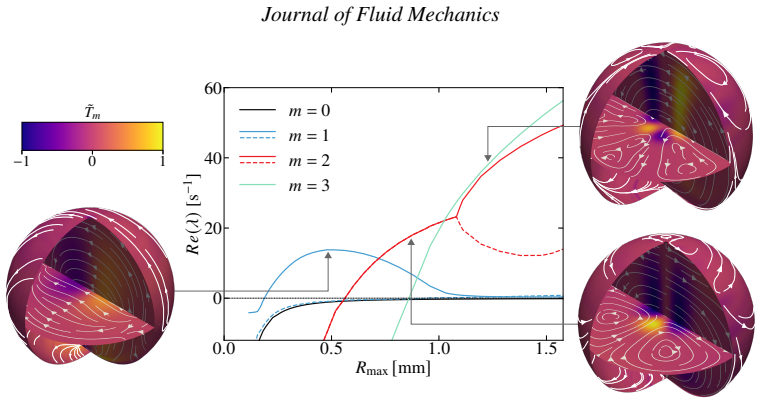
The central object is a finite-element direct numerical simulation of an axisymmetric Leidenfrost droplet with full Navier-Stokes flow in liquid and gas, species transport of vapour in a mixed gas-vapour phase, a saturation condition at the interface, and evaporative cooling, run quasi-stationarily over droplet radii from roughly 0.05 mm to 5 mm. Circulation is controlled by artificially raising liquid viscosity to isolate its effect. To test whether the prolate shapes are an artefact of geometry, the authors perform azimuthal eigenmode stability analysis, perturbing the axisymmetric base state with wavenumber m, and then a simplified 3D coupled Navier-Stokes/lubrication model with a plane o
Load-bearing premise
The conclusion that axisymmetry, rather than missing physics, causes the prolate shapes rests on the simplified 3D coupled Navier-Stokes/lubrication model being a faithful representation of the full system, including its patched shear coupling and neglect of humidity in the film.
What would settle it
Run a full 3D DNS of a roughly 1.6 mm radius Leidenfrost water droplet with mixed gas-vapour phase, internal circulation, and no axisymmetry constraint: if it still yields prolate shapes, the axisymmetry attribution is wrong; if it yields puddle shapes with an azimuthal mode cascade comparable to PIV experiments, the claim is supported. A simpler check is to measure the onset of azimuthal perturbations near R≈0.2 mm and compare the critical radius to the predicted bound.
If this is right
- Pure-vapour and isothermal-droplet assumptions under-predict evaporation rates and over-predict lifetimes; both humidity and circulation must be included.
- In large droplets, evaporation is not dominated by the thin vapour film; the outer surface contributes substantially when circulation is present.
- Axisymmetric models with internal circulation are unreliable for droplets larger than roughly 0.2 mm in radius, because azimuthal symmetry breaking removes the prolate shapes.
- The single model stitches together the puddle regime and the take-off regime, recovering known scalings J~R^{9/5}, J~R, and h~R^{-1/2}.
Where Pith is reading between the lines
- This suggests a practical rule of thumb: below roughly 0.2 mm radius, axisymmetric simulations of small and take-off Leidenfrost droplets remain trustworthy; above it, quantitative comparison to experiment needs 3D dynamics.
- If the simplified 3D model's conclusion holds, the remaining lifetime gap for large droplets may be closed by full 3D simulations that also resolve humidity inside the gas film, rather than by adding only Marangoni effects.
- A testable extension: droplets whose azimuthal instability is suppressed—for example by contamination or confinement—should show prolate shapes closer to the axisymmetric prediction.
Editorial analysis
A structured set of objections, weighed in public.
Referee Report
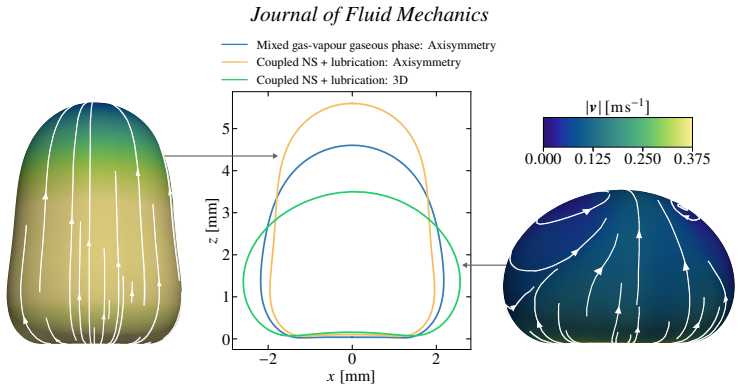
Summary. The paper develops an axisymmetric finite-element model of Leidenfrost water droplets in a mixed gas-vapour environment, with internal droplet flow, evaporation, and a non-isothermal droplet. Simulations are run from droplet radii of about 0.05 mm to several millimetres, spanning the puddle, spherical, and take-off regimes. The authors compare four models: mixed gas-vapour with and without internal circulation, and pure vapour with and without circulation. They report that ambient humidity and internal circulation together change the evaporation flux distribution and droplet height, increase the global evaporation rate, and improve agreement with measured droplet lifetimes. For large droplets, the axisymmetric model with circulation produces prolate, 'wimple'-shaped droplets that disagree with experiments; an azimuthal linear stability analysis shows instability for R ≳ 0.2 mm, and 3D simulations of a simplified coupled Navier-Stokes/lubrication model yield puddle-like shapes. The abstract concludes that the axisymmetric constraint is the cause of the discrepancy.
Significance. If the conclusions hold, the paper makes a useful contribution by coupling ambient humidity, internal circulation, and evaporation in one model and by providing a quantitative bridge between the lubrication-theory regime (Sobac et al. 2014) and the small-droplet take-off regime (Sobac et al. 2025). The paper is not curve-fitted to the target experiments: thermophysical properties are taken from prior literature, and the model recovers the known scalings h~R^{-1/2} and J~R^{9/5}. The azimuthal stability analysis (Section 5) and the systematic viscosity- and humidity-sweep methodology (Table 1) are valuable even if the final attribution to axisymmetry is not yet fully proven. The comparison with experimental evaporation times (Fig. 12d) is a concrete falsifiable prediction. However, the paper's strongest advertised claim, namely that the large-droplet shape discrepancy is due to the axisymmetry constraint, is supported only by a reduced 3D model that omits the very humidity effects that Sections 6-7 show to be important.
major comments (4)
- [§8.2, Eqs. (8.2)-(8.3), Fig. 14] The central claim in the abstract, that the large-droplet discrepancy 'is due to the unrealistic constraint of axisymmetry', is not yet supported quantitatively. The only 3D evidence comes from the reduced coupled NS-lubrication model, which (i) uses a patching angle of π/4 and surface-tangent gradients, (ii) omits the mixed gas-vapour phase and ambient humidity, and (iii) in axisymmetric form gives shapes that are even more prolate than the full MGV model (Fig. 14). The 3D result is suggestive, but the axisymmetric reduced model does not reproduce the full model, so the change to puddle-like shapes could be affected by the omitted physics or by the patching approximation rather than solely by relaxing axisymmetry. I recommend either a full 3D MGV simulation at least at one representative large-droplet condition, or an explicit validation of the reduced model against the full MGV axisymm
- [§5, Appendix A.1] The azimuthal stability analysis establishes linear instability of the axisymmetric base state, but not that the nonlinear saturated state is the puddle-like shape seen in the reduced 3D model. The growth-rate calculation also uses material properties evaluated at the film temperature and a fourth-order Taylor expansion of the saturation pressure (Appendix A.1), so the reported critical radius of about 0.2 mm is an approximation. The paper should state explicitly that the linear analysis gives only the onset, not the post-critical shape, and should quantify the sensitivity of the critical radius to the film-temperature and Taylor-expansion choices. This is not a fatal flaw, but it is load-bearing for the abstract's attribution claim.
- [§5, Fig. 7; §7, Fig. 12(d)] The model overpredicts internal droplet velocities by about an order of magnitude relative to the PIV measurements of Bouillant et al. (2018). The paper acknowledges this, but the overprediction is nevertheless used to explain the prolate shapes and to argue that internal circulation is necessary for accurate drying kinetics. Since the magnitude of the internal circulation is a key ingredient in the proposed mechanism, the conclusions would be more robust if the authors showed that the main results are preserved when the circulation is artificially limited to velocities consistent with experiments (e.g., by a modest viscosity increase or by including surfactant-induced Marangoni stresses). Without such a sensitivity test, the quantitative claim that the MGV-with-circulation model 'best aligns' with experimental lifetimes may be partly fortuitous.
- [§6, Fig. 10] The statement that ambient humidity has a 'significant impact' on geometry and drying kinetics is clearly demonstrated in the stable small-to-moderate regime (Fig. 10 and Fig. 6), but for the largest droplets the axisymmetric MGV model becomes unphysical (prolate) and the instability argument takes over. The paper should be careful to distinguish where the humidity effect is a robust model prediction and where it is intertwined with the unresolved axisymmetry issue. This is partly a presentation point, but it affects the interpretation of the abstract's first claim.
minor comments (5)
- [Appendix A.2, Table 2 and Eqs. (A1)-(A5)] Units for viscosity are written as 'Pa s−1' in Eqs. (A1) and (A2) and 'mPa s−1' in Table 2; these should be 'Pa s' and 'mPa s', respectively.
- [Fig. 9 caption] The caption says 'where 0 is at the drop of the bottom'; this should be 'at the bottom of the drop'.
- [§2.1, Eqs. (2.10)-(2.11)] The mixing rules are said to follow Poling et al. (2000), while the data source in Fig. 15 is given as Poling et al. (2008). Both references are listed, but the text should clarify which edition is used for the mixing rules and which for the pure-species data.
- [§3.1, Eq. (3.1)] The hydrostatic boundary condition is defined by an integral with a minus sign. If p_hydro(z) is intended to be the local hydrostatic pressure, the sign convention should be stated more explicitly, since it is easy to misread.
- [§7, Eq. (7.10)] The evaporation time is obtained by integrating the quasi-stationary evaporation rate. This is valid only if the quasi-stationary assumption holds over the entire integration range; the paper notes this for take-off, but it would be helpful to state it directly at Eq. (7.10) as well.
Circularity Check
No significant circularity; the derivation is self-contained, with all qualitative conclusions supported by independent numerical output and external literature rather than by construction.
full rationale
The central claims are not circular by the paper's own equations. The model solves a well-posed set of conservation equations (Section 2.1) with material properties taken from external sources (Poling et al. 2000/2008; Marrero & Mason 1972), and no parameter is fitted to the target Leidenfrost data. The four models (MGV, PV, MGV-NC, PV-NC) are generated by varying ambient vapour mass fraction and liquid viscosity; the viscosity multiplier of 10^4 is explicitly a numerical decoupling device, not a fitted parameter. The recovered scaling laws h ~ R^{-1/2} and J ~ R^{9/5} are presented as independent validations against Pomeau et al. (2012), Celestini et al. (2012), and Sobac et al. (2014, 2025); they are not used as inputs to the simulation. The azimuthal stability analysis uses the authors' own pyoomph/Diddens & Rocha (2024) numerical method, but this is an open-source computational tool, and the stability eigenvalues, critical radius, and mode cascade are new outputs rather than assumed outcomes. The axisymmetry-attribution claim rests on the stability analysis plus the simplified coupled Navier-Stokes/lubrication 3D model in Section 8.2. That model involves acknowledged approximations (patching angle pi/4, surface-tangent gradients, omission of the mixed gas-vapour phase), and the paper explicitly states that full 3D DNS is presently too expensive. This is a legitimate robustness/correctness limitation, not a circular reduction: the simplified 3D simulation is not equivalent by construction to the prolate-shape result it is used to explain, and it does not reproduce the axisymmetric full-model shape exactly (indeed it is even more prolate). The paper also openly discusses remaining discrepancies and missing physics such as Marangoni effects and surfactants, which is inconsistent with a derivation that merely renames its inputs. The only self-citation of note is the numerical-method citation (Diddens & Rocha 2024), which is not load-bearing in a circular sense: the method does not encode the conclusion that axisymmetry is the cause of prolate shapes. Therefore no circular step can be identified, and the appropriate score is 0.
Axiom & Free-Parameter Ledger
free parameters (3)
- patching angle =
π/4
- film temperature for stability analysis =
(T_w + T_sat)/2
- viscosity multiplier for NC models =
10^4
axioms (5)
- domain assumption Local thermodynamic equilibrium at the interface (Eq. 2.20): the vapour pressure at the interface is at saturation.
- domain assumption Quasi-stationary approximation: all time derivatives are zero and the droplet volume is constant (Section 2.3).
- domain assumption Axisymmetric base state for the full DNS models.
- domain assumption Far-field hydrostatic pressure boundary conditions (Eq. 3.1) instead of no-penetration.
- domain assumption Ideal gas mixture with Fick's law and mixing rules for transport properties (Section 2.1).
Cite this review
Pith. "Pith review of Leidenfrost droplets: The roles of ambient humidity and internal droplet circulation." pith.science (2026). https://pith.science/paper/5PBBM57G
@misc{pith2026260801828,
  author       = {Pith},
  title        = {Pith review of: Leidenfrost droplets: The roles of ambient humidity and internal droplet circulation},
  year         = {2026},
  howpublished = {\url{https://pith.science/paper/5PBBM57G}},
  note         = {Machine review of arXiv:2608.01828}
}
read the original abstract
A volatile droplet gently deposited on a superheated substrate can sit on a thin film of its own vapour, which prevents contact between the drop and surface. This phenomenon is called the Leidenfrost effect. In this paper, through direct numerical simulations, we analyse characteristics of Leidenfrost water droplets with a single computational model over four decades of droplet radius, stitching together previous works in the limit of large and small droplets. Using the model, we show that the ambient humidity, an underappreciated factor in the Leidenfrost system, in combination with the flow in the drop has a significant impact on the geometry and drying kinetics. Our results imply the inadequacies of commonly made assumptions of a pure vapour phase and an isothermal droplet. When modelling large Leidenfrost droplets with an axisymmetric model, large discrepancies between experiments and the computational results occur. Through azimuthal stability analysis, we show that this is due to the unrealistic constraint of axisymmetry. This finding is supported by 3D simulations of a simplified model. Finally, some hypotheses are explored to account for the remaining discrepancies with experimental data.
Figures





Reference graph
Works this paper leans on
-
[1]
1756 , publisher=
De aquae communis nonnullis qualitatibus tractatus , author=. 1756 , publisher=
-
[2]
Droplet evaporation:. Int. J. Heat Mass Transf. , volume =. 1975 , issn =. doi:https://doi.org/10.1016/0017-9310(75)90217-3 , url =
-
[3]
1732 , author =
Elementa chemiae , keywords =. 1732 , author =
-
[4]
W. Sutherland , title =. Lond. Edinb. Dublin Philos. Mag. J. Sci. , volume =. 1893 , publisher =. doi:10.1080/14786449308620508 , URL =
-
[5]
A. J. Appl. Meteorol. Climatol. , author =. 2018 , pages =. doi:10.1175/JAMC-D-17-0334.1 , language =
-
[6]
Competition between thermal and surfactant-induced. J. Colloid Interface Sci. , author =. 2022 , pages =. doi:10.1016/j.jcis.2022.04.146 , language =
-
[7]
Evaporating sessile droplets: solutal. J. Fluid Mech. , author =. 2025 , pages =. doi:10.1017/jfm.2025.10208 , language =
arXiv 2025
-
[8]
Gauthier, A. and Diddens, C. and Proville, R. and Lohse, D. and Van Der Meer, D. , month = jan, year =. Self-propulsion of inverse. Proc. Natl. Acad. Sci. , publisher =. doi:10.1073/pnas.1812288116 , language =
-
[9]
Thermocapillary instability as a mechanism for film boiling collapse , volume =. J. Fluid Mech. , author =. 2018 , pages =. doi:10.1017/jfm.2018.545 , language =
-
[10]
Spontaneous dynamics of two-dimensional. Phys. Rev. Fluids , author =. 2020 , pages =. doi:10.1103/PhysRevFluids.5.091601 , language =
-
[11]
Leidenfrost flows: instabilities and symmetry breakings , volume =. Flow , author =. 2022 , pages =. doi:10.1017/flo.2022.5 , language =
-
[12]
Bifurcation tracking on moving meshes and with consideration of azimuthal symmetry breaking instabilities , volume =. J. Comput. Phys. , author =. 2024 , pages =. doi:10.1016/j.jcp.2024.113306 , language =
arXiv 2024
-
[13]
oomph-lib – An Object-Oriented Multi-Physics Finite-Element Library , author = "M. Heil and A. Hazel", year = "2006", doi = "10.1007/3-540-34596-5\_2", language = "English", isbn = "9783540345954", volume = "53", series = "Lect. Notes Comput. Sci. Eng.", publisher = "Springer Nature", pages = "19--49", editor = "Bungartz, \ Hans-Joachim \ and Sch. Fluid-S...
-
[14]
Introduction to the. J. Symb. Comput. , author =. 2002 , pages =. doi:10.1006/jsco.2001.0494 , language =
arXiv 2002
-
[15]
Direct numerical simulations of. J. Fluid Mech. , author =. 2025 , pages =. doi:10.1017/jfm.2025.19 , language =
-
[16]
Leidenfrost droplet trampolining , volume =. Nat. Commun. , author =. 2021 , pages =. doi:10.1038/s41467-021-21981-z , language =
-
[17]
Direct numerical simulation of the impact of a droplet onto a hot surface above the. Int. J. Heat Mass Transf. , author =. 2017 , pages =. doi:10.1016/j.ijheatmasstransfer.2016.08.105 , language =
-
[18]
State of. Int. Commun. Heat Mass Transf. , author =. 2024 , pages =. doi:10.1016/j.icheatmasstransfer.2024.107299 , language =
arXiv 2024
-
[19]
Interface oscillation of droplets upon impact on a heated surface in the. Int. J. Heat Mass Transf. , author =. 2020 , pages =. doi:10.1016/j.ijheatmasstransfer.2019.119116 , language =
arXiv 2020
-
[20]
Dynamical vapour pocket of an impacting. Int. J. Heat Fluid Flow , author =. 2022 , pages =. doi:10.1016/j.ijheatfluidflow.2022.108965 , language =
arXiv 2022
-
[21]
Final fate of a. Sci. Adv. , author =. 2019 , pages =. doi:10.1126/sciadv.aav8081 , language =
-
[22]
A numerical method for the simulation of low Mach number liquid–gas flows , author =. J.Comput. Phys. , volume =. 2010 , issn =. doi:https://doi.org/10.1016/j.jcp.2010.08.013 , url =
-
[23]
Detailed finite element method modeling of evaporating multi-component droplets , volume =. J. Comput. Phys. , author =. 2017 , pages =. doi:10.1016/j.jcp.2017.03.049 , language =
-
[24]
Explosive. Phys. Rev. Fluids , author =. 2019 , pages =. doi:10.1103/PhysRevFluids.4.013602 , language =
-
[25]
Leidenfrost wheels , volume =. Nat. Phys. , author =. 2018 , pages =. doi:10.1038/s41567-018-0275-9 , language =
-
[26]
B. Sobac and P. Talbot and B. Haut and A. Rednikov and P. Colinet , keywords =. A comprehensive analysis of the evaporation of a liquid spherical drop , journal =. 2015 , issn =. doi:https://doi.org/10.1016/j.jcis.2014.09.036 , url =
-
[27]
2006 , publisher=
Transport Phenomena, revised 2nd edition , author=. 2006 , publisher=
2006
-
[28]
2000 , publisher=
The Properties of Gases and Liquids 5E , author=. 2000 , publisher=
2000
-
[29]
N. Karwa and P. Stephan , keywords =. Experimental investigation of free-surface jet impingement quenching process , journal =. 2013 , issn =. doi:https://doi.org/10.1016/j.ijheatmasstransfer.2013.05.014 , url =
-
[30]
and Li, M
Gu, H. and Li, M. and Zhang, J. and Wang, Z. , year =. Recent advances in strategies for inhibiting. J. Therm. Sci. Technol. , doi =
-
[31]
Ajaev, V.S. and Kabov, O.A. Levitation and Self-Organization of Droplets. Annu. Rev. Fluid Mech. 2021. doi:https://doi.org/10.1146/annurev-fluid-030620-094158
-
[32]
Tan, C.L.C. and Sapiha, K. and Leong, Y.F.H. and Choi, S. and Anariba, F. and Thio, B.J.R. Lotus-like effect for metal filings recovery and particle removal on heated metal surfaces using Leidenfrost water droplets. Soft Matter. 2015. doi:10.1039/C5SM01078K
-
[33]
J. Kim , keywords =. Spray cooling heat transfer: The state of the art , journal =. 2007 , note =. doi:https://doi.org/10.1016/j.ijheatfluidflow.2006.09.003 , url =
-
[34]
Stewart, S.M. , title =. 2022 , month =. doi:10.1088/1361-6404/ac3fed , url =
-
[35]
Y. Pomeau and M. The. C. R. Méc. , volume =. 2012 , note =. doi:https://doi.org/10.1016/j.crme.2012.10.034 , url =
-
[36]
and Thomson, G.H
Poling, B.E. and Thomson, G.H. and Friend, D.G. and Rowley, R.L. and Wilding, W.V. , title =. Perry's Chemical Engineers' Handbook , editor =. 2008 , isbn =
2008
-
[37]
Marrero, T.R. and Mason, E.A. , title =. J. Phys. Chem. Ref. Data , volume =. 1972 , month =. doi:10.1063/1.3253094 , url =
-
[38]
G. Mialhe and S. Tanguy and L. Tranier and E.-R. Popescu and D. Legendre , keywords =. An extended model for the direct numerical simulation of droplet evaporation. Influence of the Marangoni convection on. J. Comput. Phys. , volume =. 2023 , issn =. doi:https://doi.org/10.1016/j.jcp.2023.112366 , url =
arXiv 2023
-
[39]
G. Bleiker and E. Specht , keywords =. Film evaporation of drops of different shape above a horizontal plate , journal =. 2007 , issn =. doi:https://doi.org/10.1016/j.ijthermalsci.2006.04.016 , url =
-
[40]
B. Sobac and A. Rednikov and S. Dorbolo and P. Colinet , keywords =. Chapter 7 -. Droplet Wetting and Evaporation , publisher =. 2015 , isbn =. doi:https://doi.org/10.1016/B978-0-12-800722-8.00007-2 , url =
-
[41]
Drop impact on superheated surfaces: from capillary dominance to nonlinear advection dominance , volume =. J. Fluid Mech. , author =. 2023 , pages =. doi:10.1017/jfm.2023.290 , language =
-
[42]
Dynamic. Phys. Rev. Lett. , author =. 2016 , note =. doi:10.1103/PhysRevLett.116.064501 , number =
-
[43]
Drop. Phys. Rev. Lett. , author =. 2012 , pages =. doi:10.1103/PhysRevLett.108.036101 , language =
-
[44]
Asymptotic theory for a. J. Fluid Mech. , author =. 2019 , pages =. doi:10.1017/jfm.2018.1025 , language =
arXiv 2019
-
[45]
Leidenfrost drops on a heated liquid pool , volume =. Phys. Rev. Fluids , author =. 2016 , pages =. doi:10.1103/PhysRevFluids.1.053902 , language =
-
[46]
Star-shaped oscillations of. Phys. Rev. Fluids , author =. 2017 , pages =. doi:10.1103/PhysRevFluids.2.031602 , language =
-
[47]
Star-drops formed by periodic excitation and on an air cushion –. Eur. Phys. J. Spec. Top. , author =. 2011 , pages =. doi:10.1140/epjst/e2011-01375-5 , language =
-
[48]
Celestini, F. and Frisch, T. and Pomeau, Y. , journal =. Take Off of Small. 2012 , month =. doi:10.1103/PhysRevLett.109.034501 , url =
-
[49]
Chakraborty, I. and Chubynsky, M.V. and Sprittles, J.E. , year=. Computational modelling of. doi:10.1017/jfm.2022.66 , journal=
-
[50]
Sobac, B. and Rednikov, A. and Colinet, P. , year=. Small. doi:10.1017/jfm.2025.208 , journal=
-
[51]
Maximum size of drops levitated by an air cushion , volume =. Phys. Rev. E , author =. 2009 , pages =. doi:10.1103/PhysRevE.79.036307 , language =
-
[52]
Leidenfrost drops , volume =. Phys. Fluids , author =. 2003 , pages =. doi:10.1063/1.1572161 , language =
-
[53]
Leidenfrost effect:. Phys. Rev. E , author =. 2014 , pages =. doi:10.1103/PhysRevE.90.053011 , language =
-
[54]
Erratum:. Phys. Rev. E , author =. 2021 , pages =. doi:10.1103/PhysRevE.103.039901 , language =
-
[55]
Leidenfrost. Annu. Rev. Fluid Mech. , author =. 2013 , pages =. doi:10.1146/annurev-fluid-011212-140709 , language =
-
[56]
Geometry of the vapor Layer Under a. Phys. Rev. Lett. , author =. 2012 , pages =. doi:10.1103/PhysRevLett.109.074301 , language =
-
[57]
, journal =
Arnoldi, W.E. , journal =. The principle of minimized iterations in the solution of the matrix eigenvalue problem , urldate =
-
[58]
, title =
Saad, Y. , title =. 2011 , doi =
2011
This paper was first reviewed by deepseek-v4-flash on August 4, 2026.
discussion (0)
Sign in with ORCID, Apple, or X to comment. Anyone can read and Pith papers without signing in.