Unveiling Complex Chemistry in Planet-forming Disks with the SKAO
Pith reviewed 2026-06-26 02:43 UTC · model grok-4.3
The pith
SKA will observe heavy molecules and prebiotic species in the obscured midplanes of planet-forming disks.
A machine-rendered reading of the paper's core claim, the machinery that carries it, and where it could break.
Core claim
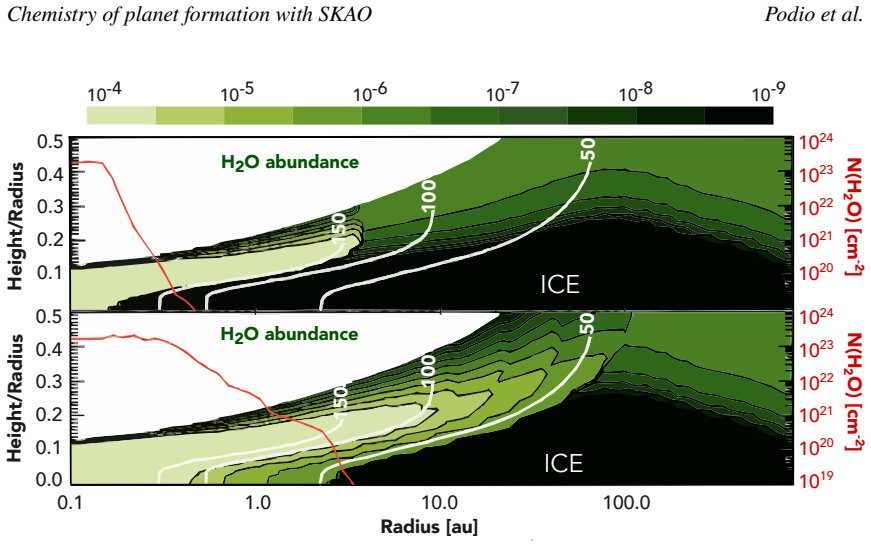
The advent of SKA will open new domains in the field by observing emission lines from heavier molecules including heavy carbon chains and rings and prebiotic molecules with peak emission in the cm range. Moreover SKA will probe molecular emission from regions which are obscured by dust opacity at mm wavelengths hence from the disk midplane and often from the inner 30 au region. These observations will constrain the initial conditions for disk evolution and planet formation allowing us to predict the chemical composition of the forming planets and their atmospheres.
What carries the argument
Centimeter-wavelength line emission from complex molecules in dust-obscured disk regions.
If this is right
- Constrain the initial chemical conditions for disk evolution and planet formation
- Allow prediction of the chemical composition of forming planets and their atmospheres
- Enable comparison with results on exoplanet atmospheres and chemistry of pristine Solar System bodies
Where Pith is reading between the lines
- Such data could help determine how much prebiotic material is available during the earliest stages of planet growth
- Observations might distinguish chemical differences between inner and outer disk regions that affect terrestrial versus giant planets
- Integration with future exoplanet spectroscopy could test whether disk chemistry directly imprints on planetary atmospheres
Load-bearing premise
The heavier molecules and prebiotic species have their strongest emission lines in the centimeter wavelength range that SKA can access and that the array's sensitivity and resolution will allow detection in the midplane and inner disk despite dust and line confusion.
What would settle it
No detection of the expected lines from heavy carbon chains or prebiotic molecules in the inner 30 au of disks after targeted SKA observations.
Figures
read the original abstract
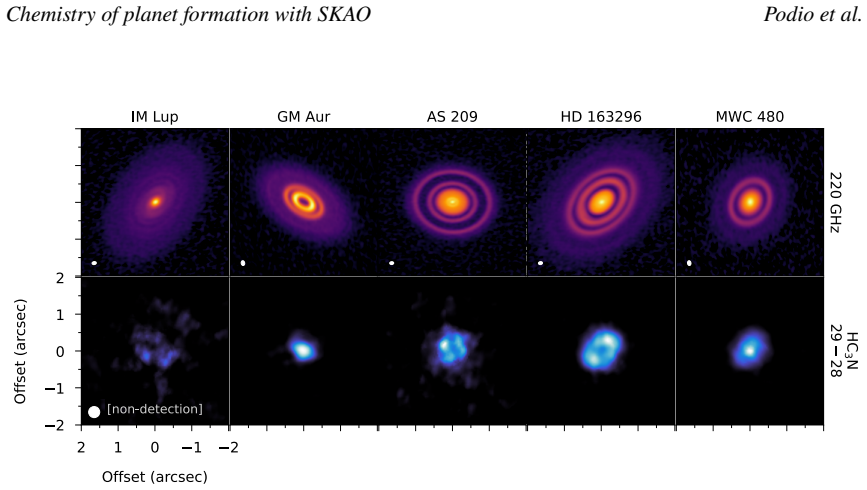
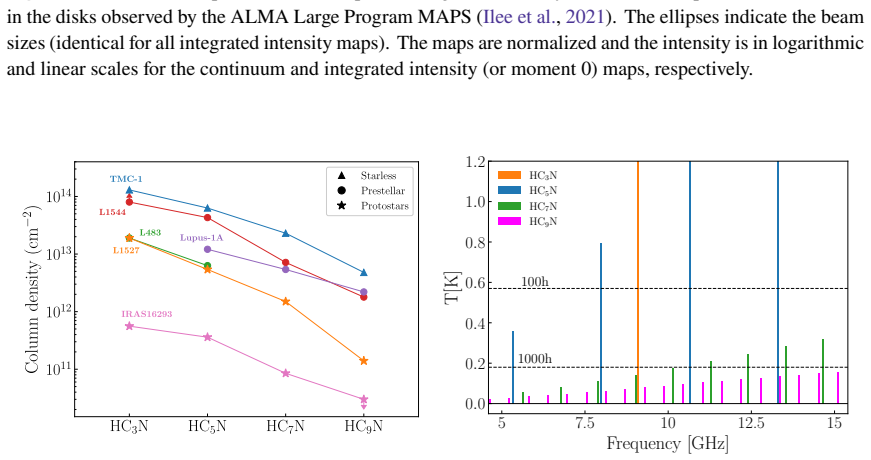
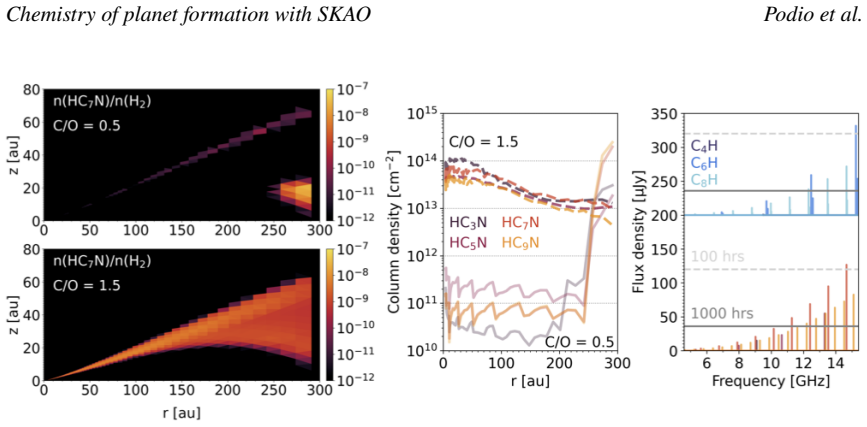
The chemical composition of planets is inherited from that of the natal protoplanetary disk at the time of planet formation. In recent years, we have made huge progress in characterizing disk chemistry. (Sub-)millimeter interferometers, such as ALMA, allowed us to detect emission lines from simple to complex organic molecules and to probe their radial and vertical distribution in disks. On the other hand, JWST has started to unveil the composition of disk ices, and line emission from the innermost disk regions. The advent of SKA will open new domains in the field, by observing emission lines from heavier molecules including heavy carbon chains and rings, and prebiotic molecules with peak emission in the cm range. Moreover, SKA will probe molecular emission from regions which are obscured by dust opacity at mm wavelengths, hence from the disk midplane, and often from the inner 30 au region. These observations will constrain the initial conditions for disk evolution and planet formation, allowing us to predict the chemical composition of the forming planets and their atmospheres. Comparison with forthcoming results on exoplanet atmospheres and on the chemistry of pristine bodies in the Solar System will provide new hints on the origin and evolution of planetary systems including our own.
Editorial analysis
A structured set of objections, weighed in public.
Referee Report
Summary. The manuscript presents a forward-looking science case arguing that the Square Kilometre Array Observatory (SKAO) will enable observations of complex chemistry in protoplanetary disks by targeting emission lines from heavy carbon chains, rings, and prebiotic molecules whose peak emission falls in the cm wavelength range, while also accessing the disk midplane and inner ~30 au regions that are obscured by dust at mm wavelengths; these data would constrain initial chemical conditions for planet formation and link to exoplanet atmospheres and Solar System bodies.
Significance. If the underlying assumptions on line frequencies, abundances, and detectability hold, the case would usefully articulate SKAO's complementary niche relative to ALMA and JWST for tracing previously inaccessible chemical reservoirs, thereby strengthening the observational basis for chemical inheritance models in planet formation.
major comments (2)
- [Abstract] Abstract: the central claim that SKA will detect heavier molecules and prebiotic species rests on the unquantified assertion that their strongest lines lie in the cm range accessible to SKA; no line frequencies, laboratory references, or column-density estimates are supplied to ground this statement.
- [Abstract] Abstract: the assertion that SKA will probe molecular emission from the dust-obscured midplane and inner 30 au lacks any optical-depth calculations, specific molecular examples, or sensitivity estimates demonstrating that cm-wavelength observations overcome the stated mm-wavelength limitations.
Simulated Author's Rebuttal
We thank the referee for their constructive comments, which highlight areas where the abstract can be strengthened with additional detail. We address each point below and will revise the abstract in the resubmitted version.
read point-by-point responses
-
Referee: [Abstract] Abstract: the central claim that SKA will detect heavier molecules and prebiotic species rests on the unquantified assertion that their strongest lines lie in the cm range accessible to SKA; no line frequencies, laboratory references, or column-density estimates are supplied to ground this statement.
Authors: We agree that the abstract would benefit from explicit examples to support the claim. The manuscript body references laboratory spectra and prior observations for relevant species. We will revise the abstract to include specific line frequencies (e.g., low-J transitions of heavy carbon chains such as HC9N near 5-10 GHz), cite the corresponding laboratory references, and provide order-of-magnitude column-density estimates extrapolated from existing ALMA disk detections. revision: yes
-
Referee: [Abstract] Abstract: the assertion that SKA will probe molecular emission from the dust-obscured midplane and inner 30 au lacks any optical-depth calculations, specific molecular examples, or sensitivity estimates demonstrating that cm-wavelength observations overcome the stated mm-wavelength limitations.
Authors: We acknowledge that the abstract presents this advantage qualitatively. The manuscript discusses reduced dust opacity at cm wavelengths relative to mm wavelengths. We will revise the abstract to include specific molecular examples, a brief reference to optical-depth arguments drawn from the literature, and sensitivity estimates based on SKA specifications compared with ALMA performance at comparable frequencies. revision: yes
Circularity Check
No significant circularity
full rationale
The manuscript is a forward-looking science case paper with no derivations, quantitative models, fitted parameters, or predictions. Claims about SKA capabilities for molecular lines rest on external domain knowledge rather than any internal chain that reduces to the paper's own inputs. No equations, self-citations as load-bearing premises, or renamings of results appear. This is the expected outcome for a prospective review-style document.
Axiom & Free-Parameter Ledger
Reference graph
Works this paper leans on
-
[1]
doi: 10.1126/sciadv. 1600285. A. Andreu et al.A&A, 677:L17, Sept
-
[2]
doi: 10.1051/0004-6361/202347484. A. M. Arabhavi et al.Science, 384(6700):1086–1090, June
-
[3]
doi: 10.1126/science.adi8147. N. Arulanantham et al.AJ, 170(2):67, Aug
-
[4]
doi: 10.3847/1538-3881/addd01. A. Bacmann et al.A&A, 541:L12, May
-
[5]
doi: 10.1051/0004-6361/201219207. N. Balucani, C. Ceccarelli, and V. Taquet.Monthly Notices of the Royal Astronomical Society: Letters, 449(1):L16–L20,
-
[6]
doi: 10.3847/2041-8213/acf5ec. V. Bariosco et al.MNRAS, 539(1):82–94, May
-
[7]
doi: 10.1093/mnras/staf476. E. A. Bergin et al.ApJ, 831(1):101, Nov
-
[8]
doi: 10.3847/0004-637X/831/1/101. E. A. Bergin et al.ApJ, 965(2):147, Apr
-
[9]
doi: 10.3847/1538-4357/ad3443. L. M. Bernabò et al.ApJ, 927(2):L22, Mar
-
[10]
doi: 10.3847/2041-8213/ac574e. E. Bianchi et al.MNRAS, 498(1):L87–L92, Nov
-
[11]
doi: 10.1093/mnrasl/slaa130. E. Bianchi et al.ApJ, 944(2):208, Feb
-
[12]
doi: 10.3847/1538-4357/acb5e8. E. Bianchi et al. InAdvancing Astrophysics with the SKA – II (AASKAII)
-
[13]
doi: 10.2458/azu_uapress_ 9780816553631-ch015. L. Boitard-Crépeau et al.ApJ, 987(2):L25, July
-
[14]
doi: 10.3847/2041-8213/ade5aa. A. S. Booth et al.Nature Astronomy, 5:684–690, Jan
-
[15]
doi: 10.1038/s41550-021-01352-w. A. S. Booth et al.AJ, 167(4):164, Apr. 2024a. doi: 10.3847/1538-3881/ad2700. A. S. Booth et al.AJ, 167(4):165, Apr. 2024b. doi: 10.3847/1538-3881/ad26ff. A. S. Booth et al.ApJ, 986(1):L9, June
-
[16]
doi: 10.3847/2041-8213/adc7b2. R. A. Booth and J. D. Ilee.MNRAS, 487(3):3998–4011, Aug
-
[17]
doi: 10.1093/mnras/stz1488. A. D. Bosman et al.ApJS, 257(1):7, Nov. 2021a. doi: 10.3847/1538-4365/ac1435. A. D. Bosman et al.ApJS, 257(1):15, Nov. 2021b. doi: 10.3847/1538-4365/ac1433. S. Bruderer, E. F. van Dishoeck, S. D. Doty, and G. J. Herczeg.A&A, 541:A91, May
-
[18]
doi: 10.1051/0004-6361/201118218. A. M. Burkhardt et al.ApJ, 913(2):L18, June
-
[19]
doi: 10.3847/2041-8213/abfd3a. J. K. Calahan et al.ApJ, 975(2):170, Nov
-
[20]
doi: 10.3847/1538-4357/ad78d1. M. T. Carney et al.A&A, 605:A21, Sept
-
[21]
doi: 10.1051/0004-6361/201629342. M. T. Carney et al.A&A, 623:A124, Mar
-
[22]
doi: 10.1051/0004-6361/201834353. S. Cazaux et al.ApJ, 593(1):L51–L55, Aug
-
[23]
doi: 10.1086/378038. C. Ceccarelli et al. In S. Inutsuka et al., editors,Protostars and Planets VII, volume 534 of Astronomical Society of the Pacific Conference Series, page 379, July
-
[24]
doi: 10.1051/0004-6361/202141156. Y. Chen et al.A&A, 690:A205, Oct
-
[25]
doi: 10.1051/0004-6361/202450706. L. A. Cieza et al.Nature, 535(7611):258–261, July
-
[26]
doi: 10.1038/nature18612. C. Codella et al. InAdvancing Astrophysics with the Square Kilometre Array (AASKA14), page 26 Chemistry of planet formation with SKAO Podio et al. 123, Apr
-
[27]
doi: 10.22323/1.215.0123. C. Codella et al.ACS Earth and Space Chemistry, 3(10):2110–2121, Oct
-
[28]
C.Codellaetal.FrontiersinAstronomyandSpaceSciences,8:227,Dec.2021
doi: 10.1021/ acsearthspacechem.9b00136. C.Codellaetal.FrontiersinAstronomyandSpaceSciences,8:227,Dec.2021. doi: 10.3389/fspas. 2021.782006. M. P. Collings et al.MNRAS, 354(4):1133–1140, Nov
-
[29]
doi: 10.1111/j.1365-2966.2004. 08272.x. M. A. Corazzi et al.ApJ, 913(2):128, June
-
[30]
doi: 10.3847/1538-4357/abf6d3. A. Coutens et al.A&A, 590:L6, May
-
[31]
doi: 10.1051/0004-6361/201628612. I. J. M. Crossfield.ApJ, 952(1):L18, July
-
[32]
doi: 10.3847/2041-8213/ace35f. F. Cruz-Sáenz de Miera et al.A&A, 696:A18, Apr
-
[33]
doi: 10.1051/0004-6361/202451487. H. M. Cuppen et al.Space Science Reviews, 212(1-2):1–58, Oct
-
[34]
doi: 10.3847/1538-4365/aac886. S. Dash et al.ApJ, 932(1):20, June
-
[35]
doi: 10.3847/1538-4357/ac67f0. M. De Simone et al.ApJ, 896(1):L3, June
-
[36]
doi: 10.3847/2041-8213/ab8d41. V. Delabrosse et al.A&A, 688:A173, Aug
-
[37]
doi: 10.1051/0004-6361/202449176. C. Dominik, C. Ceccarelli, D. Hollenbach, and M. Kaufman.ApJ, 635(1):L85–L88, Dec
-
[38]
doi: 10.1086/498942. A. Dutrey et al.A&A, 704:A33, Nov
-
[39]
doi: 10.1051/0004-6361/202555641. B. Edwards et al.AJ, 157(6):242, June
-
[40]
C.Eistrup,C.Walsh,andE.F.vanDishoeck.A&A,595:A83,Nov.2016
doi: 10.3847/1538-3881/ab1cb9. C.Eistrup,C.Walsh,andE.F.vanDishoeck.A&A,595:A83,Nov.2016. doi: 10.1051/0004-6361/ 201628509. C.Eistrup,C.Walsh,andE.F.vanDishoeck.A&A,613:A14,May2018. doi: 10.1051/0004-6361/ 201731302. L.E.J.Eriksson,T.Ronnet,andA.Johansen.A&A,648:A112,Apr.2021.doi: 10.1051/0004-6361/ 202039889. L. Evans et al.ApJ, 982(1):62, Mar
-
[41]
doi: 10.3847/1538-4357/adb287. A. M. A. Fadul et al.ApJ, 988(2):L44, Aug. 2025a. doi: 10.3847/2041-8213/adec6e. A. M. A. Fadul et al.AJ, 169(6):307, June 2025b. doi: 10.3847/1538-3881/adc998. S. Ferrero et al.ApJ, 904(1):11, Nov
-
[42]
doi: 10.3847/1538-4357/abb953. S. Ferrero et al.MNRAS, 516(2):2586–2596, Oct
-
[43]
doi: 10.1093/mnras/stac2358. W. J. Fischer et al. In S. Inutsuka et al., editors,Protostars and Planets VII, volume 534 of Astronomical Society of the Pacific Conference Series, page 355, July
-
[44]
doi: 10.1051/0004-6361/202554807. J. Frediani et al.A&A, 695:A78, Mar
-
[45]
doi: 10.1051/0004-6361/202452191. R. T. Garrod et al.ApJS, 259(1):1, Mar
-
[46]
doi: 10.3847/1538-4365/ac3131. A. Garufi et al.A&A, 645:A145, Jan
-
[47]
doi: 10.1051/0004-6361/202039483. A. Garufi et al.A&A, 658:A104, Feb
-
[48]
doi: 10.1051/0004-6361/202141264. A.Garufietal. InAdvancingAstrophysicswiththeSKA–II(AASKAII).2026. arXivsearch: Report number AASKAII/Garufi01. D. Gasman et al.A&A, 694:A147, Feb
-
[49]
27 Chemistry of planet formation with SKAO Podio et al
doi: 10.1051/0004-6361/202452152. 27 Chemistry of planet formation with SKAO Podio et al. K. Gerbig, C. T. Lenz, and H. Klahr.A&A, 629:A116, Sept
-
[51]
L. Giani et al.MNRAS, 537(4):3861–3883, Mar. 2025a. doi: 10.1093/mnras/staf189. L. Giani et al.MNRAS, staf1941, Nov. 2025b. ISSN 0035-8711. doi: 10.1093/mnras/staf1941. K. Giers et al.A&A, 676:A78, Aug
-
[52]
doi: 10.1051/0004-6361/202346433. T. Grassi et al.A&A, 643:A155, Nov
-
[53]
doi: 10.1051/0004-6361/202039087. S. Guilloteau et al.A&A, 700:L5, Aug
-
[54]
doi: 10.1051/0004-6361/202554853. T. Henning et al.PASP, 136(5):054302, May
-
[55]
doi: 10.1088/1538-3873/ad3455. E. Herbst and E. F. van Dishoeck.ARA&A, 47(1):427–480, Sept
-
[56]
doi: 10.1093/mnras/218.4.761. A. Houge et al.A&A, 699:A227, July
-
[57]
doi: 10.1051/0004-6361/202555164. J. D. Ilee et al.ApJS, 257(1):9, Nov
-
[58]
doi: 10.3847/1538-4365/ac1441. J. D. Ilee, C. Walsh, and J. K. Calahan.AJ, 171(1):3, Jan
-
[59]
doi: 10.3847/1538-3881/ae100e. A. A. Jaber, C. Ceccarelli, C. Kahane, and E. Caux.ApJ, 791:29, Aug
-
[60]
A.JohansenandM.Lambrechts.AnnualReviewofEarthandPlanetarySciences, 45(1):359–387, Aug
doi: 10.3847/1538-4365/ad9450. A.JohansenandM.Lambrechts.AnnualReviewofEarthandPlanetarySciences, 45(1):359–387, Aug
-
[61]
doi: 10.1146/annurev-earth-063016-020226. J. K. Jørgensen et al.A&A, 595:A117, Nov
-
[62]
doi: 10.1051/0004-6361/201628648. J. K. Jørgensen et al.A&A, 620:A170, Dec
-
[63]
doi: 10.1051/0004-6361/201731667. I. Kamp et al.Faraday Discussions, 245:112–137, Sept
-
[64]
doi: 10.1039/D3FD00013C. J. Kanwar et al.A&A, 689:A231, Sept
-
[65]
doi: 10.1051/0004-6361/202450078. Á. Kóspál et al.ApJS, 256(2):30, Oct
-
[66]
doi: 10.3847/1538-4365/ac0f09. S. Krijt et al.ApJ, 990(2):L72, Sept
-
[67]
doi: 10.3847/2041-8213/adfbe3. C. J. Law et al.ApJS, 257(1):3, Nov
-
[68]
doi: 10.3847/1538-4365/ac1434. R. Le Gal et al.ApJ, 876(1):72, May
-
[69]
doi: 10.3847/1538-4357/ab1416. R. Le Gal et al.ApJS, 257(1):12, Nov
-
[70]
doi: 10.3847/1538-4365/ac2583. C.-F. Lee et al.Nature Astronomy, 1:0152, July 2017a. doi: 10.1038/s41550-017-0152. C.-F. Lee et al.Science Advances, 3(4):e1602935, Apr. 2017b. doi: 10.1126/sciadv.1602935. C.-F. Lee et al.ApJ, 843(1):27, July 2017c. doi: 10.3847/1538-4357/aa7757. C.-F.Lee,C.Codella,Z.-Y.Li,andS.-Y.Liu.ApJ,876(1):63,May2019a. doi: 10.3847/1...
-
[71]
doi: 10.3847/1538-4357/ac8c28. J.-E. Lee et al.Nature Astronomy, 3:314–319, Feb. 2019b. doi: 10.1038/s41550-018-0680-0. N. F. W. Ligterink et al.A&A, 647:A87, Mar
-
[72]
doi: 10.1051/0004-6361/202039619. N. F. W. Ligterink et al.Physical Chemistry Chemical Physics (Incorporating Faraday Transac- tions), 27(37):19630–19641, Sept
-
[73]
doi: 10.1039/D5CP02278A. Z.-Y. D. Lin et al.MNRAS, 501(1):1316–1335, Feb
-
[74]
doi: 10.1093/mnras/staa3685. Z.-Y. D. Lin et al.ApJ, 951(1):9, July
-
[75]
doi: 10.3847/1538-4357/acd5c9. J. E. Lindberg, S. B. Charnley, and M. A. Cordiner.ApJ, 833(1):L14, Dec
-
[76]
2041-8213/833/1/L14
doi: 10.3847/ 28 Chemistry of planet formation with SKAO Podio et al. 2041-8213/833/1/L14. M. Lippi et al.ApJ, 970(1):L5, July
2041
-
[77]
doi: 10.3847/2041-8213/ad5a6d. J.-C. Loison et al.MNRAS, 437(1):930–945, Jan
-
[78]
doi: 10.1093/mnras/stt1956. R. A. Loomis et al.AJ, 155(4):182, Apr
-
[79]
doi: 10.3847/1538-3881/aab604. R. A. Loomis et al.ApJ, 893(2):101, Apr
-
[80]
doi: 10.3847/1538-4357/ab7cc8. R. A. Loomis et al.Nature Astronomy, 5:188–196, Jan
-
[81]
doi: 10.1038/s41550-020-01261-4. A. López-Sepulcre et al.A&A, 606:A121, Oct
discussion (0)
Sign in with ORCID, Apple, or X to comment. Anyone can read and Pith papers without signing in.