Non-holomorphic S^(prime)₄ modular symmetry for leptons and leptogenesis
Pith reviewed 2026-06-25 23:56 UTC · model grok-4.3
The pith
Thirty-six lepton models under non-holomorphic S'4 symmetry fit normal neutrino ordering with four real couplings plus the modulus, and two also reproduce the observed baryon asymmetry via leptogenesis.
A machine-rendered reading of the paper's core claim, the machinery that carries it, and where it could break.
Core claim
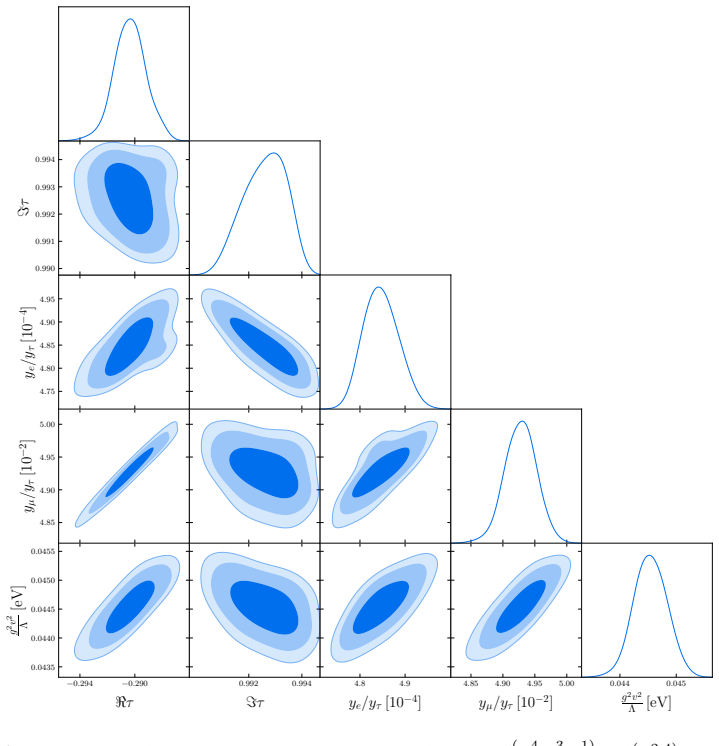
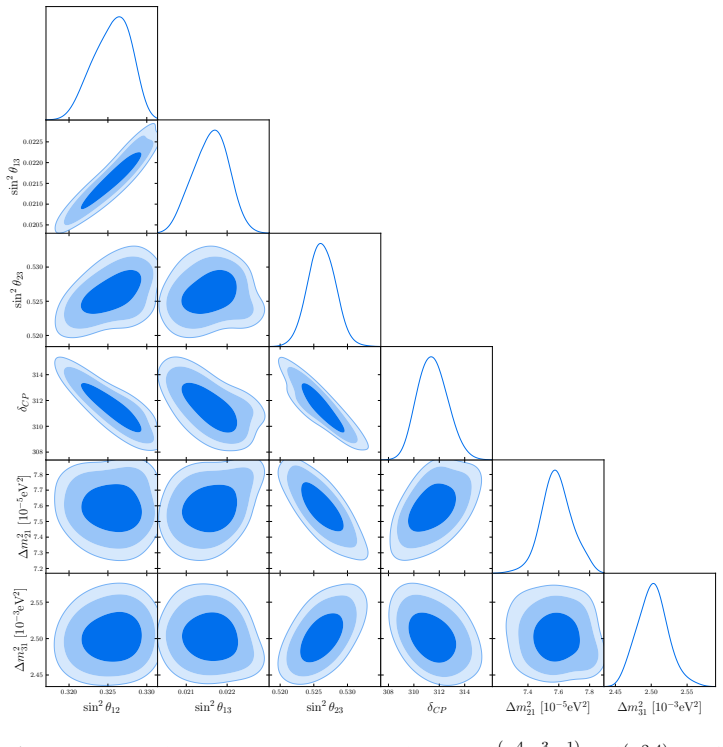
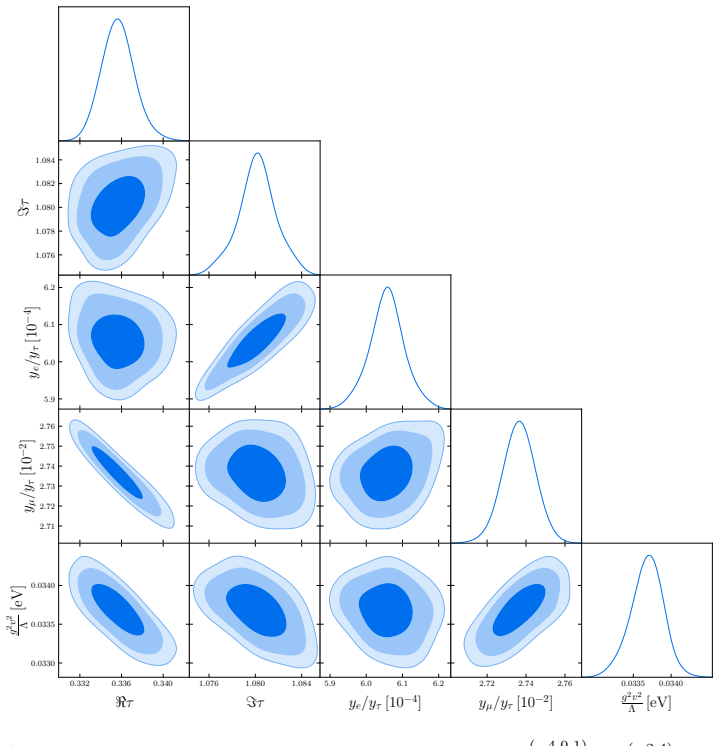
The authors establish that non-holomorphic S'4 modular symmetry, realized with level 4 polyharmonic Maaß forms of weights between -4 and 6, permits the construction of lepton models that accommodate current neutrino oscillation data with a minimal number of parameters. For normal ordering, 36 such models exist, grouped into three categories of twelve models each, distinguished by the representation assignment of the charged lepton field E^c_1. Representative models from each category produce precise predictions for the neutrino mixing angles and CP phases. Moreover, two of these models achieve successful thermal leptogenesis without flavor effects, matching the observed baryon asymmetry with
What carries the argument
non-holomorphic S'4 modular symmetry implemented through level-4 polyharmonic Maaß forms of integer weights from -4 to 6, which enter the Yukawa couplings and generate the charged-lepton and neutrino mass matrices as functions of the modulus τ
Load-bearing premise
Viability depends on the assumption that the chosen field representations and modular weights under S'4 allow numerical fits to current neutrino oscillation data within the type-I seesaw with exactly two right-handed neutrinos and without extra flavons or generalized CP symmetry.
What would settle it
A future measurement showing the Dirac CP phase δ_CP outside the narrow intervals predicted by the two successful representative models would rule out those models.
Figures
read the original abstract
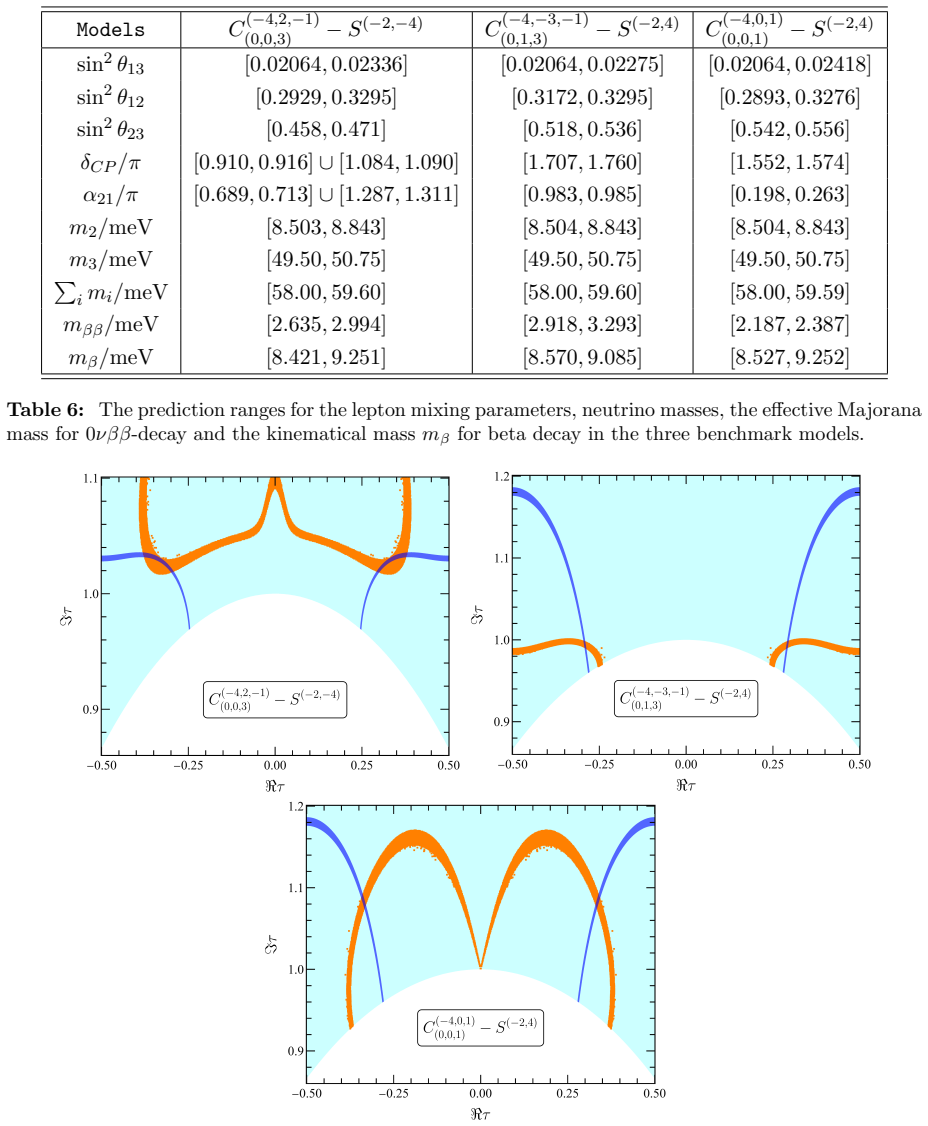
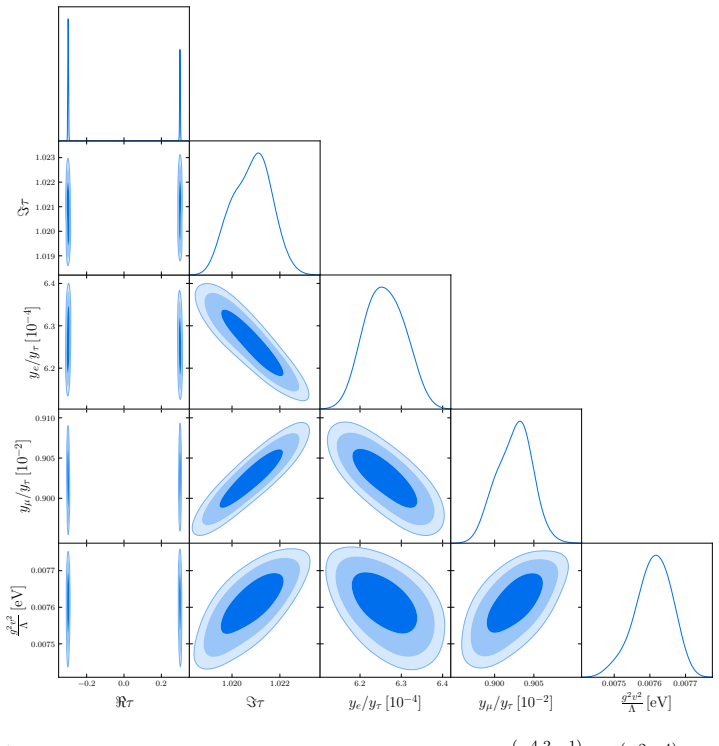
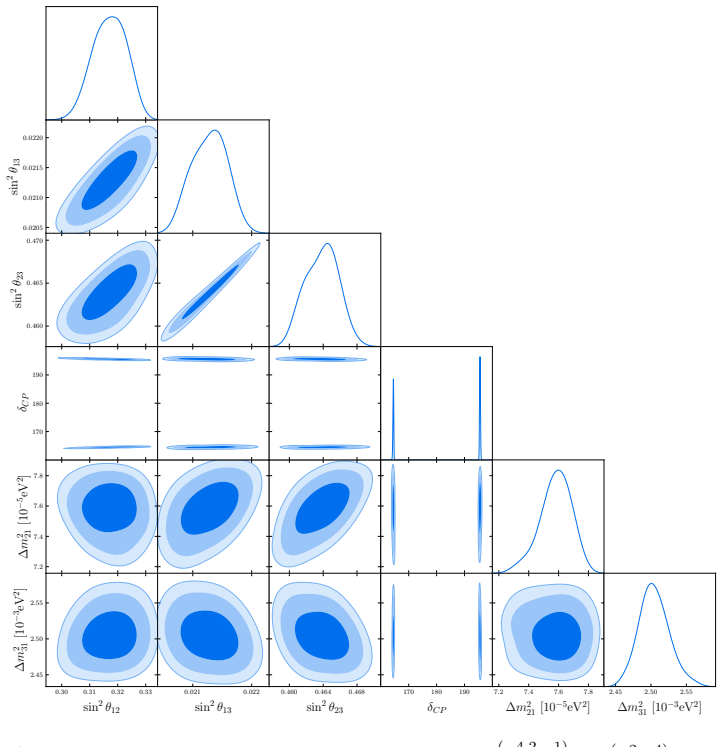
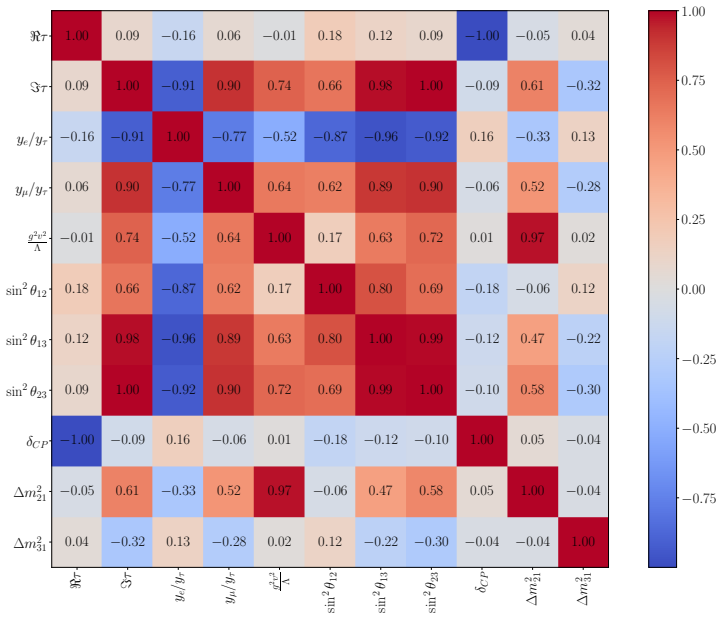
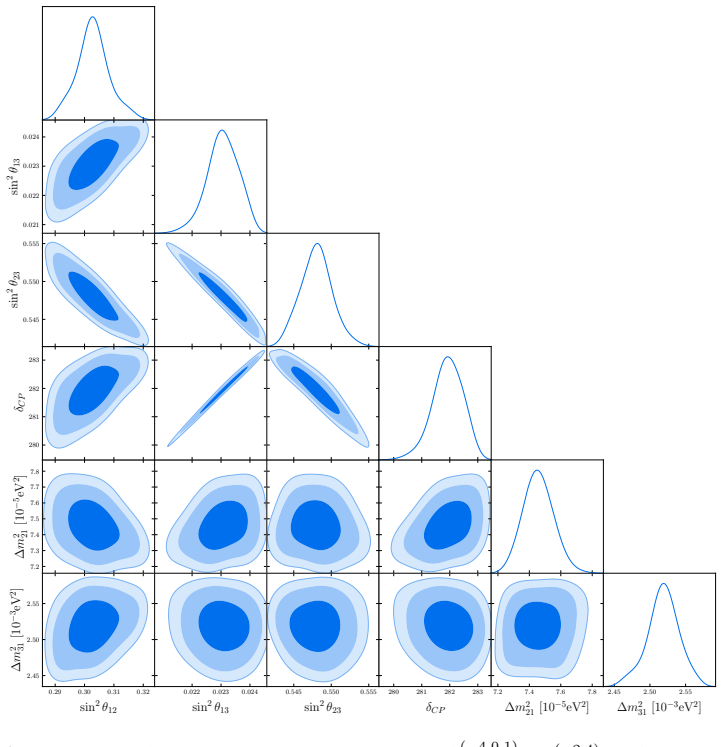
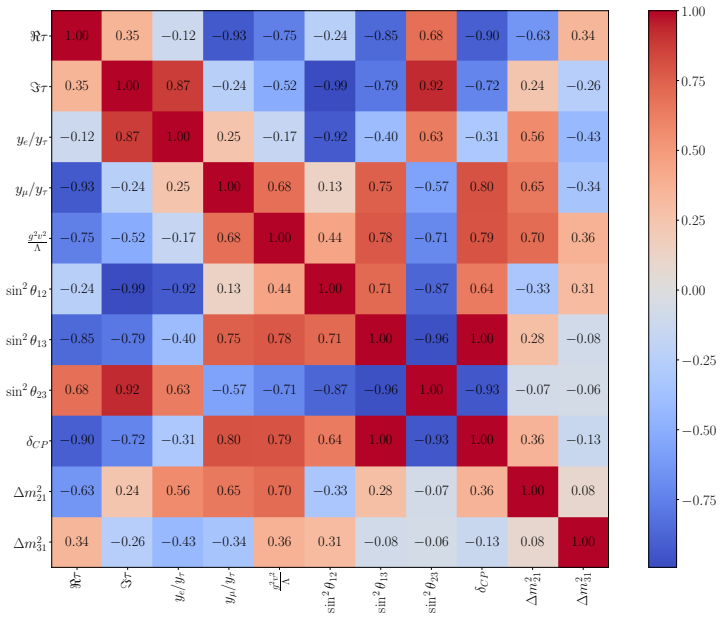
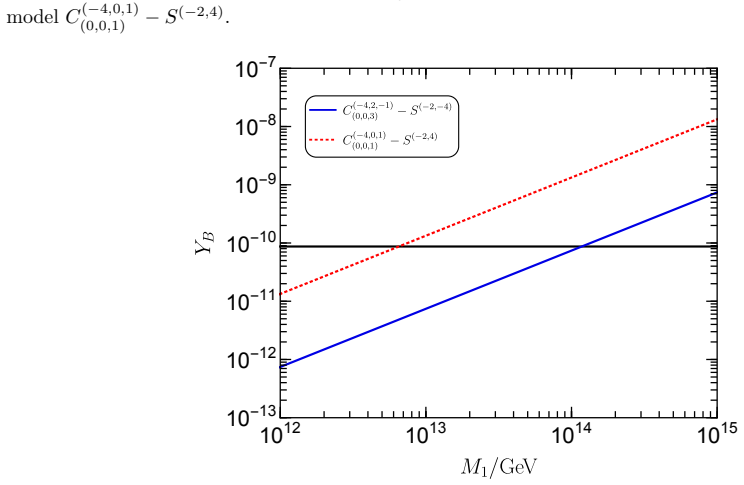
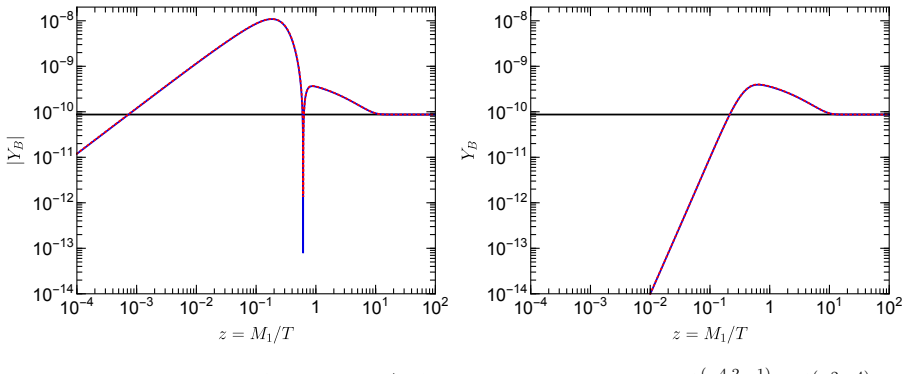
We perform a comprehensive and systematic investigation of lepton models based on the non-holomorphic $S^{\prime}_{4}$ modular symmetry, by using level 4 polyharmonic Maa{\ss} forms spanning integer weights from $-4$ to $6$. The light neutrino masses are generated by the type-I seesaw mechanism with two right-handed neutrinos, no flavon fields other than the modulus $\tau$ is introduced, and the generalized CP symmetry is not imposed. An exhaustive numerical analysis yields 36 viable models with only four real couplings besides the modulus $\tau$ when neutrino masses are normal ordering. They are classified into three categories, each containing twelve models which yield quite similar predictions for lepton observables and are distinguished by the assignment of $E^c_1$. Furthermore, we perform a detailed numerical analysis for one representative model from each category. These representative models are found to yield very sharp predictions for neutrino masses and mixing parameters, and they are distinguished by the predictions for the atmospheric mixing angle $\theta_{23}$, the Dirac CP phase $\delta_{CP}$ and the Majorana CP phase $\alpha_{21}$. Furthermore, we find that only two of these three representative models accommodate successful thermal leptogenesis in the unflavored regime, reproducing the observed baryon asymmetry with the identical parameter values that satisfy neutrino oscillation data. In these models, the real part of the modulus $\tau$ is the unique source of CP violation in both lepton mixing and leptogenesis.
Editorial analysis
A structured set of objections, weighed in public.
Referee Report
Summary. The paper performs a systematic study of lepton flavor models based on non-holomorphic S'_4 modular symmetry, employing level-4 polyharmonic Maass forms with integer weights from -4 to 6. Light neutrino masses arise via the type-I seesaw with exactly two right-handed neutrinos; no additional flavon fields or generalized CP symmetry are introduced. An exhaustive numerical scan over four real couplings plus the modulus τ identifies 36 viable models for normal neutrino mass ordering. These are grouped into three categories of twelve models each, distinguished by the assignment of E^c_1. Three representative models are examined in detail, producing sharp predictions for the neutrino mass-squared differences, mixing angles, and CP phases. Two of the three representatives also reproduce the observed baryon asymmetry via thermal leptogenesis in the unflavored regime, using the identical parameter values that fit oscillation data, with Re(τ) identified as the sole source of CP violation.
Significance. If the numerical results prove robust, the work supplies a concrete, flavon-free realization of modular symmetry for leptons that simultaneously addresses neutrino data and leptogenesis. The use of Maass forms across a range of weights, the classification into categories with similar predictions, and the explicit demonstration that the same fitted parameters can yield successful unflavored leptogenesis constitute a useful addition to the modular-flavor literature. The claim that Re(τ) is the unique CP source is a falsifiable prediction that can be tested by future precision measurements of δ_CP and the Majorana phases.
major comments (2)
- [Numerical analysis section (abstract and results section)] The central claim of exactly 36 viable models (abstract; numerical-analysis section) rests on an exhaustive scan whose sampling method, scanned ranges for the four real couplings and for Re(τ)/Im(τ) inside the fundamental domain, grid density or Monte-Carlo statistics, and precise χ² viability threshold are not specified. Without these details the enumerated count, the classification into three equal categories of twelve, and the subsequent selection of the three representative models for leptogenesis cannot be independently verified and may shift under alternative sampling choices.
- [Leptogenesis section] The assertion that only two of the three representative models accommodate successful unflavored leptogenesis (abstract; leptogenesis section) is obtained after fitting the same four couplings plus τ to oscillation data. Because the scan details are missing, it is unclear whether the parameter space has been exhaustively explored or whether local minima or degenerate solutions have been missed; this directly affects the robustness of the statement that Re(τ) is the unique CP source for both mixing and leptogenesis.
minor comments (2)
- [Abstract] The abstract states that the models use “only four real couplings besides the modulus τ”; it would improve clarity to give their explicit Lagrangian notation or coupling labels at first mention.
- [Model-construction section] Notation for the Maass forms (weights, transformation properties under S'_4) should be collected in a single table or subsection for easy reference when comparing the three categories.
Simulated Author's Rebuttal
We thank the referee for the detailed review and the positive evaluation of our work's significance. We address the two major comments point by point below. We agree that additional details on the numerical analysis are needed and will revise the manuscript accordingly.
read point-by-point responses
-
Referee: [Numerical analysis section (abstract and results section)] The central claim of exactly 36 viable models (abstract; numerical-analysis section) rests on an exhaustive scan whose sampling method, scanned ranges for the four real couplings and for Re(τ)/Im(τ) inside the fundamental domain, grid density or Monte-Carlo statistics, and precise χ² viability threshold are not specified. Without these details the enumerated count, the classification into three equal categories of twelve, and the subsequent selection of the three representative models for leptogenesis cannot be independently verified and may shift under alternative sampling choices.
Authors: We agree that the specific details of the numerical scan are not provided in the current manuscript, which is necessary for full reproducibility and verification of the 36 models. We will revise the paper to include these details in the numerical analysis section, specifying the sampling method, the ranges scanned for the couplings and τ, the grid density or Monte Carlo statistics used, and the exact χ² threshold for viability. revision: yes
-
Referee: [Leptogenesis section] The assertion that only two of the three representative models accommodate successful unflavored leptogenesis (abstract; leptogenesis section) is obtained after fitting the same four couplings plus τ to oscillation data. Because the scan details are missing, it is unclear whether the parameter space has been exhaustively explored or whether local minima or degenerate solutions have been missed; this directly affects the robustness of the statement that Re(τ) is the unique CP source for both mixing and leptogenesis.
Authors: We acknowledge that the robustness of the leptogenesis results and the claim regarding Re(τ) as the unique CP source depend on the completeness of the scan. By incorporating the detailed description of the numerical procedure in the revision (as noted in the response to the first comment), we will clarify that the scan was exhaustive within the specified method, supporting the identification of the two successful models. revision: yes
Circularity Check
No significant circularity: numerical scan fits parameters to neutrino data then independently checks leptogenesis consistency
full rationale
The paper constructs models via modular form assignments under non-holomorphic S'_4, then performs numerical fitting of four real couplings plus τ to oscillation data under type-I seesaw. It reports 36 viable models for normal ordering and checks that two representative models also reproduce the observed baryon asymmetry using exactly those fitted values. This is a standard consistency test against an external observable (baryon asymmetry), not a reduction by construction. No self-definitional equations, fitted inputs renamed as predictions, or load-bearing self-citations appear in the abstract or described chain. The count of 36 models and viability thresholds are reproducibility issues, not circularity. The derivation remains self-contained against external benchmarks.
Axiom & Free-Parameter Ledger
free parameters (2)
- four real couplings
- modulus τ
axioms (3)
- domain assumption Type-I seesaw mechanism with two right-handed neutrinos generates the light neutrino masses
- domain assumption No flavon fields other than the modulus τ are introduced
- domain assumption Generalized CP symmetry is not imposed
Reference graph
Works this paper leans on
-
[1]
Discrete Flavor Symmetries and Models of Neutrino Mixing,
G. Altarelli and F. Feruglio, “Discrete Flavor Symmetries and Models of Neutrino Mixing,”Rev. Mod. Phys.82(2010) 2701–2729,arXiv:1002.0211 [hep-ph]
Pith/arXiv arXiv 2010
-
[2]
Non-Abelian Discrete Symmetries in Particle Physics,
H. Ishimori, T. Kobayashi, H. Ohki, Y. Shimizu, H. Okada, and M. Tanimoto, “Non-Abelian Discrete Symmetries in Particle Physics,”Prog. Theor. Phys. Suppl.183 (2010) 1–163,arXiv:1003.3552 [hep-th]
Pith/arXiv arXiv 2010
-
[3]
Neutrino Mass and Mixing with Discrete Symmetry,
S. F. King and C. Luhn, “Neutrino Mass and Mixing with Discrete Symmetry,”Rept. Prog. Phys.76(2013) 056201,arXiv:1301.1340 [hep-ph]. 31
Pith/arXiv arXiv 2013
-
[4]
Neutrino Mass and Mixing: from Theory to Experiment,
S. F. King, A. Merle, S. Morisi, Y. Shimizu, and M. Tanimoto, “Neutrino Mass and Mixing: from Theory to Experiment,”New J. Phys.16(2014) 045018,arXiv:1402.4271 [hep-ph]
Pith/arXiv arXiv 2014
-
[5]
Unified Models of Neutrinos, Flavour and CP Violation,
S. F. King, “Unified Models of Neutrinos, Flavour and CP Violation,”Prog. Part. Nucl. Phys.94(2017) 217–256,arXiv:1701.04413 [hep-ph]
Pith/arXiv arXiv 2017
-
[6]
Discrete Flavour Symmetries, Neutrino Mixing and Leptonic CP Violation,
S. T. Petcov, “Discrete Flavour Symmetries, Neutrino Mixing and Leptonic CP Violation,” Eur. Phys. J. C78no. 9, (2018) 709,arXiv:1711.10806 [hep-ph]
Pith/arXiv arXiv 2018
-
[7]
Flavor structures of charged fermions and massive neutrinos,
Z.-z. Xing, “Flavor structures of charged fermions and massive neutrinos,”Phys. Rept.854 (2020) 1–147,arXiv:1909.09610 [hep-ph]
arXiv 2020
-
[8]
F. Feruglio and A. Romanino, “Lepton flavor symmetries,”Rev. Mod. Phys.93no. 1, (2021) 015007,arXiv:1912.06028 [hep-ph]
arXiv 2021
-
[9]
Neutrino Flavor Model Building and the Origins of Flavor and CP Violation,
Y. Almumin, M.-C. Chen, M. Cheng, V. Knapp-Perez, Y. Li, A. Mondol, S. Ramos-Sanchez, M. Ratz, and S. Shukla, “Neutrino Flavor Model Building and the Origins of Flavor and CP Violation,”Universe9no. 12, (2023) 512,arXiv:2204.08668 [hep-ph]
arXiv 2023
-
[10]
The symmetry approach to quark and lepton masses and mixing,
G.-J. Ding and J. W. F. Valle, “The symmetry approach to quark and lepton masses and mixing,”Phys. Rept.1109(2025) 1–105,arXiv:2402.16963 [hep-ph]
arXiv 2025
-
[11]
Feruglio,Are neutrino masses modular forms?, pp
F. Feruglio,Are neutrino masses modular forms?, pp. 227–266. 2019.arXiv:1706.08749 [hep-ph]
Pith/arXiv arXiv 2019
-
[12]
Neutrino mass and mixing with modular symmetry,
G.-J. Ding and S. F. King, “Neutrino mass and mixing with modular symmetry,”Rept. Prog. Phys.87no. 8, (2024) 084201,arXiv:2311.09282 [hep-ph]
arXiv 2024
-
[13]
Modular flavor symmetric models,
T. Kobayashi and M. Tanimoto, “Modular flavor symmetric models,” 7, 2023. arXiv:2307.03384 [hep-ph]
arXiv 2023
-
[14]
Neutrino Masses and Mixing from Double Covering of Finite Modular Groups,
X.-G. Liu and G.-J. Ding, “Neutrino Masses and Mixing from Double Covering of Finite Modular Groups,”JHEP08(2019) 134,arXiv:1907.01488 [hep-ph]
arXiv 2019
-
[15]
Duality and the Role of Nonperturbative Effects on the World Sheet,
J. Lauer, J. Mas, and H. P. Nilles, “Duality and the Role of Nonperturbative Effects on the World Sheet,”Phys. Lett. B226(1989) 251–256
1989
-
[16]
Modular Invariance in Supersymmetric Field Theories,
S. Ferrara, D. Lust, A. D. Shapere, and S. Theisen, “Modular Invariance in Supersymmetric Field Theories,”Phys. Lett. B225(1989) 363
1989
-
[17]
Target Space Modular Invariance and Low-Energy Couplings in Orbifold Compactifications,
S. Ferrara, . D. Lust, and S. Theisen, “Target Space Modular Invariance and Low-Energy Couplings in Orbifold Compactifications,”Phys. Lett. B233(1989) 147–152
1989
-
[18]
Non-holomorphic modular flavor symmetry,
B.-Y. Qu and G.-J. Ding, “Non-holomorphic modular flavor symmetry,”JHEP08(2024) 136,arXiv:2406.02527 [hep-ph]
arXiv 2024
-
[19]
Non-holomorphic modular flavor symmetry and odd weight polyharmonic Maaß form,
B.-Y. Qu, J.-N. Lu, and G.-J. Ding, “Non-holomorphic modular flavor symmetry and odd weight polyharmonic Maaß form,”arXiv:2506.19822 [hep-ph]
-
[20]
M. B. Green and M. Gutperle, “Effects of D instantons,”Nucl. Phys. B498(1997) 195–227,arXiv:hep-th/9701093. 32
Pith/arXiv arXiv 1997
-
[21]
Sixteen fermion and related terms in M theory on T**2,
M. B. Green, M. Gutperle, and H.-h. Kwon, “Sixteen fermion and related terms in M theory on T**2,”Phys. Lett. B421(1998) 149–161,arXiv:hep-th/9710151
Pith/arXiv arXiv 1998
-
[22]
A Note on nonperturbative R**4 couplings,
B. Pioline, “A Note on nonperturbative R**4 couplings,”Phys. Lett. B431(1998) 73–76, arXiv:hep-th/9804023
Pith/arXiv arXiv 1998
-
[23]
Supersymmetry constraints on type IIB supergravity,
M. B. Green and S. Sethi, “Supersymmetry constraints on type IIB supergravity,”Phys. Rev. D59(1999) 046006,arXiv:hep-th/9808061
Pith/arXiv arXiv 1999
-
[24]
On a supersymmetric completion of the R4 term in 2B supergravity,
S. de Haro, A. Sinkovics, and K. Skenderis, “On a supersymmetric completion of the R4 term in 2B supergravity,”Phys. Rev. D67(2003) 084010,arXiv:hep-th/0210080
Pith/arXiv arXiv 2003
-
[25]
Automorphic properties of low energy string amplitudes in various dimensions,
M. B. Green, J. G. Russo, and P. Vanhove, “Automorphic properties of low energy string amplitudes in various dimensions,”Phys. Rev. D81(2010) 086008,arXiv:1001.2535 [hep-th]
Pith/arXiv arXiv 2010
-
[26]
Supersymmetry constraints on theR 4 multiplet in type IIB onT 2,
A. Basu, “Supersymmetry constraints on theR 4 multiplet in type IIB onT 2,”Class. Quant. Grav.28(2011) 225018,arXiv:1107.3353 [hep-th]
Pith/arXiv arXiv 2011
-
[27]
K. Peeters, P. Vanhove, and A. Westerberg, “Supersymmetric higher derivative actions in ten-dimensions and eleven-dimensions, the associated superalgebras and their formulation in superspace,”Class. Quant. Grav.18(2001) 843–890,arXiv:hep-th/0010167
Pith/arXiv arXiv 2001
-
[28]
The G(hat)**4 lambda**16 term in IIB supergravity,
A. Sinha, “The G(hat)**4 lambda**16 term in IIB supergravity,”JHEP08(2002) 017, arXiv:hep-th/0207070
Pith/arXiv arXiv 2002
-
[29]
A radiative seesaw in a non-holomorphic modularS 3 flavor symmetry,
H. Okada and Y. Orikasa, “A radiative seesaw in a non-holomorphic modularS 3 flavor symmetry,”arXiv:2501.15748 [hep-ph]
-
[30]
Study of neutrino phenomenology and 0νββdecay using polyharmonic Maaβforms,
B. Kumar and M. K. Das, “Study of neutrino phenomenology and 0νββdecay using polyharmonic Maaβforms,”Int. J. Mod. Phys. A40no. 23, (2025) 2550090, arXiv:2405.10586 [hep-ph]
arXiv 2025
-
[31]
Type-II seesaw of a non-holomorphic modularA 4 symmetry,
T. Nomura and H. Okada, “Type-II seesaw of a non-holomorphic modularA 4 symmetry,” arXiv:2408.01143 [hep-ph]
-
[32]
Zee model in a non-holomorphic modular A4 symmetry,
T. Nomura and H. Okada, “Zee model in a non-holomorphic modular A4 symmetry,” Phys. Lett. B867(2025) 139618,arXiv:2412.18095 [hep-ph]
arXiv 2025
-
[33]
Zee-Babu model in a non-holomorphic modular A4 symmetry and modular stabilization,
T. Kobayashi, H. Okada, and Y. Orikasa, “Zee-Babu model in a non-holomorphic modular A4 symmetry and modular stabilization,”arXiv:2502.12662 [hep-ph]
-
[34]
Nonholomorphic A4 modular invariance for fermion masses and mixing in SU(5) GUT,
M. A. Loualidi, M. Miskaoui, and S. Nasri, “Nonholomorphic A4 modular invariance for fermion masses and mixing in SU(5) GUT,”Phys. Rev. D112no. 1, (2025) 015008, arXiv:2503.12594 [hep-ph]
arXiv 2025
-
[35]
B. Kumar and M. K. Das, “Leptogenesis, 0νββand lepton flavor violation in modular left-right asymmetric model with polyharmonic Maaß forms,”JHEP09(2025) 071, arXiv:2504.21701 [hep-ph]
arXiv 2025
-
[36]
A radiative neutrino mass model with leptoquarks under non-holomorphic modular A 4 symmetry,
T. Nomura, H. Okada, and X.-Y. Wang, “A radiative neutrino mass model with leptoquarks under non-holomorphic modular A 4 symmetry,”JHEP09(2025) 163, arXiv:2504.21404 [hep-ph]. 33
arXiv 2025
-
[37]
Neutrino mass model at a three-loop level from a non-holomorphic modularA 4 symmetry,
T. Nomura and H. Okada, “Neutrino mass model at a three-loop level from a non-holomorphic modularA 4 symmetry,”arXiv:2506.02639 [hep-ph]
-
[38]
Inverse seesaw model in nonholomorphic modular A4 flavor symmetry,
X. Zhang and Y. Reyimuaji, “Inverse seesaw model in nonholomorphic modular A4 flavor symmetry,”Phys. Rev. D112no. 7, (2025) 075050,arXiv:2507.06945 [hep-ph]
arXiv 2025
-
[39]
Type-III Seesaw in Non-Holomorphic Modular Symmetry and Leptogenesis,
Priya, L. Singh, B. C. Chauhan, and S. Verma, “Type-III Seesaw in Non-Holomorphic Modular Symmetry and Leptogenesis,”arXiv:2508.05047 [hep-ph]
-
[40]
B. Kumar and M. K. Das, “Neutrino phenomenology and Dark matter in a left-right asymmetric model with non-holomorphic modularA 4 group,”arXiv:2509.01205 [hep-ph]
-
[41]
S. K. Nanda, M. Ricky Devi, and S. Patra, “Non-HolomorphicA 4 Modular Symmetry in Type-I Seesaw: Implications for Neutrino Masses and Leptogenesis,”arXiv:2509.22108 [hep-ph]
-
[42]
S. Jangid and H. Okada, “A radiative seesaw model in a non-invertible selection rule with the assistance of a non-holomorphic modularA 4 symmetry,”arXiv:2510.17292 [hep-ph]
-
[43]
Minimal lepton models with non-holomorphic modular A 4 symmetry*,
X.-Y. Gao and C.-C. Li, “Minimal lepton models with non-holomorphic modular A 4 symmetry*,”Chin. Phys.50no. 5, (2026) 053109,arXiv:2512.07158 [hep-ph]
arXiv 2026
-
[44]
Dark-Portal Leptogenesis in a Non-Holomorphic Modular Scoto-Seesaw Model,
S. Nasri, L. Singh, Tapender, and S. Verma, “Dark-Portal Leptogenesis in a Non-Holomorphic Modular Scoto-Seesaw Model,”arXiv:2601.06435 [hep-ph]
-
[45]
Tri-Resonant Leptogenesis in a Non-Holomorphic Modular A 4 Scotogenic Model,
Tapender and S. Verma, “Tri-Resonant Leptogenesis in a Non-Holomorphic Modular A 4 Scotogenic Model,”arXiv:2602.17243 [hep-ph]
-
[46]
A Predictive Non-Holomorphic ModularA 4 Linear Seesaw Framework Testable at DUNE,
R. Majhi, M. K. Behera, and R. Mohanta, “A Predictive Non-Holomorphic ModularA 4 Linear Seesaw Framework Testable at DUNE,”arXiv:2602.23018 [hep-ph]
-
[47]
Predictions of Modular Symmetry Fixed Points on Neutrino Masses, Mixing, and Leptogenesis,
Priya, B. C. Chauhan, D. Kumar, and T. Nomura, “Predictions of Modular Symmetry Fixed Points on Neutrino Masses, Mixing, and Leptogenesis,”arXiv:2604.04585 [hep-ph]
-
[48]
Lepton masses and mixing in non-holomorphic modularA 4 with universal couplings,
M. Abbas, “Lepton masses and mixing in non-holomorphic modularA 4 with universal couplings,”arXiv:2604.16130 [hep-ph]
-
[49]
Non-holomorphic modular S 4 lepton flavour models,
G.-J. Ding, J.-N. Lu, S. T. Petcov, and B.-Y. Qu, “Non-holomorphic modular S 4 lepton flavour models,”JHEP01(2025) 191,arXiv:2408.15988 [hep-ph]
arXiv 2025
-
[50]
Non-holomorphic modular A 5 symmetry for lepton masses and mixing,
C.-C. Li, J.-N. Lu, and G.-J. Ding, “Non-holomorphic modular A 5 symmetry for lepton masses and mixing,”JHEP12(2024) 189,arXiv:2410.24103 [hep-ph]
arXiv 2024
-
[51]
Radiative Neutrino Mass in a Nonholomorphic T ′ Modular Invariant Model,
M. A. Loualidi, M. Miskaoui, and S. Nasri, “Radiative Neutrino Mass in a Nonholomorphic T ′ Modular Invariant Model,”arXiv:2606.11346 [hep-ph]
-
[52]
Lepton models from non-holomorphicA 5′modular flavor symmetry,
C.-C. Li and G.-J. Ding, “Lepton models from non-holomorphicA 5′modular flavor symmetry,”JHEP01(2026) 032,arXiv:2509.15183 [hep-ph]
arXiv 2026
-
[53]
Neutrino Mass and Leptogenesis in the Non-SUSY Modular A′ 5 Inverse Seesaw,
X. Zhang and Y. Reyimuaji, “Neutrino Mass and Leptogenesis in the Non-SUSY Modular A′ 5 Inverse Seesaw,”arXiv:2603.19104 [hep-ph]. 34
-
[54]
Double cover of modularS 4 for flavour model building,
P. P. Novichkov, J. T. Penedo, and S. T. Petcov, “Double cover of modularS 4 for flavour model building,”Nucl. Phys. B963(2021) 115301,arXiv:2006.03058 [hep-ph]
arXiv 2021
-
[55]
Modular invariant quark and lepton models in double covering ofS 4 modular group,
X.-G. Liu, C.-Y. Yao, and G.-J. Ding, “Modular invariant quark and lepton models in double covering ofS 4 modular group,”Phys. Rev. D103no. 5, (2021) 056013, arXiv:2006.10722 [hep-ph]
arXiv 2021
-
[56]
A minimal modular invariant neutrino model,
G.-J. Ding, X.-G. Liu, and C.-Y. Yao, “A minimal modular invariant neutrino model,” JHEP01(2023) 125,arXiv:2211.04546 [hep-ph]
arXiv 2023
-
[57]
Quark masses and CKM hierarchies fromS ′ 4 modular flavor symmetry,
Y. Abe, T. Higaki, J. Kawamura, and T. Kobayashi, “Quark masses and CKM hierarchies fromS ′ 4 modular flavor symmetry,”Eur. Phys. J. C83no. 12, (2023) 1140, arXiv:2301.07439 [hep-ph]
arXiv 2023
-
[58]
Quark and lepton hierarchies from S4’ modular flavor symmetry,
Y. Abe, T. Higaki, J. Kawamura, and T. Kobayashi, “Quark and lepton hierarchies from S4’ modular flavor symmetry,”Phys. Lett. B842(2023) 137977,arXiv:2302.11183 [hep-ph]
arXiv 2023
-
[59]
S ′ 4 Quark Flavour Model in the Vicinity of the Fixed Pointτ=i∞,
S. T. Petcov and M. Tanimoto, “S ′ 4 Quark Flavour Model in the Vicinity of the Fixed Pointτ=i∞,”arXiv:2601.04529 [hep-ph]
-
[60]
Baryogenesis Without Grand Unification,
M. Fukugita and T. Yanagida, “Baryogenesis Without Grand Unification,”Phys. Lett. B 174(1986) 45–47. [62]PlanckCollaboration, N. Aghanimet al., “Planck 2018 results. VI. Cosmological parameters,”Astron. Astrophys.641(2020) A6,arXiv:1807.06209 [astro-ph.CO]. [Erratum: Astron.Astrophys. 652, C4 (2021)]
Pith/arXiv arXiv 1986
-
[61]
Diamond and J
F. Diamond and J. Shurman,A First Course in Modular Forms. Springer, 2005
2005
-
[62]
NuFit-6.0: Updated global analysis of three-flavor neutrino oscillations,
I. Esteban, M. C. Gonzalez-Garcia, M. Maltoni, I. Martinez-Soler, J. a. P. Pinheiro, and T. Schwetz, “NuFit-6.0: Updated global analysis of three-flavor neutrino oscillations,” arXiv:2410.05380 [hep-ph]
-
[63]
Updated Values of Running Quark and Lepton Masses,
Z.-z. Xing, H. Zhang, and S. Zhou, “Updated Values of Running Quark and Lepton Masses,”Phys. Rev. D77(2008) 113016,arXiv:0712.1419 [hep-ph]
Pith/arXiv arXiv 2008
-
[64]
On Oscillations of Neutrinos with Dirac and Majorana Masses,
S. M. Bilenky, J. Hosek, and S. T. Petcov, “On Oscillations of Neutrinos with Dirac and Majorana Masses,”Phys. Lett. B94(1980) 495–498
1980
-
[65]
Fermion mass hierarchies from modular symmetry,
S. J. D. King and S. F. King, “Fermion mass hierarchies from modular symmetry,”JHEP 09(2020) 043,arXiv:2002.00969 [hep-ph]
arXiv 2020
-
[66]
Modular symmetry with weighton,
G.-J. Ding, S. F. King, J.-N. Lu, and M.-H. Weng, “Modular symmetry with weighton,” JHEP10(2025) 028,arXiv:2505.12916 [hep-ph]
arXiv 2025
-
[67]
F. Feroz and M. P. Hobson, “Multimodal nested sampling: an efficient and robust alternative to MCMC methods for astronomical data analysis,”Mon. Not. Roy. Astron. Soc.384(2008) 449,arXiv:0704.3704 [astro-ph]
Pith/arXiv arXiv 2008
-
[68]
MultiNest: an efficient and robust Bayesian inference tool for cosmology and particle physics,
F. Feroz, M. P. Hobson, and M. Bridges, “MultiNest: an efficient and robust Bayesian inference tool for cosmology and particle physics,”Mon. Not. Roy. Astron. Soc.398(2009) 1601–1614,arXiv:0809.3437 [astro-ph]. 35 [71]DUNECollaboration, B. Abiet al., “Deep Underground Neutrino Experiment (DUNE), Far Detector Technical Design Report, Volume II: DUNE Physic...
Pith/arXiv arXiv 2009
-
[69]
Sensitivities and synergies of DUNE and T2HK,
P. Ballett, S. F. King, S. Pascoli, N. W. Prouse, and T. Wang, “Sensitivities and synergies of DUNE and T2HK,”Phys. Rev. D96no. 3, (2017) 033003,arXiv:1612.07275 [hep-ph]. [75]JUNOCollaboration, A. Abuslemeet al., “First measurement of reactor neutrino oscillations at JUNO,”arXiv:2511.14593 [hep-ex]. [76]JUNOCollaboration, A. Abuslemeet al., “Sub-percent ...
Pith/arXiv arXiv 2017
-
[70]
A Saddle Point Solution in the Weinberg-Salam Theory,
F. R. Klinkhamer and N. S. Manton, “A Saddle Point Solution in the Weinberg-Salam Theory,”Phys. Rev. D30(1984) 2212
1984
-
[71]
Sphalerons, Small Fluctuations and Baryon Number Violation in Electroweak Theory,
P. B. Arnold and L. D. McLerran, “Sphalerons, Small Fluctuations and Baryon Number Violation in Electroweak Theory,”Phys. Rev. D36(1987) 581. 36
1987
-
[72]
On the Anomalous Electroweak Baryon Number Nonconservation in the Early Universe,
V. A. Kuzmin, V. A. Rubakov, and M. E. Shaposhnikov, “On the Anomalous Electroweak Baryon Number Nonconservation in the Early Universe,”Phys. Lett. B155(1985) 36
1985
-
[73]
Electroweak baryon number nonconservation in the early universe and in high-energy collisions,
V. A. Rubakov and M. E. Shaposhnikov, “Electroweak baryon number nonconservation in the early universe and in high-energy collisions,”Usp. Fiz. Nauk166(1996) 493–537, arXiv:hep-ph/9603208
Pith/arXiv arXiv 1996
-
[74]
Flavour Matters in Leptogenesis,
A. Abada, S. Davidson, A. Ibarra, F. X. Josse-Michaux, M. Losada, and A. Riotto, “Flavour Matters in Leptogenesis,”JHEP09(2006) 010,arXiv:hep-ph/0605281
Pith/arXiv arXiv 2006
-
[75]
Flavor issues in leptogenesis,
A. Abada, S. Davidson, F.-X. Josse-Michaux, M. Losada, and A. Riotto, “Flavor issues in leptogenesis,”JCAP04(2006) 004,arXiv:hep-ph/0601083
Pith/arXiv arXiv 2006
-
[76]
The Importance of flavor in leptogenesis,
E. Nardi, Y. Nir, E. Roulet, and J. Racker, “The Importance of flavor in leptogenesis,” JHEP01(2006) 164,arXiv:hep-ph/0601084
Pith/arXiv arXiv 2006
-
[77]
Flavour-Dependent Leptogenesis with Sequential Dominance,
S. Antusch, S. F. King, and A. Riotto, “Flavour-Dependent Leptogenesis with Sequential Dominance,”JCAP11(2006) 011,arXiv:hep-ph/0609038
Pith/arXiv arXiv 2006
-
[78]
S. Davidson, E. Nardi, and Y. Nir, “Leptogenesis,”Phys. Rept.466(2008) 105–177, arXiv:0802.2962 [hep-ph]
Pith/arXiv arXiv 2008
-
[79]
CP violating decays in leptogenesis scenarios,
L. Covi, E. Roulet, and F. Vissani, “CP violating decays in leptogenesis scenarios,”Phys. Lett. B384(1996) 169–174,arXiv:hep-ph/9605319
Pith/arXiv arXiv 1996
-
[80]
W. Buchmuller, P. Di Bari, and M. Plumacher, “Leptogenesis for pedestrians,”Annals Phys.315(2005) 305–351,arXiv:hep-ph/0401240
Pith/arXiv arXiv 2005
discussion (0)
Sign in with ORCID, Apple, or X to comment. Anyone can read and Pith papers without signing in.