REVIEW 4 major objections 4 minor 30 references
Deep Hashing for Signed Social Network Embedding
T0 review · 4 major / 4 minor · reviewed 2026-08-14 · deepseek-v4-flash
Pith's one-line read HSNE, a deep hashing method that uses both positive and negative links, reports higher link-prediction AUC than the positive-only hashing baseline Node2Hash on Epinions and Slashdot.
desk verdict Straightforward combination of deep hashing and signed-network triplets, but the reported AUC gains are likely inflated by transductive evaluation leakage; fix the split before trusting the numbers. read the letter →
The pith
A machine-rendered reading of the paper's core claim, the machinery that carries it, and where it could break.
The reading
What carries the argument
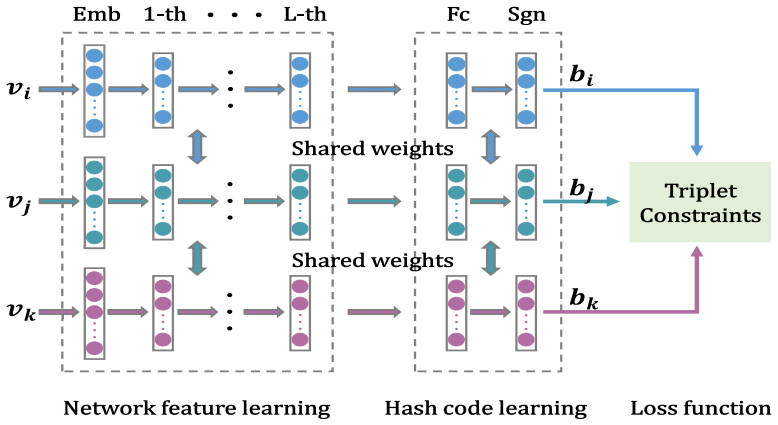
The machinery is a triplet ranking loss applied to binary hash codes, together with the identity that turns Hamming distance into an inner product: for $b_i,b_j\in\{-1,+1\}^d$, $\|b_i-b_j\|_H=\frac12(d-2\Theta_{ij})$ where $\Theta_{ij}=\frac12 b_i^\top b_j$. This identity lets the discrete Hamming loss be relaxed to a continuous objective $\sum[\Theta_{ik}-\Theta_{ij}+\delta]_+$ plus a quantization term $\eta\sum_m\|b_m-x_m\|_2^2$, so gradients can flow through a fully connected hash layer. The margin $\delta$ sets how much closer a positive pair must be than a negative pair, and a virtual node $v_0$ supplies synthetic negative references for nodes with no negative links in their 2-hop neighborhood.
What would settle it
The central claim would be settled by checking whether the code's triplet sampler draws vk from the negative graph or from the positive graph as Algorithm 1 line 5 states; if it draws from the positive graph, each triplet reduces to three near-identical positive relationships and the loss in Eq. (8) cannot encode the negative-link signal, so re-running with a corrected negative sampler should reproduce the reported AUC gain.
Extended reading notes
Core claim
On its own terms, HSNE's central claim is that negative links are usable signal, not noise, in hash-based network embedding. The method maps each node to a binary code of length d, and trains a network so that the Hamming distance between a positive pair is at least δ bits smaller than the distance between a negative pair; the objective also penalizes the quantization error between the relaxed continuous codes and their binary signs. To handle nodes whose local 2-hop neighborhood has no negative links, a virtual node v0 with a negative link to each such node supplies contrastive triplets. The reported result is that the resulting hash codes improve signed link prediction over the positive-only hashing baseline Node2Hash, and in some operators match or exceed non-hashing signed and unsigned embedding methods.
Load-bearing premise
The central premise is that each training triplet actually pairs a positive link with a negative link (or with the virtual node), so the loss can learn to pull positive pairs closer than negative pairs; if the written sampler instead draws both pairs from the positive graph, the learning signal is missing.
Editorial extensions
If this is right
- If the reported gains hold, then negative links add enough signal to make hash-based signed embedding competitive, so future hashing embedding methods should treat signed links as a first-class input rather than discarding them.
- The virtual-node construction implies that a node without local negative links can still be trained in a signed triplet framework, which lowers a practical barrier to applying signed hashing on sparse networks.
- The linear relation between Hamming distance and inner product means the method inherits the search efficiency of hash codes—approximate nearest-neighbor search in near-linear time with small storage—while preserving sign information.
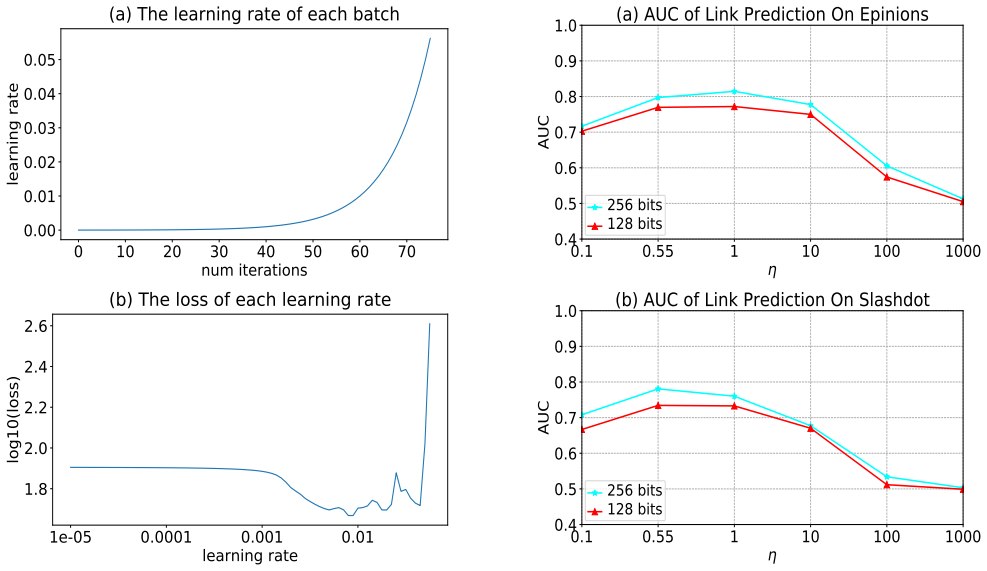
- The paper's parameter analysis shows the margin δ and the quantization weight η need tuning per network density; on sparse Slashdot the method is more sensitive to these choices, so real deployments would need per-network calibration.
Reading between the lines
- The paper's triplet sampler is written inconsistently: the problem definition and approach text want vk to be a negative-link neighbor, but Algorithm 1 line 5 draws vk from the positive graph. If the implementation follows the written rule, the loss would not be measuring positive-versus-negative ranking, and the reported results would require a corrected sampler that draws vk from the negative gr
- A natural next step the paper does not test is whether sign-aware random walks or balance-theoretic constraints, combined with the same hashing layer, would push the method closer to non-hashing signed methods like SiNE and SNE on the hadamard operator.
- The virtual-node trick could generalize to unsigned networks or heterogeneous graphs as a general way to manufacture contrastive anchors when negative supervision is absent, a consequence the paper leaves implicit.
Signed reviews
Editorial analysis
A structured set of objections, weighed in public.
Referee Report
Summary. This paper proposes HSNE, a deep hashing method for embedding nodes of a signed social network into binary codes. The method constructs triplets from signed links, feeds them through an embedding layer and three fully connected layers, and optimizes a relaxed triplet ranking loss with a quantization penalty and a virtual node for nodes that lack negative neighbors. Link prediction experiments on Epinions and Slashdot compare HSNE against Node2Hash, DeepWalk, LINE, SiNE, and SNE, and the authors report that HSNE outperforms Node2Hash, especially on Epinions, concluding that negative links improve hashing-based signed network embedding.
Significance. If the evaluation were valid, the paper would offer a useful first step: it brings deep hashing to signed network embedding and is the first hashing-based method in this line to use negative links. The relaxed triplet loss and quantization formulation are standard, and the virtual-node trick is a reasonable attempt to deal with nodes that lack negative neighbors. The reported parameter sensitivity analysis also gives practical guidance. However, the current manuscript has load-bearing inconsistencies in triplet construction and a transductive evaluation protocol, so the empirical claims are not yet supported. The core idea is defensible and correctable, which is why I recommend major revision rather than rejection.
major comments (4)
- [Approach - Problem Definition and Algorithm 1] The triplet definition is internally inconsistent. Problem Definition states that each training triplet (vi,vj,vk) satisfies eij=1 and ejk=-1, while the description of Network feature learning states eij=1 and eik=-1. Algorithm 1 line 5 selects vk as a neighbor of vi in the positive graph, which would make eik=1, not -1. With the algorithm as written, the generated triplets do not match the loss in Eq. (8), which requires the dissimilar pair to be (vi,vk). Please correct the definition or the algorithm, and make explicit whether vk is chosen from the negative graph; otherwise the training signal cannot implement the intended ranking.
- [Experiments - Link Prediction] The evaluation is transductive. Algorithm 1 takes the full graph G=(V,E) as input, so the embeddings used in the link-prediction experiment are learned from all edges, including those that later appear in the test folds of the 10-fold cross-validation. The paper does not state that embeddings are recomputed on each training fold. Because HSNE is the only method whose embedding stage consumes negative links, its higher AUC on negative test edges may be caused by memorization rather than by learning a generalizable representation. Please rerun the comparison with an inductive protocol, or otherwise show that test edges are excluded from triplet construction.
- [Results and Discussion - Table 2] HSNE and Node2Hash differ not only in the use of negative links but also in architecture (deep versus shallow) and objective function, so Table 2 alone cannot isolate the effect of negative links. The paper's conclusion that negative links help improve performance requires an ablation of HSNE trained on positive links only; the current experiments do not provide one.
- [Parameter Analysis] The hyperparameters (lr, delta, delta0, eta, L) are selected by inspecting AUC on the same datasets and with the same metric reported in Table 2, as shown in Figures 3-4 and Table 5. This selection bias is compounded by the leakage in the evaluation protocol and makes the reported gains difficult to interpret. Please use a validation split or an independent tuning procedure and report the corresponding test AUC.
minor comments (4)
- [Algorithm 1] The pseudocode reuses the index vj in the outer and inner loops, which is confusing; please rename the loop variables, e.g., 'for vi in positive graph' and 'for vj in neighbors of vi'.
- [Eq. (8)] The objective is optimized over x0 and b0, but the quantization term only sums over m=1,...,M; please clarify whether the virtual node's hash code is exempt from quantization and why.
- [Tables 2-4] The tables report only point estimates of AUC; adding standard deviations or a small number of repeated runs would make the comparison more convincing.
- [Table 2] For HSNE, the l1 and l2 columns are exactly equal on both datasets; if these are rounded averages, please provide more precision or note the coincidence.
Circularity Check
Reported AUC gains are fit-quality scores because HSNE trains on the full signed graph and then 'predicts' the same edges.
-
fitted input called prediction
[Experiments (Link Prediction) and Algorithm 1 (Training Stage of HSNE)]
"Algorithm 1 Training Stage of HSNE Require: Graph: G = (V,E) ... for vj in positive graph do for vj neighbors vi in positive graph do ... Put (vi,vj,vk) in T ... Compute the triplet loss and quantization error using Eq. (8). ... we first use node representation to compose link representations ... a one-vs-rest logistic regression classifier is trained by 10-fold cross validation to predict whether there is a positive or negative links between two nodes."
The paper's only described embedding training, Algorithm 1, consumes the full signed graph G=(V,E) to construct triplets and optimize Eq. (8); no train/test split is applied to the embedding stage. The link-prediction section then builds link features from those node representations and applies 10-fold cross-validation only to the logistic regression classifier. As written, edges in the held-out folds were already used to shape the Hamming distances that define the link features. Since HSNE is the only method whose training triplets include negative links, the reported AUC advantage over Node2Hash partly measures memorization of the signed edges rather than generalization from negative links. The predicted edge signs are thus fitted inputs renamed as predictions.
full rationale
The paper is empirical rather than a formal derivation chain, and I find no self-citation or uniqueness-theorem circularity: the method is a standard combination of triplet ranking loss, hashing relaxation, and a virtual node, with the external citations used as component tools rather than load-bearing self-support. The one significant circularity is evaluation leakage in the central performance claim. Algorithm 1 trains HSNE on the entire signed graph, including all positive and negative edges, and the link-prediction experiment does not state that embeddings are recomputed on each training fold. Consequently, the 10-fold cross-validation applies only to the classifier, while the embedding features already encode the signs of the edges being predicted. That converts the reported AUC values into fit-quality measures, especially for the negative-link signal that is the paper's claimed contribution. There is also a separate, non-circular correctness flaw: the problem definition says triplets require eij=1 and ejk=-1, yet the approach text says eik=-1 and Algorithm 1 line 5 selects vk as a neighbor of vi in the positive graph, which would not produce the required negative pair. In addition, hyperparameters are selected using the same AUC metric on the same datasets, so the reported numbers are also tuned values. These issues do not make the derivation circular by definition, but they do mean the headline comparison against Node2Hash is not a valid held-out prediction experiment. For these reasons, I assign a score of 6 rather than a higher score: there is a real algorithm and the overlap between training and test edges is partial rather than a direct equation-level identity.
Assumptions & free parameters
free parameters (8)
- hash code dimension d =
256
- embedding layer dimension d0 =
200
- hidden layer dimensions di =
320 for each of L=3 layers
- margin delta =
24 on Epinions, 16 on Slashdot
- virtual node margin delta0 =
12 on Epinions, 8 on Slashdot
- quantization weight eta =
40 on Epinions, 0.55 on Slashdot
- learning rate lr =
0.009
- regularization weight alpha =
not reported
assumptions (4)
- domain assumption Positive links indicate similarity and negative links indicate dissimilarity in signed networks.
- domain assumption Triplet labels from (vi, vj, vk) with eij=1 and eik=-1 are a sufficient supervision signal for embedding learning.
- ad hoc to paper A virtual node v0 with negative links to nodes lacking negative neighbors preserves the triplet structure.
- standard math The logistic regression on composed link representations measures embedding quality for link prediction.
invented entities (1)
-
virtual node v0
Cite this review
Pith. "Pith review of Deep Hashing for Signed Social Network Embedding." pith.science (2026). https://pith.science/paper/5Q7L3SLV
@misc{pith2026190804007,
  author       = {Pith},
  title        = {Pith review of: Deep Hashing for Signed Social Network Embedding},
  year         = {2026},
  howpublished = {\url{https://pith.science/paper/5Q7L3SLV}},
  note         = {Machine review of arXiv:1908.04007}
}
read the original abstract
Network embedding is a promising way of network representation, facilitating many signed social network processing and analysis tasks such as link prediction and node classification. Recently, feature hashing has been adopted in several existing embedding algorithms to improve the efficiency, which has obtained a great success. However, the existing feature hashing based embedding algorithms only consider the positive links in signed social networks. Intuitively, negative links can also help improve the performance. Thus, in this paper, we propose a novel deep hashing method for signed social network embedding by considering simultaneously positive and negative links. Extensive experiments show that the proposed method performs better than several state-of-the-art baselines through link prediction task over two real-world signed social networks.
Figures

Reference graph
Works this paper leans on
-
[1]
write newline
" write newline "" before.all 'output.state := FUNCTION fin.entry add.period write newline FUNCTION new.block output.state before.all = 'skip after.block 'output.state := if FUNCTION new.sentence output.state after.block = 'skip output.state before.all = 'skip after.sentence 'output.state := if if FUNCTION not #0 #1 if FUNCTION and 'skip pop #0 if FUNCTIO...
-
[2]
Cao, S.; Lu, W.; and Xu, Q. 2016. Deep neural networks for learning graph representations. In AAAI , 1145--1152
work page 2016
-
[3]
Getoor, L., and Diehl, C. P. 2005. Link mining: a survey. Acm Sigkdd Explorations Newsletter 7(2):3--12
work page 2005
-
[4]
Grover, A., and Leskovec, J. 2016. node2vec: Scalable feature learning for networks. In Proceedings of the 22nd ACM SIGKDD international conference on Knowledge discovery and data mining , 855--864. ACM
work page 2016
-
[5]
Hamilton, W. L.; Ying, R.; and Leskovec, J. 2017. Representation learning on graphs: Methods and applications. arXiv preprint arXiv:1709.05584
arXiv 2017
-
[6]
E.; Krizhevsky, A.; and Wang, S
Hinton, G. E.; Krizhevsky, A.; and Wang, S. D. 2011. Transforming auto-encoders. In International Conference on Artificial Neural Networks , 44--51. Springer
work page 2011
-
[7]
Indyk, P., and Motwani, R. 1998. Approximate nearest neighbors: towards removing the curse of dimensionality. In Proceedings of the thirtieth annual ACM symposium on Theory of computing , 604--613. ACM
work page 1998
-
[8]
Leskovec, J.; Huttenlocher, D.; and Kleinberg, J. 2010. Predicting positive and negative links in online social networks. In Proceedings of the 19th international conference on World wide web , 641--650. ACM
work page 2010
Show all 30 references
-
[9]
Li, W.-J.; Wang, S.; and Kang, W.-C. 2015. Feature learning based deep supervised hashing with pairwise labels. arXiv preprint arXiv:1511.03855
2015 arXiv
-
[10]
Liben-Nowell, D., and Kleinberg, J. 2007. The link-prediction problem for social networks. Journal of the American society for information science and technology 58(7):1019--1031
2007
-
[11]
L \"u , L., and Zhou, T. 2011. Link prediction in complex networks: A survey. Physica A: statistical mechanics and its applications 390(6):1150--1170
2011
-
[12]
J.; and Salakhutdinov, R
Norouzi, M.; Fleet, D. J.; and Salakhutdinov, R. R. 2012. Hamming distance metric learning. In Advances in neural information processing systems , 1061--1069
2012
-
[13]
Ou, M.; Cui, P.; Pei, J.; Zhang, Z.; and Zhu, W. 2016. Asymmetric transitivity preserving graph embedding. In Proceedings of the 22nd ACM SIGKDD international conference on Knowledge discovery and data mining , 1105--1114. ACM
2016
-
[14]
Perozzi, B.; Al-Rfou, R.; and Skiena, S. 2014. Deepwalk: Online learning of social representations. In Proceedings of the 20th ACM SIGKDD international conference on Knowledge discovery and data mining , 701--710. ACM
2014
-
[15]
Salakhutdinov, R., and Hinton, G. 2009. Semantic hashing. International Journal of Approximate Reasoning 50(7):969--978
2009
-
[16]
Sen, P.; Namata, G.; Bilgic, M.; Getoor, L.; Galligher, B.; and Eliassi-Rad, T. 2008. Collective classification in network data. AI magazine 29(3):93
2008
-
[17]
Smith, L. N. 2017. Cyclical learning rates for training neural networks. In Applications of Computer Vision (WACV), 2017 IEEE Winter Conference on , 464--472. IEEE
2017
-
[18]
Tang, J.; Qu, M.; Wang, M.; Zhang, M.; Yan, J.; and Mei, Q. 2015. Line: Large-scale information network embedding. In Proceedings of the 24th International Conference on World Wide Web , 1067--1077. International World Wide Web Conferences Steering Committee
2015
-
[19]
Tang, J.; Hu, X.; and Liu, H. 2014. Is distrust the negation of trust?: the value of distrust in social media. In Proceedings of the 25th ACM conference on Hypertext and social media , 148--157. ACM
2014
-
[20]
T.; Song, J.; and Ji, J
Wang, J.; Shen, H. T.; Song, J.; and Ji, J. 2014. Hashing for similarity search: A survey. arXiv preprint arXiv:1408.2927
2014 arXiv
-
[21]
Wang, S.; Tang, J.; Aggarwal, C.; Chang, Y.; and Liu, H. 2017a. Signed network embedding in social media. In Proceedings of the 2017 SIAM international conference on data mining , 327--335. SIAM
2017
-
[22]
Wang, X.; Cui, P.; Wang, J.; Pei, J.; Zhu, W.; and Yang, S. 2017b. Community preserving network embedding. In AAAI , 203--209
-
[23]
T.; et al
Wang, J.; Zhang, T.; Sebe, N.; Shen, H. T.; et al. 2018a. A survey on learning to hash. IEEE transactions on pattern analysis and machine intelligence 40(4):769--790
-
[24]
Wang, Q.; Wang, S.; Gong, M.; and Wu, Y. 2018b. Feature hashing for network representation learning. In IJCAI , 2812--2818
-
[25]
Wang, D.; Cui, P.; and Zhu, W. 2016. Structural deep network embedding. In Proceedings of the 22nd ACM SIGKDD international conference on Knowledge discovery and data mining , 1225--1234. ACM
2016
-
[26]
Wang, X.; Shi, Y.; and Kitani, K. M. 2016. Deep supervised hashing with triplet labels. In Asian Conference on Computer Vision , 70--84. Springer
2016
-
[27]
Wu, W.; Li, B.; Chen, L.; and Zhang, C. 2018. Efficient attributed network embedding via recursive randomized hashing. In IJCAI , volume 18, 2861--2867
2018
-
[28]
Yuan, S.; Wu, X.; and Xiang, Y. 2017. Sne: signed network embedding. In Pacific-Asia conference on knowledge discovery and data mining , 183--195. Springer
2017
-
[29]
Zhang, P.; Zhang, W.; Li, W.-J.; and Guo, M. 2014. Supervised hashing with latent factor models. In Proceedings of the 37th international ACM SIGIR conference on Research & development in information retrieval , 173--182. ACM
2014
-
[30]
Zhao, F.; Huang, Y.; Wang, L.; and Tan, T. 2015. Deep semantic ranking based hashing for multi-label image retrieval. In Proceedings of the IEEE conference on computer vision and pattern recognition , 1556--1564
2015
Reviewed August 14, 2026 · model on record in the stance chip above.
Discussion (0). Continue with ORCID to comment.