REVIEW 4 major objections 6 minor 33 references
Point Cloud Recombination: Systematic Real Data Augmentation Using Robotic Targets for LiDAR Perception Validation
T0 review · 4 major / 6 minor · reviewed 2026-08-16 · deepseek-v4-flash
Pith's one-line read Point Cloud Recombination mixes laboratory-measured LiDAR objects into real scenes to build controlled, sensor-realistic validation data.
desk verdict Useful, clearly written augmentation pipeline for LiDAR validation, but the central claim currently rests on an evaluation that reuses the reference object points; needs an end-to-end lab-to-scene test. read the letter →
The pith
A machine-rendered reading of the paper's core claim, the machinery that carries it, and where it could break.
The reading
What carries the argument
The load-bearing mechanism is the mesh-to-point-cloud registration plus raycasting occlusion pipeline. A 3D mesh of each target object, reconstructed from 360-degree drone imagery, is aligned to the object's laboratory point cloud by repeated ICP runs with rotational sampling around the vertical axis, scored by Chamfer distance. Once registered, the mesh is placed in a sensor-centered virtual scene and rays are cast from each scene point toward the sensor origin; points whose rays intersect the mesh are removed, and the measured object point cloud is concatenated into the filtered scene. Using the mesh instead of the point cloud for occlusion lets the method survive sparse or distorted real points, such as the point cancellation caused by reflective clothing.
What would settle it
Capture a target object in the laboratory, insert it into a real scene scan with PCR, then physically place the same object at the same position and take a reference scan; if the recombined-versus-reference Chamfer distance and F1 score exceed the scan-to-scan noise baseline by a meaningful margin, the interchangeability assumption fails and the claimed validation fidelity is not established.
Extended reading notes
Core claim
The central claim is that physically measured object point clouds, captured in the laboratory with the same LiDAR sensor and mounted at the same height, can be recombined into real scene scans to produce repeatable, physically accurate test data that a perception system cannot reliably distinguish from data taken with the object physically present. The paper supports this by showing that a recombined scene, consisting of the original scene with occluded points removed and the measured object points re-inserted, has low Chamfer distance, low RMSE, and an F1 score near 99% against the real reference scan, with deviations comparable to the sensor's own scan-to-scan noise. The method is designed for validation rather than training: every insertion is accompanied by metadata for automatic bounding-box labels, and insertion maps constrain placements to plausible regions.
Load-bearing premise
The method assumes that a point cloud of a target object captured separately in the laboratory is interchangeable with the same object as it would appear in a real scene, including its intensity values, noise level, and geometry; if lab and real acquisition conditions differ enough, the recombined scene's similarity to real data is not guaranteed.
Editorial extensions
If this is right
- Engineers can generate large numbers of realistic test scenes from a small set of laboratory measurements by varying object placement, pose, clothing, and props while holding the background constant.
- Perception failures can be attributed to object properties, scene context, or their combination, because only one factor changes at a time.
- Rare safety-critical pedestrian states, such as falling, crouching, or reflective clothing, can be tested at scale without staging them on real roads.
- Validation data stays within the plausible output range of the real sensor, so conclusions about detector limitations transfer to real deployment better than simulator-generated tests do.
- The same pipeline can produce automatically labeled test data for 3D object detection on sensors that lack public datasets.
Reading between the lines
- Not tested in the paper, but implied by its claim: an object point cloud captured independently in the lab, rather than extracted from the reference scan, should produce the same close match against a real scene with the object physically present.
- If the interchangeability holds, the pipeline should transfer to other material-sensitive sensors, such as radar or thermal imaging, that have the same requirement for a measured object signature plus a registered mesh for occlusion.
- A cheap falsifying variant is deliberately corrupting the object point cloud while keeping the mesh intact: the occlusion region should remain unchanged, because the mesh, not the points, carries the occlusion geometry.
Signed reviews
Editorial analysis
A structured set of objections, weighed in public.
Referee Report
Summary. This paper proposes Point Cloud Recombination (PCR), a method for augmenting real LiDAR scenes by inserting point clouds of physical target objects acquired in a controlled laboratory environment, using registered 3D meshes to compute plausible occlusions via raycasting. The method is intended to support systematic validation of LiDAR perception, with three requirements: fixed sensor mounting, object placement within measured radial distance, and compatibility checks. The authors describe an automated lab setup with a mobile robot for positioning humanoid dummies, drone-based mesh reconstruction, ICP-based mesh-to-point-cloud registration, and occlusion-aware point removal. They evaluate the approach with an Ouster OS1-128 Rev7 sensor on urban and rural scenes, reporting Chamfer distances between 0.0006 and 0.0161, F1-scores around 99%, and a Noise Reference baseline of 0.0003.
Significance. The idea of recombining real measured data with mesh-based occlusion modeling is valuable and offers a promising middle ground between virtual simulation and real-world testing. If the central claim of high fidelity under full lab-to-scene transfer were established, PCR would be relevant for validation of LiDAR perception. The paper provides clear algorithmic pseudocode (Algorithms 1–3), a detailed application description, and it is honest about limitations such as transparent surfaces and moderate weather. The careful motivation for controlled, repeatable augmentation is a strength. However, the evaluation as presented does not yet demonstrate the central claim of close matching between recombined scenes and real sensor outputs.
major comments (4)
- [VI, Table I] The evaluation protocol in Section VI is circular with respect to the paper's central claim. The recombined scene is constructed by 'inserting the measured object points from the reference' into the object-free scan, and then evaluated against that same reference scan. Consequently, the object points in the reference and recombined clouds are identical by construction, and the reported Chamfer distances (0.0006–0.0161), RMSE values, and F1-scores (98.81%–99.70%) quantify only the accuracy of the mesh-based occlusion removal, not the fidelity of the full PCR pipeline. The abstract's statement that 'recombined scenes closely match real sensor outputs' is therefore not supported by this experiment. To substantiate the claim, the authors should insert an independently captured laboratory object PCD into the scene and compare the result against a real reference scan with the object physically present, reporting geometry and intensity differences.
- [IV, Req 2] Requirement 2 assumes that an object point cloud captured in the laboratory is interchangeable with the object as it would appear in the real scene at the same radial distance and pose. This assumption is never tested. The evaluation in Section VI uses object points measured in situ, so it cannot reveal whether laboratory acquisition introduces differences in geometry, intensity, noise, or dropout behavior. Since the paper's method explicitly relies on lab-acquired object PCDs (PCR 2.b) and its motivation includes physical sensor realism such as intensity, the authors should provide a controlled experiment comparing lab-captured and in-situ object PCDs at matched distances, including intensity residual statistics.
- [VI, Noise Reference] The Noise Reference baseline is defined as the difference between two scans of the same static scene taken seconds apart, yielding a Chamfer distance of 0.0003. While this bounds sensor noise in a static scene, it does not bound the variation introduced by the full PCR process, because that process adds a lab-acquired object point cloud with different noise and dropout characteristics. Using this baseline to argue that PCR deviations are 'indistinguishable' from real scans is therefore not valid without also measuring the lab-to-field object transfer variation. Additionally, only a single scan pair per background is reported; there are no error bars or repeated acquisitions, so the reported metrics may not be stable.
- [IV, PCR 4.a; Algorithm 1] The text in Section IV states that 'the mesh is scaled to match the height of the point cloud,' but Algorithm 1 contains no scaling step: it applies only rotations around the Z-axis and two-stage ICP with translational/rotational alignment. This discrepancy makes the registration procedure as described unreproducible, and because the subsequent occlusion handling depends on the mesh being correctly aligned, the missing scale step is not a cosmetic detail. The authors should either add the scale estimation to Algorithm 1 or clarify where scaling is performed.
minor comments (6)
- [IV] Inconsistent labels: PCR 4.a), PCR 4.b), but 'PCR-4.C)' appears in Section IV; standardize to a single numbering convention.
- [VI, Table I] The 'Noise Reference' row is a baseline, not a PCR result; move it to a separate line or label it clearly to avoid confusion.
- [IV] The term 'phenomena-aware occlusions' is used without definition; define it earlier or replace it with a clearer term.
- [III-D, Eq. (7)] Equation (7) defines Chamfer Distance with squared distances, which makes the reported values less interpretable than RMSE in meters; consider using the symmetric mean of nearest-neighbor distances.
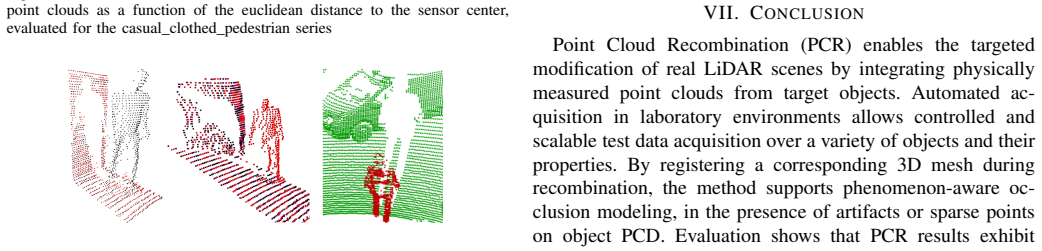
- [VI, Figure 7] Figure 7 is dense and the color coding (black, red, green) is not described in the caption; add a legend to make the pruned results interpretable.
- [VII] The conclusion's phrase 'deliberately dancing between virtuality and reality' is informal and should be revised for a technical venue.
Circularity Check
Section VI evaluation inserts the reference scan's own object points into the recombined scene, so the reported 'closely match real sensor outputs' is forced on the object region by construction.
-
self definitional
[Section VI, Evaluation, second paragraph (paragraph beginning 'Secondly, the evaluation addresses...')]
"A reference scan is taken with the object present, followed by a second, object-free scan used as input for the recombination process. The object region is replaced by inserting the measured object points from the reference and applying occlusion modeling based on a drone-derived mesh."
The recombined cloud's object points are literally the reference cloud's object points, so the Table I comparison cannot measure whether a separately captured laboratory object PCD reproduces the object as it would appear in a real scene. All reported Chamfer, Hausdorff, RMSE, and F1 values therefore primarily test occlusion removal on the background, while the central claim of 'closely match real sensor outputs' for the inserted object is true by construction. Req 2 and Algorithm 3 assume interchangeability of lab and in-situ object acquisitions, but that assumption is never tested.
full rationale
The paper's core technical contribution is a pipeline for inserting laboratory-measured object point clouds into real scenes with mesh-based occlusion handling. The evaluation does test the occlusion-handling component independently: an object-free scene is recombined and compared to a reference scene containing the object, so if the object-free background points behind the object are not removed correctly, the metrics would degrade. However, the evaluation uses 'the measured object points from the reference' as the inserted object, which makes the object signal identical in both clouds by construction. The headline quantitative claim that recombined scenes 'closely match real sensor outputs' is therefore only demonstrated for the occlusion-editing of the background, not for the central scenario of inserting a separately captured laboratory object PCD, whose geometry, intensity, noise, and dropout statistics are asserted to be interchangeable (Req 2) but never independently verified. A secondary point: the registration evaluation reports the 'best Chamfer Distance which is already part of the algorithm,' i.e., the same objective minimized during ICP and rotational sampling, so it is a residual rather than an independent accuracy measure. No self-citation chain or imported uniqueness theorem is load-bearing here. Score is 6 rather than higher because the occlusion handling on the scene side is an independent, non-circular component and the paper is transparent about limitations; the circularity is confined to the object-side fidelity claim that supports the abstract's 'closely match real sensor outputs' statement.
Assumptions & free parameters
free parameters (4)
- Rotational sampling divisor d
- Two-stage ICP convergence thresholds =
[0.1, 0.05]
- F1 threshold tau
- Surface variation adaptive radius settings
assumptions (5)
- domain assumption ICP with rotational sampling finds a globally correct mesh-to-point-cloud alignment.
- domain assumption The photogrammetrically reconstructed mesh is an adequate geometric proxy for occlusion by the physical object as seen by LiDAR.
- domain assumption Raycasting from each scene point to the sensor origin through the mesh correctly models LiDAR occlusion, even where the object PCD has artifacts.
- domain assumption Laboratory-captured object PCD and real-scene PCD from the same sensor are interchangeable in intensity, noise, and geometry.
- standard math Standard metric definitions for Chamfer distance, Hausdorff distance, RMSE, and F1 score are correct mathematical background.
Cite this review
Pith. "Pith review of Point Cloud Recombination: Systematic Real Data Augmentation Using Robotic Targets for LiDAR Perception Validation." pith.science (2026). https://pith.science/paper/5QD6NKOA
@misc{pith2026250502476,
  author       = {Pith},
  title        = {Pith review of: Point Cloud Recombination: Systematic Real Data Augmentation Using Robotic Targets for LiDAR Perception Validation},
  year         = {2026},
  howpublished = {\url{https://pith.science/paper/5QD6NKOA}},
  note         = {Machine review of arXiv:2505.02476}
}
read the original abstract
The validation of LiDAR-based perception of intelligent mobile systems operating in open-world applications remains a challenge due to the variability of real environmental conditions. Virtual simulations allow the generation of arbitrary scenes under controlled conditions but lack physical sensor characteristics, such as intensity responses or material-dependent effects. In contrast, real-world data offers true sensor realism but provides less control over influencing factors, hindering sufficient validation. Existing approaches address this problem with augmentation of real-world point cloud data by transferring objects between scenes. However, these methods do not consider validation and remain limited in controllability because they rely on empirical data. We solve these limitations by proposing Point Cloud Recombination, which systematically augments captured point cloud scenes by integrating point clouds acquired from physical target objects measured in controlled laboratory environments. Thus enabling the creation of vast amounts and varieties of repeatable, physically accurate test scenes with respect to phenomena-aware occlusions with registered 3D meshes. Using the Ouster OS1-128 Rev7 sensor, we demonstrate the augmentation of real-world urban and rural scenes with humanoid targets featuring varied clothing and poses, for repeatable positioning. We show that the recombined scenes closely match real sensor outputs, enabling targeted testing, scalable failure analysis, and improved system safety. By providing controlled yet sensor-realistic data, our method enables trustworthy conclusions about the limitations of specific sensors in compound with their algorithms, e.g., object detection.
Figures


Figures from the paper (4 more)


Reference graph
Works this paper leans on
-
[1]
Deep learning for lidar point clouds in autonomous driving: A review,
Y . Li, L. Ma, Z. Zhong, F. Liu, M. A. Chapman, D. Cao, and J. Li, “Deep learning for lidar point clouds in autonomous driving: A review,” IEEE Transactions on Neural Networks and Learning Systems , vol. 32, no. 8, pp. 3412–3432, 2021
work page 2021
-
[2]
Cocar nextgen: a multi-purpose platform for connected autonomous driving research,
M. Heinrich, M. Zipfl, M. Uecker, S. Ochs, M. Gontscharow, T. Fleck, J. Doll, P. Schörner, C. Hubschneider, M. R. Zofka, A. Viehl, and J. M. Zöllner, “Cocar nextgen: a multi-purpose platform for connected autonomous driving research,” 2024. [Online]. Available: https://arxiv.org/abs/2404.17550
arXiv 2024
-
[3]
Robdekon: Robotic systems for decontamination in hazardous environments,
J. Petereit, J. Beyerer, T. Asfour, S. Gentes, B. Hein, U. D. Hanebeck, F. Kirchner, R. Dillmann, H. H. Götting, M. Weiser, M. Gustmann, and T. Egloffstein, “Robdekon: Robotic systems for decontamination in hazardous environments,” in IEEE International Symposium on Safety, Security, and Rescue Robotics (SSRR) , 2019
work page 2019
-
[4]
Recent trends in mobile robotics for 3d mapping in agriculture,
D. Tiozzo Fasiolo, L. Scalera, E. Maset, and A. Gasparetto, “Recent trends in mobile robotics for 3d mapping in agriculture,” in Advances in Service and Industrial Robotics , A. Müller and M. Brandstötter, Eds. Cham: Springer International Publishing, 2022, pp. 428–435
work page 2022
-
[5]
Real-time 3d object detection and slam fusion in a low-cost lidar test vehicle setup,
D. Fernandes, T. Afonso, P. Girão, D. Gonzalez, A. Silva, R. Návoa, P. Novais, J. Monteiro, and P. Melo-Pinto, “Real-time 3d object detection and slam fusion in a low-cost lidar test vehicle setup,” Sensors, vol. 21, no. 24, p. 8381, 2021. [Online]. Available: https://www.mdpi.com/1424-8220/21/24/8381
work page 2021
-
[6]
Contour detection in unstructured 3d point clouds,
T. Hackel, J. D. Wegner, and K. Schindler, “Contour detection in unstructured 3d point clouds,” in Proceedings of the IEEE Conference on Computer Vision and Pattern Recognition (CVPR) , 2016, pp. 1610–
work page 2016
-
[7]
A step towards explainable artificial neural networks in image processing by dataset assessment,
N. F. Heide, A. Albrecht, and M. Heizmann, “A step towards explainable artificial neural networks in image processing by dataset assessment,” in Forum Bildverarbeitung 2020 . KIT Scientific Publishing, 2020, pp. 97–108. [Online]. Available: https://publikationen.bibliothek.kit.edu/ 1000123387
work page 2020
-
[8]
H. Padusinski, C. Steinhauser, T. Braun, L. Ries, and E. Sax, “The machine vision iceberg explained: Advancing dynamic testing by consid- ering holistic environmental relations,” in 2024 IEEE 27th International Conference on Intelligent Transportation Systems (ITSC) , 2024, pp. 70– 77
work page 2024
Show all 33 references
-
[9]
Methodology for a statistical analysis of influencing factors on 3d object detection performance,
A. Kuznietsov, D. Schweickard, and S. Peters, “Methodology for a statistical analysis of influencing factors on 3d object detection performance,” 2025. [Online]. Available: https://arxiv.org/abs/2411. 08482
2025
-
[10]
Vision meets robotics: The kitti dataset,
A. Geiger, P. Lenz, C. Stiller, and R. Urtasun, “Vision meets robotics: The kitti dataset,” International Journal of Robotics Research (IJRR) , 2013
2013
-
[11]
Scalability in perception for autonomous driving: Waymo open dataset,
P. Sun, H. Kretzschmar, X. Dotiwalla, A. Chouard, V . Patnaik, P. Tsui, J. Guo, Y . Zhou, Y . Chai, B. Caine, V . Vasudevan, W. Han, J. Ngiam, H. Zhao, A. Timofeev, S. Ettinger, M. Krivokon, A. Gao, A. Joshi, Y . Zhang, J. Shlens, Z. Chen, and D. Anguelov, “Scalability in perc...
2020
-
[12]
Noise or signal: The role of image backgrounds in object recognition,
K. Xiao, L. Engstrom, A. Ilyas, and A. Madry, “Noise or signal: The role of image backgrounds in object recognition,” in International Conference on Learning Representations (ICLR) , 2021. [Online]. Available: https://arxiv.org/abs/2006.09994
2021 arXiv
-
[13]
Imbalance problems in object detection: A review,
K. Oksuz, B. C. Cam, S. Kalkan, and E. Akbas, “Imbalance problems in object detection: A review,” IEEE Transactions on Pattern Analysis and Machine Intelligence , vol. 43, no. 10, pp. 3388–3415, 2021. [Online]. Available: https://doi.org/10.1109/TPAMI.2020.2981890
2021
-
[14]
PV-RCNN: Point-V oxel Feature Set Abstraction for 3D Object Detection,
S. Shi, Z. Wang, J. Shi, X. Wang, and H. Li, “PV-RCNN: Point-V oxel Feature Set Abstraction for 3D Object Detection,” in Proceedings of the IEEE/CVF Conference on Computer Vision and Pattern Recognition (CVPR), 2020. [Online]. Available: https://arxiv.org/abs/1912.13192
2020 arXiv
-
[15]
SqueezeSeg: Convolutional Neural Nets with Recurrent CRF for Real-Time Road-Object Segmentation from 3D LiDAR Point Cloud,
B. Wu, A. Wan, X. Yue, and K. Keutzer, “SqueezeSeg: Convolutional Neural Nets with Recurrent CRF for Real-Time Road-Object Segmentation from 3D LiDAR Point Cloud,” in IEEE International Conference on Robotics and Automation (ICRA) , 2018. [Online]. Available: https://arxiv.org...
2018 arXiv
-
[16]
BEVFusion: Multi-Task Multi-Sensor Fusion with Unified Bird's-Eye View Representation,
Z. Liu, H. Tang, A. Amini, D. Rus, and S. Han, “BEVFusion: Multi-Task Multi-Sensor Fusion with Unified Bird's-Eye View Representation,” arXiv preprint arXiv:2205.13542 , 2022. [Online]. Available: https://arxiv.org/abs/2205.13542
2022 arXiv
-
[17]
"curse of rarity
H. X. Liu and S. Feng, “"curse of rarity" for autonomous vehicles,”
-
[18]
Simulation of lidar sensors in real environmental conditions,
J. R. Vargas Rivero, “Simulation of lidar sensors in real environmental conditions,” Ph.D. dissertation, Technische Universität München, 2024. [Online]. Available: https://mediatum.ub.tum.de/1712677
2024
-
[19]
2d gaussian splatting for geometrically accurate radiance fields,
B. Huang, Z. Yu, A. Chen, A. Geiger, and S. Gao, “2d gaussian splatting for geometrically accurate radiance fields,” in Special Interest Group on Computer Graphics and Interactive Techniques Conference Conference Papers, ser. SIGGRAPH ’24. ACM, Jul. 2024, pp. 1–11. [Online]. A...
2024
-
[20]
Pharr, W
M. Pharr, W. Jakob, and G. Humphreys, Physically Based Rendering: From Theory to Implementation , 3rd ed. Morgan Kaufmann, 2016
2016
-
[21]
A survey on lidar scanning mechanisms,
T. Raj, F. H. Hashim, A. B. Huddin, M. F. Ibrahim, and A. Hussain, “A survey on lidar scanning mechanisms,” Electronics, vol. 9, no. 5, p. 741, 2020
2020
-
[22]
A methodology to model the rain and fog effect on the performance of automotive lidar sensors,
A. Haider, M. Pigniczki, S. Koyama, M. H. Köhler, L. Haas, M. Fink, M. Schardt, K. Nagase, T. Zeh, A. Eryildirim, T. Poguntke, H. Inoue, M. Jakobi, and A. W. Koch, “A methodology to model the rain and fog effect on the performance of automotive lidar sensors,” Sensors, vol. 23...
2023
-
[23]
Infrared reflectivity of pedestrian mannequin for autonomous emergency braking testing,
T. Haran and S. Chien, “Infrared reflectivity of pedestrian mannequin for autonomous emergency braking testing,” in 2016 IEEE 19th Interna- tional Conference on Intelligent Transportation Systems (ITSC) . IEEE, 2016, pp. 2230–2235
2016
-
[24]
Performance analysis of 10 models of 3d lidars for automated driving,
J. Lambert, A. Carballo, A. Monrroy, D. Wong, P. Narksri, Y . Kitsukawa, E. Takeuchi, S. Kato, and K. Takeda, “Performance analysis of 10 models of 3d lidars for automated driving,” IEEE Access , vol. 8, pp. 131 669–131 684, 2020
2020
-
[25]
6d target mover,
M. GmbH, “6d target mover,” https://www.messring.de/de/produkte/ aktive-sicherheit/6d-target-mover/, zugriff am 7. April 2025
2025
-
[26]
Modeling backscattering behavior of vulnerable road users based on high-resolution radar measurements,
S. Abadpour, “Modeling backscattering behavior of vulnerable road users based on high-resolution radar measurements,” Ph.D. dissertation, Karlsruher Institut für Technologie (KIT), 2023
2023
-
[27]
Lidar- aug: A general rendering-based augmentation framework for 3d object detection,
J. Fang, X. Zuo, D. Zhou, S. Jin, S. Wang, and L. Zhang, “Lidar- aug: A general rendering-based augmentation framework for 3d object detection,” in Proceedings of the IEEE/CVF Conference on Computer Vision and Pattern Recognition (CVPR) , June 2021, pp. 4710–4720
2021
-
[28]
Real3d-aug: Point cloud augmentation by placing real objects with occlusion handling for 3d detection and segmentation,
P. Šebek, v. Pokorný, P. Vacek, and T. Svoboda, “Real3d-aug: Point cloud augmentation by placing real objects with occlusion handling for 3d detection and segmentation,” 2022. [Online]. Available: https://arxiv.org/abs/2206.07634
2022 arXiv
-
[29]
Paved2paradise: Cost-effective and scalable lidar simulation by factoring the real world,
M. A. Alcorn and N. Schwartz, “Paved2paradise: Cost-effective and scalable lidar simulation by factoring the real world,” 2024. [Online]. Available: https://arxiv.org/abs/2312.01117
2024 arXiv
-
[30]
Training deep networks with synthetic data: Bridging the reality gap by domain randomization,
J. Tremblay, A. Prakash, D. Acuna, M. Brophy, V . Jampani, C. Anil, T. To, E. Cameracci, S. Boochoon, and S. Birchfield, “Training deep networks with synthetic data: Bridging the reality gap by domain randomization,” 2018. [Online]. Available: https: //arxiv.org/abs/1804.06516
2018 arXiv
-
[31]
Nerf: Representing scenes as neural radiance fields for view synthesis,
B. Mildenhall, P. P. Srinivasan, M. Tancik, J. T. Barron, R. Ramamoorthi, and R. Ng, “Nerf: Representing scenes as neural radiance fields for view synthesis,” 2020. [Online]. Available: https://arxiv.org/abs/2003.08934
2020 arXiv
-
[1618]
Available: https://openaccess.thecvf.com/content_cvpr_ 2016/html/Hackel_Contour_Detection_in_CVPR_2016_paper.html
[Online]. Available: https://openaccess.thecvf.com/content_cvpr_ 2016/html/Hackel_Contour_Detection_in_CVPR_2016_paper.html
2016
-
[2022]
Available: https://arxiv.org/abs/2207.02749
[Online]. Available: https://arxiv.org/abs/2207.02749
Reviewed August 16, 2026 · model on record in the stance chip above.
Discussion (0). Continue with ORCID to comment.