REVIEW 2 major objections 6 minor 25 references
Enabling hyperparameter optimization in sequential autoencoders for spiking neural data
T0 review · 2 major / 6 minor · reviewed 2026-08-14 · deepseek-v4-flash
Pith's one-line read Sequential autoencoders for spiking data can silently overfit by copying spikes through a controller bypass, and this paper shows that coordinated dropout closes that loophole and enables hyperparameter search down to a tenth of the…
desk verdict Genuine failure-mode analysis and a clean regularization trick; the 10x small-data claim needs an ablation to separate HP search from coordinated dropout. read the letter →
The pith
A machine-rendered reading of the paper's core claim, the machinery that carries it, and where it could break.
The reading
What carries the argument
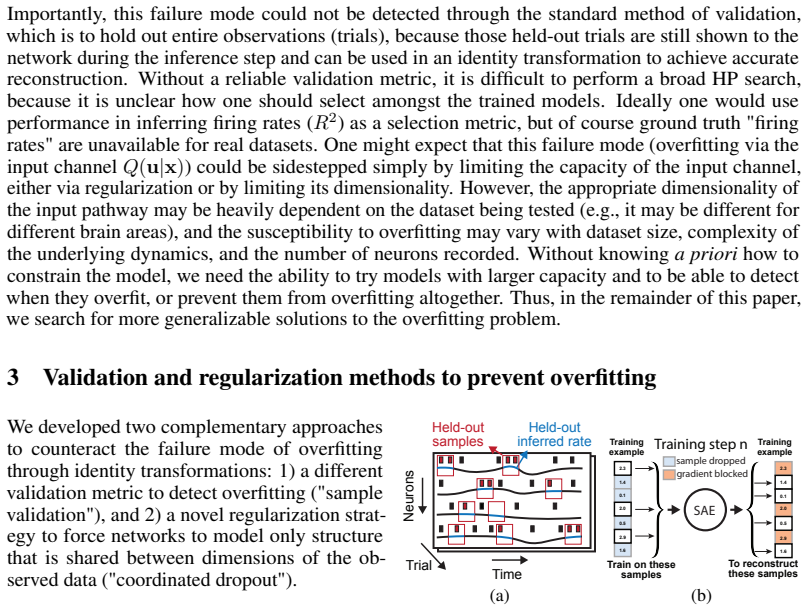
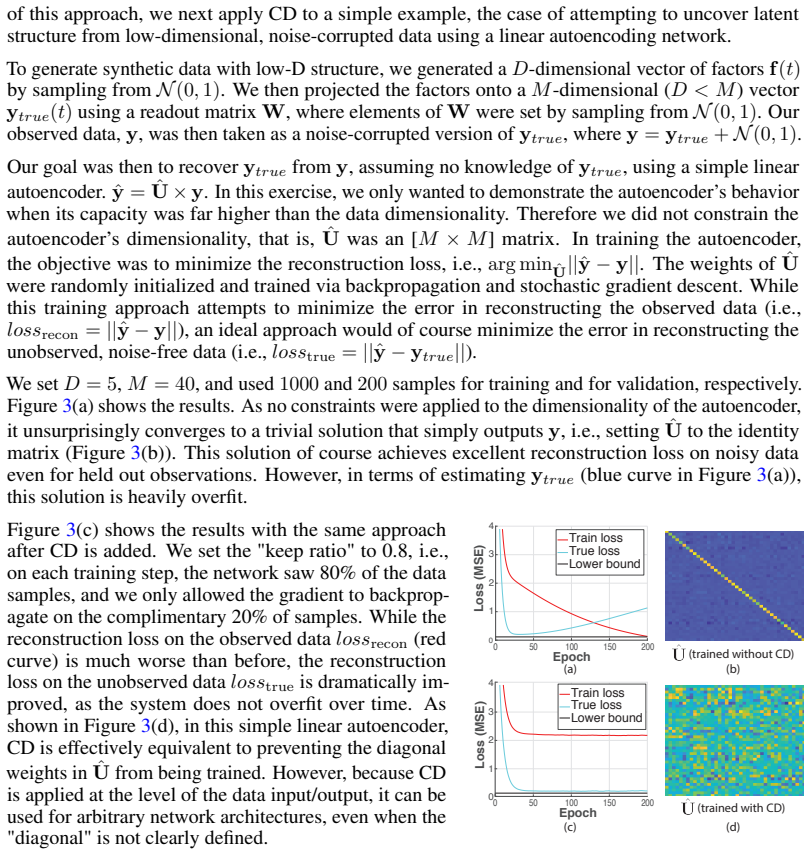
The load-bearing component is the controller input pathway of the LFADS architecture, a recurrent network that outputs a time-varying input distribution Q(u(t)|x(t)) and injects a sample into the decoder; intended to model input-driven dynamics, this pathway is the route through which the identity shortcut operates. Coordinated dropout is the central new mechanism: at each training step a random binary mask drops a subset of observed samples at the network input, and the complementary mask blocks backpropagation for exactly those samples at the output, so no sample is ever reconstructing itself. This forces the network to use structure shared across neurons and time rather than copying individual spikes. Sample validation plays the supporting role of a cross-validation scheme that holds out random individual samples in the data tensor, scores the network only on those held-out samples, and thereby gives a validation signal that the identity shortcut cannot game.
What would settle it
On the synthetic RNN dataset, train a suite of LFADS models with coordinated dropout at the paper's keep ratio and inspect the controller pathway: if any model still reconstructs held-out spike trains with high fidelity while its inferred firing-rate R2 stays near zero, the claimed prevention of identity overfitting fails. On the Monkey J Maze data, train fixed-HP models with coordinated dropout on the small subsets; if they match the HP-optimized models' decoding performance, the paper's attribution of the improvement to hyperparameter search is falsified.
Extended reading notes
Core claim
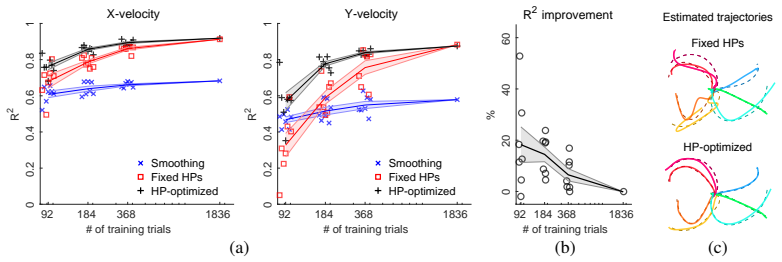
The central claim is that LFADS and similar sequential autoencoders have a specific overfitting mode—an identity-like mapping through the controller pathway Q(u|x) that reconstructs observed spikes directly—and that this mode defeats standard trial-holdout validation because held-out trials are still available to the network during inference. The paper argues that coordinated dropout prevents this shortcut by applying complementary masks at the network input and output, and that with this regularizer the standard validation loss becomes a trustworthy guide for model selection. On real motor-cortex data from a reaching task, models trained under large-scale population-based hyperparameter search with coordinated dropout maintain performance down to about 10% of the original training data, whereas models with fixed hyperparameters degrade substantially as data shrink.
Load-bearing premise
The comparison that attributes the small-data gains to hyperparameter search assumes that trained-with-coordinated-dropout fixed-HP models would not have achieved the same gains, even though the paper never runs that fixed-HP-plus-coordinated-dropout control.
Editorial extensions
If this is right
- Standard trial-holdout validation should not be trusted for LFADS-style autoencoders with an input pathway, since held-out trials remain visible during inference and can be used for self-reconstruction.
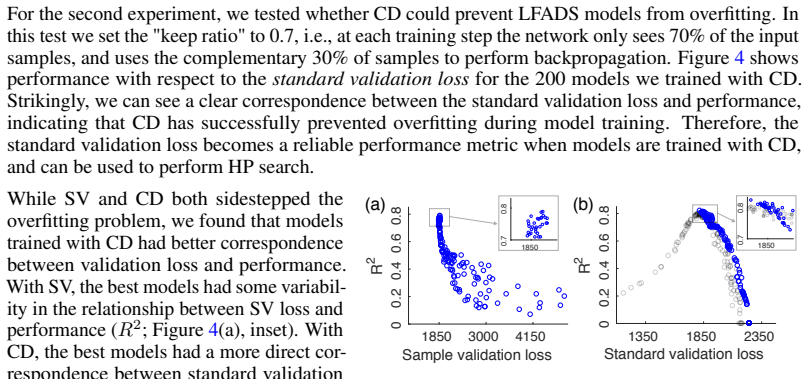
- With coordinated dropout in place, standard validation loss becomes a usable model-selection metric, so random search or population-based training can replace hand-tuning for LFADS hyperparameters.
- The real-data results imply that sequential autoencoders can remain viable when training data is scarce: performance held up to roughly a tenfold reduction in training trials when hyperparameters were optimized.
- Because coordinated dropout and sample validation operate on the data tensor rather than on a particular network layer, the same masking recipe should transfer to other autoencoder architectures applied to sparse high-dimensional data.
Reading between the lines
- A natural control the paper does not report would train fixed-HP models with coordinated dropout alone; if those matched the HP-optimized arm, the small-data gains would be regularization effects rather than search effects.
- The diagnosis of identity-overfitting suggests a general evaluation rule for autoencoders: whenever input and output are the same modality and a bypass pathway exists, check for self-reconstruction with a speckled holdout before trusting held-out-trial loss.
- A straightforward extension would anneal the coordinated-dropout keep ratio from small to near one during training, which might preserve capacity while still blocking the identity shortcut; the paper does not explore this schedule.
- The results hint at a practical protocol researchers could adopt: run hyperparameter search on a small subset of trials with coordinated dropout, then retrain the selected model on the full dataset, a two-stage procedure the paper's framework would support.
Signed reviews
Editorial analysis
A structured set of objections, weighed in public.
Referee Report
Summary. This manuscript studies hyperparameter optimization for sequential autoencoders (SAEs) applied to spiking neural population data, using the LFADS architecture as the concrete instantiation. The authors report that SAEs are prone to an overfitting mode in which the controller input pathway Q(u|x) learns to pass the observed spikes through to the reconstruction in a near-identity manner, yielding low standard validation loss while producing poor estimates of the underlying firing rates. Because held-out trials are still provided as input during inference, the standard validation loss cannot detect this failure. The paper proposes two remedies: sample validation (SV), which holds out individual neuron-time samples and uses their reconstruction loss as a cross-validated metric, and coordinated dropout (CD), which masks input samples and blocks gradients for the complementary output samples so no sample is ever used for self-reconstruction. Synthetic experiments with ground-truth rates show that both SV and CD restore a relationship between validation loss and firing-rate R2, with CD producing a tighter correspondence. On a real motor-cortex dataset, the authors combine CD with population-based training (PBT) over seven hyperparameters and report that hyperparameter-optimized models maintain decoding performance down to approximately 10-fold less training data, whereas fixed-hyperparameter models degrade.
Significance. The paper addresses a genuine and practical barrier to using LFADS-style autoencoders in neuroscience: without a reliable model-selection metric, hyperparameter search is not feasible, and with limited data the models previously performed poorly. The synthetic evaluation is well constructed because ground-truth rates allow the authors to show directly that low standard validation loss can coincide with poor firing-rate inference, and that CD restores the validation loss-performance correspondence. CD is a simple, architecture-agnostic regularizer that could generalize beyond LFADS; SV is a useful alternative to whole-trial holdout for autoencoders. If the real-data result is supported, the work would be of broad interest to researchers applying deep generative sequence models to neural data. The main caveat is that the real-data experiment currently conflates coordinated dropout with hyperparameter search and does not report a test split independent of model selection; these gaps need to be closed before the central claim is established.
major comments (2)
- [Section 4.2/4.3, Figure 5] The central real-data comparison is confounded because the fixed-hyperparameter arm is trained without coordinated dropout, while the hyperparameter-optimized arm always uses CD and includes the CD keep ratio among the searched hyperparameters (Table 1). The improvement at small dataset sizes in Figure 5(a) could therefore be entirely due to CD's regularization, and the claim that hyperparameter search enables the roughly 10-fold data reduction is not isolated. Please run a fixed-hyperparameter control with CD (e.g., with a keep ratio in the optimized range) and, if possible, a hyperparameter-search arm without CD, so that the contributions of regularization and search can be attributed separately.
- [Section 4.1/4.3/4.4] The evaluation does not define a held-out test split. The 20% validation trials are used for model selection via PBT (Section 4.3), and the velocity-decoding R2 in Section 4.4 is computed without specifying whether it uses these same validation trials or a separate test set. Using the same trials for selection and reporting biases the reported performance and weakens the comparison between fixed-HP and HP-optimized models. Please state explicitly which trials are used for the reported R2 and ensure that no trial used for selection, early stopping, or decoder fitting appears in the reported test metric.
minor comments (6)
- [Section 4.1] The text says 'we generated seven separate datasets' but then gives the example '5 draws of 115 trials'; please clarify the number of random draws for each subsample.
- [Section 4.3/Table 1] The PBT population size, number of generations, exploration/exploitation schedule, and early-stopping criterion are not reported, which makes the large-scale search hard to reproduce. Please add these details.
- [Section 3.1/Figure 2] The sample-validation procedure would benefit from a precise pseudo-code description, including how the 20% held-out fraction is sampled and how the input scaling compensates for zeroed samples.
- [Section 3.3/Figure 4] The insets in Figure 4(a) and (b) are not self-explanatory; the caption should define their axes and state what is shown.
- [Section 2.2/Figure 1] Because the paper's claim is that standard validation loss is unreliable, reporting the Spearman rank correlation between validation loss and R2 for Figures 1 and 4 would make the comparison quantitative.
- [Section 4.4] The '10-fold reduction' statement should be tied to the actual training-trial counts (184 vs. 1836, or 115 vs. 2296 if full trials are meant) rather than presented only as a round multiplier.
Circularity Check
No significant circularity: the central claims are validated against external ground-truth and behavioral metrics, and the new methods are not defined in terms of the quantities they are used to predict.
full rationale
The paper's main claims are grounded in external benchmarks rather than in the quantities being optimized. The overfitting failure mode is demonstrated on a synthetic RNN dataset with known ground-truth firing rates, and sample validation and coordinated dropout are evaluated by their correlation with ground-truth R2 (Figures 1, 3, and 4), not merely by the same validation loss used for model selection. On real data, PBT selects hyperparameters using standard reconstruction validation loss, but the reported performance metric is a separate behavioral measure: hand-velocity decoding R2 computed by optimal linear estimation with 5-fold cross-validation. Thus the prediction is not forced by the selection objective by construction. The real-data comparison between fixed-HP and HP-optimized models does not include a fixed-HP arm trained with coordinated dropout, so CD and HP search are confounded, but that is an experimental ablation gap rather than a circular reduction: no equation or fitted parameter is reused as the target result. Self-citations to prior LFADS work [10, 12] provide the architecture and baseline hand-tuned hyperparameters, but the novel contributions (SV, CD, and their validation-loss reliability claims) are tested against independent synthetic and behavioral outcomes, so the self-citations are not load-bearing in a circular sense. No step in the derivation defines a claimed result in terms of that same result or renames a fitted input as a prediction.
Assumptions & free parameters
free parameters (3)
- CD keep ratio =
0.7 (synthetic RNN); 0.8 (linear toy); searched 0.3-0.99 in PBT
- PBT hyperparameter search ranges =
L2 Gen/Con (5,5e4), KL IC/CO (0.05,5), dropout (0,0.7), keep ratio (0.3,0.99), learning rate (1e-5,0.02)
- Fixed-HP baseline values =
Not reproduced in text; refers to [12] Supp. Table 1, CursorJump
assumptions (5)
- domain assumption Spiking data are generated by inhomogeneous Poisson processes with underlying rates, and the reconstruction loss is the Poisson log-likelihood.
- domain assumption Observed neural activity lies on a lower-dimensional subspace, so forcing the network to use only shared structure is a valid regularizer.
- domain assumption The synthetic RNN dataset is representative of real neural dynamics.
- domain assumption Velocity decoding R2 is a valid proxy for quality of inferred firing rates and latent dynamics.
- domain assumption CursorJump hyperparameters from a different task are a reasonable default for the Maze dataset.
Cite this review
Pith. "Pith review of Enabling hyperparameter optimization in sequential autoencoders for spiking neural data." pith.science (2026). https://pith.science/paper/5QXW6K3E
@misc{pith2026190807896,
  author       = {Pith},
  title        = {Pith review of: Enabling hyperparameter optimization in sequential autoencoders for spiking neural data},
  year         = {2026},
  howpublished = {\url{https://pith.science/paper/5QXW6K3E}},
  note         = {Machine review of arXiv:1908.07896}
}
read the original abstract
Continuing advances in neural interfaces have enabled simultaneous monitoring of spiking activity from hundreds to thousands of neurons. To interpret these large-scale data, several methods have been proposed to infer latent dynamic structure from high-dimensional datasets. One recent line of work uses recurrent neural networks in a sequential autoencoder (SAE) framework to uncover dynamics. SAEs are an appealing option for modeling nonlinear dynamical systems, and enable a precise link between neural activity and behavior on a single-trial basis. However, the very large parameter count and complexity of SAEs relative to other models has caused concern that SAEs may only perform well on very large training sets. We hypothesized that with a method to systematically optimize hyperparameters (HPs), SAEs might perform well even in cases of limited training data. Such a breakthrough would greatly extend their applicability. However, we find that SAEs applied to spiking neural data are prone to a particular form of overfitting that cannot be detected using standard validation metrics, which prevents standard HP searches. We develop and test two potential solutions: an alternate validation method ("sample validation") and a novel regularization method ("coordinated dropout"). These innovations prevent overfitting quite effectively, and allow us to test whether SAEs can achieve good performance on limited data through large-scale HP optimization. When applied to data from motor cortex recorded while monkeys made reaches in various directions, large-scale HP optimization allowed SAEs to better maintain performance for small dataset sizes. Our results should greatly extend the applicability of SAEs in extracting latent dynamics from sparse, multidimensional data, such as neural population spiking activity.
Figures

Figures from the paper (2 more)
Reference graph
Works this paper leans on
-
[1]
Empirical models of spiking in neural populations
Jakob H Macke, Lars Buesing, John P Cunningham, M Yu Byron, Krishna V Shenoy, and Maneesh Sahani. Empirical models of spiking in neural populations. In Advances in neural information processing systems, pages 1350–1358, 2011
work page 2011
-
[2]
Lars Buesing, Jakob H Macke, and Maneesh Sahani. Spectral learning of linear dynamics from generalised-linear observations with application to neural population data. In Advances in neural information processing systems, pages 1682–1690, 2012
work page 2012
-
[3]
Linear dynamical neural population models through nonlinear embeddings
Yuanjun Gao, Evan W Archer, Liam Paninski, and John P Cunningham. Linear dynamical neural population models through nonlinear embeddings. In Advances in neural information processing systems, pages 163–171, 2016
work page 2016
-
[4]
Bayesian learning and inference in recurrent switching linear dynamical systems
Scott Linderman, Matthew Johnson, Andrew Miller, Ryan Adams, David Blei, and Liam Paninski. Bayesian learning and inference in recurrent switching linear dynamical systems. In Artificial Intelligence and Statistics, pages 914–922, 2017
work page 2017
-
[5]
Learning structured neural dynamics from single trial population recording
Josue Nassar, Scott W Linderman, Yuan Zhao, Mónica Bugallo, and Il Memming Park. Learning structured neural dynamics from single trial population recording. In 2018 52nd Asilomar Conference on Signals, Systems, and Computers, pages 666–670. IEEE, 2018
work page 2018
-
[6]
Byron M Yu, John P Cunningham, Gopal Santhanam, Stephen I Ryu, Krishna V Shenoy, and Maneesh Sahani. Gaussian-process factor analysis for low-dimensional single-trial analysis of neural population activity. In Advances in neural information processing systems , pages 1881–1888, 2009
work page 2009
-
[7]
Yuan Zhao and Il Memming Park. Variational latent gaussian process for recovering single-trial dynamics from population spike trains. Neural computation, 29(5):1293–1316, 2017
work page 2017
-
[8]
Gaussian process based nonlinear latent structure discovery in multivariate spike train data
Anqi Wu, Nicholas A Roy, Stephen Keeley, and Jonathan W Pillow. Gaussian process based nonlinear latent structure discovery in multivariate spike train data. In Advances in neural information processing systems, pages 3496–3505, 2017
work page 2017
Show all 25 references
-
[9]
Temporal alignment and latent gaussian process factor inference in population spike trains
Lea Duncker and Maneesh Sahani. Temporal alignment and latent gaussian process factor inference in population spike trains. In Advances in Neural Information Processing Systems, pages 10445–10455, 2018
2018
-
[10]
Lfads-latent factor analysis via dynamical systems
David Sussillo, Rafal Jozefowicz, LF Abbott, and Chethan Pandarinath. Lfads-latent factor analysis via dynamical systems. arXiv preprint arXiv:1608.06315, 2016
2016 arXiv
-
[11]
Interpretable nonlinear dynamic modeling of neural trajecto- ries
Yuan Zhao and Il Memming Park. Interpretable nonlinear dynamic modeling of neural trajecto- ries. In Advances in neural information processing systems, pages 3333–3341, 2016
2016
-
[12]
Inferring single-trial neural population dynamics using sequential auto-encoders
Chethan Pandarinath, Daniel J O’Shea, Jasmine Collins, Rafal Jozefowicz, Sergey D Stavisky, Jonathan C Kao, Eric M Trautmann, Matthew T Kaufman, Stephen I Ryu, Leigh R Hochberg, et al. Inferring single-trial neural population dynamics using sequential auto-encoders. Nature met...
2018
-
[13]
Learning inter- pretable continuous-time models of latent stochastic dynamical systems
Lea Duncker, Gergo Bohner, Julien Boussard, and Maneesh Sahani. Learning inter- pretable continuous-time models of latent stochastic dynamical systems. arXiv preprint arXiv:1902.04420, 2019
1902 arXiv
-
[14]
Auto-encoding variational bayes
Diederik P Kingma and Max Welling. Auto-encoding variational bayes. arXiv preprint arXiv:1312.6114, 2013
2013 arXiv
-
[15]
Stochastic backpropagation and approximate inference in deep generative models
Danilo Jimenez Rezende, Shakir Mohamed, and Daan Wierstra. Stochastic backpropagation and approximate inference in deep generative models. arXiv preprint arXiv:1401.4082, 2014
2014 arXiv
-
[16]
Draw: A recurrent neural network for image generation
Karol Gregor, Ivo Danihelka, Alex Graves, Danilo Jimenez Rezende, and Daan Wierstra. Draw: A recurrent neural network for image generation. arXiv preprint arXiv:1502.04623, 2015
2015 arXiv
-
[17]
Deep variational bayes filters: Unsupervised learning of state space models from raw data
Maximilian Karl, Maximilian Soelch, Justin Bayer, and Patrick van der Smagt. Deep variational bayes filters: Unsupervised learning of state space models from raw data. arXiv preprint arXiv:1605.06432, 2016. 9
2016 arXiv
-
[18]
Structured inference networks for nonlinear state space models
Rahul G Krishnan, Uri Shalit, and David Sontag. Structured inference networks for nonlinear state space models. In Thirty-First AAAI Conference on Artificial Intelligence, 2017
2017
-
[19]
Neural population dynamics during reaching
Mark M Churchland, John P Cunningham, Matthew T Kaufman, Justin D Foster, Paul Nuyu- jukian, Stephen I Ryu, and Krishna V Shenoy. Neural population dynamics during reaching. Nature, 487(7405):51, 2012
2012
-
[20]
beta-vae: Learning basic visual concepts with a constrained variational framework
Irina Higgins, Loic Matthey, Arka Pal, Christopher Burgess, Xavier Glorot, Matthew Botvinick, Shakir Mohamed, and Alexander Lerchner. beta-vae: Learning basic visual concepts with a constrained variational framework. In International Conference on Learning Representations, vol...
2017
-
[21]
Dropout: a simple way to prevent neural networks from overfitting
Nitish Srivastava, Geoffrey Hinton, Alex Krizhevsky, Ilya Sutskever, and Ruslan Salakhutdinov. Dropout: a simple way to prevent neural networks from overfitting. The Journal of Machine Learning Research, 15(1):1929–1958, 2014
1929
-
[22]
Cross-validatory estimation of the number of components in factor and principal components models
Svante Wold. Cross-validatory estimation of the number of components in factor and principal components models. Technometrics, 20(4):397–405, 1978
1978
-
[23]
Unsupervised discovery of demixed, low-dimensional neural dynamics across multiple timescales through tensor compo- nent analysis
Alex H Williams, Tony Hyun Kim, Forea Wang, Saurabh Vyas, Stephen I Ryu, Krishna V Shenoy, Mark Schnitzer, Tamara G Kolda, and Surya Ganguli. Unsupervised discovery of demixed, low-dimensional neural dynamics across multiple timescales through tensor compo- nent analysis. Neur...
2018
-
[24]
Decoding vectorial information from firing rates
Emilio Salinas and LF Abbott. Decoding vectorial information from firing rates. In The Neurobiology of Computation, pages 299–304. Springer, 1995
1995
-
[25]
Population based training of neural networks
Max Jaderberg, Valentin Dalibard, Simon Osindero, Wojciech M Czarnecki, Jeff Donahue, Ali Razavi, Oriol Vinyals, Tim Green, Iain Dunning, Karen Simonyan, et al. Population based training of neural networks. arXiv preprint arXiv:1711.09846, 2017. 10
2017 arXiv
Reviewed August 14, 2026 · model on record in the stance chip above.
Discussion (0). Continue with ORCID to comment.