REVIEW 3 major objections 5 minor 64 references
SSL4SAR: Self-Supervised Learning for Glacier Calving Front Extraction from SAR Imagery
T0 review · 3 major / 5 minor · reviewed 2026-08-06 · deepseek-v4-flash
Pith's one-line read This paper claims that pretraining a hybrid transformer-CNN on unlabeled Sentinel-1 radar imagery of Arctic glaciers improves calving front delineation by 67 m over the previous state of the art, and that an ensemble approaches…
desk verdict Good new dataset and architecture, but the headline transfer gains are compromised by a likely train/test overlap and non-significant statistics. read the letter →
The pith
A machine-rendered reading of the paper's core claim, the machinery that carries it, and where it could break.
The reading
What carries the argument
The machinery is the SSL4SAR dataset plus two generative multimodal pretraining tasks. In OptSimMIM, random patches of a Sentinel-1 radar image are masked and the model must predict the corresponding pixel values of the glacier's single optical image; in OptTranslator, the model learns to translate the full radar image into its optical counterpart. Both tasks force the SwinV2 transformer encoder to learn SAR-specific features while using only one optical reference per glacier, instead of a temporally matched optical image per radar scene. The TYRION architecture — a single-branch SwinV2 encoder feeding a residual CNN decoder that reads a 512x512 input and outputs a 256x256 segmentation — replaces the two-branch HookFormer and produces smoother fronts.
What would settle it
Retrain the OptTranslator setup with all Columbia Glacier images removed from SSL4SAR and re-run the CaFFe evaluation; if the MDE stays near 293 m, the gain is genuine transfer, whereas a large degradation shows the result depended on seeing the test glacier during pretraining. A simpler check is to compare acquisition dates of the Sentinel-1 scenes in SSL4SAR with the CaFFe Columbia test images and look for temporal overlap.
Extended reading notes
Core claim
The central claim is that in-domain self-supervised pretraining on unlabeled Sentinel-1 imagery materially improves automatic calving front delineation in SAR, and that an ensemble of the resulting models approaches human-level performance. Concretely, pretraining TYRION with the SAR-to-optical translation task ('OptTranslator') and ImageNet-initialized weights yields a mean distance error of 293 m on the CaFFe test set, down from 360 m for the previous state of the art (HookFormer with ImageNet weights), a 67 m improvement. The two proposed pretraining tasks both beat ImageNet-only initialization when starting from ImageNet weights, and the ensemble of five TYRION models achieves an MDE of 75 m on the multi-annotator ground truth, compared with the 38 m inter-annotator MDE. The authors attribute the gains to domain-specific representations learned from radar imagery that ImageNet cannot provide, and they show that the largest per-sensor improvement occurs on Sentinel-1, the sensor used in pretraining.
Load-bearing premise
The claim of 293 m assumes that SSL4SAR's pretraining data is cleanly separate from the CaFFe test set; if the Columbia Glacier radar scenes used for pretraining overlap with the Columbia scenes used for testing, part of the measured improvement could simply be familiarity with the test glacier.
Editorial extensions
If this is right
- Pretraining on unlabeled, in-domain SAR can replace at least part of the need for large labeled datasets for calving front mapping.
- The single-optical-image-per-glacier design cuts the data curation cost of multimodal pretraining from thousands of matched pairs to 14 images.
- The ensemble approach yields per-pixel uncertainty maps, giving glaciologists a measure of confidence to flag ambiguous fronts.
- Near-human performance on the multi-annotator benchmark suggests the method can support operational monitoring of marine- and lake-terminating glaciers.
Reading between the lines
- The paper does not disclose that Columbia Glacier appears in both SSL4SAR pretraining and the CaFFe test set; if the Sentinel-1 scenes overlap temporally or geometrically, a portion of the measured gain could reflect test-glacier exposure rather than general transfer, and a clean test would withhold Columbia from pretraining.
- The largest per-sensor gain on Sentinel-1 is consistent with the sensor-domain hypothesis, but also with the glacier-overlap hypothesis; separating the two would require ablating glaciers rather than sensors.
- The pretraining tasks use optical imagery only as a supervision signal, so one could test whether the same gains are obtainable with synthetic or multi-temporal radar-only targets, which would remove the need for any optical reference.
Editorial analysis
A structured set of objections, weighed in public.
Referee Report
Summary. This paper introduces SSL4SAR, a new unlabeled dataset of 9,562 Sentinel-1 images and 14 Sentinel-2 optical images of 14 Arctic glaciers, together with two multimodal self-supervised pretraining strategies (OptSimMIM and OptTranslator) that use a single optical image per glacier as supervision signal. The authors also propose TYRION, a hybrid Swin-Transformer/residual-CNN architecture for calving front segmentation. The paper claims that pretraining TYRION on SSL4SAR, after ImageNet initialization, yields a mean distance error (MDE) of 293 m on the CaFFe benchmark, a 67 m improvement over the previous best model (HookFormer), and that an ensemble reaches 75 m in the multi-annotator study, approaching a human MDE of 38 m.
Significance. If substantiated, the paper would make three contributions: a new in-domain pretraining dataset for SAR glacier imagery, a multimodal pretraining approach requiring far fewer optical images than previous methods, and a new state-of-the-art architecture with near-human performance. The authors provide public code and data links, and the dataset release is a useful community resource. However, the central quantitative claims are undermined by data leakage between the pretraining and test sets and by the lack of statistical support reported in the paper's own supplement, so the significance of the contributions cannot be assessed from the current evidence.
major comments (3)
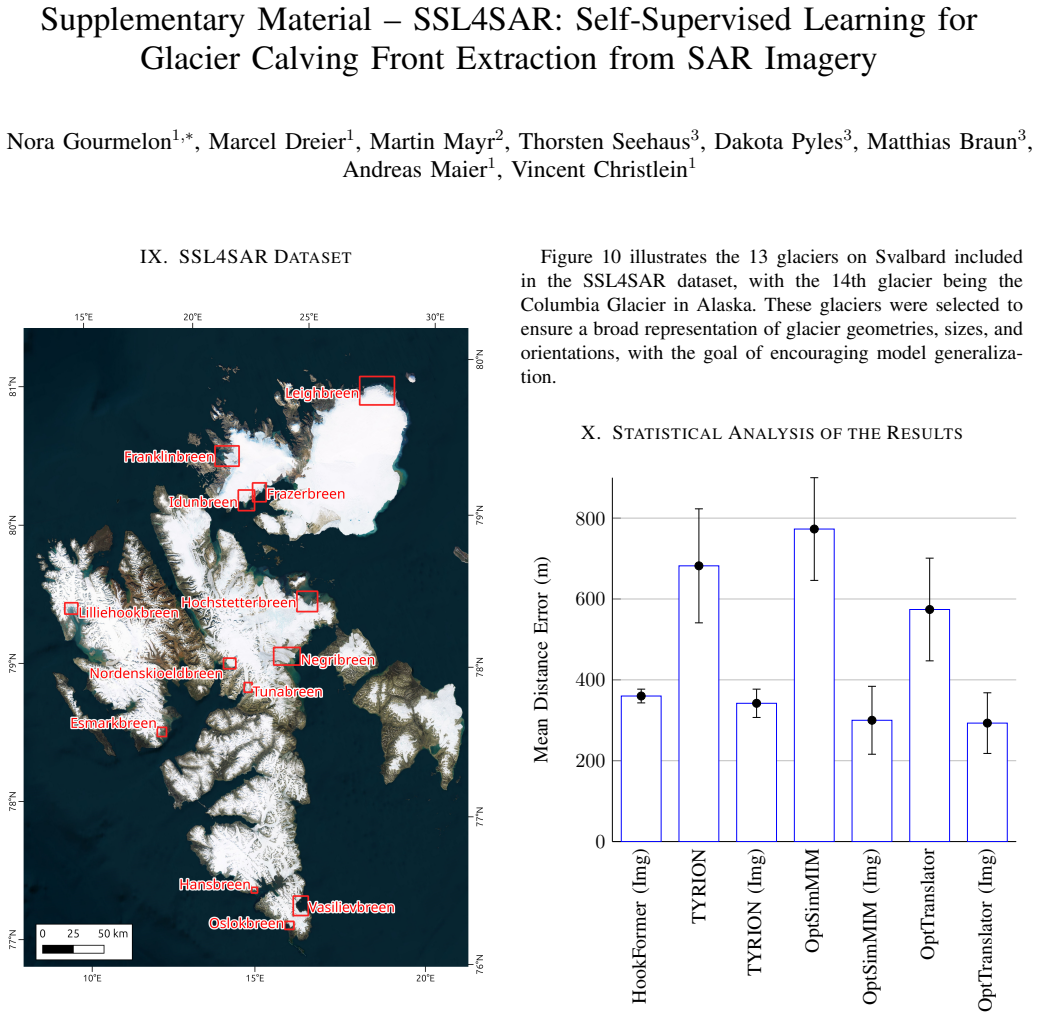
- [Section III-A, III-B and Supplementary Fig. 10] The SSL4SAR pretraining set includes Sentinel-1 imagery of Columbia Glacier from 2015-2022 and one Sentinel-2 optical image of Columbia from summer 2020, while the CaFFe test set consists entirely of Mapple and Columbia Glacier images with acquisitions through 2020. The paper never discloses that the same glacier appears in both pretraining and test sets. If the Columbia Sentinel-1 scenes in SSL4SAR overlap with the CaFFe test acquisitions (which is highly plausible given the temporal ranges), the reported MDE gains—particularly the 21% S1 improvement for OptSimMIM in Table I—may reflect exposure to the test glacier rather than transferable SSL representations. The paper reports no Mapple-only results and no overlap analysis. The authors should either exclude Columbia from the pretraining set, provide a Mapple-only evaluation, or demonstrate that the pretraining and test images are temporally and spatially disjoint.
- [Supplementary Table III and Section VI] The paper's own statistical analysis shows that all six one-sided Mann-Whitney comparisons fail the Bonferroni-corrected alpha of 0.008; the lowest reported p-value is 0.08. The supplement explicitly states that 'a difference between the groups simply cannot be statistically proven with the available data.' Nevertheless, the abstract and Section VI claim that TYRION 'outperforms' HookFormer by 67 m, and the conclusion describes the results as 'new state-of-the-art.' With only five runs per configuration and overlapping confidence intervals (e.g., HookFormer 360 ± 13 vs. OptTranslator 293 ± 54 in Table I), these strong claims are not supported. The authors should temper the language, disclose the non-significance in the main text, or increase the number of runs to achieve adequate power.
- [Section V-C and Table I] The ensemble MDEs of 238 m (all sensors) and 75 m (multi-annotator study) are reported without any uncertainty estimates or significance tests. Figure 8 explicitly excludes ensembles from the confidence intervals. The claim that the ensemble 'approaches human performance of 38 m' is therefore not quantified with respect to variability, and the reader cannot assess the robustness of the near-human result, especially given the outlier analysis in the supplement (Figs. 12-13) that shows large per-image errors for several Columbia and Mapple cases.
minor comments (5)
- [Abstract and Section III-A] The abstract states that SSL4SAR contains 9,563 Sentinel-1 images, while Section III-A states 9,562; please make these consistent.
- [Section VI-A] The parameter counts '59.3 G' and '50.9 G' are presumably 'M' (millions); a SwinV2-Transformer with 59.3 billion parameters would be implausible.
- [Section VI-A] The phrase 'Even without pretraining, TYRION (setup 2)' is misleading; setup 2 includes ImageNet-pretrained weights, only omitting the SSL4SAR stage. Please rephrase to 'without in-domain pretraining.'
- [Discussion (Section VI-H)] The paper lacks an explicit limitations section; in particular, the potential overlap between SSL4SAR and CaFFe test data noted in the major comments should be discussed.
- [Figure 8] Figure 8 would be more informative if confidence intervals for the ensemble results were added, rather than only for the individual models and humans.
Circularity Check
No constructional circularity; the Columbia-Glacier pretraining/test overlap is a benchmark-contamination risk, not a derivation-by-construction.
full rationale
The central claim—that SSL4SAR pretraining yields a 293 m MDE on CaFFe—is an empirical fine-tuning result, not a derivation from the pretraining objective. The SSL pretext tasks (OptSimMIM and OptTranslator) are trained on unlabeled SAR and optical images without any CaFFe calving-front labels, and fine-tuning uses the official CaFFe train/test split, so the reported MDE is measured on test images that were not used for fitting. The comparisons to HookFormer and ImageNet initialization rest on published, externally checkable baselines, and the self-citations (CaFFe, the multi-annotator study) are independently published datasets and protocols, so they are real evidence rather than a self-supporting loop. One serious reviewer concern is that SSL4SAR includes the Columbia Glacier (Supplementary Section IX states 'the 14th glacier being the Columbia Glacier in Alaska') while CaFFe's test split is composed entirely of Mapple and Columbia images (Section III-B); consequently, the S1-specific gains in Section VI-D may reflect exposure to the same glacier rather than transferable SSL representations. This is a leakage/benchmark-contamination risk that should be addressed with a Mapple-only result or an overlap analysis, but it is not an equivalence-by-construction, a fitted parameter renamed as a prediction, or a load-bearing self-citation chain, so it does not meet the circularity bar defined in this review.
Assumptions & free parameters
free parameters (5)
- SimMIM mask ratio (OptSimMIM)
- Optimizer, learning rate, batch size, epochs for pretraining and fine-tuning
- Fine-tuning loss weights (CE full, CE inner, Dice full, Dice inner) =
not reported
- Minimum calving front length for post-processing =
750 m
- Ensemble size and test-time augmentation set =
5 models; four-fold rotations; 50% overlap
assumptions (4)
- domain assumption Replicated single-channel SAR input is a valid proxy for the RGB input distribution expected by ImageNet-pretrained SwinV2.
- domain assumption SSL4SAR's Sentinel-1-only, 14-glacier Arctic imagery transfers to CaFFe's six-sensor, 1996 to 2020 dataset.
- domain assumption The post-processing pipeline (largest ocean component, bounding-box masking, 750 m front cutoff) is valid across all sensors and test glaciers.
- ad hoc to paper L1 reconstruction of optical imagery is a useful pretext signal for calving front delineation.
Cite this review
Pith. "Pith review of SSL4SAR: Self-Supervised Learning for Glacier Calving Front Extraction from SAR Imagery." pith.science (2026). https://pith.science/paper/5QY2Q2CF
@misc{pith2026250701747,
  author       = {Pith},
  title        = {Pith review of: SSL4SAR: Self-Supervised Learning for Glacier Calving Front Extraction from SAR Imagery},
  year         = {2026},
  howpublished = {\url{https://pith.science/paper/5QY2Q2CF}},
  note         = {Machine review of arXiv:2507.01747}
}
read the original abstract
Glaciers are losing ice mass at unprecedented rates, increasing the need for accurate, year-round monitoring to understand frontal ablation, particularly the factors driving the calving process. Deep learning models can extract calving front positions from Synthetic Aperture Radar imagery to track seasonal ice losses at the calving fronts of marine- and lake-terminating glaciers. The current state-of-the-art model relies on ImageNet-pretrained weights. However, they are suboptimal due to the domain shift between the natural images in ImageNet and the specialized characteristics of remote sensing imagery, in particular for Synthetic Aperture Radar imagery. To address this challenge, we propose two novel self-supervised multimodal pretraining techniques that leverage SSL4SAR, a new unlabeled dataset comprising 9,563 Sentinel-1 and 14 Sentinel-2 images of Arctic glaciers, with one optical image per glacier in the dataset. Additionally, we introduce a novel hybrid model architecture that combines a Swin Transformer encoder with a residual Convolutional Neural Network (CNN) decoder. When pretrained on SSL4SAR, this model achieves a mean distance error of 293 m on the "CAlving Fronts and where to Find thEm" (CaFFe) benchmark dataset, outperforming the prior best model by 67 m. Evaluating an ensemble of the proposed model on a multi-annotator study of the benchmark dataset reveals a mean distance error of 75 m, approaching the human performance of 38 m. This advancement enables precise monitoring of seasonal changes in glacier calving fronts.
Figures


Figures from the paper (8 more)




Reference graph
Works this paper leans on
-
[1]
Annual mass changes for each glacier in the world from 1976 to 2023,
I. Dussaillant, R. Hugonnet, M. Huss, E. Berthier, J. Bannwart, F. Paul, and M. Zemp, “Annual mass changes for each glacier in the world from 1976 to 2023,” Earth System Science Data Discussions , vol. 2024, pp. 1–41, 2024. [Online]. Available: https: //essd.copernicus.org/preprints/essd-2024-323/
work page 1976
-
[2]
Randolph Glacier Inventory - A Dataset of Global Glacier Outlines, Version 6,
RGI Consortium, “Randolph Glacier Inventory - A Dataset of Global Glacier Outlines, Version 6,” 2017, GLIMS, data set id: NSIDC-0770, https://doi.org/10. 7265/4m1f-gd79
work page 2017
-
[3]
Greenland ice sheet mass balance: a review,
S. A. Khan, A. Aschwanden, A. A. Bjørk, J. Wahr, K. K. Kjeldsen, and K. H. Kjær, “Greenland ice sheet mass balance: a review,” Reports on Progress in Physics, vol. 78, no. 4, p. 046801, 2015
work page 2015
-
[4]
Mass balance of the antarctic ice sheet from 1992 to 2017,
A. Sheperd, E. Ivins, E. Rignot, B. Smith, M. van den Broeke, I. Velicogna, P. Whitehouse, K. Briggs, and I. Joughin, “Mass balance of the antarctic ice sheet from 1992 to 2017,” Nature, vol. 558, no. 7709, pp. 219–222, 2018
1992
-
[5]
IPCC, Climate Change 2021: The Physical Science Basis. Contribution of Working Group I to the Sixth Assessment Report of the Intergovernmental Panel on Climate Change. Cambridge, United Kingdom and New York, NY , USA: Cambridge University Press, 2021
work page 2021
-
[6]
A deep active contour model for delineating glacier calving fronts,
K. Heidler, L. Mou, E. Loebel, M. Scheinert, S. Lef `evre, and X. X. Zhu, “A deep active contour model for delineating glacier calving fronts,” IEEE Transactions on Geoscience and Remote Sensing, vol. 61, pp. 1–12, 2023
work page 2023
-
[7]
E. Loebel, M. Scheinert, M. Horwath, K. Heidler, J. Christmann, L. D. Phan, A. Humbert, and X. X. Zhu, “Extracting glacier calving fronts by deep learning: the benefit of multi-spectral, topographic and textural input features,” IEEE Transactions on Geoscience and Remote Sensing, p. 1, 2022
work page 2022
-
[8]
Remote sensing of antarctic glacier and ice-shelf front dynamics – a review,
C. Baumhoer, A. Dietz, S. Dech, and C. Kuenzer, “Remote sensing of antarctic glacier and ice-shelf front dynamics – a review,” Remote Sensing , vol. 10, no. 9, pp. 1445:1–1445:28, 2018
work page 2018
Show all 64 references
-
[9]
Calving fronts and where to find them: a benchmark dataset and methodology for automatic glacier calving front extraction from synthetic aperture 11 radar imagery,
N. Gourmelon, T. Seehaus, M. Braun, A. Maier, and V . Christlein, “Calving fronts and where to find them: a benchmark dataset and methodology for automatic glacier calving front extraction from synthetic aperture 11 radar imagery,” Earth System Science Data , vol. 14, no. 9, p...
2022
-
[10]
Comparison study: Glacier calving front delineation in synthetic aperture radar images with deep learning,
N. Gourmelon, K. Heidler, E. Loebel, D. Cheng, J. Klink, A. Dong, F. Wu, N. Maul, M. Koch, M. Dreier, D. Pyles, T. Seehaus, M. Braun, A. Maier, and V . Christlein, “Comparison study: Glacier calving front delineation in synthetic aperture radar images with deep learning,” 2025...
2025 arXiv
-
[11]
Contextual hookformer for glacier calving front segmentation,
F. Wu, N. Gourmelon, T. Seehaus, J. Zhang, M. Braun, A. Maier, and V . Christlein, “Contextual hookformer for glacier calving front segmentation,” IEEE Transactions on Geoscience and Remote Sensing , vol. 62, pp. 1–15, 2024
2024
-
[12]
Swin transformer: Hierarchical vision transformer using shifted windows,
Z. Liu, Y . Lin, Y . Cao, H. Hu, Y . Wei, Z. Zhang, S. Lin, and B. Guo, “Swin transformer: Hierarchical vision transformer using shifted windows,” in Proceedings of the IEEE/CVF International Conference on Computer Vision (ICCV), 2021, pp. 10 012–10 022
2021
-
[13]
Imagenet: A large-scale hierarchical image database,
J. Deng, W. Dong, R. Socher, L.-J. Li, K. Li, and L. Fei-Fei, “Imagenet: A large-scale hierarchical image database,” in 2009 IEEE Conference on Computer Vision and Pattern Recognition, 2009, pp. 248–255
2009
-
[14]
Segment anything, from space?
S. Ren, F. Luzi, S. Lahrichi, K. Kassaw, L. M. Collins, K. Bradbury, and J. M. Malof, “Segment anything, from space?” in Proceedings of the IEEE/CVF Winter Confer- ence on Applications of Computer Vision (WACV) , 2024, pp. 8355–8365
2024
-
[15]
In-domain self-supervised learning improves re- mote sensing image scene classification,
I. Dimitrovski, I. Kitanovski, N. Simidjievski, and D. Ko- cev, “In-domain self-supervised learning improves re- mote sensing image scene classification,” IEEE Geo- science and Remote Sensing Letters , vol. 21, pp. 1–5, 2024
2024
-
[16]
Self- supervised vision transformers for joint sar-optical rep- resentation learning,
Y . Wang, C. M. Albrecht, and X. X. Zhu, “Self- supervised vision transformers for joint sar-optical rep- resentation learning,” in IGARSS 2022 - 2022 IEEE In- ternational Geoscience and Remote Sensing Symposium , 2022, pp. 139–142
2022
-
[17]
Seasonal contrast: Unsupervised pre-training from uncurated remote sensing data,
O. Ma ˜nas, A. Lacoste, X. Gir ´o-i Nieto, D. Vazquez, and P. Rodr \’\iguez, “Seasonal contrast: Unsupervised pre-training from uncurated remote sensing data,” in Proceedings of the IEEE/CVF International Conference on Computer Vision (ICCV) , 2021, pp. 9414–9423
2021
-
[18]
Self-supervised classification of sar images with optical image assis- tance,
C. Li, W. Guo, Z. Zhang, and T. Zhang, “Self-supervised classification of sar images with optical image assis- tance,” IEEE Transactions on Geoscience and Remote Sensing, vol. 61, pp. 1–15, 2023
2023
-
[19]
Automated extraction of coastline from satellite imagery by integrating canny edge detection and locally adaptive thresholding methods,
H. Liu and K. C. Jezek, “Automated extraction of coastline from satellite imagery by integrating canny edge detection and locally adaptive thresholding methods,” International Journal of Remote Sensing , vol. 25, no. 5, pp. 937–958, 2004. [Online]. Available: https://doi.org/1...
2004 doi
-
[20]
Automatic calving front delienation on terrasar-x and sentinel-1 sar imagery,
L. Krieger and D. Floricioiu, “Automatic calving front delienation on terrasar-x and sentinel-1 sar imagery,” in 2017 IEEE International Geoscience and Remote Sensing Symposium (IGARSS), 2017. [Online]. Available: https://elib.dlr.de/114563/
2017
-
[21]
Mapping ice sheet margins from ers-1 sar and spot imagery,
H.-G. Sohn and K. C. Jezek, “Mapping ice sheet margins from ers-1 sar and spot imagery,” International Journal of Remote Sensing , vol. 20, no. 15-16, pp. 3201–3216, 1999. [Online]. Available: https://doi.org/ 10.1080/014311699211705
1999 doi
-
[22]
Ocean forcing of the greenland ice sheet: Calving fronts and patterns of retreat identified by au- tomatic satellite monitoring of eastern outlet glaciers,
A. Seale, P. Christoffersen, R. I. Mugford, and M. O’Leary, “Ocean forcing of the greenland ice sheet: Calving fronts and patterns of retreat identified by au- tomatic satellite monitoring of eastern outlet glaciers,” Journal of Geophysical Research: Earth Surface , vol. 116, ...
2011
-
[23]
Automated detection of marine glacier calving fronts using the 2-d wavelet transform modulus maxima seg- mentation method,
J. Liu, E. M. Enderlin, H.-P. Marshall, and A. Khalil, “Automated detection of marine glacier calving fronts using the 2-d wavelet transform modulus maxima seg- mentation method,” IEEE Transactions on Geoscience and Remote Sensing , vol. 59, no. 11, pp. 9047–9056, 2021
2021
-
[24]
Automated extraction of antarctic glacier and ice shelf fronts from sentinel-1 imagery using deep learning,
C. A. Baumhoer, A. J. Dietz, C. Kneisel, and C. Kuenzer, “Automated extraction of antarctic glacier and ice shelf fronts from sentinel-1 imagery using deep learning,” Remote Sensing, vol. 11, no. 21, p. 2529, 2019
2019
-
[25]
Calving front machine (calfin): glacial termini dataset and automated deep learning extraction method for greenland, 1972–2019,
D. Cheng, W. Hayes, E. Larour, Y . Mohajerani, M. Wood, I. Velicogna, and E. Rignot, “Calving front machine (calfin): glacial termini dataset and automated deep learning extraction method for greenland, 1972–2019,” The Cryosphere , vol. 15, no. 3, pp. 1663–1675, 2021. [Online]...
1972
-
[26]
Pixel-wise distance regression for glacier calving front detection and segmentation,
A. Davari, C. Baller, T. Seehaus, M. Braun, A. Maier, and V . Christlein, “Pixel-wise distance regression for glacier calving front detection and segmentation,” IEEE Transactions on Geoscience and Remote Sensing, vol. 60, pp. 1–10, 2022
2022
-
[27]
On mathews correlation coefficient and improved distance map loss for automatic glacier calving front segmentation in sar imagery,
A. Davari, S. Islam, T. Seehaus, A. Hartmann, M. Braun, A. Maier, and V . Christlein, “On mathews correlation coefficient and improved distance map loss for automatic glacier calving front segmentation in sar imagery,” IEEE Transactions on Geoscience and Remote Sensing, vol. 6...
2021
-
[28]
Conditional random fields for im- proving deep learning-based glacier calving front delin- eations,
N. Gourmelon, J. Klink, T. Seehaus, M. Braun, A. Maier, and V . Christlein, “Conditional random fields for im- proving deep learning-based glacier calving front delin- eations,” in IEEE International Geoscience and Remote Sensing Symposium (IGARSS) , 2023, pp. 4939–4942
2023
-
[29]
Bayesian u-net for segmenting glaciers in sar imagery,
A. Hartmann, A. Davari, T. Seehaus, M. Braun, A. Maier, and V . Christlein, “Bayesian u-net for segmenting glaciers in sar imagery,” in 2021 IEEE International Geoscience and Remote Sensing Symposium IGARSS, Brussels, Belgium, 11–16 July 2021 , 2021, pp. 3479– 3482
2021
-
[30]
Hed-unet: Combined segmentation and edge de- tection for monitoring the antarctic coastline,
K. Heidler, L. Mou, C. Baumhoer, A. Dietz, and X. X. Zhu, “Hed-unet: Combined segmentation and edge de- tection for monitoring the antarctic coastline,” IEEE Transactions on Geoscience and Remote Sensing , vol. 2021, pp. 1–14, 2021
2021
-
[31]
Out-of-the-box 12 calving-front detection method using deep learning,
O. Herrmann, N. Gourmelon, T. Seehaus, A. Maier, J. J. F¨urst, M. H. Braun, and V . Christlein, “Out-of-the-box 12 calving-front detection method using deep learning,” The Cryosphere, vol. 17, no. 11, pp. 4957–4977, 2023. [Online]. Available: https://tc.copernicus.org/articles...
2023
-
[32]
Glacier calving front seg- mentation using attention u-net,
M. Holzmann, A. Davari, T. Seehaus, M. Braun, A. Maier, and V . Christlein, “Glacier calving front seg- mentation using attention u-net,” in 2021 IEEE Inter- national Symposium on Geoscience and Remote Sensing (IGARSS), Brussels, Belgium, 11–16 July 2021, 2021, pp. 3483–3486
2021
-
[33]
Image classification of marine- terminating outlet glaciers in greenland using deep learning methods,
M. Marochov, C. R. Stokes, and P. E. Carbonneau, “Image classification of marine- terminating outlet glaciers in greenland using deep learning methods,” The Cryosphere , vol. 15, no. 11, pp. 5041–5059, 2021. [Online]. Available: https://tc.copernicus.org/articles/15/5041/2021/
2021
-
[34]
Detection of glacier calving margins with convolutional neural networks: A case study,
Y . Mohajerani, M. Wood, I. Velicogna, and E. Rignot, “Detection of glacier calving margins with convolutional neural networks: A case study,” Remote Sensing, vol. 11, no. 1, p. 74, 2019
2019
-
[35]
How to get the most out of u-net for glacier calving front segmentation,
M. Periyasamy, A. Davari, T. Seehaus, M. Braun, A. Maier, and V . Christlein, “How to get the most out of u-net for glacier calving front segmentation,” IEEE Journal of Selected Topics in Applied Earth Observations and Remote Sensing , vol. 15, pp. 1712–1723, 2022
2022
-
[36]
Amd-hooknet for glacier front segmentation,
F. Wu, N. Gourmelon, T. Seehaus, J. Zhang, M. Braun, A. Maier, and V . Christlein, “Amd-hooknet for glacier front segmentation,” IEEE Transactions on Geoscience and Remote Sensing , vol. 61, pp. 1–12, 2023
2023
-
[37]
Automatically delin- eating the calving front of jakobshavn isbræ from mul- titemporal terrasar-x images: a deep learning approach,
E. Zhang, L. Liu, and L. Huang, “Automatically delin- eating the calving front of jakobshavn isbræ from mul- titemporal terrasar-x images: a deep learning approach,” The Cryosphere, vol. 13, no. 6, pp. 1729–1741, 2019
2019
-
[38]
An au- tomated, generalized, deep-learning-based method for delineating the calving fronts of greenland glaciers from multi-sensor remote sensing imagery,
E. Zhang, L. Liu, L. Huang, and K. S. Ng, “An au- tomated, generalized, deep-learning-based method for delineating the calving fronts of greenland glaciers from multi-sensor remote sensing imagery,” Remote Sensing of the Environment, vol. 254, p. 112265, 2021
2021
-
[39]
Autoterm: an automated pipeline for glacier terminus extraction using machine learning and a “big data
E. Zhang, G. Catania, and D. T. Trugman, “Autoterm: an automated pipeline for glacier terminus extraction using machine learning and a “big data” repository of greenland glacier termini,” The Cryosphere , vol. 17, no. 8, pp. 3485–3503, 2023. [Online]. Available: https://tc.cop...
2023
-
[40]
U-net: Convo- lutional networks for biomedical image segmentation,
O. Ronneberger, P. Fischer, and T. Brox, “U-net: Convo- lutional networks for biomedical image segmentation,” in Medical Image Computing and Computer-Assisted Inter- vention – MICCAI 2015 , N. Navab, J. Hornegger, W. M. Wells, and A. F. Frangi, Eds. Springer International Publ...
2015
-
[41]
Encoder-decoder with atrous separable con- volution for semantic image segmentation,
L.-C. Chen, Y . Zhu, G. Papandreou, F. Schroff, and H. Adam, “Encoder-decoder with atrous separable con- volution for semantic image segmentation,” in Proceed- ings of the European Conference on Computer Vision (ECCV), September 2018
2018
-
[42]
Gla-stdeeplab: Sar enhancing glacier and ice shelf front detection using swin-transdeeplab with global–local attention,
Q. Zhu, H. Guo, L. Zhang, D. Liang, Z. Wu, Y . Liu, and Z. Lv, “Gla-stdeeplab: Sar enhancing glacier and ice shelf front detection using swin-transdeeplab with global–local attention,” IEEE Transactions on Geoscience and Remote Sensing, vol. 61, pp. 1–13, 2023
2023
-
[43]
Self-supervised learning in remote sensing: A review,
Y . Wang, C. M. Albrecht, N. A. A. Braham, L. Mou, and X. X. Zhu, “Self-supervised learning in remote sensing: A review,” IEEE Geoscience and Remote Sensing Mag- azine, vol. 10, no. 4, pp. 213–247, 2022
2022
-
[44]
Self-supervised encoders are better transfer learners in remote sensing applications,
Z. D. Calhoun, S. Lahrichi, S. Ren, J. M. Malof, and K. Bradbury, “Self-supervised encoders are better transfer learners in remote sensing applications,” Remote Sensing, vol. 14, no. 21, 2022
2022
-
[45]
Cmid: A unified self-supervised learning framework for remote sensing image understanding,
D. Muhtar, X. Zhang, P. Xiao, Z. Li, and F. Gu, “Cmid: A unified self-supervised learning framework for remote sensing image understanding,” IEEE Transactions on Geoscience and Remote Sensing, vol. 61, pp. 1–17, 2023
2023
-
[46]
Very high resolution canopy height maps from rgb imagery using self-supervised vision transformer and convolutional decoder trained on aerial lidar,
J. Tolan, H.-I. Yang, B. Nosarzewski, G. Couairon, H. V . V o, J. Brandt, J. Spore, S. Majumdar, D. Haziza, J. Vama- raju, T. Moutakanni, P. Bojanowski, T. Johns, B. White, T. Tiecke, and C. Couprie, “Very high resolution canopy height maps from rgb imagery using self-supervis...
2024
-
[47]
Ex- tending global-local view alignment for self-supervised learning with remote sensing imagery,
X. Wanyan, S. Seneviratne, S. Shen, and M. Kirley, “Ex- tending global-local view alignment for self-supervised learning with remote sensing imagery,” in Proceedings of the IEEE/CVF Conference on Computer Vision and Pattern Recognition (CVPR) Workshops, 2024, pp. 2443– 2453
2024
-
[48]
Self-supervised sar-optical data fusion of sentinel-1/-2 images,
Y . Chen and L. Bruzzone, “Self-supervised sar-optical data fusion of sentinel-1/-2 images,” IEEE Transactions on Geoscience and Remote Sensing , vol. 60, pp. 1–11, 2022
2022
-
[49]
Self-supervised mate- rial and texture representation learning for remote sensing tasks,
P. Akiva, M. Purri, and M. Leotta, “Self-supervised mate- rial and texture representation learning for remote sensing tasks,” in Proceedings of the IEEE/CVF Conference on Computer Vision and Pattern Recognition (CVPR), 2022, pp. 8203–8215
2022
-
[50]
Masked autoencoders are scalable vision learn- ers,
K. He, X. Chen, S. Xie, Y . Li, P. Doll ´ar, and R. Gir- shick, “Masked autoencoders are scalable vision learn- ers,” in Proceedings of the IEEE/CVF Conference on Computer Vision and Pattern Recognition (CVPR), 2022, pp. 16 000–16 009
2022
-
[51]
Simmim: A simple framework for masked image modeling,
Z. Xie, Z. Zhang, Y . Cao, Y . Lin, J. Bao, Z. Yao, Q. Dai, and H. Hu, “Simmim: A simple framework for masked image modeling,” in Proceedings of the IEEE/CVF Conference on Computer Vision and Pattern Recognition (CVPR), 2022, pp. 9653–9663
2022
-
[52]
One for all: Toward unified foundation models for earth vision,
Z. Xiong, Y . Wang, F. Zhang, and X. X. Zhu, “One for all: Toward unified foundation models for earth vision,” 2024
2024
-
[53]
Self-supervised multi-image super-resolution for push-frame satellite images,
N. L. Nguyen, J. Anger, A. Davy, P. Arias, and G. Fac- ciolo, “Self-supervised multi-image super-resolution for push-frame satellite images,” in Proceedings of the IEEE/CVF Conference on Computer Vision and Pattern Recognition (CVPR) Workshops , June 2021, pp. 1121– 1131
2021
-
[54]
Hyperspectral image restoration with self-supervised learning: A two- 13 stage training approach,
Y . Qian, H. Zhu, L. Chen, and J. Zhou, “Hyperspectral image restoration with self-supervised learning: A two- 13 stage training approach,” IEEE Transactions on Geo- science and Remote Sensing , vol. 60, pp. 1–17, 2022
2022
-
[55]
Self-supervised vision transformers for land-cover seg- mentation and classification,
L. Scheibenreif, J. Hanna, M. Mommert, and D. Borth, “Self-supervised vision transformers for land-cover seg- mentation and classification,” in Proceedings of the IEEE/CVF Conference on Computer Vision and Pattern Recognition (CVPR) Workshops, 2022, pp. 1422–1431
2022
-
[56]
CaFFe (CAlving Fronts and where to Find thEm: a benchmark dataset and methodology for automatic glacier calving front extraction from sar imagery),
N. Gourmelon, T. Seehaus, M. Braun, A. Maier, and V . Christlein, “CaFFe (CAlving Fronts and where to Find thEm: a benchmark dataset and methodology for automatic glacier calving front extraction from sar imagery),” 2022, pANGAEA [dataset], https://doi.org/10.1594/PANGAEA.9409...
2022 doi
-
[57]
Swin transformer v2: Scaling up capacity and resolution,
Z. Liu, H. Hu, Y . Lin, Z. Yao, Z. Xie, Y . Wei, J. Ning, Y . Cao, Z. Zhang, L. Dong, F. Wei, and B. Guo, “Swin transformer v2: Scaling up capacity and resolution,” in Proceedings of the IEEE/CVF Conference on Computer Vision and Pattern Recognition (CVPR) , June 2022, pp. 12 ...
2022
-
[58]
Deep resid- ual learning for image recognition,
K. He, X. Zhang, S. Ren, and J. Sun, “Deep resid- ual learning for image recognition,” in Proceedings of the IEEE Conference on Computer Vision and Pattern Recognition (CVPR), June 2016
2016
-
[59]
Taming trans- formers for high-resolution image synthesis,
P. Esser, R. Rombach, and B. Ommer, “Taming trans- formers for high-resolution image synthesis,” in Proceed- ings of the IEEE/CVF Conference on Computer Vision and Pattern Recognition (CVPR), June 2021, pp. 12 873– 12 883
2021
-
[60]
What makes multi-modal learning better than single (provably),
Y . Huang, C. Du, Z. Xue, X. Chen, H. Zhao, and L. Huang, “What makes multi-modal learning better than single (provably),” Advances in Neural Information Processing Systems, vol. 34, pp. 10 944–10 956, 2021
2021
-
[61]
Ssl4eo-s12: A large-scale multimodal, multitemporal dataset for self-supervised learning in earth observation [software and data sets],
Y . Wang, N. A. A. Braham, Z. Xiong, C. Liu, C. M. Albrecht, and X. X. Zhu, “Ssl4eo-s12: A large-scale multimodal, multitemporal dataset for self-supervised learning in earth observation [software and data sets],” IEEE Geoscience and Remote Sensing Magazine, vol. 11, no. 3, pp...
2023
-
[62]
Field, Discovering Statistics Using IBM SPSS Statis- tics, 5th ed
A. Field, Discovering Statistics Using IBM SPSS Statis- tics, 5th ed. London: Sage Publications, 2018
2018
-
[63]
Measuring and Modeling Mountain glaciers and ice caps in a Changing ClimAte
J. Bortz and C. Schuster, Statistik f ¨ur Human- und Sozialwissenschaftler. Lehrbuch mit Online-Materialien , 7th ed. Berlin, Heidelberg: Springer, 2010. VIII. B IOGRAPHY SECTION Nora Gourmelon received the B.Sc. and M.Sc. degrees (passed with distinction) in computer science ...
2010
-
[2023]
4D nanoscope
Later on, he joined the Pattern Recognition Lab in October 2023 as a Ph.D candidate under the supervision of Prof. Andreas Maier. His current research focuses on machine learning on radargrams. Martin Mayr obtained his Master’s degree in Computer Science from Friedrich–Alexand...
2023
Reviewed August 6, 2026 · model on record in the stance chip above.
Discussion (0). Sign in to comment.