REVIEW 5 major objections 6 minor 73 references
Dual Protection Ring: User Profiling Via Differential Privacy and Service Dissemination Through Private Information Retrieval
T0 review · 5 major / 6 minor · reviewed 2026-08-07 · deepseek-v4-flash
Pith's one-line read This paper proposes a dual-ring protection scheme in which differential privacy hides the true interest profile and private information retrieval hides which service is fetched, so personalized ads can survive without exposing who you are.
desk verdict Useful mobile PIR measurements wrapped in a privacy argument that breaks on the unstated trust placed in the Local Server. read the letter →
The pith
A machine-rendered reading of the paper's core claim, the machinery that carries it, and where it could break.
The reading
What carries the argument
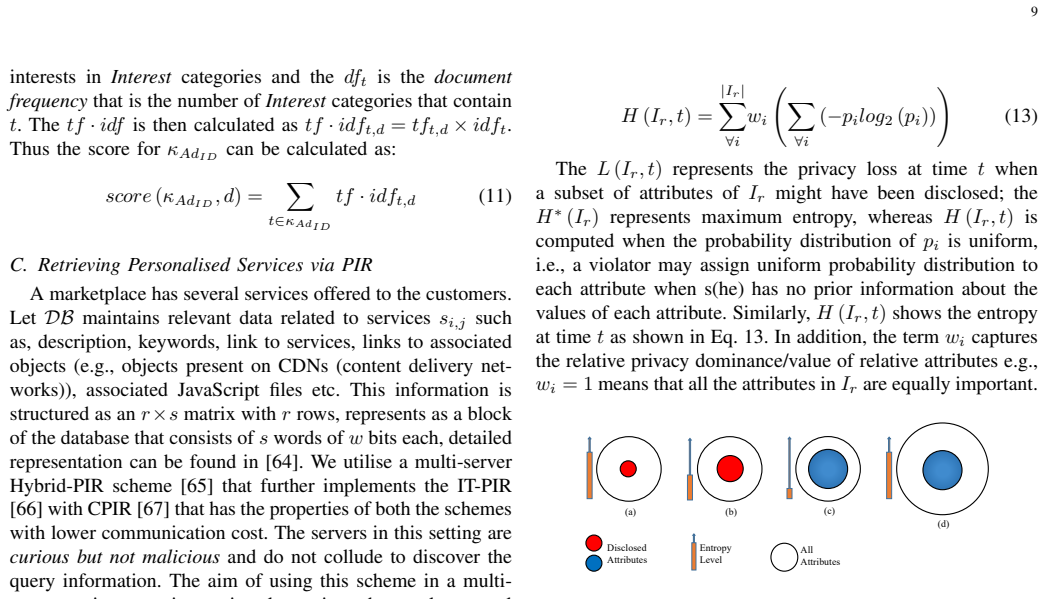
The carrying mechanism is a "dual ring" with an entropy gate between the rings. Ring one is differential privacy via the Laplace Perturbation Algorithm, applied at the Local Server to the aggregated interest database, which converts each user's profile into an $\epsilon$-differentially private surrogate before any service evaluation occurs. Ring two is multi-server hybrid PIR, combining an information-theoretic scheme with a computational scheme, which lets the user device retrieve the index of the personalized service the marketplace matched against the noised profile while the non-colluding servers learn nothing about which record was retrieved. The entropy gate computes the entropy of profile attributes and the resulting privacy loss $L(I_r,t)=H^*(I_r)-H(I_r,t)$ and, depending on thresholds, either releases the profile, distorts it through data evaporation, or destroys private attributes through apoptosis and restarts profiling. The two rings are what make both sides blind: the marketplace sees only a noisy profile, and the PIR servers never see which service is fetched.
What would settle it
Instrument the Local Server so it logs the messages it receives in the step described in the scheme: if, as the architecture specifies, the consumer's raw interest profile arrives before any noise is added, the log contains the true private attributes exactly, and no downstream differential privacy or PIR changes what the Local Server already saw; that observation alone would falsify the claimed user-side profiling privacy. A second check is scale: measure PIR end-to-end latency with the record counts and collusion assumptions of a real marketplace rather than the experimental caps (databases to 10 GB, $l = 3$ to $l = 6$ non-colluding servers), and verify whether retrieval time still fits inside the 20–60 second ad-refresh window.
Extended reading notes
Core claim
The central claim is that user privacy and service personalization can be protected at the same time if the two exposure surfaces are separated and each is closed with its own mechanism. On the user side, the true interest profile is never shown to the marketplace: the consumer sends the raw profile to a Local Server, which releases an $\epsilon$-differentially private version (Laplace noise scaled to query sensitivity) and evaluates the entropy of the profiling attributes, invoking data evaporation to raise entropy or apoptosis to destroy private attributes when thresholds are crossed. On the service side, the marketplace evaluates personalized services against the noised profile using a tf-idf similarity match, but the actual retrieval of the chosen service runs through multi-server PIR (an information-theoretic scheme combined with a computational scheme), so no server learns which record was fetched. The experimental evidence is that differential privacy barely changes the served ad mix — targeted ads fall from 30.60% to 26.95%, generic ads rise from 43.28% to 47.97%, and random ads are untouched — and that PIR on an Android client over databases up to 10 GB takes seconds, far below the 20–60 second refresh interval. The paper concludes that the model "provides better-profiling privacy by lowering the dominance of private attributes and provides private services with a minute impact over the targeted services."
Load-bearing premise
The load-bearing premise is that the Local Server is trustworthy: the consumer sends the raw, un-noised interest profile to the Local Server before differential privacy is applied, and the paper never states that this server is trusted, so a curious, compromised, or malicious Local Server sees the true profile at the first hop and the differential-privacy ring never engages.
Editorial extensions
If this is right
- Targeted advertising survives differential privacy: in the measured ad mix, targeted ads drop by about 3.65 percentage points and generic ads rise by about 4.68, so privacy protection does not erase ad relevance.
- PIR is practical on mobile hardware: an Android proof-of-concept retrieves an ad from multi-server databases (0.5–10 GB) in under a second to a few seconds, comfortably inside the 20–60 second ad-refresh window of current systems.
- Both exposure surfaces are covered: the marketplace never holds the true profile, and the PIR servers never learn which service record was fetched, which addresses threats such as profiling fingerprinting, monitoring, profile perturbation, and targeted-service inference.
- Integration into existing advertising ecosystems is incremental: the main changes are moving profiling to the client side, restricting analytics servers from collecting persistent identifiers, and running the PIR layer over the distributed multi-server infrastructure that ad systems already use.
- Batching helps: retrieving 1 to 8 ads in a single PIR query adds only modest extra bandwidth (about 0.7 MB on average for a 0.5 GB database), so fetching several ads at once plus local caching can cut per-ad overhead further.
Reading between the lines
- The scheme's privacy guarantee stops at the Local Server, and the paper never states that the Local Server is trusted: if it is honest-but-curious, compromised, or malicious, the raw profile is exposed at the first hop and the differential-privacy ring never engages; a direct fix would be to apply the noise on the user device so the true profile never leaves it.
- The "minute impact" claim is an average across app categories; categories with heavy baseline targeting may lose more than 3.65 percentage points, so the claim deserves a per-category significance check before it is taken as a general result.
- The dual-ring structure transfers to other personalized services — news feeds, video recommendations, health or financial content — because the profile side and the retrieval side are agnostic to the content; replacing the ad database and similarity matching is all that is needed.
- Because the ad-refresh window (20–60 seconds) is much larger than the measured PIR delay, an attacker could in principle send many PIR queries per refresh window; a testable extension is to check whether higher query rates let servers correlate request patterns over time and erode the privacy benefit.
Editorial analysis
A structured set of objections, weighed in public.
Referee Report
Summary. The paper proposes a 'dual-ring' architecture for privacy-preserving personalised services. A consumer device builds a local interest profile (Eqs. 1-6), sends it to a Local Server (LS), which applies an epsilon-differential-privacy mechanism (Eqs. 7-9), evaluates the entropy of the resultant profile (Eqs. 12-13), and optionally invokes 'data evaporation' or 'apoptosis' to distort or delete attributes. The noisy profile is then used to evaluate personalised services, which are retrieved with IT-PIR or Hybrid-PIR (Section V-C). The paper reports an Android proof-of-concept port of Percy++, ad-collection experiments (10,800 hours of profiling, 2,160 hours of ad collection) showing modest changes in ad-class distributions after applying differential privacy (Table II), and PIR experiments with 3-6 servers and databases up to 10GB showing delays that the authors argue are comparable to current ad systems. The paper concludes that the model provides better profiling privacy while keeping the impact on targeted services minute.
Significance. If the central claims were fully established, the architecture would be a useful contribution because it combines local profiling, differential privacy, and PIR in one pipeline, and the PIR experimental work is a genuine engineering contribution with concrete measurements on a ported Android implementation. The paper is strongest on the PIR side and on the ad-classification methodology. The user-side privacy claim, however, is not supported by the current formalization: the raw profile is exposed to the LS before differential privacy is applied, the DP mechanism is not fully specified for the actual profile release, and the entropy-based privacy metric is definitional rather than tied to an adversary model. The evaluation measures ad-targeting statistics, not privacy. With an explicit trust model and a completed DP analysis, the PIR component could still form the basis of a defensible system.
major comments (5)
- [Section V-A, Figure 4, Section VI-B2] The user-side privacy ring does not protect against the Local Server. Section V-A states that 'The consumer sends Interest profile to the Local Server before sending it to the service marketplace,' and Figure 4 repeats this flow. Section VI-B2 further says that the LS 'accumulates the Interest Profiles from individual users and associates similar profiles.' The threat model in Section III-D lists service-provider exploitation as a risk but never states whether the LS is trusted, honest-but-curious, or adversarial. If the LS is compromised or malicious, the raw profile, including the private attribute weights in Eq. (4), is exposed at the first hop and the differential-privacy ring never engages. The claimed 'better-profiling privacy on the user side' therefore rests on an unstated trust assumption that the paper's own threat model puts in question.
- [Section V-A, Eqs. (7)-(9)] The differential-privacy mechanism is not instantiated for the actual profile release. Equation (7) states the standard epsilon-DP definition, and Eq. (8) applies Laplace noise, but the query Q is only described as 'most requested service,' with a generic sensitivity bound. The paper's actual profiles are weighted interest categories, as in Eqs. (3)-(5), and the paper gives no sensitivity calculation for releasing those noisy profile weights. In addition, the profile is updated continuously in Section IV-D, but no composition budget is provided for multiple releases over time, so the total privacy loss cannot be audited. Without these elements, the DP guarantee for the proposed system is not supported by a complete derivation.
- [Section V-D, Eqs. (12)-(13)] The privacy-loss metric is definitional rather than tied to an adversary. Equation (12) defines L(Ir,t) = H*(Ir) - H(Ir,t), and the mechanisms 'data evaporation' and 'apoptosis' are judged successful when they raise H(Ir,t), i.e., when they lower L(Ir,t) by definition. The conclusion that these mechanisms 'provide better-profiling privacy by lowering the dominance of private attributes' therefore follows from the paper's own definition rather than from an independent measure of privacy, such as an adversary's inference error, re-identification success, or profiling accuracy. The paper should either connect entropy to a concrete adversary model or relabel the quantity as a utility/dominance metric rather than 'privacy loss.'
- [Section V-B vs. Section V-C] There is a load-bearing inconsistency about who computes the personalised-service index. Section V-B says the service marketplace evaluates a similarity match between the noisy profile and service keywords, using Eqs. (10)-(11). Section V-C says 'The client first derives the index of personalised services (as shown in Section V-B), subsequent, it encodes a PIR query' and sends it to the servers. If the marketplace computes the index, it learns which service is requested, weakening the PIR privacy guarantee; if the client computes it, the role of the marketplace in Section V-B is unclear. This needs to be resolved because the 'dual-ring' claim depends on both the profile and the retrieval being protected.
- [Section VII-B1, Table II] The empirical evaluation does not measure the privacy property that the paper claims. Table II compares the proportions of random, targeted, contextual, and generic ads before and after applying differential privacy, showing small changes (targeted ads from 30.60% to 26.95%, generic ads from 43.28% to 47.97%). These experiments do not measure an adversary's ability to infer private attributes, profile fingerprinting resistance, or attribute dominance. The conclusion in Section IX that the model 'provides better-profiling privacy' is therefore not supported by the presented data; the experiments only show a modest effect on ad classification, and the privacy claim needs a dedicated evaluation or a substantial re-scoping of the conclusions.
minor comments (6)
- [Eq. (8)] The symbol c is used in Eq. (8) before it is defined; it should be stated explicitly that c is the true d-dimensional output vector of Q(D).
- [Eq. (13)] The summation notation in Eq. (13) is confusing: the first sum ranges over |Ir| and the inner sum also uses the index i for the probability distribution; the weights w_i and the maximum-entropy value H*(Ir) should be defined precisely.
- [Section VII-B1] The text says 'the average proportion of targeted ads is 30.06%,' but Table II reports 30.60%; one of these is a typo and should be corrected.
- [Section V-D vs. Figure 4] Section V-D says entropy is evaluated 'before publishing data to the Local Server or marketplace,' but Figure 4 and the Section V overview show entropy being calculated at the LS after differential privacy is applied; the two descriptions should be reconciled.
- [Section VII-B1] The sentence 'Our analysis shows that consecutive ads from AdMob are more frequently served compared to combine the top 5 other Ad networks' is garbled; 'compared to combine' should be 'compared with the combined.'
- [Section VIII] The assumption that service providers do not collude is stated in the discussion, but it should be introduced earlier in the threat model in Section III-D, since the PIR guarantee depends on it.
Circularity Check
The entropy-based 'privacy loss' claim is self-definitional: data evaporation and apoptosis are validated with the same entropy gap that defines L(Ir,t), making the qualitative privacy conclusion forced by the metric's definition; the PIR overhead study remains independently benchmarked.
-
self definitional
[Section V-D, Equations (12)-(13) and Figure 5; conclusion in Section IX]
"L (Ir, t) = H ∗ (Ir) − H (Ir, t) (12) ... 5 (b) the data evaporation can be invoked to artificially increase entropy by controlled data distortion, or 5 (c) when entropy drops to a certain low threshold then invoke apoptosis process i.e., destroy the private profiling attributes and ‘re-evaluate user profile’"
Privacy loss is defined as H*(Ir) minus H(Ir,t). The mechanisms 'data evaporation' and 'apoptosis' are judged successful when they raise H(Ir,t) or remove disclosed attributes, which is exactly the quantity that reduces L by construction. Therefore, the paper's qualitative conclusion that these processes provide 'better-profiling privacy by lowering the dominance of private attributes' restates the definition of L rather than deriving it from an independent measure of disclosure. The experimental section validates ad-class percentages and PIR delays, not re-identification or attribute-inference risk, so the entropy-based privacy claim is not supported outside its own definition.
full rationale
Most of the paper is not circular. The differential-privacy component follows the standard Laplace mechanism, the tf-idf service matching is ordinary, and the PIR experiments are benchmarked against measured ad-refresh intervals (20–60 seconds), so the PIR overhead claim has independent empirical content. The self-citations, e.g., [20] and [56], provide background on profile establishment and ad characteristics and are not load-bearing in the derivation of the main result. The one genuinely circular component is the entropy-based privacy metric in Section V-D: Eq. (12) defines L(Ir,t) as H*(Ir) - H(Ir,t), and the proposed protections are deemed successful when they raise H(Ir,t), i.e., when they shrink L by the paper's own definition. This makes the 'privacy protection via entropy' claim partially forced by construction rather than independently demonstrated. The PIR/second ring and the empirical ad-statistics work are self-contained, which prevents a higher score. Separately, the protocol sends the raw Interest profile to the Local Server before differential privacy is applied (Section V-A: 'The consumer sends Interest profile to the Local Server before sending it to the service marketplace'), and the threat model does not state a trust boundary for that server. This is a serious correctness/security-model gap, but it is not a circularity and therefore does not by itself raise the circularity score.
Assumptions & free parameters
free parameters (4)
- Epsilon (epsilon) for differential privacy =
not specified
- Entropy threshold for data evaporation and apoptosis =
not specified
- Profile weight thresholds zeta_min^l, zeta_max^l, C_max^t =
not specified
- Similarity grouping threshold at the Local Server =
60% to 100%
assumptions (5)
- standard math The Laplace mechanism achieves epsilon-differential privacy under the standard sensitivity definition.
- domain assumption The Local Server is trusted with the raw interest profile.
- domain assumption Entropy H(Ir,t) is a valid proxy for privacy loss.
- domain assumption Profiles reach a stable state after 5 days of app usage.
- domain assumption PIR servers are non-colluding and curious-but-honest.
Cite this review
Pith. "Pith review of Dual Protection Ring: User Profiling Via Differential Privacy and Service Dissemination Through Private Information Retrieval." pith.science (2026). https://pith.science/paper/5RTP7ZPX
@misc{pith2026250613170,
  author       = {Pith},
  title        = {Pith review of: Dual Protection Ring: User Profiling Via Differential Privacy and Service Dissemination Through Private Information Retrieval},
  year         = {2026},
  howpublished = {\url{https://pith.science/paper/5RTP7ZPX}},
  note         = {Machine review of arXiv:2506.13170}
}
read the original abstract
User profiling is crucial in providing personalised services, as it relies on analysing user behaviour and preferences to deliver targeted services. This approach enhances user experience and promotes heightened engagement. Nevertheless, user profiling also gives rise to noteworthy privacy considerations due to the extensive tracking and monitoring of personal data, potentially leading to surveillance or identity theft. We propose a dual-ring protection mechanism to protect user privacy by examining various threats to user privacy, such as behavioural attacks, profiling fingerprinting and monitoring, profile perturbation, etc., both on the user and service provider sides. We develop user profiles that contain sensitive private attributes and an equivalent profile based on differential privacy for evaluating personalised services. We determine the entropy of the resultant profiles during each update to protect profiling attributes and invoke various processes, such as data evaporation, to artificially increase entropy or destroy private profiling attributes. Furthermore, we use different variants of private information retrieval (PIR) to retrieve personalised services against differentially private profiles. We implement critical components of the proposed model via a proof-of-concept mobile app to demonstrate its applicability over a specific case study of advertising services, which can be generalised to other services. Our experimental results show that the observed processing delays with different PIR schemes are similar to the current advertising systems.
Figures


Figures from the paper (7 more)



Reference graph
Works this paper leans on
-
[1]
A Machine Learning Approach to User Profiling for Data Annotation of Online Behavior
Moona Kanwal, Najeed A Khan, and Aftab A Khan. “A Machine Learning Approach to User Profiling for Data Annotation of Online Behavior.” In: Computers, Materials & Continua 78.2 (2024)
work page 2024
-
[2]
I know you: User profiling on social media usage of Chinese private university students
Yunyan Wang and Poh-Chuin Teo. “I know you: User profiling on social media usage of Chinese private university students”. In: Jurnal Ilmiah Peuradeun 12.1 (2024), pp. 71–98
work page 2024
-
[3]
Big Brother is Watching You: Non-Intrusive ZigBee User Profiling
Katharina OE M ¨uller et al. “Big Brother is Watching You: Non-Intrusive ZigBee User Profiling”. In: 2024 20th International Conference on Network and Service Management (CNSM). IEEE. 2024, pp. 1–7
work page 2024
-
[4]
User modeling and user pro- filing: A comprehensive survey
Erasmo Purificato, Ludovico Boratto, and Ernesto William De Luca. “User modeling and user pro- filing: A comprehensive survey”. In: arXiv preprint arXiv:2402.09660 (2024)
arXiv 2024
-
[5]
Lala Hu et al. “The effect of utilitarian and hedonic motivations on mobile shopping outcomes. A cross- cultural analysis”. In: International Journal of Con- sumer Studies 47.2 (2023), pp. 751–766
work page 2023
-
[6]
Mehak Rehman et al. “Impact of Customers’ Attitude Towards and Behavioural Intention to Shop at Brick- and-Mortar Stores: Moderating Role of Gender”. In: Business and Economics Research Journal 13.3 (2022), pp. 483–503
work page 2022
-
[7]
An integrated effectiveness framework of mobile in-app advertising
Vinh Nguyen Xuan Truong, Mathews Nkhoma, Wan- niwat Pansuwong, et al. “An integrated effectiveness framework of mobile in-app advertising”. In: Aus- tralasian Journal of Information Systems 23 (2019)
work page 2019
-
[8]
Mobile advertising: A sys- tematic literature review and future research agenda
Charles Jebarajakirthy et al. “Mobile advertising: A sys- tematic literature review and future research agenda”. In: International Journal of Consumer Studies 45.6 (2021), pp. 1258–1291
work page 2021
Show all 73 references
-
[9]
Online advertising security: Issues, taxonomy, and future directions
Zahra Pooranian et al. “Online advertising security: Issues, taxonomy, and future directions”. In: IEEE Com- munications Surveys & Tutorials 23.4 (2021), pp. 2494– 2524
2021
-
[10]
Privacy in targeted advertising: A survey
Imdad Ullah, Roksana Boreli, and Salil S Kanhere. “Privacy in targeted advertising: A survey”. In: arXiv preprint arXiv:2009.06861 (2020)
2020 arXiv
-
[11]
A Survey on User Profiling, Data Collection, and Privacy Issues of Internet Services
Dardan Maraj, Marin Vukovi ´c, and Petar Hotovec. “A Survey on User Profiling, Data Collection, and Privacy Issues of Internet Services”. In: Telecom. V ol. 5. 4. MDPI. 2024, pp. 961–976
2024
-
[12]
Pervasive user data collection from cyberspace: Privacy concerns and countermeasures
Yinhao Jiang et al. “Pervasive user data collection from cyberspace: Privacy concerns and countermeasures”. In: Cryptography 8.1 (2024), p. 5
2024
-
[13]
Privad: Practical privacy in online advertising
Saikat Guha, Bin Cheng, and Paul Francis. “Privad: Practical privacy in online advertising”. In: USENIX conference on Networked systems design and implemen- tation. 2011, pp. 169–182
2011
-
[14]
Adnostic: Privacy Preserving Targeted Advertising
Vincent Toubiana et al. “Adnostic: Privacy Preserving Targeted Advertising”. In: NDSS. The Internet Society, 2010
2010
-
[15]
Privacy-preserving targeted mobile advertising: A blockchain-based framework for mobile ads
Imdad Ullah, Salil S Kanhere, and Roksana Boreli. “Privacy-preserving targeted mobile advertising: A blockchain-based framework for mobile ads”. In: Jour- nal of Network and Computer Applications 211 (2023), p. 103559. 18
2023
-
[16]
Obliviad: Provably secure and practical online behavioral advertising
Michael Backes et al. “Obliviad: Provably secure and practical online behavioral advertising”. In: (2012), pp. 257–271
2012
-
[17]
Ibex: Privacy-preserving ad conversion tracking and bidding
Ke Zhong, Yiping Ma, and Sebastian Angel. “Ibex: Privacy-preserving ad conversion tracking and bidding”. In: Proceedings of the 2022 ACM SIGSAC Confer- ence on Computer and Communications Security. 2022, pp. 3223–3237
2022
-
[18]
Security and Privacy Preservation in Mobile Advertising
Dongxiao Liu. “Security and Privacy Preservation in Mobile Advertising”. In: (2020)
2020
-
[19]
Privacy- preserving and advertising-friendly web surfing
David S ´anchez and Alexandre Viejo. “Privacy- preserving and advertising-friendly web surfing”. In: Computer Communications 130 (2018), pp. 113–123
2018
-
[20]
ProfileGuard: Privacy Preserving Obfuscation for Mobile User Profiles
Imdad Ullah et al. “ProfileGuard: Privacy Preserving Obfuscation for Mobile User Profiles”. In: (2014), pp. 83–92
2014
-
[21]
OpenNym: Privacy preserv- ing recommending via pseudonymous group authenti- cation
Alessandro Checco et al. “OpenNym: Privacy preserv- ing recommending via pseudonymous group authenti- cation”. In: Security and Privacy 5.2 (2022), e201
2022
-
[22]
Un- traceable secret credentials: Trust establishment with privacy
Laurent Bussard, Yves Roudier, and Refik Molva. “Un- traceable secret credentials: Trust establishment with privacy”. In: IEEE Annual Conference on Pervasive Computing and Communications Workshops, 2004. Pro- ceedings of the Second . IEEE. 2004, pp. 122–126
2004
-
[23]
Privacy preserving stream analytics: The marriage of randomized response and approxi- mate computing
Do Le Quoc et al. “Privacy preserving stream analytics: The marriage of randomized response and approxi- mate computing”. In: arXiv preprint arXiv:1701.05403 (2017)
2017 arXiv
-
[24]
Successive point-of-interest recommendation with lo- cal differential privacy
Jong Seon Kim, Jong Wook Kim, and Yon Dohn Chung. “Successive point-of-interest recommendation with lo- cal differential privacy”. In: IEEE Access 9 (2021), pp. 66371–66386
2021
-
[25]
Toward privacy-preserving person- alized recommendation services
Cong Wang et al. “Toward privacy-preserving person- alized recommendation services”. In: Engineering 4.1 (2018), pp. 21–28
2018
-
[26]
Differential privacy histogram pub- lishing method based on dynamic sliding window
Qian Chen et al. “Differential privacy histogram pub- lishing method based on dynamic sliding window”. In: Frontiers of Computer Science 17.4 (2023), p. 174809
2023
-
[27]
Heteroge- neous private information retrieval
Hamid Mozaffari and Amir Houmansadr. “Heteroge- neous private information retrieval”. In: Network and Distributed Systems Security (NDSS) Symposium 2020 . 2020
2020
-
[28]
Private Information Retrieval Schemes Using Cyclic Codes
S ¸eyma Bodur, Edgar Mart´ınez-Moro, and Diego Ruano. “Private Information Retrieval Schemes Using Cyclic Codes”. In: Arithmetic of Finite Fields: 9th Interna- tional Workshop, WAIFI 2022, Chengdu, China, Au- gust 29–September 2, 2022, Revised Selected Papers . Springer. 2023,...
2022
-
[29]
Demystifying Privacy Policy of Third-Party Libraries in Mobile Apps
Zhao Kaifa et al. “Demystifying Privacy Policy of Third-Party Libraries in Mobile Apps”. In: arXiv preprint arXiv:2301.12348 (2023)
2023 arXiv
-
[30]
Privacy considerations for online advertising: a stakeholder’s perspective to programmatic advertising
Dylan A Cooper et al. “Privacy considerations for online advertising: a stakeholder’s perspective to programmatic advertising”. In: Journal of Consumer Marketing 40.2 (2023), pp. 235–247
2023
-
[31]
The role of perceived usefulness and annoyance on programmatic advertising: The mod- erating effect of Internet user privacy and cookies
Estela N ´unez-Barriopedro, Pedro Cuesta-Vali ˜no, and Sara Mansori-Amar. “The role of perceived usefulness and annoyance on programmatic advertising: The mod- erating effect of Internet user privacy and cookies”. In: Corporate Communications: An International Journal 28.2 (20...
2023
-
[32]
Programmatic advertising in online retailing: consumer perceptions and future av- enues
Robert Ciuchita et al. “Programmatic advertising in online retailing: consumer perceptions and future av- enues”. In: Journal of Service Management 34.2 (2023), pp. 231–255
2023
-
[33]
Data privacy: Effects on customer and firm performance
Kelly D Martin, Abhishek Borah, and Robert W Pal- matier. “Data privacy: Effects on customer and firm performance”. In: Journal of Marketing 81.1 (2017), pp. 36–58
2017
-
[34]
Subscrip- tions versus one-off purchases: the impact of fee- charging models on consumer privacy concerns
Chenfeng Yan, Zhilin Yang, and Xin Dai. “Subscrip- tions versus one-off purchases: the impact of fee- charging models on consumer privacy concerns”. In: International Journal of Bank Marketing (2023)
2023
-
[35]
The double-edged effects of data privacy practices on customer responses
Shijiao Joseph Chen et al. “The double-edged effects of data privacy practices on customer responses”. In: International Journal of Information Management 69 (2023), p. 102600
2023
-
[36]
Information disclosing willingness in mobile in- ternet contexts
Bill Ming Gao, Matthew Tingchi Liu, and Rongwei Chu. “Information disclosing willingness in mobile in- ternet contexts”. In: Asia Pacific Journal of Marketing and Logistics 35.1 (2023), pp. 108–129
2023
-
[37]
The Impact of the General Data Protection Regulation (GDPR) on Online Tracking
Karlo Lukic, Klaus M Miller, and Bernd Skiera. “The Impact of the General Data Protection Regulation (GDPR) on Online Tracking”. In: Available at SSRN (2023)
2023
-
[38]
Resolving the privacy paradox: Toward a cognitive appraisal and emotion approach to online privacy behaviors
Han Li et al. “Resolving the privacy paradox: Toward a cognitive appraisal and emotion approach to online privacy behaviors”. In: Information & management 54.8 (2017), pp. 1012–1022
2017
-
[39]
The ‘privacy paradox’in the social web: The impact of privacy concerns, individual charac- teristics, and the perceived social relevance on different forms of self-disclosure
Monika Taddicken. “The ‘privacy paradox’in the social web: The impact of privacy concerns, individual charac- teristics, and the perceived social relevance on different forms of self-disclosure”. In: Journal of computer- mediated communication 19.2 (2014), pp. 248–273
2014
-
[40]
Privacy in the digital age: a review of information privacy research in information systems
France B ´elanger and Robert E Crossler. “Privacy in the digital age: a review of information privacy research in information systems”. In: MIS quarterly (2011), pp. 1017–1041
2011
-
[41]
The psychology of privacy in the digital age
Avelie Stuart, Arosha K Bandara, and Mark Levine. “The psychology of privacy in the digital age”. In: So- cial and Personality Psychology Compass 13.11 (2019), e12507
2019
-
[42]
What’s the gist? privacy- preserving aggregation of user profiles
Igor Bilogrevic et al. “What’s the gist? privacy- preserving aggregation of user profiles”. In: Com- puter Security-ESORICS 2014: 19th European Sym- posium on Research in Computer Security, Wroclaw, Poland, September 7-11, 2014. Proceedings, Part II 19 . Springer. 2014, pp. 128–145
2014
-
[43]
Non-tracking web analytics
Istemi Ekin Akkus et al. “Non-tracking web analytics”. In: Proceedings of the 2012 ACM conference on Com- puter and communications security. 2012, pp. 687–698
2012
-
[44]
Prefetching mobile ads: Can advertising systems afford it?
Prashanth Mohan, Suman Nath, and Oriana Riva. “Prefetching mobile ads: Can advertising systems afford it?” In: Proceedings of the 8th ACM European Confer- ence on Computer Systems . 2013, pp. 267–280. 19
2013
-
[45]
Adnostic: Privacy preserving targeted advertising
Vincent Toubiana et al. “Adnostic: Privacy preserving targeted advertising”. In: Proceedings Network and Dis- tributed System Symposium . 2010
2010
-
[46]
For sale: your data: by: you
Christopher Riederer et al. “For sale: your data: by: you”. In: Proceedings of the 10th ACM WORKSHOP on Hot Topics in Networks . 2011, pp. 1–6
2011
-
[47]
Optimal targeted advertising strat- egy for secure wireless edge metaverse
Hongyang Du et al. “Optimal targeted advertising strat- egy for secure wireless edge metaverse”. In: GLOBE- COM 2022-2022 IEEE Global Communications Con- ference. IEEE. 2022, pp. 4346–4351
2022
-
[48]
SplitX: High-performance Private Analytics
Ruichuan Chen, Istemi Ekin Akkus, and Paul Fran- cis. “SplitX: High-performance Private Analytics”. In: SIGCOMM Comput. Commun. Rev. 43.4 (Aug. 2013), pp. 315–326. ISSN : 0146-4833. DOI: 10.1145/2534169. 2486013. URL: http://doi.acm.org/10.1145/2534169. 2486013
2013 doi
-
[49]
Towards statistical queries over distributed private user data
Ruichuan Chen et al. “Towards statistical queries over distributed private user data”. In: Presented as part of the 9th {USENIX} Symposium on Networked Sys- tems Design and Implementation ( {NSDI} 12). 2012, pp. 169–182
2012
-
[50]
Differential privacy for re- newable energy resources based smart metering
Muneeb Ul Hassan et al. “Differential privacy for re- newable energy resources based smart metering”. In: Journal of Parallel and Distributed Computing 131 (2019), pp. 69–80
2019
-
[51]
A review of preserving privacy in data collected from buildings with differential privacy
K Janghyun, H Barry, H Tianzhen, et al. “A review of preserving privacy in data collected from buildings with differential privacy”. In: Journal of Building Engineer- ing 56 (2022), p. 104724
2022
-
[52]
DP-TrajGAN: A privacy-aware tra- jectory generation model with differential privacy
Jing Zhang et al. “DP-TrajGAN: A privacy-aware tra- jectory generation model with differential privacy”. In: Future Generation Computer Systems 142 (2023), pp. 25–40
2023
-
[53]
Privacy-preserving streaming truth discovery in crowdsourcing with differential privacy
Dan Wang et al. “Privacy-preserving streaming truth discovery in crowdsourcing with differential privacy”. In: IEEE Transactions on Mobile Computing 21.10 (2021), pp. 3757–3772
2021
-
[54]
Personalization and customiza- tion technologies
Sviatoslav Braynov. “Personalization and customiza- tion technologies”. In: The Internet Encyclopedia 3 (), pp. 51–63
-
[55]
A combination approach to web user profiling
Jie Tang et al. “A combination approach to web user profiling”. In: ACM Transactions on Knowledge Dis- covery from Data (TKDD) 5.1 (2010), pp. 1–44
2010
-
[56]
Joint Optimization of Privacy and Cost of in-App Mobile User Profil- ing and Targeted Ads
Imdad Ullah and Adel Binbusayyis. “Joint Optimization of Privacy and Cost of in-App Mobile User Profil- ing and Targeted Ads”. In: IEEE Access 10 (2022), pp. 38664–38683
2022
-
[57]
A firm foundation for private data analysis
Cynthia Dwork. “A firm foundation for private data analysis”. In: Communications of the ACM 54.1 (2011), pp. 86–95
2011
-
[58]
Our data, ourselves: Privacy via distributed noise generation
Cynthia Dwork et al. “Our data, ourselves: Privacy via distributed noise generation”. In: Annual international conference on the theory and applications of crypto- graphic techniques. Springer. 2006, pp. 486–503
2006
-
[59]
Combining differential privacy and pir for efficient strong location privacy
Eric Fung, Georgios Kellaris, and Dimitris Papadias. “Combining differential privacy and pir for efficient strong location privacy”. In: International Symposium on Spatial and Temporal Databases . Springer. 2015, pp. 295–312
2015
-
[60]
Private and continual release of statistics
T-H Hubert Chan, Elaine Shi, and Dawn Song. “Private and continual release of statistics”. In: ACM Transac- tions on Information and System Security (TISSEC) 14.3 (2011), pp. 1–24
2011
-
[61]
Differential privacy under continual observation
Cynthia Dwork et al. “Differential privacy under continual observation”. In: Proceedings of the forty- second ACM symposium on Theory of computing. 2010, pp. 715–724
2010
-
[62]
Recommendation sys- tems: Principles, methods and evaluation
Folasade Olubusola Isinkaye, Yetunde O Folajimi, and Bolande Adefowoke Ojokoh. “Recommendation sys- tems: Principles, methods and evaluation”. In: Egyptian informatics journal 16.3 (2015), pp. 261–273
2015
-
[63]
Introduction to infor- mation retrieval
Christopher D et.al Manning. Introduction to infor- mation retrieval . V ol. 1. Cambridge university press Cambridge, 2008
2008
-
[64]
Op- timally robust private information retrieval
Casey Devet, Ian Goldberg, and Nadia Heninger. “Op- timally robust private information retrieval”. In: Cryp- tology ePrint Archive (2012)
2012
-
[65]
The best of both worlds: Combining information-theoretic and computa- tional PIR for communication efficiency
Casey Devet and Ian Goldberg. “The best of both worlds: Combining information-theoretic and computa- tional PIR for communication efficiency”. In: Interna- tional Symposium on Privacy Enhancing Technologies Symposium. Springer. 2014, pp. 63–82
2014
-
[66]
A random server model for private information retrieval
Yael Gertner, Shafi Goldwasser, and Tal Malkin. “A random server model for private information retrieval”. In: International Workshop on Randomization and Ap- proximation Techniques in Computer Science. Springer. 1998, pp. 200–217
1998
-
[67]
Optimal error correction against computationally bounded noise
Silvio Micali et al. “Optimal error correction against computationally bounded noise”. In: Theory of Cryp- tography Conference. Springer. 2005, pp. 1–16
2005
-
[68]
Simple demographics often identify people uniquely
Latanya Sweeney. “Simple demographics often identify people uniquely”. In: Health (San Francisco) 671.2000 (2000), pp. 1–34
2000
-
[69]
Attribute suscepti- bility and entropy based data anonymization to improve users community privacy and utility in publishing data
Abdul Majeed and Sungchang Lee. “Attribute suscepti- bility and entropy based data anonymization to improve users community privacy and utility in publishing data”. In: Applied Intelligence 50.8 (2020), pp. 2555–2574
2020
-
[70]
Breaking for commer- cials: characterizing mobile advertising
Narseo Vallina-Rodriguez et al. “Breaking for commer- cials: characterizing mobile advertising”. In: Proceed- ings of the ACM conference on Internet measurement conference. ACM. 2012, pp. 343–356
2012
-
[71]
A lattice-based computationally-efficient private informa- tion retrieval protocol
Carlos Aguilar Melchor and Philippe Gaborit. “A lattice-based computationally-efficient private informa- tion retrieval protocol”. In: Cryptology ePrint Archive (2007)
2007
-
[72]
Characterising user targeting for in-app mobile ads
Imdad Ullah et al. “Characterising user targeting for in-app mobile ads”. In: 2014 IEEE Conference on computer communications workshops (INFOCOM WK- SHPS). IEEE. 2014, pp. 547–552
2014
-
[73]
Information Leakage through Mo- bile Analytics Services
Terence Chen et al. “Information Leakage through Mo- bile Analytics Services”. In: 15th International Work- shop on Mobile Computing Systems and Applications . ACM HotMobile, 2014
2014
Reviewed August 7, 2026 · model on record in the stance chip above.
Discussion (0). Sign in to comment.