REVIEW 2 minor 47 references
Optimal and Adaptive Bayesian Sampling for Non-Linear Parameter Estimation under White Noise
T0 review · 0 major / 2 minor · reviewed 2026-06-26 · grok-4.3
Pith's one-line read Bayesian optimal design for non-linear parameters is obtained by optimizing the posterior after marginalizing linear ones under white Gaussian noise.
desk verdict Applies Bayesian optimal design to the marginalized posterior for nonlinear parameters under white Gaussian noise, with examples in exponential decay signals for NMR. read the letter →
The pith
A machine-rendered reading of the paper's core claim, the machinery that carries it, and where it could break.
The reading
What carries the argument
The marginalized posterior distribution over the non-linear parameters, which serves as the objective for the Bayesian design optimization.
What would settle it
An experiment that compares parameter-estimation errors obtained from the paper's recommended sampling times against those from uniform or heuristic sampling, under controlled additive white Gaussian noise; if the recommended times do not reduce error, the claim is falsified.
Extended reading notes
Core claim
The central claim is that the Bayesian framework for design optimization, when applied to the posterior distribution obtained after marginalization over linear parameters, yields optimal and adaptive sampling strategies for estimating non-linear parameters in the presence of additive white Gaussian noise, as demonstrated through examples of exponentially decaying signals.
Load-bearing premise
The noise must be additive white Gaussian for the Bayesian framework to apply directly to the design optimization.
Editorial extensions
If this is right
- Optimal sampling times can be computed for exponentially decaying signals by maximizing the expected information gain in the marginalized posterior.
- The same procedure extends directly to oscillating exponential decays.
- Adaptive sampling becomes possible by updating the marginalized posterior after each measurement and re-optimizing the next design point.
- The resulting designs improve efficiency for parameter estimation tasks such as those arising in nuclear magnetic resonance and relaxometry with solid-state spin sensors.
Reading between the lines
- The marginalization step may reduce computational cost when the number of linear parameters is large relative to the non-linear ones.
- If the white-noise assumption is relaxed, the same marginalization idea could be tested with colored noise models to see whether the optimality properties survive.
- The approach suggests a general template for separating linear and non-linear contributions in other inverse problems that admit closed-form marginalization.
Signed reviews
Editorial analysis
A structured set of objections, weighed in public.
Referee Report
Summary. The manuscript applies the Bayesian framework for optimal experimental design to the posterior distribution after marginalization over linear parameters, under the assumption of additive white Gaussian noise. It discusses implications of this approach and complements the discussion with examples of exponentially decaying signals, both with and without oscillations, relevant to nuclear magnetic resonance and relaxometry experiments using solid-state spin sensors.
Significance. Marginalization over linear parameters before optimizing designs for non-linear ones is a standard technique that reduces the dimensionality of the optimization problem in Bayesian experimental design. The examples illustrate potential practical implications for adaptive sampling in physical measurement contexts. The work is an application of an established framework rather than a derivation of new theory.
minor comments (2)
- The abstract states the core contribution but provides no indication of the specific design criterion (e.g., expected information gain) or the form of the marginalized posterior used; adding one sentence on this would improve clarity for readers.
- The title emphasizes both 'Optimal and Adaptive' sampling, yet the abstract focuses on design optimization; ensure the full text explicitly distinguishes or connects the adaptive aspect to the optimal design results.
Simulated Author's Rebuttal
We thank the referee for their review of our manuscript. We appreciate the recognition that our examples have potential practical implications for adaptive sampling in physical measurement contexts such as NMR and relaxometry.
read point-by-point responses
-
Referee: Marginalization over linear parameters before optimizing designs for non-linear ones is a standard technique that reduces the dimensionality of the optimization problem in Bayesian experimental design. The examples illustrate potential practical implications for adaptive sampling in physical measurement contexts. The work is an application of an established framework rather than a derivation of new theory.
Authors: We agree that marginalization over linear parameters is a standard technique that reduces the dimensionality of the design optimization. Our manuscript applies this established approach specifically to the marginalized posterior for non-linear parameter estimation under additive white Gaussian noise. The contribution consists of a focused discussion of the implications of this choice together with concrete examples of exponentially decaying signals (with and without oscillations) that are directly relevant to nuclear magnetic resonance and relaxometry experiments using solid-state spin sensors. While the underlying Bayesian framework is not new, the specific application to this setting and the accompanying analysis of adaptive sampling strategies provide practical guidance that, to our knowledge, has not been presented in this form for these experimental contexts. revision: no
Circularity Check
No significant circularity
full rationale
The abstract frames the work as an application of the Bayesian design optimization framework to the marginalized posterior under the explicit additive white Gaussian noise assumption, with examples of exponentially decaying signals. No equations, derivations, self-citations, or load-bearing steps are present in the provided text that reduce a claimed prediction or result to its own inputs by construction. The central contribution is presented as an application plus discussion of implications, with no evidence of self-definitional fits, renamed known results, or uniqueness theorems imported from the authors' prior work. The derivation chain is therefore self-contained against external benchmarks.
Assumptions & free parameters
Cite this review
Pith. "Pith review of Optimal and Adaptive Bayesian Sampling for Non-Linear Parameter Estimation under White Noise." pith.science (2026). https://pith.science/paper/5RYJ2TIT
@misc{pith2026260619896,
  author       = {Pith},
  title        = {Pith review of: Optimal and Adaptive Bayesian Sampling for Non-Linear Parameter Estimation under White Noise},
  year         = {2026},
  howpublished = {\url{https://pith.science/paper/5RYJ2TIT}},
  note         = {Machine review of arXiv:2606.19896}
}
read the original abstract
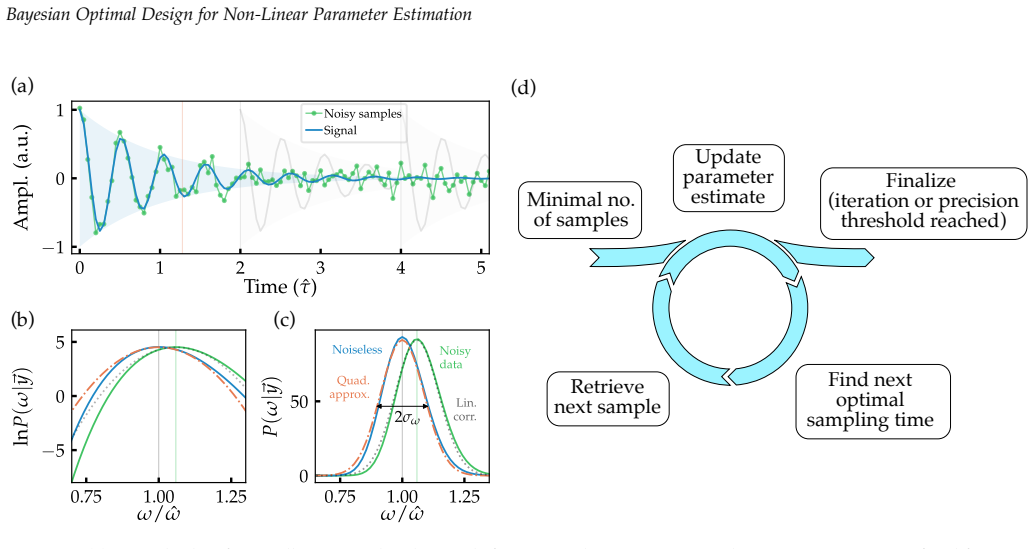
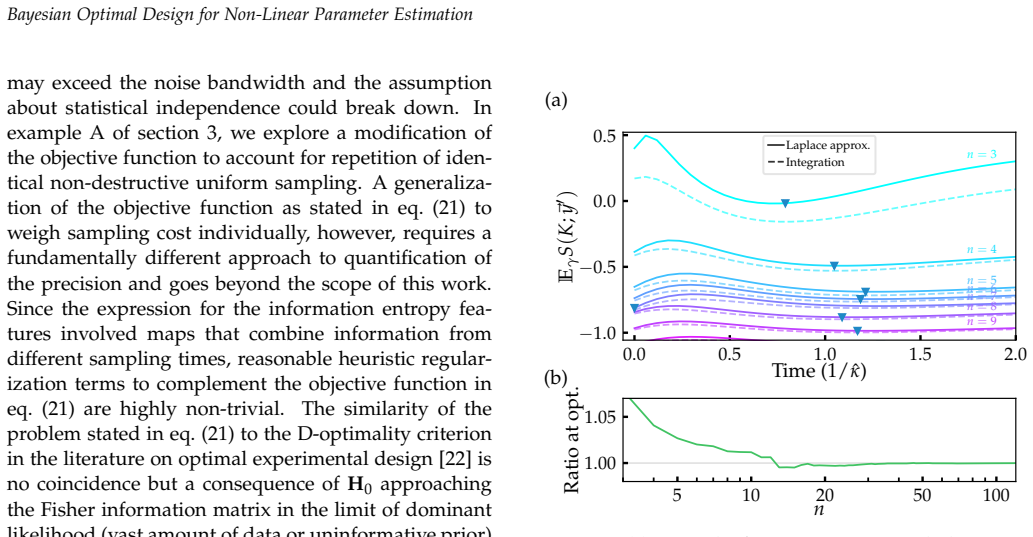
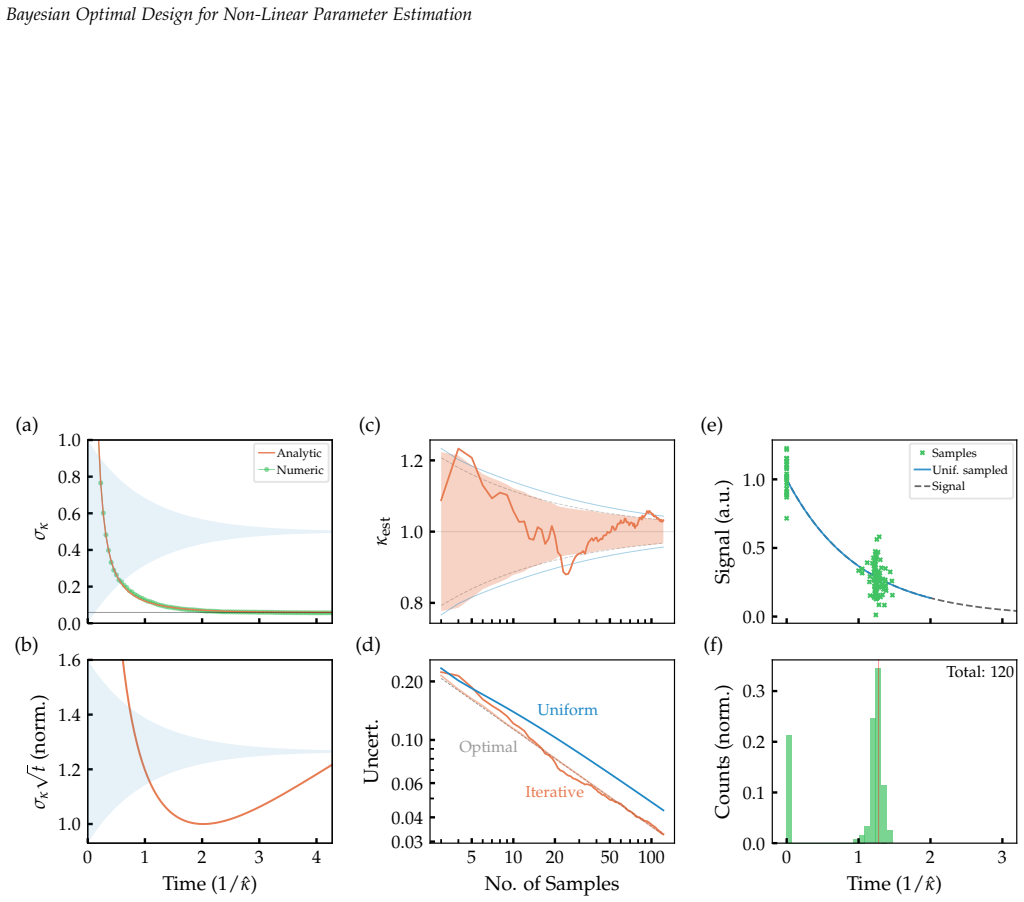
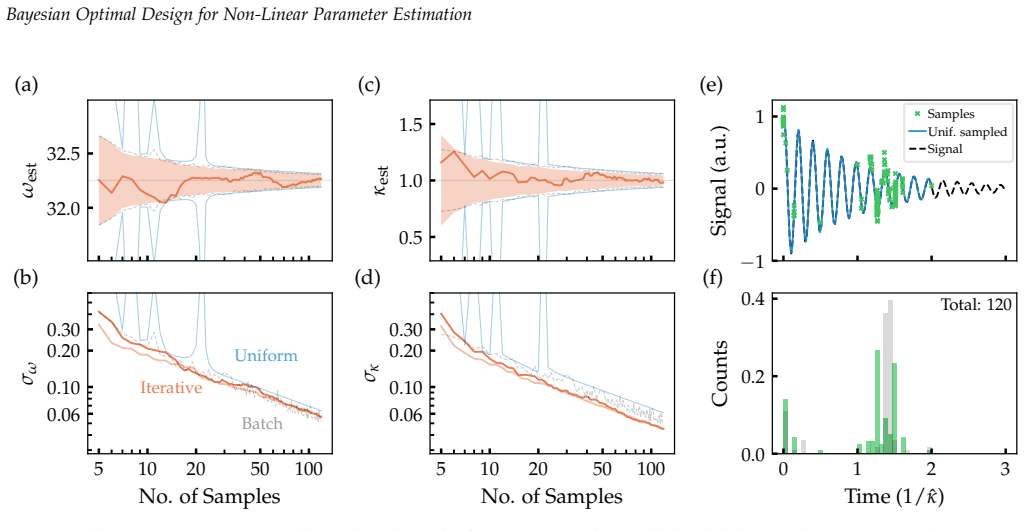
The question of optimal experimental design has been addressed in a vast variety of contexts and answered using manifold approaches. Assuming additive white Gaussian noise, this work applies the Bayesian framework for design optimization to the posterior distribution after marginalization over linear parameters and discusses the implications. Examples of exponentially decaying signals with and without oscillations complement the discussion. Application of the examples considered include but are not limited to nuclear magnetic resonance and relaxometry experiments using solid-state spins sensors.
Figures
Figures from the paper (3 more)
Reference graph
Works this paper leans on
-
[1]
Pukelsheim,Optimal Design of Experiments(So- ciety for Industrial and Applied Mathematics, Jan
F. Pukelsheim,Optimal Design of Experiments(So- ciety for Industrial and Applied Mathematics, Jan. 2006)
2006
-
[2]
Atkinson, A
A. Atkinson, A. Donev, and R. Tobias,Optimum Experimental Designs, with SAS(Oxford Univer- sity Press, May 2007)
2007
-
[3]
A tutorial on adaptive design optimization
J. I. Myung, D. R. Cavagnaro, and M. A. Pitt, “A tutorial on adaptive design optimization”, Jour- nal of Mathematical Psychology57, 53–67 (2013)
2013
-
[4]
Near- optimal sensor placements in Gaussian pro- cesses
A. Krause, A. Singh, and C. Guestrin, “Near- optimal sensor placements in Gaussian pro- cesses”, Journal of Machine Learning Research 9, 235–284 (2008)
2008
-
[5]
Optimal design in psycho- logical research
G. H. McClelland, “Optimal design in psycho- logical research.”, Psychological Methods2, 3–19 (1997)
1997
-
[6]
Adaptive Design Optimization as a Promising Tool for Re- liable and Efficient Computational Fingerprint- ing
M. Kwon, S. H. Lee, and W.-Y. Ahn, “Adaptive Design Optimization as a Promising Tool for Re- liable and Efficient Computational Fingerprint- ing”, Biological Psychiatry: Cognitive Neuro- science and Neuroimaging8, Reliability of Neu- rocognitive Measures for Mental Health, 798–804 (2023)
2023
-
[7]
Optimized quantum sensing with a sin- gle electron spin using real-time adaptive mea- surements
C. Bonato, M. S. Blok, H. T. Dinani, D. W. Berry, M. L. Markham, D. J. Twitchen, and R. Han- son, “Optimized quantum sensing with a sin- gle electron spin using real-time adaptive mea- surements”, Nature Nanotechnology11, 247–252 (2016). 14 Bayesian Optimal Design for Non-Linear Parameter Estimation
2016
-
[8]
Bayesian estimation for quantum sensing in the absence of single-shot detection
H. T. Dinani, D. W. Berry, R. Gonzalez, J. R. Maze, and C. Bonato, “Bayesian estimation for quantum sensing in the absence of single-shot detection”, Phys. Rev. B99, 125413 (2019)
2019
Show all 47 references
-
[9]
Sequential Bayesian Experiment Design for Optically Detected Magnetic Resonance of Nitrogen-Vacancy Centers
S. Dushenko, K. Ambal, and R. D. McMichael, “Sequential Bayesian Experiment Design for Optically Detected Magnetic Resonance of Nitrogen-Vacancy Centers”, Phys. Rev. Appl.14, 054036 (2020)
2020
-
[10]
Sequential Bayesian experiment design for adaptive Ramsey sequence measurements
R. D. McMichael, S. Dushenko, and S. M. Blak- ley, “Sequential Bayesian experiment design for adaptive Ramsey sequence measurements”, Jour- nal of Applied Physics130, 144401 (2021)
2021
-
[11]
Online adaptive quantum characteriza- tion of a nuclear spin
T. Joas, S. Schmitt, R. Santagati, A. A. Gentile, C. Bonato, A. Laing, L. P . McGuinness, and F. Jelezko, “Online adaptive quantum characteriza- tion of a nuclear spin”, npj Quantum Information 7, 56 (2021)
2021
-
[12]
Maximal Adaptive-Decision Speedups in Quantum-State Readout
B. D’Anjou, L. Kuret, L. Childress, and W. A. Coish, “Maximal Adaptive-Decision Speedups in Quantum-State Readout”, Phys. Rev. X6, 011017 (2016)
2016
-
[13]
Robust Spin Relaxometry with Fast Adap- tive Bayesian Estimation
M. Caouette-Mansour, A. Solyom, B. Ruffolo, R. D. McMichael, J. Sankey, and L. Childress, “Robust Spin Relaxometry with Fast Adap- tive Bayesian Estimation”, Phys. Rev. Appl.17, 064031 (2022)
2022
-
[14]
Bayesian Experi- mental Design: A Review
K. Chaloner and I. Verdinelli, “Bayesian Experi- mental Design: A Review”, Statistical Science10, 273–304 (1995)
1995
-
[15]
Modern Bayesian Experimental De- sign
T. Rainforth, A. Foster, D. R. Ivanova, and F. Bick- ford Smith, “Modern Bayesian Experimental De- sign”, Statistical Science39,10.1214/23-sts915 (2024)
2024 doi
-
[16]
Maximum En- tropy Sampling and Optimal Bayesian Experi- mental Design
P . Sebastiani and H. P . Wynn, “Maximum En- tropy Sampling and Optimal Bayesian Experi- mental Design”, Journal of the Royal Statistical Society Series B: Statistical Methodology62, 145– 157 (2000)
2000
-
[17]
Fast estimation of expected information gains for Bayesian experimental designs based on Laplace approximations
Q. Long, M. Scavino, R. Tempone, and S. Wang, “Fast estimation of expected information gains for Bayesian experimental designs based on Laplace approximations”, Computer Methods in Applied Mechanics and Engineering259, 24–39 (2013)
2013
-
[18]
Fast Bayesian experimental design: Laplace-based importance sampling for the ex- pected information gain
J. Beck, B. M. Dia, L. F. Espath, Q. Long, and R. Tempone, “Fast Bayesian experimental design: Laplace-based importance sampling for the ex- pected information gain”, Computer Methods in Applied Mechanics and Engineering334, 523– 553 (2018)
2018
-
[19]
A Fast and Scal- able Computational Framework for Large-Scale High-Dimensional Bayesian Optimal Experimen- tal Design
K. Wu, P . Chen, and O. Ghattas, “A Fast and Scal- able Computational Framework for Large-Scale High-Dimensional Bayesian Optimal Experimen- tal Design”, SIAM/ASA Journal on Uncertainty Quantification11, 235–261 (2023)
2023
-
[20]
Asymptotic Cramer- Rao bounds for estimation of the parameters of damped sine waves in noise
T. Wigren and A. Nehorai, “Asymptotic Cramer- Rao bounds for estimation of the parameters of damped sine waves in noise”, IEEE Transactions on Signal Processing39, 1017–1020 (1991)
1991
-
[21]
Optimal Sampling Strategies for the Measure- ment of Spin–Spin Relaxation Times
J. Jones, P . Hodgkinson, A. Barker, and P . Hore, “Optimal Sampling Strategies for the Measure- ment of Spin–Spin Relaxation Times”, Journal of Magnetic Resonance, Series B113, 25–34 (1996)
1996
-
[22]
D- and c-optimal de- signs for exponential regression models used in viral dynamics and other applications
C. Han and K. Chaloner, “D- and c-optimal de- signs for exponential regression models used in viral dynamics and other applications”, Journal of Statistical Planning and Inference115, 585–601 (2003)
2003
-
[23]
Optimal subsam- pling of multichannel damped sinusoids
G. Chardon and L. Daudet, “Optimal subsam- pling of multichannel damped sinusoids”, in Sensor Array and Multichannel Signal Process- ing Workshop (SAM), 2010 IEEE (2010), pp. 25– 28
2010
-
[24]
Fisher information for smart sampling in time- domain spectroscopy
L. Bolzonello, N. F. van Hulst, and A. Jakobsson, “Fisher information for smart sampling in time- domain spectroscopy”, The Journal of Chemical Physics160, 214110 (2024)
2024
-
[25]
S. M. Kay,Fundamentals of Statistical Signal Pro- cessing: Estimation Theory(Prentice Hall, 1993)
1993
-
[26]
LII. An essay towards solving a problem in the doctrine of chances. By the late Rev. Mr. Bayes, F. R. S. communicated by Mr. Price, in a letter to John Canton, A. M. F. R. S
T. Bayes and R. Price, “LII. An essay towards solving a problem in the doctrine of chances. By the late Rev. Mr. Bayes, F. R. S. communicated by Mr. Price, in a letter to John Canton, A. M. F. R. S”, Philosophical Transactions, 370–418 (1763)
-
[27]
J. K. Kruschke,Doing Bayesian Data Analysis, A Tutorial with R, JAGS, and Stan, 2nd ed. (Aca- demic Press, Boston, Jan. 2015)
2015
-
[28]
Bayesian analysis. III. Applica- tions to NMR signal detection, model selection, and parameter estimation
G. L. Bretthorst, “Bayesian analysis. III. Applica- tions to NMR signal detection, model selection, and parameter estimation”, Journal of Magnetic Resonance88, 571–595 (1990)
1990
-
[29]
Bayesian analysis. I. Param- eter estimation using quadrature NMR mod- els
G. L. Bretthorst, “Bayesian analysis. I. Param- eter estimation using quadrature NMR mod- els”, Journal of Magnetic Resonance88, 533–551 (1990)
1990
-
[30]
Bayesian analysis. II. Signal de- tection and model selection
G. L. Bretthorst, “Bayesian analysis. II. Signal de- tection and model selection”, Journal of Mag- netic Resonance88, 552–570 (1990). 15 Bayesian Optimal Design for Non-Linear Parameter Estimation
1990
-
[31]
Fast Marginal Likelihood Maximisation for Sparse Bayesian Models
M. E. Tipping and A. C. Faul, “Fast Marginal Likelihood Maximisation for Sparse Bayesian Models”, in Proceedings of the Ninth Interna- tional Workshop on Artificial Intelligence and Statistics, Vol. R4, edited by C. M. Bishop and B. J. Frey, Proceedings of Machine Learning Re-...
2021
-
[32]
Variational Bayesian Inference of Line Spectra
M.-A. Badiu, T. L. Hansen, and B. H. Fleury, “Variational Bayesian Inference of Line Spectra”, Trans. Sig. Proc.65, 2247–2261 (2017)
2017
-
[33]
Super- fast Line Spectral Estimation
T. L. Hansen, B. H. Fleury, and B. D. Rao, “Super- fast Line Spectral Estimation”, IEEE Trans. Signal Process.66, 2511–2526 (2018)
2018
-
[34]
Variance of least squares estimators for a damped sinusoidal pro- cess
Y.-X. Yao and S. Pandit, “Variance of least squares estimators for a damped sinusoidal pro- cess”, IEEE Transactions on Signal Processing42, 3016–3025 (1994)
1994
-
[35]
G. L. Bretthorst,Bayesian Spectrum Analysis and Parameter Estimation, Lecture Notes in Statistics 48 (Springer-Verlag, New York, New York, 1988)
1988
-
[36]
A mathematical theory of com- munication
C. E. Shannon, “A mathematical theory of com- munication”, The Bell System Technical Journal 27, 379–423 (1948)
1948
-
[37]
The Fredholm Determinant
I. Gohberg, S. Goldberg, and N. Krupnik, “The Fredholm Determinant”, inTraces and Determi- nants of Linear Operators(Birkhäuser, Basel, 2000), pp. 111–132
2000
-
[38]
Katsevich,The Laplace approximation accuracy in high dimensions: a refined analysis and new skew adjustment, 2024, arXiv:2306.07262 [math.ST]
A. Katsevich,The Laplace approximation accuracy in high dimensions: a refined analysis and new skew adjustment, 2024, arXiv:2306.07262 [math.ST]
2024
-
[39]
Meyer,Matrix Analysis and Applied Linear Al- gebra(SIAM, Philadelphia, PA, Jan
C. Meyer,Matrix Analysis and Applied Linear Al- gebra(SIAM, Philadelphia, PA, Jan. 2000)
2000
-
[40]
The Levenberg-Marquardt algorithm: Implementation and theory
J. J. Moré, “The Levenberg-Marquardt algorithm: Implementation and theory”, in Numerical Anal- ysis, edited by G. A. Watson (1978), pp. 105–116
1978
-
[41]
The Differenti- ation of Pseudo-Inverses and Nonlinear Least Squares Problems Whose Variables Separate
G. H. Golub and V . Pereyra, “The Differenti- ation of Pseudo-Inverses and Nonlinear Least Squares Problems Whose Variables Separate”, SIAM Journal on Numerical Analysis10, 413–432 (1973)
1973
-
[42]
A variable projection method for solving separable nonlinear least squares prob- lems
L. Kaufman, “A variable projection method for solving separable nonlinear least squares prob- lems”, BIT Numerical Mathematics15, 49–57 (1975)
1975
-
[43]
Variable pro- jection for nonlinear least squares problems
D. P . O’Leary and B. W. Rust, “Variable pro- jection for nonlinear least squares problems”, Computational Optimization and Applications 54, 579–593 (2013)
2013
-
[44]
Hierarchical max- imum likelihood estimation for time-resolved NMR data
L. H. Bosch, P . R. Jensen, N. Striegler, T. Un- den, J. Scharpf, U. Qureshi, P . Neumann, M. Gierse, J. W. Blanchard, S. Knecht, J. Scheuer, I. Schwartz, and M. B. Plenio, “Hierarchical max- imum likelihood estimation for time-resolved NMR data”, Journal of Magnetic Resonance...
2026
-
[45]
R. Gong, A. L. Melendez, G. He, Z. Liu, C. Zu, and H. Zhao,Spin Relaxometry with Solid-State Defects: Theory, Platforms, and Applications, 2026, arXiv:2602.01521 [cond-mat.mes-hall]
2026
-
[46]
Cramer-Rao lower bounds for a damped sinusoidal process
Y.-X. Yao and S. Pandit, “Cramer-Rao lower bounds for a damped sinusoidal process”, IEEE Transactions on Signal Processing43, 878–885 (1995)
1995
-
[47]
Adjustment of an Inverse Matrix Corresponding to Changes in the Elements of a Given Column or a Given Row of the Original Matrix
J. Sherman and W. J. Morrison, “Adjustment of an Inverse Matrix Corresponding to Changes in the Elements of a Given Column or a Given Row of the Original Matrix”, The Annals of Mathe- matical Statistics20, 620–624 (1949). Appendix A Update of the Asymptotic Posterior Dis- trib...
1949
Reviewed June 26, 2026 · model on record in the stance chip above.
Discussion (0). Continue with ORCID to comment.