Industrial electrification in the era of data centers: A Bayesian Optimization approach for grid-aware large load allocation
Pith reviewed 2026-06-30 10:27 UTC · model grok-4.3
The pith
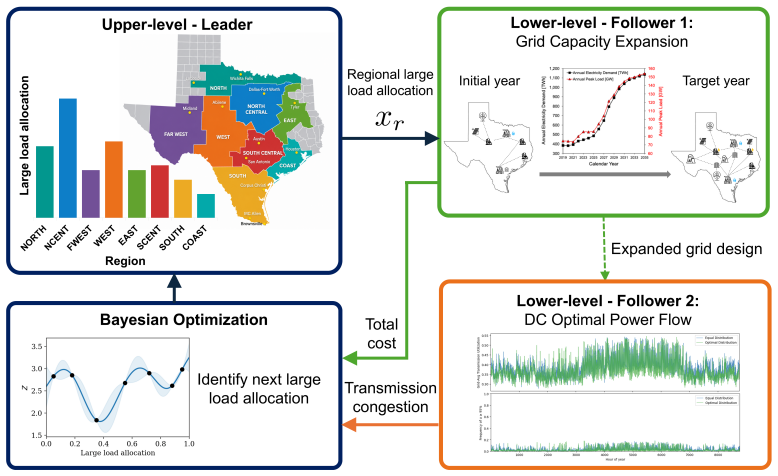
A bilevel model with Bayesian solving allocates data center and refinery loads across a Texas-like grid to minimize expansion costs while avoiding transmission congestion.
A machine-rendered reading of the paper's core claim, the machinery that carries it, and where it could break.
Core claim
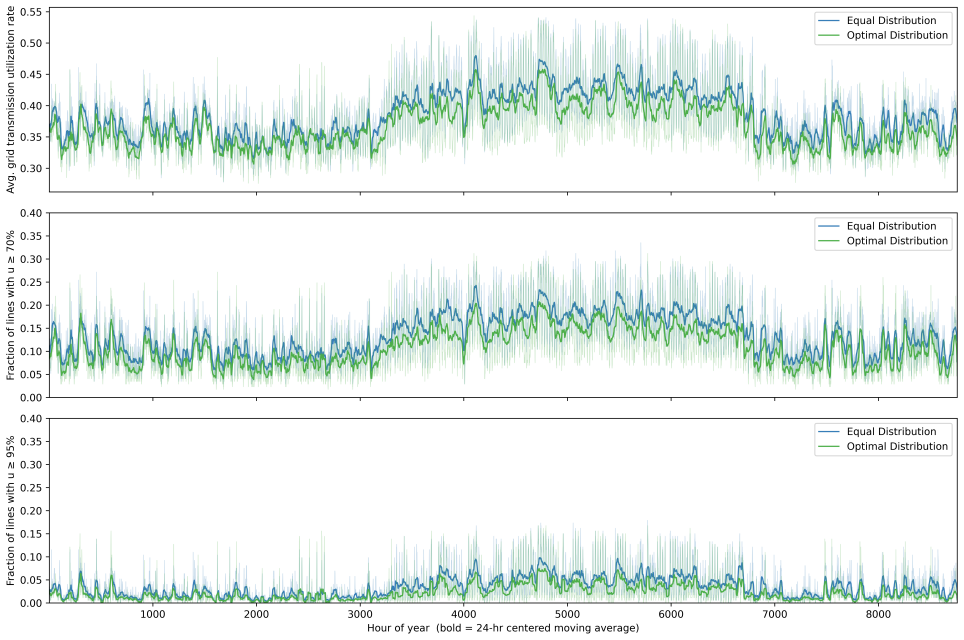
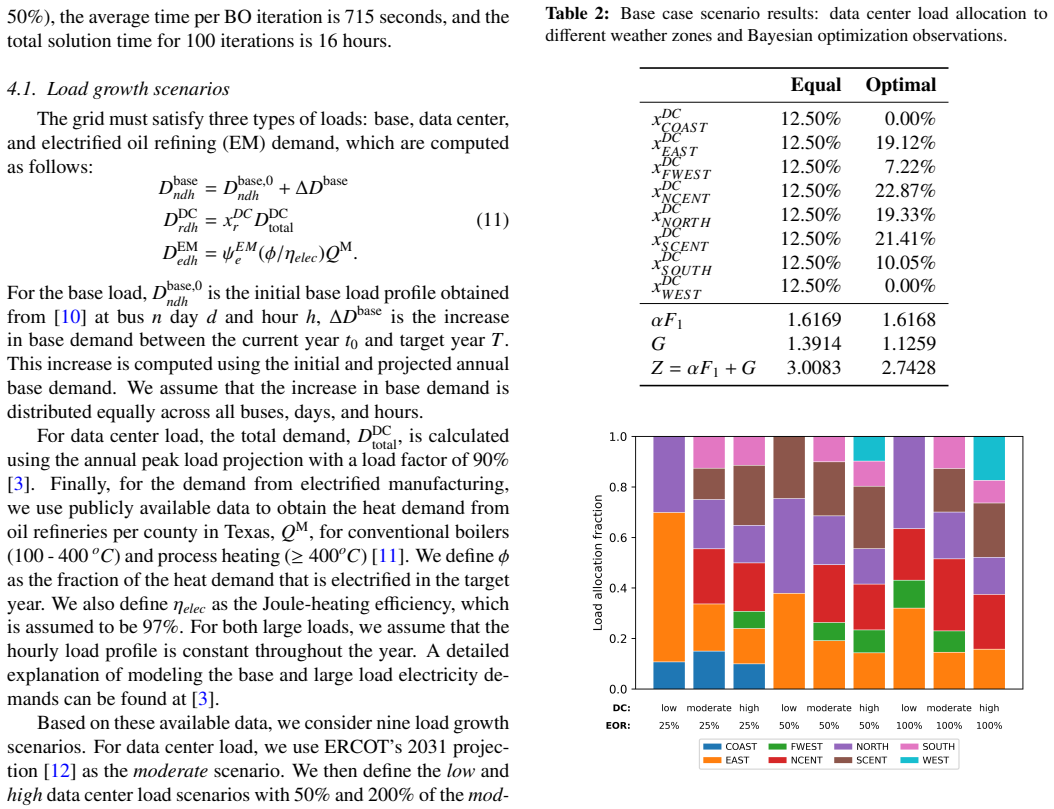
The bilevel framework, solved via Bayesian Optimization on the black-box followers, produces large-load siting decisions that explicitly trade off grid expansion cost against transmission utilization; on an ERCOT-resembling test system these decisions cause data-center demand to disperse under high-load conditions so that it avoids zones with heavy industrial-electrification demand.
What carries the argument
Leader-follower bilevel optimization in which the leader decides load locations and the followers compute expansion cost and line flows, solved by Bayesian Optimization that queries the followers only as a black box.
If this is right
- Large loads from data centers and electrified industry compete directly for transmission capacity on the same network.
- Under high total demand, data-center siting spreads to regions not already heavily used by industrial loads.
- Integrating short-term operational decisions into long-term siting reduces both expansion cost and congestion risk.
- The black-box Bayesian approach scales the bilevel model to realistic grid sizes without enumerating every follower solution.
Where Pith is reading between the lines
- The same bilevel structure could be applied to other regions whose transmission topology differs from the ERCOT-like test case.
- Adding time-varying renewable output as an additional follower objective would likely shift the optimal load locations toward areas with excess renewable capacity.
- Updating the Bayesian surrogate with live operational data could turn the static planning model into a rolling operational tool.
Load-bearing premise
That the grid-expansion and transmission-utilization calculations can be treated as a black box without losing critical interactions or solution accuracy.
What would settle it
Run the same small test network with both the Bayesian black-box solver and a full nested bilevel solver; if the siting patterns or cost values differ by more than a few percent, the black-box approximation does not preserve the essential interactions.
Figures
read the original abstract
Large loads from industrial electrification and data centers are reshaping the planning and operation of the power grid. Identifying optimal large load siting decisions while accounting for transmission congestion is key to reducing expansion cost and operational risks. In this paper, we propose a leader-follower bilevel optimization framework to identify optimal large load allocation strategies. The leader determines the allocation of large loads, while the followers determine grid expansion cost and transmission utilization. This modeling approach explicitly integrates strategic planning with detailed short-term operational decisions. Moreover, we develop a Bayesian Optimization approach to efficiently solve the bilevel optimization problem by treating the followers as a black box. We use the framework to study large-scale load allocation from electrified oil refineries and data centers on a synthetic power grid that resembles key characteristics of the Texas (ERCOT) system. The results show that these large loads compete for electricity, and under high-load scenarios, data center demand is distributed across the entire grid, avoiding regions with high demand from industrial electrification.
Editorial analysis
A structured set of objections, weighed in public.
Referee Report
Summary. The paper proposes a leader-follower bilevel optimization framework for allocating large loads (electrified oil refineries and data centers) on a synthetic ERCOT-like grid. The leader optimizes load siting to minimize costs and risks, while followers compute grid expansion costs and transmission utilization; the bilevel problem is solved via Bayesian Optimization by treating the followers as a black box. The central empirical claim is that the loads compete for electricity and that, under high-load scenarios, data-center demand spreads grid-wide to avoid industrial-electrification hotspots.
Significance. If the Bayesian Optimization surrogate faithfully reproduces follower responses, the framework would provide a scalable method for integrating long-term planning with short-term operational decisions in power-system expansion problems. The explicit bilevel structure and the ERCOT-scale case study are strengths; the black-box treatment enables handling of complex followers but requires validation to support the reported siting patterns.
major comments (2)
- [Abstract / Bayesian Optimization approach section] Abstract and methods description of the Bayesian Optimization routine: treating the followers (grid expansion cost and transmission utilization) as a black box is load-bearing for the headline distribution result, yet no cross-validation against an exact follower solver, error bounds on the surrogate, or sensitivity checks on the acquisition function are reported; systematic bias in non-convex interactions (e.g., discrete line switching or congestion costs) would directly alter the apparent competition and siting pattern.
- [Results / case study] Results section on high-load scenarios: the claim that data-center demand is distributed across the entire grid to avoid industrial-electrification regions is presented without accompanying validation metrics, comparison to a non-black-box solver, or sensitivity to follower modeling assumptions, leaving the robustness of the competition finding unverified.
minor comments (2)
- [Framework section] Notation for the leader and follower objectives should be introduced with explicit variable definitions before the bilevel formulation is stated.
- [Case study setup] The synthetic grid description would benefit from a table listing key parameters (bus count, line capacities, base load) to allow reproducibility assessment.
Simulated Author's Rebuttal
We thank the referee for the constructive comments, which highlight important aspects of validating the Bayesian Optimization surrogate and the robustness of the high-load siting results. We address each major comment below.
read point-by-point responses
-
Referee: [Abstract / Bayesian Optimization approach section] Abstract and methods description of the Bayesian Optimization routine: treating the followers (grid expansion cost and transmission utilization) as a black box is load-bearing for the headline distribution result, yet no cross-validation against an exact follower solver, error bounds on the surrogate, or sensitivity checks on the acquisition function are reported; systematic bias in non-convex interactions (e.g., discrete line switching or congestion costs) would directly alter the apparent competition and siting pattern.
Authors: We agree that explicit validation of the surrogate is necessary to support the distribution results. The manuscript currently relies on the standard theoretical convergence guarantees of Bayesian Optimization and the exact solution of each follower subproblem at every evaluation point, without reporting cross-validation metrics, surrogate error bounds, or acquisition-function sensitivity. A full exact bilevel solver is computationally intractable at ERCOT scale, which is the motivation for the black-box treatment; we will add a dedicated subsection discussing this limitation, potential biases from non-convex follower elements, and new sensitivity checks on the acquisition function in the revised manuscript. revision: partial
-
Referee: [Results / case study] Results section on high-load scenarios: the claim that data-center demand is distributed across the entire grid to avoid industrial-electrification regions is presented without accompanying validation metrics, comparison to a non-black-box solver, or sensitivity to follower modeling assumptions, leaving the robustness of the competition finding unverified.
Authors: The reported distribution pattern emerges directly from the bilevel solutions under increasing load levels. We acknowledge that the results section does not include explicit validation metrics against an exact solver or sensitivity sweeps on follower assumptions. Because an exact non-black-box solver is infeasible at this scale, we will incorporate additional robustness checks (e.g., varying follower cost parameters and acquisition-function hyperparameters) and report corresponding changes in the siting patterns in a revised results section. revision: partial
Circularity Check
No circularity: bilevel framework and BO solver are forward methods
full rationale
The paper defines a standard leader-follower bilevel model where the leader chooses load allocations and the followers compute expansion costs and transmission utilization; Bayesian Optimization is then applied by treating the follower subproblems as an external black-box oracle. No equation reduces a prediction to a fitted input by construction, no self-citation supplies a load-bearing uniqueness theorem, and no ansatz or renaming is smuggled in. The reported siting patterns therefore emerge from the explicit optimization rather than from any definitional equivalence or self-referential fit.
Axiom & Free-Parameter Ledger
axioms (2)
- domain assumption The synthetic power grid resembles key characteristics of the Texas (ERCOT) system
- domain assumption Followers determining grid expansion cost and transmission utilization can be treated as a black box
Reference graph
Works this paper leans on
-
[1]
Shehabi, S
A. Shehabi, S. J. Smith, A. Hubbard, A. Newkirk, N. Lei, M. A. B. Siddik, B. Holecek, J. Koomey, E. Masanet, D. Sartor, 2024 United States data center energy usage report, Lawrence Berkeley National LaboratoryLBNL- 2001637 (2024)
2024
-
[2]
Baldea, E
M. Baldea, E. E. Endler, E. Hale, C. T. Maravelias, M. Barolo, I. Harjunkoski, M. Mercangoz, S. L. Shah, M. Soroush, B. R. Young, et al., Transforming the pro- cess industries through electrification: Challenges and op- portunities, Ind. Eng. Chem. Res. 64 (34) (2025) 16466– 16478
2025
-
[3]
J. Lee, M. Agustin, J. Langsdorf, E. Kutanoglu, M. Baldea, I. Mitrai, Grid capacity expansion under data centers and electrified manufacturing large loads, arXiv preprint arXiv:2605.29053 (2026)
work page internal anchor Pith review Pith/arXiv arXiv 2026
-
[4]
Z. Shao, N. Yu, D. Wong, Stochastic long-term joint de- carbonization planning for power systems and data cen- ters: A case study in pjm, International Journal of Electri- cal Power & Energy Systems 173 (2025) 111377
2025
-
[5]
Abdelhady, E
M. Abdelhady, E. Iakovou, E. N. Pistikopoulos, Optimal energy portfolio investment strategies for data centers un- der deep market uncertainty, Applied Energy 410 (2026) 127510
2026
-
[6]
F. R. Dogar, T. Karagiannis, H. Ballani, A. Rowstron, Decentralized task-aware scheduling for data center net- works, ACM SIGCOMM Computer Communication Re- view 44 (4) (2014) 431–442
2014
-
[7]
J. Lee, E. Kutanoglu, M. Baldea, I. Mitrai, Effect of data center and electrified manufacturing demand on power grid expansion, Procedia CIRPIn press (2026)
2026
-
[8]
Balandat, B
M. Balandat, B. Karrer, D. Jiang, S. Daulton, B. Letham, A. G. Wilson, E. Bakshy, Botorch: A framework for effi- cient monte-carlo bayesian optimization, Adv. Neural Inf. Process. Syst. 33 (2020) 21524–21538
2020
-
[9]
W. E. Hart, C. D. Laird, J.-P. Watson, D. L. Woodruff, G. A. Hackebeil, B. L. Nicholson, J. D. Siirola, et al., Pyomo-optimization modeling in python, V ol. 67, Springer, 2017
2017
-
[10]
J. Lu, X. Li, H. Li, T. Chegini, C. Gamarra, Y . E. Yang, M. Cook, G. Dillingham, A synthetic texas power sys- tem with time-series weather-dependent spatiotemporal profiles, Sustainable Energy, Grids and Networks (2025) 101774
2025
-
[11]
McMillan, M
C. McMillan, M. Ruth, Industrial process heat demand characterization, Technical report, National Renewable Energy Laboratory (2018)
2018
-
[12]
Electric Reliability Council of Texas (ERCOT), 2025 er- cot system planning: Long-term hourly peak demand and energy forecast, Technical report (Apr. 2025)
2025
-
[13]
J. Lee, E. Kutanoglu, M. Baldea, I. Mitrai, Bilevel opti- mization framework for grid-aware large load allocation, gitHub repository (2026). URLhttps://github.com/PSE-Lab/Bilevel-Opt imization-Framework-for-Grid-aware-Large-L oad-Allocation 6
2026
discussion (0)
Sign in with ORCID, Apple, or X to comment. Anyone can read and Pith papers without signing in.