REVIEW 3 major objections 5 minor 13 references
Exploring Properties of Icosoku by Constraint Satisfaction Approach
T0 review · 3 major / 5 minor · reviewed 2026-08-14 · deepseek-v4-flash
Pith's one-line read A constraint model proves every Icosoku peg arrangement admits a solution with 20 distinct tiles.
desk verdict A plausible, well-scoped computational answer to two new Icosoku questions, undercut mainly by missing incidence data and unreleased code; referee it with a request for artifacts. read the letter →
The pith
A machine-rendered reading of the paper's core claim, the machinery that carries it, and where it could break.
The reading
What carries the argument
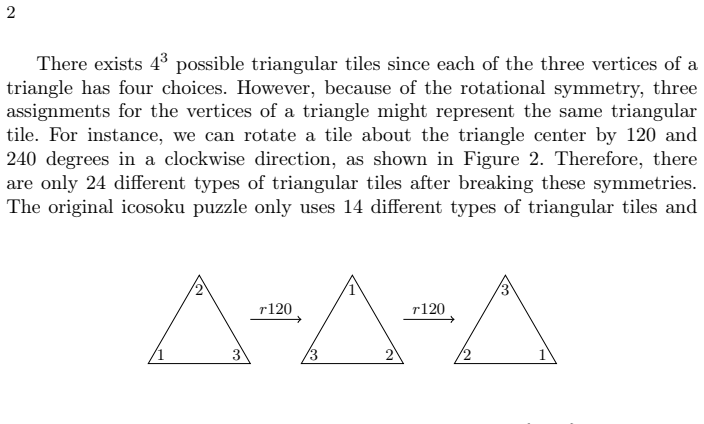
The central object is the constraint satisfaction model of the Icosoku, a CSP with 92 variables and 35 constraints built around a $20\times4$ matrix $F$. Each row of $F$ lists the three vertex dot counts of one triangular face and the corresponding tile type from the 24 rotationally distinct types; the table constraint restricts each row to the 64 allowed tuples, the allDifferent constraint forces the 20 tile types to be pairwise distinct, the scalar constraints enforce that each vertex value equals the sum of its five incident face-vertex values, and the arithm constraint fixes the first vertex to 1. The mechanism carries the argument by turning a geometric/combinatorial existence question into a finite CSP whose exhaustive solution, with value and rotation symmetry broken, certifies the universality claim.
What would settle it
Run the exhaustive check again with an independently generated face-vertex incidence table that does not come from the same labeling routine, or with a brute-force enumerator that does not use the constraint solver; if any of the $12!$ peg arrangements yields no ADTS in that independent implementation, the universality claim would be refuted.
Extended reading notes
Core claim
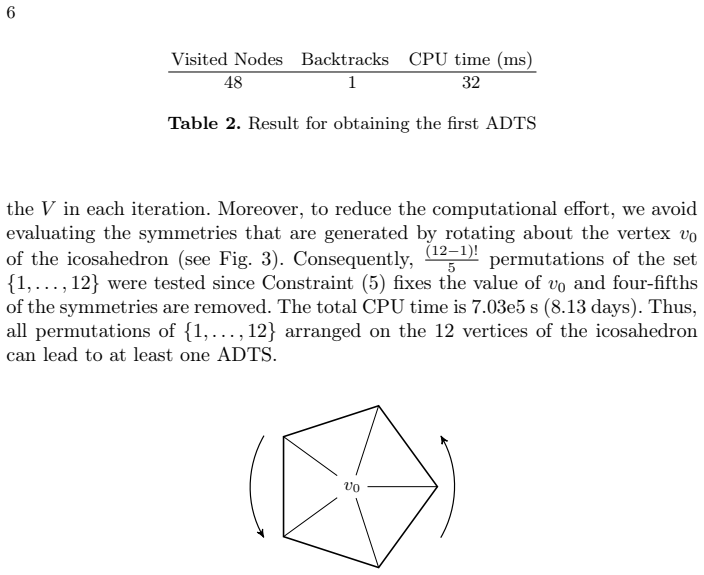
The paper's central claim is that the Icosoku puzzle has an all-different triangular solution (ADTS)—a feasible placement in which the 20 face tiles are pairwise distinct—and, more strongly, that every assignment of the values $\{1,\dots,12\}$ to the 12 vertices of the icosahedron admits at least one such solution. The evidence is a constraint satisfaction model with 92 variables and 35 constraints: vertex variables are constrained by allDifferent, a $20\times4$ face matrix is constrained by table constraints linking each face's three vertex dot counts to one of the 24 rotationally distinct tile types, scalar constraints require each vertex value to equal the sum of the five incident face-vertex values, and one arithm constraint fixes the first vertex's value to break value symmetry. Running this model in a constraint solver finds an ADTS for the first tested arrangement and, after reducing the $12!$ permutations to $(12-1)!/5$ by fixing one vertex and quotienting the fivefold rotational symmetry, the exhaustive run took $7.03\times10^5$ seconds and found an ADTS for every remaining arrangement. On this evidence the paper concludes that Questions 1 and 2 are answered in the affirmative.
Load-bearing premise
The exhaustive result depends on the unstated mapping from the icosahedron's actual geometry to the five-tuple $F_{\text{subset}}$ used in the scalar constraints, and on the rotation-symmetry reduction from $12!$ to $(12-1)!/5$ being exact; if either is wrong, the claimed universality may not apply to the physical puzzle.
Editorial extensions
If this is right
- The first two questions are settled: an ADTS exists, and every permutation of $\{1,\dots,12\}$ on the vertices admits at least one ADTS.
- The original puzzle's 'always solvable' assertion holds in a stronger form: it remains solvable even when all 20 face tiles are required to be pairwise distinct.
- The symmetry reduction shows that the exhaustive check covered $11!/5 \approx 7.98$ million genuinely different peg arrangements after fixing one vertex and quotienting the fivefold rotational symmetry.
- The total computation time of about 8.13 days on a laptop makes Icosoku a feasible but nontrivial benchmark for constraint solvers.
Reading between the lines
- If the universality result extends to the remaining open questions, the six-question hierarchy suggests a structural conjecture: the set of all ADTSs may form a single orbit under the icosahedral rotation group, which would reduce Questions 4–6 to counting orbits of 20-tile sets.
- The same constraint model could be re-run on the other Platonic solids to test whether 'every vertex-labeling admits an all-distinct-face solution' is a general property of polyhedral symmetry or special to the icosahedron's five-faces-per-vertex structure.
- A constructive certificate that maps every peg arrangement explicitly to an ADTS, without search, would replace the 8-day computation and could yield a human-readable proof of the universality claim.
Signed reviews
Editorial analysis
A structured set of objections, weighed in public.
Referee Report
Summary. The paper studies what it calls 'all different triangular solutions' (ADTS) of the Icosoku puzzle: an assignment of the values 1..12 to the 12 vertices of the icosahedron such that each vertex value equals the sum of the five surrounding face-corner values and such that the 20 triangular face types are pairwise distinct. The authors formulate a constraint programming model (Constraints (1)-(5)) and report two computational results: a first ADTS was found, and an exhaustive test of (12-1)!/5 symmetry-reduced peg permutations showed that every such permutation admits at least one ADTS. The remaining questions Q3-Q6 are left open. The paper is short, explicitly framed as a preliminary result, and aimed at encouraging further work in group theory and constraint programming.
Significance. If the central claim is correct, the paper answers two natural mathematical questions about Icosoku: ADTS existence and universality over all 12! peg arrangements. The constraint model is a direct and natural encoding of the puzzle rules, and the symmetry-reduction argument from 12! to (12-1)!/5 cases is sound because the ADTS property is invariant under rotations fixing the vertex v0. The paper also formulates five further questions that are interesting open problems. However, the manuscript omits the concrete face-vertex incidence data needed to instantiate the scalar constraints (4), provides only a partial tuple table, and releases no code or per-instance data, so the computational results cannot currently be verified by a reader. The contribution is therefore an interesting preliminary report rather than a self-contained proof.
major comments (3)
- [Section 3, Eq. (4)] The scalar constraints (4) use a subset Fsubset of the matrix F that is never defined. The text explicitly says that the five elements are not specified 'because they depend on how the triangular faces and the variables representing their vertices on the icosahedron are labelled in practice.' Since the universal ADTS claim depends on the specific 20-face incidence structure of a regular icosahedron, the model as written is only a template. A reader cannot determine whether the implemented constraints correspond to the true puzzle geometry, and the claimed exhaustive result does not follow from the paper as written.
- [Section 4] The experimental results are not reproducible from the manuscript. Table 1 lists only a subset of the 64 tuples, with no full tuple table in an appendix or supplement. The paper reports overall runtime statistics but does not give the first ADTS solution, does not release code, and does not provide per-permutation data from the exhaustive run. Consequently, both the existence claim and the universal claim rest on an unverifiable implementation. The authors should supply at least an appendix with the explicit Fsubset incidence, the complete tuple table, and a link to the code, or a machine-checkable certificate for the claimed results.
- [Section 5] The conclusion states that 'we have proved the existence of the ADTS, and any permutation of {1...12} for the vertices of the icosahedron can produce at least one ADTS.' The term 'proved' is appropriate for a computational search only if the search is exhaustively specified and the artifacts are available. The symmetry reduction is described plausibly, but the missing incidence data, the incomplete tuple table, and the unreleased implementation prevent an independent check. The paper should either soften the claim to a computational report or provide the artifacts needed to verify the exhaustive result.
minor comments (5)
- [Section 3, near Eq. (3)] The text says 'all combinations of values that can be assigned to every row of the matrix F are 644-tuples'; this appears to be a typo and should read '64 4-tuples' or '64 tuples'.
- [Footnote 1] The footnote says the scalar constraint is called the 'linear and LinearInt constraint in Geode and JaCoP'; 'Geode' should be 'Gecode'.
- [Section 3, paragraph before Eq. (4)] The phrase 'the sum of values assigned to the vertices of the triangle surrounding this vertex' is imprecise; the authors mean the sum of values on the five triangular faces meeting at the vertex, and should phrase it accordingly to avoid confusion.
- [Table 1] The caption contains 'T able' with an errant space, and the caption should also note that the full tuple list is available only from an external source or supplement, since the paper provides only a partial list.
- [Section 4] The statement that 'four-fifths of the symmetries are removed' is imprecise; after fixing v0=1, the remaining 11! value assignments are partitioned into orbits of size 5 under the rotations about v0, so (12-1)!/5 representative permutations are tested.
Circularity Check
No circularity: the constraint model directly formalizes the ADTS definition and the answers come from exhaustive search, not from fitted inputs or prior results.
full rationale
The derivation chain is the constraint model in Section 3. Constraint (1) imposes allDifferent on the 12 vertex variables, Constraint (2) imposes allDifferent on the face-type column, Constraint (3) uses table Tfaces to link each face's three vertex values to its tile type, and Constraint (4) enforces the defining property that each vertex value equals the sum of the five incident face-vertex values. These are direct transcriptions of the ADTS definition in Section 1, not restatements of the target answers. The affirmative answers to Questions 1 and 2 are obtained by actual search: Section 4 reports an exhaustive test of (12-1)!/5 permutations after fixing v0=1 and removing rotation symmetries, taking 7.03e5 s of CPU time. There are no fitted parameters, no quantity is renamed as a prediction, and the authors' prior work [6] is cited only as a Social Golfer benchmark analogy in future work, not as load-bearing evidence for the Icosoku result. The unstated face-vertex incidence behind Fsubset in Constraint (4) is a reproducibility and correctness gap, but it is not circularity: the model is not defined in terms of the claimed existence result, and no equation reduces to its own input.
Assumptions & free parameters
assumptions (3)
- standard math The icosahedron has 12 vertices, 20 triangular faces, and exactly five faces meet at each vertex, with the cyclic adjacency structure used in the model.
- standard math There are exactly 24 distinct triangular tile types up to 120-degree rotation, encoded by the 64-row table Tfaces.
- domain assumption The Choco solver is complete for finite CSP instances, so finding a solution for each tested permutation establishes satisfiability.
Cite this review
Pith. "Pith review of Exploring Properties of Icosoku by Constraint Satisfaction Approach." pith.science (2026). https://pith.science/paper/5S2RMEDD
@misc{pith2026190806003,
  author       = {Pith},
  title        = {Pith review of: Exploring Properties of Icosoku by Constraint Satisfaction Approach},
  year         = {2026},
  howpublished = {\url{https://pith.science/paper/5S2RMEDD}},
  note         = {Machine review of arXiv:1908.06003}
}
read the original abstract
Icosoku is a challenging and interesting puzzle that exhibits highly symmetrical and combinatorial nature. In this paper, we pose the questions derived from the puzzle, but with more difficulty and generality. In addition, we also present a constraint programming model for the proposed questions, which can provide the answers to our first two questions. The purpose of this paper is to share our preliminary result and problems to encourage researchers in both group theory and constraint communities to consider this topic further.
Figures

Reference graph
Works this paper leans on
-
[1]
Dechter, R.: Constraint processing. Elsevier Morgan Kaufmann (2003), http://www.elsevier.com/wps/find/bookdescription.agents/678024/description
work page 2003
-
[2]
Harvey, W.: CSPLib problem 010: Social golfers problem (2002), http://www.csplib.org/Problems/prob010, last accessed on 04/28/19
work page 2002
-
[3]
Jefferson, C., \"o zg \"u r Akg \"u n.: CSPLib : A problem library for constraints (1999), http://www.csplib.org/, last accessed on 04/28/19
work page 1999
-
[4]
Kuchcinski, K., Szymanek, R.: JaCoP Documentation. Lund University (2017), available from https://osolpro.atlassian.net/wiki/spaces/JACOP/pages/24248322/JaCoP+Overview
-
[5]
Lecoutre, C.: Constraint Networks: Techniques and Algorithms. John Wiley & Sons (2009)
work page 2009
-
[6]
Liu., K., Löffler., S., Hofstedt., P.: Solving the social golfers problems by constraint programming in sequential and parallel. In: Proceedings of the 11th International Conference on Agents and Artificial Intelligence - Volume 2: ICAART,. pp. 29--39. INSTICC, SciTePress (2019). doi:10.5220/0007252300290039
-
[7]
TASC - LS2N CNRS UMR 6241, COSLING S.A.S
Prud'homme, C., Fages, J.G., Lorca, X.: Choco Documentation. TASC - LS2N CNRS UMR 6241, COSLING S.A.S. (2017), available from http://www.choco-solver.org
work page 2017
-
[8]
Constraints 10(1), 23--46 (2005)
Puget, J.: Symmetry breaking revisited. Constraints 10(1), 23--46 (2005). doi:10.1007/s10601-004-5306-8, https://doi.org/10.1007/s10601-004-5306-8
Show all 13 references
-
[9]
(eds.): Handbook of Constraint Programming, Foundations of Artificial Intelligence, vol
Rossi, F., van Beek, P., Walsh, T. (eds.): Handbook of Constraint Programming, Foundations of Artificial Intelligence, vol. 2. Elsevier (2006), http://www.sciencedirect.com/science/bookseries/15746526/2
2006
-
[10]
Gecode Team (2017), available from https://www.gecode.org/
Schulte, C., Tack, G., Lagerkvist, M.Z.: Modeling and programming with gecode. Gecode Team (2017), available from https://www.gecode.org/
2017
-
[11]
Clarke, F., Ekeland, I.: Nonlinear oscillations and boundary-value problems for Hamiltonian systems. Arch. Rat. Mech. Anal. 78, 315--333 (1982)
1982
-
[12]
, " * write output.state after.block = add.period write
ENTRY address author booktitle chapter doi edition editor eid howpublished institution journal key month note number organization pages publisher school series title type url volume year label INTEGERS output.state before.all mid.sentence after.sentence after.block FUNCTION in...
-
[13]
write newline
" write newline "" before.all 'output.state := FUNCTION n.dashify 't := "" t empty not t #1 #1 substring "-" = t #1 #2 substring "--" = not "--" * t #2 global.max substring 't := t #1 #1 substring "-" = "-" * t #2 global.max substring 't := while if t #1 #1 substring * t #2 gl...
Reviewed August 14, 2026 · model on record in the stance chip above.
Discussion (0). Continue with ORCID to comment.