Study of Polarized Emission in Radio Halos and Filaments in the SKA Telescopes Era
Pith reviewed 2026-06-25 20:41 UTC · model grok-4.3
The pith
Cosmological simulations predict that SKA-Mid can detect polarized synchrotron emission from galaxy cluster halos to cosmic web filaments at 1.4 GHz.
A machine-rendered reading of the paper's core claim, the machinery that carries it, and where it could break.
Core claim
Using data from cosmological magneto-hydro-dynamic simulations, the expected polarized surface brightness of diffuse synchrotron sources is predicted from the center of galaxy clusters to filaments of the cosmic web at 1.4 GHz. The possibility to detect these sources with a polarization survey with SKA-Mid with AA4 telescopes is explored and compared to pointed observations with longer exposure times.
What carries the argument
Cosmological magneto-hydro-dynamic simulations that model magnetic fields and relativistic particles to predict polarized emission at 1.4 GHz for SKA observations.
Load-bearing premise
The cosmological magneto-hydro-dynamic simulations used accurately capture the properties of magnetic fields and relativistic particles in galaxy clusters and filaments.
What would settle it
If SKA observations of a known merging galaxy cluster show polarized emission levels significantly below the simulated predictions at 1.4 GHz, that would challenge the model's accuracy.
Figures
read the original abstract
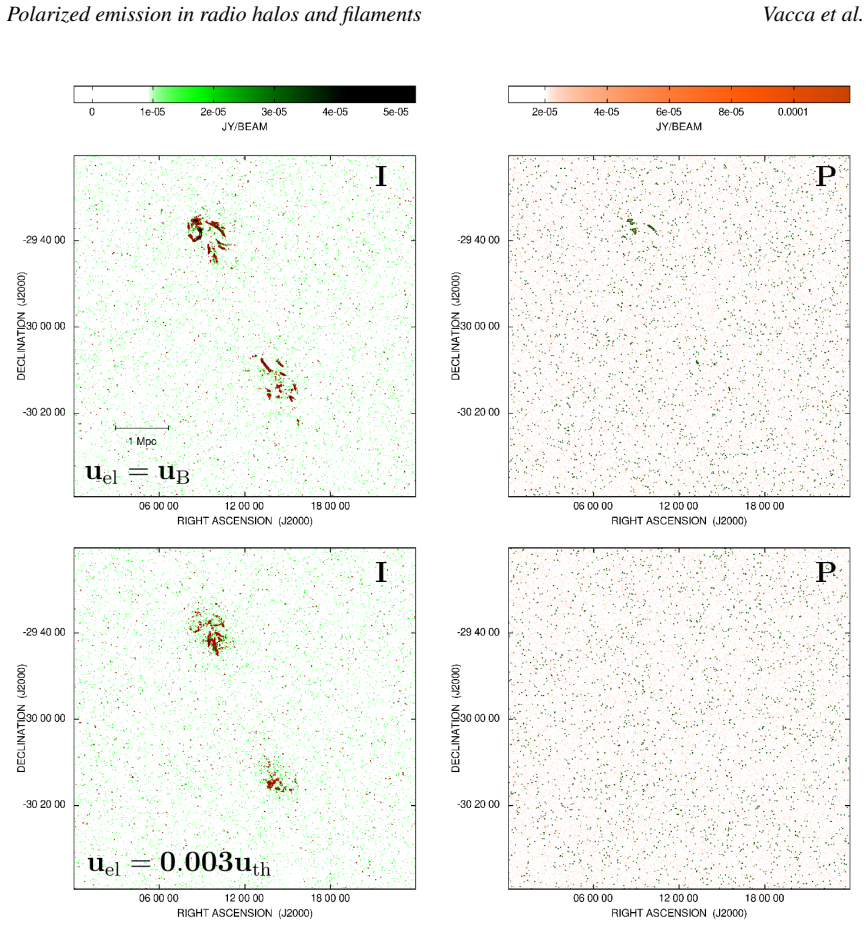
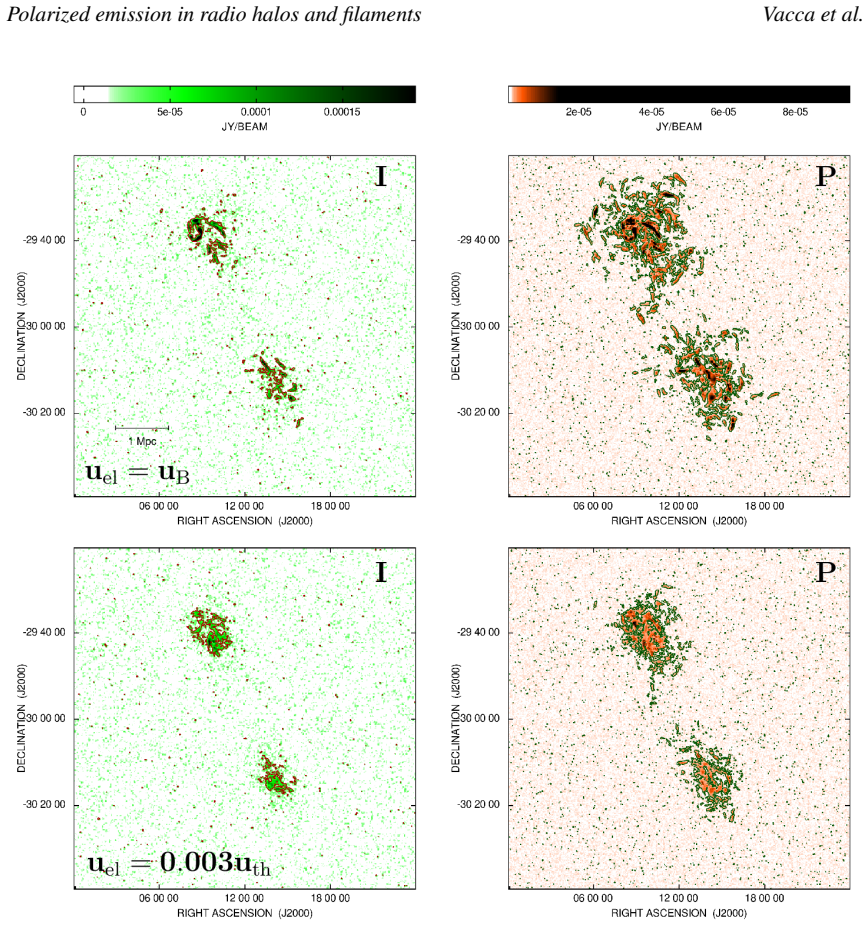
Synchrotron diffuse emission in merging galaxy clusters and along filaments connecting them demonstrates the presence of relativistic particles and magnetic fields in these environments. The study of the polarized signal associated with this emission represents a powerful tool to constrain the properties of intracluster magnetic fields and the physics of acceleration and transport of relativistic particles. Despite technological progress, detecting this polarized signal is still very challenging. In order to shed light on the capabilities of the SKA telescopes to study this emission, we use the data of cosmological magneto-hydro-dynamic simulations to predict the expected polarized surface brightness of diffuse synchrotron sources from the center of galaxy clusters to filaments of the cosmic web at 1.4 GHz. We explore the possibility to detect these sources with a polarization survey with SKA-Mid with AA4 telescopes and compare the results with those from pointed observations corresponding to longer exposure times. These simulations provide precious information to understand the potential of the SKA telescopes for studying the origin and evolution of cosmological magnetic fields. We discuss how these observations can be used in order to characterize the magnetic field and the distribution and energy content of the radio emitting plasma and to shed light on the link between non-thermal and thermal properties and the dynamical state of the system.
Editorial analysis
A structured set of objections, weighed in public.
Referee Report
Summary. The manuscript uses outputs from cosmological magneto-hydro-dynamic simulations to generate predictions of polarized synchrotron surface brightness for diffuse radio halos in galaxy cluster centers and along cosmic-web filaments at 1.4 GHz. These predictions are employed to evaluate detectability prospects with SKA-Mid in both a wide-field polarization survey (AA4 configuration) and deeper pointed observations, with the goal of informing constraints on intracluster magnetic fields, relativistic particle acceleration, and the connection between non-thermal and thermal properties.
Significance. If the simulation-based predictions hold, they would supply concrete surface-brightness and polarization targets that could directly guide SKA observing strategies and help interpret future detections in terms of magnetic-field coherence and electron energy content across a range of densities. The forward-modeling approach from cosmological runs to observable polarized quantities is a constructive element of the work.
major comments (2)
- [Abstract] Abstract: the central claim that the simulations 'provide precious information' for SKA studies of cosmological magnetic fields rests on the accuracy of both |B| and the relativistic-electron distribution, yet the abstract supplies no validation against existing polarized observations of clusters, no error analysis, and no quantitative surface-brightness values, leaving the detectability forecasts without demonstrated robustness.
- [Abstract] Simulation post-processing (implicit in the method described in the abstract): relativistic electrons are treated via ad-hoc prescriptions (shock injection efficiency, spectral index, aging) that are not self-consistently evolved; because these choices are least constrained in low-density filaments, even factor-of-a-few variations would shift the predicted polarized brightness by amounts comparable to the claimed SKA sensitivity thresholds, undermining the quantitative comparison between survey and pointed modes.
minor comments (1)
- [Abstract] The abstract would be strengthened by inclusion of at least one numerical example of predicted polarized surface brightness or fractional polarization to anchor the qualitative statements.
Simulated Author's Rebuttal
We thank the referee for the constructive feedback on our manuscript. We address the two major comments below and indicate the revisions made to the abstract and main text.
read point-by-point responses
-
Referee: [Abstract] Abstract: the central claim that the simulations 'provide precious information' for SKA studies of cosmological magnetic fields rests on the accuracy of both |B| and the relativistic-electron distribution, yet the abstract supplies no validation against existing polarized observations of clusters, no error analysis, and no quantitative surface-brightness values, leaving the detectability forecasts without demonstrated robustness.
Authors: We agree the abstract is too concise on these points. The main text contains comparisons to existing polarized cluster observations (Section 4) and quantitative surface-brightness predictions at 1.4 GHz, but these were not summarized in the abstract. We have revised the abstract to include representative polarized surface-brightness values for both cluster halos and filaments, a brief statement on the validation against current data, and a note that uncertainties are quantified in the methods and results sections. An explicit error analysis on the post-processed quantities has also been added to Section 2. revision: yes
-
Referee: [Abstract] Simulation post-processing (implicit in the method described in the abstract): relativistic electrons are treated via ad-hoc prescriptions (shock injection efficiency, spectral index, aging) that are not self-consistently evolved; because these choices are least constrained in low-density filaments, even factor-of-a-few variations would shift the predicted polarized brightness by amounts comparable to the claimed SKA sensitivity thresholds, undermining the quantitative comparison between survey and pointed modes.
Authors: The use of ad-hoc prescriptions for the relativistic-electron population is a standard limitation of current cosmological MHD simulations, as full self-consistent evolution of the electron spectrum remains computationally prohibitive. We acknowledge that these choices introduce larger uncertainties in low-density filaments. In the revised manuscript we have added a dedicated sensitivity analysis (new subsection in Section 3) that varies shock injection efficiency, spectral index, and aging timescales by factors of a few and shows the resulting range in polarized brightness. While absolute values carry sizable uncertainties, the relative detectability contrast between the wide-field survey and pointed observations remains stable across the explored parameter space; this comparison is now presented with explicit uncertainty bands. revision: partial
Circularity Check
No significant circularity in forward simulation predictions for SKA
full rationale
The paper uses independent cosmological MHD simulations as input to generate forward predictions of polarized surface brightness at 1.4 GHz for SKA-Mid observations, from cluster centers to cosmic-web filaments. No equations or steps reduce outputs to fitted parameters drawn from the target SKA data itself; the simulations are treated as external benchmarks whose outputs are compared against hypothetical observations. No self-definitional relations, fitted-input-as-prediction, or load-bearing self-citation chains appear in the derivation. The central claim remains a genuine prediction exercise rather than a renaming or tautology.
Axiom & Free-Parameter Ledger
Reference graph
Works this paper leans on
-
[1]
doi: 10.1051/0004-6361/200912520. A. Bonafede et al.A&A, 513:A30, Apr
-
[2]
doi: 10.1051/0004-6361/200913696. A. Botteon et al.MNRAS, 499(1):L11–L15, Dec
-
[3]
doi: 10.1093/mnrasl/slaa142. G. Brunetti and T. W. Jones.International Journal of Modern Physics D, 23(4):1430007-98, Mar
-
[4]
doi: 10.1142/S0218271814300079. G. Brunetti, S. Zimmer, and F. Zandanel.MNRAS, 472(2):1506–1525, Dec
-
[5]
S.J.George,J.M.Stil,andB.W.Keller.PASA,29(3):214–220,Oct.2012
doi: 10.1051/0004-6361:20030172. S.J.George,J.M.Stil,andB.W.Keller.PASA,29(3):214–220,Oct.2012. doi: 10.1071/AS11027. M. Girardi et al.MNRAS, 456(3):2829–2847, Mar
-
[6]
doi: 10.1093/mnras/stv2827. M. Girardi et al.A&A, 658:A159, Feb
-
[7]
doi: 10.1051/0004-6361/202142213. F. Govoni et al.A&A, 430:L5–L8, Jan
-
[8]
doi: 10.1051/0004-6361:200400113. F. Govoni et al.A&A, 460(2):425–438, Dec
-
[9]
doi: 10.1051/0004-6361:20065964. F. Govoni et al.A&A, 554:A102, June
-
[10]
doi: 10.1051/0004-6361/201321403. F.Govonietal. InAdvancingAstrophysicswiththeSquareKilometreArray(AASKA14),page105, Apr
-
[11]
doi: 10.22323/1.215.0105. F. Govoni et al.A&A, 603:A122, July
-
[12]
doi: 10.1051/0004-6361/201630349. F. Govoni et al.Science, 364(6444):981–984, June
-
[13]
doi: 10.1126/science.aat7500. D. Guidetti et al.A&A, 483(3):699–713, June
-
[14]
doi: 10.1051/0004-6361:20078576. D. Guidetti et al.A&A, 514:A50, May
-
[15]
doi: 10.1051/0004-6361/200913872. G. Heald et al.Galaxies, 8(3):53, July
-
[16]
doi: 10.3390/galaxies8030053. A. D. Hincks et al.MNRAS, 510(3):3335–3355, Mar
-
[17]
doi: 10.1093/mnras/stab3391. D. Hu et al.A&A, 694:A320, Feb
-
[18]
doi: 10.1051/0004-6361/202453200. K. Kurahara et al. InAdvancing Astrophysics with the SKA – II (AASKAII)
-
[19]
doi: 10.1111/j.1365-2966.2008.13895.x. F. Loi et al.MNRAS, 490(4):4841–4857, Dec. 2019a. doi: 10.1093/mnras/stz2699. 13 Polarized emission in radio halos and filaments Vacca et al. F. Loi et al.MNRAS, 485(4):5285–5293, June 2019b. doi: 10.1093/mnras/stz350. F. Loi et al. InAdvancing Astrophysics with the SKA – II (AASKAII)
-
[20]
doi: 10.1051/0004-6361:20040191. S.P.O’Sullivanetal. InAdvancingAstrophysicswiththeSKA–II(AASKAII).2026. arXivsearch: Report number AASKAII/OSullivan01. G. V. Pignataro et al.A&A, 691:A99, Nov
-
[21]
Planck Collaboration et al.A&A, 550:A134, Feb
doi: 10.1051/0004-6361/202451529. Planck Collaboration et al.A&A, 550:A134, Feb
-
[22]
Planck Collaboration et al.A&A, 594:A22, Sept
doi: 10.1051/0004-6361/201220194. Planck Collaboration et al.A&A, 594:A22, Sept
-
[23]
doi: 10.1051/0004-6361/201525826. K. Roettiger and J. O. Burns. InAmerican Astronomical Society Meeting Abstracts, volume 195 of American Astronomical Society Meeting Abstracts, page 13.04, Dec
-
[24]
doi: 10.1111/j.1365-2966.2006.09918.x. V. Vacca et al.A&A, 514:A71, May
-
[25]
doi: 10.1051/0004-6361/200913060. V. Vacca et al.A&A, 540:A38, Apr
-
[26]
doi: 10.1051/0004-6361/201116622. V. Vacca et al.MNRAS, 514(4):4969–4981, Aug
-
[27]
doi: 10.1093/mnras/stac1421. V. Vacca et al.A&A, 691:A334, Nov
-
[28]
Astronomy & Astrophysics , keywords =
doi: 10.1051/0004-6361/202349095. V.Vaccaetal. InAdvancingAstrophysicswiththeSKA–II(AASKAII).2026. arXivsearch: Report number AASKAII/Vacca02. R. J. van Weeren et al.SSR, 215(1):16, Feb
-
[29]
doi: 10.1007/s11214-019-0584-z. F. Vazza, E. Roediger, and M. Brüggen.A&A, 544:A103, Aug
-
[30]
doi: 10.1051/0004-6361/ 201118688. T. Venturi et al.A&A, 660:A81, Apr
-
[31]
doi: 10.1051/0004-6361/202142048. T. Vernstrom et al.Science Advances, 9(7):eade7233, Feb
-
[32]
doi: 10.1126/sciadv.ade7233. H. Xu et al.ApJL, 681(2):L61, July
-
[33]
doi: 10.1086/590407. H. Xu et al.ApJL, 698(1):L14–L17, June
-
[34]
doi: 10.1088/0004-637X/698/1/L14. H. Xu et al.ApJ, 725(2):2152–2165, Dec
-
[35]
doi: 10.1088/0004-637X/725/2/2152. H. Xu et al.ApJ, 759(1):40, Nov
-
[36]
doi: 10.1088/0004-637X/759/1/40. 14
discussion (0)
Sign in with ORCID, Apple, or X to comment. Anyone can read and Pith papers without signing in.