REVIEW 5 major objections 7 minor 1 cited by
LSDM: LLM-Enhanced Spatio-temporal Diffusion Model for Service-Level Mobile Traffic Prediction
T0 review · 5 major / 7 minor · reviewed 2026-08-06 · deepseek-v4-flash
Pith's one-line read LSDM predicts per-user, per-app mobile traffic by treating it as a conditional diffusion problem conditioned on satellite imagery, POI counts, and LLM-written place descriptions.
desk verdict Plausible architecture, but the evaluation section's metric tables contradict the paper's own definitions, so the headline numbers are not verifiable. read the letter →
The pith
A machine-rendered reading of the paper's core claim, the machinery that carries it, and where it could break.
The reading
What carries the argument
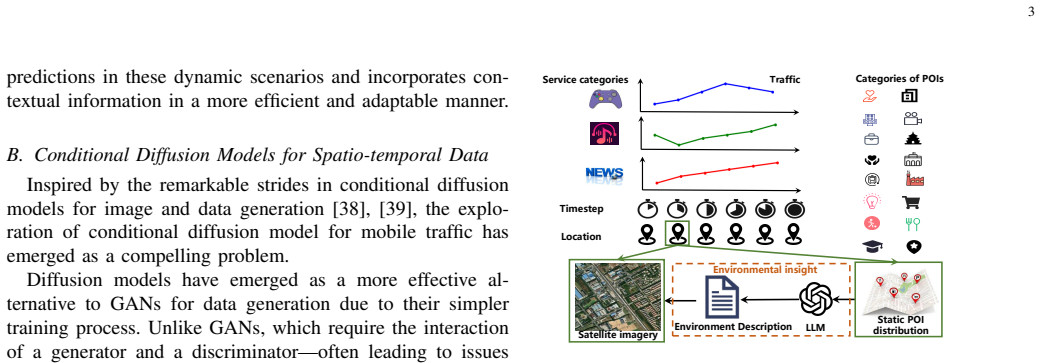
The load-bearing object is a conditional diffusion model with a two-dimensional attention denoiser. The forward process adds Gaussian noise to the app-usage matrix; the reverse process removes noise step by step, with the denoiser conditioned on historical traffic, POI counts, satellite imagery, and LLM-generated text. The denoiser is a double-layer transformer: the first layer attends over time for each service, the second attends over services for each time step, with adaptive layer normalization feeding in the conditioning vector. The LLM contribution is a CLIP-style multimodal encoder that produces an environmental vector $z_{\text{env}} = \alpha z_I + \beta z_T$, a weighted sum of satellite-image and text embeddings, which is then used as a condition during every denoising step. This machinery is what lets the model generate a whole traffic matrix jointly across services instead of predicting each service independently.
What would settle it
Compare LSDM's predictions against the same model trained with the environmental condition removed, on users whose true locations differ sharply from their connected base stations (for example, users who are indoors or on a highway far from the cell tower). If the reported $R^2$ gain from environmental context disappears for those users, the location proxy is the source of the improvement rather than genuine environmental understanding.
Extended reading notes
Core claim
The core discovery is that service-level mobile traffic forecasts improve when the prediction is treated as a conditional denoising task and the conditioning includes static environmental semantics. LSDM learns a reverse diffusion process whose input is the user's hourly traffic matrix, and the denoising network alternates a temporal transformer over hours and a service transformer over app categories, so it can represent both time dynamics and cross-service dependencies such as simultaneous use of streaming and messaging. Environmental context enters through a fine-tuned CLIP encoder that combines satellite image embeddings with text embeddings of LLM-generated place descriptions and POI counts; the paper's ablations show this contextual branch, together with the two-dimensional attention, is what separates LSDM from diffusion baselines. The reported headline numbers are $R^2 = 0.6639$ and RMSE $= 0.2262$ with the conditioned model, compared with $R^2 = 0.6452$ for the same model without environmental conditioning and RMSE $= 0.2449$ for CSDI.
Load-bearing premise
The load-bearing premise is that the base station a user connects to represents where the user actually is, so the satellite image and POI counts of that base station capture the environment that shapes the user's hourly app usage.
Editorial extensions
If this is right
- User-level resource allocation becomes possible: operators could predict tomorrow's demand per app category for each user, not just per base station.
- Cross-service dependencies are learnable structure; the 2D attention result implies joint usage patterns such as streaming while messaging can be exploited rather than treated as noise.
- Static urban context carries predictive signal; satellite images and POI counts are sufficient in the reported settings to shift forecasts.
- Long-horizon prediction does not immediately blow up: the multi-step experiment reports stable MSE for 20 steps and usable forecasts at 30 steps, which supports day-ahead planning.
Reading between the lines
- Editorial inference: if the base-station location proxy is reliable, the same pipeline should transfer across cities by swapping satellite tiles and POI counts, since the environmental encoder is pretrained and does not need city-specific labels.
- Editorial inference: the paper's stability analysis singles out entertainment services as the hardest to forecast, so a focused extension replacing static imagery with time-varying activity or event schedules could improve exactly where the current model degrades.
- Editorial inference: the claimed 2.83% $R^2$ gain is an average across services and users; a direct test would stratify the gain by user mobility level, since users who move between functional zones should benefit most from environmental conditioning and stationary users least.
Editorial analysis
A structured set of objections, weighed in public.
Referee Report
Summary. The paper proposes LSDM, a conditional diffusion model with a two-dimensional transformer attention mechanism for predicting service-level mobile traffic of individual users. The model conditions on historical traffic, satellite images, POI counts, and LLM-generated textual descriptions of POI distributions, fused through a CLIP-based encoder. The authors report experiments on a real-world dataset, claiming that the model outperforms ARIMA, LLM-prompting baselines, and diffusion baselines such as CSDI and DiT, with at least 2.83% improvement in R² from adding contextual information and at least 8.29% RMSE reduction over CSDI.
Significance. The task is well-motivated and the framework is reasonable: diffusion for distribution modeling, 2D attention for time/category dependencies, and CLIP-style multimodal fusion are sensible design choices. The paper gives explicit equations for the diffusion process, the loss, and the algorithm pseudocode, which is helpful. If the reported results were reproducible, LSDM would be a useful contribution to service-level mobile traffic prediction. However, the empirical support is currently not reliable: the metric tables are internally inconsistent, the dataset is not cited or described, there are no error bars or multiple seeds, baseline adaptations are undocumented, and the code/data are not yet available. The central quantitative claims cannot be verified from the manuscript as it stands.
major comments (5)
- [Tables III–V, Section V.A.3] In Section V.A.3, Eqs. (10) and (11) define RMSE as the square root of MSE. In Tables III–V, however, every diffusion-based row violates this identity: for 'Ours' MSE = 0.0700 while RMSE = 0.2262, but sqrt(0.0700) ≈ 0.2646; CSDI has MSE = 0.0888 and RMSE = 0.2449, but sqrt(0.0888) ≈ 0.2980. The R² column is also inconsistent with a fixed target variance: using 'Ours' (MSE 0.0700, R² 0.6639) gives Var(y) ≈ 0.208, while DiT (MSE 0.0892, R² 0.5089) implies Var(y) ≈ 0.182 and NetDiffus (MSE 0.0976, R² 0.5723) implies Var(y) ≈ 0.228; RF-diffusion's R² of 0.1531 with MSE 0.0936 is far lower than the value implied by Ours' row. Because the abstract's headline improvements ('at least 2.83%' in R² and 'at least 8.29%' in RMSE) are computed from these rows, the central quantitative claims are not currently verifiable. Please correct the tables, provide a normalization explanation if one exists, and recompute all deltas.
- [Section V.A.1 and V.B] The experimental section does not cite or name the dataset used, report its size (number of users, base stations, hours), describe the train/validation/test split, or give the number of random seeds and standard deviations. All conclusions are drawn from a single dataset, so the claims of 'outstanding generalization and adaptability' in the abstract and Section V.B are not supported. The statement that 'the code and dataset will be available' does not allow independent verification at this time. Please provide a dataset citation, dataset statistics, multi-seed results, and release the code and data, or temper the generalization claims.
- [Section V.A.2 and V.B] The only description of RF-diffusion is 'modified by us to operate effectively in the time domain.' No details are given about the modification, training configurations, hyperparameters, or implementation choices for any baseline. Without this information, the claimed superiority over RF-diffusion and the other baselines cannot be reproduced or audited. Please document all baseline adaptations and training setups in sufficient detail.
- [Section V.A.1] Environmental conditioning is built from satellite images and POI counts 'based on the geographic coordinates of the base stations connected by users.' Since users may not be at the base station location, this proxy may mis-specify the user's actual environment, and the paper provides no validation that the proxy is adequate. Because the environmental context is a core contribution, please provide evidence (e.g., user location traces, sensitivity checks, or a careful discussion of the assumption) that the base-station proxy supports the claimed gains.
- [Table IV, Section VI.A and abstract] The abstract credits the 2.83% R² improvement to 'incorporating contextual information via LLM,' but the comparison 'Ours-Non CON' vs. 'Ours' in Table IV bundles satellite image embeddings, POI counts, and LLM-generated textual descriptions into a single multimodal condition. There is no ablation that removes only the LLM-generated text while keeping the image and POI features, so the specific benefit of the LLM component is not identified. Please add an ablation that isolates the textual modality, or revise the attribution.
minor comments (7)
- [Section IV] The model name is misspelled as 'LDSM' in the opening sentence of Section IV, and 'ciffusion' appears in Section IV.B; please correct these typos.
- [Table III and Section V.B] The text refers to 'Ours-Non condition' and 'Ours+condition,' but Table III only lists a single 'Ours' row; please align the terminology between text and table.
- [Section VI.A and Table IV] The text says 'metrics such as SSIM, CS, and R2 exhibit notable gains,' but Table IV contains no SSIM column and SSIM is not defined anywhere in the paper.
- [Figures 6 and 7] The captions for Figures 6 and 7 contain literal strings such as '/uni00000038/uni00000057/...' that appear to be encoding artifacts; these should be removed and the figures regenerated.
- [Equation (9)] The parameters alpha and beta in Eq. (9) are described only as 'tunable parameters'; please state whether they are learned during training, set by validation, or fixed, and report their values.
- [Conclusion and abstract] The conclusion states that 'compared to advanced diffusion models, the R2 improves by at least 14%,' while the abstract reports 'at least 2.83%' for contextual information; please clarify that these refer to different comparisons and are consistent with the corrected tables.
- [Table V and Section VI.B] GPT-3, GPT-4, and GPT-4O are used as multimodal processing baselines, but GPT-3 is not a multimodal model and the embedding-extraction or fine-tuning procedure is not described; please clarify how these baselines were constructed.
Circularity Check
No significant circularity detected: the conditioning variables are constructed from inputs, the central claims are benchmarked against external baselines, and the self-citations are not load-bearing.
full rationale
LSDM's derivation chain is self-contained. The prediction function in Eq. (6) maps historical traffic A[t-H:t], external features B[t-H:t], and spatial information S[t-H:t] to the future A[t+1]; the target is never used to construct the conditioning variables, and the diffusion training loss in Eq. (5) is the standard conditional denoising objective. The reported gains (2.83% R2, 8.29% RMSE) are computed from comparisons in Tables III-V against external baselines (CSDI, DiT, PatchTST, NetDiffus) and from the Ours vs. Ours-Non CON ablation; no fitted parameter or physical constant is defined in terms of the result it is said to predict. Self-citations exist (e.g., [17] NetDiff for the two-layer transformer design, and [36] for prior GAN traffic generation), but they are provenance citations: the 2D attention is fully re-specified in Algorithm 1 and Section IV.C, and no uniqueness theorem or unverified prior result is invoked to force the framework. The inconsistency between MSE and RMSE values in Tables III-V (e.g., MSE=0.0700 vs. RMSE=0.2262) is a reporting and verifiability concern, not a circularity concern, because it does not make any prediction equivalent to its input by construction.
Assumptions & free parameters
free parameters (3)
- Loss weighting coefficients lambda_1, lambda_2 =
Not reported
- Modality mixing weights alpha, beta =
Not reported
- Architecture hyperparameters =
Not reported
assumptions (5)
- standard math The standard DDPM forward and reverse processes (Equations 1 to 5) correctly model conditional prediction for this task.
- domain assumption The base station a user connects to is a sufficient proxy for the user's actual location and environment at each hour.
- domain assumption Service-level traffic is meaningfully predictable from historical traffic and static environmental features such as satellite images and POI counts.
- ad hoc to paper LLM-generated textual descriptions of POI counts add information beyond the raw POI counts themselves.
- domain assumption The single real-world dataset used in Section V is representative of general urban environments.
Cite this review
Pith. "Pith review of LSDM: LLM-Enhanced Spatio-temporal Diffusion Model for Service-Level Mobile Traffic Prediction." pith.science (2026). https://pith.science/paper/5SD4MM4Z
@misc{pith2026250717795,
  author       = {Pith},
  title        = {Pith review of: LSDM: LLM-Enhanced Spatio-temporal Diffusion Model for Service-Level Mobile Traffic Prediction},
  year         = {2026},
  howpublished = {\url{https://pith.science/paper/5SD4MM4Z}},
  note         = {Machine review of arXiv:2507.17795}
}
read the original abstract
Service-level mobile traffic prediction for individual users is essential for network efficiency and quality of service enhancement. However, current prediction methods are limited in their adaptability across different urban environments and produce inaccurate results due to the high uncertainty in personal traffic patterns, the lack of detailed environmental context, and the complex dependencies among different network services. These challenges demand advanced modeling techniques that can capture dynamic traffic distributions and rich environmental features. Inspired by the recent success of diffusion models in distribution modeling and Large Language Models (LLMs) in contextual understanding, we propose an LLM-Enhanced Spatio-temporal Diffusion Model (LSDM). LSDM integrates the generative power of diffusion models with the adaptive learning capabilities of transformers, augmented by the ability to capture multimodal environmental information for modeling service-level patterns and dynamics. Extensive evaluations on real-world service-level datasets demonstrate that the model excels in traffic usage predictions, showing outstanding generalization and adaptability. After incorporating contextual information via LLM, the performance improves by at least 2.83% in terms of the coefficient of determination. Compared to models of a similar type, such as CSDI, the root mean squared error can be reduced by at least 8.29%. The code and dataset will be available at: https://github.com/SoftYuaneR/LSDM.
Figures


Figures from the paper (7 more)


Forward citations
Cited by 1 Pith paper
-
MIDiff: Tackling Sparsity and Imbalance in Mobile Usage Generation via Multivariate-Imaging Diffusion
A diffusion model trained on C-GASF images of mobile usage generates synthetic user traces that match real trace statistics far better than prior time-series generative baselines.
Reference graph
Works this paper leans on
-
[1]
Kgda: A knowledge graph driven decomposition approach for cellular traffic prediction,
J. Gong, T. Li, H. Wang, Y . Liu, X. Wang, Z. Wang, C. Deng, J. Feng, D. Jin, and Y . Li, “Kgda: A knowledge graph driven decomposition approach for cellular traffic prediction,” ACM Transactions on Intelligent Systems and Technology, vol. 15, no. 6, pp. 1–22, 2024
work page 2024
-
[2]
W. Huang, T. Li, Y . Cao, Z. Lyu, Y . Liang, L. Yu, D. Jin, J. Zhang, and Y . Li, “Safe-nora: Safe reinforcement learning-based mobile network resource allocation for diverse user demands,” in Proceedings of the 32nd ACM International Conference on Information and Knowledge Management, 2023, pp. 885–894
work page 2023
-
[3]
Dynamic channel allocation scheme based on traffic prediction in dense wireless networks,
K. Sun, J. Zhang, X. Gao, W. Huang, H. Zhang, and V . C. Leung, “Dynamic channel allocation scheme based on traffic prediction in dense wireless networks,” IEEE Transactions on Wireless Communications , vol. 23, no. 9, pp. 12 331–12 342, 2024
work page 2024
-
[4]
Carbon emissions of 5g mobile networks in china,
T. Li, L. Yu, Y . Ma, T. Duan, W. Huang, Y . Zhou, D. Jin, Y . Li, and T. Jiang, “Carbon emissions of 5g mobile networks in china,” Nature Sustainability, vol. 6, no. 12, pp. 1620–1631, 2023
work page 2023
-
[5]
Artificial intelligence for reducing the carbon emissions of 5g networks in china,
T. Li and Y . Li, “Artificial intelligence for reducing the carbon emissions of 5g networks in china,” pp. 1522–1523, 2023
work page 2023
-
[6]
Mobile traffic prediction from raw data using lstm networks,
H. D. Trinh, L. Giupponi, and P. Dini, “Mobile traffic prediction from raw data using lstm networks,” in 2018 IEEE 29th annual international symposium on personal, indoor and mobile radio communications (PIMRC). IEEE, 2018, pp. 1827–1832
work page 2018
-
[7]
Deeptp: An end-to-end neural network for mobile cellular traffic prediction,
J. Feng, X. Chen, R. Gao, M. Zeng, and Y . Li, “Deeptp: An end-to-end neural network for mobile cellular traffic prediction,” IEEE Network , vol. 32, no. 6, pp. 108–115, 2018
work page 2018
-
[8]
Z. Wang, J. Hu, G. Min, Z. Zhao, Z. Chang, and Z. Wang, “Spatial- temporal cellular traffic prediction for 5g and beyond: A graph neural networks-based approach,” IEEE Transactions on Industrial Informatics, vol. 19, no. 4, pp. 5722–5731, 2022
work page 2022
Show all 70 references
-
[9]
Empowering spatial knowledge graph for mobile traffic prediction,
J. Gong, Y . Liu, T. Li, H. Chai, X. Wang, J. Feng, C. Deng, D. Jin, and Y . Li, “Empowering spatial knowledge graph for mobile traffic prediction,” in Proceedings of the 31st ACM International Conference on Advances in Geographic Information Systems , 2023, pp. 1–11
2023
-
[10]
Sdgnet: A handover-aware spa- tiotemporal graph neural network for mobile traffic forecasting,
Y . Fang, S. Erg ¨ut, and P. Patras, “Sdgnet: A handover-aware spa- tiotemporal graph neural network for mobile traffic forecasting,” IEEE Communications Letters, vol. 26, no. 3, pp. 582–586, 2022
2022
-
[11]
To what extent we repeat ourselves? discovering daily activity patterns across mobile app usage,
T. Li, Y . Li, M. A. Hoque, T. Xia, S. Tarkoma, and P. Hui, “To what extent we repeat ourselves? discovering daily activity patterns across mobile app usage,” IEEE Transactions on Mobile Computing , vol. 21, no. 4, pp. 1492–1507, 2020
2020
-
[12]
Atpp: A mobile app prediction system based on deep marked temporal point processes,
K. Yang, X. Zhao, J. Zou, and W. Du, “Atpp: A mobile app prediction system based on deep marked temporal point processes,” ACM Trans- actions on Sensor Networks , vol. 19, no. 3, pp. 1–24, 2023
2023
-
[13]
On mining mobile apps usage behavior for predicting apps usage in smartphones,
Z.-X. Liao, Y .-C. Pan, W.-C. Peng, and P.-R. Lei, “On mining mobile apps usage behavior for predicting apps usage in smartphones,” in Proceedings of the 22nd ACM international conference on Information & Knowledge Management , 2013, pp. 609–618
2013
-
[14]
Fundamentals of recurrent neural network (rnn) and long short-term memory (lstm) network,
A. Sherstinsky, “Fundamentals of recurrent neural network (rnn) and long short-term memory (lstm) network,” Physica D: Nonlinear Phe- nomena, vol. 404, p. 132306, 2020
2020
-
[15]
Diffusion models in vision: A survey,
F.-A. Croitoru, V . Hondru, R. T. Ionescu, and M. Shah, “Diffusion models in vision: A survey,” IEEE Transactions on Pattern Analysis and Machine Intelligence , vol. 45, no. 9, pp. 10 850–10 869, 2023
2023
-
[16]
Exploiting geographical influence for collaborative point-of-interest recommendation,
M. Ye, P. Yin, W.-C. Lee, and D.-L. Lee, “Exploiting geographical influence for collaborative point-of-interest recommendation,” in Pro- ceedings of the 34th international ACM SIGIR conference on Research and development in Information Retrieval , 2011, pp. 325–334
2011
-
[17]
Netdiff: A service-guided hierarchical diffusion model for network flow trace generation,
S. Zhang, T. Li, D. Jin, and Y . Li, “Netdiff: A service-guided hierarchical diffusion model for network flow trace generation,” Proceedings of the ACM on Networking , vol. 2, no. CoNEXT3, pp. 1–21, 2024
2024
-
[18]
Cellular traffic prediction with machine learning: A survey,
W. Jiang, “Cellular traffic prediction with machine learning: A survey,” Expert Systems with Applications , vol. 201, p. 117163, 2022
2022
-
[19]
Mobile traffic prediction in consumer applications: a multimodal deep learning approach,
W. Jiang, Y . Zhang, H. Han, Z. Huang, Q. Li, and J. Mu, “Mobile traffic prediction in consumer applications: a multimodal deep learning approach,” IEEE Transactions on Consumer Electronics , 2024
2024
-
[20]
Diffusion convolutional re- current neural network: Data-driven traffic forecasting,
Y . Li, R. Yu, C. Shahabi, and Y . Liu, “Diffusion convolutional re- current neural network: Data-driven traffic forecasting,” arXiv preprint arXiv:1707.01926, 2017
2017 arXiv
-
[21]
Attentive crowd flow machines,
L. Liu, R. Zhang, J. Peng, G. Li, B. Du, and L. Lin, “Attentive crowd flow machines,” in Proceedings of the 26th ACM international conference on Multimedia , 2018, pp. 1553–1561
2018
-
[22]
Deep spatio-temporal residual networks for citywide crowd flows prediction,
J. Zhang, Y . Zheng, and D. Qi, “Deep spatio-temporal residual networks for citywide crowd flows prediction,” in Proceedings of the AAAI conference on artificial intelligence , vol. 31, no. 1, 2017
2017
-
[23]
Predrnn++: Towards a resolution of the deep-in-time dilemma in spatiotemporal predictive learning,
Y . Wang, Z. Gao, M. Long, J. Wang, and S. Y . Philip, “Predrnn++: Towards a resolution of the deep-in-time dilemma in spatiotemporal predictive learning,” in International conference on machine learning . PMLR, 2018, pp. 5123–5132
2018
-
[24]
Predrnn: Recurrent neural networks for predictive learning using spatiotemporal lstms,
Y . Wang, M. Long, J. Wang, Z. Gao, and P. S. Yu, “Predrnn: Recurrent neural networks for predictive learning using spatiotemporal lstms,” Advances in neural information processing systems , vol. 30, 2017
2017
-
[25]
Graph attention spatial- temporal network with collaborative global-local learning for citywide mobile traffic prediction,
K. He, X. Chen, Q. Wu, S. Yu, and Z. Zhou, “Graph attention spatial- temporal network with collaborative global-local learning for citywide mobile traffic prediction,” IEEE Transactions on mobile computing , vol. 21, no. 4, pp. 1244–1256, 2020
2020
-
[26]
Transformer-based spatio-temporal traffic prediction for access and metro networks,
F. Wang, X. Xin, Z. Lei, Q. Zhang, H. Yao, X. Wang, Q. Tian, and F. Tian, “Transformer-based spatio-temporal traffic prediction for access and metro networks,” Journal of Lightwave Technology , 2024
2024
-
[27]
Spatio-temporal graph transformer networks for pedestrian trajectory prediction,
C. Yu, X. Ma, J. Ren, H. Zhao, and S. Yi, “Spatio-temporal graph transformer networks for pedestrian trajectory prediction,” in Computer Vision–ECCV 2020: 16th European Conference, Glasgow, UK, August 23–28, 2020, Proceedings, Part XII 16 . Springer, 2020, pp. 507–523
2020
-
[28]
Transformer based traffic flow forecasting in sdn- vanet,
A. A. Shuvro, M. S. Khan, M. Rahman, F. Hussain, M. Moniruzzaman, and M. S. Hossen, “Transformer based traffic flow forecasting in sdn- vanet,” IEEE Access, vol. 11, pp. 41 816–41 826, 2023
2023
-
[29]
Mobile network traffic prediction using mlp, mlpwd, and svm,
A. Y . Nikravesh, S. A. Ajila, C.-H. Lung, and W. Ding, “Mobile network traffic prediction using mlp, mlpwd, and svm,” in 2016 IEEE international congress on big data (BigData Congress) . IEEE, 2016, pp. 402–409
2016
-
[30]
Characterization and prediction of mobile-app traffic using markov modeling,
G. Aceto, G. Bovenzi, D. Ciuonzo, A. Montieri, V . Persico, and A. Pescap ´e, “Characterization and prediction of mobile-app traffic using markov modeling,” IEEE Transactions on Network and Service Management, vol. 18, no. 1, pp. 907–925, 2021
2021
-
[31]
Spatio-temporal diffusion point processes,
Y . Yuan, J. Ding, C. Shao, D. Jin, and Y . Li, “Spatio-temporal diffusion point processes,” in Proceedings of the 29th ACM SIGKDD Conference on Knowledge Discovery and Data Mining , 2023, pp. 3173–3184
2023
-
[32]
Towards generative modeling of urban flow through knowledge-enhanced denoising diffusion,
Z. Zhou, J. Ding, Y . Liu, D. Jin, and Y . Li, “Towards generative modeling of urban flow through knowledge-enhanced denoising diffusion,” in Proceedings of the 31st ACM International Conference on Advances in Geographic Information Systems , 2023, pp. 1–12
2023
-
[33]
Network traffic prediction based on diffusion convo- lutional recurrent neural networks,
D. Andreoletti, S. Troia, F. Musumeci, S. Giordano, G. Maier, and M. Tornatore, “Network traffic prediction based on diffusion convo- lutional recurrent neural networks,” in IEEE INFOCOM 2019-IEEE Conference on Computer Communications Workshops (INFOCOM WK- SHPS). IEEE, 2019, ...
2019
-
[34]
Spatio-temporal knowledge driven diffusion model for mobile traffic generation,
H. Chai, X. Qi, and Y . Li, “Spatio-temporal knowledge driven diffusion model for mobile traffic generation,” IEEE Transactions on Mobile Computing, no. 01, pp. 1–18, 2025
2025
-
[35]
Practical gan-based synthetic ip header trace generation using netshare,
Y . Yin, Z. Lin, M. Jin, G. Fanti, and V . Sekar, “Practical gan-based synthetic ip header trace generation using netshare,” in Proceedings of the ACM SIGCOMM 2022 Conference , 2022, pp. 458–472
2022
-
[36]
Mobile user traffic generation via multi-scale hierarchical gan,
T. Li, S. Hui, S. Zhang, H. Wang, Y . Zhang, P. Hui, D. Jin, and Y . Li, “Mobile user traffic generation via multi-scale hierarchical gan,” ACM Transactions on Knowledge Discovery from Data , 2024
2024
-
[37]
Mobile data traffic prediction by exploiting time-evolving user mobility patterns,
F. Sun, P. Wang, J. Zhao, N. Xu, J. Zeng, J. Tao, K. Song, C. Deng, J. C. Lui, and X. Guan, “Mobile data traffic prediction by exploiting time-evolving user mobility patterns,” IEEE Transactions on mobile computing, vol. 21, no. 12, pp. 4456–4470, 2021
2021
-
[38]
Conditional image generation with score-based diffusion models,
G. Batzolis, J. Stanczuk, C.-B. Sch ¨onlieb, and C. Etmann, “Conditional image generation with score-based diffusion models,” arXiv preprint arXiv:2111.13606, 2021
2021 arXiv
-
[39]
scdiffusion: conditional generation of high-quality single-cell data using diffusion model,
E. Luo, M. Hao, L. Wei, and X. Zhang, “scdiffusion: conditional generation of high-quality single-cell data using diffusion model,” Bioin- formatics, vol. 40, no. 9, p. btae518, 2024
2024
-
[40]
Netdiffus: Network traffic generation by diffusion models through time-series imaging,
N. Sivaroopan, D. Bandara, C. Madarasingha, G. Jourjon, A. P. Jaya- sumana, and K. Thilakarathna, “Netdiffus: Network traffic generation by diffusion models through time-series imaging,” Computer Networks, vol. 251, p. 110616, 2024. 14
2024
-
[41]
Pcapgan: Packet capture file gen- erator by style-based generative adversarial networks,
B. Dowoo, Y . Jung, and C. Choi, “Pcapgan: Packet capture file gen- erator by style-based generative adversarial networks,” in 2019 18th IEEE International Conference On Machine Learning And Applications (ICMLA). IEEE, 2019, pp. 1149–1154
2019
-
[42]
Large language models: A survey,
S. Minaee, T. Mikolov, N. Nikzad, M. Chenaghlu, R. Socher, X. Am- atriain, and J. Gao, “Large language models: A survey,” arXiv preprint arXiv:2402.06196, 2024
2024 arXiv
-
[43]
Clip and complementary methods,
M. Hafner, M. Katsantoni, T. K ¨oster, J. Marks, J. Mukherjee, D. Staiger, J. Ule, and M. Zavolan, “Clip and complementary methods,” Nature Reviews Methods Primers , vol. 1, no. 1, pp. 1–23, 2021
2021
-
[44]
Contrastive learning of medical visual representations from paired images and text,
Y . Zhang, H. Jiang, Y . Miura, C. D. Manning, and C. P. Langlotz, “Contrastive learning of medical visual representations from paired images and text,” in Machine Learning for Healthcare Conference . PMLR, 2022, pp. 2–25
2022
-
[45]
Pubmedclip: How much does clip benefit visual question answering in the medical domain?
S. Eslami, C. Meinel, and G. De Melo, “Pubmedclip: How much does clip benefit visual question answering in the medical domain?” in Findings of the Association for Computational Linguistics: EACL 2023 , 2023, pp. 1181–1193
2023
-
[46]
Medclip: Contrastive learning from unpaired medical images and text,
Z. Wang, Z. Wu, D. Agarwal, and J. Sun, “Medclip: Contrastive learning from unpaired medical images and text,” arXiv preprint arXiv:2210.10163, 2022
2022 arXiv
-
[47]
Biomedclip: a multimodal biomedical foundation model pretrained from fifteen million scientific image-text pairs,
S. Zhang, Y . Xu, N. Usuyama, H. Xu, J. Bagga, R. Tinn, S. Preston, R. Rao, M. Wei, N. Valluri et al., “Biomedclip: a multimodal biomedical foundation model pretrained from fifteen million scientific image-text pairs,” arXiv preprint arXiv:2303.00915 , 2023
2023 arXiv
-
[48]
Remoteclip: A vision language foundation model for remote sensing,
F. Liu, D. Chen, Z. Guan, X. Zhou, J. Zhu, Q. Ye, L. Fu, and J. Zhou, “Remoteclip: A vision language foundation model for remote sensing,” IEEE Transactions on Geoscience and Remote Sensing , 2024
2024
-
[49]
Diffusion models: A comprehensive survey of methods and applications,
L. Yang, Z. Zhang, Y . Song, S. Hong, R. Xu, Y . Zhao, W. Zhang, B. Cui, and M.-H. Yang, “Diffusion models: A comprehensive survey of methods and applications,” ACM Computing Surveys , vol. 56, no. 4, pp. 1–39, 2023
2023
-
[50]
How much can clip benefit vision-and-language tasks?
S. Shen, L. H. Li, H. Tan, M. Bansal, A. Rohrbach, K.-W. Chang, Z. Yao, and K. Keutzer, “How much can clip benefit vision-and-language tasks?” arXiv preprint arXiv:2107.06383 , 2021
2021 arXiv
-
[51]
Urbanclip: Learning text-enhanced urban region profiling with contrastive language-image pretraining from the web,
Y . Yan, H. Wen, S. Zhong, W. Chen, H. Chen, Q. Wen, R. Zimmer- mann, and Y . Liang, “Urbanclip: Learning text-enhanced urban region profiling with contrastive language-image pretraining from the web,” in Proceedings of the ACM on Web Conference 2024, 2024, pp. 4006–4017
2024
-
[52]
Enhancing multi- modal understanding with clip-based image-to-text transformation,
C. Che, Q. Lin, X. Zhao, J. Huang, and L. Yu, “Enhancing multi- modal understanding with clip-based image-to-text transformation,” in Proceedings of the 2023 6th International Conference on Big Data Technologies, 2023, pp. 414–418
2023
-
[53]
Forecasting long-term spatial-temporal dynamics with generative transformer networks
D. Park, H. Lee, and S. Ryu, “Forecasting long-term spatial-temporal dynamics with generative transformer networks.”
-
[54]
Long-range trans- formers for dynamic spatiotemporal forecasting,
J. Grigsby, Z. Wang, N. Nguyen, and Y . Qi, “Long-range trans- formers for dynamic spatiotemporal forecasting,” arXiv preprint arXiv:2109.12218, 2021
2021 arXiv
-
[55]
Poster: A one-size-fits-all solution for cross-technology communication via transformer,
S. Liao, J. Tong, Z. Mei, D. Dai, Y . Feng, Q. Lin, and L. Yang, “Poster: A one-size-fits-all solution for cross-technology communication via transformer,” in Proceedings of the 22nd Annual International Conference on Mobile Systems, Applications and Services , 2024, pp. 722–723
2024
-
[56]
Multimodal condi- tioned diffusion model for recommendation,
H. Ma, Y . Yang, L. Meng, R. Xie, and X. Meng, “Multimodal condi- tioned diffusion model for recommendation,” inCompanion Proceedings of the ACM on Web Conference 2024 , 2024, pp. 1733–1740
2024
-
[57]
Text-difuse: An interactive multi-modal image fusion framework based on text-modulated diffusion model,
H. Zhang, L. Cao, and J. Ma, “Text-difuse: An interactive multi-modal image fusion framework based on text-modulated diffusion model,” arXiv preprint arXiv:2410.23905 , 2024
2024 arXiv
-
[58]
Latent diffusion transformer for probabilistic time series forecasting,
S. Feng, C. Miao, Z. Zhang, and P. Zhao, “Latent diffusion transformer for probabilistic time series forecasting,” in Proceedings of the AAAI Conference on Artificial Intelligence , vol. 38, no. 11, 2024, pp. 11 979– 11 987
2024
-
[59]
Fit: Flexible vision transformer for diffusion model,
Z. Lu, Z. Wang, D. Huang, C. Wu, X. Liu, W. Ouyang, and L. Bai, “Fit: Flexible vision transformer for diffusion model,” arXiv preprint arXiv:2402.12376, 2024
2024 arXiv
-
[60]
Samples: Self adaptive mining of persistent lexical snippets for classifying mobile application traffic,
H. Yao, G. Ranjan, A. Tongaonkar, Y . Liao, and Z. M. Mao, “Samples: Self adaptive mining of persistent lexical snippets for classifying mobile application traffic,” in Proceedings of the 21st Annual International Conference on Mobile Computing and Networking , 2015, pp. 439–451
2015
-
[61]
Machine learning for interconnect network traffic forecasting: Investigation and exploitation,
X. Xu, X. Wang, E. Cruz-Camacho, C. D. Carothers, K. A. Brown, R. B. Ross, Z. Lan, and K. Shu, “Machine learning for interconnect network traffic forecasting: Investigation and exploitation,” in Proceed- ings of the 2023 ACM SIGSIM Conference on Principles of Advanced Discrete...
2023
-
[62]
Tempo: Prompt-based generative pre-trained transformer for time series forecasting,
D. Cao, F. Jia, S. O. Arik, T. Pfister, Y . Zheng, W. Ye, and Y . Liu, “Tempo: Prompt-based generative pre-trained transformer for time series forecasting,” arXiv preprint arXiv:2310.04948 , 2023
2023 arXiv
-
[63]
Time-llm: Time series forecasting by re- programming large language models,
M. Jin, S. Wang, L. Ma, Z. Chu, J. Y . Zhang, X. Shi, P.-Y . Chen, Y . Liang, Y .-F. Li, S. Panet al., “Time-llm: Time series forecasting by re- programming large language models,” arXiv preprint arXiv:2310.01728, 2023
2023 arXiv
-
[64]
A time series is worth 64 words: Long-term forecasting with transformers,
Y . Nie, N. H. Nguyen, P. Sinthong, and J. Kalagnanam, “A time series is worth 64 words: Long-term forecasting with transformers,” arXiv preprint arXiv:2211.14730, 2022
2022 arXiv
-
[65]
Scalable diffusion models with transformers,
W. Peebles and S. Xie, “Scalable diffusion models with transformers,” in Proceedings of the IEEE/CVF International Conference on Computer Vision, 2023, pp. 4195–4205
2023
-
[66]
Csdi: Conditional score- based diffusion models for probabilistic time series imputation,
Y . Tashiro, J. Song, Y . Song, and S. Ermon, “Csdi: Conditional score- based diffusion models for probabilistic time series imputation,” Ad- vances in Neural Information Processing Systems , vol. 34, pp. 24 804– 24 816, 2021
2021
-
[67]
Rf-diffusion: Radio signal generation via time-frequency diffusion,
G. Chi, Z. Yang, C. Wu, J. Xu, Y . Gao, Y . Liu, and T. X. Han, “Rf-diffusion: Radio signal generation via time-frequency diffusion,” in Proceedings of the 30th Annual International Conference on Mobile Computing and Networking , 2024, pp. 77–92
2024
-
[68]
ChatGPT,
OpenAI, “ChatGPT,” Large language model, 2023, version: Jan 15. [Online]. Available: https://chat.openai.com/chat
2023
-
[69]
Gpt-4 technical report,
J. Achiam, S. Adler, S. Agarwal, L. Ahmad, I. Akkaya, F. L. Aleman, D. Almeida, J. Altenschmidt, S. Altman, S. Anadkat et al. , “Gpt-4 technical report,” arXiv preprint arXiv:2303.08774 , 2023
2023 arXiv
-
[70]
Gpt-4o system card,
A. Hurst, A. Lerer, A. P. Goucher, A. Perelman, A. Ramesh, A. Clark, A. Ostrow, A. Welihinda, A. Hayes, A. Radford et al., “Gpt-4o system card,” arXiv preprint arXiv:2410.21276 , 2024
2024 arXiv
Reviewed August 6, 2026 · model on record in the stance chip above.
Discussion (0). Sign in to comment.