REVIEW 3 major objections 5 minor 47 references
Crystal electric field splitting and f-electron hybridization in heavy fermion CePt2In7
T0 review · 3 major / 5 minor · reviewed 2026-08-14 · deepseek-v4-flash
Pith's one-line read CePt2In7's 4f electrons hybridize with conduction bands far more weakly than in CeIrIn5 and CeRhIn5, and its crystal-field-split 4f levels are directly resolved.
desk verdict Solid ARPES study with a convincing 3D Fermi surface and a plausible but under-supported weak-hybridization ranking; deserves review with a request to control the cross-compound intensity comparison. read the letter →
The pith
A machine-rendered reading of the paper's core claim, the machinery that carries it, and where it could break.
The reading
What carries the argument
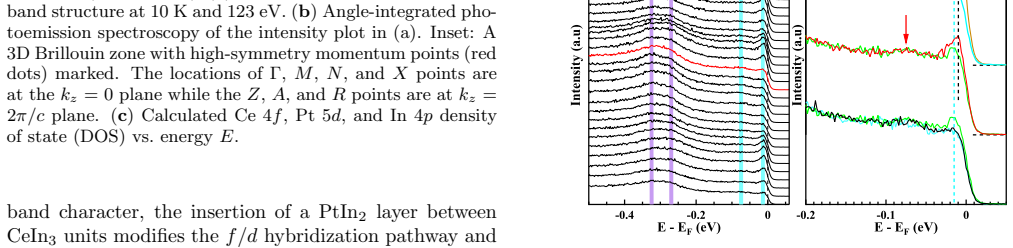
The experimental machinery is on-resonance $4d\rightarrow 4f$ photoemission, which selectively amplifies Ce 4f spectral weight, together with the single-impurity Anderson model (SIAM) relation that the f1 photoemission peak grows with hybridization strength. The paper applies two independent SIAM-based measures: the $f^1/f^0$ intensity ratio, compared with CeIrIn5 and CeRhIn5, and the energy dispersion of the hybridized quasiparticle band near the Fermi level (about 5 meV versus more than 10 meV in CeIrIn5 and CeCoIn5). For crystal-electric-field splitting, second-derivative band maps resolve four flat $f^1$-derived bands; the $4f^1_{7/2}$ state splits into peaks at about $-325$ and $-270$ meV, and the $4f^1_{5/2}$ state into peaks at about $-75$ and $-15$ meV. Variable photon energies (34, 80, 100, and 123 eV) map $k_z$ dispersion and establish the strongly three-dimensional Fermi surface.
What would settle it
Measure the f1/f0 intensity ratio and the hybridized-band dispersion in CePt2In7, CeIrIn5, and CeRhIn5 with the same photon energy, polarization, and surface preparation; finding a ratio or dispersion for CePt2In7 comparable to or larger than its siblings would overturn the weak-hybridization claim.
Extended reading notes
Core claim
CePt2In7 is an antiferromagnetic heavy fermion whose 4f electrons are nearly localized. Using on-resonance ($4d\rightarrow 4f$) photoemission, the paper resolves the spin-orbit-split $4f^1_{5/2}$ and $4f^1_{7/2}$ final states and shows each splits further under the crystal electric field into two flat bands: the $4f^1_{7/2}$ peaks at about $-325$ and $-270$ meV, and the $4f^1_{5/2}$ peaks at about $-75$ and $-15$ meV. The $f^1/f^0$ intensity ratio is smaller than in CeIrIn5 and CeRhIn5, and the hybridized quasiparticle band disperses by only about 5 meV near the Fermi level, versus more than 10 meV in the other compounds. The paper reads both observations, through the single-impurity Anderson model, as evidence that c-f hybridization in CePt2In7 is significantly weaker, while still strong enough for 4f electrons to participate in bonding and Fermi-surface formation. It further shows from photon-energy-dependent ARPES that the Fermi surface is strongly three-dimensional, consistent with density-functional calculations. The intended conclusion is that CePt2In7 is a weakly hybridized member of the CeIn3-derived family, where superconductivity emerges without strong f-electron itinerancy.
Load-bearing premise
The ranking of CePt2In7 as more weakly hybridized than CeIrIn5 and CeRhIn5 assumes that the f1/f0 intensity ratio is a transferable measure of hybridization across these compounds, with no material-dependent matrix-element or surface effects changing the comparison.
Editorial extensions
If this is right
- CePt2In7 becomes the benchmark weakly hybridized member of the CeIn3-derived family, so pressure studies can map how superconductivity emerges as hybridization is tuned.
- The resolved level positions (about $-325$, $-270$, $-75$, and $-15$ meV) give an experimental 4f crystal-field scheme that neutron scattering and thermodynamic models can check.
- Because the Fermi surface is strongly three-dimensional except near the M(A) zone corner, single-photon-energy ARPES cuts are incomplete and future band mappings must be $k_z$-resolved.
- The weak but observable hybridized quasiparticle band shows that even in this weakly hybridized limit, 4f electrons contribute to bonding and Fermi-surface formation.
Reading between the lines
- A quantitative cross-check would measure the same $f^1/f^0$ intensity ratio in CePt2In7, CeIrIn5, and CeRhIn5 under identical photon energy, polarization, and surface conditions; if matrix-element corrections preserve the ordering, the hybridization ranking becomes a quantitative scale.
- If the crystal-field assignment is correct, the same four levels should appear as Schottky anomalies in specific heat and as inelastic neutron scattering peaks; a mismatch would point to surface effects or a modified crystal-field scheme.
- The weak-hybridization result opens the question of whether pairing in CePt2In7 is mediated by local-moment and crystal-field fluctuations rather than by conventional Kondo screening; comparing superconducting $T_c$ with hybridization strength across the family would discriminate.
- The same on-resonance ARPES protocol could rank hybridization in other CeM2In7 and CeMIn5 compounds, connecting dimensionality and hybridization to superconducting $T_c$.
Editorial analysis
A structured set of objections, weighed in public.
Referee Report
Summary. The manuscript reports angle-resolved photoemission spectroscopy (ARPES) measurements on the heavy fermion compound CePt2In7, using Ce 4d-4f on-resonance spectroscopy to probe the 4f electronic states. The authors claim to resolve fine structure in the 4f spectrum that they attribute to spin-orbit and crystal electric field (CEF) splitting, and they report an f1/f0 intensity ratio smaller than in CeIrIn5 and CeRhIn5, which they interpret as substantially weaker c-f hybridization. They also report a strongly three-dimensional Fermi surface, in agreement with density functional theory calculations. The 3D Fermi surface claim is well supported by photon-energy-dependent measurements and DFT overlays; the CEF splitting and weak-hybridization interpretations rely on visual identification of weak spectral features and on cross-experiment comparisons that are not quantitatively controlled.
Significance. If the claims are substantiated, the paper would provide direct spectroscopic evidence about the degree of 4f hybridization and CEF splitting in a member of the CeIn3-derived heavy fermion family, with implications for the relationship between dimensionality, hybridization, and unconventional superconductivity. The study uses an appropriate technique (on-resonance ARPES), a high-quality single crystal, and an independent DFT comparison, and the variable-photon-energy measurements convincingly establish the kz dispersion and 3D topology. The weaker-hybridization ranking relative to CeIrIn5 and CeRhIn5 is physically plausible and consistent with prior work, but it is not yet rigorously established because the supporting f1/f0 comparison is uncontrolled and the CEF splitting of the 4f5/2 manifold rests on a single weak feature without quantitative analysis.
major comments (3)
- [Page 3, 'According to SIAM...' paragraph] The claim that the f1/f0 intensity ratio is smaller for CePt2In7 than for CeIrIn5 or CeRhIn5 is load-bearing for the headline 'much weaker hybridization,' but it is not quantitatively supported. The manuscript does not show the comparison spectra side by side, does not define the integration windows or background subtraction, and does not report error bars or a numerical value for the ratio. The comparison is made with published spectra from Ref. [12] acquired under presumably different conditions (photon energy, resolution, surface quality), which can strongly affect the f1/f0 ratio. Because the SIAM-based interpretation treats this ratio as a transferable hybridization measure, the ranking could be inverted by uncontrolled experimental differences. Please present the comparison spectra, define the integration and normalization procedure, report uncertainties, and ideally re-measure CeIrIn5 and CeRhIn5 under identical conditions, or explicitly temper the claim.
- [Fig. 2 and surrounding text, especially the -75 meV feature] The CEF splitting of the 4f5/2 manifold is claimed based on two peaks, one at about -15 meV and a 'weak, but observable' feature at about -75 meV. No peak fitting, statistical uncertainty, or reproducibility check is provided for these positions, and the second-derivative enhancement in Fig. 2(b) can produce spurious flat features. Since the CEF splitting in the abstract and conclusion is a central claim, the weak -75 meV feature must be established quantitatively. Please fit the EDCs with a defined line-shape model, report the extracted peak positions with error bars, show the raw and fitted EDCs, and demonstrate that the feature persists across multiple momentum cuts and independent measurements.
- [Fig. 2(d) and the paragraph 'Hybridization occurs at where...'] The reported ~5 meV dispersion of the hybridized quasiparticle band is described only as 'the peak positions of EDCs near the EF that cross two different regions have shifted a little.' No quantitative dispersion value, error estimate, or fitting details are given. The comparison with dispersions 'more than 10 meV' for CeIrIn5 and CeCoIn5 from Refs. [13,31] is again a cross-experiment comparison. To support the weak-hybridization ranking, the same EDC peak-analysis procedure should be applied to the reference compounds or at least the uncertainty in the 5 meV estimate should be quantified.
minor comments (5)
- [Page 2, first paragraph] The word 'APRES' appears to be a typo; it should read 'ARPES.'
- [Page 3, 'Attempts to perform DFT...'] The statement that DFT calculations in the 4f1 localized configuration 'failed to stabilize such state' is vague and not reproducible. Please specify what was attempted and what 'failed to stabilize' means, or remove the sentence.
- [Page 3, 'estimated based on an inner potential of 11 eV [40]'] The inner potential V0 = 11 eV is used to assign kz for the Fermi surface maps, but the main text does not describe how V0 was determined or its uncertainty. Please provide this information, or cite the specific supplemental section that describes it.
- [Fig. 1(c)] The DFT DOS calculation should state whether the 4f electrons are treated as itinerant or localized, and should specify the energy zero and the exchange-correlation functional used (GGA with SOC is mentioned only in footnote [33]).
- [Fig. 2(d)] The integration widths for the colored momentum regions are not specified. Please state the momentum widths used for the brown, cyan, black, red, and green EDCs, or confirm that they are identical.
Circularity Check
No significant circularity: central claims rest on direct ARPES measurements and independent DFT, not on fitted parameters or self-citation chains.
full rationale
The paper's load-bearing claims are derived from direct measurements and independent calculations, not from inputs that reappear as outputs. The weak-hybridization conclusion is based on two separate empirical observations: the Ce 4f f1/f0 intensity ratio compared with published spectra of CeIrIn5 and CeRhIn5, and the measured ~5 meV dispersion of the hybridized quasiparticle band compared with >10 meV reported for other heavy-fermion compounds. These are cross-experiment comparisons, not equations that reduce to the paper's own inputs; any uncontrolled differences in measurement conditions are a correctness or uncertainty concern, not circularity. The SIAM statement that f1 intensity increases with hybridization is an external theoretical relation, not a self-citation. The CEF splitting assignments are read directly from EDCs and second-derivative images, with peak positions stated explicitly. The 3D Fermi-surface claim is validated against independent DFT/GGA calculations performed for this paper, and agreement with earlier published ARPES and quantum-oscillation work is corroborative, not definitional. The only auxiliary parameter mentioned, an inner potential of 11 eV, is used for kz labeling of the Fermi-surface map and does not enter the CEF or hybridization conclusions. No fitted parameter is renamed as a prediction, and no load-bearing uniqueness theorem is imported from the authors' prior work. The paper is therefore self-contained for its main claims, and the circularity score is 0.
Assumptions & free parameters
free parameters (1)
- inner potential V0 =
11 eV
assumptions (3)
- domain assumption The f^1 peak intensity in resonant photoemission increases with c-f hybridization strength (single-impurity Anderson model).
- domain assumption The energy dispersion of the hybridized quasiparticle band is a monotonic measure of hybridization strength (periodic Anderson model).
- domain assumption The four flat bands observed in the second-derivative spectra are intrinsic Ce 4f states, not surface states or final-state artifacts.
Cite this review
Pith. "Pith review of Crystal electric field splitting and f-electron hybridization in heavy fermion CePt2In7." pith.science (2026). https://pith.science/paper/5SJFUPTQ
@misc{pith2026190809975,
  author       = {Pith},
  title        = {Pith review of: Crystal electric field splitting and f-electron hybridization in heavy fermion CePt2In7},
  year         = {2026},
  howpublished = {\url{https://pith.science/paper/5SJFUPTQ}},
  note         = {Machine review of arXiv:1908.09975}
}
read the original abstract
We use high-resolution angle-resolved photoemission spectroscopy to investigate the electronic structure of the antiferromagnetic heavy fermion compound CePt2In7, which is a member of the CeIn3-derived heavy fermion material family. Weak hybridization among 4f electron states and conduction bands was identified in CePt2In7 at low temperature much weaker than that in the other heavy fermion compounds like CeIrIn5 and CeRhIn5. The Ce 4f spectrum shows fine structures near the Fermi energy, reflecting the crystal electric field splitting of the 4f^1_5/2 and 4f^1_7/2 states. Also, we find that the Fermi surface has a strongly three-dimensional topology, in agreement with density-functional theory calculations.
Figures


Figures from the paper (1 more)

Reference graph
Works this paper leans on
-
[12]
J. D. Denlinger, G.-H. Gweon, J. W. Allen, C. G. Olson, M. B. Maple, J. L. Sarrao, P. E. Armstrong, Z. Fisk, and H. Yamagami, J. Electron Spectrosc. Relat. Phenom. 117-117, 347 (2001)
work page 2001
-
[1]
Pfleiderer, Rev
C. Pfleiderer, Rev. Mod. Phys. 81, 1551 (2009)
2009
- [2]
-
[3]
R. H. Heffner and M. R. Norman, Comments Condens. Matter Phys. 17, 361 (1996)
work page 1996
-
[4]
C. Petrovic, P. G. Pagliuso, M. F. Hundley, R. Movshovich, J. L. Sarrao, J. D. Thompson, Z. Fisk, and P. Monthoux, J. Phys.: Condens. Matter 13 (17), L337 (2001)
work page 2001
- [5]
-
[6]
up to an order of magnitude higher than the maximum pressure-induced T c of 0.25 K found in cubic building block CeIn 3 [7]. Recent polarized soft x-ray absorption and nonresonant inelastic x-ray scattering experiments find that, in addition to the crystal structure, details of anisotropic hybridization off and itinerant electrons play a nontrivial role in...
work page Pith review arXiv 2008
-
[7]
I. R. Walker, F. M. Grosche, D. M. Freye and G. G. Lonzarich, Physica C: Superconductivity 282-287, 303 (1997)
work page 1997
Show all 47 references
-
[8]
J. D. Thompson, R. Movshovich, Z. Fisk, F. Bouquet, N. J. Curro, R. A. Fisher, P. C. Hammel, H. Hegger, M. F. Hundley, M. Jaime, P. G. Pagliuso, C. Petrovic, N. E. Phillips, and J. L. Sarrao, J. Magn. Magn. Mater. 226, 5 (2001)
2001
-
[9]
Sundermann, A
M. Sundermann, A. Amorese, F. Strigari, M. W. Haverkort, L. H. Tjeng, M. Moretti Sala, H. Yava¸ s, E. D. Bauer, P. F. S. Rosa, J. D. Thompson, A. Severing, arXiv: 1902.06726
1902 arXiv
-
[10]
Brookes, Eric D
Thomas Willers, Fabio Strigari, Zhiwei Hu, Violetta Sessi, Nicholas B. Brookes, Eric D. Bauer, John L. Sar- rao, J. D. Thompson, Arata Tanaka, Steffen Wirth, Liu Hao Tjeng and Andrea Severing, Proceedings of the Na- tional Academy of Sciences 112, 2384 (2015). 6
2015
-
[11]
Petrovic, Kai-Ming Ho and Adam Kaminski, Phys
Rui Jiang, Daixing Mou, Chang Liu, Xin Zhao, Yongxin Yao, Hyejin Ryu, C. Petrovic, Kai-Ming Ho and Adam Kaminski, Phys. Rev. B 91, 165101 (2015)
2015
-
[13]
S. I. Fujimori, A. Fujimori, K. Shimada, T. Narimura, K. Kobayashi, H. Namatame, M. Taniguchi, H. Harima, H. Shishido, S. Ikeda, D. Aoki, Y. Tokiwa, Y. Haga, and Y. Onuki, Phys. Rev. B 73, 224517 (2006)
2006
-
[14]
S. I. Fujimori, T. Okane, J. Okamoto, K. Mamiya, Y. Muramatsu, A. Fujimori, T. Narimura, K. Kobayashi, K. Shimada, H. Namatame, M. Taniguchi, H. Harima, D. Aoki, S. Ikeda, H. Shishido, Y. Tokiwa, Y. Haga, and Y. Onuki, Physica B 329 (Part 2), 547 (2003)
2003
-
[15]
Zh. M. Kurenbaeva, E. V. Murashova, Y. D. Seropegin, H. Noel, and A. I. Tursina, Intermetallics 16, 979 (2008)
2008
-
[16]
Q. Y. Chen, D. F. Xu, X. H. Niu, R. Peng, H. C. Xu, C. H. P. Wen, X. Liu, L. Shu, S. Y. Tan, X. C. Lai, Y. J. Zhang, H. Lee, V. N. Strocov, F. Bisti, P. Dudin, J. X. Zhu, H. Q. Yuan, S. Kirchner, and D. L. Feng, Phys. Rev. Lett. 120, 066403 (2018)
2018
-
[17]
V. A. Sidorov, Xin Lu, T. Park, Hanoh Lee, P. H. Tobash, R. E. Baumbach, F. Ronning, E. D. Bauer, and J. D. Thompson, Phys. Rev. B 88, 020503(R) (2013)
2013
-
[18]
E. D. Bauer, H. O. Lee, V. A. Sidorov, N. Kurita, K. Gofryk, J. X. Zhu, F. Ronning, R. Movshovich, J. D. Thompson, and T. Park, Phys. Rev. B 81, 180507(R) (2010)
2010
-
[19]
M. M. Altarawneh, N. Harrison, R. D. McDonald, F. F. Balakirev, C. H. Mielke, P. H. Tobash, J. X. Zhu, J. D. Thompson, F. Ronning, and E. D. Bauer, Phys. Rev. B 83, 081103(R) (2011)
2011
-
[20]
E. D. Bauer, V. A. Sidorov, H. Lee, N. Kurita, F. Ron- ning, R. Movshovich, and J. D. Thompson, J. Phys.: Conf. Ser. 200, 012011 (2010)
2010
-
[21]
B. Shen, L. Yu, K. Liu, S. Lyu, X. Jia, E. D. Bauer, J. D. Thompson, Y. Zhang, C. Wang, C. Hu, Y. Ding, X. Sun, Y. Hu, J. Liu, Q. Gao, L. Zhao, G. Liu, Z. Xu, C. Chen, Z. Lu, and X. J. Zhou, Chin. Phys. B 26, 77401 (2017)
2017
-
[22]
Klimczuk, O
T. Klimczuk, O. Walter, L. M¨ uchler, J. W. Krizan, F. Kinnart, and R. J. Cava, J. Phys.: Condens. Matter 26, 402201 (2014)
2014
-
[23]
None of these earlier experi- ments, however, directly probed the 4 f electron states that are essential to the physics of this family of materi- als
or coexistence of commensurate and incommensu- rate [24, 25] antiferromagnetism orders were revealed by nuclear quadrupolar resonance as well as muon spin rotation/relaxation [26]. None of these earlier experi- ments, however, directly probed the 4 f electron states that are e...
2017
-
[24]
R. Y. Chen, S. J. Zhang, E. D. Bauer, J. D. Thompson, and N. L. Wang, Phys. Rev. B 94, 035161 (2016)
2016
-
[25]
apRoberts-Warren, A
N. apRoberts-Warren, A. P. Dioguardi, A. C. Shockley, C. H. Lin, J. Crocker, P. Klavins, and N. J. Curro, Phys. Rev. B 81, 180403(R) (2010)
2010
-
[26]
Sakai, Y
H. Sakai, Y. Tokunaga, S. Kambe, H.-O. Lee, V. A. Sidorov, P. H. Tobash, F. Ronning, E. D. Bauer, and J. D. Thompson, Phys. Rev. B 83, 140408(R) (2011)
2011
-
[27]
Sakai, Y
H. Sakai, Y. Tokunaga, S. Kambe, H. Lee, V. A. Sidorov, P. H. Tobash, F. Ronning, E. D. Bauer, and J. D. Thomp- son, Journal of Physics: Conference Series 391, 12057 (2012)
2012
-
[28]
M˚ ansson, K
M. M˚ ansson, K. Prˇ sa. Y. Sassa, P. H. Tobash, E. D. Bauer, C. Rusu, D. Andreica, O. Tjernberg, K. Sedlak, M. Grioni, T. Durakiewicz and J. Sugiyama, Journal of Physics: Conference Series 551, 012028 (2014)
2014
-
[29]
P. H. Tobash, F. Ronning, J. D. Thompson, B. L. Scott, P. J. W. Moll, B. Batlogg, and E. D. Bauer, J. Phys.: Condens. Matter 24, 15601 (2012)
2012
-
[30]
Patil, A
S. Patil, A. Generalov, M. G¨ uttler, P. Kushwaha, A. Chikina, K. Kummer, T. C. R¨ odel, A. F. Santander- Syro, N. Caroca-Canales, C. Geibel, S. Danzenb¨ acher, Yu. Kucherenko, C. Laubschat, J. W. Allen, and D. V. Vyalikh, Nat. Commun. 7, 11029 (2016)
2016
-
[31]
Q. Y. Chen, C. H. P. Wen, Q. Yao, K. Huang, Z. F. Ding, L. Shu, X. H. Niu, Y. Zhang, X. C. Lai, Y. B. Huang, G. B. Zhang, S. Kirchner, and D. L. Feng, Phys. Rev. B 97, 075149 (2018)
2018
-
[32]
Yun Zhang, Wei Feng, Xia Lou, Tianlun Yu, Xiegang Zhu, Shiyong Tan, Bingkai Yuan, Yi Liu, Haiyan Lu, Donghua Xie, Qin Liu, Wen Zhang, Xuebing Luo, Yaobo Huang, Lizhu Luo, Zhengjun Zhang, Xinchun Lai and Qiuyun Chen, Phys. Rev. B 97, 45128 (2018)
2018
-
[33]
Q. Y. Chen, D. F. Xu, X. H. Niu, J. Jiang, R. Peng, H. C. Xu, C. H. P. Wen, Z. F. Ding, K. Huang, L. Shu, Y. J. Zhang, H. Lee, V. N. Strocov, M. Shi, F. Bisti, T. Schmitt, Y. B. Huang, P. Dudin, X. C. Lai, S. Kirchner, H. Q. Yuan and D. L. Feng, Phys. Rev. B 96, 045107 (2017)
2017
-
[34]
Blaha, G
P. Blaha, G. Madsen, K. Schwarz, D. Kvasnicka, and J. Luitz, WIEN2k, An Augmented Plane Wave + Local Orbitals Program for Calculating Crystal Properties (Vi- enna University of Technology, Vienna, 2001)
2001
-
[35]
RKmax = 7 .5 led to approximately 1000 basis functions
DFT calculations were performed in nonmagnetic state using GGA exchange correlation functional including spin-orbital coupling effects in second variational treat- ment. RKmax = 7 .5 led to approximately 1000 basis functions. Brillouin zone integration was performed with modifie...
-
[36]
Jian-Qiao Meng, P. M. Oppeneer, J. A. Mydosh, P. S. Riseborough, K. Gofryk, J. J. Joyce, E. D. Bauer, Yin- wan Li and T. Durakiewicz, Phys. Rev. Lett.111, 127002 (2013)
2013
-
[37]
Gunnarsson and K
O. Gunnarsson and K. Sch¨ onhammer, Phys. Rev. B 28, 4315 (1983)
1983
-
[38]
A. D. Christianson, J. M. Lawrence, P. S. Riseborough, N. O. Moreno, P. G. Pagliuso, E. D. Bauer, J. L. Sarrao, W. Bao, E. A. Goremychkin, S. Kerm, F. R. Trouw, and M. P. Hehlen, J. Neutron Res. 13, 179 (2005)
2005
-
[39]
Willers, Z
T. Willers, Z. Hu, N. Hollmann, P. O. K¨ orner, J. Gegner, T. Burnus, H. Fujiwara, A. Tanaka, D. Schmitz, H. H. Hsieh, H. J. Lin, C. T. Chen, E. D. Bauer, J. L. Sarrao, E. Goremychkin, M. Koza, L. H. Tjeng and A. Severing, Phys. Rev. B 81, 195114 (2010)
2010
-
[40]
A. D. Christianson, E. D. Bauer, J. M. Lawrence, P. S. Riseborough, N. O. Moreno, P. G. Pagliuso, J. L. Sarrao, J. D. Thompson, E. A. Goremychkin, F. R. Trouw, M. P. Hehlen, and R. J. McQueeney, Phys. Rev. B 70, 134505 (2004)
2004
-
[41]
S. I. Fujimori, Journal of Physics: Condensed Matter 28, 153002 (2016)
2016
-
[42]
See supplemental material for crystal electric field split- ting and f-electron hybridization in heavy fermion CePt2In7, which includes Refs. [41C45]
-
[43]
Shin-ichi Fujimori, Masaaki Kobata, Yukiharu Takeda, Tetsuo Okane, Yuji Saitoh, Atsushi Fujimori, Hiroshi Ya- magami, Yuji Matsumoto, Etsuji Yamamoto, Naoyuki Tateiwa and Yoshinori Haga, Phys. Rev. B 96, 125117 (2017). 7
2017
-
[44]
V. N. Strocov, J. Electron Spectrosc. Relat. Phenom. 130, 65 (2003)
2003
-
[45]
Wadati, T
H. Wadati, T. Yoshida, A. Chikamatsu, H. Kumigashira, M. Oshima, H. Eisaki, Z.-X. Shen, T. Mizokawa and A. Fujimori, Phase Transitions 79, 617-635 (2006)
2006
-
[46]
Xiao-Fang Tang, Yu-Xia Duan, Fan-Ying Wu, Shu-Yu Liu, Chen Zhang, Yin-Zou Zhao, Jiao-Jiao Song, Yang Luo, Qi-Yi Wu, Jun He, H. Y. Liu, Wen Xu and Jian- Qiao Meng, Phys. Rev. B 99, 125112 (2019)
2019
-
[47]
D. Ehm, F. Reinert, G. Nicolay, S. Schmidt, S. Hufner, R. Claessen, V. Eyert, and C. Geibel, Phys. Rev. B 64, 235104 (2001)
2001
Reviewed August 14, 2026 · model on record in the stance chip above.
Discussion (0). Continue with ORCID to comment.