Electromagnetic Signatures From Primordial Black Holes in the Solar System
Pith reviewed 2026-06-29 21:14 UTC · model grok-4.3
The pith
Calculations show that instruments like AMEGO-X could detect Hawking radiation from primordial black holes transiting within 0.1 AU of Earth, while HAWC and LHAASO could observe their explosions out to 0.1 and 0.5 parsecs.
A machine-rendered reading of the paper's core claim, the machinery that carries it, and where it could break.
Core claim
By evaluating local transit rates for extended primordial black hole mass distributions that could comprise all the dark matter, the authors establish that the proposed AMEGO-X satellite could reliably detect Hawking-radiated photons from transits within O(0.1 AU) of Earth, while the HAWC and LHAASO observatories are sensitive to explosions out to O(0.1 pc) and O(0.5 pc) respectively. They further show that a future explosion at a distance of about 10^3 AU could yield measurable electromagnetic signals at Earth depending on alignment with detector fields of view, although the specific 2023 KM3NeT neutrino event would not have produced detectable signals given its sky position and the offline
What carries the argument
Hawking radiation photon spectra from asteroid-mass primordial black holes, combined with computed local transit rates and explosion frequencies for extended mass distributions.
If this is right
- The AMEGO-X satellite could detect electromagnetic signals from primordial black hole transits within O(0.1 AU) of Earth.
- HAWC could register primordial black hole explosions out to O(0.1 pc).
- LHAASO could register primordial black hole explosions out to O(0.5 pc).
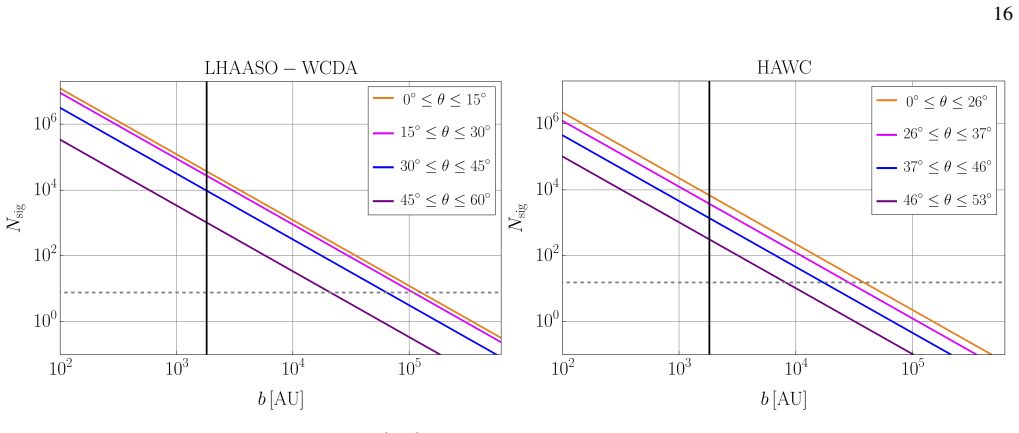
- Future primordial black hole explosions at distances around 10^3 AU could produce measurable electromagnetic signals if aligned with active detector fields of view.
- The 2023 KM3NeT neutrino event at ~10^3 AU would not have produced detectable electromagnetic signals due to sky position and HAWC status.
Where Pith is reading between the lines
- Non-detections across these instruments would tighten upper limits on the fraction of dark matter that can reside in asteroid-mass primordial black holes.
- Positive detections would allow reconstruction of the local primordial black hole mass distribution from the observed photon spectra and event rates.
- This electromagnetic channel could be combined with gravitational-wave or microlensing searches to cross-check whether primordial black holes explain isolated high-energy neutrino events.
- Alignment requirements for distant explosions imply that coordinated multi-instrument campaigns would increase the chance of capturing both electromagnetic and neutrino signals from the same event.
Load-bearing premise
Extended mass distributions of asteroid-mass primordial black holes can comprise all the dark matter, which fixes the local transit rates and explosion frequencies used to derive the quoted detection distances.
What would settle it
A null result from a multi-year search for transit or explosion signatures with AMEGO-X, HAWC, or LHAASO at the predicted rates would indicate that such primordial black holes do not make up all the dark matter.
Figures
read the original abstract
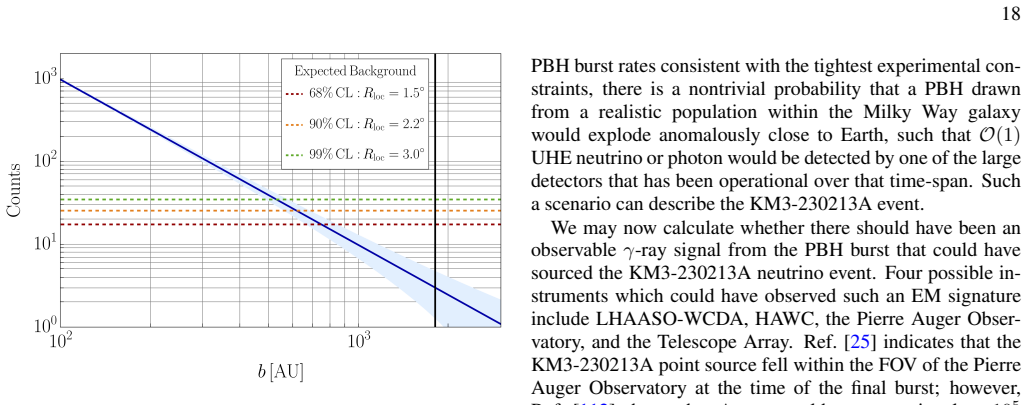
Primordial black holes (PBHs) in the asteroid-mass range, with typical masses $10^{17}\,{\rm g}\lesssim M \lesssim 10^{23}\,{\rm g}$, have drawn significant recent attention as a viable dark matter candidate. The peak frequencies of photons emitted via Hawking radiation from asteroid-mass PBHs range from infrared to $\gamma$-ray bands. We calculate expected local transit rates for extended PBH mass distributions which could comprise all the dark matter. We evaluate prospects for detecting Hawking-radiated photons from local PBH transits through the inner Solar System and from PBH explosions in the far outer edges of the Solar System. We consider several existing and proposed ground-based and space-based instruments sensitive to photons from the radio band to ultrahigh energy $\gamma$-rays. We find that proposed instruments, such as the AMEGO-X satellite, could reliably detect PBH transits within ${\cal O} (0.1 \, {\rm AU})$ of the Earth, while the HAWC and LHAASO observatories are both sensitive to PBH explosions out to ${\cal O}(0.1 \, {\rm pc})$ and ${\cal O}(0.5 \, {\rm pc})$ respectively. We conclude by specifically considering potential companion electromagnetic signatures in the case of a PBH explosion about $10^3\,{\rm AU}$ from Earth, which has been suggested as a potential source for the $\sim 220 \, {\rm PeV}$ ultrahigh-energy KM3-230213A neutrino event observed by the KM3NeT collaboration in 2023. Whereas we find that the recent KM3NeT event would not have yielded detectable electromagnetic signals -- due to its location on the sky, proposed distance from Earth, and the offline status of the HAWC observatory at that time -- we demonstrate that future PBH explosions at comparable distances could yield measurable electromagnetic signals at Earth, depending on alignment of the PBH burst with detector fields of view.
Editorial analysis
A structured set of objections, weighed in public.
Referee Report
Summary. The manuscript calculates expected local transit rates for asteroid-mass primordial black holes (10^17 g ≲ M ≲ 10^23 g) under extended mass distributions that could comprise all dark matter. It evaluates detection prospects for Hawking-radiated photons from PBH transits in the inner Solar System and explosions in the outer Solar System across instruments spanning radio to ultrahigh-energy gamma rays. The central results state that AMEGO-X could reliably detect transits within O(0.1 AU) of Earth, while HAWC and LHAASO are sensitive to explosions out to O(0.1 pc) and O(0.5 pc), respectively. The paper additionally analyzes potential electromagnetic signatures for a PBH explosion at ~10^3 AU, including in connection with the KM3NeT KM3-230213A neutrino event.
Significance. If the results hold, the work supplies concrete, instrument-specific detection horizons grounded in standard Hawking radiation calculations and published instrument sensitivities. This provides a clear bridge from PBH theory to observational strategy, enabling targeted searches or constraints on asteroid-mass PBH dark matter with existing and proposed facilities. The forward nature of the per-event signal-to-threshold calculations (independent of overall normalization) is a strength.
minor comments (3)
- [Abstract] Abstract: the central numerical claims (O(0.1 AU), O(0.1 pc), O(0.5 pc)) are stated without any reference to the underlying luminosity-threshold equating step or mass-distribution normalization; adding one sentence summarizing the key inputs would improve accessibility without lengthening the abstract.
- [Abstract] Abstract: the order-of-magnitude notation appears as 'O (0.1 AU)' with italic O and inconsistent spacing; standardizing to \mathcal{O}(0.1\,{\rm AU}) throughout would improve typographic consistency.
- The discussion of the KM3NeT event references detector status, sky position, and distance but does not tabulate these parameters; a short table would make the non-detection argument and future-prospect comparison easier to follow.
Simulated Author's Rebuttal
We thank the referee for their positive assessment of the manuscript, including the recognition of its concrete detection horizons and the strength of the per-event signal calculations. The recommendation for minor revision is noted. No specific major comments were provided in the report.
Circularity Check
No significant circularity
full rationale
The paper's central claims (instrument reach distances for PBH transits and explosions) are derived from forward calculations equating standard Hawking luminosity/fluence formulas to detector thresholds and effective areas. The extended mass distribution assumption normalizes local number density and thus event rates, but does not enter the per-event signal-to-threshold step that sets the quoted O(0.1 AU) or O(0.1-0.5 pc) distances. No equations reduce by construction to fitted parameters, no self-citation chains justify uniqueness or ansatze, and no renaming of known results occurs. The derivation is self-contained against external benchmarks.
Axiom & Free-Parameter Ledger
axioms (2)
- standard math Hawking radiation formulas for black-hole evaporation
- domain assumption Extended PBH mass distributions can comprise all dark matter
discussion (0)
Sign in with ORCID, Apple, or X to comment. Anyone can read and Pith papers without signing in.