REVIEW 2 major objections 6 minor 1 cited by
ECG-Byte: A Tokenizer for End-to-End Generative Electrocardiogram Language Modeling
T0 review · 2 major / 6 minor · reviewed 2026-08-11 · deepseek-v4-flash
Pith's one-line read A rule-based byte-pair tokenizer lets an LLM answer ECG questions end-to-end, matching learned ECG encoders at a fraction of the training cost.
desk verdict A genuinely useful tokenization recipe for ECG-LLMs, with solid efficiency numbers, but the missing conditioning control leaves the central claim under-supported. read the letter →
The pith
A machine-rendered reading of the paper's core claim, the machinery that carries it, and where it could break.
The reading
What carries the argument
The central object is ECG-Byte, an adapted byte pair encoding (BPE) tokenizer for ECG signals. It works by normalizing each ECG to the range [0,1], quantizing amplitudes into 26 symbols (the lowercase letters a-z), flattening the 12 leads into one long symbol string, and iteratively merging the most frequent adjacent symbol pairs, exactly the BPE compression algorithm, into new token IDs up to a chosen number of merges. Encoding uses a trie for longest-match tokenization. What carries the argument is that these tokens are inserted directly into the LLM's vocabulary and input sequence, so the model learns to condition generation on the ECG with no separate encoder or projection layer, while the merge history makes every token traceable back to the waveform.
What would settle it
Run the exact ECG-QA PTB-XL experiment with the ECG token block replaced by (a) no ECG tokens at all and (b) the same ECG tokens in random order. If BLEU-4, Rouge-L, Meteor, and BertScore do not drop substantially relative to the reported ECG-Byte numbers, the paper's claim that ECG-Byte conveys signal content is falsified.
Extended reading notes
Core claim
The paper's discovery is that a purely rule-based compressor, byte pair encoding applied to quantized ECG amplitudes, can carry a 12-lead ECG signal into an LLM's vocabulary well enough for competitive conditional text generation, making a learned, self-supervised ECG encoder unnecessary. ECG-Byte quantizes each normalized sample into one of 26 symbols, flattens the 12 leads into a single symbol string, and runs BPE on a large concatenated corpus to learn merges that become new vocabulary tokens. The LLM is then finetuned with the sequence [BOS] [SIG START] <ECG tokens> [SIG END] <question> <answer> [EOS], with the loss computed only on the answer tokens. Empirically, against two-stage baselines that pretrain contrastive, masked-image, or dual-objective ECG encoders, ECG-Byte is competitive or superior across BLEU-4, Rouge-L, Meteor, and BertScore on both MIMIC-IV and PTB-XL question-answer sets, while requiring about 48% of the data and roughly one-third of the total training time.
Load-bearing premise
The load-bearing premise is that the LLM's answers are actually driven by the ECG tokens; nothing in the experiments removes or scrambles the ECG input to prove this, and the attention maps show most of the model's attention falling on the text.
Editorial extensions
If this is right
- A dedicated self-supervised ECG encoder is not a necessary component for competitive ECG-to-text generation; a rule-based tokenizer suffices.
- Training time and data requirements for ECG language models can be cut to roughly one-third and one-half, respectively, without sacrificing NLG quality.
- Because ECG tokens are reversible, attention maps and token-usage statistics become interpretable in terms of P waves, QRS complexes, and T waves.
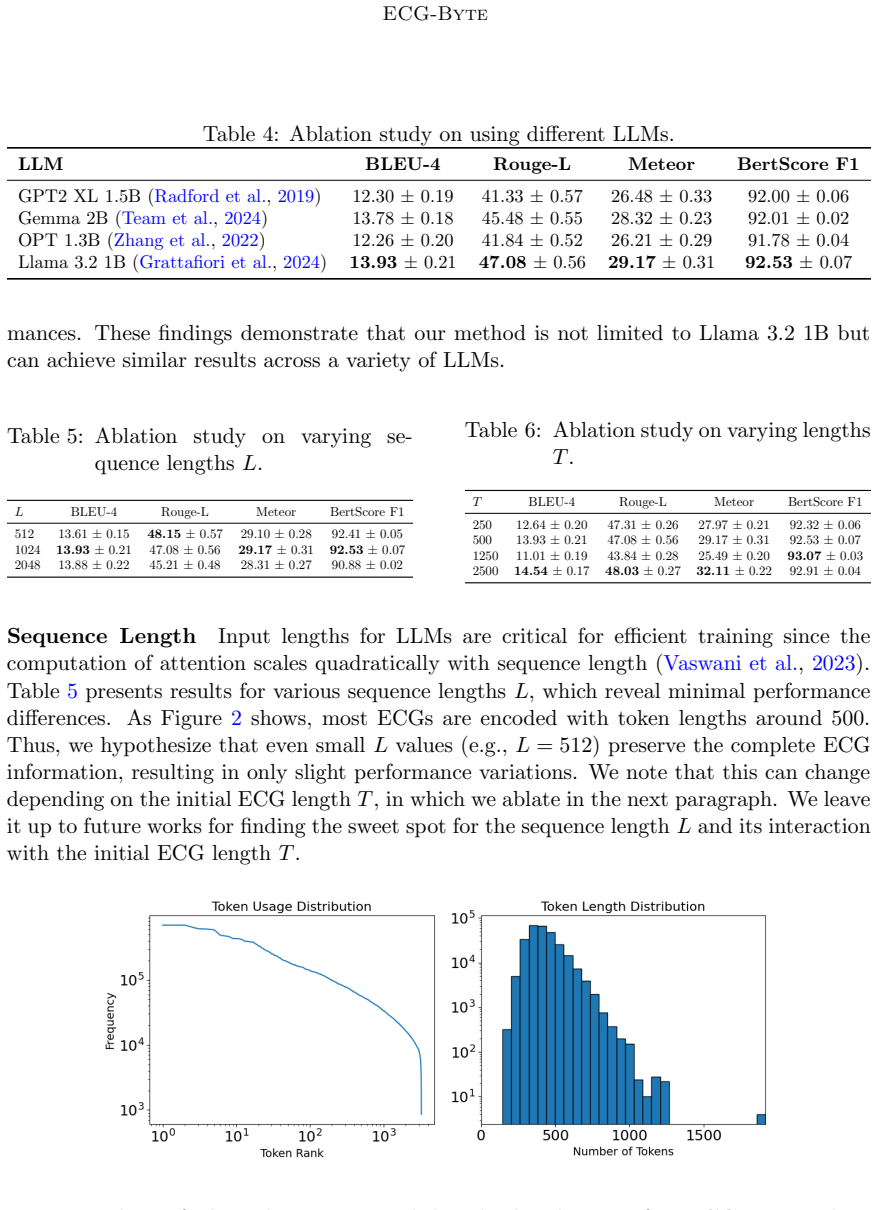
- The approach works across different base LLMs and ECG segment lengths, with full 10-second ECGs giving the highest scores in the paper's ablations.
- The same BPE-on-quantized-signal recipe can be applied to other physiological time series for generative tasks.
Reading between the lines
- One test the paper does not run is a text-only or ECG-shuffled control; without it, the competitive scores could partly reflect the LLM answering from question priors or template text rather than from the ECG tokens.
- The paper's own attention analysis shows the model concentrating on the textual part of the input, which, if confirmed by a control, would weaken the claim that the ECG tokens are what drive the generated answer.
- A practical extension is to benchmark ECG-Byte tokens against other discrete time-series encodings, such as symbolic aggregation approaches, for generative tasks; the paper proposes refined quantizers as future work but does not compare them.
- If the conditioning-control issue is resolved, the same compression approach may generalize to EEG, PPG, or EMG language modeling, where interpretable reversible tokens could help clinicians audit model reasoning.
Signed reviews
Editorial analysis
A structured set of objections, weighed in public.
Referee Report
Summary. The paper proposes ECG-Byte, a byte-pair-encoding (BPE) tokenizer that converts 12-lead ECG signals into discrete tokens by quantizing normalized amplitudes into a 26-symbol alphabet and then applying BPE merges. The tokens are fed directly into a decoder-only LLM (Llama-3.2-1B, with LoRA) together with a textual question, replacing the conventional two-stage pipeline of self-supervised ECG encoder pretraining followed by LLM finetuning. The authors report competitive or better NLG metrics on ECG-QA (MIMIC-IV and PTB-XL) compared with their implemented two-stage baselines, while using about 48% of the data and roughly 3x less total training time. They also provide ablations over LLM choice, sequence length, ECG segment length, number of merges, and model size, plus qualitative token-to-ECG mappings and attention visualizations. A central claimed advantage is interpretability: ECG tokens can be mapped back to the original signal. The paper concludes that a rule-based compressor can replace a learned ECG encoder in generative ECG language modeling.
Significance. If the central claim holds, the paper would make a useful contribution: it challenges the prevailing two-stage SSL-encoder paradigm for ECG-to-text generation and offers a simpler, faster, and more interpretable alternative. The experiments are generally well structured: results are reported as means over 5 seeds with standard deviations; ablations cover multiple LLMs, sequence lengths, ECG lengths, and merge counts; and the code is promised to be released. The efficiency comparison in Table 2 is a genuine strength, and the interpretability analysis through token-to-signal mapping is more informative than the usual latent-feature visualizations. However, the paper's load-bearing claim is conditional NLG: that the generated text actually depends on the ECG tokens. That claim is not established by the current experiments because no text-only, shuffled-ECG, or random-token control is reported. The paper's own attention analysis (Figure 4) shows that attention is concentrated on the text portion, and the authors explicitly acknowledge that this pattern is common in vision-language models.
major comments (2)
- [Section 4, Section 5.1, Section 5.5] The central claim is that ECG-Byte enables conditional NLG, where generated text depends on the ECG tokens. However, no experiment demonstrates that the ECG tokens influence the output. The training objective in Eq. (3) conditions on Context that includes XID, but the paper never reports a control with the ECG tokens removed, replaced by random tokens, or shuffled. Given that Figure 4 shows the model attending primarily to the text portion of the input, and Section 5.5 cites prior VLM work showing minimal attention to visual input, the competitive BLEU and Rouge scores in Table 1 could be driven by question priors and template answers. Please add a text-only or shuffled-ECG control and report whether the metrics change materially. If they do not change, the conditional-NLG framing in the abstract and Section 5.1 should be weakened to avoid overclaiming.
- [Section 5.1, Table 1] The sentence "Table 1 demonstrates ECG-Byte's effectiveness, showing competitive or superior performances across all metrics and datasets" is not supported by the table. On ECG-QA PTB-XL, the LMIM baseline achieves higher BLEU-4 (15.14 ± 0.28 vs 13.93 ± 0.21) and higher Meteor (29.64 ± 0.30 vs 29.17 ± 0.31) than ECG-Byte, even though ECG-Byte is superior on Rouge-L and BertScore. The text should be revised to "competitive on most metrics and datasets, superior on some," with a clear statement of where ECG-Byte loses. This overstatement appears again in the cross-dataset transfer results in Table 7, where ECG-Byte is often worse than the two-stage baselines.
minor comments (6)
- [Section 3.2, Eq. (1)] The constants ϵ1 = 0.5, ϵ2 = 10⁻⁶, and the alphabet size |A| = 26 are presented without justification. Please add a sentence on how sensitive the results are to these choices or acknowledge them as hyperparameters that were not systematically tuned.
- [Section 4.1 and Table 8] The main experiments use num_merges = 3500, but the ablation in Table 8 shows that num_merges = 2500 gives higher BLEU-4 (15.10 vs 13.93) and Meteor (30.12 vs 29.17) on ECG-QA PTB-XL. Please explain why 3500 was chosen for the main results, or report the best-performing setting.
- [Table 6] The T = 2500 row uses only 97,244 training instances instead of the 400,000 used for T = 250 and T = 500. This confounds the effect of ECG segment length with dataset size. The text should state this limitation explicitly and avoid attributing the T = 2500 improvement solely to richer ECG context.
- [Section 5.5, Figure 4] The attention visualization is qualitative and only described for one lead. Please specify how many examples were inspected and whether the pattern was consistent, or provide a quantitative summary of attention allocated to ECG vs text tokens across the evaluation set.
- [Section 5.5] The statement "we focus on one lead due to the uniformity of attention across encoded signal tokens" is asserted without supporting evidence. Please provide a quantitative comparison of attention across leads or remove the claim.
- [Headings] There are typographical artifacts in headings, e.g., "T raining" in Section 5.3 and "T oken" in Section 5.5. These should be corrected in a final proofreading pass.
Circularity Check
No circularity: ECG-Byte's NLG and efficiency claims are empirically measured, not derived from fitted inputs or self-citations.
full rationale
The paper's central claims are empirical. ECG-Byte is a rule-based BPE tokenizer trained on ECG statistics (percentiles, cluster sampling, merge counts), but these choices are not fit to the NLG metrics; the BLEU/Rouge/Meteor/BertScore results in Table 1 and the data/time ratios in Table 2 are reported observations against external baselines. The autoregressive objective (Eq. 3) conditions generation on ECG tokens, but the concern that no behavioral control proves the tokens are used is a threat to external validity, not a circular reduction: no target result is encoded in the experimental setup. Section 5.5 itself concedes 'attention visualizations may not inherently indicate which parts of the input sequence contribute to the final generated output,' and the paper flags this as an interpretability limitation. Self-citations (Han et al. 2024, Qiu et al. 2023a/b) appear only as background or as one of several inspirations for quantization, alongside independent works such as Chen et al. (2022), and are not load-bearing. No equation reduces a prediction to a fitted value, no uniqueness theorem is imported from the authors, and no known result is renamed as organization.
Assumptions & free parameters
free parameters (4)
- Quantization alphabet size =
26
- Normalization percentiles and epsilons =
p1 and p99 from 300,000 samples; eps1=0.5, eps2=1e-6
- Number of BPE merges =
3500
- ECG segment length T =
500 (2 seconds at 250 Hz)
assumptions (3)
- domain assumption Flattening the 12 leads into a single string is a valid representation for BPE merging.
- domain assumption The LLM genuinely conditions its generated text on the ECG tokens.
- domain assumption BLEU, Rouge-L, Meteor, and BertScore are adequate proxies for clinical text quality.
Cite this review
Pith. "Pith review of ECG-Byte: A Tokenizer for End-to-End Generative Electrocardiogram Language Modeling." pith.science (2026). https://pith.science/paper/5T3S2U5J
@misc{pith2026241214373,
  author       = {Pith},
  title        = {Pith review of: ECG-Byte: A Tokenizer for End-to-End Generative Electrocardiogram Language Modeling},
  year         = {2026},
  howpublished = {\url{https://pith.science/paper/5T3S2U5J}},
  note         = {Machine review of arXiv:2412.14373}
}
read the original abstract
Large Language Models (LLMs) have demonstrated exceptional versatility across domains, including applications to electrocardiograms (ECGs). A growing body of work focuses on generating text from multi-channeled ECG signals and corresponding textual prompts. Existing approaches often involve a two-stage process: pretraining an ECG-specific encoder with a self-supervised learning (SSL) objective, followed by finetuning an LLM for natural language generation (NLG) using encoder-derived features. However, these methods face two key limitations: inefficiency due to multi-stage training and challenges in interpreting encoder-generated features. To overcome these issues, we propose ECG-Byte, an adapted byte pair encoding (BPE) tokenizer pipeline for autoregressive language modeling of ECGs. ECG-Byte compresses and encodes ECG signals into tokens, enabling direct end-to-end LLM training by combining ECG and text tokens. This approach enhances interpretability, as ECG tokens can be directly mapped back to the original signals. Leveraging ECG-Byte, we achieve competitive NLG performance while training 3 times faster and using just 48\% of the data required by traditional two-stage methods.
Figures


Figures from the paper (6 more)


Forward citations
Cited by 1 Pith paper
-
Signal, Image, or Symbolic: Exploring the Best Input Representation for Electrocardiogram-Language Models Through a Unified Framework
A unified benchmark across six ECG datasets and five text-generation metrics finds tokenized symbolic ECG inputs outperform raw signal and image inputs for ECG-language models.
Reference graph
Works this paper leans on
-
[1]
Vl-interpret: An interactive visualization tool for interpreting vision-language transformers, 2022
Estelle Aflalo, Meng Du, Shao-Yen Tseng, Yongfei Liu, Chenfei Wu, Nan Duan, and Vasudev Lal. Vl-interpret: An interactive visualization tool for interpreting vision-language transformers, 2022. URL https://arxiv.org/abs/2203.17247
arXiv 2022
-
[2]
Nikolopoulos, Hans Vandierendonck, Deepu John, and Bo Ji
Kazi Hasan Ibn Arif, JinYi Yoon, Dimitrios S. Nikolopoulos, Hans Vandierendonck, Deepu John, and Bo Ji. Hired: Attention-guided token dropping for efficient inference of high-resolution vision-language models in resource-constrained environments, 2024. URL https://arxiv.org/abs/2408.10945
arXiv 2024
-
[3]
Meteor: An automatic metric for mt evaluation with improved correlation with human judgments
Satanjeev Banerjee and Alon Lavie. Meteor: An automatic metric for mt evaluation with improved correlation with human judgments. In IEEvaluation@ACL, 2005
2005
-
[4]
Fuyu-8b: A multimodal architecture for ai agents, 10 2023
Rohan Bavishi, Erich Elsen, Curtis Hawthorne, Maxwell Nye, Augustus Odena, and Sagnak Tasirlar. Fuyu-8b: A multimodal architecture for ai agents, 10 2023. URL https://www.adept.ai/blog/fuyu-8b
2023
-
[5]
Tom B. Brown, Benjamin Mann, Nick Ryder, Melanie Subbiah, Jared Kaplan, Prafulla Dhariwal, Arvind Neelakantan, Pranav Shyam, Girish Sastry, Amanda Askell, Sandhini Agarwal, Ariel Herbert-Voss, Gretchen Krueger, Tom Henighan, Rewon Child, Aditya Ramesh, Daniel M. Ziegler, Jeffrey Wu, Clemens Winter, Christopher Hesse, Mark Chen, Eric Sigler, Mateusz Litwin...
arXiv 2020
-
[6]
Llm-abba: Understand time series via symbolic approximation, 2024 a
Erin Carson, Xinye Chen, and Cheng Kang. Llm-abba: Understand time series via symbolic approximation, 2024 a . URL https://arxiv.org/abs/2411.18506
arXiv 2024
-
[7]
Quantized symbolic time series approximation, 2024 b
Erin Carson, Xinye Chen, and Cheng Kang. Quantized symbolic time series approximation, 2024 b . URL https://arxiv.org/abs/2411.15209
arXiv 2024
-
[8]
Fleet, and Geoffrey Hinton
Ting Chen, Saurabh Saxena, Lala Li, David J. Fleet, and Geoffrey Hinton. Pix2seq: A language modeling framework for object detection, 2022
2022
Show all 82 references
-
[9]
Yhdego, Fatemeh Khadem, and Fatemeh Afghah
Seokmin Choi, Sajad Mousavi, Phillip Si, Haben G. Yhdego, Fatemeh Khadem, and Fatemeh Afghah. Ecgbert: Understanding hidden language of ecgs with self-supervised representation learning, 2023
2023
-
[10]
Fading focus: Mitigating visual attention degradation in large vision-language models, 2024
Chenhang Cui, Jiabing Yang, Yiyang Zhou, Peng Xia, Ying Wei, and Huaxiu Yao. Fading focus: Mitigating visual attention degradation in large vision-language models, 2024. URL https://openreview.net/forum?id=gam5LiMPKT
2024
-
[11]
Getting the most out of your tokenizer for pre-training and domain adaptation, 2024
Gautier Dagan, Gabriel Synnaeve, and Baptiste Rozière. Getting the most out of your tokenizer for pre-training and domain adaptation, 2024. URL https://arxiv.org/abs/2402.01035
2024 arXiv
-
[12]
Bert: Pre-training of deep bidirectional transformers for language understanding, 2019
Jacob Devlin, Ming-Wei Chang, Kenton Lee, and Kristina Toutanova. Bert: Pre-training of deep bidirectional transformers for language understanding, 2019
2019
-
[13]
Unveiling encoder-free vision-language models, 2024
Haiwen Diao, Yufeng Cui, Xiaotong Li, Yueze Wang, Huchuan Lu, and Xinlong Wang. Unveiling encoder-free vision-language models, 2024. URL https://arxiv.org/abs/2406.11832
2024 arXiv
-
[14]
An image is worth 16x16 words: Transformers for image recognition at scale, 2021
Alexey Dosovitskiy, Lucas Beyer, Alexander Kolesnikov, Dirk Weissenborn, Xiaohua Zhai, Thomas Unterthiner, Mostafa Dehghani, Matthias Minderer, Georg Heigold, Sylvain Gelly, Jakob Uszkoreit, and Neil Houlsby. An image is worth 16x16 words: Transformers for image recognition at...
2021
-
[15]
Abba: Adaptive brownian bridge-based symbolic aggregation of time series, 2020
Steven Elsworth and Stefan Güttel. Abba: Adaptive brownian bridge-based symbolic aggregation of time series, 2020. URL https://arxiv.org/abs/2003.12469
2020 arXiv
-
[16]
A density-based algorithm for discovering clusters in large spatial databases with noise
Martin Ester, Hans-Peter Kriegel, J\" o rg Sander, and Xiaowei Xu. A density-based algorithm for discovering clusters in large spatial databases with noise. In Proceedings of the Second International Conference on Knowledge Discovery and Data Mining, KDD'96, page 226–231. AAAI...
1996
-
[17]
Cardiogpt: An ecg interpretation generation model
Guohua Fu, Jianwei Zheng, Islam Abudayyeh, Chizobam Ani, Cyril Rakovski, Louis Ehwerhemuepha, Hanna Lu, Yongjuan Guo, Shenglin Liu, Huimin Chu, and Bing Yang. Cardiogpt: An ecg interpretation generation model. IEEE Access, PP: 0 1--1, 01 2024. doi:10.1109/ACCESS.2024.3384349
2024
-
[18]
A new algorithm for data compression
Philip Gage. A new algorithm for data compression. The C Users Journal archive, 12: 0 23--38, 1994. URL https://api.semanticscholar.org/CorpusID:59804030
1994
-
[19]
Han, Gautham Raghupathi, Andrew Y
Bryan Gopal, Ryan W. Han, Gautham Raghupathi, Andrew Y. Ng, Geoffrey H. Tison, and Pranav Rajpurkar. 3kg: Contrastive learning of 12-lead electrocardiograms using physiologically-inspired augmentations, 2021. URL https://arxiv.org/abs/2106.04452
2021 arXiv
-
[20]
Mimic-iv-ecg: Diagnostic electrocardiogram matched subset, 2023
Brian Gow, Tom Pollard, Larry A Nathanson, Alistair Johnson, Benjamin Moody, Chrystinne Fernandes, Nathaniel Greenbaum, Jonathan W Waks, Parastou Eslami, Tanner Carbonati, Ashish Chaudhari, Elizabeth Herbst, Dana Moukheiber, Seth Berkowitz, Roger Mark, and Steven Horng. Mimic-...
2023
-
[21]
Aaron Grattafiori, Abhimanyu Dubey, Abhinav Jauhri, Abhinav Pandey, Abhishek Kadian, Ahmad Al-Dahle, Aiesha Letman, Akhil Mathur, Alan Schelten, Alex Vaughan, Amy Yang, Angela Fan, Anirudh Goyal, Anthony Hartshorn, Aobo Yang, Archi Mitra, Archie Sravankumar, Artem Korenev, Art...
2024 arXiv
-
[22]
Training vision-language transformers from captions, 2023
Liangke Gui, Yingshan Chang, Qiuyuan Huang, Subhojit Som, Alex Hauptmann, Jianfeng Gao, and Yonatan Bisk. Training vision-language transformers from captions, 2023. URL https://arxiv.org/abs/2205.09256
2023 arXiv
-
[23]
Rosenberg, Douglas Weber, Emerson Liu, and Ding Zhao
William Jongwon Han, Diana Gomez, Avi Alok, Chaojing Duan, Michael A. Rosenberg, Douglas Weber, Emerson Liu, and Ding Zhao. Interpretation of intracardiac electrograms through textual representations, 2024. URL https://arxiv.org/abs/2402.01115
2024 arXiv
-
[24]
Hannun, Pranav Rajpurkar, Masoumeh Haghpanahi, Geoffrey H
Awni Y. Hannun, Pranav Rajpurkar, Masoumeh Haghpanahi, Geoffrey H. Tison, Codie Bourn, Mintu P. Turakhia, and Andrew Y. Ng. Cardiologist-level arrhythmia detection and classification in ambulatory electrocardiograms using a deep neural network. Nature Medicine, 25: 0 65–69, 01...
2019 doi
-
[25]
Deep residual learning for image recognition, 2015
Kaiming He, Xiangyu Zhang, Shaoqing Ren, and Jian Sun. Deep residual learning for image recognition, 2015. URL https://arxiv.org/abs/1512.03385
2015 arXiv
-
[26]
Hu, Yelong Shen, Phillip Wallis, Zeyuan Allen-Zhu, Yuanzhi Li, Shean Wang, Lu Wang, and Weizhu Chen
Edward J. Hu, Yelong Shen, Phillip Wallis, Zeyuan Allen-Zhu, Yuanzhi Li, Shean Wang, Lu Wang, and Weizhu Chen. Lora: Low-rank adaptation of large language models, 2021. URL https://arxiv.org/abs/2106.09685
2021 arXiv
-
[27]
Sarthak Jain and Byron C. Wallace. Attention is not explanation, 2019
2019
-
[28]
Promptmrg: Diagnosis-driven prompts for medical report generation, 2024
Haibo Jin, Haoxuan Che, Yi Lin, and Hao Chen. Promptmrg: Diagnosis-driven prompts for medical report generation, 2024. URL https://arxiv.org/abs/2308.12604
2024 arXiv
-
[29]
Alistair E. W. Johnson, Lucas Bulgarelli, Lu Shen, Alvin Gayles, Ayad Shammout, Steven Horng, Tom J. Pollard, Benjamin Moody, Brian Gow, Li-wei H. Lehman, Leo A. Celi, and Roger G. Mark. Mimic-iv, a freely accessible electronic health record dataset. Scientific Data, 10, 01 20...
2023 doi
-
[30]
Counties most in need of cardiologists are the most likely to have none, 07 2024
Mark Johnson. Counties most in need of cardiologists are the most likely to have none, 07 2024. URL https://www.washingtonpost.com/science/2024/07/29/cardiologists-rural-counties-shortage/
2024
-
[31]
Automated diagnostic reports from images of electrocardiograms at the point-of-care
Akshay Khunte, Veer Sangha, Evangelos K Oikonomou, Lovedeep S Dhingra, Arya Aminorroaya, Andreas Coppi, Sumukh Vasisht Shankar, Bobak J Mortazavi, Deepak L Bhatt, Harlan M Krumholz, Girish N Nadkarni, Akhil Vaid, and Rohan Khera. Automated diagnostic reports from images of ele...
2024 doi
-
[32]
Kingma and Jimmy Ba
Diederik P. Kingma and Jimmy Ba. Adam: A method for stochastic optimization, 2017
2017
-
[33]
Dani Kiyasseh, Tingting Zhu, and David A. Clifton. Clocs: Contrastive learning of cardiac signals across space, time, and patients, 2021. URL https://arxiv.org/abs/2005.13249
2021 arXiv
-
[34]
Byte-pair encoding for classifying routine clinical electroencephalograms in adults over the lifespan
Mykola Klymenko, Sam M Doesburg, George Medvedev, Pengcheng Xi, Urs Ribary, and Vasily A Vakorin. Byte-pair encoding for classifying routine clinical electroencephalograms in adults over the lifespan. IEEE Journal of Biomedical and Health Informatics, pages 1--11, 01 2023. doi...
2023
-
[35]
A simple weight decay can improve generalization
Anders Krogh and John Hertz. A simple weight decay can improve generalization. In J. Moody, S. Hanson, and R.P. Lippmann, editors, Advances in Neural Information Processing Systems, volume 4. Morgan-Kaufmann, 1991. URL https://proceedings.neurips.cc/paper_files/paper/1991/file...
1991
-
[36]
Sentencepiece: A simple and language independent subword tokenizer and detokenizer for neural text processing, 2018
Taku Kudo and John Richardson. Sentencepiece: A simple and language independent subword tokenizer and detokenizer for neural text processing, 2018. URL https://arxiv.org/abs/1808.06226
2018 arXiv
-
[37]
Rouge: A package for automatic evaluation of summaries
Chin-Yew Lin. Rouge: A package for automatic evaluation of summaries. In ACL 2004, 2004
2004
-
[38]
Zero-shot ecg classification with multimodal learning and test-time clinical knowledge enhancement, 2024 a
Che Liu, Zhongwei Wan, Cheng Ouyang, Anand Shah, Wenjia Bai, and Rossella Arcucci. Zero-shot ecg classification with multimodal learning and test-time clinical knowledge enhancement, 2024 a . URL https://arxiv.org/abs/2403.06659
2024 arXiv
-
[39]
Visual instruction tuning, 2023
Haotian Liu, Chunyuan Li, Qingyang Wu, and Yong Jae Lee. Visual instruction tuning, 2023. URL https://arxiv.org/abs/2304.08485
2023 arXiv
-
[40]
Improved baselines with visual instruction tuning, 2024 b
Haotian Liu, Chunyuan Li, Yuheng Li, and Yong Jae Lee. Improved baselines with visual instruction tuning, 2024 b . URL https://arxiv.org/abs/2310.03744
2024 arXiv
-
[41]
Teach multimodal llms to comprehend electrocardiographic images, 2024 c
Ruoqi Liu, Yuelin Bai, Xiang Yue, and Ping Zhang. Teach multimodal llms to comprehend electrocardiographic images, 2024 c . URL https://arxiv.org/abs/2410.19008
2024 arXiv
-
[42]
Some methods for classification and analysis of multivariate observations
J MacQueen. Some methods for classification and analysis of multivariate observations. Project Euclid, 5.1: 0 281--298, 1967
1967
-
[43]
Real-time frequency-independent single-lead and single-beat myocardial infarction detection
Harold Martin, Ulyana Morar, Walter Izquierdo, Mercedes Cabrerizo, Anastasio Cabrera, and Malek Adjouadi. Real-time frequency-independent single-lead and single-beat myocardial infarction detection. Artificial intelligence in medicine, 121: 0 102179, 2021
2021
-
[44]
Ecg-fm: An open electrocardiogram foundation model, 2024
Kaden McKeen, Laura Oliva, Sameer Masood, Augustin Toma, Barry Rubin, and Bo Wang. Ecg-fm: An open electrocardiogram foundation model, 2024. URL https://arxiv.org/abs/2408.05178
2024 arXiv
-
[45]
Guiding masked representation learning to capture spatio-temporal relationship of electrocardiogram, 2024
Yeongyeon Na, Minje Park, Yunwon Tae, and Sunghoon Joo. Guiding masked representation learning to capture spatio-temporal relationship of electrocardiogram, 2024. URL https://arxiv.org/abs/2402.09450
2024 arXiv
-
[46]
Electrocardiogram classification by modified efficientnet with data augmentation
Naoki Nonaka and Jun Seita. Electrocardiogram classification by modified efficientnet with data augmentation. In 2020 Computing in Cardiology, pages 1--4. IEEE, 2020
2020
-
[47]
Lead-agnostic self-supervised learning for local and global representations of electrocardiogram, 2022
Jungwoo Oh, Hyunseung Chung, Joon myoung Kwon, Dong gyun Hong, and Edward Choi. Lead-agnostic self-supervised learning for local and global representations of electrocardiogram, 2022. URL https://arxiv.org/abs/2203.06889
2022 arXiv
-
[48]
Ecg-qa: A comprehensive question answering dataset combined with electrocardiogram, 2023
Jungwoo Oh, Gyubok Lee, Seongsu Bae, Joon myoung Kwon, and Edward Choi. Ecg-qa: A comprehensive question answering dataset combined with electrocardiogram, 2023. URL https://arxiv.org/abs/2306.15681
2023 arXiv
-
[49]
Cardiovascular diseases, 2024
World Health Organization. Cardiovascular diseases, 2024. URL https://www.who.int/health-topics/cardiovascular-diseases#tab=tab_1
2024
-
[50]
Bleu: a method for automatic evaluation of machine translation
Kishore Papineni, Salim Roukos, Todd Ward, and Wei-Jing Zhu. Bleu: a method for automatic evaluation of machine translation. In ACL, 2002
2002
-
[51]
C-melt: Contrastive enhanced masked auto-encoders for ecg-language pre-training, 2024
Manh Pham, Aaqib Saeed, and Dong Ma. C-melt: Contrastive enhanced masked auto-encoders for ecg-language pre-training, 2024. URL https://arxiv.org/abs/2410.02131
2024 arXiv
-
[52]
Jielin Qiu, William Han, Jiacheng Zhu, Mengdi Xu, Michael Rosenberg, Emerson Liu, Douglas Weber, and Ding Zhao. Transfer knowledge from natural language to electrocardiography: Can we detect cardiovascular disease through language models? In Andreas Vlachos and Isabelle Augens...
2023 doi
-
[53]
Rosenberg, Emerson Liu, Douglas Weber, and Ding Zhao
Jielin Qiu, Jiacheng Zhu, Shiqi Liu, William Han, Jingqi Zhang, Chaojing Duan, Michael A. Rosenberg, Emerson Liu, Douglas Weber, and Ding Zhao. Automated cardiovascular record retrieval by multimodal learning between electrocardiogram and clinical report. In Stefan Hegselmann,...
2023
-
[54]
Language models are unsupervised multitask learners, 2019
Alec Radford, Jeffrey Wu, Rewon Child, David Luan, Dario Amodei, and Ilya Sutskever. Language models are unsupervised multitask learners, 2019. URL https://cdn.openai.com/better-language-models/language_models_are_unsupervised_multitask_learners.pdf
2019
-
[55]
Learning transferable visual models from natural language supervision
Alec Radford, Jong Wook Kim, Chris Hallacy, Aditya Ramesh, Gabriel Goh, Sandhini Agarwal, Girish Sastry, Amanda Askell, Pamela Mishkin, Jack Clark, Gretchen Krueger, and Ilya Sutskever. Learning transferable visual models from natural language supervision. In ICML, 2021
2021
-
[56]
Hannun, Masoumeh Haghpanahi, Codie Bourn, and Andrew Y
Pranav Rajpurkar, Awni Y. Hannun, Masoumeh Haghpanahi, Codie Bourn, and Andrew Y. Ng. Cardiologist-level arrhythmia detection with convolutional neural networks, 2017. URL https://arxiv.org/abs/1707.01836
2017 arXiv
-
[57]
why should i trust you?
Marco Tulio Ribeiro, Sameer Singh, and Carlos Guestrin. "why should i trust you?": Explaining the predictions of any classifier, 2016. URL https://arxiv.org/abs/1602.04938
2016 arXiv
-
[58]
Rousseeuw
Peter J. Rousseeuw. Silhouettes: A graphical aid to the interpretation and validation of cluster analysis. Journal of Computational and Applied Mathematics, 20: 0 53--65, 1987. ISSN 0377-0427. doi:https://doi.org/10.1016/0377-0427(87)90125-7. URL https://www.sciencedirect.com/...
1987
-
[59]
Neural machine translation of rare words with subword units, 2016
Rico Sennrich, Barry Haddow, and Alexandra Birch. Neural machine translation of rare words with subword units, 2016. URL https://arxiv.org/abs/1508.07909
2016 arXiv
-
[60]
Graphbpe: Molecular graphs meet byte-pair encoding, 2024
Yuchen Shen and Barnabás Póczos. Graphbpe: Molecular graphs meet byte-pair encoding, 2024. URL https://arxiv.org/abs/2407.19039
2024 arXiv
-
[61]
Assessing the impact of downsampled ecgs and alternative loss functions in multi-label classification of 12-lead ecgs
Bj rn-Jostein Singstad and Eraraya Morenzo Muten. Assessing the impact of downsampled ecgs and alternative loss functions in multi-label classification of 12-lead ecgs. medRxiv, 2022. doi:10.1101/2022.11.16.22282373. URL https://www.medrxiv.org/content/early/2022/11/18/2022.11...
2022 doi
-
[62]
Deep learning for ecg analysis: Benchmarks and insights from ptb-xl
Nils Strodthoff, Patrick Wagner, Tobias Schaeffter, and Wojciech Samek. Deep learning for ecg analysis: Benchmarks and insights from ptb-xl. IEEE Journal of Biomedical and Health Informatics, 25: 0 1519--1528, 2021
2021
-
[63]
Axiomatic attribution for deep networks, 2017
Mukund Sundararajan, Ankur Taly, and Qiqi Yan. Axiomatic attribution for deep networks, 2017. URL https://arxiv.org/abs/1703.01365
2017 arXiv
-
[64]
Heartbert: A self-supervised ecg embedding model for efficient and effective medical signal analysis, 2024
Saedeh Tahery, Fatemeh Hamid Akhlaghi, Termeh Amirsoleimani, and Saeed Farzi. Heartbert: A self-supervised ecg embedding model for efficient and effective medical signal analysis, 2024. URL https://arxiv.org/abs/2411.11896
2024 arXiv
-
[65]
Electrocardiogram-language model for few-shot question answering with meta learning, 2024 a
Jialu Tang, Tong Xia, Yuan Lu, Cecilia Mascolo, and Aaqib Saeed. Electrocardiogram-language model for few-shot question answering with meta learning, 2024 a . URL https://arxiv.org/abs/2410.14464
2024 arXiv
-
[66]
Electrocardiogram report generation and question answering via retrieval-augmented self-supervised modeling, 2024 b
Jialu Tang, Tong Xia, Yuan Lu, Cecilia Mascolo, and Aaqib Saeed. Electrocardiogram report generation and question answering via retrieval-augmented self-supervised modeling, 2024 b . URL https://arxiv.org/abs/2409.08788
2024 arXiv
-
[67]
Pattern discovery in time series with byte pair encoding, 2021
Nazgol Tavabi and Kristina Lerman. Pattern discovery in time series with byte pair encoding, 2021. URL https://arxiv.org/abs/2106.00614
2021 arXiv
-
[68]
Gemma Team, Morgane Riviere, Shreya Pathak, Pier Giuseppe Sessa, Cassidy Hardin, Surya Bhupatiraju, Léonard Hussenot, Thomas Mesnard, Bobak Shahriari, Alexandre Ramé, Johan Ferret, Peter Liu, Pouya Tafti, Abe Friesen, Michelle Casbon, Sabela Ramos, Ravin Kumar, Charline Le Lan...
2024 arXiv
-
[69]
Heartbeit: Vision transformer for electrocardiogram data improves diagnostic performance at low sample sizes, 2022
Akhil Vaid, Joy Jiang, Ashwin Sawant, Stamatios Lerakis, Edgar Argulian, Yuri Ahuja, Joshua Lampert, Alexander Charney, Hayit Greenspan, Benjamin Glicksberg, Jagat Narula, and Girish Nadkarni. Heartbeit: Vision transformer for electrocardiogram data improves diagnostic perform...
2022
-
[70]
Gomez, Lukasz Kaiser, and Illia Polosukhin
Ashish Vaswani, Noam Shazeer, Niki Parmar, Jakob Uszkoreit, Llion Jones, Aidan N. Gomez, Lukasz Kaiser, and Illia Polosukhin. Attention is all you need, 2023
2023
-
[71]
Lunze, Wojciech Samek, and Tobias Schaeffter
Patrick Wagner, Nils Strodthoff, Ralf-Dieter Bousseljot, Dieter Kreiseler, Fatima I. Lunze, Wojciech Samek, and Tobias Schaeffter. PTB - XL , a large publicly available electrocardiography dataset. Scientific Data, 7 0 (1): 0 154, May 2020. ISSN 2052-4463. doi:10.1038/s41597-0...
2020 doi
-
[72]
Meit: Multi-modal electrocardiogram instruction tuning on large language models for report generation, 2024
Zhongwei Wan, Che Liu, Xin Wang, Chaofan Tao, Hui Shen, Zhenwu Peng, Jie Fu, Rossella Arcucci, Huaxiu Yao, and Mi Zhang. Meit: Multi-modal electrocardiogram instruction tuning on large language models for report generation, 2024. URL https://arxiv.org/abs/2403.04945
2024 arXiv
-
[73]
Vision as lora, 2025
Han Wang, Yongjie Ye, Bingru Li, Yuxiang Nie, Jinghui Lu, Jingqun Tang, Yanjie Wang, and Can Huang. Vision as lora, 2025. URL https://arxiv.org/abs/2503.20680
2025 arXiv
-
[74]
Attention is not not explanation, 2019
Sarah Wiegreffe and Yuval Pinter. Attention is not not explanation, 2019
2019
-
[75]
Principal component analysis
Svante Wold, Kim Esbensen, and Paul Geladi. Principal component analysis. Chemometrics and Intelligent Laboratory Systems, 2 0 (1): 0 37--52, 1987. ISSN 0169-7439. doi:https://doi.org/10.1016/0169-7439(87)80084-9. URL https://www.sciencedirect.com/science/article/pii/016974398...
1987
-
[76]
Thomas Wolf, Lysandre Debut, Victor Sanh, Julien Chaumond, Clement Delangue, Anthony Moi, Pierric Cistac, Tim Rault, Rémi Louf, Morgan Funtowicz, Joe Davison, Sam Shleifer, Patrick von Platen, Clara Ma, Yacine Jernite, Julien Plu, Canwen Xu, Teven Le Scao, Sylvain Gugger, Mari...
2020
-
[77]
Don't miss the forest for the trees: Attentional vision calibration for large vision language models, 2024
Sangmin Woo, Donguk Kim, Jaehyuk Jang, Yubin Choi, and Changick Kim. Don't miss the forest for the trees: Attentional vision calibration for large vision language models, 2024. URL https://arxiv.org/abs/2405.17820
2024 arXiv
-
[78]
Masked autoencoder for ecg representation learning
Shunxiang Yang, Cheng Lian, and Zhigang Zeng. Masked autoencoder for ecg representation learning. In 2022 12th International Conference on Information Science and Technology (ICIST), pages 95--98, 2022. doi:10.1109/ICIST55546.2022.9926900
2022
-
[79]
k-labelsets method for multi-label ecg signal classification based on se-resnet
Jihye Yoo, Yeongbong Jin, Bonggyun Ko, and Min-Soo Kim. k-labelsets method for multi-label ecg signal classification based on se-resnet. Applied Sciences, 11 0 (16), 2021. ISSN 2076-3417. doi:10.3390/app11167758. URL https://www.mdpi.com/2076-3417/11/16/7758
2021 doi
-
[80]
Opt: Open pre-trained transformer language models, 2022
Susan Zhang, Stephen Roller, Naman Goyal, Mikel Artetxe, Moya Chen, Shuohui Chen, Christopher Dewan, Mona Diab, Xian Li, Xi Victoria Lin, Todor Mihaylov, Myle Ott, Sam Shleifer, Kurt Shuster, Daniel Simig, Punit Singh Koura, Anjali Sridhar, Tianlu Wang, and Luke Zettlemoyer. O...
2022 arXiv
-
[81]
Weinberger, and Yoav Artzi
Tianyi Zhang, Varsha Kishore, Felix Wu, Kilian Q. Weinberger, and Yoav Artzi. Bertscore: Evaluating text generation with bert. ArXiv, abs/1904.09675, 2020
1904 arXiv
-
[82]
Ecg-chat: A large ecg-language model for cardiac disease diagnosis, 2024
Yubao Zhao, Tian Zhang, Xu Wang, Puyu Han, Tong Chen, Linlin Huang, Youzhu Jin, and Jiaju Kang. Ecg-chat: A large ecg-language model for cardiac disease diagnosis, 2024. URL https://arxiv.org/abs/2408.08849
2024 arXiv
Reviewed August 11, 2026 · model on record in the stance chip above.
Discussion (0). Continue with ORCID to comment.