REVIEW 67 references
A Geometric Theory of Fermion-to-Qubit Encodings
T0 review · reviewed 2026-08-02 · deepseek-v4-flash
Pith's one-line read Fermion-to-qubit encodings carry an intrinsic geometry that mirrors many-body physics.
desk verdict Genuine geometric reformulation, but the 'exact spectral partition' is asserted without a definition of tree- vs site-dominated modes, so the central claim is not checkable. read the letter →
The pith
A machine-rendered reading of the paper's core claim, the machinery that carries it, and where it could break.
The reading
What carries the argument
The machinery is a Pauli-term-to-hyperedge map: each non-identity Pauli string becomes a hyperedge on the qubits it touches, weighted by |coefficient|, then clique-expanded to a graph Laplacian. The Fiedler eigenvalue (second-smallest Laplacian eigenvalue) measures global connectivity, and the ratio ρ(U) compares kinetic versus interaction sectors. The binary-tree architecture of the BK encoding is the mechanism claimed to fix the 1:3 spectral partition: a fixed fraction of interaction modes inherit 'tree-dominated' character from the update structure, while the remaining 'site-dominated' modes carry the rest. The XBK route uses the exactly equivalent diagonal Ising form to define a coupling
What would settle it
Take the 4×4 BK Hubbard interaction hypergraph with the paper's clique-expansion weights (Z-leg weight 1, X/Y-leg weight 1/2) and its stated Laplacian, then compute the full spectrum. If any reproducible mode-classification rule — threshold on eigenvector participation, sign-change structure, or mode ancestry in the BK tree — yields a tree-dominated count other than n_q/4 for any lattice size or interaction strength, the central spectral partition is false.
Extended reading notes
Core claim
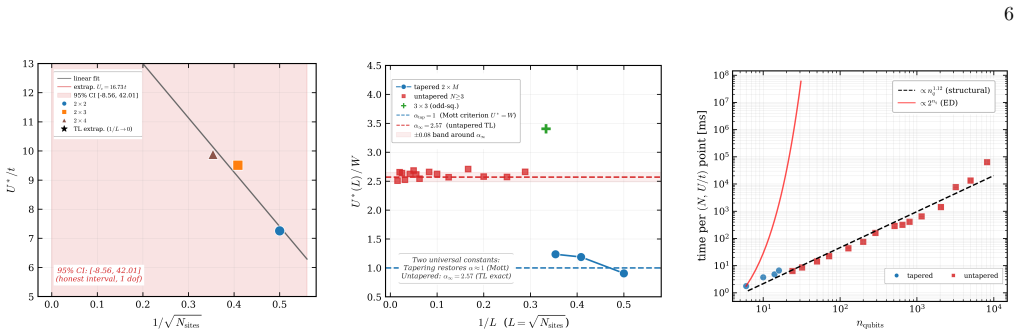
The paper's core claim is that the Bravyi–Kitaev transformation induces a hypergraph geometry with a rigid internal organization. For the Hubbard, spinless t–V, Anderson impurity, and Kitaev models, the interaction hypergraph's Laplacian spectrum splits into two families whose relative sizes are exactly N_tree = n_q/4 and N_site = 3n_q/4 for every system treated, from 4×4 to 16×16 lattices. The Fiedler eigenvalue always belongs to the tree-dominated quarter, which the paper identifies as the reason the characteristic interaction scale U* = C/α is nearly size-independent for untapered encodings and why tapered encodings form a separate branch. In the XBK picture, the same reorganization appea
Load-bearing premise
The exact spectral partition rests on the unstated rule by which Laplacian eigenmodes are classified as tree- or site-dominated; the paper groups eigenvalues visually (Appendix A), and without a precise classifier the claimed exact 1:3 ratio is not independently checkable.
Editorial extensions
If this is right
- The characteristic interaction scale U* can be read off from the encoded Hamiltonian alone, without computing ground states.
- Untapered BK encodings of the 2D Hubbard model converge to a near-size-independent geometric limit because the lowest mode always samples the tree-dominated quarter.
- Tapered and untapered encodings are geometrically distinct classes; comparisons between simulations using different tapering schemes should account for this.
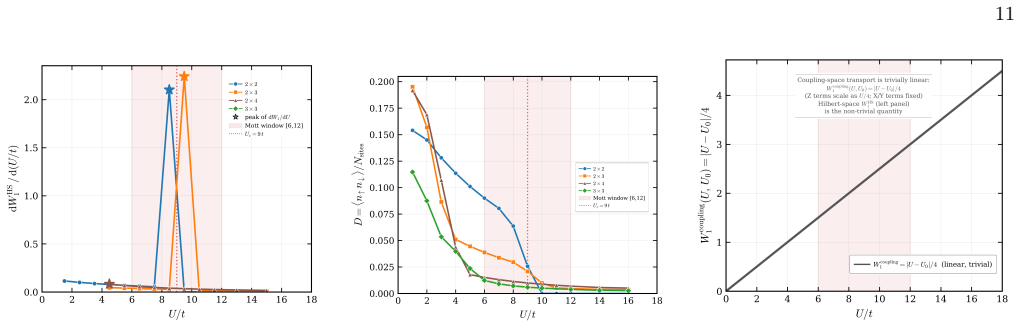
- The Wasserstein maximum in coupling space serves as an independent wavefunction-free marker for interaction-driven reorganization, matching double-occupancy behaviour.
- The same construction applies uniformly to Hubbard, spinless t–V, Anderson impurity, and Kitaev models, suggesting a model-independent geometric language.
Reading between the lines
- If the 1:3 partition is exact rather than a numerical coincidence, it should be provable from the recursive binary-tree structure of BK update circuits; a combinatorial derivation would be a natural next step.
- The framework invites extension to other fermion-to-qubit encodings (superfast, segment-based, or low-weight variants): each would carry its own characteristic hypergraph spectrum, and the mode ratio may differ from 1:3.
- The paper's own caution about three-point finite-size extrapolation suggests the quantitative value U_c/t ≈ 8.87 should be treated as a trend indicator; the universality-class separation is the more durable claim.
- Because the BK and XBK probes agree where double occupancy changes fastest, a combined geometric order parameter — connecting spectral connectivity and coupling transport — could be tested against standard correlation functions on the same lattices.
Editorial analysis
A structured set of objections, weighed in public.
Circularity Check
The 'exact competition law' is a definitional scaling identity; the spectral partition is under-specified but not a circular reduction.
-
other
[Section III.A, Eq. (6); Appendix A.3]
"Since multiplying every edge weight of a weighted graph by a constant scales its Laplacian spectrum by the same constant, the interaction connectivity satisfies λ2(Lint)=αU... Substituting these relations into Eq. (5) immediately yields ρ(U)=C/(αU), which constitutes an exact geometric relation."
The observable ρ is defined as λ2(Lhop)/λ2(Lint) in Eq. (5). The 'exact geometric competition law' follows solely from the homogeneity of Lint under the global scaling Jα∝U; no independent information about the encoded Hamiltonian enters. The characteristic scale U*=C/α is simply the point where this defined ratio equals 1, so it is a rearrangement of the input definitions and the linear-U weighting, not a testable prediction. Appendix A confirms this: 'since λ2(Lint(U))=slope·U by construction, the crossing is U*=λ2(Lhop)/slope.'
full rationale
Most of the paper is a self-contained numerical exploration: the hypergraph constructed from Pauli strings, the clique-expanded Laplacian, the spectral statistics, and the Wasserstein distances are all computed directly from the encoded Hamiltonians, with no circular dependence on the conclusions. The two universality classes and the 1:3 spectral partition are empirical groupings of the computed spectra; they are not derived by assuming the conclusion. However, Eq. (8) is underdetermined because the manuscript never specifies a deterministic rule for classifying an eigenmode as 'tree-dominated' versus 'site-dominated'; this is a correctness/falsifiability gap rather than a circular reduction. The self-citation to ref. [1] (the Chakrabarti-Hassan-Shankar distance) is peripheral and not load-bearing for the central geometric claims. The one genuinely construction-bound result is Eq. (6): it is a scaling identity that follows immediately from the definition of ρ and the linear-U scaling of the interaction hypergraph, so presenting it as an 'exact geometric law' overstates its content. For this reason the score is moderate (4), not higher.
Assumptions & free parameters
free parameters (3)
- Tapered lattice family {2×2, 2×3, 2×4} =
3 sizes
- Mode classification rule for tree vs site families =
not specified
- Ground-metric length for coupling-space transport =
ℓ(α)_ij = |S_α|/|c_α|
assumptions (4)
- standard math Standard spectral graph theory: the clique expansion of a hypergraph to a weighted graph preserves the Laplacian's role as a connectivity measure.
- domain assumption The BK encoding's binary-tree architecture is the origin of the claimed universal spectral partition.
- domain assumption The XBK mapping produces a probability measure over effective Ising couplings that is a meaningful representation for transport analysis.
- ad hoc to paper The self-cited 'Chakrabarti-Hassan-Shankar' distance (ref [1]) is valid and appropriately used as a fidelity ground truth.
Cite this review
Pith. "Pith review of A Geometric Theory of Fermion-to-Qubit Encodings." pith.science (2026). https://pith.science/paper/5T4MGR5A
@misc{pith2026260714883,
  author       = {Pith},
  title        = {Pith review of: A Geometric Theory of Fermion-to-Qubit Encodings},
  year         = {2026},
  howpublished = {\url{https://pith.science/paper/5T4MGR5A}},
  note         = {Machine review of arXiv:2607.14883}
}
read the original abstract
Exact fermion to qubit transformations are conventionally regarded as algorithmic tools that translate many-body Hamiltonians into qubit representations for quantum simulation. Here we show that they also define intrinsic geometric representations whose structure encodes physically meaningful information beyond spectral equivalence. We develop a geometric framework based on weighted hypergraphs and coupling space representations constructed from the Bravyi--Kitaev (BK) and Xia--Bian--Kais (XBK) encodings. Within the BK representation, we introduce a geometric observable that compares the algebraic connectivities of the kinetic and interaction hypergraphs, derive its exact analytical dependence on interaction strength, and uncover two geometric universality classes together with an exact spectral organization originating from the binary tree architecture of the encoding. The complementary XBK representation describes the evolution of encoded Hamiltonians through probability measures in coupling space, where optimal transport quantifies interaction-driven reorganization independently of the spectral analysis. Applications to the Hubbard, spinless tV , single impurity Anderson, and Kitaev models demonstrate that these connectivity and transport based geometric descriptions consistently capture the structural evolution of encoded quantum Hamiltonians across distinct classes of many-body systems. Our results establish hypergraph geometry as a new framework for understanding fermion-to-qubit encodings,revealing that they serve not only as computational mappings but also as geometric representations of quantum many-body Hamiltonians.
Figures


Figures from the paper (3 more)


Reference graph
Works this paper leans on
-
[1]
Nagpal, A
L. Nagpal, A. Kumar, and S. Hassan, Scientific Reports 16, 16249 (2026)
2026
-
[2]
R. P. Feynman, International Journal of Theoretical Physics21, 467– 488 (1999)
1999
-
[3]
Lloyd, Science273, 1073–1078 (1996)
S. Lloyd, Science273, 1073–1078 (1996)
1996
-
[4]
Preskill, Quantum2, 79 (2018)
J. Preskill, Quantum2, 79 (2018)
2018
-
[5]
M. A. Nielsen and I. L. Chuang,Quantum Computation and Quantum Information, 10th ed. (Cambridge Univer- sity Press, 2010)
2010
-
[6]
Jordan and E
P. Jordan and E. Wigner, Zeitschrift fur Physik47, 631–651 (1928)
1928
-
[7]
Bravyi and A
S. Bravyi and A. Kitaev, Annals of Physics298, 210–226 (2002)
2002
-
[8]
J. T. Seeley, M. J. Richard, and P. J. Love, The Journal of Chemical Physics137, 224109 (2012)
2012
Show all 67 references
-
[9]
Aspuru-Guzik, A
A. Aspuru-Guzik, A. D. Dutoi, P. J. Love, and M. Head- Gordon, Science309, 1704–1707 (2005)
2005
-
[10]
Peruzzo, J
A. Peruzzo, J. R. McClean, P. Shadbolt, M.-H. Yung, X.- Q. Zhou, P. J. Love, A. Aspuru-Guzik, and J. L. OBrien, Nature Communications5, 4213 (2014)
2014
-
[11]
Y. Cao, J. Romero, J. P. Olson, M. Degroote, P. D. John- son, M. Kieferova, I. D. Kivlichan, T. Menke, B. Per- opadre, N. P. D. Sawaya, S. Sim, L. Veis, and A. Aspuru- Guzik, Chemical Reviews 10.1021/acs.chemrev.8b00803 (2019)
2019 doi
-
[12]
McArdle, S
S. McArdle, S. Endo, A. Aspuru-Guzik, S. C. Benjamin, and X. Yuan, Quantum computational chemistry (2018)
2018
-
[13]
Havlicek, M
V. Havlicek, M. Troyer, and J. D. Whitfield, Physical Review A95, 032332 (2017)
2017
-
[14]
Steudtner and S
M. Steudtner and S. Wehner, Physical Review A99, 022308 (2019)
2019
-
[15]
S. R. White, Physical Review Letters69, 2863–2866 (1992)
1992
-
[16]
S. R. White, Physical Review B48, 10345–10356 (1993)
1993
-
[17]
Schollwock, Annals of Physics326, 96–192 (2011)
U. Schollwock, Annals of Physics326, 96–192 (2011)
2011
-
[18]
Orus, Annals of Physics 10.1016/j.aop.2014.06.013 (2014)
R. Orus, Annals of Physics 10.1016/j.aop.2014.06.013 (2014)
2014 doi
-
[19]
Troyer and U.-J
M. Troyer and U.-J. Wiese, Physical Review Letters94, 170201 (2005)
2005
-
[20]
R. Xia, T. Bian, and S. Kais, The Journal of Physical Chemistry B 10.1021/acs.jpcb.7b10371 (2017)
2017 doi
-
[21]
R. Xia, T. Bian, and S. Kais, The Journal of Chemical Physics154, 014106 (2021)
2021
-
[22]
Lucas, Frontiers in Physics2, 5 (2014)
A. Lucas, Frontiers in Physics2, 5 (2014)
2014
-
[23]
Glover, G
F. Glover, G. A. Kochenberger, and Y. Du, A tu- torial on formulating and using qubo models (2018), arXiv:1811.11538 [quant-ph]
2018 arXiv
-
[24]
Boros and P
E. Boros and P. L. Hammer, Discrete Applied Mathe- matics123, 155– 225 (2002)
2002
-
[25]
I. G. Rosenberg, Cahiers du Centre d’Etudes de Recherche Operationnelle17, 71– 74 (1975)
1975
-
[26]
Ishikawa, IEEE Transactions on Pattern Analysis and Machine Intelligence33, 1234–1249 (2011)
H. Ishikawa, IEEE Transactions on Pattern Analysis and Machine Intelligence33, 1234–1249 (2011). 14
2011
-
[27]
Dinkelbach, Management Science13, 492– 498 (1967)
W. Dinkelbach, Management Science13, 492– 498 (1967)
1967
-
[28]
Choi, Quantum Information Processing10, 343–353 (2011)
V. Choi, Quantum Information Processing10, 343–353 (2011)
2011
-
[29]
Choi, Quantum Information Processing10, 193–209 (2008)
V. Choi, Quantum Information Processing10, 193–209 (2008)
2008
-
[30]
Bravyi, J
S. Bravyi, J. M. Gambetta, A. Mezzacapo, and K. Temme, Tapering off qubits to simulate fermionic hamiltonians (2017), arXiv:1701.08213 [quant- ph]
2017 arXiv
-
[31]
Gottesman,Stabilizer Codes and Quantum Error Cor- rection, Ph.D
D. Gottesman,Stabilizer Codes and Quantum Error Cor- rection, Ph.D. thesis, California Institute of Technology (1997)
1997
-
[32]
Aaronson and D
S. Aaronson and D. Gottesman, Proceedings of the Royal Society A461, 3473–3482 (2005)
2005
-
[33]
Kadowaki and H
T. Kadowaki and H. Nishimori, Physical Review E58, 5355–5363 (1998)
1998
-
[34]
A. B. Finnila, M. A. Gomez, C. Sebenik, C. Stenson, and J. D. Doll, Chemical Physics Letters219, 343– 348 (1994)
1994
-
[35]
Albash and D
T. Albash and D. A. Lidar, Reviews of Modern Physics 90, 015002 (2018)
2018
-
[36]
McGeoch and C
C. McGeoch and C. Wang, inProceedings of the ACM In- ternational Conference on Computing Frontiers(2013)
2013
-
[37]
Venturelli, S
D. Venturelli, S. Mandra, S. Knysh, B. OGorman, R. Biswas, and V. Smelyanskiy, Physical Review X5, 031040 (2015)
2015
-
[38]
A. D. King, J. Carrasquilla, J. Raymond, I. Ozfidan, E. Andriyash, A. J. Berkley, M. Reis, T. Lanting, R. Har- ris, E. Altman, and M. H. Amin, Nature560, 456–460 (2018)
2018
-
[39]
T. F. Ronnnow, Z. Wang, J. Job, S. Boixo, S. V. Isakov, D. Wecker, K. M. Svore, and M. Troyer, Science345, 420–424 (2014)
2014
-
[40]
Hukushima and K
K. Hukushima and K. Nemoto, Journal of the Physical Society of Japan65, 1604–1608 (1996)
1996
-
[41]
Farhi, J
E. Farhi, J. Goldstone, S. Gutmann, and M. Sipser, Quantum computation by adiabatic evolution (2000), arXiv:quant-ph/0001106 [quant-ph]
2000 arXiv
-
[42]
Farhi, J
E. Farhi, J. Goldstone, S. Gutmann, J. M. La- pan, A. Lundgren, and D. Preda, Science 10.1126/sci- ence.1057726 (2001)
2001 doi
-
[43]
Roland and N
J. Roland and N. J. Cerf, Physical Review A65, 042308 (2002)
2002
-
[44]
Teplukhin, B
A. Teplukhin, B. K. Kendrick, and D. Babikov, Journal of Chemical Theory and Computation 10.1021/acs.jctc.9b00402 (2019)
2019 doi
-
[45]
Teplukhin, B
A. Teplukhin, B. K. Kendrick, S. Tretiak, and P. A. Dub, Scientific Reports 10.1038/s41598-020-77315-4 (2020)
2020 doi
-
[46]
Teplukhin, B
A. Teplukhin, B. K. Kendrick, S. M. Mniszewski, Y. Zhang, A. Kumar, C. F. A. Negre, P. M. Anisi- mov, S. Tretiak, and P. A. Dub, Scientific Reports 10.1038/s41598-021-98331- y (2021)
2021 doi
-
[47]
Teplukhin, B
A. Teplukhin, B. K. Kendrick, S. M. Mniszewski, S. Tretiak, and P. A. Dub, PLOS ONE 10.1371/ jour- nal.pone.0263849 (2022)
2022
-
[48]
Ushijima-Mwesigwa, C
H. Ushijima-Mwesigwa, C. F. A. Negre, and S. M. Mniszewski, inProceedings of the ACM International Conference on Computing Frontiers(2017)
2017
-
[49]
Boothby, P
K. Boothby, P. I. Bunyk, J. Raymond, and A. Roy, Next-generation topology of d-wave quantum processors (2020), arXiv preprint
2020
-
[50]
Verstraete and J
F. Verstraete and J. I. Cirac, Journal of Statistical Me- chanics: Theory and Experiment , P09012 (2005)
2005
-
[51]
R. C. Ball, Physical Review Letters95, 176407 (2005)
2005
-
[52]
Setia and J
K. Setia and J. D. Whitfield, The Journal of Chemical Physics , 164104 (2018)
2018
-
[53]
Setia, S
K. Setia, S. Bravyi, A. Mezzacapo, and J. D. Whitfield, Physical Review Research1, 033033 (2019)
2019
-
[54]
Hagge and N
T. Hagge and N. Wiebe, Error mitigation via error de- tection using generalized superfast encodings (2023)
2023
-
[55]
S. M. Mniszewski, P. A. Dub, S. Tretiak, P. M. Anisimov, Y. Zhang, and C. F. A. Negre, Downfolding the molecular hamiltonian matrix using quantum community detection (2020), arXiv preprint
2020
-
[56]
Motta, C
M. Motta, C. Sun, A. T. K. Tan, M. J. ORourke, E. Ye, A. J. Minnich, F. G. S. Brandao, and G. K.-L. Chan, Nature Physics 10.1038/s41567-019-0704-4 (2020)
2020 doi
-
[57]
J. R. McClean, J. Romero, R. Babbush, and A. Aspuru- Guzik, New Journal of Physics18, 023023 (2016)
2016
-
[58]
J. R. McClean, N. C. Rubin, I. D. Kivlichan, K. J. Sung, D. S. Steiger, X. Bonet-Monroig, Y. Cao, C. Dai, E. S. Fried, C. Gidney, P. Gokhale, T. Haner, T. S. Hardikar, V. Havlicek, O. Higgott, C. Huang, J. Izaac, Z. Jiang, X. Liu, S. McArdle, M. Neeley, T. E. OBrien, B. OGorma...
2017
-
[59]
Farhi, J
E. Farhi, J. Goldstone, and S. Gutmann, A quan- tum approximate optimization algorithm (2014), arXiv:1411.4028 [quant-ph]
2014 arXiv
-
[60]
Hauke, H
P. Hauke, H. G. Katzgraber, W. Lechner, H. Nishimori, and W. D. Oliver, Reports on Progress in Physics83, 054401 (2020). 15 Appendix A: Computational Methods All results are obtained by classical simulation. This appendix specifies the numerical methods and system sizes used t...
2020
-
[61]
Model and encoding The 2D Hubbard model on anL x ×L y lattice is H=−t X ⟨i,j⟩,σ (c† iσcjσ + h.c.) +U X i ni↑ni↓ −µ X i,σ niσ, (A1) with half filling (Ne =L xLy,µ= 0). Comparison models (1D Hubbard, spinlesst–Vchain, SIAM, Kitaev chain) use analogous conventions; the Kitaev cha...
-
[62]
T apering Z2 qubit tapering [30] is performed by writing each Pauli string as a symplectic row over GF(2), taking the kernel of the resulting parity-check matrix to obtain inde- pendent symmetry generators, and projecting the Hamil- tonian onto the sector (over all±1 generator...
-
[63]
The TABLE II: System sizes used in each figure.n q is the BK qubit count (Laplacian dimension), untapered unless noted
Hypergraph Laplacian and clique expansion Each qubit is a vertex; each non-identity Pauli term of coefficientc α is a hyperedgeS α over its support. The TABLE II: System sizes used in each figure.n q is the BK qubit count (Laplacian dimension), untapered unless noted. Dataset ...
-
[64]
Table II lists exactly the sizes used
Eigenvalue solves and system sizes All eigensolves reported in the paper are dense (eigvalsh), affordable sincen q never exceeds a few hun- dred in any submitted figure. Table II lists exactly the sizes used. TheUgrid is non-uniform, denser near the crossover; U ∗ is obtained ...
-
[65]
Probabilities are truncated to supportp(x)>10 −10 (renormalized)
Exact diagonalization and W asserstein-1 distance Ground states for the Wasserstein and double- occupancy diagnostics come from exact diagonalization 16 of the tapered, penalty-free Hamiltonian (n q ≤14), us- ing the eigenvector of least eigenvalue. Probabilities are truncated...
-
[66]
Finite-size scaling The tapered crossings (U ∗/t= 7.26,9.51,9.89 forN= 4,6,8) are fit toU ∗(L) =U c +a/ √Nsites. With only three points, this is a one-degree-of-freedom linear re- gression, and we report the resulting uncertainty hon- estly:U c/t= 8.87±2.18 (1σ), with a wide c...
-
[67]
All computation is determin- istic except where randomness enters (e.g., bootstrap re- sampling), for which a fixed seed is used
Reproducibility Simulations ran in a fixed Python environment (NumPy, SciPy/HiGHS, a graph library for shortest paths, a fermion-to-qubit transformation package) on in- stitutional HPC resources. All computation is determin- istic except where randomness enters (e.g., bootstra...
Reviewed August 2, 2026 · model on record in the stance chip above.
Discussion (0). Sign in to comment.