Spectroscopic performance of the electrical functional models for the eXTP SFA-T detectors
Pith reviewed 2026-06-30 03:55 UTC · model grok-4.3
The pith
Electrical Functional Modules for SFA-T detectors deliver energy resolution meeting requirements at -45°C operating temperature.
A machine-rendered reading of the paper's core claim, the machinery that carries it, and where it could break.
Core claim
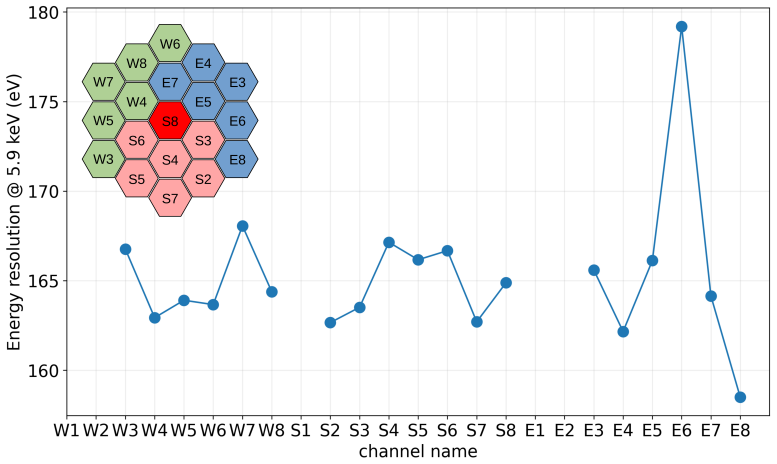
The assembled EFMs for the five SFA-T telescopes demonstrate spectroscopic performance at -45°C that supports the mission requirements for energy resolution, with the baffle covering pixel edges studied as part of the characterization.
What carries the argument
Electrical Functional Modules (EFM) built around Silicon Drift Detector (SDD) arrays, tested under laboratory conditions at the planned operating temperature with and without the edge-covering baffle.
If this is right
- The SFA-T instruments can meet the required high time resolution and low dead time for observations of bright sources such as the Crab.
- Energy resolution better than 180 eV at 6 keV enables combined timing and spectroscopic studies in the instrument's high-throughput mode.
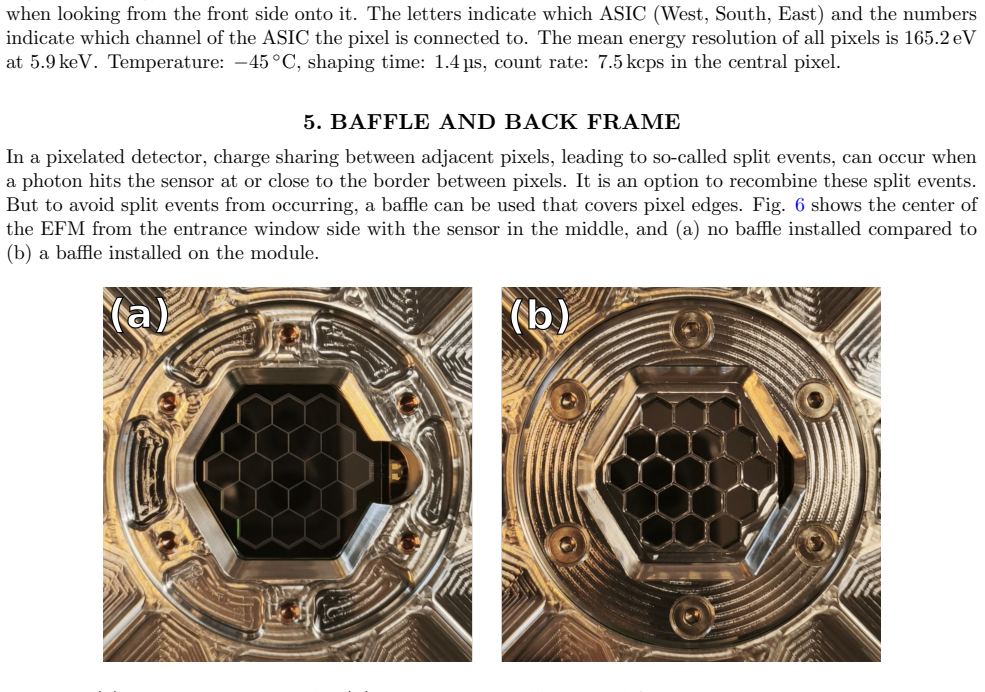
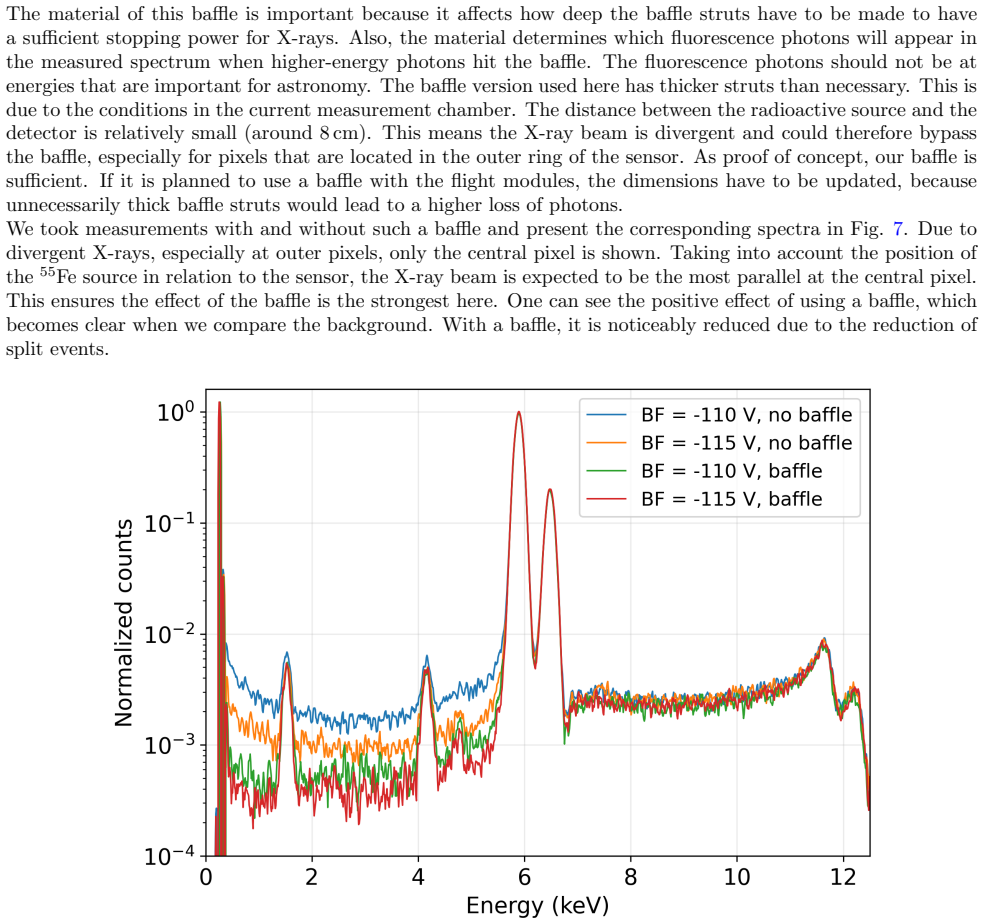
- Use of the baffle improves pixel edge performance and contributes to achieving the target resolution.
Where Pith is reading between the lines
- If the lab results hold after integration, the SFA-T component of eXTP will enable timing studies of X-ray variability down to microsecond scales with usable spectral information.
- The baffle approach may be relevant for other SDD arrays where edge effects limit resolution in similar focal-plane designs.
- Differences between lab and flight environments could be quantified by comparing pre-launch EFM data to early in-orbit calibration spectra.
Load-bearing premise
Laboratory measurements on the assembled EFMs at MPE accurately represent the spectroscopic behavior of the detectors once integrated into the flight telescopes and operated in the space environment.
What would settle it
Energy resolution measurements obtained from the fully integrated SFA-T cameras in orbit that differ significantly from the lab EFM results at -45°C would indicate the claim does not hold.
Figures
read the original abstract
The Spectroscopy Focusing Array (SFA) is one of the three instruments on the eXTP satellite. It consists of six telescopes plus focal plane cameras, where five are equipped with a Silicon Drift Detector (SDD) array. These five SFA-T (T stands for timing) instruments are used for observations with high time resolution (better than 10 microseconds), high throughput (dead time less than 5 % when observing a 1 Crab source), and good energy resolution (better than 180 eV at 6 keV). This paper presents the spectroscopic performance of the Electrical Functional Modules (EFM) for SFA-T that are assembled and tested at the Max Planck Institute for Extraterrestrial Physics (MPE). A focus lies on the energy resolution at the planned sensor operating temperature of -45 {\deg}C. Additionally, the use of a baffle that covers the pixel edges is studied.
Editorial analysis
A structured set of objections, weighed in public.
Referee Report
Summary. The manuscript reports laboratory spectroscopic performance measurements of the Electrical Functional Modules (EFMs) for the SFA-T detectors on the eXTP satellite. It emphasizes energy resolution at the planned operating temperature of -45°C and examines the effect of a baffle covering pixel edges, based on tests of assembled EFMs at MPE. The work is framed as supporting the instrument requirements of better than 180 eV resolution at 6 keV, high time resolution, and low dead time.
Significance. If the reported laboratory data are internally consistent and correctly analyzed, the results would provide useful validation for the SFA-T detector system ahead of integration into the eXTP flight telescopes. The focus on temperature dependence and baffle effects directly addresses design choices relevant to achieving the mission's spectroscopic goals.
major comments (1)
- [Abstract] Abstract: The abstract states that the paper presents the spectroscopic performance but supplies no quantitative results, measured energy resolutions, error bars, methods details, or analysis procedures. This omission prevents any assessment of whether the laboratory measurements support the performance claims or meet the stated requirements (better than 180 eV at 6 keV).
Simulated Author's Rebuttal
We thank the referee for the constructive comment on our manuscript. We agree that the abstract requires quantitative results to allow immediate evaluation of the performance claims and will revise it accordingly.
read point-by-point responses
-
Referee: [Abstract] Abstract: The abstract states that the paper presents the spectroscopic performance but supplies no quantitative results, measured energy resolutions, error bars, methods details, or analysis procedures. This omission prevents any assessment of whether the laboratory measurements support the performance claims or meet the stated requirements (better than 180 eV at 6 keV).
Authors: We agree that the abstract, as currently written, is purely descriptive and does not report the measured energy resolutions, uncertainties, or analysis details. This limits the ability to assess the results at a glance. In the revised manuscript we will expand the abstract to include the key quantitative findings from the EFM tests at -45°C (energy resolution values with error bars at 6 keV and other relevant energies), together with a concise statement of the methods and analysis procedures used. These numbers are already present and discussed in the body of the paper; the revision will simply bring them into the abstract so that the performance relative to the <180 eV requirement is immediately clear. revision: yes
Circularity Check
No significant circularity detected
full rationale
The paper is a straightforward experimental report on laboratory spectroscopic measurements of assembled Electrical Functional Modules for SFA-T detectors, focusing on energy resolution at -45°C and baffle effects. No equations, derivations, fitted parameters, or load-bearing theoretical steps are present in the provided description or abstract. The central claims consist of direct reporting of measured performance data from MPE tests, with no self-definitional reductions, fitted-input predictions, or self-citation chains that collapse the results to their own inputs by construction. The work is self-contained against external benchmarks as an empirical presentation.
Axiom & Free-Parameter Ledger
Reference graph
Works this paper leans on
-
[1]
The enhanced x-ray timing and polarimetry mission—extp for launch in 2030,
Zhang, S.-N. et al., “The enhanced x-ray timing and polarimetry mission—extp for launch in 2030,”Science China Physics, Mechanics & Astronomy68(11) (2025)
2030
-
[2]
The detectors for the sfa instrument of the enhanced x-ray timing and polarimetry (extp) satellite mission,
Meidinger, N. et al., “The detectors for the sfa instrument of the enhanced x-ray timing and polarimetry (extp) satellite mission,” Submitted to Proc. SPIE 2026 (2026)
2026
-
[3]
Silicon drift detectors for high count rate x-ray spectroscopy at room temperature,
Lechner, P. et al., “Silicon drift detectors for high count rate x-ray spectroscopy at room temperature,” Nuclear Instruments and Methods in Physics Research Section A: Accelerators, Spectrometers, Detectors and Associated Equipment458(1), 281–287 (2001). Proc. 11th Inbt. Workshop on Room Temperature Semiconductor X- and Gamma-Ray Detectors and Associated...
2001
-
[4]
The neutron star interior composition explorer (nicer): design and development,
Gendreau, K. C. et al., “The neutron star interior composition explorer (nicer): design and development,” in [Space Telescopes and Instrumentation 2016: Ultraviolet to Gamma Ray],9905, SPIE (2016)
2016
-
[5]
Silicon drift detectors for the spectroscopy focusing array of extp,
Altmann, A. et al., “Silicon drift detectors for the spectroscopy focusing array of extp,” in [Space Telescopes and Instrumentation 2024: Ultraviolet to Gamma Ray], den Herder, J.-W. A., Nakazawa, K., and Nikzad, S., eds., 257, SPIE (Aug. 2024)
2024
-
[6]
A multichannel integrated readout circuit for high throughput x-ray spectroscopy with silicon drift detectors,
Bombelli, L. et al., “A multichannel integrated readout circuit for high throughput x-ray spectroscopy with silicon drift detectors,”IEEE Transactions on Nuclear Science60(1), 430–436 (2013)
2013
-
[7]
ECSS-Q-ST-70-12C Space Product Assurance – Design Rules for Printed Circuit Boards,
European Cooperation for Space Standardization, “ECSS-Q-ST-70-12C Space Product Assurance – Design Rules for Printed Circuit Boards,” tech. rep., European Space Agency (ESA), Noordwijk, The Netherlands (July 2014)
2014
-
[8]
Thermo-mechanical design tradeoff for the spice x-ray detector,
Muegge, J. W. et al., “Thermo-mechanical design tradeoff for the spice x-ray detector,” Submitted to Proc. SPIE 2026 (2026)
2026
-
[9]
Semiconductor drift chamber — an application of a novel charge transport scheme,
Gatti, E. and Rehak, P., “Semiconductor drift chamber — an application of a novel charge transport scheme,”Nuclear Instruments and Methods in Physics Research225(3), 608–614 (1984)
1984
-
[10]
Characterization and setting of fast multiplexing readout electronics for a multicell silicon drift detector used in x-ray spectroscopy,
Altmann, A. et al., “Characterization and setting of fast multiplexing readout electronics for a multicell silicon drift detector used in x-ray spectroscopy,”IEEE Transactions on Nuclear Science71(2), 184–195 (2024)
2024
-
[11]
Roan, a root based analysis framework,
Lauf, T. and Andritschke, R., “Roan, a root based analysis framework,”arXiv(2013)
2013
-
[12]
Silicon drift detectors for high resolution room temperature x-ray spectroscopy,
Lechner, P. et al., “Silicon drift detectors for high resolution room temperature x-ray spectroscopy,”Nu- clear Instruments and Methods in Physics Research Section A: Accelerators, Spectrometers, Detectors and Associated Equipment377(2–3), 346–351 (1996). 8
1996
discussion (0)
Sign in with ORCID, Apple, or X to comment. Anyone can read and Pith papers without signing in.