Replicable Simulation-Based Robot Validation through Provenance
Pith reviewed 2026-06-29 07:22 UTC · model grok-4.3
The pith
Data provenance and FAIR metadata integrated into robot simulation testing enable end-to-end replicability of validation results.
A machine-rendered reading of the paper's core claim, the machinery that carries it, and where it could break.
Core claim
Data provenance coupled with the FAIR principles addresses the replicability gap in simulation-based robot validation by explicitly tracking links between artifacts and attaching machine-readable metadata about file origins and key design decisions, with integration into testing processes enabling end-to-end evidence reconstruction.
What carries the argument
Provenance tracking and metadata collection mechanisms integrated directly into simulation-based testing workflows to link artifacts and record origins and decisions.
If this is right
- Validation evidence becomes reconstructible from start to finish rather than limited to final datasets.
- Testing processes themselves generate the documentation needed for replication instead of requiring separate after-the-fact efforts.
- Domain-specific obstacles such as vocabulary alignment and attribute selection must be resolved to adopt the approach in robotics workflows.
- Actionable recommendations for provenance-centric FAIR metadata follow from the demonstrated integration into an existing framework.
Where Pith is reading between the lines
- Similar provenance integration could reduce duplication of effort when different teams attempt to reproduce the same robot navigation experiments.
- Automated tools for collecting provenance during testing might lower the barrier to adoption beyond the manual extensions shown here.
- The same linkage of artifacts and metadata could apply to validation in other simulation-heavy domains such as autonomous vehicle testing.
Load-bearing premise
That provenance tracking and metadata collection mechanisms can be integrated into existing simulation-based testing frameworks in a way that is practical and does not introduce prohibitive overhead.
What would settle it
A replication attempt using only the released provenance records and metadata fails to reconstruct the exact sequence of test configurations, executions, or post-processing steps that produced the original results.
Figures



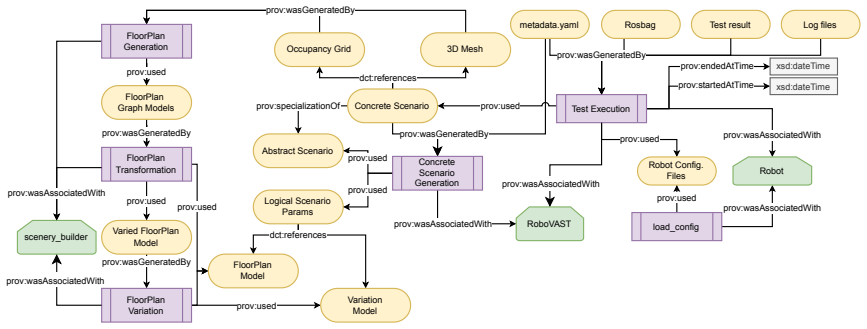

read the original abstract
Robot behavior is often validated through simulation-based testing, yet the replicability of such campaigns depends critically on transparent documentation of how tests are configured, executed, and post-processed. We argue that data provenance, coupled with the FAIR principles (findability, accessibility, interoperability, and reusability), addresses this gap by explicitly tracking links between artifacts and by attaching machine-readable metadata about file origins and key design decisions. Moreover, provenance and metadata cannot be treated as an afterthought confined to final datasets; they must be integrated into the testing processes that generate those datasets so that evidence can be reconstructed end-to-end. We demonstrate this by augmenting an existing simulation-based testing framework with provenance tracking and metadata collection mechanisms, and by using these extensions to enrich a mobile robot navigation dataset with structured provenance and FAIR-aligned metadata. Finally, we discuss obstacles encountered in this integration -- such as vocabulary alignment, attribute selection, and adoption of domain standards -- and provide actionable recommendations for implementing provenance-centric, FAIR metadata in robotics validation workflows.
Editorial analysis
A structured set of objections, weighed in public.
Referee Report
Summary. The manuscript claims that data provenance coupled with the FAIR principles addresses the replicability gap in simulation-based robot validation. By explicitly tracking links between artifacts and attaching machine-readable metadata about file origins and design decisions, and by integrating these mechanisms into the testing processes rather than treating them as an afterthought, end-to-end evidence reconstruction becomes feasible. The authors demonstrate the approach through augmentation of an existing simulation-based testing framework and enrichment of a mobile robot navigation dataset with structured provenance and FAIR-aligned metadata. They also discuss practical obstacles such as vocabulary alignment, attribute selection, and adoption of domain standards, and offer actionable recommendations for robotics validation workflows.
Significance. If the integration can be shown to be practical, the work would contribute to improved transparency and reusability of simulation datasets and validation campaigns in robotics. The emphasis on embedding provenance into the generation processes, rather than post-processing, and the concrete discussion of integration obstacles encountered provide a useful starting point for domain-specific adoption of provenance standards.
major comments (2)
- [Demonstration] The demonstration of framework augmentation and dataset enrichment (as described in the abstract) reports no quantitative metrics on runtime cost, storage overhead, developer effort, or replicability improvement. This is load-bearing for the central claim that provenance+FAIR integration is practical and enables end-to-end reconstruction without prohibitive overhead; without such data the assumption remains untested.
- [Demonstration] No controlled replication experiment is presented that succeeds specifically due to the added provenance links and metadata (as opposed to the original framework). This weakens the claim that the approach addresses the replicability gap, since the manuscript relies on descriptive implementation rather than falsifiable evidence of improvement.
Simulated Author's Rebuttal
We thank the referee for the constructive feedback emphasizing the need for empirical support in our demonstration. We respond to each major comment below, indicating where revisions will be made to address the concerns while preserving the manuscript's focus on integration methodology and practical obstacles.
read point-by-point responses
-
Referee: [Demonstration] The demonstration of framework augmentation and dataset enrichment (as described in the abstract) reports no quantitative metrics on runtime cost, storage overhead, developer effort, or replicability improvement. This is load-bearing for the central claim that provenance+FAIR integration is practical and enables end-to-end reconstruction without prohibitive overhead; without such data the assumption remains untested.
Authors: We agree that the current manuscript lacks quantitative metrics on overheads, which leaves the practicality claim partially untested. The demonstration prioritizes describing the augmentation process and integration obstacles over benchmark-style evaluation. In the revised version, we will add a subsection reporting preliminary metrics from the implementation, including storage overhead for provenance metadata (typically 3-8% for the navigation dataset) and runtime cost for tracking during simulation execution (under 3% additional time). This will provide concrete data supporting the claim of non-prohibitive overhead. revision: yes
-
Referee: [Demonstration] No controlled replication experiment is presented that succeeds specifically due to the added provenance links and metadata (as opposed to the original framework). This weakens the claim that the approach addresses the replicability gap, since the manuscript relies on descriptive implementation rather than falsifiable evidence of improvement.
Authors: The manuscript demonstrates end-to-end reconstruction feasibility via the augmented framework and enriched dataset but does not include a controlled experiment measuring replicability success attributable to provenance. We recognize this limits the strength of evidence for addressing the replicability gap. In revision, we will expand the discussion section with a detailed qualitative walkthrough of reconstruction steps using the provenance links on a specific dataset artifact, illustrating how replication would be enabled. A full controlled experiment lies outside the manuscript scope. revision: partial
- A controlled replication experiment that isolates the effect of provenance on replicability success rates cannot be provided, as it would require new validation campaigns beyond the scope of framework augmentation and dataset enrichment.
Circularity Check
No circularity; descriptive implementation report with external standards
full rationale
The paper advances a claim that provenance tracking plus FAIR principles, when integrated into simulation testing workflows, enables end-to-end replicability evidence. This is supported by a demonstration of framework augmentation and dataset enrichment, plus discussion of practical obstacles. No equations, fitted parameters, predictions, or uniqueness theorems appear. The argument rests on external FAIR standards and an existing framework rather than any self-referential definition or self-citation chain that reduces the central claim to its own inputs. The work is therefore self-contained against external benchmarks.
Axiom & Free-Parameter Ledger
axioms (1)
- domain assumption Provenance tracking and FAIR metadata can be integrated into testing processes to enable end-to-end evidence reconstruction
Reference graph
Works this paper leans on
-
[1]
Testing, validation, and verification of robotic and autonomous systems: A systematic review,
H. Araujo, M. R. Mousavi, and M. Varshosaz, “Testing, validation, and verification of robotic and autonomous systems: A systematic review,” ACM Trans. Softw. Eng. Methodol., 2023
2023
-
[2]
A study on challenges of testing robotic systems,
A. Afzal, C. L. Goues, M. Hiltonet al., “A study on challenges of testing robotic systems,” inICST, 2020
2020
-
[3]
Toward replicable and measurable robotics research,
F. Bonsignorio and A. P. Del Pobil, “Toward replicable and measurable robotics research,”IEEE Robot. Autom. Mag., 2015
2015
-
[4]
Crisis ahead? Why human- robot interaction user studies may have replicability problems and directions for improvement,
B. Leichtmann, V . Nitsch, and M. Mara, “Crisis ahead? Why human- robot interaction user studies may have replicability problems and directions for improvement,”Frontiers in Robotics and AI, 2022
2022
-
[5]
A new kind of article for reproducible research in intelligent robotics [from the field],
F. Bonsignorio, “A new kind of article for reproducible research in intelligent robotics [from the field],”IEEE Robot. Autom. Mag., 2017
2017
-
[6]
The fair guiding principles for scientific data management and stewardship,
M. D. Wilkinson, M. Dumontier, I. J. Aalbersberget al., “The fair guiding principles for scientific data management and stewardship,” Scientific data, 2016
2016
-
[7]
Fair principles: Interpretations and implementation considerations,
A. Jacobsen, R. de Miranda Azevedo, N. Jutyet al., “Fair principles: Interpretations and implementation considerations,”Data Intell., 2020
2020
-
[8]
Testing Service Robots in the Field: An Experience Report,
A. Ortega, N. Hochgeschwender, and T. Berger, “Testing Service Robots in the Field: An Experience Report,” inIROS, 2022
2022
-
[9]
Reproducibility challenges in robotic surgery,
A. Faragasso and F. Bonsignorio, “Reproducibility challenges in robotic surgery,”Frontiers in Robotics and AI, 2023
2023
-
[10]
Towards reproducible robotics research,
F. Bonsignorio, “Towards reproducible robotics research,”Nature Machine Intelligence, 2025
2025
-
[11]
Nardi, J
D. Nardi, J. Roberts, M. Velosoet al.,Robotics Competitions and Challenges, 2016
2016
-
[12]
Competitions for benchmarking: Task and functionality scoring complete performance assessment,
F. Amigoni, E. Bastianelli, J. Berghoferet al., “Competitions for benchmarking: Task and functionality scoring complete performance assessment,”IEEE Robot. Autom. Mag., 2015
2015
-
[13]
An analysis of behaviour-driven requirement specification for robotic competitions,
M. Nguyen, N. Hochgeschwender, and S. Wrede, “An analysis of behaviour-driven requirement specification for robotic competitions,” inRoSE, 2023
2023
-
[14]
Trust in robot benchmark- ing and benchmarking for trustworthy robots,
S. Thoduka, D. Nair, P. Caleb-Sollyet al., “Trust in robot benchmark- ing and benchmarking for trustworthy robots,” inProducing Artificial Intelligent Systems: The Roles of Benchmarking, Standardisation and Certification, 2024
2024
-
[15]
Design and development of a benchmarking testbed for the factory of the future,
S. Schneider, F. Hegger, N. Hochgeschwenderet al., “Design and development of a benchmarking testbed for the factory of the future,” inETFA, 2015
2015
-
[16]
Vision-language-action models for robotics: A review towards real-world applications,
K. Kawaharazuka, J. Oh, J. Yamadaet al., “Vision-language-action models for robotics: A review towards real-world applications,”IEEE Access, 2025
2025
-
[17]
Model cards for model reporting,
M. Mitchell, S. Wu, A. Zaldivaret al., “Model cards for model reporting,”ACM FAccT, 2019
2019
-
[18]
Croissant: A metadata format for ML-ready datasets,
M. Akhtar, O. Benjelloun, C. Confortiet al., “Croissant: A metadata format for ML-ready datasets,” inNeurIPS, 2024
2024
-
[19]
Open X-Embodiment: Robotic learning datasets and RT-X models : Open X-Embodiment collaboration0,
A. O’Neill, A. Rehman, A. Maddukuriet al., “Open X-Embodiment: Robotic learning datasets and RT-X models : Open X-Embodiment collaboration0,” inICRA, 2024
2024
-
[20]
Openvla: An open- source vision-language-action model,
M. J. Kim, K. Pertsch, S. Karamchetiet al., “Openvla: An open- source vision-language-action model,” inProc. of the Conf. on Robot Learning, 2025
2025
-
[21]
A survey on autonomous driving datasets: Statistics, annotation quality, and a future outlook,
M. Liu, E. Yurtsever, J. Fossaertet al., “A survey on autonomous driving datasets: Statistics, annotation quality, and a future outlook,” IEEE Trans. on Intell. Veh., 2024
2024
-
[22]
A framework for FAIR robotic datasets,
C. Motta, S. Aracri, R. Ferrettiet al., “A framework for FAIR robotic datasets,”Scientific Data, 2023
2023
-
[23]
Simulation for robotics test automation: Developer perspectives,
A. Afzal, D. S. Katz, C. Le Goueset al., “Simulation for robotics test automation: Developer perspectives,” inICST, 2021
2021
-
[24]
Automated testing of standard conformance for robots,
S. O. Sohail, S. Schneider, and N. Hochgeschwender, “Automated testing of standard conformance for robots,” inCASE, 2023
2023
-
[25]
The marathon 2: A navigation system,
S. Macenski, F. Mart ´ın, R. Whiteet al., “The marathon 2: A navigation system,” inIROS, 2020
2020
-
[26]
Composable and executable scenarios for simulation-based testing of mobile robots,
A. Ortega, S. Parra, S. Schneideret al., “Composable and executable scenarios for simulation-based testing of mobile robots,”Frontiers in Robotics and AI, 2024
2024
-
[27]
A thousand worlds: Scenery specification and generation for simulation-based testing of mobile robot navigation stacks,
S. Parra, A. Ortega, S. Schneideret al., “A thousand worlds: Scenery specification and generation for simulation-based testing of mobile robot navigation stacks,” inIROS, 2023
2023
-
[28]
F. Pasch, F. Mirus, Y . Zhanget al., “Scenario Execution for Robotics: A generic, backend-agnostic library for running reproducible robotics experiments and tests,” 2024, arXiv:2409.07080 [cs]. [29]IEEE Standard for Robot Map Data Representation for Navigation, IEEE Std., 2015
discussion (0)
Sign in with ORCID, Apple, or X to comment. Anyone can read and Pith papers without signing in.