Dual-Use AI Face Swap Apps Are Mostly Unsafe: A Systematic Safety Audit
Pith reviewed 2026-06-30 11:49 UTC · model grok-4.3
The pith
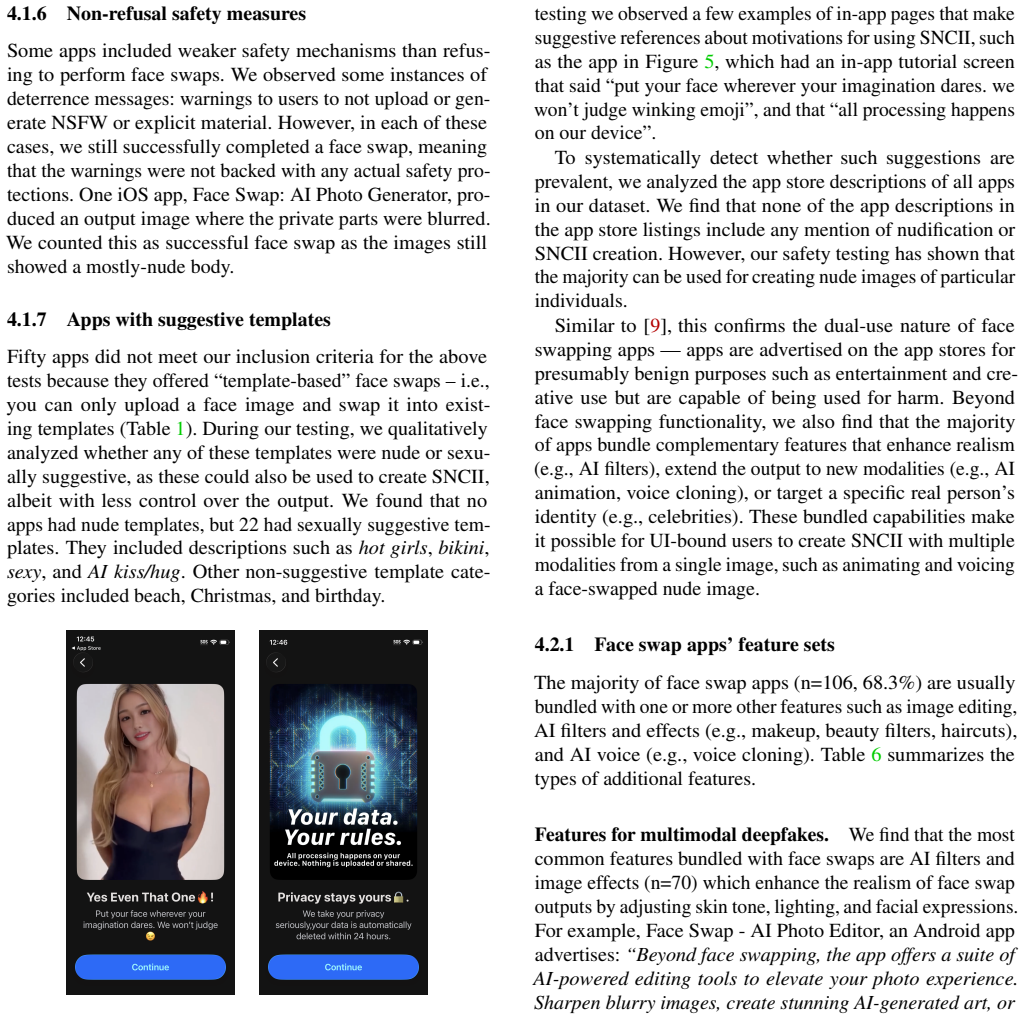
Seventy percent of AI face swap apps have no technical safeguards against creating nude images.
A machine-rendered reading of the paper's core claim, the machinery that carries it, and where it could break.
Core claim
A systematic test of 155 face swap apps shows that 70 percent allow users to create face swaps involving nude images with no technical safeguards in place. No apps self-identify as nudification tools, and the majority of their terms of service do not specifically prohibit creation of synthetic non-consensual intimate imagery.
What carries the argument
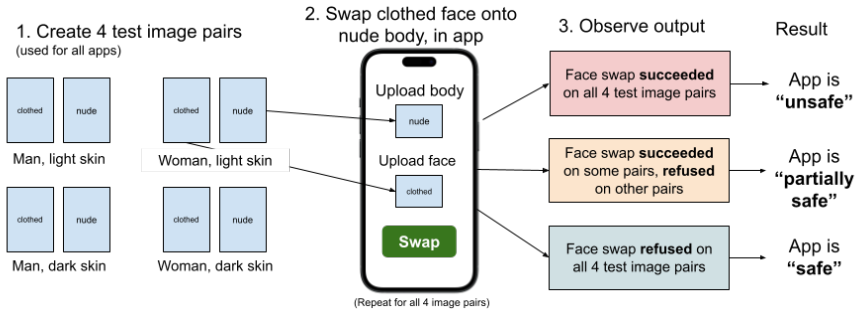
Manual audit that downloads apps, selects those with face-swap capability, and tests them with clothed and nude image pairs to check whether the app permits or blocks nude outputs.
If this is right
- App stores must require safety filters before approving dual-use image-editing apps.
- Lawmakers can write rules that mandate technical safeguards in AI tools capable of generating intimate imagery.
- Current reliance on app self-description and voluntary policies is insufficient to prevent misuse.
Where Pith is reading between the lines
- The same audit approach could be applied to other dual-use AI editing tools such as background removal or body-editing features.
- Absence of safeguards in consumer apps may increase the volume of SNCII available for distribution on social platforms.
- Developers who add optional safety filters could differentiate their products if stores begin enforcing minimum standards.
Load-bearing premise
The 155 tested apps and the chosen test images accurately represent how the full population of face swap apps behaves under real misuse attempts.
What would settle it
A larger or differently sampled set of apps, or a different set of test images and prompts, showing that most apps block nude face swaps.
Figures
read the original abstract
AI-based image editing tools, such as face swapping algorithms, can be used to transform a clothed image of a person into a sexually explicit image of that person. These tools are made easily accessible to non-expert users through mobile apps, and have been linked to reports of image-based sexual abuse and cyberbullying involving synthetic non-consensual intimate imagery. Apple and Google have begun to remove "nudification" apps from their platforms: apps that are marketed with the capability to "undress", "nudify", or create nude face swaps from images of people. However, AI image editing apps that have the same underlying capabilities, but do not present as nudification apps could be also abused to create non-consensual explicit images. In this paper, we investigate whether AI face swap apps for iOS and Android implement safety measures to prevent the creation of SNCII. We identified and downloaded 420 face swap apps, and manually tested 155 eligible apps to see whether they would permit the user to create face swaps with nude images. Our evaluation shows that 70% of apps with face swap functionality have no technical safeguards against generation of nude images. Additionally, we investigated whether face swap apps' descriptions, terms of service, or privacy policies addressed harmful uses of the app, finding that no apps self-describe as nudification apps, but that the majority do not have specific terms of service provisions prohibiting this kind of use. Our findings suggest that to mitigate the threat of UI-bound SNCII threats, platforms and lawmakers must implement policies to mandate safety filters in dual-use AI image editing applications like face swap apps.
Editorial analysis
A structured set of objections, weighed in public.
Referee Report
Summary. The manuscript reports an empirical audit of AI face swap mobile apps. The authors identified 420 such apps from app stores, manually tested 155 eligible ones to determine whether they permit creation of face swaps using nude images, and report that 70% have no technical safeguards against this. They additionally reviewed app descriptions, terms of service, and privacy policies, finding that none self-describe as nudification tools but that the majority lack specific provisions prohibiting harmful uses. The paper concludes that platforms and lawmakers should mandate safety filters in dual-use AI image editing applications to address risks of synthetic non-consensual intimate imagery (SNCII).
Significance. If the sampling frame and testing protocol are sound, the work supplies a concrete, large-scale measurement of the absence of safeguards in consumer dual-use AI tools. This is useful for policy discussions on app-store moderation and regulation of image-based abuse risks. The direct, manual testing approach and dual focus on technical and policy dimensions are strengths; the scale (420 identified, 155 tested) adds weight if representativeness can be established.
major comments (2)
- [Abstract / Methods] Abstract and Methods: The headline result (70% of 155 apps lack safeguards) is a direct count whose validity depends on the step from 420 identified apps to the 155 eligible ones and on the concrete testing procedure. The manuscript provides no eligibility criteria, no description of how the 155 were chosen, no specification of the test images/prompts, no definition of what counts as a 'technical safeguard,' and no information on number of attempts or success criteria. This omission is load-bearing for the central empirical claim.
- [Results] Results: The 70% figure is presented without any accompanying breakdown (e.g., by platform, by app popularity, or by whether the app processed the input at all). Without this, it is impossible to assess whether the result is driven by a particular subset or by apps that simply failed to run the test case.
minor comments (2)
- [Abstract] The acronym SNCII appears in the abstract before any definition; spell out 'synthetic non-consensual intimate imagery' on first use.
- [Methods] Clarify the exact search terms and date of the initial 420-app identification so that the study could be replicated or extended.
Simulated Author's Rebuttal
We thank the referee for their careful reading and constructive feedback on the empirical claims. The comments highlight important areas for improving transparency in the Methods and Results sections. We address each major comment below and commit to revisions that strengthen the manuscript without altering its core findings.
read point-by-point responses
-
Referee: [Abstract / Methods] Abstract and Methods: The headline result (70% of 155 apps lack safeguards) is a direct count whose validity depends on the step from 420 identified apps to the 155 eligible ones and on the concrete testing procedure. The manuscript provides no eligibility criteria, no description of how the 155 were chosen, no specification of the test images/prompts, no definition of what counts as a 'technical safeguard,' and no information on number of attempts or success criteria. This omission is load-bearing for the central empirical claim.
Authors: We agree that the current Methods section lacks sufficient detail for full reproducibility and assessment of the 70% figure. In the revised manuscript we will expand the Methods with: (1) explicit eligibility criteria (apps must implement face-swap functionality, be downloadable from the respective store, and accept user-uploaded images); (2) the precise sampling procedure used to move from the 420 identified apps to the 155 tested ones; (3) the exact test images and prompts employed (including clothed source images paired with nude target images); (4) a clear operational definition of 'technical safeguard' (whether the app rejects, blurs, or otherwise prevents processing when a nude image is supplied); and (5) the testing protocol, including the number of attempts per app and the success/failure criteria. These additions will directly address the load-bearing concerns while preserving the original empirical result. revision: yes
-
Referee: [Results] Results: The 70% figure is presented without any accompanying breakdown (e.g., by platform, by app popularity, or by whether the app processed the input at all). Without this, it is impossible to assess whether the result is driven by a particular subset or by apps that simply failed to run the test case.
Authors: We concur that disaggregated results would improve interpretability. The revised Results section will include breakdowns by platform (iOS versus Android), by app popularity where download or rating data are available, and by whether each app successfully processed the test input or failed to run. We will add a table or supplementary figure showing these stratifications so readers can evaluate whether the aggregate 70% is driven by any particular subset or by non-functional apps. revision: yes
Circularity Check
No circularity: empirical audit with direct observations only
full rationale
The paper is a measurement study that identifies 420 apps, manually tests 155, and reports a direct count (70% lack safeguards). No equations, derivations, fitted parameters, or self-citation chains exist. Results are raw observations from testing and policy review, fully independent of any prior fitted values or author theorems. The derivation chain is empty; the central claim does not reduce to its inputs by construction.
Axiom & Free-Parameter Ledger
axioms (1)
- domain assumption Apps identified via store search and description keywords are correctly classified as face-swap capable.
Reference graph
Works this paper leans on
-
[1]
[Online; accessed 2026-05-18]
Acceptable use policy | ensure responsible ai use today — stability ai. [Online; accessed 2026-05-18]
2026
-
[2]
What is inpainting and how does it work? http s://www.adobe.com/products/photoshop/inpai nting.html
Adobe. What is inpainting and how does it work? http s://www.adobe.com/products/photoshop/inpai nting.html
-
[3]
State-of- the-art in nudity classification: A comparative analysis
Fatih Cagatay Akyon and Alptekin Temizel. State-of- the-art in nudity classification: A comparative analysis. In2023 IEEE International Conference on Acoustics, Speech, and Signal Processing Workshops (ICASSPW), pages 1–5. IEEE, 2023
2023
-
[4]
App review guidelines: Safety
Apple Inc. App review guidelines: Safety. Apple Devel- oper, February 2026. https://developer.apple.co m/app-store/review/guidelines/#safety
2026
-
[5]
Technology-facilitated gender- based violence
Kristine Baekgaard. Technology-facilitated gender- based violence. Georgetown Institute for Women, Peace and Security at Georgetown University, 2024. https://giwps.georgetown.edu/resource/tech nology-facilitated-gender-based-violence/
2024
-
[6]
Expanding concepts of non-consensual image- disclosure abuse: A study of ncida in pakistan
Amna Batool, Mustafa Naseem, and Kentaro Toyama. Expanding concepts of non-consensual image- disclosure abuse: A study of ncida in pakistan. In Proceedings of the 2024 CHI Conference on Human Factors in Computing Systems, CHI ’24, New York, NY , USA, 2024. Association for Computing Machinery
2024
-
[7]
What we know and don’t know about deepfakes: An investigation into the state of the research and regulatory landscape.New Media & Society, 27(12):6819–6838, 2025
Alena Birrer and Natascha Just. What we know and don’t know about deepfakes: An investigation into the state of the research and regulatory landscape.New Media & Society, 27(12):6819–6838, 2025
2025
-
[8]
No vengeance for revenge porn vic- tims: Unraveling why this latest female-centric, intimate- partner offense is still legal, and why we should crimi- nalize it.F ordham Urb
Sarah Bloom. No vengeance for revenge porn vic- tims: Unraveling why this latest female-centric, intimate- partner offense is still legal, and why we should crimi- nalize it.F ordham Urb. LJ, 42:233, 2014
2014
-
[9]
Examining risks in the AI companion appli- cation ecosystem, 2026
Natalie Grace Brigham, Lucy Qin, and Tadayoshi Kohno. Examining risks in the AI companion appli- cation ecosystem, 2026
2026
-
[10]
The deepfake nudes crisis in schools is much worse than you thought.WIRED, April 2026
Matt Burgess. The deepfake nudes crisis in schools is much worse than you thought.WIRED, April 2026. https://www.wired.com/story/deepfake-nudif y-schools-global-crisis/
2026
-
[11]
Deep fakes: A looming challenge for privacy, democracy, and national security.Calif
Bobby Chesney and Danielle Citron. Deep fakes: A looming challenge for privacy, democracy, and national security.Calif. L. Rev., 107:1753, 2019
2019
-
[12]
Stop the nonconsensual use of nude images in research
Princessa Cintaqia, Arshia Arya, Elissa M Redmiles, Deepak Kumar, Allison McDonald, and Lucy Qin. Stop the nonconsensual use of nude images in research. In Proceedings of the AAAI/ACM Conference on AI, Ethics, and Society, volume 8, pages 628–629, 2025
2025
-
[13]
To pay or not to pay: An exploratory analysis of sextortion in the context of romance fraud.Criminology & Criminal Justice, 25(3):777–792, 2025
Cassandra Cross, Karen Holt, and Thomas J Holt. To pay or not to pay: An exploratory analysis of sextortion in the context of romance fraud.Criminology & Criminal Justice, 25(3):777–792, 2025
2025
-
[14]
Musk’s Grok AI generated thou- sands of undressed images per hour on X.Bloomberg, January 2026
Cecilia D’Anastasio. Musk’s Grok AI generated thou- sands of undressed images per hour on X.Bloomberg, January 2026. https://www.bloomberg.com/news /articles/2026-01-07/musk-s-grok-ai-gener ated-thousands-of-undressed-images-per-hou r-on-x
2026
-
[15]
Neil Francis Doherty, Leonidas Anastasakis, and Heather Fulford. Reinforcing the security of corpo- rate information resources: A critical review of the role of the acceptable use policy.International Journal of Information Management, 31(3):201–209, 2011
2011
-
[16]
Eaton, Holly E Jacobs, and Yanet Ruvalcaba
Asia A. Eaton, Holly E Jacobs, and Yanet Ruvalcaba. 2017 nationwide online study of nonconsensual porn victimization and perpetration, 2017. https://api.se manticscholar.org/CorpusID:220427342
2017
-
[17]
Fair Housing Council of San Fernando Valley v
Electronic Frontier Foundation. Fair Housing Council of San Fernando Valley v. Roommates.com, LLC, 521 F.3d 1157 (9th cir. 2008). https://www.eff.org/is sues/cda230/cases/fair-housing-council-san -fernando-valley-v-roommatescom
2008
-
[18]
European Parliament. AI act: Deal on simplification measures, ban on “nudifier” apps. European Parliament Press Release, Ref. 20260427IPR42011, April 2026. ht tps://www.europarl.europa.eu/news/en/press -room/20260427IPR42011/ai-act-deal-on-simpl ification-measures-ban-on-nudifier-apps
-
[19]
Where in the world? warning letters address geolocation and COPPA coverage
Lesley Fair. Where in the world? warning letters address geolocation and COPPA coverage. FTC Business Blog, Federal Trade Commission, April 2018. Accessed: 2026- 05-16. https://www.ftc.gov/business-guidanc e/blog/2018/04/where-world-warning-letters -address-geolocation-coppa-coverage
2018
-
[20]
Dean Fido, Jaya Rao, and Craig A Harper. Celebrity status, sex, and variation in psychopathy predicts judge- ments of and proclivity to generate and distribute deep- fake pornography.Computers in Human Behavior, 129:107141, 2022
2022
-
[21]
a stalker’s paradise
Diana Freed, Jackeline Palmer, Diana Minchala, Karen Levy, Thomas Ristenpart, and Nicola Dell. “a stalker’s paradise” how intimate partner abusers exploit technol- ogy. InProceedings of the 2018 CHI conference on human factors in computing systems, pages 1–13, 2018. 16
2018
-
[22]
Deepwarp: Photorealistic image resynthesis for gaze manipulation
Yaroslav Ganin, Daniil Kononenko, Diana Sungatullina, and Victor Lempitsky. Deepwarp: Photorealistic image resynthesis for gaze manipulation. InEuropean con- ference on computer vision, pages 311–326. Springer, 2016
2016
-
[23]
Cassidy Gibson, Daniel Olszewski, Natalie Grace Brigham, Anna Crowder, Kevin R. B. Butler, Patrick Traynor, Elissa M. Redmiles, and Tadayoshi Kohno. An- alyzing the AI nudification application ecosystem. In 34th USENIX Security Symposium (USENIX Security 25), Seattle, W A, USA, August 2025. USENIX Associ- ation
2025
-
[24]
Google. Ai-generated content. Google Play Console Help, 2026. https://support.google.com/googl eplay/android-developer/answer/13985936
-
[25]
Gemini app safety and policy guidelines
Google. Gemini app safety and policy guidelines. Google, 2026. https://gemini.google/policy -guidelines/
2026
-
[26]
Characterizing the mrdeepfakes sexual deep- fake marketplace
Catherine Han, Anne Li, Deepak Kumar, and Zakir Du- rumeric. Characterizing the mrdeepfakes sexual deep- fake marketplace. InProceedings of the 34th USENIX Conference on Security Symposium, SEC ’25, USA,
-
[27]
Characterizing the {MrDeepFakes} sexual deepfake marketplace
Catherine Han, Anne Li, Deepak Kumar, and Zakir Du- rumeric. Characterizing the {MrDeepFakes} sexual deepfake marketplace. In34th USENIX Security Sym- posium (USENIX Security 25), pages 5169–5188, 2025
2025
-
[28]
Casual conversations: A dataset for measuring fair- ness in ai
Caner Hazirbas, Joanna Bitton, Brian Dolhansky, Jacqueline Pan, Albert Gordo, and Cristian Canton Fer- rer. Casual conversations: A dataset for measuring fair- ness in ai. InProceedings of the IEEE/CVF Conference on Computer Vision and Pattern Recognition, pages 2289–2293, 2021
2021
-
[29]
Beyond the ‘sext’: Technology-facilitated sexual violence and harassment against adult women.Australian & New Zealand journal of criminology, 48(1):104–118, 2015
Nicola Henry and Anastasia Powell. Beyond the ‘sext’: Technology-facilitated sexual violence and harassment against adult women.Australian & New Zealand journal of criminology, 48(1):104–118, 2015
2015
-
[30]
doing gender
Nicola Henry, Courtney V owles, and Gemma Beard. “doing gender”: A digital ethnography of image-based abuse perpetration.New Media & Society, 28(4):1571– 1591, 2026
2026
-
[31]
Mitigating deep- fake harm in online communities: Insights from the bts army fandom
Jhertau Her and Kathryn E Ringland. Mitigating deep- fake harm in online communities: Insights from the bts army fandom. InProceedings of the Extended Abstracts of the CHI Conference on Human Factors in Computing Systems, pages 1–6, 2025
2025
-
[32]
Lora: Low-rank adaptation of large language models.Iclr, 1(2):3, 2022
Edward J Hu, Yelong Shen, Phillip Wallis, Zeyuan Allen- Zhu, Yuanzhi Li, Shean Wang, Liang Wang, Weizhu Chen, et al. Lora: Low-rank adaptation of large language models.Iclr, 1(2):3, 2022
2022
-
[33]
Internet Watch Foundation. Ai becoming ‘child sexual abuse machine’, warns iwf, Jan 2026.https://www.iw f.org.uk/news-media/news/ai-becoming-child -sexual-abuse-machine-adding-to-dangerous -record-levels-of-online-abuse-iwf-warns/
2026
-
[34]
iperov/deepfacelab: Deepfacelab is the leading software for creating deepfakes.GitHub
iperov. iperov/deepfacelab: Deepfacelab is the leading software for creating deepfakes.GitHub. https://gi thub.com/iperov/deepfacelab
-
[35]
Addressing the psy- chiatric implications of ai-enabled non-consensual sex- ual imagery.The British Journal of Psychiatry, 228(1):73–74, 2026
Ajay Jose and Sonia Mathew. Addressing the psy- chiatric implications of ai-enabled non-consensual sex- ual imagery.The British Journal of Psychiatry, 228(1):73–74, 2026
2026
-
[36]
Deep video portraits.ACM transactions on graphics (TOG), 37(4):1–14, 2018
Hyeongwoo Kim, Pablo Garrido, Ayush Tewari, Weipeng Xu, Justus Thies, Matthias Niessner, Patrick Pérez, Christian Richardt, Michael Zollhöfer, and Chris- tian Theobalt. Deep video portraits.ACM transactions on graphics (TOG), 37(4):1–14, 2018
2018
-
[37]
The legal and policy contexts of ‘revenge porn’criminalisation: The need for multiple approaches.Oxford University Com- monwealth Law Journal, 19(1):1–29, 2019
Tyrone Kirchengast and Thomas Crofts. The legal and policy contexts of ‘revenge porn’criminalisation: The need for multiple approaches.Oxford University Com- monwealth Law Journal, 19(1):1–29, 2019
2019
-
[38]
Revenge Porn Helpline 2023 Report
Konstantinos Papachristou. Revenge Porn Helpline 2023 Report. Technical report, Revenge Porn Helpline, 2024
2023
-
[39]
AI nudifiers continue to reach millions and make millions.The In- dicator, July 2025
Santiago Lakatos and Alexios Mantzarlis. AI nudifiers continue to reach millions and make millions.The In- dicator, July 2025. https://indicator.media/p/ ai-nudifiers-continue-to-reach-millions-a nd-make-millions
2025
-
[40]
Generative face completion
Yijun Li, Sifei Liu, Jimei Yang, and Ming-Hsuan Yang. Generative face completion. InProceedings of the IEEE conference on computer vision and pattern recognition, pages 3911–3919, 2017
2017
-
[41]
A bag-of-features approach based on hue-sift descrip- tor for nude detection
Ana PB Lopes, Sandra EF de Avila, Anderson NA Peixoto, Rodrigo S Oliveira, and Arnaldo de A Araújo. A bag-of-features approach based on hue-sift descrip- tor for nude detection. In2009 17th European signal processing conference, pages 1552–1556. IEEE, 2009
2009
-
[42]
Apple removes nonconsensual AI nude apps following 404 media investigation.404 Me- dia, April 2024
Emanuel Maiberg. Apple removes nonconsensual AI nude apps following 404 media investigation.404 Me- dia, April 2024. https://www.404media.co/appl e-removes-nonconsensual-ai-nude-apps-follo wing-404-media-investigation/. 17
2024
-
[43]
Making sense of deepfakes: Social- izing ai and building data literacy on github and youtube
Anthony McCosker. Making sense of deepfakes: Social- izing ai and building data literacy on github and youtube. New Media & Society, 26(5):2786–2803, 2024
2024
-
[44]
Image-based sexual abuse.Oxford journal of legal studies, 37(3):534–561, 2017
Clare McGlynn and Erika Rackley. Image-based sexual abuse.Oxford journal of legal studies, 37(3):534–561, 2017
2017
-
[45]
Be- yond ‘revenge porn’: The continuum of image-based sexual abuse.Feminist legal studies, 25(1):25–46, 2017
Clare McGlynn, Erika Rackley, and Ruth Houghton. Be- yond ‘revenge porn’: The continuum of image-based sexual abuse.Feminist legal studies, 25(1):25–46, 2017
2017
-
[46]
Jaron Mink, Lucy Qin, and Elissa M Redmiles. " unlim- ited realm of exploration and experimentation": Meth- ods and motivations of ai-generated sexual content cre- ators.arXiv preprint arXiv:2601.21028, 2026
work page internal anchor Pith review Pith/arXiv arXiv 2026
-
[47]
Minnesota passes the nation’s first ban on ‘nudification’ apps.The 19th, April 2026
Jasmine Mithani. Minnesota passes the nation’s first ban on ‘nudification’ apps.The 19th, April 2026. https: //19thnews.org/2026/04/minnesota-nudificat ion-ban-ai-deepfake/
2026
-
[48]
Ciardha, John Buckley, and Rebecca Portnoff
Caoilte Ó. Ciardha, John Buckley, and Rebecca Portnoff. Ai-generated child sexual abuse material: what’s the harm?AI & SOCIETY, pages 1–14, 2026
2026
-
[49]
Roberta Liggett O’Malley and Karen M. Holt. Cy- ber sextortion: An exploratory analysis of different per- petrators engaging in a similar crime.Journal of In- terpersonal Violence, 37(1-2):258–283, 2022. PMID: 32146856
2022
-
[50]
Pater, Moon K
Jessica A. Pater, Moon K. Kim, Elizabeth D. Mynatt, and Casey Fiesler. Characterizations of online harass- ment: Comparing policies across social media platforms. InProceedings of the 2016 ACM International Confer- ence on Supporting Group Work, GROUP ’16, page 369–374, New York, NY , USA, 2016. Association for Computing Machinery
2016
-
[51]
Context encoders: Feature learning by inpainting
Deepak Pathak, Philipp Krahenbuhl, Jeff Donahue, Trevor Darrell, and Alexei A Efros. Context encoders: Feature learning by inpainting. InProceedings of the IEEE conference on computer vision and pattern recog- nition, pages 2536–2544, 2016
2016
-
[52]
Shooting the messenger: Remedia- tion of disclosed vulnerabilities as cfaa" loss".Rich
Riana Pfefferkorn. Shooting the messenger: Remedia- tion of disclosed vulnerabilities as cfaa" loss".Rich. JL & Tech., 29:89, 2022
2022
-
[53]
There’s one easy solution to the A.I
Riana Pfefferkorn. There’s one easy solution to the A.I. porn problem.The New York Times, January 2026. https://www.nytimes.com/2026/01/12/opinion /grok-digital-undressing.html
2026
-
[54]
Sdxl: Improving latent diffusion mod- els for high-resolution image synthesis
Dustin Podell, Zion English, Kyle Lacey, Andreas Blattmann, Tim Dockhorn, Jonas Müller, Joe Penna, and Robin Rombach. Sdxl: Improving latent diffusion mod- els for high-resolution image synthesis. InInternational Conference on Learning Representations, volume 2024, pages 1862–1874, 2024
2024
-
[55]
Image-based sexual abuse
Anastasia Powell, Nicola Henry, and Asher Flynn. Image-based sexual abuse. InRoutledge handbook of critical criminology, pages 305–315. Routledge, 2018
2018
-
[56]
Unsupervised Representation Learning with Deep Convolutional Generative Adversarial Networks
Alec Radford, Luke Metz, and Soumith Chintala. Un- supervised representation learning with deep convolu- tional generative adversarial networks.arXiv preprint arXiv:1511.06434, 2015
work page internal anchor Pith review Pith/arXiv arXiv 2015
-
[57]
Think twice before you search: Deterrence messaging designs to prevent searches for non-consensual intimate images
Varun Nagaraj Rao and Dhanaraj Thakur. Think twice before you search: Deterrence messaging designs to prevent searches for non-consensual intimate images. The Center for Democracy and Technology, November
-
[58]
https://cdt.org/insights/think-twice -before-you-search-deterrence-messaging-d esigns-to-prevent-searches-for-non-consens ual-intimate-images/
-
[59]
An art-centric perspective on ai-based content moderation of nudity
Piera Riccio, Georgina Curto, Thomas Hofmann, and Nuria Oliver. An art-centric perspective on ai-based content moderation of nudity. InEuropean Conference on Computer Vision, pages 121–138. Springer, 2024
2024
-
[60]
Yanet Ruvalcaba and Asia A Eaton. Nonconsensual pornography among us adults: A sexual scripts frame- work on victimization, perpetration, and health corre- lates for women and men.Psychology of violence, 10(1):68, 2020
2020
-
[61]
community guidelines make this the best party on the internet
Brennan Schaffner, Arjun Nitin Bhagoji, Siyuan Cheng, Jacqueline Mei, Jay L Shen, Grace Wang, Marshini Chetty, Nick Feamster, Genevieve Lakier, and Chenhao Tan. "community guidelines make this the best party on the internet": An in-depth study of online platforms’ content moderation policies. InProceedings of the 2024 CHI Conference on Human Factors in Co...
2024
-
[62]
2023 state of deepfakes: Realities, threats, and impact, 2023
Security Hero. 2023 state of deepfakes: Realities, threats, and impact, 2023. https://www.securityhe ro.io/state-of-deepfakes/#targeted-individ uals
2023
-
[63]
A review of the gaps and opportunities of nudity and skin detection al- gorithmic research for the purpose of combating adoles- cent sexting behaviors
Muhammad Uzair Tariq, Afsaneh Razi, Karla Badillo- Urquiola, and Pamela Wisniewski. A review of the gaps and opportunities of nudity and skin detection al- gorithmic research for the purpose of combating adoles- cent sexting behaviors. InInternational Conference on Human-Computer Interaction, pages 90–108. Springer, 2019. 18
2019
-
[64]
Apple and google are steering users to nudify apps, April 2026
Tech Transparency Project. Apple and google are steering users to nudify apps, April 2026. https: //www.techtransparencyproject.org/articl es/apple-and-google-are-steering-users-t o-nudify-apps
2026
-
[65]
Nudify apps widely avail- able in apple and google app stores, January 2026
Tech Transparency Project. Nudify apps widely avail- able in apple and google app stores, January 2026. https://www.techtransparencyproject.org/ articles/nudify-apps-widely-available-in-a pple-and-google-app-stores
2026
-
[66]
Generative ml and csam: Implications and mitigations
David Thiel, Melissa Stroebel, and Rebecca Portnoff. Generative ml and csam: Implications and mitigations. Thorn & Stanford Internet Observatory, 2023
2023
-
[67]
Roland Thomas and Yves J
D. Roland Thomas and Yves J. Decady. Testing for association using multiple response survey data: Ap- proximate procedures based on the rao-scott approach. International Journal of Testing, 4(1):43–59, 2004
2004
-
[68]
Studying the online deepfake com- munity.Journal of Online Trust and Safety, 2(1), 2023
Brian Timmerman, Pulak Mehta, Progga Deb, Kevin Gallagher, Brendan Dolan-Gavitt, Siddharth Garg, and Rachel Greenstadt. Studying the online deepfake com- munity.Journal of Online Trust and Safety, 2(1), 2023
2023
-
[69]
Deepfakes and beyond: A survey of face manipulation and fake detection.Information Fusion, 64:131–148, 2020
Ruben Tolosana, Ruben Vera-Rodriguez, Julian Fierrez, Aythami Morales, and Javier Ortega-Garcia. Deepfakes and beyond: A survey of face manipulation and fake detection.Information Fusion, 64:131–148, 2020
2020
-
[70]
An examination of fairness of ai models for deepfake detection.arXiv preprint arXiv:2105.00558, 2021
Loc Trinh and Yan Liu. An examination of fairness of ai models for deepfake detection.arXiv preprint arXiv:2105.00558, 2021
-
[71]
Non-consensual synthetic intimate imagery: Prevalence, attitudes, and knowledge in 10 countries
Rebecca Umbach, Nicola Henry, Gemma Faye Beard, and Colleen M Berryessa. Non-consensual synthetic intimate imagery: Prevalence, attitudes, and knowledge in 10 countries. InProceedings of the 2024 CHI Confer- ence on Human Factors in Computing Systems, pages 1–20, 2024
2024
-
[72]
Deepfakes and disinformation: Exploring the impact of synthetic political video on deception, uncertainty, and trust in news.Social Media + Society, 6(1):2056305120903408, 2020
Cristian Vaccari and Andrew Chadwick. Deepfakes and disinformation: Exploring the impact of synthetic political video on deception, uncertainty, and trust in news.Social Media + Society, 6(1):2056305120903408, 2020
2020
-
[73]
Self-Consistency Improves Chain of Thought Reasoning in Language Models
Xuezhi Wang, Jason Wei, Dale Schuurmans, Quoc Le, Ed Chi, Sharan Narang, Aakanksha Chowdhery, and Denny Zhou. Self-consistency improves chain of thought reasoning in language models.arXiv preprint arXiv:2203.11171, 2022
work page internal anchor Pith review Pith/arXiv arXiv 2022
-
[74]
we’re utterly ill-prepared to deal with something like this
Miranda Wei, Christina Yeung, Franziska Roesner, and Tadayoshi Kohno. " we’re utterly ill-prepared to deal with something like this": Teachers’ perspectives on student generation of synthetic nonconsensual explicit imagery. InProceedings of the 2025 CHI Conference on Human Factors in Computing Systems, pages 1–18, 2025
2025
-
[75]
The acceptable state: An analysis of the current state of acceptable use policies in academic institutions
Jake Weidman and Jens Grossklags. The acceptable state: An analysis of the current state of acceptable use policies in academic institutions. InProceedings of the 27th European Conference on Information Systems (ECIS), Stockholm and Uppsala, Sweden, June 2019
2019
-
[76]
Hundreds of nonconsensual ai images being created by grok on x, data shows.The Guardian, 4 2026
Jason Wilson. Hundreds of nonconsensual ai images being created by grok on x, data shows.The Guardian, 4 2026. https://www.theguardian.com/technolo gy/2026/jan/08/grok-x-nonconsensual-images
2026
-
[77]
Deepfakes: uncov- ering hardcore open source on github.Porn Studies, 7(4):382–397, 2020
Rachel Winter and Anastasia Salter. Deepfakes: uncov- ering hardcore open source on github.Porn Studies, 7(4):382–397, 2020
2020
-
[78]
target face
Raymond A Yeh, Chen Chen, Teck Yian Lim, Alexan- der G Schwing, Mark Hasegawa-Johnson, and Minh N Do. Semantic image inpainting with deep generative models. InProceedings of the IEEE conference on com- puter vision and pattern recognition, pages 5485–5493, 2017. A Ethical Considerations A.1 Use of Generated Nude Images To rigorously test whether face swap...
2017
-
[79]
Any study using nude images of real people would require consent, at minimum
Harm 1: Consent to Face SwappingSwapping a face onto a nude body, if done without the consent of the people in both images, is a violation of both peoples’ pri- vacy, bodily autonomy, and research ethics on informed consent. Any study using nude images of real people would require consent, at minimum
-
[80]
remixing
Harm 2: Harmful usage by third parties.Even if obtained with consent, the images used for testing may be collected by app developers. The app developers may use the images for purposes that people did not consent 19 to, such as generating their own nonconsensual intimate imagery, or training models. A.1.1 Approaches considered Based on these harms, we imm...
discussion (0)
Sign in with ORCID, Apple, or X to comment. Anyone can read and Pith papers without signing in.