REVIEW 2 major objections 2 minor 1 cited by
ATLAS-NN: Adaptive Transfer Learnable Symplectic-aware Neural Network for Long-Time Hamiltonian Dynamics
T0 review · 2 major / 2 minor · reviewed 2026-06-28 · grok-4.3
Pith's one-line read ATLAS-NN adds a learnable time-scaling function to Hamiltonian neural networks and transfers it from short to long intervals to reduce prediction error.
desk verdict ATLAS-NN pairs a learnable nonlinear time reparameterization with two-stage short-to-long transfer on HNNs, but the frozen scaling's behavior in chaotic long-time regimes is the untested load-bearing piece. read the letter →
The pith
A machine-rendered reading of the paper's core claim, the machinery that carries it, and where it could break.
The reading
What carries the argument
The learnable temporal scaling function that parametrizes a nonlinear mapping of time and is identified on short intervals before transfer.
What would settle it
Numerical comparison on the Hénon-Heiles system in which the long-time error with the frozen transferred scaling equals or exceeds the error of a standard HNN without any learned scaling.
Extended reading notes
Core claim
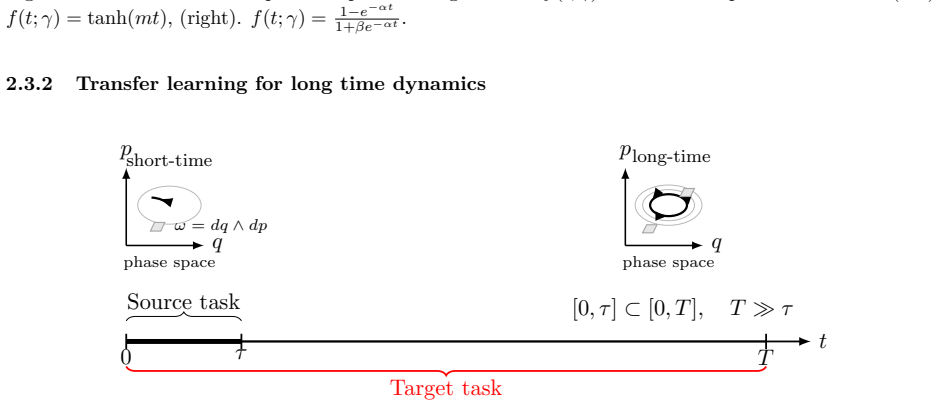
The Adaptive Transfer Learnable Symplectic-aware Neural Network (ATLAS-NN) augments the HNN architecture with a learnable temporal scaling mechanism that parametrizes a nonlinear mapping of time, automatically adapting to the system's intrinsic complexity through a two-stage transfer learning strategy where the model is trained on a short-time source interval to identify the Hamiltonian structure and optimal temporal reparameterization and the learned scaling function is then frozen and transferred to an extended target interval for fine-tuning.
Load-bearing premise
The learned temporal scaling function identified on a short-time source interval remains optimal and transferable when frozen and applied to an extended target interval without introducing new phase errors or instability.
Editorial analysis
A structured set of objections, weighed in public.
Referee Report
Summary. The paper proposes ATLAS-NN, which augments standard Hamiltonian Neural Networks with a learnable nonlinear temporal scaling function. A two-stage transfer learning procedure is used: the model (including the scaling) is trained on a short source interval to identify the Hamiltonian and optimal reparameterization; the scaling is then frozen and transferred to a longer target interval for fine-tuning. Numerical experiments on nonlinear oscillators and the chaotic Hénon-Heiles system are reported to yield nearly an order of magnitude reduction in long-time prediction error relative to baseline HNNs and traditional symplectic integrators.
Significance. If the transfer procedure is shown to be robust, the method would address a practical limitation of fixed-time HNNs in multiscale Hamiltonian systems and could improve long-time integration accuracy without sacrificing the symplectic structure. The two-stage strategy with frozen scaling is a concrete, testable idea that, if validated, would be of interest to the geometric integration and physics-informed ML communities.
major comments (2)
- [§4] §4 (Numerical Experiments on Hénon-Heiles): the reported order-of-magnitude error reduction rests on the assumption that the source-derived temporal scaling remains near-optimal when frozen on the target interval. No sensitivity analysis, phase-error bound, or ablation on scaling mismatch is provided for the chaotic regime; a mismatch would directly undermine the central performance claim relative to standard HNNs.
- [§3.2] §3.2 (two-stage transfer procedure): the claim that freezing the learned scaling preserves the symplectic property and does not inject new instability over long times lacks either a theoretical argument or explicit numerical verification (e.g., monitoring of energy drift or Poincaré sections) when the underlying flow is chaotic.
minor comments (2)
- [Abstract] The abstract states 'nearly an order of magnitude reduction' without naming the precise error metric, baseline implementations, or number of independent runs; this should be clarified in the main text and abstract.
- [§3] Notation for the temporal scaling function (e.g., how it enters the loss or the integrator) is introduced without an explicit equation reference in the method section; adding a numbered equation would improve clarity.
Simulated Author's Rebuttal
We thank the referee for the constructive and detailed comments. We address each major point below, agreeing that additional analysis will strengthen the manuscript.
read point-by-point responses
-
Referee: [§4] §4 (Numerical Experiments on Hénon-Heiles): the reported order-of-magnitude error reduction rests on the assumption that the source-derived temporal scaling remains near-optimal when frozen on the target interval. No sensitivity analysis, phase-error bound, or ablation on scaling mismatch is provided for the chaotic regime; a mismatch would directly undermine the central performance claim relative to standard HNNs.
Authors: We agree that the manuscript would benefit from explicit sensitivity analysis in the chaotic regime. In the revised version we will add an ablation study that perturbs the transferred scaling parameters on the Hénon-Heiles system and reports the resulting long-time prediction errors, thereby quantifying robustness to scaling mismatch. revision: yes
-
Referee: [§3.2] §3.2 (two-stage transfer procedure): the claim that freezing the learned scaling preserves the symplectic property and does not inject new instability over long times lacks either a theoretical argument or explicit numerical verification (e.g., monitoring of energy drift or Poincaré sections) when the underlying flow is chaotic.
Authors: The symplectic property is preserved by construction because the HNN component continues to learn a Hamiltonian vector field; the frozen scaling is a monotonic time reparameterization that does not modify the underlying geometric structure. To provide the requested verification we will include, in the revision, long-time energy-drift curves and Poincaré sections for the Hénon-Heiles system under the transferred scaling. revision: yes
Circularity Check
No significant circularity in derivation chain
full rationale
The paper proposes ATLAS-NN as an augmentation of HNNs with a learnable temporal scaling function identified via two-stage transfer learning (short source interval training followed by frozen transfer to target interval). The central claims rest on numerical experiments demonstrating error reduction on oscillators and Hénon-Heiles, which are independent empirical outcomes rather than quantities forced by construction from the inputs. No self-definitional relations, fitted parameters renamed as predictions, or load-bearing self-citations appear in the provided text. The transfer assumption is stated explicitly as a modeling choice but does not reduce the reported results to tautology.
Assumptions & free parameters
assumptions (1)
- domain assumption Hamiltonian systems possess a conserved energy structure that can be learned by neural networks
Cite this review
Pith. "Pith review of ATLAS-NN: Adaptive Transfer Learnable Symplectic-aware Neural Network for Long-Time Hamiltonian Dynamics." pith.science (2026). https://pith.science/paper/5UEXVRW3
@misc{pith2026260604447,
  author       = {Pith},
  title        = {Pith review of: ATLAS-NN: Adaptive Transfer Learnable Symplectic-aware Neural Network for Long-Time Hamiltonian Dynamics},
  year         = {2026},
  howpublished = {\url{https://pith.science/paper/5UEXVRW3}},
  note         = {Machine review of arXiv:2606.04447}
}
read the original abstract
Modeling Hamiltonian systems over long temporal intervals remains a significant challenge due to intrinsic multiscale structures and rapid nonlinear transitions. While Hamiltonian Neural Networks (HNNs) incorporate geometric invariants to improve stability, they typically rely on a fixed, externally prescribed temporal structure. This lack of adaptability often leads to accumulated phase errors and degraded accuracy in systems with heterogeneous temporal scales. To address these limitations, we put forward the Adaptive Transfer Learnable Symplectic-aware Neural Network (ATLAS-NN). Our framework augments the HNN architecture with a learnable temporal scaling mechanism that parametrize a nonlinear mapping of time, automatically adapting to the system's intrinsic complexity. We propose a two-stage transfer learning strategy: the model is first trained on a short-time \textit{source} interval to identify the Hamiltonian structure and optimal temporal reparameterization; the learned scaling function is then frozen and transferred to an extended \textit{target} interval for fine-tuning. Numerical experiments on nonlinear oscillators and the chaotic H\'enon--Heiles system demonstrate that ATLAS-NN provides a more efficient alternative to standard HNNs and traditional symplectic integrators, yielding nearly an order of magnitude reduction in long-time prediction error.
Figures


Figures from the paper (10 more)


Forward citations
Cited by 1 Pith paper
-
Dynamical and Optimization Trade-offs of Levi--Civita Coordinates for Learned Close-Encounter Dynamics
Levi-Civita coordinates improve rollout survival of learned close-encounter models but worsen raw-basis regression conditioning, while accurate neural residual learning remains unresolved.
Reference graph
Works this paper leans on
-
[1]
Machine learning and the physical sciences.Reviews of Modern Physics, 91(4):045002, 2019
Giuseppe Carleo, Ignacio Cirac, Kyle Cranmer, Laurent Daudet, Maria Schuld, Naftali Tishby, Leslie Vogt-Maranto, and Lenka Zdeborová. Machine learning and the physical sciences.Reviews of Modern Physics, 91(4):045002, 2019
2019
-
[2]
Physics- informed neural networks (pinns) for fluid mechanics: A review.Acta Mechanica Sinica, 37(12):1727– 1738, 2021
Shengze Cai, Zhiping Mao, Zhicheng Wang, Minglang Yin, and George Em Karniadakis. Physics- informed neural networks (pinns) for fluid mechanics: A review.Acta Mechanica Sinica, 37(12):1727– 1738, 2021
2021
-
[3]
Learning nonlinear operators via deeponet based on the universal approximation theorem of operators.Nature machine intelligence, 3(3):218–229, 2021
Lu Lu, Pengzhan Jin, Guofei Pang, Zhongqiang Zhang, and George Em Karniadakis. Learning nonlinear operators via deeponet based on the universal approximation theorem of operators.Nature machine intelligence, 3(3):218–229, 2021
2021
-
[4]
Fourier neural operator for parametric partial differential equations
ZongyiLi, NikolaBorislavovKovachki, KamyarAzizzadenesheli, KaushikBhattacharya, AndrewStuart, Anima Anandkumar, et al. Fourier neural operator for parametric partial differential equations. In International Conference on Learning Representations
-
[5]
Changhong Mou, Leslie M Smith, and Nan Chen. Combining stochastic parameterized reduced-order models with machine learning for data assimilation and uncertainty quantification with partial obser- vations.Journal of Advances in Modeling Earth Systems, 15(10):e2022MS003597, 2023
2023
-
[6]
Scientific machine learning benchmarks.Nature Reviews Physics, 4(6):413–420, 2022
Jeyan Thiyagalingam, Mallikarjun Shankar, Geoffrey Fox, and Tony Hey. Scientific machine learning benchmarks.Nature Reviews Physics, 4(6):413–420, 2022. 25 A preprint - June 4, 2026
2022
-
[7]
Universal differential equations for scientific machine learning.CoRR, 2020
Christopher Rackauckas, Yingbo Ma, Julius Martensen, Collin Warner, Kirill Zubov, Rohit Supekar, Dominic Skinner, and Ali Jasim Ramadhan. Universal differential equations for scientific machine learning.CoRR, 2020
2020
-
[8]
Neural ordinary differ- ential equations.Advances in neural information processing systems, 31, 2018
Ricky TQ Chen, Yulia Rubanova, Jesse Bettencourt, and David K Duvenaud. Neural ordinary differ- ential equations.Advances in neural information processing systems, 31, 2018
2018
Show all 41 references
-
[9]
Neural ode control for classification, approximation, and transport.SIAM Review, 65(3):735–773, 2023
Domenec Ruiz-Balet and Enrique Zuazua. Neural ode control for classification, approximation, and transport.SIAM Review, 65(3):735–773, 2023
2023
-
[10]
Hamiltonian systems and transformation in hilbert space.Proceedings of the National Academy of Sciences, 17(5):315–318, 1931
Bernard O Koopman. Hamiltonian systems and transformation in hilbert space.Proceedings of the National Academy of Sciences, 17(5):315–318, 1931
1931
-
[11]
Marsden.Foundations of Mechanics
Ralph Abraham and Jerrold E. Marsden.Foundations of Mechanics. Benjamin/Cummings, 2 edition, 1978
1978
-
[12]
Springer Science & Business Media, 2013
Jerrold E Marsden and Tudor S Ratiu.Introduction to mechanics and symmetry: a basic exposition of classical mechanical systems, volume 17. Springer Science & Business Media, 2013
2013
-
[13]
Pearson Education India, 2011
Herbert Goldstein.Classical mechanics. Pearson Education India, 2011
2011
-
[14]
Hamiltonian operator inference: Physics-preserving learning of reduced-order models for canonical hamiltonian systems.Physica D: Nonlinear Phenomena, 431:133122, 2022
Harsh Sharma, Zhu Wang, and Boris Kramer. Hamiltonian operator inference: Physics-preserving learning of reduced-order models for canonical hamiltonian systems.Physica D: Nonlinear Phenomena, 431:133122, 2022
2022
-
[15]
Symplectic integrators: An introduction.American Journal of Physics, 73(10):938–945, 2005
Denis Donnelly and Edwin Rogers. Symplectic integrators: An introduction.American Journal of Physics, 73(10):938–945, 2005
2005
-
[16]
Number 14
Benedict Leimkuhler and Sebastian Reich.Simulating hamiltonian dynamics. Number 14. Cambridge university press, 2004
2004
-
[17]
Structure-preserving algorithms for ordinary differential equations.Geometric numerical integration, 31, 2006
Ernst Hairer, Christian Lubich, and Gerhard Wanner. Structure-preserving algorithms for ordinary differential equations.Geometric numerical integration, 31, 2006
2006
-
[18]
The symplectic methods for the computation of hamiltonian equations
Kang Feng and Meng-zhao Qin. The symplectic methods for the computation of hamiltonian equations. InNumerical Methods for Partial Differential Equations: Proceedings of a Conference held in Shanghai, PR China, March 25–29, 1987, pages 1–37. Springer, 2006
1987
-
[19]
A new look at finite elements in time: a variational interpretation of runge-kutta methods.Applied Numerical Mathematics, 25(4):355–368, 1997
Carlo L Bottasso. A new look at finite elements in time: a variational interpretation of runge-kutta methods.Applied Numerical Mathematics, 25(4):355–368, 1997
1997
-
[20]
Hamiltonian neural networks.Advances in neural information processing systems, 32, 2019
Samuel Greydanus, Misko Dzamba, and Jason Yosinski. Hamiltonian neural networks.Advances in neural information processing systems, 32, 2019
2019
-
[21]
Hamiltonian neural networks for solving equations of motion.Physical Review E, 105(6):065305, 2022
Marios Mattheakis, David Sondak, Akshunna S Dogra, and Pavlos Protopapas. Hamiltonian neural networks for solving equations of motion.Physical Review E, 105(6):065305, 2022
2022
-
[22]
Maziar Raissi, Paris Perdikaris, and George E Karniadakis. Physics-informed neural networks: A deep learning framework for solving forward and inverse problems involving nonlinear partial differential equations.Journal of Computational physics, 378:686–707, 2019
2019
-
[23]
Port- hamiltonian neural networks for learning explicit time-dependent dynamical systems.Physical Review E, 104(3):034312, 2021
Shaan A Desai, Marios Mattheakis, David Sondak, Pavlos Protopapas, and Stephen J Roberts. Port- hamiltonian neural networks for learning explicit time-dependent dynamical systems.Physical Review E, 104(3):034312, 2021
2021
-
[24]
Transfer learn- ing with physics-informed neural networks for efficient simulation of branched flows.arXiv preprint arXiv:2211.00214, 2022
Raphaël Pellegrin, Blake Bullwinkel, Marios Mattheakis, and Pavlos Protopapas. Transfer learn- ing with physics-informed neural networks for efficient simulation of branched flows.arXiv preprint arXiv:2211.00214, 2022
2022
-
[25]
Springer, 2003
Stephen Wiggins.Introduction to applied nonlinear dynamical systems and chaos. Springer, 2003
2003
-
[26]
Addison-wesley Reading, MA, 1950
Herbert Goldstein, Charles P Poole, and John Safko.Classical mechanics, volume 2. Addison-wesley Reading, MA, 1950
1950
-
[27]
Cambridge University Press, 2020
Jun John Sakurai and Jim Napolitano.Modern quantum mechanics. Cambridge University Press, 2020
2020
-
[28]
John Wiley & Sons, 2016
Linda E Reichl.A modern course in statistical physics. John Wiley & Sons, 2016
2016
-
[29]
Springer, 1998
Alexandre M Zagoskin.Quantum theory of many-body systems, volume 174. Springer, 1998
1998
-
[30]
A survey of transfer learning.Journal of Big data, 3(1):9, 2016
Karl Weiss, Taghi M Khoshgoftaar, and DingDing Wang. A survey of transfer learning.Journal of Big data, 3(1):9, 2016. 26 A preprint - June 4, 2026
2016
-
[31]
Transfer learning
Lisa Torrey and Jude Shavlik. Transfer learning. InHandbook of research on machine learning applica- tions and trends: algorithms, methods, and techniques, pages 242–264. IGI Global Scientific Publishing, 2010
2010
-
[32]
A comprehensive survey on transfer learning.Proceedings of the IEEE, 109(1):43–76, 2020
Fuzhen Zhuang, Zhiyuan Qi, Keyu Duan, Dongbo Xi, Yongchun Zhu, Hengshu Zhu, Hui Xiong, and Qing He. A comprehensive survey on transfer learning.Proceedings of the IEEE, 109(1):43–76, 2020
2020
-
[33]
Anharmonic oscillator.Physical Review, 184(5):1231, 1969
Carl M Bender and Tai Tsun Wu. Anharmonic oscillator.Physical Review, 184(5):1231, 1969
1969
-
[34]
An efficient data-driven multiscale stochastic reduced order modeling framework for complex systems.Journal of Computational Physics, 493:112450, 2023
Changhong Mou, Nan Chen, and Traian Iliescu. An efficient data-driven multiscale stochastic reduced order modeling framework for complex systems.Journal of Computational Physics, 493:112450, 2023
2023
-
[35]
Springer, 2016
Andrew J Majda.Introduction to turbulent dynamical systems in complex systems. Springer, 2016
2016
-
[36]
Using machine learning to predict extreme events in complex systems
Di Qi and Andrew J Majda. Using machine learning to predict extreme events in complex systems. Proceedings of the National Academy of Sciences, 117(1):52–59, 2020
2020
-
[37]
A stochastic precipitating quasi- geostrophic model.Physics of Fluids, 36(11), 2024
Nan Chen, Changhong Mou, Leslie M Smith, and Yeyu Zhang. A stochastic precipitating quasi- geostrophic model.Physics of Fluids, 36(11), 2024
2024
-
[38]
Yeyu Zhang, Leslie M Smith, and Samuel N Stechmann. Convergence to precipitating quasi-geostrophic equations with phase changes: asymptotics and numerical assessment.Philosophical Transactions of the Royal Society A: Mathematical, Physical and Engineering Sciences, 380(2226), 2022
2022
-
[39]
Fast-wave averaging with phase changes: asymptotics and application to moist atmospheric dynamics.Journal of Nonlinear Science, 31(2):38, 2021
Yeyu Zhang, Leslie M Smith, and Samuel N Stechmann. Fast-wave averaging with phase changes: asymptotics and application to moist atmospheric dynamics.Journal of Nonlinear Science, 31(2):38, 2021
2021
-
[40]
Pas-net: Physics-informed adaptive scale deep operator network.arXiv preprint arXiv:2511.14925, 2025
Changhong Mou, Yeyu Zhang, Xuewen Zhu, and Qiao Zhuang. Pas-net: Physics-informed adaptive scale deep operator network.arXiv preprint arXiv:2511.14925, 2025
2025
-
[41]
Pip2 net: Physics-informed partition penalty deep operator network.arXiv preprint arXiv:2512.15086, 2025
Hongjin Mi, Huiqiang Lun, Changhong Mou, and Yeyu Zhang. Pip2 net: Physics-informed partition penalty deep operator network.arXiv preprint arXiv:2512.15086, 2025. 27
2025
Reviewed June 28, 2026 · model on record in the stance chip above.
Discussion (0). Continue with ORCID to comment.