Revisiting fermion bound states in baby Skyrme background with Dzyaloshinskii Moriya interaction
Pith reviewed 2026-07-01 00:59 UTC · model grok-4.3
The pith
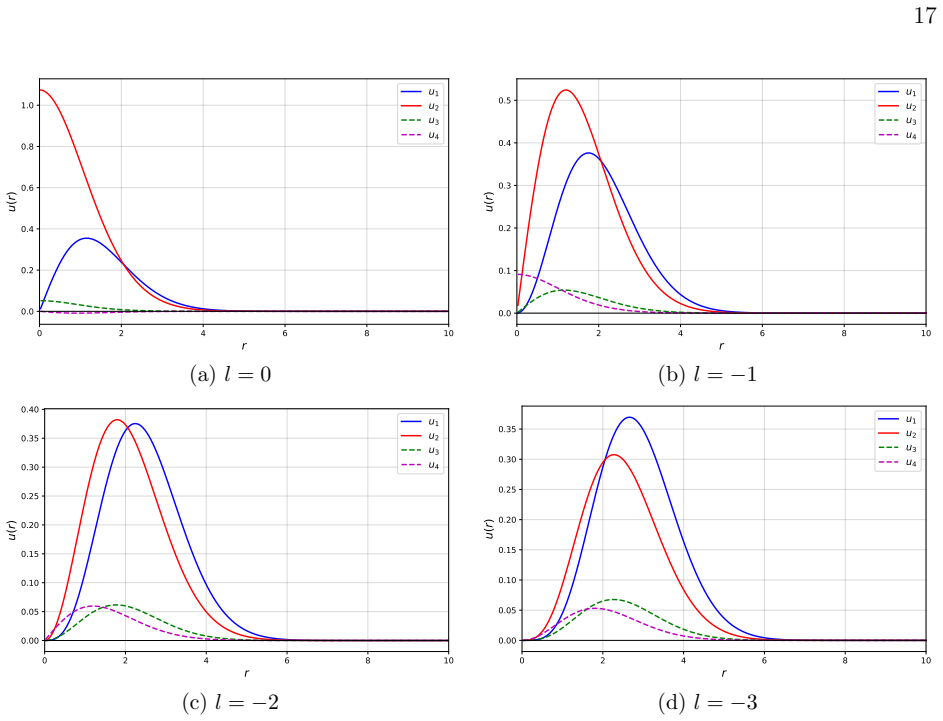
Localized solutions exist only for electrically charged fermions with positive charge and negative angular momentum bound to the Skyrmion.
A machine-rendered reading of the paper's core claim, the machinery that carries it, and where it could break.
Core claim
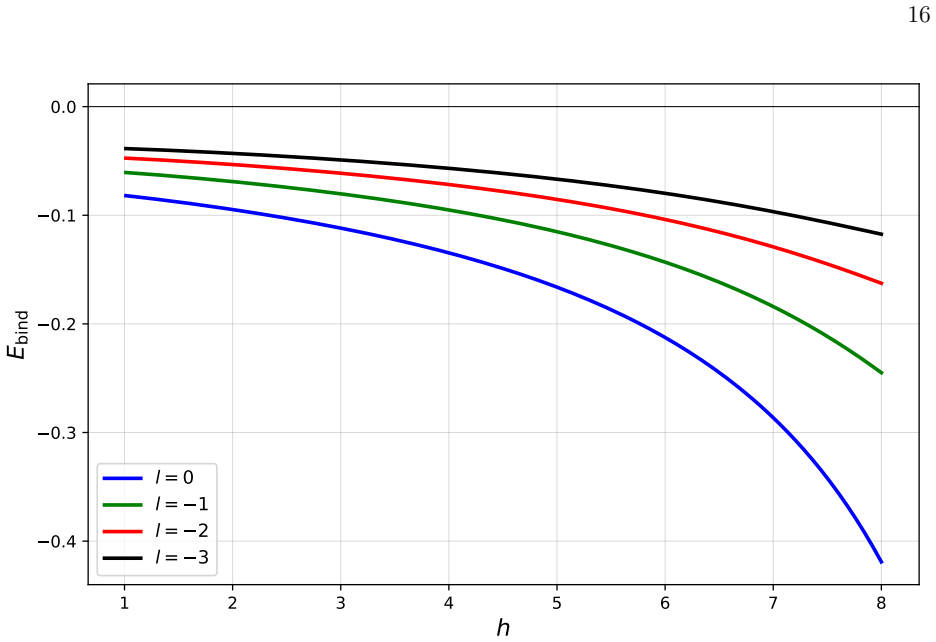
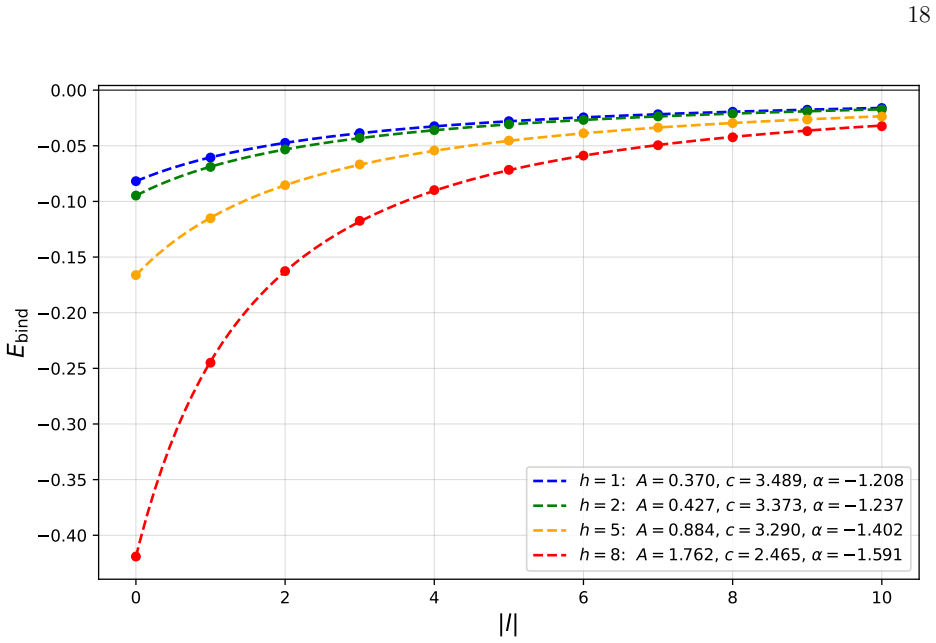
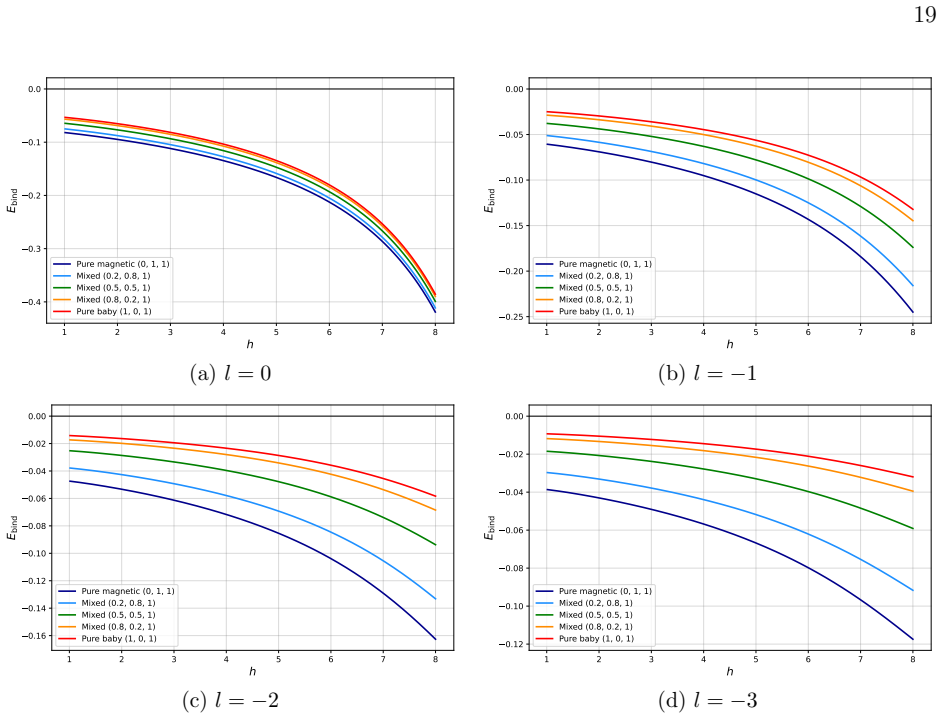
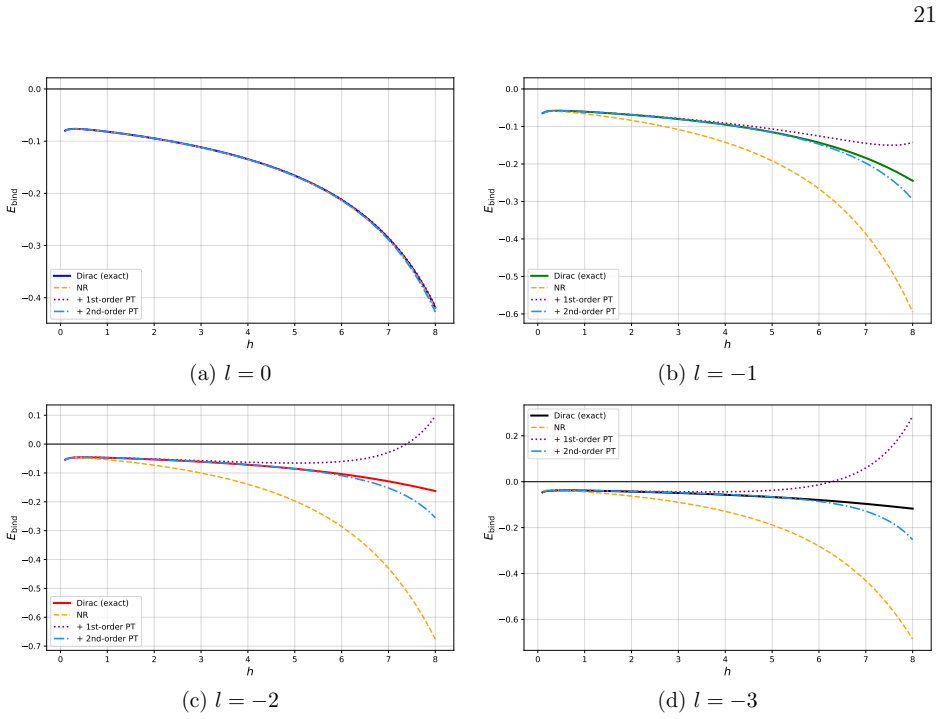
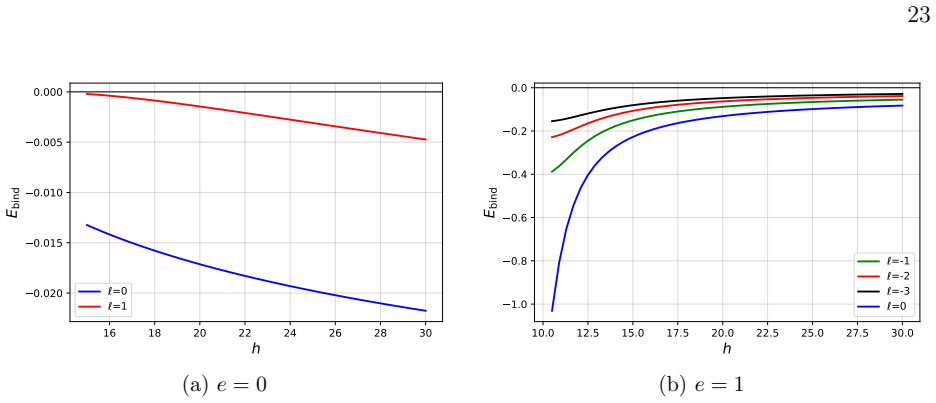
The central claim is that the Dirac equation in this fixed Skyrmion background admits localized bound-state solutions only for electrically charged fermions that carry positive charge and negative angular momentum; neutral fermions produce no localized solutions. The energy of the lowest bound state per angular-momentum channel is determined as a function of the fermion mass, its electric charge, and the coupling constant h to the Skyrmion isospin, and the dependence is compared explicitly between the pure magnetic Skyrmion, the baby-Skyrme limit, and the intermediate mixed regime.
What carries the argument
The Dirac equation for the fermion in the fixed classical Skyrmion background that includes both Dzyaloshinskii-Moriya and Skyrme interaction terms.
If this is right
- The fermion-Skyrmion system forms an electrically charged composite state bound to a topological texture.
- Bound states are absent for neutral fermions in every parameter regime examined.
- The energy of the lowest bound state in each sector depends on fermion mass, charge, and the isospin coupling h.
- The binding behavior differs systematically between magnetic, baby, and mixed Skyrmion backgrounds.
- These composites furnish concrete signatures that could be sought in transport and scattering experiments on chiral magnets.
Where Pith is reading between the lines
- In real chiral magnets the bound charge could locally alter the texture mobility under applied currents.
- Including dynamical back-reaction would test whether the fermion deforms the Skyrmion radius or stability window.
- Analogous calculations in 3+1 dimensions could link to baryon-Skyrmion binding in higher-dimensional models.
- Scattering phase shifts off the composite might produce measurable resonances distinct from free fermions.
Load-bearing premise
The Skyrmion background is treated as a fixed classical configuration that does not receive back-reaction from the fermion field.
What would settle it
A numerical spectrum that exhibits a localized bound state for a neutral fermion, or that fails to produce any bound state for a positively charged fermion with negative angular momentum, would falsify the central result.
Figures
read the original abstract
In this paper, we investigate a fermion coupled to a Skyrme model in $2+1$ dimensions, where the Skyrmion is stabilized by the Dzyaloshinskii-Moriya and Skyrme interactions under a quadratic potential. This framework interpolates between the magnetic Skyrmion at the critical coupling and the baby-Skyrme limit. The Dirac equation is studied both analytically in a non-relativistic reduction and numerically for the full relativistic spectrum, and the parameter region admitting states bound to the Skyrmion is determined. Localized solutions exist only for electrically charged fermions with positive charge and negative angular momentum, and are absent for neutral fermions. The lowest bound state in each angular momentum sector is characterized as a function of the fermion mass, charge, and the coupling $h$ to the Skyrmion isospin, and its behavior is compared across the magnetic, baby, and mixed Skyrmion backgrounds. The resulting fermion--Skyrmion composite constitutes an electrically charged state bound to a topological texture, providing concrete signatures for potential future transport and scattering measurements in chiral magnets.
Editorial analysis
A structured set of objections, weighed in public.
Referee Report
Summary. The paper studies a fermion coupled to a 2+1D Skyrme model stabilized by Dzyaloshinskii-Moriya and Skyrme terms under quadratic potential, interpolating between magnetic Skyrmion and baby-Skyrme limits. Both analytic non-relativistic reduction of the Dirac equation and full numerical relativistic solutions are used to determine the parameter region for bound states to the Skyrmion. Localized solutions exist only for electrically charged fermions with positive charge q>0 and negative angular momentum; they are absent for neutral fermions. The lowest bound state per angular-momentum sector is characterized versus fermion mass, charge, and coupling h, with comparisons across magnetic, baby, and mixed backgrounds.
Significance. If the results hold, the work supplies concrete conditions for electrically charged fermion-Skyrmion composites and potential transport/scattering signatures in chiral magnets. The dual analytic-plus-numeric treatment of the Dirac spectrum in the fixed background is a methodological strength that allows direct comparison of limits.
major comments (2)
- [Abstract] Abstract and numerical section: the claim that bound states exist only for q>0 and negative angular momentum rests on the effective potential obtained from the fixed classical Skyrmion background; the manuscript provides no quantitative error controls, convergence tests, or data-exclusion criteria for the numerical eigenvalue search, leaving the reported restriction unverifiable at the stated soundness level.
- [Model setup] Background treatment (throughout): the Skyrmion is held fixed with no back-reaction from the fermion field; this assumption is load-bearing for the central claim, because any fermion-induced deformation of the texture could modify the effective potential and the reported charge/angular-momentum selection rule.
minor comments (2)
- [Lagrangian] The definition and normalization of the coupling h to the Skyrmion isospin should be stated explicitly in the Lagrangian to allow reproduction of the numerical scans.
- [Results figures] Figure captions and axis labels for the bound-state energy versus h and q should include the precise angular-momentum values shown, to clarify the sector-by-sector comparison.
Simulated Author's Rebuttal
We thank the referee for their careful reading of the manuscript and for providing constructive comments. We address the major comments point by point below.
read point-by-point responses
-
Referee: [Abstract] Abstract and numerical section: the claim that bound states exist only for q>0 and negative angular momentum rests on the effective potential obtained from the fixed classical Skyrmion background; the manuscript provides no quantitative error controls, convergence tests, or data-exclusion criteria for the numerical eigenvalue search, leaving the reported restriction unverifiable at the stated soundness level.
Authors: We acknowledge that the manuscript lacks explicit documentation of numerical error controls and convergence tests. In the revised version we will add a dedicated subsection describing the numerical eigenvalue method (including discretization, grid parameters, and cutoff), together with convergence checks under variation of grid size and radial cutoff, plus estimates of eigenvalue accuracy. These additions will make the reported restrictions on charge and angular momentum directly verifiable. revision: yes
-
Referee: [Model setup] Background treatment (throughout): the Skyrmion is held fixed with no back-reaction from the fermion field; this assumption is load-bearing for the central claim, because any fermion-induced deformation of the texture could modify the effective potential and the reported charge/angular-momentum selection rule.
Authors: The study is performed entirely within the fixed-background approximation, which is stated in the model section and is the standard approach when the goal is to determine the Dirac spectrum in a prescribed topological texture. The reported selection rule follows directly from the structure of the effective potential generated by that fixed texture. While a self-consistent treatment including back-reaction is a natural extension, it lies outside the present scope; we will add an explicit statement clarifying the approximation and its domain of validity. revision: partial
Circularity Check
No significant circularity; derivation is direct solution of Dirac equation
full rationale
The paper derives bound-state existence by solving the Dirac equation (both non-relativistic reduction and full numerical spectrum) in a fixed classical Skyrmion background whose parameters are scanned. The reported restriction to q>0 and negative angular momentum is a direct output of the resulting effective potential and eigenvalue condition, with no reduction to a fit, self-definition, or load-bearing self-citation. The computation is self-contained against the model equations and external to any prior author result invoked as an unverified premise.
Axiom & Free-Parameter Ledger
axioms (1)
- domain assumption The Skyrmion background is stabilized by Dzyaloshinskii-Moriya and Skyrme interactions under a quadratic potential.
Reference graph
Works this paper leans on
-
[1]
For the coupling to fermions, we will take the symmetric gauge for the corresponding gauge potential, i.e
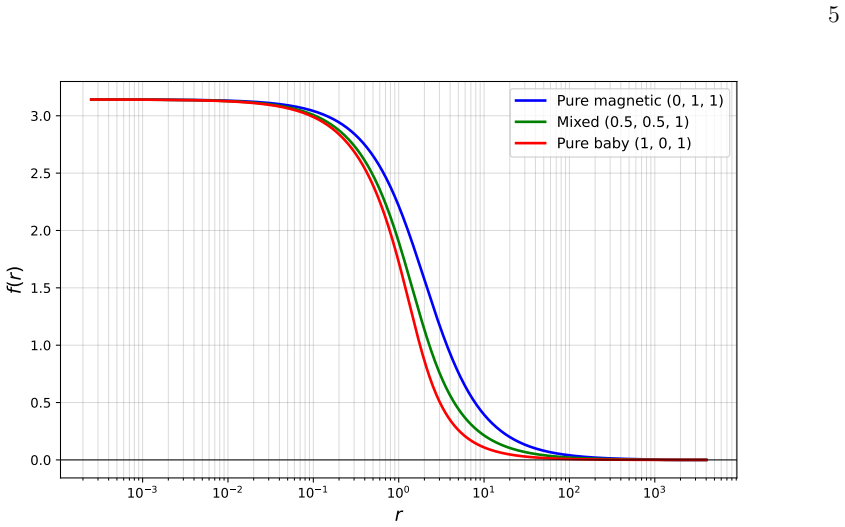
(2) indicating the background magnetic field isB=µ 2ˆz. For the coupling to fermions, we will take the symmetric gauge for the corresponding gauge potential, i.e. Aν = µ2 2 0,−y, x (3) We can fixµ= 1 by a rescaling of the parameters. Following the notation in [36], we consider the ansatz of the Skyrmion profile S= sinf(r) cos(θ+δ),sinf(r) sin(θ+δ),cosf(r)...
-
[2]
Rajaraman,Solitons and instantons : an introduction to solitons and instantons in quantum field theory(Amsterdam, Netherlands: North-holland, 1982)
R. Rajaraman,Solitons and instantons : an introduction to solitons and instantons in quantum field theory(Amsterdam, Netherlands: North-holland, 1982)
1982
-
[3]
N. S. Manton and P. Sutcliffe,Topological solitons, Cambridge Monographs on Mathematical Physics (Cambridge University Press, 2004)
2004
-
[4]
Y. M. Shnir,Topological and Non-Topological Solitons in Scalar Field Theories(Cambridge University Press, 2018)
2018
-
[5]
Shifman,Advanced Topics in Quantum Field Theory(Cambridge University Press, 2022)
M. Shifman,Advanced Topics in Quantum Field Theory(Cambridge University Press, 2022)
2022
-
[6]
Shifman and A
M. Shifman and A. Yung,Supersymmetric Solitons(Cambridge University Press, 2023)
2023
-
[7]
D. R. Nelson,Defects and Geometry in Condensed Matter Physics(Cambridge University Press, 2002)
2002
-
[8]
T. H. R. Skyrme, Proc. Roy. Soc. Lond. A260, 127 (1961)
1961
-
[9]
T. H. R. Skyrme, Nucl. Phys.31, 556 (1962)
1962
-
[10]
A. Fert, V. Cros, and J. Sampaio, Nat. Nanotech.8, 152 (2013)
2013
-
[11]
Nagaosa and Y
N. Nagaosa and Y. Tokura, Nat. Nanotech.8, 899 (2013)
2013
-
[12]
A. Fert, N. Reyren, and V. Cros, Nat. Rev. Materials2, 1 (2017)
2017
-
[13]
F. Hanada and N. Sawado, Nucl. Phys. B996, 116377 (2023), arXiv:2303.15751 [hep-th]
arXiv 2023
-
[14]
S. Bolognesi, S. B. Gudnason, and R. Menta, Phys. Rev. Res.6, 043162 (2024), arXiv:2406.03941 [cond-mat.mes-hall]
arXiv 2024
-
[15]
S.-Z. Lin, A. Saxena, and C. D. Batista, Phys. Rev. B91, 224407 (2015)
2015
-
[16]
U. K. R¨ oßler, A. N. Bogdanov, and C. Pfleiderer, Nature442, 797 (2006), arXiv:cond- mat/0603103 [cond-mat.stat-mech]
arXiv 2006
-
[17]
J. H. Han, J. Zang, Z. Yang, J.-H. Park, and N. Nagaosa, Phys. Rev. B82, 094429 (2010)
2010
-
[18]
S. M¨ uhlbauer, B. Binz, F. Jonietz, C. Pfleiderer, A. Rosch, A. Neubauer, R. Georgii, and P. B¨ oni, Science323, 915 (2009), arXiv:0902.1968 [cond-mat.str-el]
Pith/arXiv arXiv 2009
-
[19]
X. Z. Yu, Y. Onose, N. Kanazawa, J. H. Park, J. H. Han, Y. Matsui, N. Nagaosa, and Y. Tokura, Nature465, 901 (2010). 25
2010
-
[20]
Heinze, K
S. Heinze, K. von Bergmann, M. Menzel, J. Brede, A. Kubetzka, R. Wiesendanger, G. Bihlmayer, and S. Bl¨ ugel, Nature Physics7, 713 (2011)
2011
-
[21]
C. Ross, N. Sakai, and M. Nitta, JHEP02, 095 (2021), arXiv:2003.07147 [cond-mat.mes-hall]
arXiv 2021
-
[22]
Y. Amari and M. Nitta, Phys. Rev. B111, 134441 (2025), arXiv:2409.07943 [cond-mat.mes- hall]
arXiv 2025
-
[23]
B. G¨ obel, I. Mertig, and O. A. Tretiakov, Phys. Rept.895, 1 (2021), arXiv:2005.01390 [cond- mat.mes-hall]
arXiv 2021
- [24]
-
[25]
C. Ross, N. Sakai, and M. Nitta, JHEP12, 163 (2021), arXiv:2012.08800 [cond-mat.mes-hall]
arXiv 2021
-
[26]
Chen, Nature Physics13, 112 (2017)
G. Chen, Nature Physics13, 112 (2017)
2017
-
[27]
J. Zang, M. Mostovoy, J. H. Han, and N. Nagaosa, Phys. Rev. Lett.107, 136804 (2011), arXiv:1102.5384 [cond-mat.mes-hall]
Pith/arXiv arXiv 2011
-
[28]
W. Jiang, X. Zhang, G. Yu, W. Zhang, X. Wang, M. Benjamin Jungfleisch, J. E. Pearson, X. Cheng, O. Heinonen, K. L. Wang, Y. Zhou, A. Hoffmann, and S. G. E. te Velthuis, Nature Physics13, 162 (2017), arXiv:1603.07393 [cond-mat.mes-hall]
Pith/arXiv arXiv 2017
-
[29]
K. Litzius, I. Lemesh, B. Kr¨ uger, P. Bassirian, L. Caretta, K. Richter, F. B¨ uttner, K. Sato, O. A. Tretiakov, J. F¨ orster, R. M. Reeve, M. Weigand, I. Bykova, H. Stoll, G. Sch¨ utz, G. S. D. Beach, and M. Kl¨ aui, Nature Physics13, 170 (2017), arXiv:1608.07216 [cond-mat.mtrl-sci]
Pith/arXiv arXiv 2017
-
[30]
S. L. Sondhi, A. Karlhede, S. A. Kivelson, and E. H. Rezayi, Phys. Rev. B47, 16419 (1993)
1993
-
[31]
Neubauer, C
A. Neubauer, C. Pfleiderer, B. Binz, A. Rosch, R. Ritz, P. G. Niklowitz, and P. B¨ oni, Phys. Rev. Lett.102, 186602 (2009)
2009
-
[32]
A. C. Balram, U. Wurstbauer, A. W´ ojs, A. Pinczuk, and J. K. Jain, Nature Communications 6, 8981 (2015), arXiv:1406.4042 [cond-mat.str-el]
Pith/arXiv arXiv 2015
-
[33]
A. M. Cook, Phys. Rev. B109, 155123 (2024), arXiv:2305.18626 [cond-mat.str-el]
arXiv 2024
-
[34]
I. Perapechka, N. Sawado, and Y. Shnir, JHEP10, 081 (2018), arXiv:1808.07787 [hep-th]
Pith/arXiv arXiv 2018
-
[35]
M. Barsanti and G. Tallarita, JHEP06, 076 (2023), arXiv:2106.02410 [hep-th]
arXiv 2023
-
[36]
I. Perapechka and Y. Shnir, Phys. Rev. D99, 125001 (2019), arXiv:1901.06925 [hep-th]
Pith/arXiv arXiv 2019
-
[37]
B. Barton-Singer, C. Ross, and B. J. Schroers, Commun. Math. Phys.375, 2259 (2020), arXiv:1812.07268 [cond-mat.str-el]. 26
arXiv 2020
- [38]
-
[39]
A. Y. Loginov, Phys. Rev. D104, 045011 (2021), arXiv:2104.08520 [hep-th]
arXiv 2021
-
[40]
A. Y. Loginov, Eur. Phys. J. C84, 545 (2024), arXiv:2402.02422 [hep-th]
arXiv 2024
- [41]
-
[42]
Virtanen, R
P. Virtanen, R. Gommers, T. E. Oliphant, M. Haberland, T. Reddy, D. Cournapeau, E. Burovski, P. Peterson, W. Weckesser, J. Bright, S. J. van der Walt, M. Brett, J. Wil- son, K. J. Millman, N. Mayorov, A. R. J. Nelson, E. Jones, R. Kern, E. Larson, C. J. Carey, ˙I. Polat, Y. Feng, E. W. Moore, J. VanderPlas, D. Laxalde, J. Perktold, R. Cimrman, I. Hen- rik...
2020
-
[43]
H. B. Nielsen and M. Ninomiya, Nucl. Phys. B185, 20 (1981), [Erratum: Nucl.Phys.B 195, 541 (1982)]
1981
-
[44]
I. I. Fishchuk and V. N. Rudko, Phys. Stat. Sol. 889, 61 (1978)
1978
-
[45]
Friedman and M
L. Friedman and M. Pollak, Phil. Mag. 838, 173 (1978)
1978
-
[46]
Friedman and M
L. Friedman and M. Pollak, Phil. Mag. 844, 487 (1981)
1981
-
[47]
Butcher, J
P. Butcher, J. Clark, A. Kumar, and J. McInnes, J. Non-Crystal. Solids35-36, 89 (1980)
1980
-
[48]
Movaghar, B
B. Movaghar, B. Pohlmann, and D. Wurtz, J. Phys. C14, 5127 (1981)
1981
-
[49]
Shklovskii and A
B. Shklovskii and A. Efros,Electronic Properties of Doped Semiconductors(Springer Berlin, Heidelberg, 1984)
1984
-
[50]
C.-Z. Wang, H.-Y. Xu, and Y.-C. Lai, Phys. Rev. Res.2, 013247 (2020), arXiv:2002.02944 [cond-mat.mes-hall]
arXiv 2020
discussion (0)
Sign in with ORCID, Apple, or X to comment. Anyone can read and Pith papers without signing in.