Double copy of form factors with multiple operator insertions
Pith reviewed 2026-06-27 06:17 UTC · model grok-4.3
The pith
Dyeing procedure extends double copy to form factors with multiple operator insertions by revealing a scalar-ordering structure preserved in gravity.
A machine-rendered reading of the paper's core claim, the machinery that carries it, and where it could break.
Core claim
By introducing a dyeing procedure that promotes color-singlet operators to adjoint colored states, form factors with multiple operator insertions map to colored amplitudes that obey BCJ relations. The original form factors are recovered by the inverse bleaching operation, or U(1) decoupling, and the framework shows that a new scalar-ordering structure survives the double copy to gravity.
What carries the argument
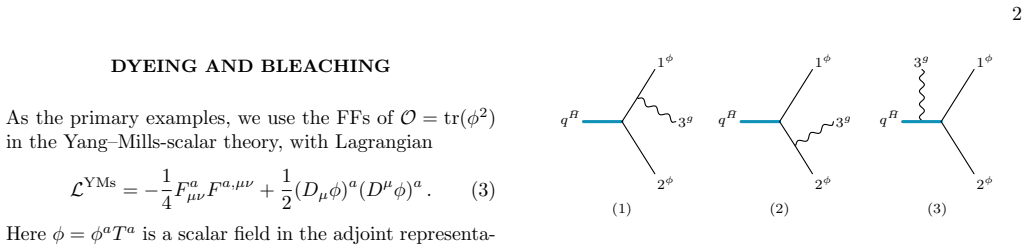
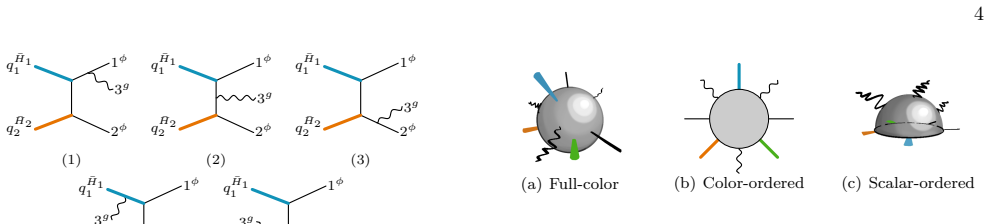
The dyeing procedure that promotes color-singlet operators to adjoint colored states, with bleaching as the inverse U(1) decoupling operation, turning spurious poles into propagators and exposing scalar ordering.
If this is right
- Spurious poles in the form factor become physical propagators of the dyed states.
- Hidden factorization relations follow directly from BCJ relations of the dyed amplitudes.
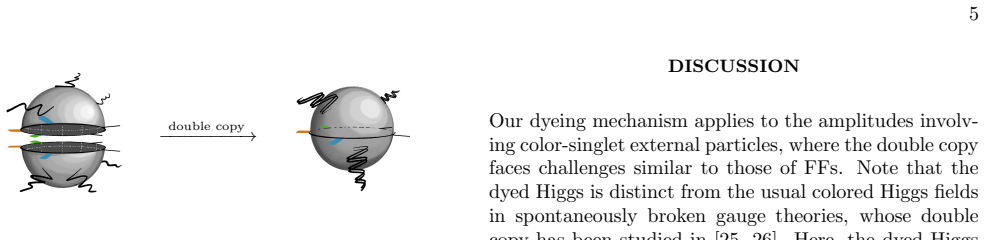
- The scalar-ordering structure identified for multiple insertions survives the double copy to gravity.
- The method generalizes the double copy to form factors built from several local operators.
Where Pith is reading between the lines
- The scalar-ordering structure may supply new organizing principles for gravity quantities involving multiple operator insertions.
- The dyeing approach could be applied to other observables that mix color-singlet operators with colored fields.
- Explicit calculations in maximally supersymmetric theories could provide direct tests of the ordering pattern after double copy.
Load-bearing premise
The dyeing procedure and its inverse bleaching correctly preserve the physical content of the original form factor while allowing BCJ relations to apply without introducing artifacts or unintended changes to the pole structure.
What would settle it
Compute an explicit two-operator form factor in a gauge theory, apply the dyeing and bleaching steps, and check whether the predicted scalar-ordering structure appears in the gravity double copy or whether bleaching introduces extra poles.
Figures
read the original abstract
Extending the double copy of scattering amplitudes to more general physical quantities involving local gauge-invariant operators is a central open question. While progress has been made in the double copy of form factors (FFs) with a single-operator insertion, it has led to two intriguing features: poles that are spurious from the FF viewpoint become physical propagators in gravity, and FFs obey hidden factorization relations on these poles. This picture is difficult to generalize to FFs with multiple operator insertions due to even more complicated spurious pole structures. We resolve this problem by introducing a "dyeing" procedure that promotes color-singlet operators to adjoint colored states, while the original FF is recovered by the inverse "bleaching" (U(1) decoupling) operation. In this new picture, the spurious poles are propagators of the dyed state, and the hidden factorization relations follow from BCJ relations of the dyed amplitudes. For multiple operator insertions, this framework uncovers a new scalar-ordering structure that survives the double copy to gravity.
Editorial analysis
A structured set of objections, weighed in public.
Referee Report
Summary. The manuscript extends the double-copy construction from single-insertion form factors to multiple operator insertions by introducing a dyeing procedure that promotes color-singlet operators to adjoint states. BCJ relations then apply to the dyed amplitudes (with spurious poles becoming physical propagators), and the original form factor is recovered via the inverse bleaching (U(1) decoupling) operation. The framework is claimed to uncover a new scalar-ordering structure that survives the double copy to gravity.
Significance. If the dyeing/bleaching map is shown to preserve pole residues and factorization properties exactly, the result would provide a systematic route to multi-insertion form factors in the double-copy paradigm and identify new hidden structures. The approach leverages existing BCJ relations without introducing free parameters, which is a conceptual strength.
major comments (2)
- [§3.2] §3.2, definition of the dyeing map and Eq. (17): the claim that the procedure maps the original spurious poles to physical propagators of the dyed state without residue modification is central, yet no explicit residue computation is given for a two-insertion example to confirm that bleaching exactly cancels extra color factors.
- [§4.3] §4.3, the double-copy map after bleaching: the assertion that the new scalar-ordering structure survives to the gravity form factor relies on the inverse operation commuting with the double-copy replacement; this is load-bearing for the multi-insertion claim but is not verified by an explicit gravity-side factorization check.
minor comments (2)
- [Eq. (22)] Notation for the bleached states in Eq. (22) could be clarified to distinguish the U(1) decoupling from standard color-trace operations.
- [Introduction] The abstract and introduction would benefit from a brief statement of the single-insertion case that is being generalized.
Simulated Author's Rebuttal
We thank the referee for the careful reading and constructive comments, which help clarify the presentation of the dyeing procedure and its implications for the double copy. We address each major comment below and will revise the manuscript accordingly.
read point-by-point responses
-
Referee: [§3.2] §3.2, definition of the dyeing map and Eq. (17): the claim that the procedure maps the original spurious poles to physical propagators of the dyed state without residue modification is central, yet no explicit residue computation is given for a two-insertion example to confirm that bleaching exactly cancels extra color factors.
Authors: We agree that an explicit residue computation for a two-insertion example would strengthen the central claim. The manuscript presents the general argument that the dyeing map promotes color-singlet operators to adjoint states such that spurious poles become physical propagators, with bleaching recovering the original form factor via U(1) decoupling. However, a concrete verification of residue preservation is not included. In the revised manuscript we will add an explicit two-insertion calculation demonstrating that the residues match after bleaching. revision: yes
-
Referee: [§4.3] §4.3, the double-copy map after bleaching: the assertion that the new scalar-ordering structure survives to the gravity form factor relies on the inverse operation commuting with the double-copy replacement; this is load-bearing for the multi-insertion claim but is not verified by an explicit gravity-side factorization check.
Authors: The commutation follows from the linearity of the double-copy replacement (which acts on kinematic numerators) and the fact that bleaching is a color projection independent of kinematics. While this is implicit in the general construction, we acknowledge that an explicit gravity-side factorization check is not provided. In the revised version we will include a concrete example verifying that the scalar-ordering structure persists after the double copy to the gravity form factor. revision: yes
Circularity Check
No significant circularity; derivation builds new procedure on existing BCJ relations without reduction to inputs.
full rationale
The paper introduces a dyeing/bleaching procedure as a novel construction to handle multi-insertion form factors, allowing BCJ relations to apply before recovering the original FF. The abstract and description present this as an extension that uncovers a new scalar-ordering structure, with no quoted equations or steps showing self-definition, fitted inputs renamed as predictions, or load-bearing self-citations that reduce the central claim to prior unverified inputs by construction. The framework is described as resolving a generalization problem using established BCJ relations, making the derivation self-contained against external benchmarks.
Axiom & Free-Parameter Ledger
axioms (1)
- domain assumption BCJ relations hold for the dyed amplitudes
invented entities (1)
-
dyed state
no independent evidence
Forward citations
Cited by 1 Pith paper
-
Dyeing form factors as amplitudes
A dyeing procedure maps form factors to colored amplitudes, recovering the originals by bleaching and explaining double-copy features through standard BCJ relations.
Reference graph
Works this paper leans on
-
[1]
This matches precisely the hidden factorization relation ofF 3 [12]
= 1. This matches precisely the hidden factorization relation ofF 3 [12]. This example illustrates the two central roles played by the dyeing framework. First, dyeing embeds the FF into a fully colored amplitude, where the pole that appears spurious in the FF construction is an ordinary massive propagator of the dyed Higgs. After bleaching, the corre- spo...
-
[2]
block size
and (s 3q2 −m 2 2), and identifying the corresponding color-ordered amplitudes with the color- ordered FFs, we obtain the factorization relation for the two-operator FF: s13F[2] 3 (1ϕ,3 g,2 ϕ, qH2 2 , qH1 1 ) s3q1=m2 1 s3q2=m2 2 (34) =− h A3(q ¯H1 1 ,3 g,−P ¯H1 3q1)F[2] 2 (1ϕ,2 ϕ, qH2 2 ,P H1 3q1) i s3q2=m2 2 + h A3(−P ¯H2 3q2 ,3 g, q ¯H2 2 )F[2] 2 (1ϕ,2 ...
-
[3]
Kawai, D
H. Kawai, D. C. Lewellen, and S. H. H. Tye, Nucl. Phys. B269, 1 (1986)
1986
-
[4]
Z. Bern, J. Carrasco, and H. Johansson, Phys.Rev.D78, 085011 (2008), arXiv:0805.3993 [hep-ph]
Pith/arXiv arXiv 2008
-
[5]
Z. Bern, J. J. M. Carrasco, and H. Johansson, Phys.Rev.Lett.105, 061602 (2010), arXiv:1004.0476 [hep-th]
Pith/arXiv arXiv 2010
-
[6]
F. Cachazo, S. He, and E. Y. Yuan, Phys. Rev. Lett.113, 171601 (2014), arXiv:1307.2199 [hep-th]
Pith/arXiv arXiv 2014
-
[7]
F. Cachazo, S. He, and E. Y. Yuan, JHEP07, 149, arXiv:1412.3479 [hep-th]
-
[8]
Z. Bern, J. J. Carrasco, M. Chiodaroli, H. Johans- son, and R. Roiban, J. Phys. A57, 333002 (2024), arXiv:1909.01358 [hep-th]
arXiv 2024
-
[9]
Z. Bern, J. J. Carrasco, M. Chiodaroli, H. Johans- son, and R. Roiban, J. Phys. A55, 443003 (2022), arXiv:2203.13013 [hep-th]
arXiv 2022
- [10]
-
[11]
J. Maldacena and A. Zhiboedov, JHEP1011, 104, arXiv:1009.1139 [hep-th]
-
[12]
A. Brandhuber, B. Spence, G. Travaglini, and G. Yang, JHEP1101, 134, arXiv:1011.1899 [hep-th]
-
[13]
L. Bork, D. Kazakov, and G. Vartanov, JHEP1102, 063, arXiv:1011.2440 [hep-th]
- [14]
- [15]
- [16]
-
[17]
O. T. Engelund and R. Roiban, JHEP1303, 172, arXiv:1209.0227 [hep-th]
- [18]
-
[19]
L. Koster, V. Mitev, M. Staudacher, and M. Wilhelm, JHEP03, 131, arXiv:1611.08599 [hep-th]
- [20]
-
[21]
Wilczek, Phys
F. Wilczek, Phys. Rev. Lett.39, 1304 (1977)
1977
-
[22]
M. A. Shifman, A. I. Vainshtein, M. B. Voloshin, and V. I. Zakharov, Sov. J. Nucl. Phys.30, 711 (1979)
1979
-
[23]
Dawson, Nucl
S. Dawson, Nucl. Phys. B359, 283 (1991)
1991
-
[24]
B. A. Kniehl and M. Spira, Z. Phys. C69, 77 (1995), arXiv:hep-ph/9505225
Pith/arXiv arXiv 1995
-
[25]
K. G. Chetyrkin, B. A. Kniehl, and M. Steinhauser, Nucl. Phys.B510, 61 (1998), arXiv:hep-ph/9708255 [hep-ph]
Pith/arXiv arXiv 1998
-
[26]
V. Del Duca, L. Dixon, and F. Maltoni, Nucl. Phys. B 571, 51 (2000), arXiv:hep-ph/9910563 [hep-ph]
Pith/arXiv arXiv 2000
-
[27]
M. Chiodaroli, M. Gunaydin, H. Johansson, and R. Roiban, JHEP06, 064, arXiv:1511.01740 [hep-th]
-
[28]
S. G. Naculich, JHEP09, 122, arXiv:1506.06134 [hep-th]
-
[29]
J. J. M. Carrasco, L. Rodina, and S. Zekioglu, JHEP06, 169, arXiv:2104.08370 [hep-th]
-
[30]
J. J. M. Carrasco and N. H. Pavao, Phys. Rev. D107, 065005 (2023), arXiv:2211.04431 [hep-th]
arXiv 2023
-
[31]
J. J. M. Carrasco, S. S. Chava, A. Edison, E. Kloster, and S. Zekio˘ glu, Phys. Rev. D113, 125008 (2026), arXiv:2601.09815 [hep-th]
arXiv 2026
-
[32]
R. H. Boels, B. A. Kniehl, O. V. Tarasov, and G. Yang, JHEP1302, 063, arXiv:1211.7028 [hep-th]
-
[33]
G. Yang, Phys. Rev. Lett.117, 271602 (2016), arXiv:1610.02394 [hep-th]
Pith/arXiv arXiv 2016
-
[34]
G. Lin, G. Yang, and S. Zhang, Phys. Rev. Lett.127, 171602 (2021), arXiv:2106.05280 [hep-th]
arXiv 2021
-
[35]
Z. Li, G. Yang, and G. Zhu, JHEP02, 011, arXiv:2410.17041 [hep-th]
discussion (0)
Sign in with ORCID, Apple, or X to comment. Anyone can read and Pith papers without signing in.