REVIEW 2 major objections 5 minor 38 references
When Do Corrective Features Help? An Agent for Corrective Feature Discovery on Black-Box Forecasters
T0 review · 2 major / 5 minor · reviewed 2026-08-08 · deepseek-v4-flash
Pith's one-line read The paper claims that on six public datasets and six frozen backbones, its residual-mining agent CRAFTER beats every dedicated feature-engineering system at every feature budget, roughly doubling the lift of the corrector alone and…
desk verdict Careful empirical study with an oversold headline: the headroom characterization holds, the blanket 'surpasses every system at every budget' claim does not. read the letter →
The pith
A machine-rendered reading of the paper's core claim, the machinery that carries it, and where it could break.
The reading
What carries the argument
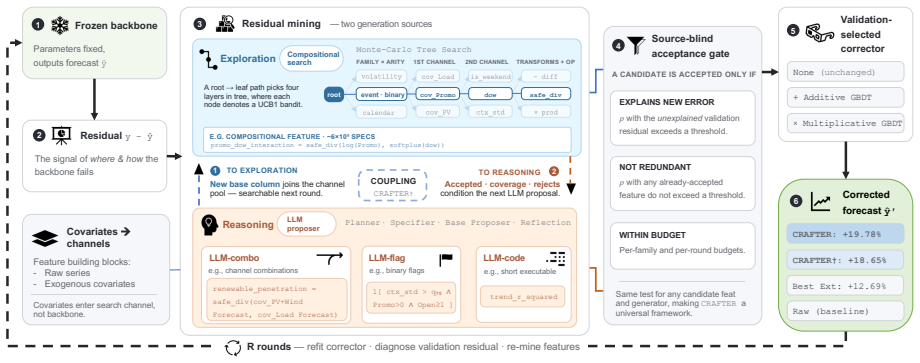
The load-bearing mechanism is the source-blind acceptance gate. A candidate feature is accepted only if its Spearman correlation with the still-unexplained validation residual exceeds a fixed threshold τ=0.05, if it is not collinear (|ρ|≤0.75) with an already-accepted feature, and if per-family and per-round budgets hold. Because the same test applies to every candidate regardless of which generator produced it, the gate makes the two generators commensurable and also turns the pipeline into an instrument: external feature-engineering systems run through the identical gate, corrector, and budget, so forecast differences are attributable to the feature source alone. A validation-selected corrector (identity, additive, or multiplicative gradient-boosted trees) then applies the survivors or leaves the forecast unchanged.
What would settle it
Re-run the exact harness on a seventh public dataset with a frozen backbone and an abrupt regime shift between the validation window and the test window: if CRAFTER's test wMAPE is worse than the uncorrected backbone on a substantial share of cells, or if at any feature budget K an external generator beats it, the empirical headline fails. Concretely, find one (dataset, backbone, K) cell where CRAFTER loses to the best external system under the shared gate.
Extended reading notes
Core claim
On the paper's own terms, the discovery is that a frozen forecaster's residual contains exploitable, model-specific structure that can be mined as interpretable features, and that mining it with two heterogeneous generators—a compositional Monte-Carlo tree search over raw channels and an LLM proposing named combinations, flags, and code—through a single source-blind gate produces consistent gains. Across the 6×6 grid of datasets and backbones, CRAFTER surpasses every dedicated feature-engineering system at every feature budget, roughly doubling the improvement of the corrector alone and reducing the error of the weakest backbones by up to 27%. The gain is governed by residual headroom: it is large on weak backbones with informative forecast covariates, where LLM-named features are the differentiator, and neutral or harmful once a strong backbone saturates the series.
Load-bearing premise
The load-bearing assumption is that features accepted because they correlate with the validation residual, and correctors chosen by validation wMAPE, keep helping on later, out-of-sample test windows; the paper itself flags that the validation gate is a safeguard, not a test guarantee.
Editorial extensions
If this is right
- If the headroom condition holds generally, the deployment rule is to apply corrective feature discovery only when validation residuals remain structured; a larger feature budget amplifies but does not create gains.
- The source-blind pipeline doubles as an evaluation instrument, so any future feature generator can be tested under identical conditions and its contribution attributed to the feature source alone.
- Gains persist when the corrected backbone is fine-tuned rather than used zero-shot, so corrective features act as a deployment-time layer that survives backbone adaptation.
- Features learned on one backtest window transfer to later windows with mild decay, supporting a lightweight feature-memory that amortizes search across time.
- Weak backbones benefit most, suggesting corrective features as a cheap alternative to per-series fine-tuning in large-scale frozen-model deployments.
Reading between the lines
- The headroom rule implies a practical diagnostic: measuring the correlation between a frozen backbone's validation residual and available covariates could predict in advance whether correction will pay, without running the full pipeline.
- The gate's blindness to source suggests it could be repurposed as an audit tool for LLM-proposed features in other domains, separating whether a gain comes from feature semantics or from the proposer's priors.
- The finding that LLM-code features are almost always pruned hints that executable-code proposals are a weak lever in this setting; a testable extension would be to restrict proposers to named combinations and flags to reduce variance.
- A natural stress test the paper does not run is a dataset where the residual structure shifts abruptly between validation and test windows, directly probing the weakest assumption about validation-time safeguards.
Editorial analysis
A structured set of objections, weighed in public.
Referee Report
Summary. The paper studies corrective feature discovery for frozen black-box forecasters: rather than fine-tuning the backbone, CRAFTER mines interpretable features of the backbone's residual and fits a lightweight post-hoc corrector. Two candidate generators are used, a compositional Monte-Carlo tree search over raw channels and an LLM that proposes named feature combinations, flags, and code. A source-blind validation-grounded gate accepts or rejects candidates based on Spearman correlation with the unexplained validation residual, and a validation-selected corrector (identity, additive GBDT, or multiplicative GBDT) produces the final forecast. The method is evaluated on six public datasets and six frozen backbone families under a rolling-origin three-split multi-seed protocol, with three external feature-engineering systems run inside the same harness. The paper claims that CRAFTER surpasses every dedicated feature-engineering system at every feature budget, roughly doubles the corrector-only improvement, and that gains concentrate where residual headroom is large while being neutral or harmful in saturated cells.
Significance. If the headline results hold, the paper makes a useful contribution: a source-agnostic, validation-grounded pipeline for residual correction, coupled with an explicit characterization of when correction helps, would be valuable for deploying frozen forecasters. The strengths of the manuscript include the careful rolling-origin protocol, the use of one shared harness for all feature generators, the honest reporting of negative and saturated cells, detailed appendices (feature grammar, prompts, per-cell tables), and the explicit acknowledgment that the validation gate is not a test guarantee. The central claim is plausible and the empirical evidence is substantial, but the abstract's 'surpasses every system at every feature budget' statement goes beyond what the per-cell results support, and the validation-to-test transfer risk is not quantified to the standard the headline requires.
major comments (2)
- [Abstract, §5.1, Table S11] The claim that CRAFTER 'surpasses every dedicated feature-engineering system at every feature budget' is supported only as a mean over cells, not as a per-cell statement. Table S11 shows that at K=5 CRAFTER beats the best external system in only 60% of the 30 cells, and at K=10/20/50 the win rate is 73%, with mean differences of -0.020 to -0.039 wMAPE. Per-cell regressions exist in Table S12, e.g. BIZITOBS/Chronos goes from RAW 24.6 to CRAFTER 31.4 (GPT-5.2), and several FAVORITA and M5 cells are at or above RAW. The abstract and Section 5.1 should state that the advantage is an aggregate mean over cells and that negative cells occur; as written, the headline overclaims.
- [§3.4, §3.3, App. D] The load-bearing assumption that validation-selected features and correctors transfer to later test windows is explicitly disclaimed in §3.4: the gate is 'a validation-time safeguard, not a test guarantee.' This is not merely a cosmetic caveat. App. D reports that split variance dominates for CRAFTER (median split-std ~3.2 versus seed-std 0.49), so with only three rolling splits the reported means can be driven by favorable windows. In addition, the fixed threshold tau=0.05 in §3.3 is a low absolute correlation on validation residual, and the paper does not report the number of candidates tested per cell or any multiple-testing control, leaving the rate of spuriously accepted features unquantified. The empirical headline would be much more convincing with per-split, per-cell ranges and an analysis of gate false discoveries under validation-to-test shift.
minor comments (5)
- [Table S11] The label '30 GPT-5.2 cells' is inconsistent with the 6×6=36-cell main grid; please clarify whether the Chronos-2 single-seed rows are excluded from the budget sweep and why.
- [Figure 2] In Figure 2a the legend appears to list 'CRAFTER' twice without clearly distinguishing the dagger variants; please fix the legend rendering.
- [App. D, Table S13] App. D states that seed-std is quantified on the DeepSeek grid, while Table S13's caption says the reproduction is single-seed; please clarify the seeding actually used for the DeepSeek runs.
- [Abstract] The phrase 'roughly doubling the improvement achieved by the corrector alone' should define what 'the corrector alone' refers to (COV? a corrector with no accepted features?) at first use, since the corrector set includes an identity option.
- [§4, App. E] The statement in §4 that the comparison is 'fair by construction' is too strong: the external systems are run inside the CRAFTER harness with their native selection mechanisms replaced by the shared gate, so what is measured is each generator under CRAFTER's selection rule, not the external system as originally designed. App. E acknowledges this, but the main-text phrasing should be softened.
Circularity Check
No significant circularity. The headline gains are out-of-sample benchmarks against external systems; the validation-grounded gate is the method's stated objective, and the paper explicitly disclaims it as a test guarantee.
full rationale
The paper's load-bearing claims are empirical, not derived from fitted constants. The headline - test wMAPE across six public datasets and six frozen backbones, versus external systems TSFRESH, CAAFE, and LLM-FE run inside the same harness - is an out-of-sample benchmark, and the comparison is explicitly designed so that only the feature generator differs (Sec. 4). The only self-referential element is the admission rule itself (Sec. 3.3): candidates are kept only if their Spearman correlation with the unexplained validation residual exceeds tau=0.05, and the corrector ships only if validation wMAPE improves. This makes the validation-time statement 'correction helps where the validation residual is structured' partly true by construction, but the paper's claims are test-time, and the paper explicitly disclaims the validation-to-test link: 'This is a validation-time safeguard, not a test guarantee: under rolling-origin shift a low-headroom cell can still regress out-of-sample (e.g., BIZITOBS/Chronos, Sec. 5.1)' (Sec. 3.4). Consistent with that disclaimer, the per-cell grid (Table S12) shows genuine test-time failures on saturated cells (BIZITOBS/Chronos: 24.6 RAW to 31.4 CRAFTER; several FAVORITA and M5 cells at or below RAW), so the test-time gain is not forced. The feature-transfer experiment (Sec. 5.5) is a true out-of-sample replay - accepted features carried to a later split with the LLM and search off - and it reports its own catastrophic-transfer corner (Moirai/EPF) rather than hiding it. The only self-citation is He et al. (2025) in Related Work, a decorative grouping with LoRA-style adapters that carries no load-bearing argument; all backbones, datasets, and baselines are external, and no uniqueness theorem is imported. Robustness claims are appropriately hedged (Table 1 shows backend-dependent per-cell increments), and the paper's own limitation passages - split variance dominating seed variance (App. D: median split-std ~3.2 vs seed-std 0.49) and the 60% win rate at K=5 (Table S11) - are statistical-risk admissions, not evidence of circularity. No prediction in the paper reduces by construction to its inputs; the headroom characterization is measured at test time and explicitly disclaimed as a guarantee.
Assumptions & free parameters
free parameters (4)
- Validation acceptance threshold tau =
0.05 (global, fixed)
- Corrector clip bounds =
[0.3, 3.0]
- GBDT corrector configuration =
200 trees, depth 4, lr 0.1, min-samples-leaf 20
- Gate and search loop hyperparameters =
kappa=1.4, alpha=0.4, beta=0.3, gamma=0.3, R=3 rounds, K=4 planner directions, budgets 2 per family and 10 per round…
assumptions (5)
- domain assumption Validation-selected features and correctors generalize to test windows under rolling-origin shift
- domain assumption External feature-engineering systems are fairly represented by running them as generators inside CRAFTER's harness
- domain assumption LLM proposals, conditioned on residual diagnostics, provide semantically useful features beyond syntactic search
- domain assumption GBDT can fit the residual correction well enough for the gate to measure feature value
- domain assumption Public datasets and six backbones are representative of deployment regimes for corrective features
Cite this review
Pith. "Pith review of When Do Corrective Features Help? An Agent for Corrective Feature Discovery on Black-Box Forecasters." pith.science (2026). https://pith.science/paper/5XQHIXFD
@misc{pith2026260805207,
  author       = {Pith},
  title        = {Pith review of: When Do Corrective Features Help? An Agent for Corrective Feature Discovery on Black-Box Forecasters},
  year         = {2026},
  howpublished = {\url{https://pith.science/paper/5XQHIXFD}},
  note         = {Machine review of arXiv:2608.05207}
}
read the original abstract
Frozen pretrained forecasters often fail in structured, recurring ways that are costly to repair through fine-tuning. We study corrective feature discovery: mining interpretable features of a frozen forecaster's residual to drive a lightweight post-hoc corrector. Prior automated feature engineering models the data-generating process; corrective features instead model the model-failure process. We present CRAFTER (Corrective Residual Agent with Feature-based Temporal Exploration and Reasoning), which keeps the backbone frozen and mines its residual with two complementary generators: a compositional search over the raw input channels, and a large language model (LLM) that proposes named feature combinations, binary flags, and short executable code. A single validation-grounded gate accepts or rejects every candidate regardless of its origin, and a validation-selected corrector applies the accepted features or leaves the forecast unchanged. This source-agnostic pipeline also allows prior feature-engineering systems to be evaluated under identical conditions, making CRAFTER an instrument for attributing forecast improvements to the feature source alone. Across six public datasets and six frozen backbones, CRAFTER surpasses every dedicated feature-engineering system at every feature budget, roughly doubling the improvement achieved by the corrector alone and reducing the error of the weakest backbones by up to 27%. These gains are robust across different LLM backends and persist even when applied on top of fine-tuned backbones.
Figures


Reference graph
Works this paper leans on
-
[1]
VEST: Automatic Feature Engineering for Forecasting
VEST: Automatic Feature Engineering for Forecasting , author=. arXiv preprint arXiv:2010.07137 , year=
work page Pith review arXiv 2010
-
[2]
Autofits: Automated Feature Engineering for Irregular Time-Series , author=
-
[3]
arXiv preprint arXiv:2305.03403 , year=
Large Language Models for Automated Data Science: Introducing CAAFE for Context-Aware Automated Feature Engineering , author=. arXiv preprint arXiv:2305.03403 , year=
-
[4]
arXiv preprint arXiv:2406.08527 , year=
Optimized Feature Generation for Tabular Data via LLMs with Decision Tree Reasoning , author=. arXiv preprint arXiv:2406.08527 , year=
-
[5]
arXiv preprint arXiv:2503.14434 , year=
LLM-FE: Automated Feature Engineering for Tabular Data with LLMs as Evolutionary Optimizers , author=. arXiv preprint arXiv:2503.14434 , year=
-
[6]
Counterfactual Explanations for Time Series Forecasting
Counterfactual Explanations for Time Series Forecasting , author=. arXiv preprint arXiv:2310.08137 , year=
-
[7]
Surrogate Modeling for Explainable Predictive Time Series Corrections
Surrogate Modeling for Explainable Predictive Time Series Corrections , author=. arXiv preprint arXiv:2412.19897 , year=
-
[8]
ELATE: Evolutionary Language model for Automated Time-series Engineering
ELATE: Evolutionary Language model for Automated Time-series Engineering , author=. arXiv preprint arXiv:2508.14667 , year=
Show all 38 references
-
[9]
Proceedings of the 41st International Conference on Machine Learning , pages=
Timer: generative pre-trained transformers are large time series models , author=. Proceedings of the 41st International Conference on Machine Learning , pages=
-
[10]
Transactions on Machine Learning Research , issn=
Chronos: Learning the Language of Time Series , author=. Transactions on Machine Learning Research , issn=. 2024 , url=
2024
- [11]
-
[12]
arXiv preprint arXiv:2511.11698 , year=
Moirai 2.0: When less is more for time series forecasting , author=. arXiv preprint arXiv:2511.11698 , year=
-
[13]
Machine Learning , volume=
Finite-time Analysis of the Multiarmed Bandit Problem , author=. Machine Learning , volume=. 2002 , publisher=
2002
-
[14]
Machine Learning: ECML 2006 , pages=
Bandit Based Monte-Carlo Planning , author=. Machine Learning: ECML 2006 , pages=. 2006 , publisher=
2006
-
[15]
A general reinforcement learning algorithm that masters chess, shogi, and
Silver, David and Hubert, Thomas and Schrittwieser, Julian and Antonoglou, Ioannis and Lai, Matthew and Guez, Arthur and Lanctot, Marc and Sifre, Laurent and Kumaran, Dharshan and Graepel, Thore and Lillicrap, Timothy and Simonyan, Karen and Hassabis, Demis , journal=. A gener...
2018
-
[16]
Zhang, Tianping and Zhang, Zheyu and Fan, Zhiyuan and Luo, Haoyan and Liu, Fengyuan and Liu, Qian and Cao, Wei and Li, Jian , journal=
-
[17]
, journal=
Christ, Maximilian and Braun, Nils and Neuffer, Julius and Kempa-Liehr, Andreas W. , journal=. Time Series. 2018 , publisher=
2018
-
[18]
Proceedings of the AAAI Conference on Artificial Intelligence , volume=
Feature Engineering for Predictive Modeling using Reinforcement Learning , author=. Proceedings of the AAAI Conference on Artificial Intelligence , volume=
-
[19]
Automatic Feature Engineering Through
Huang, Yiran and Zhou, Yexu and Hefenbrock, Michael and Riedel, Till and Fang, Likun and Beigl, Michael , booktitle=. Automatic Feature Engineering Through. 2022 , publisher=
2022
-
[20]
, journal=
Liu, Fengze and Wang, Haoyu and Cho, Joonhyuk and Roth, Dan and Lo, Andrew W. , journal=
-
[21]
Peter , journal=
Zhang, G. Peter , journal=. Time series forecasting using a hybrid. 2003 , publisher=
2003
-
[22]
Shchur, Oleksandr and Turkmen, Ali Caner and Erickson, Nick and Shen, Huibin and Shirkov, Alexander and Hu, Tony and Wang, Bernie , booktitle=
-
[23]
arXiv preprint arXiv:2505.15354 , year=
Post-Training Corrections for Improved Time-Series Forecasting , author=. arXiv preprint arXiv:2505.15354 , year=
-
[24]
arXiv preprint arXiv:2601.20280 , year=
The Forecast After the Forecast: A Post-Processing Shift in Time Series , author=. arXiv preprint arXiv:2601.20280 , year=
-
[25]
Sisuo Lyu and Siru Zhong and Tiegang Chen and Weilin Ruan and Qingxiang Liu and Taiqiang Lv and Qingsong Wen and Raymond Chi-Wing Wong and Yuxuan Liang , journal=
-
[26]
arXiv preprint arXiv:2606.14222 , year=
Learning the Context of Errors: Black-Box Online Adaptation of Time Series Foundation Models , author=. arXiv preprint arXiv:2606.14222 , year=
-
[27]
Ziming Dai and Dabiao Ma and Jinle Tong and Mengyuan Han and Jian Yang and Hongtao Liu and Haojun Fei and Qing Yang , journal=
-
[28]
Proceedings of the 41st International Conference on Machine Learning (ICML) , year=
Unified Training of Universal Time Series Forecasting Transformers , author=. Proceedings of the 41st International Conference on Machine Learning (ICML) , year=
-
[29]
arXiv preprint arXiv:2407.07874 , year=
Toto: Time Series Optimized Transformer for Observability , author=. arXiv preprint arXiv:2407.07874 , year=
-
[30]
Applied Energy , volume =
Forecasting day-ahead electricity prices: A review of state-of-the-art algorithms, best practices and an open-access benchmark , author =. Applied Energy , volume =. 2021 , doi =
2021
-
[31]
International Journal of Forecasting , volume =
M5 accuracy competition: Results, findings, and conclusions , author =. International Journal of Forecasting , volume =. 2022 , doi =
2022
-
[32]
Proceedings of the AAAI Conference on Artificial Intelligence , volume =
AutoMixer for Improved Multivariate Time-Series Forecasting on Business and IT Observability Data , author =. Proceedings of the AAAI Conference on Artificial Intelligence , volume =. 2024 , doi =
2024
-
[33]
Rossmann Store Sales , year =
-
[34]
2017 , howpublished =
Corporaci. 2017 , howpublished =
2017
-
[35]
Rohlik Sales Forecasting Challenge , year =
-
[36]
2025 , eprint=
Can Molecular Foundation Models Know What They Don't Know? A Simple Remedy with Preference Optimization , author=. 2025 , eprint=
2025
-
[37]
2021 , eprint=
LoRA: Low-Rank Adaptation of Large Language Models , author=. 2021 , eprint=
2021
-
[38]
2019 , eprint=
Parameter-Efficient Transfer Learning for NLP , author=. 2019 , eprint=
2019
Reviewed August 8, 2026 · model on record in the stance chip above.
Discussion (0). Continue with ORCID to comment.