REVIEW 4 major objections 5 minor 58 references
Towards Expressive and Faithful Audio-to-Image Generation: A Unified Multimodal Dataset and Synthesis Framework
T0 review · 4 major / 5 minor · reviewed 2026-08-11 · deepseek-v4-flash
Pith's one-line read A 323K-pair dataset, two-thirds synthetic, plus a small FiLM audio adapter on a frozen diffusion backbone, makes audio-to-image generation more expressive and better aligned than prior systems.
desk verdict The A2I-Set dataset is a genuinely useful resource and the pipeline write-up is thorough, but the paper's 'faithful and generally outperforming' model claim is not yet supported by its evaluation, which leans too heavily on the same synthetic pipeline and weak FID references. read the letter →
The pith
A machine-rendered reading of the paper's core claim, the machinery that carries it, and where it could break.
The reading
What carries the argument
Two mechanisms carry the argument. The first is the A2I-Set synthesis pipeline, a staged assembly line in which an audio-image pair is admitted only if it survives an object-level alignment check: every sound-emitting object named in the caption must be separable from the audio by Sam Audio, confirmed audible by RMS energy detection, and locatable in the image by visual grounding with Qwen3-VL-Flash and Grounding DINO. The second is FiLM-weighted Audio-Text Fusion (FAT-Fusion), an added cross-attention block in each UNet layer that computes a text representation and an audio representation separately with a shared query, then modulates each branch by channel-wise scale-and-shift parameters $(\gamma, \beta)$ learned from the branch itself and blends them with a fixed weight of $\alpha = 0.5$; with the text input kept empty, the audio branch alone drives generation. This lets a frozen Stable Diffusion v1.4 backbone be conditioned purely on audio, with only the audio projector and fusion modules trainable.
What would settle it
Audit a random sample of synthetic A2I-Set pairs: have annotators listen to each audio clip with the image hidden, list the objects they can confidently infer from the sound alone, and count how many of the image's main-subject objects were not inferable; if a substantial fraction of pairs fail, the faithfulness premise is broken. The companion control is to generate images with AudioCanvas and with the same frozen backbone conditioned only on the visual-generation instruction text, with audio dropped: if the audio-conditioned outputs are indistinguishable from the instruction-only outputs under AIS and TIS, the reported cross-modal alignment lives in the LLM-written instruction rather than in the audio adapter.
Extended reading notes
Core claim
The paper's central claim is that audio-to-image generation can be made expressive and faithful at the same time by replacing low-quality, misaligned audio-image pairs with a large, clean tri-modal dataset and fine-tuning a strong text-to-image model with a dedicated audio-conditioning path. A2I-Set is assembled through a four-stage pipeline: vision-enhanced audio captioning, in which audio and video captions are fused by an LLM and filtered by CLAP similarity; real image extraction, which keeps only high-resolution, low-jitter, quality-scored frames; synthetic image generation, in which GPT-4o-mini rewrites each audio caption into a visual generation instruction, FLUX.1-Krea-dev renders it, and two large vision-language models reject any image that does not look like a real photograph (a 10–20% pass rate); and an object-level alignment filter, in which Sam Audio separates each sound-emitting object from the audio, RMS energy confirms it is audible, and Qwen3-VL-Flash and Grounding DINO verify it is visible in the image. The resulting model, AudioCanvas, projects multi-level CLAP features into CLIP space with a learnable-query audio projector trained by MSE and InfoNCE losses, then feeds the projection through a decoupled cross-attention layer in each UNet block, where a FiLM gate blends it with the empty text branch. In the paper's comparison, AudioCanvas takes first or second place on most metrics in the 3,280-pair A2I-eval set, including the best IS, aesthetic, HPSv3, AIS, and TIS scores, and the best aesthetic and HPSv3 scores on the external Landscape set.
Load-bearing premise
The load-bearing premise is that the caption-to-instruction stage — GPT-4o-mini rewriting an audio caption into a detailed visual generation instruction — adds only visual details that the audio genuinely implies; if the LLM invents scene content, the synthetic half of A2I-Set encodes spurious associations and the model's faithfulness is really text-to-image generation from hallucinated captions, since the alignment filter verifies object tokens but not overall scene semantics.
Editorial extensions
If this is right
- If the central claim holds, data quality — not generative architecture — is the main lever in audio-to-image generation, so future systems can keep a frozen text-to-image backbone and spend their effort on curation and alignment filtering.
- The object-level alignment recipe (audio separation plus visual grounding) transfers directly to auditing and cleaning other audio-visual datasets, including video-derived pairs that currently leak misaligned frames.
- A2I-Set's 241 classes, its balanced 10K subset, and the 3,280-pair A2I-eval benchmark give later work a common training set and a standard mixed-source test set for A2I and related audio-visual tasks.
- The model learns multi-source audio without any explicit decomposition module, supporting the paper's claim that large amounts of mixed-source pairs are enough for the alignment to be learned implicitly.
Reading between the lines
- Editorial inference: the faithfulness claim has an unmeasured ceiling — the caption-transfer prompt explicitly permits GPT-4o-mini to expand the audio caption with potential visual descriptions, and the alignment filter checks object tokens rather than overall scene semantics, so a human audit counting scene elements not inferable from the audio alone would quantify the genuinely audio-grounded fr
- Editorial inference: the ablations compare data splits but never run an instruction-only control, so a decisive attribution test would be to fine-tune the same frozen backbone on the visual-generation instructions alone (audio dropped) and compare AIS and TIS; if indistinguishable, the reported cross-modal gain sits in the LLM-written instruction rather than the audio adapter.
- Editorial inference: because the filtering stage rejects every image that does not look like a real photograph, the pipeline is structurally biased toward photorealistic scenes; an artistic or stylized audio-to-image version would require relaxing or replacing that filter.
- Editorial inference: the alignment filter already produces structured object boxes for each sounding object, so A2I-Set could double as weak supervision for sound-source localization and audio-visual grounding — applications the paper does not claim.
Editorial analysis
A structured set of objections, weighed in public.
Referee Report
Summary. The paper presents A2I-Set, a new audio-image-text dataset of about 323K tri-modal samples built from AudioSet and VGGSound, where roughly 60% of images are synthesized with FLUX.1-Krea-dev from LLM-generated visual instructions and the rest are real video frames selected by a multi-stage filtering pipeline. The authors also propose AudioCanvas, which injects CLAP audio features into a frozen Stable Diffusion 1.4 backbone through a pre-aligned audio projector and a FiLM-weighted dual cross-attention fusion, and evaluate it on a hand-checked internal test set (A2I-eval) plus the external Landscape set. The central claim is that AudioCanvas, trained on A2I-Set, achieves state-of-the-art or competitive results on visual expressiveness and cross-modal alignment.
Significance. If the dataset and model claims hold, the contribution is potentially significant: a large, open, fine-grained audio-image dataset with a documented construction pipeline, a lightweight adapter for audio-to-image generation that avoids retraining the diffusion backbone, and a new human-checked test set for the community. The dataset construction is described with unusual detail, and the appendix provides abundant examples and failure-case analysis. The paper also ships code and dataset links, which is a practical strength. The main significance is therefore conditional on whether the dataset's audio-image entailment and the evaluation metrics actually support the 'faithful' and 'generally outperforming' claims, which is not fully established in the current manuscript.
major comments (4)
- [§3.3, Fig. 10, §3.4] The synthetic-image pipeline lets GPT-4o-mini expand an audio caption into a 'Visual Generation Instruction' that may add scene elements not entailed by the audio. Since the LLM receives only text, it cannot verify audio-grounding. For example, Figure 1 shows that an audio implying a female vocalist and acoustic guitar was rendered with 'vintage microphone', 'warm lighting', and 'small stage'—plausible but not implied. The §3.4 alignment filter only checks that annotated sounding objects appear in the image via object-level grounding; it does not verify that added visual elements are semantically entailed by the audio. If such additions are systematic, A2I-Set encodes spurious audio-image associations, undermining the 'faithful' claim and the validity of training and evaluation. I ask the authors to quantify this risk, e.g., by a human-verification study on a random subset testing whether the visual instruction is strictly implied by the audio alone, and by publishing the filter pass rates or a manual audit of unverifiable details.
- [§5.2, Appendix B] FID is computed against the precomputed distribution of ImageNet rather than against real evaluation images. This makes the FID values in Tables 1 and 2 dependent on the relationship between each model's output distribution and ImageNet, not on fidelity to the actual test domain. Since A2I-Set is trained on FLUX-synthesized realistic images, such a reference may bias FID in favor of the proposed method. Please report FID computed with real images from A2I-eval (or another relevant real-image set) as the reference distribution, or justify the ImageNet reference with additional evidence that it does not change the conclusions.
- [§4.2 Eq. (3), §5.2 TIS] The audio projector is trained with an MSE loss that pulls audio features toward CLIP text embeddings of the form 'An image of <object1> and <object2>...', and the TIS metric measures CLIP similarity between generated images and the same type of text labels. Consequently, TIS is partially aligned with the pre-alignment training objective of AudioCanvas, giving it an inherent advantage over baselines that do not use this textual pre-alignment. To strengthen the cross-modal alignment claim, please either use a held-out alignment metric not optimized during training, or show that the TIS advantage persists when the text encoder or the prompt template is changed.
- [§3.5, §6, Tables 1–2] A2I-eval is drawn from the same data construction pipeline as the training set. While Section 6 openly acknowledges this, the results in Table 1 can still largely reflect the model's ability to reproduce the pipeline's visual prior rather than genuine audio-to-image faithfulness. The external Landscape set in Table 2 is a useful check but covers only nine single-source natural-sound categories, not the 241-class mixed-source setting claimed in the paper. Please add a broader external evaluation (e.g., on VGGSounder or a human-rated held-out audio-image set) or a human study that probes whether the generated images' added details are actually implied by the audio for a diverse sample.
minor comments (5)
- [Abstract] The phrase 'generally outperforming existing approaches' should be 'generally outperforms existing approaches' for grammatical correctness.
- [§3.5] Figure references 'fig. 3', 'fig. 4', 'fig. 5' are inconsistently capitalized; use 'Fig. 3' etc. for consistency with the rest of the manuscript.
- [Equation (2)] The InfoNCE loss as written omits the positive-pair term from the denominator; the standard form includes exp(sim(a_i, pos)) in the sum. Please correct the equation or clarify the notation, and specify the temperature.
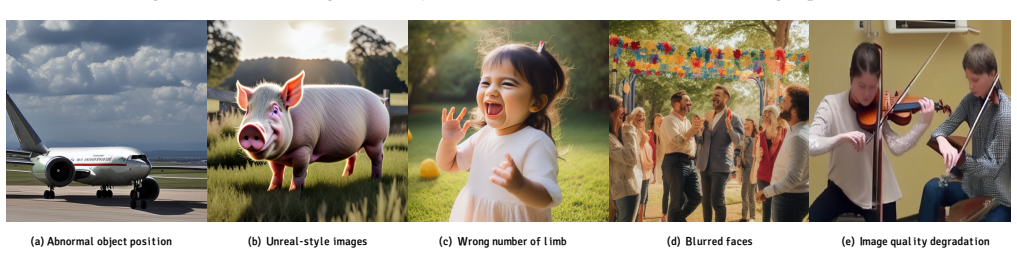
- [Appendix F] The final paragraph of Appendix F appears truncated: after the heading '(c) Wrong number of limb' the text jumps directly to 'Overall, although limited by a relative weak backbone model...'—the missing discussion of that failure case should be restored.
- [Figure 2] The pipeline diagram in Figure 2 is extremely dense and hard to read at page size; consider splitting it into two figures or enlarging the font for the final version.
Circularity Check
TIS evaluation is partly aligned with the audio projector's training target; otherwise the empirical pipeline is largely self-contained.
-
fitted input called prediction
[Section 4.2, Eq. (3); Section 5.2, TIS metric definition]
""Thanks to the object elements corresponding to the audio in our annotations, we directly use 'An image of <object1> and <object2> ... ' as the input to CLIP." ... "LMSE = ||a_i - t_i||^2_2." ... "we directly measure the similarity between the generated image and the ground truth labels with CLIP, namely Text-Image Similarity (TIS).""
The pre-alignment objective trains the audio projector to minimize the MSE between the audio feature a_i and t_i, the CLIP text embedding of the object-label template. The TIS metric then scores generated images by CLIP similarity to the same ground-truth-label CLIP text embedding t_i. Since the diffusion model is conditioned on the projected audio feature that was explicitly fitted to t_i, TIS partly measures how well the model reproduces its own training target rather than an independent audio-to-image alignment. This portion of the reported cross-modal alignment evidence is thus partially forced by the training objective. Other metrics (AIS via Wav2CLIP, FID, IS, Aes, HPSv3) are not tied to this training target, so the circularity is partial.
full rationale
The central claim is empirical: a dataset is built with an external pipeline (FLUX.1-Krea-dev, GPT-4o-mini, CLAP, Qwen, Grounding DINO, etc.) and a model is trained with the standard SD denoising objective. I find no load-bearing self-citation or imported uniqueness theorem; the authors' citations to their own prior work ([10,20,25,37,39,51,52,54]) are contextual and do not justify the core method or forbid alternatives. The paper itself acknowledges in Section 6 that "A2I-eval, which shares the same source data with our training data. This may bring potential impact on evaluation fairness." That is an evaluation-leakage concern rather than a circular derivation, but it does weaken the generalization claim. The one concrete reduction is the TIS metric: Eq. (3) fits audio features to the same CLIP label-text embeddings that TIS later compares against, so part of the alignment score is aligned with the training objective by construction. Since the paper also relies on AIS, human-preference scores, and the external Landscape set, and since the visual-quality metrics are independent, the overall circularity is moderate rather than total.
Assumptions & free parameters
free parameters (5)
- CLAP caption-filter thresholds =
0.4 for AudioSet-derived data, 0.3 for VGGSound-derived data
- FiLM fusion balance alpha =
0.5
- InfoNCE loss weight =
0.2
- Visual quality and grounding thresholds =
ARNIQA >= 0.4; Ground DINO BOX_THRESHOLD and TEXT_THRESHOLD = 0.3
- Audio dropout probability =
0.1
assumptions (7)
- domain assumption CLAP cosine similarity is a valid measure of audio-caption semantic alignment
- domain assumption Sam Audio separation plus RMS energy correctly establishes the presence of an object in audio
- domain assumption Visual grounding models correctly determine object existence in images
- domain assumption GPT-4o-mini caption fusion and instruction transfer preserves audio semantics and avoids hallucination
- domain assumption VLM 'real photo' judgment is a reliable proxy for image quality and realism
- domain assumption Wav2CLIP and CLIP similarities measure audio-image and text-image alignment respectively
- standard math Standard diffusion and cross-attention training assumptions for a frozen SD1.4 backbone
Cite this review
Pith. "Pith review of Towards Expressive and Faithful Audio-to-Image Generation: A Unified Multimodal Dataset and Synthesis Framework." pith.science (2026). https://pith.science/paper/5XUYO6BU
@misc{pith2026260809529,
  author       = {Pith},
  title        = {Pith review of: Towards Expressive and Faithful Audio-to-Image Generation: A Unified Multimodal Dataset and Synthesis Framework},
  year         = {2026},
  howpublished = {\url{https://pith.science/paper/5XUYO6BU}},
  note         = {Machine review of arXiv:2608.09529}
}
read the original abstract
As an important subfield of cross-modal generation, synthesizing static visual content in the form of images from audio, namely audio-to-image (A2I) generation, has attracted increasing research attention in recent years. Nevertheless, despite the remarkable visual quality of modern text-to-image (T2I) models, the performance of A2I remains fundamentally limited by traditional datasets, which often lack both high-fidelity images and precise cross-modal alignment. As a result, existing methods still struggle to achieve high-quality audio-to-image generation through finetuning strong T2I models, thereby constraining practical applications in this area. Motivated by this gap, we introduce A2I-Set, a unified, high-quality tri-modal dataset consisting of 323K paired audio, images, and detailed text captions, specifically designed for audio-visual research, including audio-conditioned image generation. Besides, we developed a new mixed-source test set for the A2I task through human supervision. We further propose an A2I model, AudioCanvas, fine-tuned on our A2I-Set. Experiments show that AudioCanvas achieves more visually expressive as well as cross-modal alignment results that generally outperforming existing approaches. Our dataset and source code are available at https://github.com/gdx012/A2I-Generation.
Figures


Figures from the paper (11 more)




Reference graph
Works this paper leans on
-
[1]
Lorenzo Agnolucci, Leonardo Galteri, Marco Bertini, and Alberto Del Bimbo
-
[2]
Jean-Baptiste Alayrac, Adria Recasens, Rosalia Schneider, Relja Arandjelović, Jason Ramapuram, Jeffrey De Fauw, Lucas Smaira, Sander Dieleman, and Andrew Zisserman. 2020. Self-supervised multimodal versatile networks.Advances in neural information processing systems33 (2020), 25–37
2020
-
[3]
Shuai Bai, Yuxuan Cai, Ruizhe Chen, Keqin Chen, Xionghui Chen, Zesen Cheng, Lianghao Deng, Wei Ding, Chang Gao, Chunjiang Ge, et al . 2025. Qwen3-vl technical report.arXiv preprint arXiv:2511.21631(2025)
arXiv 2025
-
[4]
Burak Can Biner, Farrin Marouf Sofian, Umur Berkay Karakaş, Duygu Ceylan, Erkut Erdem, and Aykut Erdem. 2024. Sonicdiffusion: Audio-driven image genera- tion and editing with pretrained diffusion models.arXiv preprint arXiv:2405.00878 (2024)
arXiv 2024
-
[5]
Arantxa Casanova, Marlene Careil, Jakob Verbeek, Michal Drozdzal, and Adriana Romero Soriano. 2021. Instance-conditioned gan.Advances in Neural Information Processing Systems34 (2021), 27517–27529
work page 2021
-
[6]
Moitreya Chatterjee and Anoop Cherian. 2020. Sound2sight: Generating visual dynamics from sound and context. InEuropean Conference on Computer Vision. Springer, 701–719
work page 2020
-
[7]
Honglie Chen, Weidi Xie, Andrea Vedaldi, and Andrew Zisserman. 2020. Vg- gsound: A large-scale audio-visual dataset. InICASSP 2020-2020 IEEE International Conference on Acoustics, Speech and Signal Processing (ICASSP). IEEE, 721–725
2020
-
[8]
Jiuhai Chen, Zhiyang Xu, Xichen Pan, Yushi Hu, Can Qin, Tom Goldstein, Lifu Huang, Tianyi Zhou, Saining Xie, Silvio Savarese, et al. 2025. Blip3-o: A family of fully open unified multimodal models-architecture, training and dataset.arXiv preprint arXiv:2505.09568(2025)
arXiv 2025
Show all 58 references
-
[9]
Shunian Chen, Xinyuan Xie, Zheshu Chen, Liyan Zhao, Owen Lee, Zhan Su, Qilin Sun, and Benyou Wang. 2025. FusionAudio-1.2 M: Towards Fine-grained Audio Captioning with Multimodal Contextual Fusion.arXiv preprint arXiv:2506.01111 (2025)
2025 arXiv
-
[10]
Shihao Cheng, Jiaxu Zhang, Quanyue Song, Shansong Liu, Zhizhi Guo, Xiaolei Zhang, Chi Zhang, Xuelong Li, and Zhigang Tu. 2026. Unison: Harmoniz- ing Motion, Speech, and Sound for Human-Centric Audio-Video Generation. arXiv:2605.08729 [cs.CV] https://arxiv.org/abs/2605.08729
2026 arXiv
-
[11]
Yunfei Chu, Jin Xu, Qian Yang, Haojie Wei, Xipin Wei, Zhifang Guo, Yichong Leng, Yuanjun Lv, Jinzheng He, Junyang Lin, et al. 2024. Qwen2-audio technical report.arXiv preprint arXiv:2407.10759(2024)
2024 arXiv
-
[12]
Xiaoliang Dai, Ji Hou, Chih-Yao Ma, Sam Tsai, Jialiang Wang, Rui Wang, Peizhao Zhang, Simon Vandenhende, Xiaofang Wang, Abhimanyu Dubey, et al. 2023. Emu: Enhancing image generation models using photogenic needles in a haystack. arXiv preprint arXiv:2309.15807(2023)
2023 arXiv
-
[13]
Gunnar Farnebäck. 2003. Two-frame motion estimation based on polynomial expansion. InScandinavian conference on Image analysis. Springer, 363–370
2003
-
[14]
Jort F Gemmeke, Daniel PW Ellis, Dylan Freedman, Aren Jansen, Wade Lawrence, R Channing Moore, Manoj Plakal, and Marvin Ritter. 2017. Audio set: An ontology and human-labeled dataset for audio events. In2017 IEEE international conference on acoustics, speech and signal process...
2017
-
[15]
Rohit Girdhar, Alaaeldin El-Nouby, Zhuang Liu, Mannat Singh, Kalyan Vasudev Alwala, Armand Joulin, and Ishan Misra. 2023. Imagebind: One embedding space to bind them all. InProceedings of the IEEE/CVF conference on computer vision and pattern recognition. 15180–15190
2023
-
[16]
Tiancheng Gu, Kaicheng Yang, Chaoyi Zhang, Yin Xie, Xiang An, Ziyong Feng, Dongnan Liu, Weidong Cai, and Jiankang Deng. 2025. Realsyn: An effective and scalable multimodal interleaved document transformation paradigm. In Proceedings of the 33rd ACM International Conference on ...
2025
-
[17]
Martin Heusel, Hubert Ramsauer, Thomas Unterthiner, Bernhard Nessler, and Sepp Hochreiter. 2017. Gans trained by a two time-scale update rule converge to a local nash equilibrium.Advances in neural information processing systems30 (2017)
2017
-
[18]
Jonathan Ho, Ajay Jain, and Pieter Abbeel. 2020. Denoising diffusion probabilistic models.Advances in neural information processing systems33 (2020), 6840–6851
2020
-
[19]
Wenyi Hong, Wenmeng Yu, Xiaotao Gu, Guo Wang, Guobing Gan, Haomiao Tang, Jiale Cheng, Ji Qi, Junhui Ji, Lihang Pan, et al. 2025. Glm-4.5 v and glm-4.1 v-thinking: Towards versatile multimodal reasoning with scalable reinforcement learning.arXiv preprint arXiv:2507.01006(2025)
2025 arXiv
-
[20]
Zhihao Huang, Xi Qiu, Yukuo Ma, Yifu Zhou, Junjie Chen, Hongyuan Zhang, Chi Zhang, and Xuelong Li. 2026. NFIG: multi-scale autoregressive image generation via frequency ordering.Advances in Neural Information Processing Systems38 (2026), 25692–25714
2026
-
[21]
Sangwu Lee, Titus Ebbecke, Erwann Millon, Will Beddow, Le Zhuo, Iker García- Ferrero, Liam Esparraguera, Mihai Petrescu, Gian Saß, Gabriel Menezes, and Victor Perez. 2025. FLUX.1 Krea [dev]. https://github.com/krea-ai/flux-krea
2025
-
[22]
Seung Hyun Lee, Wonseok Roh, Wonmin Byeon, Sang Ho Yoon, Chanyoung Kim, Jinkyu Kim, and Sangpil Kim. 2022. Sound-guided semantic image manipu- lation. InProceedings of the IEEE/CVF conference on computer vision and pattern recognition. 3377–3386
2022
-
[23]
Ruilong Li, Shan Yang, David A Ross, and Angjoo Kanazawa. 2021. Ai choreog- rapher: Music conditioned 3d dance generation with aist++. InProceedings of the IEEE/CVF international conference on computer vision. 13401–13412
2021
-
[24]
Tingle Li, Yichen Liu, Andrew Owens, and Hang Zhao. 2022. Learning visual styles from audio-visual associations. InEuropean Conference on Computer Vision. Springer, 235–252
2022
-
[25]
Fan Liu, Cheng Gong, Boyu Zhu, Ruihao Jing, Chunyu Qiang, Tianrui Wang, Xiao-Lei Zhang, and Xuelong Li. 2025. Augment Mandarin to Cantonese Speech Databases via Retrieval-Augmented Generation and Speech Synthesis. InInter- speech 2025. 4248–4252. doi:10.21437/Interspeech.2025-737
2025 doi
-
[26]
Shansong Liu, Atin Sakkeer Hussain, Chenshuo Sun, and Ying Shan. 2024. Music understanding llama: Advancing text-to-music generation with question an- swering and captioning. InICASSP 2024-2024 IEEE International Conference on Acoustics, Speech and Signal Processing (ICASSP). ...
2024
-
[27]
Shilong Liu, Zhaoyang Zeng, Tianhe Ren, Feng Li, Hao Zhang, Jie Yang, Chunyuan Li, Jianwei Yang, Hang Su, Jun Zhu, et al . 2023. Grounding dino: Marrying dino with grounded pre-training for open-set object detection.arXiv preprint arXiv:2303.05499(2023)
2023 arXiv
-
[28]
Yuhang Ma, Xiaoshi Wu, Keqiang Sun, and Hongsheng Li. 2025. Hpsv3: To- wards wide-spectrum human preference score. InProceedings of the IEEE/CVF International Conference on Computer Vision. 15086–15095
2025
-
[29]
Andrew Owens, Phillip Isola, Josh McDermott, Antonio Torralba, Edward H Adelson, and William T Freeman. 2016. Visually indicated sounds. InProceedings of the IEEE conference on computer vision and pattern recognition. 2405–2413
2016
-
[30]
Ethan Perez, Florian Strub, Harm De Vries, Vincent Dumoulin, and Aaron Courville. 2018. Film: Visual reasoning with a general conditioning layer. In Proceedings of the AAAI conference on artificial intelligence, Vol. 32
2018
-
[31]
Can Qin, Ning Yu, Chen Xing, Shu Zhang, Zeyuan Chen, Stefano Ermon, Yun Fu, Caiming Xiong, and Ran Xu. 2023. Gluegen: Plug and play multi-modal encoders for x-to-image generation. InProceedings of the IEEE/CVF international conference on computer vision. 23085–23096
2023
-
[32]
Alec Radford, Jong Wook Kim, Chris Hallacy, Aditya Ramesh, Gabriel Goh, Sandhini Agarwal, Girish Sastry, Amanda Askell, Pamela Mishkin, Jack Clark, et al. 2021. Learning transferable visual models from natural language supervision. InInternational conference on machine learnin...
2021
-
[33]
Robin Rombach, Andreas Blattmann, Dominik Lorenz, Patrick Esser, and Björn Ommer. 2022. High-resolution image synthesis with latent diffusion models. In Proceedings of the IEEE/CVF conference on computer vision and pattern recognition. 10684–10695
2022
-
[34]
Andrew Rosenberg, Yu Zhang, Bhuvana Ramabhadran, Ye Jia, Pedro Moreno, Yonghui Wu, and Zelin Wu. 2019. Speech Recognition with Augmented Syn- thesized Speech. In2019 IEEE Automatic Speech Recognition and Understanding Workshop (ASRU). 996–1002. doi:10.1109/ASRU46091.2019.9003990
2019
-
[35]
Ludan Ruan, Yiyang Ma, Huan Yang, Huiguo He, Bei Liu, Jianlong Fu, Nicholas Jing Yuan, Qin Jin, and Baining Guo. 2023. Mm-diffusion: Learning multi-modal diffusion models for joint audio and video generation. InProceed- ings of the IEEE/CVF Conference on Computer Vision and Pa...
2023
-
[36]
Tim Salimans, Ian Goodfellow, Wojciech Zaremba, Vicki Cheung, Alec Radford, and Xi Chen. 2016. Improved techniques for training gans.Advances in neural information processing systems29 (2016)
2016
-
[37]
Jiawei Shao and Xuelong Li. 2025. Ai flow at the network edge.IEEE Network40, 1 (2025), 330–336
2025
-
[38]
Bowen Shi, Andros Tjandra, John Hoffman, Helin Wang, Yi-Chiao Wu, Luya Gao, Julius Richter, Matt Le, Apoorv Vyas, Sanyuan Chen, et al. 2025. Sam audio: Segment anything in audio.arXiv preprint arXiv:2512.18099(2025)
2025
-
[39]
Quanyue Song, Yishan He, Yanfei Zhang, Shihao Cheng, Zhixiang He, Zhizhi Guo, Chi Zhang, Xuelong Li, and Caigui Jiang. 2026. InteractiveAvatar: Real- Time Streaming Video Generation for Consistent and Intent-Aware Avatars. arXiv:2606.22905 [cs.CV] https://arxiv.org/abs/2606.22905
2026 arXiv
-
[40]
Tomáš Souček and Jakub Lokoč. 2020. TransNet V2: An effective deep network architecture for fast shot transition detection.arXiv preprint arXiv:2008.04838 (2020)
2020 arXiv
-
[41]
Kim Sung-Bin, Arda Senocak, Hyunwoo Ha, Andrew Owens, and Tae-Hyun Oh
-
[42]
Zineng Tang, Ziyi Yang, Chenguang Zhu, Michael Zeng, and Mohit Bansal. 2023. Any-to-any generation via composable diffusion.Advances in Neural Information Processing Systems36 (2023), 16083–16099
2023
-
[43]
Qwen Team. 2025. Qwen2.5-VL. https://qwenlm.github.io/blog/qwen2.5-vl/
2025
-
[44]
Mingjie Wang, Song Yuan, Xian-Feng Han, and Zili Yi. 2025. Draw What You Hear: High-Fidelity Image Generation and Manipulation via SoundAdapter.IEEE Transactions on Neural Networks and Learning Systems(2025). 10 Towards Expressive and Faithful Audio-to-Image Generation: A Unif...
2025
-
[45]
Ho-Hsiang Wu, Prem Seetharaman, Kundan Kumar, and Juan Pablo Bello. 2022. Wav2clip: Learning robust audio representations from clip. InICASSP 2022-2022 IEEE International Conference on Acoustics, Speech and Signal Processing (ICASSP). IEEE, 4563–4567
2022
-
[46]
Yusong Wu*, Ke Chen*, Tianyu Zhang*, Yuchen Hui*, Taylor Berg-Kirkpatrick, and Shlomo Dubnov. 2023. Large-scale Contrastive Language-Audio Pretraining with Feature Fusion and Keyword-to-Caption Augmentation. InIEEE International Conference on Acoustics, Speech and Signal Proce...
2023
-
[47]
Lin Xu, Yilin Zhao, Daquan Zhou, Zhijie Lin, See Kiong Ng, and Jiashi Feng. 2024. Pllava: Parameter-free llava extension from images to videos for video dense captioning.arXiv preprint arXiv:2404.16994(2024)
2024 arXiv
-
[48]
Guy Yariv, Itai Gat, Lior Wolf, Yossi Adi, and Idan Schwartz. 2023. Audiotoken: Adaptation of text-conditioned diffusion models for audio-to-image generation. arXiv preprint arXiv:2305.13050(2023)
2023 arXiv
-
[49]
Hu Ye, Jun Zhang, Sibo Liu, Xiao Han, and Wei Yang. 2023. Ip-adapter: Text compatible image prompt adapter for text-to-image diffusion models.arXiv preprint arXiv:2308.06721(2023)
2023 arXiv
-
[50]
Junyan Ye, Dongzhi Jiang, Zihao Wang, Leqi Zhu, Zhenghao Hu, Zilong Huang, Jun He, Zhiyuan Yan, Jinghua Yu, Hongsheng Li, et al. 2025. Echo-4o: Harnessing the power of gpt-4o synthetic images for improved image generation.arXiv preprint arXiv:2508.09987(2025)
2025 arXiv
-
[51]
Lei Zhao, Rujin Chen, Chi Zhang, Xiao-Lei Zhang, and Xuelong Li. 2025. Fo- leyspace: Vision-aligned binaural spatial audio generation.arXiv preprint arXiv:2508.12918(2025)
2025 arXiv
-
[52]
Lei Zhao, Linfeng Feng, Dongxu Ge, Fangqiu Yi, Chi Zhang, Xiao-Lei Zhang, and Xuelong Li. 2025. UniForm: A Unified Diffusion Transformer for Audio-Video Generation.arXiv e-prints(2025), arXiv–2502
2025
-
[53]
Hao Zhou, Xiaobao Guo, Yuzhe Zhu, and Adams Wai-Kin Kong. 2025. MACS: Multi-source Audio-to-image Generation with Contextual Significance and Se- mantic Alignment.arXiv preprint arXiv:2503.10287(2025)
2025
-
[54]
Ruishu Zhu, Zhihao Huang, Jiacheng Sun, Ping Luo, Hongyuan Zhang, and Xuelong Li. 2025. Viewmask-1-to-3: Multi-view consistent image generation via multimodal discrete diffusion models.arXiv preprint arXiv:2512.14099(2025)
2025 arXiv
-
[55]
silent frames
Daniil Zverev, Thaddäus Wiedemer, Ameya Prabhu, Matthias Bethge, Wieland Brendel, and A Koepke. 2025. Vggsounder: Audio-visual evaluations for founda- tion models. InProceedings of the IEEE/CVF International Conference on Computer Vision. 1027–1037. 11 MM ’26, November 10–14, ...
2025
-
[58]
the sound of a vehicle driving
Signal-to-Noise Ratio (SNR) filtering: we use short-time RMS energy to distinguish signal from noise, and adopt 1.5× median energy as the separation threshold between signal and noise to ensure audio clarity and eliminate samples with excessive noise. Given audio-video pairs, ...
2026
-
[2023]
In Proceedings of the IEEE/CVF Conference on Computer Vision and Pattern Recognition
Sound to visual scene generation by audio-to-visual latent alignment. In Proceedings of the IEEE/CVF Conference on Computer Vision and Pattern Recognition. 6430–6440
-
[2024]
In Proceedings of the IEEE/CVF Winter Conference on Applications of Computer Vision
ARNIQA: Learning Distortion Manifold for Image Quality Assessment. In Proceedings of the IEEE/CVF Winter Conference on Applications of Computer Vision. 189–198
Reviewed August 11, 2026 · model on record in the stance chip above.
Discussion (0). Continue with ORCID to comment.