REVIEW 3 major objections 5 minor 75 references
Squeezing Towards the Heisenberg Limit with Locally Interacting Spins
T0 review · 3 major / 5 minor · reviewed 2026-08-15 · deepseek-v4-flash
Pith's one-line read Local spins reach near-Heisenberg sensitivity sublinearly in time
desk verdict A clean, parameter-free derivation of a sublinear time to Heisenberg scaling for local countertwisting, with a legitimate but unresolved question about nonlinear corrections at the optimal time. read the letter →
The pith
A machine-rendered reading of the paper's core claim, the machinery that carries it, and where it could break.
The reading
What carries the argument
The central object is a linear spin-wave (Holstein-Primakoff) expansion of the XYZ Hamiltonian around the fully polarized state, which reduces the early-time dynamics to coupled bosonic modes: $H\approx\sum_k[\chi_k(a^\dagger_{-k}a^\dagger_k+a_k a_{-k})/2+\omega_k a^\dagger_k a_k]$. For $H_{\mathrm{gct}}$, the zero-momentum mode is resonant ($\omega_0=0$) and squeezes exponentially, while each nonzero mode $k$ is detuned by $\omega_k=f_k-1$ and parametrically driven at rate $\chi_k=\chi f_k$; requiring $|\omega_k/\chi_k|>1$ yields the critical rate $\chi_c=1-1/f_{k_c}$. This stability condition, together with the dispersion $\omega_k\propto k^\gamma$ ($\gamma=\min(2,\alpha-d)$), turns the correlation length $L_c\propto\chi^{-1/\gamma}$ into a prediction for metrological gain $G\propto L_c^d\propto\chi^{-d/\gamma}$, and converts the rate bound into the time scaling $t_H\sim N^{\gamma/d}\log N$. The mechanism is gap protection: the Heisenberg coupling $s_i\cdot s_j$ energetically suppresses leakage out of the collective $S=N/2$ manifold, letting local interactions mimic permutation-symmetric entanglement.
What would settle it
At the largest simulated size $N=4096$, the fitted exponent extracted from the quantum Fisher information is still about $\gamma\approx 1.3$ rather than the predicted 1; if simulations at $N=10^4$ to $10^5$ show the fitted exponent plateauing above 1, the claimed sublinear time scaling fails.
Extended reading notes
Core claim
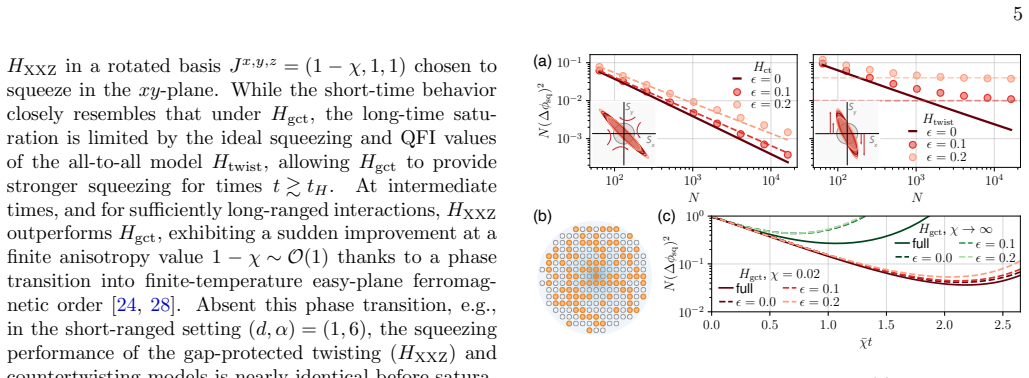
The paper's central claim is that the gap-protected countertwisting Hamiltonian $H_{\mathrm{gct}}=\sum_{i\neq j}J(r_{ij})[s_i\cdot s_j+(\chi/2)(s_i^+s_j^++s_i^-s_j^-)]$ with power-law couplings $J\propto r^{-\alpha}$ reproduces, for sufficiently slow countertwisting, the Heisenberg scaling $G\propto N$ of the all-to-all countertwisting model. The Heisenberg term is the load-bearing protector: it opens an energy gap between manifolds of different total spin, constraining the dynamics to the permutation-symmetric $k=0$ mode while countertwisting parametrically amplifies that mode. Spin-wave theory sets the critical countertwisting rate at $\chi_c=1-1/f_{k_c}\propto N^{-\gamma/d}$ with $\gamma=\min(2,\alpha-d)$; below this rate the optimal squeezing parameter approaches $N(\Delta\varphi_{\mathrm{sq}})^2=c_{\mathrm{sq}}/N$ with $c_{\mathrm{sq}}\approx 3.9$, and the quantum Fisher information gives $N(\Delta\varphi_{\mathrm{QFI}})^2=c_{\mathrm{QFI}}/N$ with $c_{\mathrm{QFI}}\approx 1.56$. The time to reach Heisenberg scaling is therefore $t_H\sim N^{\gamma/d}\log N$, which is sublinear for the experimentally relevant cases $(d,\alpha)=(2,3)$ and $(3,6)$. Numerical simulations based on the discrete truncated Wigner approximation up to $N=4096$, benchmarked against exact diagonalization at $N=16$, support the scaling predictions and the predicted robustness to disorder and density fluctuations.
Load-bearing premise
The main calculation assumes that the linear spin-wave description of the early dynamics stays accurate up to the optimal squeezing time, so that nonlinear corrections and leakage out of the protected total-spin manifold can be neglected at large particle number.
Editorial extensions
If this is right
- For 2D dipolar ($\alpha=3$) and 3D van der Waals ($\alpha=6$) interactions, squeezing at the critical rate reaches near-Heisenberg sensitivity within $t_H\sim N^{1/2}\log N$ and $t_H\sim N^{2/3}\log N$, respectively.
- If practical constraints cap the total interaction time, a smaller gain $G$ can still be obtained by squeezing faster: $\chi\sim G^{-\gamma/d}$ for time $t\sim G^{\gamma/d}\log G$.
- The protocol inherits countertwisting's robustness to fluctuations in interaction strength: under fractional density fluctuations $\epsilon$, the optimal squeezing degrades as $N^{-(1-\epsilon)}$ rather than saturating like one-axis twisting, which hits a floor near $\epsilon^2$.
- Because countertwisting and Heisenberg spreading are distinct terms, the Hamiltonian can be generated by Floquet engineering from native Ising or XY interactions with global $\pi/2$ pulses, with accessible rates $0\leq\chi\leq\chi_{\max}$ depending on the native anisotropy.
- An echo protocol that reverses the sign of interactions after a small rotation accesses the quantum-Fisher-information-bound sensitivity, extending the metrological gain beyond what the squeezing parameter alone shows.
Reading between the lines
- Beyond the paper: because the distance-dependent plateau in pairwise correlations directly encodes the dispersion exponent $\gamma$, a real-space measurement of $C_{\max}(r)$ in a dipolar platform could independently confirm the critical-rate prediction $\chi_c\propto N^{-\gamma/d}$ without requiring very large atom numbers.
- Beyond the paper: the fixed squeezed quadrature of countertwisting suggests the protocol could be adapted to parameter estimation in the presence of slowly varying fields, where one-axis twisting protocols degrade because their squeezed axis rotates with the unknown parameter.
- A testable extension the authors do not pursue is a time-dependent rate $\chi(t)$, starting fast for early exponential squeezing and slowing near the critical rate to grow the correlation plateau; whether this outcompetes the optimal fixed-rate schedule is open.
- The paper leaves open whether $t_H$ can be improved to the Lieb-Robinson speed limits; comparing the achieved exponents $\gamma/d$ (1/2 for 2D dipolar, 2/3 for 3D van der Waals, 2 for 1D short-range) against those bounds is a concrete quantitative check.
Signed reviews
Editorial analysis
A structured set of objections, weighed in public.
Referee Report
Summary. The manuscript proposes a gap-protected countertwisting Hamiltonian, Eq. (1), with power-law Heisenberg and countertwisting interactions, and analyzes its spin-squeezing dynamics. Using a Holstein-Primakoff reduction to the quadratic spin-wave Hamiltonian Eq. (2), the authors derive the critical squeezing rate χ_c = 1 − 1/f_{k_c} (Eq. 3) and predict a time t_H ∼ N^{γ/d} log N to approach Heisenberg-limited sensitivity N(Δφ)² = c/N, with constants c_sq ≈ 3.9 and c_QFI ≈ 1.56 inherited from the all-to-all countertwisting model. The claims are supported by DTWA simulations up to N = 4096, benchmarked against exact diagonalization at small N, together with an analysis of Floquet implementations and robustness to disorder and density fluctuations.
Significance. If the central scaling claim holds, the paper would constitute an important step for spin squeezing with local and power-law interactions: it identifies a concrete Hamiltonian whose metrological gain reaches the Heisenberg limit in sublinear time for two-dimensional dipolar and three-dimensional van der Waals systems, and it provides a transparent, non-circular derivation of the allowable squeezing rate from the momentum-space couplings f_k. The paper is also commendable for computing the all-to-all constants c_sq and c_QFI from the collective model and then comparing them with local-interaction simulations, rather than extracting them as fit parameters. The main weakness is that the asymptotic time-to-Heisenberg scaling relies on the validity of quadratic spin-wave theory up to occupation numbers of order N, and the numerical evidence at the largest simulated sizes has not yet converged to the predicted exponent. These issues are load-bearing but, in my view, addressable within the manuscript's scope.
major comments (3)
- [Eqs. (2)-(3); Supplemental Sec. II.1; Fig. S3(b)] The derivation of χ_c and of the time scaling t_H ∼ N^{γ/d} log N is based on the stability condition |ω_k/χ_k| > 1, which is evaluated for infinitesimally populated spin-wave modes. However, reaching the claimed sensitivity requires evolving to χt_opt ∼ log N, where the k = 0 mode occupation is n_0 ∼ N. At that point the quartic terms omitted from Eq. (2) are not small: the four-magnon process 2(k=0) → k+(−k) has an effective coupling of order J, while the protective gap at the nearest competing mode is ω_{k_c} ∼ J(1−1/f_{k_c}) ∼ J N^{−γ/d}. For large N this nonlinear coupling exceeds the linear gap, and the manuscript neither estimates the associated scattering rate nor shows that the process is kinematically suppressed. Because the central claim is precisely that the dynamics remains confined to the k = 0 mode up to t_H, this missing estimate is load-bearing.
- [Supplemental Sec. III.1, Fig. S3(b); main text Fig. 2(b-c)] The numerical support for the asymptotic scaling is not yet convergent. At (d, α) = (2, 3), the fit of the QFI scaling N(Δφ_QFI)² ∝ (χ_c/χ)^{−2/γ} yields γ ≈ 1.3 at the largest simulated system size N = 4096, whereas the predicted value is γ = 1. The supplement states that the fitted values 'approach' the prediction, but the trend is still approximately 30% away at the largest size, and DTWA is a semiclassical method that cannot by itself exclude a quantum contribution to the exponent. This is precisely the kind of deviation that the omitted nonlinear terms could produce, so the empirical case for the claimed asymptotic time scaling is incomplete.
- [Main text 'In approaching the Heisenberg limit'; Supplemental Sec. IV] The paper uses F = 4(ΔS_max)² for the quantum Fisher information and extracts the constant c_QFI ≈ 1.56 from DTWA simulations, but DTWA operates with second moments of a semiclassical distribution. For the strongly non-Gaussian states reached near the Heisenberg limit, this expression is not guaranteed to equal the true QFI, and the supplement's echo protocol is the concrete proposal for accessing this sensitivity. However, the echo analysis is performed only within the same DTWA framework and is not benchmarked against exact diagonalization for the local-interaction case. A short discussion of the validity of F = 4(ΔS_max)² for the states generated by Eq. (1) would strengthen the claim that the reported QFI values are rigorous metrological bounds.
minor comments (5)
- [Fig. 2(a)] The axis annotation '40¯6' appears to be a typo for 4096; please correct it.
- [Eq. (3) and Supplemental Sec. II.3] The open-boundary generalization of the critical rate uses the two largest eigenvalues f̃ and f̃′ of the real-space coupling matrix, but the main text does not define these quantities; adding a sentence tying f̃ and f̃′ to f_{k_c} would help the reader.
- [Abstract and introduction] The abstract uses 'local interactions' while the model includes power-law interactions ranging down to all-to-all α = 0; please clarify in the abstract what is meant by 'local' (for example, 'short-range or power-law interacting').
- [Fig. 4(a) and Supplemental Sec. V] The horizontal axis label in the main-text figure appears as 'πtott' but should read J_tot t; also, the analytical model of Eq. (S13) is first used in the main text, so citing the supplement section at that point would be helpful.
- [General] Several quantitative statements, including the scalings in Fig. 5(a) and the three-regime model in Fig. 4, are deferred to the supplement via a single reference [49]; please add section-specific pointers to the supplement so that the reader can locate the derivations.
Circularity Check
No significant circularity: the scaling claims are derived from spin-wave theory and independently benchmarked by DTWA, not fitted from the target data.
full rationale
The central derivation is self-contained. The critical rate chi_c is obtained from the spin-wave stability condition |omega_k/chi_k| > 1 applied to the smallest nonzero momentum mode kc, with omega_k and chi_k computed from the Fourier couplings f_k of the Hamiltonian (Eqs. 2-3 and Supplement Sec. II); the time t_H = log N / chi_c then follows from the exponential k=0 squeezing rate chi and the N-dependence of f_kc through the dispersion exponent gamma. The Heisenberg-limit constants c_sq approx 3.9 and c_QFI approx 1.56 are computed from the all-to-all two-axis countertwisting model and used as benchmarks, not extracted from the local-interaction data. The DTWA simulations are an independent approximate solver of the full Hamiltonian, benchmarked against exact diagonalization in Fig. S1; the finite-size fit gamma approx 1.3 at N = 4096 (Fig. S3b) is honestly reported as not converged, which is a validation shortfall rather than a circular reduction. Self-citations (e.g., Refs. [29,44,47,53]) concern experimental realizations and echo protocols and are not load-bearing for the analytic derivation. The printed form of Eq. (3), chi < 1 - 1/f_kc, has an apparent sign issue (for f_kc < 1 the intended bound should be 1/f_kc - 1, which is the expression used in the numerics), but this is a typographical or correctness matter, not a circularity.
Assumptions & free parameters
free parameters (1)
- countertwisting rate χ =
scanned 0.01 ≤ χ ≤ 2; critical value χ_c = 1 − 1/f_kc derived from Eq. (3), not fitted
assumptions (6)
- domain assumption Holstein-Primakoff linear spin-wave expansion around the fully polarized state is valid up to the optimal squeezing time χt_opt ≲ log N.
- domain assumption Gap protection confines dynamics to the permutation-symmetric k = 0 manifold when χ < χ_c, so the collective spin coherence is preserved.
- standard math Dispersion relation ω_k ∝ k^γ with γ = min(2, α−d) for power-law interactions in d dimensions.
- standard math Bogoliubov diagonalization of the quadratic bosonic spin-wave Hamiltonian determines parametric stability via λ_k = ±√(ω_k² − χ_k²).
- standard math The quantum Fisher information of the pure state equals 4(ΔS_max)², so metrological gain is captured by collective spin variance.
- domain assumption Floquet engineering can realize Hgct with negligible Trotter error in the limit of small step size, with positive frame times for χ within the accessible range.
Cite this review
Pith. "Pith review of Squeezing Towards the Heisenberg Limit with Locally Interacting Spins." pith.science (2026). https://pith.science/paper/5YLTE2ZP
@misc{pith2026250616973,
  author       = {Pith},
  title        = {Pith review of: Squeezing Towards the Heisenberg Limit with Locally Interacting Spins},
  year         = {2026},
  howpublished = {\url{https://pith.science/paper/5YLTE2ZP}},
  note         = {Machine review of arXiv:2506.16973}
}
read the original abstract
We propose a robust approach to spin squeezing with local interactions that approaches the Heisenberg limit of phase sensitivity. To generate the requisite entanglement, we generalize the paradigmatic two-axis countertwisting Hamiltonian -- akin to squeezing by parametric amplification -- to systems with power-law interactions, incorporating a Heisenberg coupling that aids in spreading correlations and protects the collective spin coherence. The resulting time to approach the Heisenberg limit scales sublinearly with particle number in 2D dipolar and 3D van der Waals interacting systems. Our protocol is robust to disorder and density fluctuations, and can be implemented in near-term experiments with molecules, Rydberg atoms, and solid-state spins.
Figures


Figures from the paper (1 more)
Reference graph
Works this paper leans on
-
[1]
Pezz` e, A
L. Pezz` e, A. Smerzi, M. K. Oberthaler, R. Schmied, and P. Treutlein, Rev. Mod. Phys. 90, 035005 (2018)
2018
-
[2]
C. L. Degen, F. Reinhard, and P. Cappellaro, Rev. Mod. Phys. 89, 035002 (2017)
2017
- [3]
-
[4]
Kitagawa and M
M. Kitagawa and M. Ueda, Phys. Rev. A47, 5138 (1993)
1993
-
[5]
D. J. Wineland, J. J. Bollinger, W. M. Itano, and D. J. Heinzen, Phys. Rev. A 50, 67 (1994)
1994
-
[6]
A. S. Sørensen and K. Mølmer, Phys. Rev. Lett. 86, 4431 (2001)
2001
-
[7]
Y. C. Liu, Z. F. Xu, G. R. Jin, and L. You, Phys. Rev. Lett. 107, 013601 (2011)
2011
-
[8]
Leibfried, M
D. Leibfried, M. D. Barrett, T. Schaetz, J. Britton, J. Chiaverini, W. M. Itano, J. D. Jost, C. Langer, and D. J. Wineland, Science 304, 1476 (2004)
2004
Show all 75 references
-
[9]
Est` eve, C
J. Est` eve, C. Gross, A. Weller, S. Giovanazzi, and M. K. Oberthaler, Nature 455, 1216 (2008)
2008
-
[10]
M. F. Riedel, P. B¨ ohi, Y. Li, T. W. H¨ ansch, A. Sinatra, and P. Treutlein, Nature 464, 1170 (2010)
2010
-
[11]
I. D. Leroux, M. H. Schleier-Smith, and V. Vuleti´ c, Phys. Rev. Lett. 104, 073602 (2010)
2010
-
[12]
L¨ ucke, M
B. L¨ ucke, M. Scherer, J. Kruse, L. Pezz´ e, F. Deuret- zbacher, P. Hyllus, O. Topic, J. Peise, W. Ertmer, J. Arlt, L. Santos, A. Smerzi, and C. Klempt, Science 334, 773 (2011)
2011
-
[13]
C. D. Hamley, C. S. Gerving, T. M. Hoang, E. M. Book- jans, and M. S. Chapman, Nature Physics 8, 305 (2012)
2012
-
[14]
Berrada, S
T. Berrada, S. van Frank, R. B¨ ucker, T. Schumm, J. F. Schaff, and J. Schmiedmayer, Nature Communications 4, 2077 (2013)
2013
-
[15]
Hosten, R
O. Hosten, R. Krishnakumar, N. J. Engelsen, and M. A. Kasevich, Science 352, 1552 (2016)
2016
-
[16]
J. G. Bohnet, B. C. Sawyer, J. W. Britton, M. L. Wall, A. M. Rey, M. Foss-Feig, and J. J. Bollinger, Science 352, 1297 (2016)
2016
-
[17]
Pedrozo-Pe˜ nafiel, S
E. Pedrozo-Pe˜ nafiel, S. Colombo, C. Shu, A. F. Adiy- atullin, Z. Li, E. Mendez, B. Braverman, A. Kawasaki, D. Akamatsu, Y. Xiao, and V. Vuleti´ c, Nature588, 414 (2020)
2020
-
[18]
G. P. Greve, C. Luo, B. Wu, and J. K. Thompson, Na- ture 610, 472 (2022)
2022
-
[19]
Z. Li, S. Colombo, C. Shu, G. Velez, S. Pilatowsky- Cameo, R. Schmied, S. Choi, M. Lukin, E. Pedrozo- Pe˜ nafiel, and V. Vuleti´ c, Science380, 1381 (2023)
2023
-
[20]
A. M. Rey, L. Jiang, M. Fleischhauer, E. Demler, and M. D. Lukin, Phys. Rev. A 77, 052305 (2008)
2008
-
[21]
Fr´ erot, P
I. Fr´ erot, P. Naldesi, and T. Roscilde, Phys. Rev. B 95, 245111 (2017)
2017
-
[22]
M. P. Kwasigroch and N. R. Cooper, Phys. Rev. A 96, 053610 (2017)
2017
-
[23]
Kaubruegger, P
R. Kaubruegger, P. Silvi, C. Kokail, R. van Bijnen, A. M. Rey, J. Ye, A. M. Kaufman, and P. Zoller, Phys. Rev. Lett. 123, 260505 (2019)
2019
-
[24]
M. A. Perlin, C. Qu, and A. M. Rey, Phys. Rev. Lett. 125, 223401 (2020)
2020
-
[25]
Bilitewski, L
T. Bilitewski, L. De Marco, J.-R. Li, K. Matsuda, W. G. Tobias, G. Valtolina, J. Ye, and A. M. Rey, Phys. Rev. Lett. 126, 113401 (2021)
2021
-
[26]
Comparin, F
T. Comparin, F. Mezzacapo, and T. Roscilde, Phys. Rev. A 105, 022625 (2022)
2022
-
[27]
Comparin, F
T. Comparin, F. Mezzacapo, M. Robert-de Saint- Vincent, and T. Roscilde, Phys. Rev. Lett. 129, 113201 (2022)
2022
-
[28]
Block, B
M. Block, B. Ye, B. Roberts, S. Chern, W. Wu, Z. Wang, L. Pollet, E. J. Davis, B. I. Halperin, and N. Y. Yao, Nature Physics 20, 1575 (2024)
2024
-
[29]
J. A. Hines, S. V. Rajagopal, G. L. Moreau, M. D. Wahrman, N. A. Lewis, O. Markovi´ c, and M. Schleier- Smith, Phys. Rev. Lett. 131, 063401 (2023)
2023
-
[30]
W. J. Eckner, N. Darkwah Oppong, A. Cao, A. W. Young, W. R. Milner, J. M. Robinson, J. Ye, and A. M. Kaufman, Nature 621, 734 (2023)
2023
-
[31]
Bornet, G
G. Bornet, G. Emperauger, C. Chen, B. Ye, M. Block, M. Bintz, J. A. Boyd, D. Barredo, T. Comparin, F. Mez- zacapo, T. Roscilde, T. Lahaye, N. Y. Yao, and A. Browaeys, Nature 621, 728 (2023)
2023
-
[32]
Franke, S
J. Franke, S. R. Muleady, R. Kaubruegger, F. Kranzl, R. Blatt, A. M. Rey, M. K. Joshi, and C. F. Roos, Nature 621, 740 (2023)
2023
-
[33]
Y. K. Lee, M. Block, H. Lin, V. Fedoseev, P. J. D. Crowley, N. Y. Yao, and W. Ketterle, (2024), arXiv:2409.17398 [quant-ph]
2024 arXiv
-
[34]
Douglas, V
A. Douglas, V. Kaxiras, L. Su, M. Szurek, V. Singh, O. Markovi´ c, and M. Greiner, (2024), arXiv:2411.07219 [quant-ph]
2024 arXiv
-
[35]
W. Wu, E. J. Davis, L. B. Hughes, B. Ye, Z. Wang, D. Kufel, T. Ono, S. A. Meynell, M. Block, C. Liu, H. Yang, A. C. B. Jayich, and N. Y. Yao, (2025), arXiv:2503.14585 [quant-ph]
2025
-
[36]
Christakis, J
L. Christakis, J. S. Rosenberg, R. Raj, S. Chi, A. Morn- ingstar, D. A. Huse, Z. Z. Yan, and W. S. Bakr, Nature 614, 64 (2023)
2023
-
[37]
C. M. Holland, Y. Lu, and L. W. Cheuk, Science 382, 1143 (2023)
2023
-
[38]
Miller, A
C. Miller, A. N. Carroll, J. Lin, H. Hirzler, H. Gao, H. Zhou, M. D. Lukin, and J. Ye, Nature 633, 332 (2024)
2024
-
[39]
E. H. Lieb and D. W. Robinson, Communications in Mathematical Physics 28, 251 (1972)
1972
-
[40]
M. C. Tran, A. Y. Guo, C. L. Baldwin, A. Ehrenberg, A. V. Gorshkov, and A. Lucas, Phys. Rev. Lett. 127, 160401 (2021)
2021
-
[41]
M. C. Tran, A. Y. Guo, A. Deshpande, A. Lucas, and A. V. Gorshkov, Phys. Rev. X 11, 031016 (2021)
2021
-
[42]
Roscilde, T
T. Roscilde, T. Comparin, and F. Mezzacapo, Phys. Rev. Lett. 131, 160403 (2023)
2023
-
[43]
M. A. Norcia, R. J. Lewis-Swan, J. R. K. Cline, B. Zhu, 7 A. M. Rey, and J. K. Thompson, Science 361, 259 (2018)
2018
-
[44]
E. J. Davis, A. Periwal, E. S. Cooper, G. Bentsen, S. J. Evered, K. Van Kirk, and M. H. Schleier-Smith, Phys. Rev. Lett. 125, 060402 (2020)
2020
-
[45]
Z. Niu, V. M. Sch¨ afer, H. Zhang, C. Wagner, N. R. Taylor, D. J. Young, E. Y. Song, A. Chu, A. M. Rey, and J. K. Thompson, (2024), arXiv:2409.16265 [physics.atom-ph]
2024 arXiv
-
[46]
C. Luo, H. Zhang, A. Chu, C. Maruko, A. M. Rey, and J. K. Thompson, Nature Physics 21, 916 (2025)
2025
-
[47]
H. Gao, L. S. Martin, L. B. Hughes, N. T. Leitao, P. Put, H. Zhou, N. U. Koyluoglu, S. A. Meynell, A. C. B. Jayich, H. Park, and M. D. Lukin, (2025), arXiv:2503.14598 [quant-ph]
2025 arXiv
-
[48]
Schachenmayer, A
J. Schachenmayer, A. Pikovski, and A. M. Rey, Phys. Rev. X 5, 011022 (2015)
2015
-
[49]
[65, 66], for additional details and supporting calculations
See Supplemental Material, which includes Refs. [65, 66], for additional details and supporting calculations
-
[50]
D. J. Wineland, J. J. Bollinger, W. M. Itano, F. L. Moore, and D. J. Heinzen, Phys. Rev. A 46, R6797 (1992)
1992
-
[51]
S. L. Braunstein and C. M. Caves, Phys. Rev. Lett. 72, 3439 (1994)
1994
-
[52]
Giovannetti, S
V. Giovannetti, S. Lloyd, and L. Maccone, Nature Pho- tonics 5, 222 (2011)
2011
-
[53]
Davis, G
E. Davis, G. Bentsen, and M. Schleier-Smith, Phys. Rev. Lett. 116, 053601 (2016)
2016
-
[54]
Macr` ı, A
T. Macr` ı, A. Smerzi, and L. Pezz` e, Phys. Rev. A 94, 010102 (2016)
2016
-
[55]
Anders, L
F. Anders, L. Pezz` e, A. Smerzi, and C. Klempt, Phys. Rev. A 97, 043813 (2018)
2018
-
[56]
J. T. Young, S. R. Muleady, M. A. Perlin, A. M. Kauf- man, and A. M. Rey, Phys. Rev. Res. 5, L012033 (2023)
2023
-
[57]
Bouchoule and K
I. Bouchoule and K. Mølmer, Phys. Rev. A 65, 041803 (2002)
2002
-
[58]
A. W. Glaetzle, M. Dalmonte, R. Nath, C. Gross, I. Bloch, and P. Zoller, Phys. Rev. Lett. 114, 173002 (2015)
2015
-
[59]
Steinert, P
L.-M. Steinert, P. Osterholz, R. Eberhard, L. Festa, N. Lorenz, Z. Chen, A. Trautmann, and C. Gross, Phys. Rev. Lett. 130, 243001 (2023)
2023
-
[60]
J. Choi, H. Zhou, H. S. Knowles, R. Landig, S. Choi, and M. D. Lukin, Phys. Rev. X 10, 031002 (2020)
2020
-
[61]
Geier, N
S. Geier, N. Thaicharoen, C. Hainaut, T. Franz, A. Salzinger, A. Tebben, D. Grimshandl, G. Z¨ urn, and M. Weidem¨ uller, Science374, 1149 (2021)
2021
-
[62]
Borregaard, E
J. Borregaard, E. J. Davis, G. S. Bentsen, M. H. Schleier- Smith, and A. S. Sørensen, New Journal of Physics 19, 093021 (2017)
2017
-
[63]
Colombo, E
S. Colombo, E. Pedrozo-Pe˜ nafiel, A. F. Adiyatullin, Z. Li, E. Mendez, C. Shu, and V. Vuleti´ c, Nature Physics 18, 925 (2022)
2022
-
[64]
Potirniche, A
I.-D. Potirniche, A. C. Potter, M. Schleier-Smith, A. Vishwanath, and N. Y. Yao, Phys. Rev. Lett. 119, 123601 (2017)
2017
-
[65]
Muessel, H
W. Muessel, H. Strobel, D. Linnemann, T. Zibold, B. Juli´ a-D´ ıaz, and M. K. Oberthaler, Phys. Rev. A92, 023603 (2015)
2015
-
[66]
J. Hu, W. Chen, Z. Vendeiro, A. Urvoy, B. Braverman, and V. Vuleti´ c, Phys. Rev. A96, 050301 (2017). S1 Squeezing T owards the Heisenberg Limit with Locally Interacting Spins: Supplemental Material In this supplement, we present additional information about numerical and anal...
2017
-
[67]
Spin-wave Hamiltonian and dynamics We consider the generic XYZ model in a ˆz-field: HXYZ = X i,j,µ Jµ(rij)sµ isµ j +h X i sz i, (S1) where µ∈{x,y,z}. Writing the same generic model in momentum space, with couplings ˜Jµ k≡P re−ik·rJµ(r) and spin operators Sµ k = 1√ N P je−ik·rj...
-
[68]
(S2) The early-time dynamics of a system initialized in a spin-polarized state along the ˆz axis can be analyzed by applying a Holstein-Primakoff (HP) transformation, which maps the spin operators to bosonic operators a† k, ak that create and annihilate spin waves of momentum ...
-
[69]
S5-S6 yield squeezing rates χk = χfk and mode frequencies ωk = fk− 1, where we have fixed f0=1 so that the energy scales extensively
(S6) For the case of gap-protected countertwisting, with Jx,y,z k = (1 +χ, 1−χ, 1)fk andh = 0, Eqs. S5-S6 yield squeezing rates χk = χfk and mode frequencies ωk = fk− 1, where we have fixed f0=1 so that the energy scales extensively. More generally, Eq. S4 provides a useful fr...
-
[70]
S8 impose a stability condition |ωk/χk|≥ 1 for each momentum mode k, since real (imaginary) eigenenergies indicate stability (instability) to parametric amplification
Comparison of squeezing Hamiltonians The Bogoliubov eigenenergies λk in Eq. S8 impose a stability condition |ωk/χk|≥ 1 for each momentum mode k, since real (imaginary) eigenenergies indicate stability (instability) to parametric amplification. The ideal conditions to achieve f...
-
[71]
Gap protection in the spectrum In gap-protected countertwisting, the gap protection is achieved by energetically constraining dynamics to the permutation-symmetric manifold of collective spin S = N/2, i.e., the k = 0 spin-wave mode. In previous sections, we used linear spin-wa...
-
[72]
In this section, we explore deviations to the predicted scalings due to finite-size effects via numerical simulations for a representative case ( d,α ) = (2, 3)
Finite-size effects on sensitivity In the main text, we apply linear spin-wave theory to predict the critical squeezing rate χc to achieve Heisenberg scaling, as well as the metrological gain achievable when squeezing faster than χc, examining the dependence on system size N, ...
-
[73]
To this end, we provide supporting data for Fig
Logarithmic scaling of optimal time In this section, we verify the logarithmic dependence of optimal squeezing time χtopt, scaled by the squeezing rate χ, on system size N. To this end, we provide supporting data for Fig. 2(b-c) of the main text, which presents DTWA simulation...
-
[74]
This quadrature shrinks exponentially as a function of χt, with normalized spin noise ζmin≈e−χt for times χt <logN where the state remains Gaussian. A small fractional change ±ϵ in the collective interaction strength ˜χ≈χ(1±ϵ) affects the rate of squeezing, thereby modifying t...
-
[75]
(S20) The range of accessible squeezing rates χ as a function of anisotropy ∆ is depicted by the green shaded area in Fig
(S19d) Furthermore, as global π/2 pulses do not change the sign of interactions, we use Lµ≥ 0 to obtain upper bounds for the squeezing rate χ≥ 0, defined to be non-negative: χ≤χmax = 1− ∆ 2 + ∆· ( 1, −2< ∆≤ 1, −1, ∆<−2 or ∆ > 1. (S20) The range of accessible squeezing rates χ ...
Reviewed August 15, 2026 · model on record in the stance chip above.
Discussion (0). Continue with ORCID to comment.