REVIEW 3 major objections 4 minor 100 references
Generative Bayesian Filtering for State Estimation
T0 review · 3 major / 4 minor · reviewed 2026-08-02 · deepseek-v4-flash
Pith's one-line read A pretrained conditional generative model can serve as the observation likelihood inside a recursive Bayesian filter, and score-based posterior sampling over class logits and continuous embeddings gives more accurate, robust state estimates
desk verdict Novel modular filtering idea with solid empirical work, but the posterior-sampling derivation is tempered by an unreported σ, which undercuts the uncertainty-quantification claims. read the letter →
The pith
A machine-rendered reading of the paper's core claim, the machinery that carries it, and where it could break.
The reading
What carries the argument
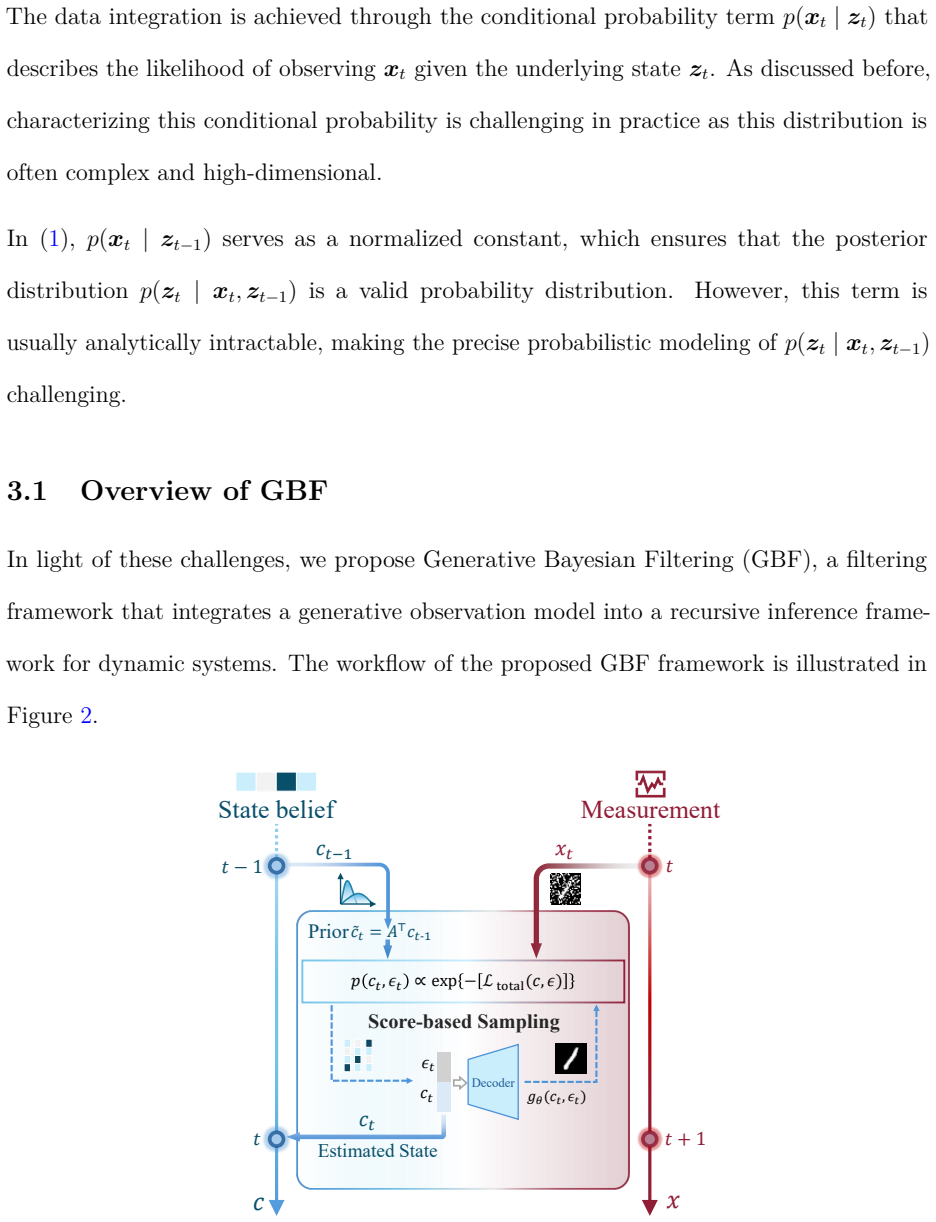
The load-bearing object is the CVAE decoder g_theta, used as p(observation | z) approximate N(g_theta(c,epsilon), sigma^2 I), together with the score-based update. Instead of computing the posterior's normalizing constant, GBF defines a total energy L_total = reconstruction error + latent embedding prior + soft cross-entropy against the transition-predicted belief, and samples from exp(-L_total) with stochastic gradient Langevin dynamics. This turns backpropagation through the decoder into a filter update, and the ensemble of sampled particles provides uncertainty.
What would settle it
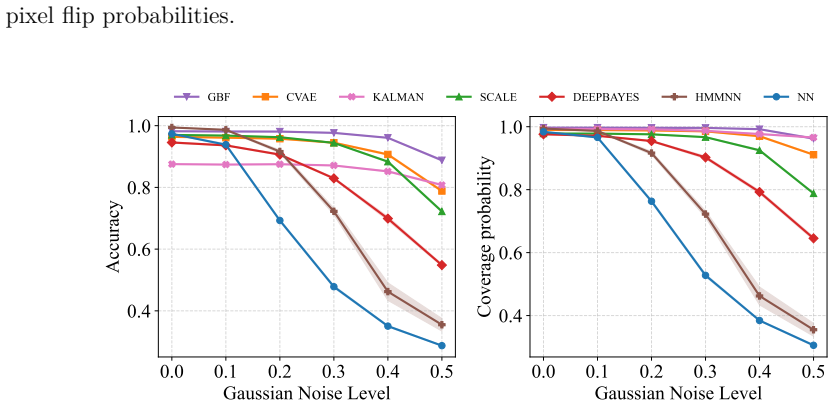
Estimate the decoder noise sigma from reconstruction residuals on held-out clean data, then run GBF on corrupted test sequences at several noise levels without re-tuning sigma (or with sigma set to the true corruption level). If accuracy or 75% coverage degrades sharply when sigma is set honestly, the robustness claim rests on an unmeasured calibration parameter.
Extended reading notes
Core claim
GBF's central claim is that a decoder trained only to generate data can be repurposed as the likelihood in a Bayesian filter. The latent state is z=(c,epsilon), with c a softmax class vector and epsilon a continuous embedding; the decoder defines an isotropic Gaussian likelihood around its reconstruction. Combining this likelihood with a Markov transition matrix as temporal prior yields a total energy whose gradient with respect to z is the score of the posterior. Sampling from exp(-L_total) via stochastic gradient Langevin dynamics over multiple particles gives both a point estimate and a posterior distribution. The stated result is that this modular generative likelihood keeps state estima
Load-bearing premise
The decoder trained on clean paired data must continue to score corrupted observations as a valid likelihood, well enough that SGLD posteriors are meaningful, while the noise scale sigma is fixed and never estimated or reported.
Editorial extensions
If this is right
- Any pretrained conditional generative observation model can be plugged into a recursive filter without retraining the dynamics model or the inference subroutine.
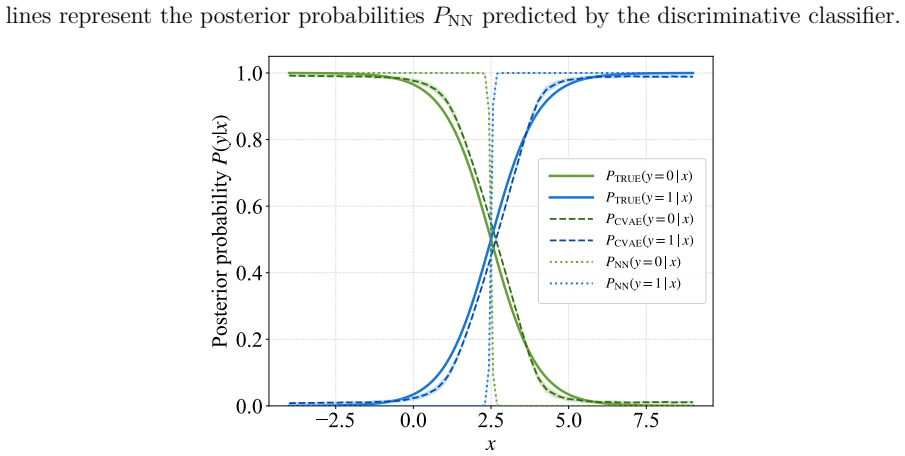
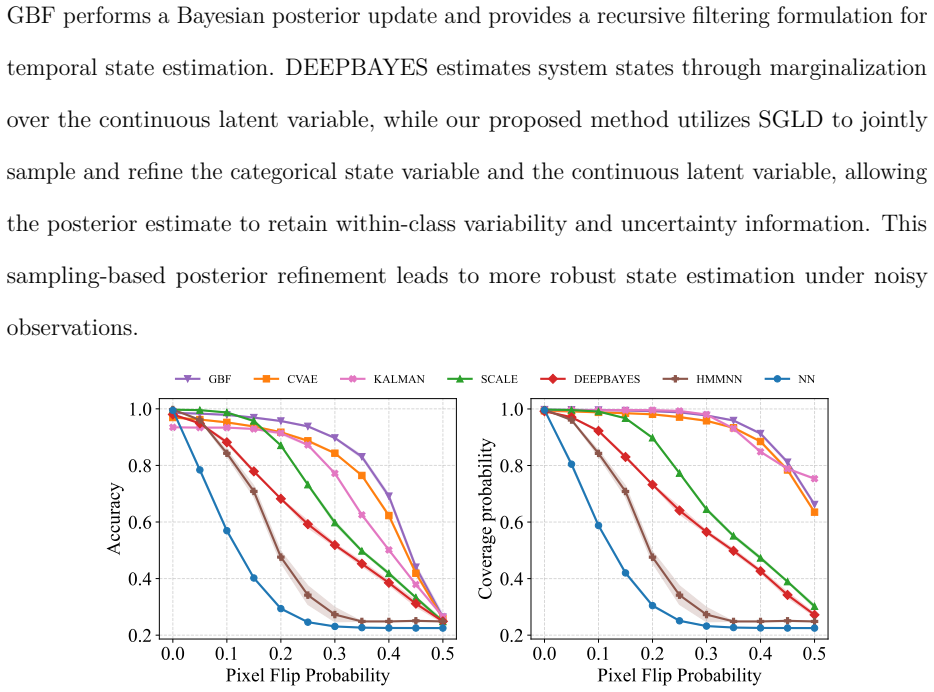
- State estimates retain uncertainty information (posterior spread and coverage), whereas discriminative neural classifiers are claimed to become overconfident under distribution shift.
- Noise robustness is inherited from the generative likelihood, so filtering can operate directly on high-dimensional raw sensor streams instead of hand-crafted pseudo-observations.
- The same framework extends to any Markovian discrete-state system where a transition matrix is known or estimable offline.
- Because gradient-based sampling replaces analytic updates, filtering no longer requires linearity or an explicitly specified observation function.
Reading between the lines
- If the method is correct, any CVAE trained for conditional generation could be reused for recurrent state inference without re-training, opening a plug-and-play route from generative models to online filtering.
- A testable extension would replace the fixed isotropic Gaussian observation assumption with a learned or input-dependent noise model; if robustness is driven by the likelihood curvature, a learned sigma could further improve calibration under heteroscedastic noise.
- The paper leaves sigma fixed and unreported, so an editor predicts that the calibration benefit hinges on this unestimated scale; setting sigma honestly from held-out data at each noise level would clarify whether the reported robustness is intrinsic or comes from a tuned hyperparameter.
- For continuous latent states, replacing the Markov transition matrix with a learned dynamics model might make GBF a general posterior sampler for deep state-space models, extending the same score-based update beyond categorical states.
Editorial analysis
A structured set of objections, weighed in public.
Referee Report
Summary. The paper proposes Generative Bayesian Filtering (GBF), a state-estimation framework that replaces the observation likelihood in a recursive filter with a pretrained conditional variational autoencoder (CVAE) decoder. The latent state is represented as a categorical class vector c and a continuous embedding ε; the transition prior is a Markov matrix on c and an independent standard Gaussian on ε; the measurement update is performed by stochastic gradient Langevin dynamics (SGLD) on an energy combining reconstruction error with prior terms. Experiments on temporal MNIST/Fashion-MNIST, a laser powder bed fusion manufacturing dataset, and the MIT-BIH ECG dataset report accuracy, coverage, Brier score, and expected calibration error, and claim that GBF outperforms Kalman filtering, a neural-network classifier, an HMM-NN hybrid, and several generative inference baselines, particularly under observation noise and distribution shift.
Significance. If the derivation were exact, GBF would provide a modular way to inject pretrained generative observation models into Bayesian filtering, which is practically attractive for high-dimensional, noisy sensor streams. The empirical study is broad, includes two real-world case studies, and the code is publicly linked. The core idea of using a decoder as a likelihood inside a score-based filter is original and worth pursuing. However, the exact-Bayesian framing is not supported by the equations as written: the energy in Eq. (13) is a tempered version of the negative log posterior, and the recursive update in Algorithm 1 collapses the posterior to a point estimate. These issues directly affect the uncertainty-quantification claims (coverage, ECE). With corrections and a more careful framing as an approximate/tempered energy-based filter, the contribution could be valuable; in its current form, the central claim needs substantial revision.
major comments (3)
- [§3.2, Eq. (3); §3.4, Eq. (13); Algorithm 1, line 8] The stated energy is not a negative log posterior. With x|z ∼ N(gθ(z), σ²I) and ε ∼ N(0,I), the negative log-posterior (up to constants) is E = (1/(2σ²))||x−gθ(c,ε)||² + (1/2)||ε||² + L_softCE(c, c̃_t). Equation (13) with μ_latent=μ_prior=1 gives L_total = ||x−gθ||² + σ²||ε||² + 2σ²L_softCE = 2σ²E. Therefore exp(−L_total) = posterior^{2σ²}, not proportional to the posterior. Equation (3) has the same problem: L_cls = 2σ² times the reconstruction/prior negative log-density. Algorithm 1 line 8 uses yet another weighting (||ε||² and L_softCE without σ factors), so the implemented target is not even consistent with Eq. (13). No value of σ is reported anywhere. This is not a harmless constant: multiplying the SGLD energy by a positive constant changes the stationary distribution by tempering, directly affecting coverage and ECE, which are headline claims. Please correct the coefficients, repo
- [§3.5, Algorithm 1, lines 1–13] The recursion is not a full Bayesian recursion, despite the paper's claim in Section 3.5. After SGLD, Algorithm 1 aggregates the particles by their empirical mean c_t = (1/N)Σ c^{(i)}, and the next prediction step uses only this point estimate in c̃_t = A^T c_{t−1}. Posterior covariance and multimodality are discarded. Thus the framework is an assumed-density filter with a delta/point approximation for the previous belief, not the exact Bayesian recursion described in Eq. (1). This approximation should be stated explicitly and its effect on the reported coverage/ECE should be discussed; otherwise the uncertainty-quantification claims overstate what is computed.
- [§3.4, Eq. (14)] The SGLD sampler is run on logits ξ with c = softmax(ξ), but the target distribution is not the posterior over the original latent variables. SGLD on ξ with energy L_total(softmax(ξ)) has stationary density proportional to exp(−L_total(softmax(ξ))) on ξ-space, without the log-Jacobian of the softmax transformation and without a specified prior on ξ that induces the categorical prior on c. Consequently, the samples do not correspond to the stated categorical posterior over c. If the softmax parameterization is intended as an approximation or as a reparameterization with a different prior, this needs to be stated and justified; as written, the claim that GBF 'samples from the Bayesian filter posterior' is not established.
minor comments (4)
- [§3.2, Eq. (2)] The ELBO notation is slightly loose: gθ(x|ε,c) is written as a likelihood, but gθ is the decoder; please clarify the distinction between the decoder output and the Gaussian/Bernoulli likelihood it parametrizes.
- [§4, experimental setup] Key hyperparameters are missing: σ, μ_latent, μ_prior, SGLD step count M, number of particles N, learning rate η, AdamW-SGLD parameters, and the CVAE architecture/latent dimension for each dataset. The code link is helpful, but the paper should report these values and ideally a sensitivity analysis for μ_latent/μ_prior.
- [Algorithm 1, line 2] The initialization 'ξ,ε ∼ (0, q_φ(ε_t | x_t, c^{(i)}))' is unclear: what is the zero distribution for ξ? Using the encoder q_φ at test time on corrupted observations is a choice that should be justified, since q_φ was trained on clean data.
- [Table 1] Kalman filtering achieves the highest AUC (0.855) while GBF has the highest accuracy and F1. The paper mentions this but does not explain the discrepancy; please discuss the accuracy/AUC tradeoff and why accuracy/F1 are the primary criteria in this application.
Circularity Check
No significant circularity: the GBF posterior combines a separately trained CVAE likelihood with a temporal prior and is evaluated on held-out noisy benchmarks; the main caveat is an under-specified energy scaling, which is a correctness/calibration issue rather than a circular equivalence.
full rationale
The claimed derivation is not circular. The CVAE decoder is trained offline on clean labeled pairs (Eq. 2) and then fixed; Eq. (1) composes this learned likelihood with a transition prior through Bayes' rule, and Algorithm 1's SGLD sampler is tested on held-out noisy sequences (Figs. 8-9, Tables 1-2). The accuracy, coverage, Brier, and ECE values are not used to define the energy or the transition matrix A, which is estimated only from training trajectories. Self-citations (Ren et al. 2023, 2024) supply externally validated synchrotron/X-ray ground truth and are not load-bearing to the method's derivation. One caveat belongs to correctness rather than circularity: Eq. (13) asserts Ltotal is proportional to the negative log posterior, but with the Gaussian likelihood and Gaussian prior of Eqs. (11)-(12), SGLD with arbitrary mu_latent, mu_prior, and un-reported sigma samples a tempered/weighted energy rather than the exact posterior. This undermines the 'Bayesian' calibration claim, but it does not make the empirical predictions equivalent to the inputs by construction; the method's outputs are not forced by its training data or by a self-citation chain, and a corrected implementation with reported constants could test the same claim independently.
Assumptions & free parameters
free parameters (5)
- sigma (observation noise) =
not reported
- mu_latent, mu_prior =
not reported
- SGLD steps M and particles N =
not reported
- transition matrix A (ECG) =
estimated from training set
- CVAE latent dimension / architecture =
d_epsilon=128 for LPBF; unspecified elsewhere
assumptions (5)
- domain assumption Markov conditional structure p(x_t | z_t, z_{t-1}) = p(x_t | z_t) and z_{t-1} sufficient statistic
- ad hoc to paper epsilon_t ~ N(0,I) independent over time
- ad hoc to paper c_t | c_{t-1}, ε_{t-1} ~ Categorical(A^T c_{t-1}) with softmax parameterization
- domain assumption pretrained CVAE decoder remains a valid likelihood under test-time noise/distribution shift
- standard math SGLD converges to the target energy
Cite this review
Pith. "Pith review of Generative Bayesian Filtering for State Estimation." pith.science (2026). https://pith.science/paper/5YOMJEIO
@misc{pith2026260720521,
  author       = {Pith},
  title        = {Pith review of: Generative Bayesian Filtering for State Estimation},
  year         = {2026},
  howpublished = {\url{https://pith.science/paper/5YOMJEIO}},
  note         = {Machine review of arXiv:2607.20521}
}
read the original abstract
The state of a dynamic system evolves over time, switching among several latent modes that govern its observable behavior. Filtering methods infer the latent state from observations. Classical filtering approaches, including Kalman filters, typically rely on simple observation models, such as linear-Gaussian models, that are incapable of characterizing the increasingly nonlinear and heterogeneous patterns in high-dimensional sensor signals. To tackle the challenge, we propose Generative Bayesian Filtering (GBF), a filtering framework that replaces restrictive observation models with pretrained conditional generative models parametrized by conditional variational autoencoders (CVAE). For online inference, GBF performs a Bayesian prediction-update recursion in which the measurement update is formulated as a posterior sampling problem that combines the dynamical prior with the CVAE-induced likelihood. The resulting filtering problem is then transformed into a score-based sampling problem, which naturally inherits the flexibility from generative models and the uncertainty quantification capabilities from ensembling. Experiments on synthetic datasets and real-world applications involving manufacturing system monitoring and arrhythmia diagnosis demonstrate that GBF improves state estimation accuracy and robustness relative to baseline approaches.
Figures


Figures from the paper (11 more)





Reference graph
Works this paper leans on
-
[1]
The American Statistician , volume=
Understanding the ensemble Kalman filter , author=. The American Statistician , volume=. 2016 , publisher=
2016
-
[2]
Proceedings of the 28th international conference on machine learning (ICML-11) , pages=
Bayesian learning via stochastic gradient Langevin dynamics , author=. Proceedings of the 28th international conference on machine learning (ICML-11) , pages=
-
[3]
PLoS One , volume=
Conditional VAE for personalized neurofeedback in cognitive training , author=. PLoS One , volume=. 2025 , publisher=
2025
-
[4]
arXiv preprint arXiv:2604.02222 , year=
SCALE: Semantic-and Confidence-Aware Conditional Variational Autoencoder for Zero-shot Skeleton-based Action Recognition , author=. arXiv preprint arXiv:2604.02222 , year=
-
[5]
IEEE Transactions on Reliability , volume=
Deep variational autoencoder classifier for intelligent fault diagnosis adaptive to unseen fault categories , author=. IEEE Transactions on Reliability , volume=. 2021 , publisher=
2021
-
[6]
International conference on machine learning , pages=
Robust inference via generative classifiers for handling noisy labels , author=. International conference on machine learning , pages=. 2019 , organization=
2019
-
[7]
International Conference on Machine Learning , pages=
Are generative classifiers more robust to adversarial attacks? , author=. International Conference on Machine Learning , pages=. 2019 , organization=
2019
-
[8]
ICASSP 2022-2022 IEEE International Conference on Acoustics, Speech and Signal Processing (ICASSP) , pages=
Uncertainty estimation with a VAE-classifier hybrid model , author=. ICASSP 2022-2022 IEEE International Conference on Acoustics, Speech and Signal Processing (ICASSP) , pages=. 2022 , organization=
2022
Show all 100 references
-
[9]
2020 IEEE international workshop on metrology for industry 4.0 & IoT , pages=
Bayesian autoencoders for drift detection in industrial environments , author=. 2020 IEEE international workshop on metrology for industry 4.0 & IoT , pages=. 2020 , organization=
2020
-
[10]
2021 , booktitle=
Score-Based Generative Classifiers , author=. 2021 , booktitle=
2021
-
[11]
Biomedical Signal Processing and Control , volume=
A single-channel EEG based automatic sleep stage classification method leveraging deep one-dimensional convolutional neural network and hidden Markov model , author=. Biomedical Signal Processing and Control , volume=. 2021 , publisher=
2021
-
[12]
Artificial Intelligence Surgery , volume=
Artificial intelligence for real-time surgical phase recognition in minimal invasive inguinal hernia repair: a systematic review on behalf of TROGSS-the robotic global surgical society , author=. Artificial Intelligence Surgery , volume=. 2025 , publisher=
2025
-
[13]
Science , volume=
Keyhole threshold and morphology in laser melting revealed by ultrahigh-speed x-ray imaging , author=. Science , volume=. 2019 , publisher=
2019
-
[14]
Advanced Robotics , volume=
Data-efficient learning of robotic clothing assistance using Bayesian Gaussian process latent variable model , author=. Advanced Robotics , volume=. 2019 , publisher=
2019
-
[15]
IEEE Transactions on Industrial Informatics , volume=
Deep learning of latent variable models for industrial process monitoring , author=. IEEE Transactions on Industrial Informatics , volume=. 2021 , publisher=
2021
-
[16]
Materials Futures , volume=
Sub-millisecond keyhole pore detection in laser powder bed fusion using sound and light sensors and machine learning , author=. Materials Futures , volume=. 2024 , publisher=
2024
-
[17]
Science , volume=
Machine learning--aided real-time detection of keyhole pore generation in laser powder bed fusion , author=. Science , volume=. 2023 , publisher=
2023
-
[18]
Additive Manufacturing , pages=
A mechanistic study on environment gas in laser powder bed fusion , author=. Additive Manufacturing , pages=. 2025 , publisher=
2025
-
[19]
Learning Representations and Generative Models for 3
Achlioptas, Panos and Diamanti, Olga and Mitliagkas, Ioannis and Guibas, Leonidas , booktitle =. Learning Representations and Generative Models for 3. 2018 , editor =
2018
-
[20]
npj Acoustics , volume=
Machine learning in acoustics: A review and open-source repository , author=. npj Acoustics , volume=. 2025 , publisher=
2025
-
[21]
ACM Computing Surveys , volume=
A survey on video diffusion models , author=. ACM Computing Surveys , volume=. 2024 , publisher=
2024
-
[22]
Journal of Sensors , volume=
Kalman filter: historical overview and review of its use in robotics 60 years after its creation , author=. Journal of Sensors , volume=. 2021 , publisher=
2021
-
[23]
Proceedings of the 28th international conference on intelligent user interfaces , pages=
Large-scale text-to-image generation models for visual artists’ creative works , author=. Proceedings of the 28th international conference on intelligent user interfaces , pages=
-
[24]
Australian journal of basic and applied sciences , volume=
A review of navigation systems (integration and algorithms) , author=. Australian journal of basic and applied sciences , volume=
-
[25]
IEEE Transactions on industrial electronics , volume=
Kalman filter for robot vision: a survey , author=. IEEE Transactions on industrial electronics , volume=. 2011 , publisher=
2011
-
[26]
International journal of extreme manufacturing , volume=
Multi-sensor measurement and data fusion technology for manufacturing process monitoring: a literature review , author=. International journal of extreme manufacturing , volume=. 2020 , publisher=
2020
-
[27]
International Journal of Precision Engineering and Manufacturing-Green Technology , volume=
Additive manufacturing of sensors: A comprehensive review , author=. International Journal of Precision Engineering and Manufacturing-Green Technology , volume=. 2025 , publisher=
2025
-
[28]
Sensors , volume=
Advances in sensor technologies in the era of smart factory and industry 4.0 , author=. Sensors , volume=. 2020 , publisher=
2020
-
[29]
Xingjian Wu and Xiangfei Qiu and Hongfan Gao and Jilin Hu and Bin Yang and Chenjuan Guo , booktitle=. K^2. 2025 , url=
2025
-
[30]
Multi-Component
Fouad Oubari and Mohamed El Baha and Rapha. Multi-Component. The 29th International Conference on Artificial Intelligence and Statistics , year=
-
[31]
arXiv preprint arXiv:1511.05121 , year=
Deep kalman filters , author=. arXiv preprint arXiv:1511.05121 , year=
-
[32]
International Conference on Learning Representations , year=
Deep Variational Bayes Filters: Unsupervised Learning of State Space Models from Raw Data , author=. International Conference on Learning Representations , year=
-
[33]
Advances in Neural Information Processing Systems , volume=
Latent matters: Learning deep state-space models , author=. Advances in Neural Information Processing Systems , volume=
-
[34]
International Conference on Machine Learning , pages=
Semi-amortized variational autoencoders , author=. International Conference on Machine Learning , pages=. 2018 , organization=
2018
-
[35]
International Conference on Machine Learning , pages=
Iterative amortized inference , author=. International Conference on Machine Learning , pages=. 2018 , organization=
2018
-
[36]
, author=
The iterated sigma point kalman filter with applications to long range stereo. , author=. Robotics: Science and Systems , volume=. 2006 , organization=
2006
-
[37]
NeurIPS 2020 Workshop SVRHM , year=
Iterative VAE as a predictive brain model for out-of-distribution generalization , author=. NeurIPS 2020 Workshop SVRHM , year=
2020
-
[38]
arXiv preprint arXiv:1312.6114 , year=
Auto-encoding variational bayes , author=. arXiv preprint arXiv:1312.6114 , year=
-
[39]
Advances in neural information processing systems , volume=
Semi-supervised learning with deep generative models , author=. Advances in neural information processing systems , volume=
-
[40]
International conference on machine learning , pages=
Conditional variational autoencoder with adversarial learning for end-to-end text-to-speech , author=. International conference on machine learning , pages=. 2021 , organization=
2021
-
[41]
, title =
Mishra, Ashish and Krishna Reddy, Shiva and Mittal, Anurag and Murthy, Hema A. , title =. Proceedings of the IEEE Conference on Computer Vision and Pattern Recognition (CVPR) Workshops , month =
-
[42]
Proceedings of the 55th Annual Meeting of the Association for Computational Linguistics (Volume 1: Long Papers) , pages=
Learning discourse-level diversity for neural dialog models using conditional variational autoencoders , author=. Proceedings of the 55th Annual Meeting of the Association for Computational Linguistics (Volume 1: Long Papers) , pages=
-
[43]
Institute for Systems and Robotics , volume=
Kalman and extended kalman filters: Concept, derivation and properties , author=. Institute for Systems and Robotics , volume=. 2004 , publisher=
2004
-
[44]
Proceedings of the IEEE 2000 adaptive systems for signal processing, communications, and control symposium (Cat
The unscented Kalman filter for nonlinear estimation , author=. Proceedings of the IEEE 2000 adaptive systems for signal processing, communications, and control symposium (Cat. No. 00EX373) , pages=. 2000 , organization=
2000
-
[45]
Advances in neural information processing systems , volume=
A disentangled recognition and nonlinear dynamics model for unsupervised learning , author=. Advances in neural information processing systems , volume=
-
[46]
IEEE Transactions on Automation Science and Engineering , year=
Diffusion-based surrogate modeling and multi-fidelity calibration , author=. IEEE Transactions on Automation Science and Engineering , year=
-
[47]
FlowDAS: A Stochastic Interpolant-based Framework for Data Assimilation , author=
-
[48]
Advances in neural information processing systems , volume=
Simple and scalable predictive uncertainty estimation using deep ensembles , author=. Advances in neural information processing systems , volume=
-
[49]
arXiv preprint arXiv:2009.09535 , year=
Stochastic gradient langevin dynamics algorithms with adaptive drifts , author=. arXiv preprint arXiv:2009.09535 , year=
2009 arXiv
-
[50]
arXiv preprint arXiv:1412.6572 , year=
Explaining and harnessing adversarial examples , author=. arXiv preprint arXiv:1412.6572 , year=
-
[51]
2025 , publisher=
Artificial intelligence-driven defect detection and localization in metal 3D printing using convolutional neural networks , author=. 2025 , publisher=
2025
-
[52]
arXiv preprint arXiv:1708.07747 , year=
Fashion-mnist: a novel image dataset for benchmarking machine learning algorithms , author=. arXiv preprint arXiv:1708.07747 , year=
-
[53]
IEEE engineering in medicine and biology magazine , volume=
The impact of the MIT-BIH arrhythmia database , author=. IEEE engineering in medicine and biology magazine , volume=. 2001 , publisher=
2001
-
[54]
2006 , publisher=
Optimal state estimation: Kalman, H infinity, and nonlinear approaches , author=. 2006 , publisher=
2006
-
[55]
IEEE Transactions on Industrial Informatics , volume=
A framework for robust hybrid state estimation with unknown measurement noise statistics , author=. IEEE Transactions on Industrial Informatics , volume=. 2017 , publisher=
2017
-
[56]
Automatica , volume=
Maximum likelihood recursive state estimation: An incomplete-information based approach , author=. Automatica , volume=. 2024 , publisher=
2024
-
[57]
Advances in neural information processing systems , volume=
Learning structured output representation using deep conditional generative models , author=. Advances in neural information processing systems , volume=
-
[58]
Technometrics , pages=
Multimodal Deep Generative Model for Semi-Supervised Learning under Class Imbalance , author=. Technometrics , pages=. 2026 , publisher=
2026
-
[59]
GAMM-Mitteilungen , volume=
An introduction to deep generative modeling , author=. GAMM-Mitteilungen , volume=. 2021 , publisher=
2021
-
[60]
2025 IEEE Swiss Conference on Data Science (SDS) , pages=
Learning Actionable World Models for Industrial Process Control , author=. 2025 IEEE Swiss Conference on Data Science (SDS) , pages=. 2025 , organization=
2025
-
[61]
Advances in Neural Information Processing Systems , volume=
Roboscape: Physics-informed embodied world model , author=. Advances in Neural Information Processing Systems , volume=
-
[62]
Computers in Industry , volume=
A survey on machine learning based analysis of heterogeneous data in industrial automation , author=. Computers in Industry , volume=. 2023 , publisher=
2023
-
[63]
IEEE Transactions on Industrial Informatics , volume=
Intelligent fault diagnosis with noisy labels via semisupervised learning on industrial time series , author=. IEEE Transactions on Industrial Informatics , volume=. 2023 , publisher=
2023
-
[64]
Journal of Manufacturing Systems , volume=
A transformer-based approach for novel fault detection and fault classification/diagnosis in manufacturing: A rotary system application , author=. Journal of Manufacturing Systems , volume=. 2023 , publisher=
2023
-
[65]
Scientific data , volume=
Multitask learning and benchmarking with clinical time series data , author=. Scientific data , volume=. 2019 , publisher=
2019
-
[66]
BMJ open , volume=
Overtesting and undertesting in primary care: a systematic review and meta-analysis , author=. BMJ open , volume=. 2018 , publisher=
2018
-
[67]
Journal of Big Data , volume=
Sensor data quality: A systematic review , author=. Journal of Big Data , volume=. 2020 , publisher=
2020
-
[68]
Archives of Computational Methods in Engineering , volume=
A review on Kalman filter models , author=. Archives of Computational Methods in Engineering , volume=. 2023 , publisher=
2023
-
[69]
IEEE Access , year=
Multitask deep learning for predicting Parkinson’s progression and depression from multimodal time series data , author=. IEEE Access , year=
-
[70]
Biomimetic Intelligence and Robotics , volume=
A survey on the visual perception of humanoid robot , author=. Biomimetic Intelligence and Robotics , volume=. 2025 , publisher=
2025
-
[71]
Proceedings of the IEEE/CVF International Conference on Computer Vision , pages=
End-to-end driving with online trajectory evaluation via bev world model , author=. Proceedings of the IEEE/CVF International Conference on Computer Vision , pages=
-
[72]
stat , volume=
Auto-Encoding Variational Bayes , author=. stat , volume=
-
[73]
Advances in neural information processing systems , volume=
Variational autoencoder for deep learning of images, labels and captions , author=. Advances in neural information processing systems , volume=
-
[74]
International conference on artificial intelligence and statistics , pages=
Variational autoencoders and nonlinear ica: A unifying framework , author=. International conference on artificial intelligence and statistics , pages=. 2020 , organization=
2020
-
[75]
Advances in Neural Information Processing Systems , volume=
Embrace the gap: Vaes perform independent mechanism analysis , author=. Advances in Neural Information Processing Systems , volume=
-
[76]
Artificial intelligence review , volume=
Autoencoders and their applications in machine learning: a survey , author=. Artificial intelligence review , volume=. 2024 , publisher=
2024
-
[77]
IET control theory & applications , volume=
Kalman filtering with state constraints: a survey of linear and nonlinear algorithms , author=. IET control theory & applications , volume=. 2010 , publisher=
2010
-
[78]
IEEE Transactions on Signal Processing , volume=
Nonlinear Kalman filtering with divergence minimization , author=. IEEE Transactions on Signal Processing , volume=. 2017 , publisher=
2017
-
[79]
Advances in Neural Information Processing Systems , volume=
The autoencoding variational autoencoder , author=. Advances in Neural Information Processing Systems , volume=
-
[80]
Entropy , volume=
An overview of variational autoencoders for source separation, finance, and bio-signal applications , author=. Entropy , volume=. 2021 , publisher=
2021
-
[81]
Advances in neural information processing systems , volume=
NVAE: A deep hierarchical variational autoencoder , author=. Advances in neural information processing systems , volume=
-
[82]
International Conference on Algorithmic Learning Theory , pages=
Convergence of score-based generative modeling for general data distributions , author=. International Conference on Algorithmic Learning Theory , pages=. 2023 , organization=
2023
-
[83]
2019 18th IEEE international conference on machine learning and applications (ICMLA) , pages=
Anomaly detection with conditional variational autoencoders , author=. 2019 18th IEEE international conference on machine learning and applications (ICMLA) , pages=. 2019 , organization=
2019
-
[84]
Advances in neural information processing systems , volume=
Generative modeling by estimating gradients of the data distribution , author=. Advances in neural information processing systems , volume=
-
[85]
International Conference on Learning Representations , volume=
Analysis of learning a flow-based generative model from limited sample complexity , author=. International Conference on Learning Representations , volume=
-
[86]
SIAM/ASA Journal on Uncertainty Quantification , volume=
Efficient state/parameter estimation in nonlinear unsteady PDEs by a reduced basis ensemble Kalman filter , author=. SIAM/ASA Journal on Uncertainty Quantification , volume=. 2017 , publisher=
2017
-
[87]
International Conference on Learning Representations , volume=
Larp: Tokenizing videos with a learned autoregressive generative prior , author=. International Conference on Learning Representations , volume=
-
[88]
International conference on machine learning , pages=
On calibration of modern neural networks , author=. International conference on machine learning , pages=. 2017 , organization=
2017
-
[89]
Neural computation , volume=
Backpropagation applied to handwritten zip code recognition , author=. Neural computation , volume=. 1989 , publisher=
1989
-
[90]
Obermeyer, Ziad and Schubert, Alexander and Ross, James and Mullainathan, Sendhil and Lingman, Markus , year =. An. doi:10.1038/s41586-026-10674-6 , journal =
-
[91]
IEEE transactions on biomedical engineering , volume=
Automatic classification of heartbeats using ECG morphology and heartbeat interval features , author=. IEEE transactions on biomedical engineering , volume=. 2004 , publisher=
2004
-
[92]
Annual Reviews in Control , volume=
Sensor fusion , author=. Annual Reviews in Control , volume=. 2002 , publisher=
2002
-
[93]
2014 , publisher=
Adaptive filtering prediction and control , author=. 2014 , publisher=
2014
-
[94]
Advances in neural information processing systems , volume=
A universal approximation theorem of deep neural networks for expressing probability distributions , author=. Advances in neural information processing systems , volume=
-
[95]
Proceedings of the Thirty-Seventh Conference on Uncertainty in Artificial Intelligence , pages =
Faster Convergence of Stochastic Gradient Langevin Dynamics for Non-Log-Concave Sampling , author =. Proceedings of the Thirty-Seventh Conference on Uncertainty in Artificial Intelligence , pages =. 2021 , editor =
2021
-
[96]
Advances in Neural Information Processing Systems , editor=
Improved Convergence Rate of Stochastic Gradient Langevin Dynamics with Variance Reduction and its Application to Optimization , author=. Advances in Neural Information Processing Systems , editor=
-
[97]
2019 IEEE Intelligent Transportation Systems Conference (ITSC) , pages=
Vehicle trajectory prediction using intention-based conditional variational autoencoder , author=. 2019 IEEE Intelligent Transportation Systems Conference (ITSC) , pages=. 2019 , organization=
2019
-
[98]
Proceedings of the IEEE , volume=
Gradient-based learning applied to document recognition , author=. Proceedings of the IEEE , volume=. 1998 , publisher=
1998
-
[99]
Journal of Basic Engineering , volume=
A New Approach to Linear Filtering and Prediction Problems , author=. Journal of Basic Engineering , volume=. 1960 , publisher=
1960
-
[100]
Proceedings of the IEEE conference on computer vision and pattern recognition , pages=
Deep neural networks are easily fooled: High confidence predictions for unrecognizable images , author=. Proceedings of the IEEE conference on computer vision and pattern recognition , pages=
Reviewed August 2, 2026 · model on record in the stance chip above.
Discussion (0). Sign in to comment.