Equilibrium state of a Fermi system in the diffusion approximation of kinetic theory
Pith reviewed 2026-06-27 23:10 UTC · model grok-4.3
The pith
A consistent mapping of the diffusion equation from momentum to energy space shows equivalent temperature definitions but yields energy-dependent equilibrium temperature when kinetic coefficients vary with energy.
A machine-rendered reading of the paper's core claim, the machinery that carries it, and where it could break.
Core claim
The central claim is that a consistent transformation from the momentum-space diffusion equation to energy space preserves particle-number conservation. Under constant level density the equation reduces to a one-dimensional diffusion problem in energy space. The stationary solution demonstrates that the temperature definition is equivalent in both spaces. Allowing the kinetic coefficients to depend on energy produces an energy-dependent equilibrium temperature and a corresponding modification of the distribution function.
What carries the argument
The consistent transformation of the diffusion equation from momentum space to energy space that preserves particle-number conservation.
If this is right
- The equilibrium temperature remains unambiguously defined whether the diffusion equation is written in momentum or energy variables.
- Energy dependence of the kinetic coefficients produces an equilibrium temperature that itself varies with energy.
- The equilibrium distribution function acquires a modified form once kinetic coefficients depend on energy.
- Relaxation processes in atomic nuclei can be described by the resulting one-dimensional energy-space diffusion equation.
Where Pith is reading between the lines
- The same transformation technique could be applied to systems with slowly varying level density to obtain approximate energy-dependent temperatures.
- The modified distribution may alter predicted spectra or yields in nuclear collision simulations that assume a standard Fermi-Dirac form.
- Similar consistency requirements on temperature definitions might appear in other transport approximations used for quantum many-body systems.
Load-bearing premise
The single-particle level density is independent of energy.
What would settle it
A stationary solution computed directly in momentum space that yields a different temperature from the energy-space solution under the same kinetic coefficients would falsify the claimed equivalence.
Figures
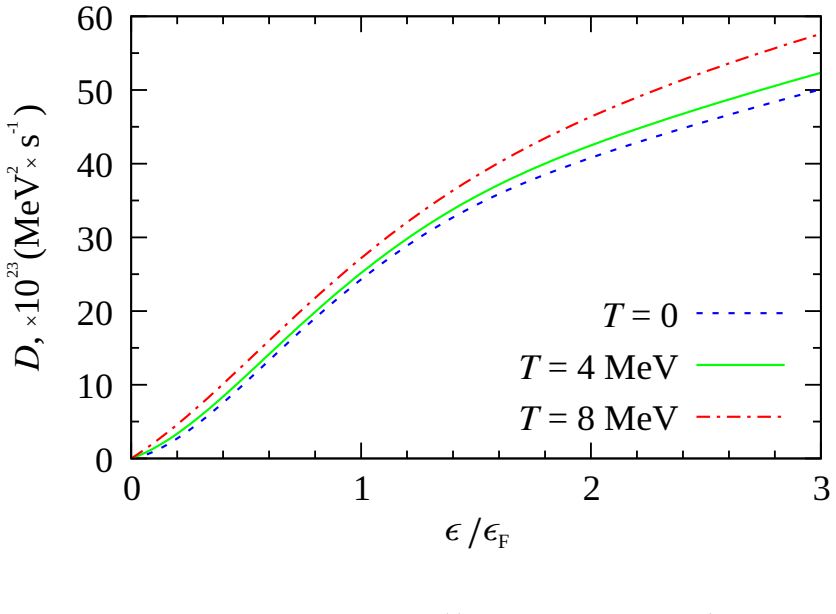
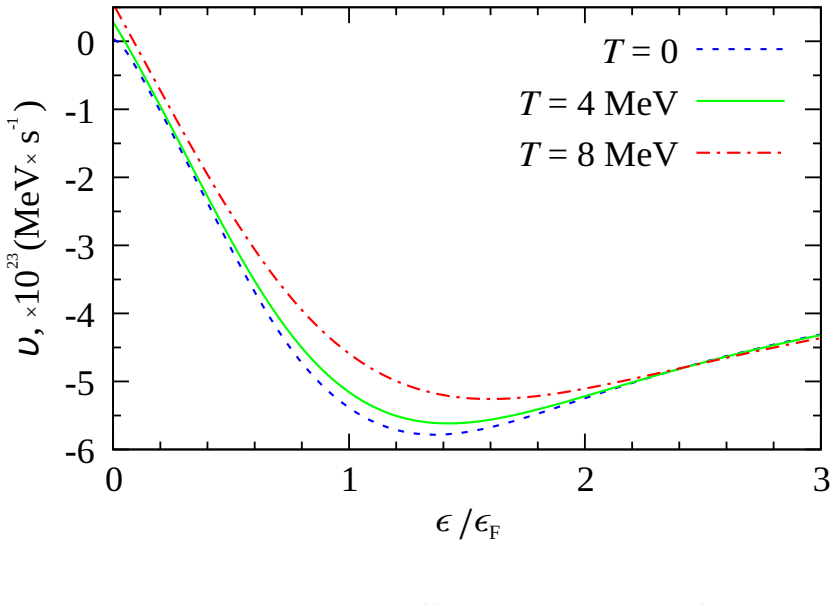
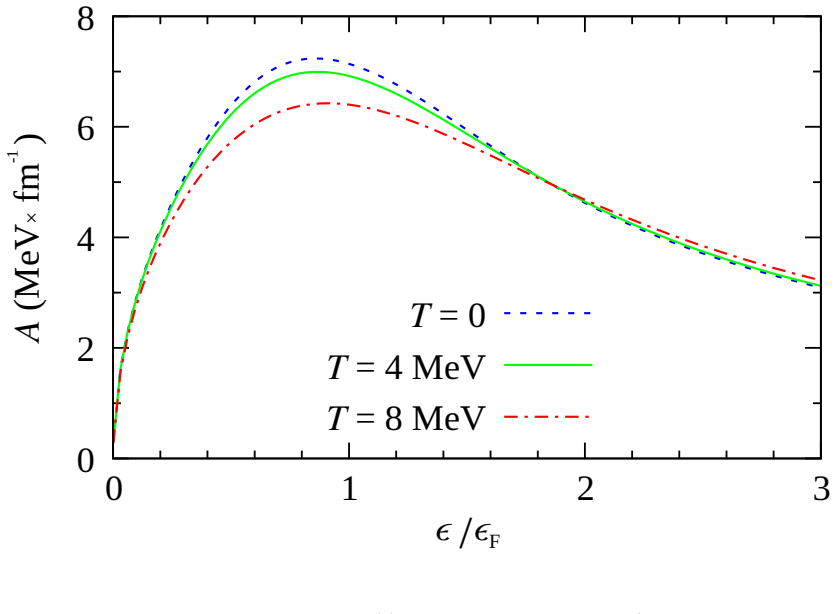
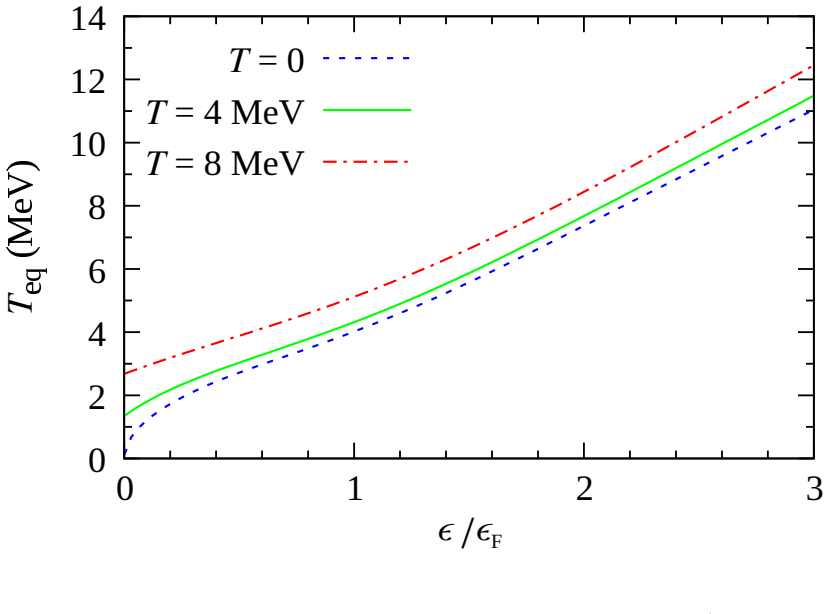
read the original abstract
A consistent transformation from momentum space to energy space is performed for the diffusion equation within kinetic theory, with particle-number conservation explicitly preserved. Under the assumption of a constant single-particle level density, the equation reduces to a one-dimensional diffusion equation in energy space with consistent kinetic coefficients. The equivalence of the definitions of the equilibrium temperature in momentum space and in energy space is demonstrated. It is established that the inclusion of the energy dependence of the kinetic coefficients leads to an energy-dependent equilibrium temperature and a modification of the distribution function. The obtained results may be used to analyze relaxation processes in atomic nuclei and nonequilibrium dynamics of Fermi systems.
Editorial analysis
A structured set of objections, weighed in public.
Referee Report
Summary. The manuscript performs a consistent transformation of the diffusion equation from momentum space to energy space for a Fermi system in the diffusion approximation of kinetic theory, with explicit preservation of particle number. Under the assumption of constant single-particle level density, the equation reduces to a one-dimensional diffusion equation in energy space with consistent kinetic coefficients. It demonstrates equivalence of the equilibrium temperature definitions in momentum and energy spaces, and shows that energy-dependent kinetic coefficients lead to an energy-dependent equilibrium temperature and a modified distribution function. The results are positioned for application to relaxation processes in atomic nuclei and nonequilibrium Fermi dynamics.
Significance. If the central derivations hold, the work supplies a technically consistent route to energy-space formulations of the diffusion approximation while preserving key conservation laws and thermodynamic consistency (temperature equivalence). This could facilitate modeling of nuclear relaxation and nonequilibrium evolution where energy-space treatments are preferred, particularly when kinetic coefficients vary with energy.
minor comments (3)
- The abstract states that the transformation 'explicitly preserves' particle number, but the manuscript should include an explicit verification step (e.g., integration over the transformed distribution) to confirm this holds after the change of variables.
- The reduction to the one-dimensional energy-space diffusion equation is stated to occur under the constant level-density assumption; a brief remark on the magnitude of corrections when level density varies slowly would strengthen the applicability discussion.
- The claim that energy-dependent kinetic coefficients produce an energy-dependent temperature is presented as a derived result; the manuscript should clarify whether this follows directly from the transformed Fokker-Planck operator or requires an additional closure.
Simulated Author's Rebuttal
We thank the referee for the positive summary, significance assessment, and recommendation of minor revision. No specific major comments were raised in the provided report.
Circularity Check
No significant circularity detected
full rationale
The paper performs an explicit transformation from momentum-space diffusion equation to energy space while enforcing particle-number conservation, then invokes an explicit assumption of constant single-particle level density to reduce to a 1D energy diffusion equation. The claimed equivalence of equilibrium-temperature definitions is presented as a derived result under that assumption, and the effect of energy-dependent kinetic coefficients is stated as a separate consequence. No step reduces by construction to a fitted parameter, self-citation, or redefinition of the target quantity; all load-bearing steps are conditional on stated assumptions and are not shown to be equivalent to their own inputs. The derivation chain is therefore self-contained against external benchmarks.
Axiom & Free-Parameter Ledger
axioms (2)
- domain assumption Constant single-particle level density
- domain assumption Diffusion approximation of kinetic theory
Reference graph
Works this paper leans on
-
[1]
Particular attention has been devoted to the equivalence between the descriptions in momentum and energy space
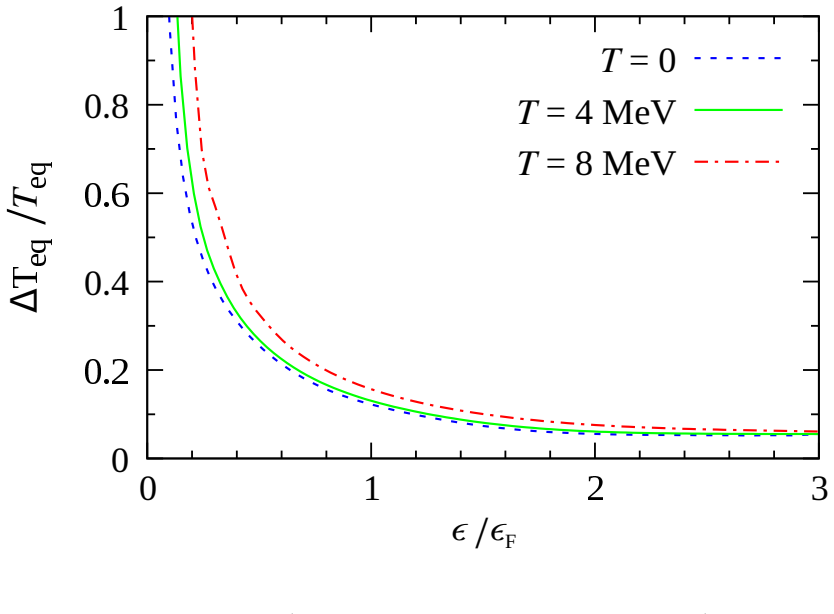
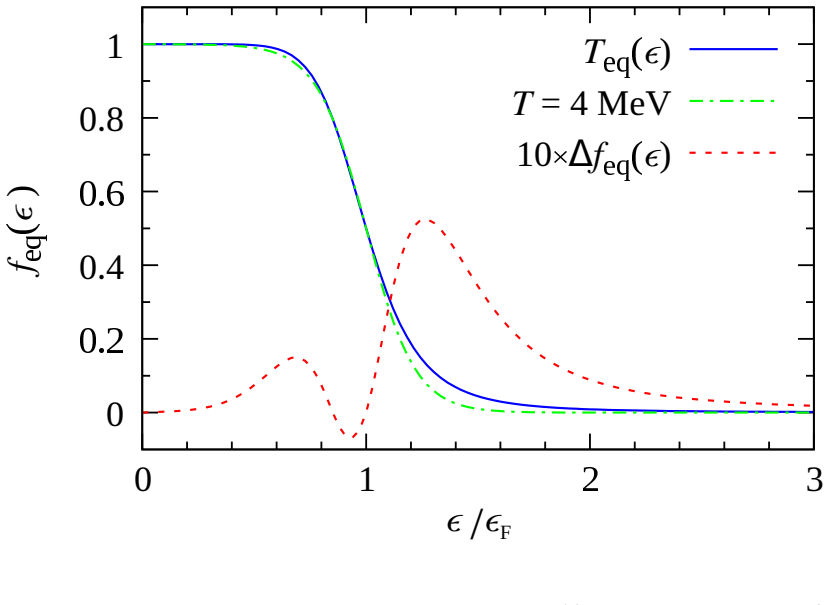
and ( 23). Particular attention has been devoted to the equivalence between the descriptions in momentum and energy space. At first sight, different definitions of the kinetic coefficients 20 may suggest an apparent ambiguity, in particular in the definition of t he equilibrium tem- perature Teq through the ratio of diffusion and drift coefficients. It has been sh...
-
[2]
V. M. Kolomietz and S. Shlomo, Mean Field Theory (World Scientific, Singapore, 2020)
2020
-
[3]
E. M. Lifshitz and L. P. Pitaevskii, Physical kinetics (Pergamon Press, Oxford, 1981) Chap. 2
1981
-
[4]
Risken, The Fokker–Planck Equation: Methods of Solution and Applica tions, 2nd ed., Springer Series in Synergetics, Vol
H. Risken, The Fokker–Planck Equation: Methods of Solution and Applica tions, 2nd ed., Springer Series in Synergetics, Vol. 18 (Springer, Berlin, 1989)
1989
-
[5]
Chomaz, M
P. Chomaz, M. Colonna, and J. Randrup, Nuclear spinodal f ragmentation, Phys. Rep. 389, 263 (2004)
2004
-
[6]
V. M. Kolomietz and S. V. Lukyanov, Diffusion on the distort ed Fermi surface, Ukr. J. Phys. 59, 764 (2014) , arXiv:1409.1391 [nucl-th]
Pith/arXiv arXiv 2014
-
[7]
V. M. Kolomietz and S. V. Lukyanov, Diffuse approximation t o the kinetic theory in a Fermi system, Int. Journ. Mod. Phys. E 24, 1550023 (2015) , arXiv:1504.00216 [nucl-th]
Pith/arXiv arXiv 2015
-
[8]
N¨ orenberg, Transport phenomena in multi-nucleon tr ansfer reactions, Phys
W. N¨ orenberg, Transport phenomena in multi-nucleon tr ansfer reactions, Phys. Lett. B 52, 289 (1974)
1974
-
[9]
Ayik and W
S. Ayik and W. N¨ orenberg, Transport theory of deeply ine lastic heavy-ion collisions: II. Microscopic derivation of friction and diffusion coefficients , Z. Phys. A 297, 55 (1980)
1980
-
[10]
W. U. Schr¨ oder and J. R. Huizenga, Damped nuclear reacti ons, Treatise on Heavy-Ion Science 2, 113 (1984)
1984
-
[11]
Hilscher and H
D. Hilscher and H. Rossner, Dynamics of nuclear fission, Ann. Phys. Fr. 17, 471 (1992)
1992
-
[12]
G. F. Bertsch and S. Das Gupta, A guide to microscopic mod els for intermediate-energy heavy ion collisions, Phys. Rept. 160, 189 (1988)
1988
-
[13]
Fr¨ obrich and R
P. Fr¨ obrich and R. Lipperheide, Theory of Nuclear Reactions , Oxford Studies in Nuclear Physics (Clarendon Press, Oxford, 1996)
1996
-
[14]
Hofmann, The Physics of Warm Nuclei: With Applications to Fission and H eavy-Ion Collisions (Oxford University Press, 2008)
H. Hofmann, The Physics of Warm Nuclei: With Applications to Fission and H eavy-Ion Collisions (Oxford University Press, 2008)
2008
-
[15]
Wolschin, Equilibration in finite fermion systems, Phys
G. Wolschin, Equilibration in finite fermion systems, Phys. Rev. Lett. 48, 1004 (1982) . 23
1982
-
[16]
T. Bartsch and G. Wolschin, Equilibration in fermionic systems, Ann. Phys. 400, 21 (2019) , arXiv:1806.04044 [cond-mat.stat-mech]
Pith/arXiv arXiv 2019
-
[17]
Shlomo, The level density parameter in a nucleus, Nucl
S. Shlomo, The level density parameter in a nucleus, Nucl. Phys. A 539, 17 (1992)
1992
-
[18]
Shlomo and V
S. Shlomo and V. M. Kolomietz, Relaxation of collective excitations in quantum Fermi liquids, Phys. Rev. C 70, 014308 (2004)
2004
-
[19]
Shlomo and V
S. Shlomo and V. M. Kolomietz, Lectures on Statistical Physics of Nuclei (World Scientific, Singapore, 2005)
2005
-
[20]
S. V. Lukyanov, Properties of the diffusion and drift kine tic coefficients in momentum space for a cold Fermi system, Nucl. Phys. and At. Energy 24, 5 (2023) , arXiv:2210.15299 [nucl-th]
arXiv 2023
-
[21]
S. V. Lukyanov, Relaxation of a single-particle excita tion in a fermi system within the diffusion approximation of kinetic theory, Phys. Rev. C 113, 034312 (2026) , arXiv:2511.19689 [nucl-th]
arXiv 2026
-
[22]
A. S. Davydov, Quantum Mechanics (Pergamon Press, Oxford, New York, 1965)
1965
-
[23]
V. M. Kolomietz, V. A. Plujko, and S. Shlomo, Interplay b etween one-body and collisional damping of collective motion in nuclei, Phys. Rev. C 54, 3014 (1996)
1996
-
[24]
Shi and P
L. Shi and P. Danielewicz, Nuclear isospin diffusivity, Phys. Rev. C 68, 064604 (2003) , arXiv:0304030 [nucl-th]
2003
-
[25]
D. D. S. Coupland, W. G. Lynch, M. B. Tsang, P. Danielewic z, and Y. Zhang, In- fluence of transport variables on isospin transport ratios, Phys. Rev. C 84, 054603 (2011) , arXiv:1107.3709 [nucl-th]
Pith/arXiv arXiv 2011
-
[26]
Ravenhall, C
D. Ravenhall, C. Pethick, and J. Lattimer, Nuclear inte rface energy at finite temperatures, Nucl. Phys. A 407, 571 (1983)
1983
-
[27]
S. V. Lukyanov, Diffuse relaxation approximation in a hea ted Fermi system, Int. Journ. Mod. Phys. E 30, 2150060 (2021) , arXiv:2103.17129 [nucl-th]
arXiv 2021
-
[28]
S. V. Lukyanov, Properties of the kinetic diffusion and dr ift coefficients in momentum space for a finite-size fermi system, in Abstr. XXX Ann. Sci. Conf. Inst. Nucl. Res. NASU (2023) pp. 27–28. 24
2023
discussion (0)
Sign in with ORCID, Apple, or X to comment. Anyone can read and Pith papers without signing in.