REVIEW 2 major objections 6 minor 57 references
Managing Technical Debt in a Multidisciplinary Data Intensive Software Team: an Observational Case Study
T0 review · 2 major / 6 minor · reviewed 2026-08-06 · deepseek-v4-flash
Pith's one-line read A 6-week observational study shows how a multidisciplinary data-intensive team actually manages technical debt, mapping the debt types they discuss and the sprint-sized work breakdowns they use to pay it down.
desk verdict A carefully bounded observational case study that earns its claims about TD management in a multidisciplinary DI team; the coding-trustworthiness weakness is real but acknowledged and not disqualifying. read the letter →
The pith
A machine-rendered reading of the paper's core claim, the machinery that carries it, and where it could break.
The reading
What carries the argument
The carrying mechanism is a qualitative analysis using socio-technical grounded theory applied to observational data: 78 observed sessions, 49.5 hours of recordings, team Slack messages, Jira ticket extracts, and clarification interviews. The analysis produced a category model with 'Managing Technical Debt in a Multidisciplinary Data-Intensive Software Team' as the key category, supported by subcategories for technical debt types, identify-and-assess activities, technical debt treatment, and treatment implementation. The model is what lets the paper move from isolated observations to claims about how the team's assessment criteria, treatment choices, and sprint-capacity work breakdown fit together.
What would settle it
The decisive check would be to run the same observation protocol but add access to the unobserved channels: direct Slack messages, one-on-one Zoom calls, and the team's meetings with other teams and stakeholders, then compare the resulting technical debt categories and their frequencies. If a meaningful number of technical debt identification, assessment, or treatment decisions originate or resolve in those unobserved channels, the paper's category set would be shown to be skewed toward what happens in formal ceremonies. A lighter-weight falsifier would be to ask each team member to keep a diary of technical debt discussions for the same six weeks and compare the diary entries to the observed categories.
Extended reading notes
Core claim
The paper's central discovery is a conceptualisation of technical debt management in a multidisciplinary data-intensive software team, grounded in direct observation of team ceremonies and Slack communication. The team dealt with debt types that map unevenly onto existing software-engineering debt categories: technical data component debt (layer misalignment, naming inconsistency, obsolete components, and visualisation workarounds), pipeline debt (deployment pipeline gaps and sideloading), data communication process debt, data quality debt, and legacy documentation debt. The team assessed debt contextually: known debt was weighed by consequences of inaction and urgency, anticipated debt by familiarity, effort to avoid, and anticipated impact, and unanticipated debt by time pressure and impact on end users. Treatments included refactoring, redevelopment, component removal, collaborative testing, knowledge management, environment enhancements, and avoidance, but the team did not use formal financial technical debt language such as interest or repayment, and had no dedicated technical debt register. The authors argue that this practice-based picture reveals gaps in existing technical debt and technical debt management taxonomies, particularly for technical data component debt, data quality debt, and the work-breakdown strategies of splitting and grouping treatments to fit sprint capacity.
Load-bearing premise
The study assumes that the team ceremonies the researcher attended, plus the team Slack channel and clarification sessions, capture enough of the team's technical debt identification, assessment, and treatment decisions that the resulting categories reflect the team's actual practice. If a substantial share of those decisions happened in direct Slack messages, one-on-one Zoom calls, or meetings with other teams and stakeholders that were not observed, the conceptual categories and their relative emphasis could be incomplete or biased toward formal ceremonies. The paper itself acknowledges this limitation in Section 6.
Editorial extensions
If this is right
- If the conceptualisation is right, existing technical debt taxonomies should be extended with explicit categories for technical data component debt and data quality debt, with definitions and examples drawn from data-intensive systems.
- Technical debt management frameworks for agile teams should incorporate contextual assessment of anticipated and unanticipated debt, not just identification and repayment of known debt.
- The splitting strategies and grouping-with-enhancements the team used point to a need for new implementation patterns that break technical debt treatment into sprint-sized work, something current prioritisation frameworks do not address.
- Practitioners should consider a formal technical debt register and a shared technical debt vocabulary, because the observed team held significant tacit debt knowledge and did not consistently document it.
- Data engineering and visualisation tools should be enhanced to flag data-intensive anti-patterns and to support collaborative, multidisciplinary review of technical debt treatment work.
Reading between the lines
- Editorial inference: The observed pattern of keeping continuous improvement work at 8-9% of sprint capacity suggests that technical debt repayment in agile data teams is rationed by capacity, and that capacity-planning models for such teams should treat debt repayment as a recurring, load-bearing budget item rather than an occasional cleanup.
- Editorial inference: Because the team did not use financial technical debt language, a testable extension would be to co-design a debt vocabulary with multidisciplinary data teams and measure whether the vocabulary changes how often debt is identified or how consistently it is documented.
- Editorial inference: The distinction between 'real' delivery time pressure and 'sprint-imposed' performance pressure, which the authors observed in unanticipated debt decisions, could be examined in other teams to see whether it predicts whether debt is carried over or paid down immediately.
Signed reviews
Editorial analysis
A structured set of objections, weighed in public.
Referee Report
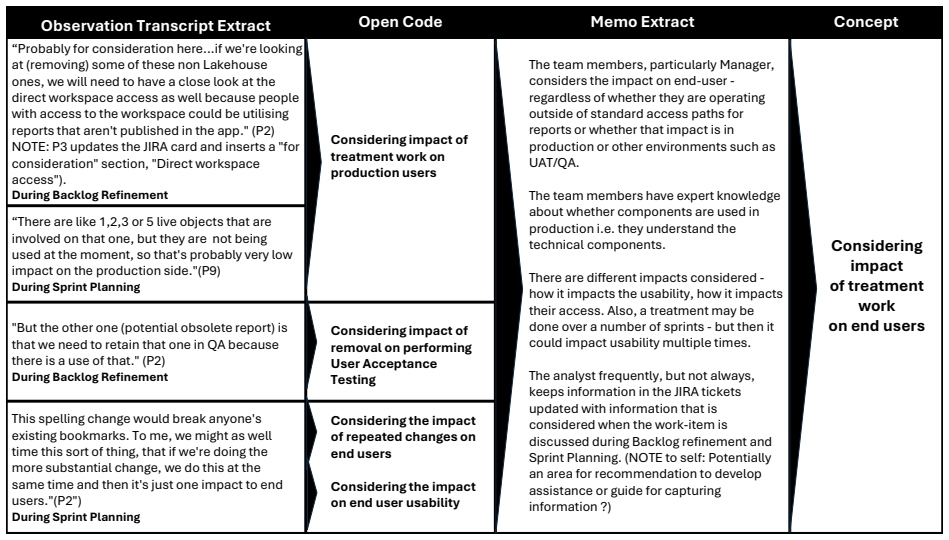
Summary. This paper reports a six-week observational case study of a twelve-member multidisciplinary data-intensive (DI) team delivering an enterprise reporting platform using Scrum. The authors used socio-technical grounded theory (STGT) in a limited application to analyze video-recorded ceremonies, clarification sessions, Slack messages, and screenshots. They identify five technical debt (TD) types observed in the team—technical data component debt, pipeline debt, data communication process debt, data quality debt, and legacy documentation debt—and conceptualize TD management as three categories: Identify and Assess TD (known, anticipated, and unanticipated TD), TD Treatment (refactoring, redevelopment, component removal, quality assurance, knowledge management, environment enhancements, and avoidance), and TD Treatment Work Breakdown (defining treatment, assessing effort/complexity/impact, and splitting/grouping work to fit sprint capacity). The findings are mapped onto existing TD taxonomies, highlighting gaps for DI systems, and the paper derives recommendations for practitioners and researchers. The paper is explicitly framed as a context-specific, exploratory case study, with limitations acknowledged in Section 6.
Significance. If the findings are accepted as credible, this study contributes a rare, richly contextualized account of how a multidisciplinary DI team actually identifies, assesses, and treats technical debt in its day-to-day Scrum ceremonies. Its strengths include the unusually detailed case context, extensive verbatim quotes, a transparent STGT analysis trajectory with worked coding examples, and a member-checking process that confirmed the representativeness of the categories. The proposed distinction between known, anticipated, and unanticipated TD and the sprint-capacity-driven splitting strategies are plausible and well-illustrated, and the careful alignment to Rios et al., Freire et al., and Li et al. reveals genuine conceptual gaps (data quality debt, TD treatment work breakdown) that are worth reporting. The main credibility limitations—single-analyst coding, incomplete coverage of unobserved channels, and an unsupported quantitative claim in Section 2.5—are acknowledged and partially mitigated, but they should be addressed in final revision.
major comments (2)
- [Section 2.5] The claim that 'more than 30% of the observed interactions' concerned TD is not supported by any definition of 'interaction,' any TD-relatedness criterion, or any counting procedure. Because this number is used to justify the study's TD focus, either provide a precise operationalization and the resulting count or remove the numerical claim.
- [Section 3.4.2 and Section 6] The central categories and subcategories rest on open coding performed solely by the first author. While the paper explicitly acknowledges this threat and describes co-author reviews and member checking, it does not report any systematic credibility exercise (e.g., double-coding of a subset, independent sorting of codes, or a structured audit trail of disagreements). Given that the dataset cannot be released, the paper should state explicitly that no inter-rater reliability was computed and should specify how many coding sessions were reviewed by co-authors and what the third author's detailed review actually verified.
minor comments (6)
- [Section 2.5] Consider moving the 'more than 30%' observation from the motivation to the findings (with proper support) or deleting it; as written it is an unsubstantiated quantitative statement in an otherwise qualitative paper.
- [Section 4.2.1] The term 'categoriesed' should be 'categorized'.
- [Section 4.2.3] The term 'conceputalise' should be 'conceptualize'.
- [Section 5.2] The repeated misspelling 'multidisicplinary' should be corrected.
- [Reference list] In the Li, Z., Avgehow riou, P., Liang, P. (2015) entry, the second author's name should read 'Avgeriou'.
- [Section 5.1.2.2] The sentence beginning 'It is possible that Freire et al. consider quality assurance as being implicit...' is speculative; consider rephrasing to report the alignment difficulty more directly.
Circularity Check
No significant circularity: the findings are observationally grounded, and the paper's self-citations are motivational or methodological, not load-bearing for the empirical categories.
full rationale
This is an observational, qualitative case study. There is no derivation chain in which a claimed prediction or result equals its input by construction. The central findings—TD types, contextual assessment, treatments, and treatment work breakdown—are induced from 78 observed sessions (49.5 hours) plus Slack messages, transcripts, screenshots, and worked coding examples. The paper explicitly details the open-coding and memoing process and supports each category with participant quotes. The self-citations to Graetsch et al. (2023) motivate the study and the STGT citations (Hoda 2022, 2024) provide the analysis method; neither determines the empirical content of the categories, which are grounded in observed team interactions and validated through co-author review and member checking. The later alignment of findings to Rios et al. and Freire et al. taxonomies is an interpretive, post-hoc mapping, not a renamed prediction or a fitted parameter disguised as a result. The unsupported 'more than 30%' figure is a reporting and credibility concern, not a circular reduction. No uniqueness theorem is imported from the authors' prior work, and no ansatz is smuggled via citation. Accordingly, no circular step is present, and the paper's central contribution is self-contained relative to its observational evidence.
Assumptions & free parameters
assumptions (3)
- domain assumption Socio-Technical Grounded Theory (STGT) is an appropriate and valid method for analyzing observational qualitative data in this software engineering context.
- domain assumption The 6-week observation window (78 sessions, 49.5 hours) is sufficient to capture recurring technical debt types and management practices in the team.
- domain assumption Participants' behavior in observed ceremonies is sufficiently representative of their normal work practices despite the awareness of being observed.
Cite this review
Pith. "Pith review of Managing Technical Debt in a Multidisciplinary Data Intensive Software Team: an Observational Case Study." pith.science (2026). https://pith.science/paper/5Z2TK4KE
@misc{pith2026250618219,
  author       = {Pith},
  title        = {Pith review of: Managing Technical Debt in a Multidisciplinary Data Intensive Software Team: an Observational Case Study},
  year         = {2026},
  howpublished = {\url{https://pith.science/paper/5Z2TK4KE}},
  note         = {Machine review of arXiv:2506.18219}
}
read the original abstract
Context: There is an increase in the investment and development of data-intensive (DI) solutions, systems that manage large amounts of data. Without careful management, this growing investment will also grow associated technical debt (TD). Delivery of DI solutions requires a multidisciplinary skill set, but there is limited knowledge about how multidisciplinary teams develop DI systems and manage TD. Objective: This research contributes empirical, practice based insights about multidisciplinary DI team TD management practices. Method: This research was conducted as an exploratory observation case study. We used socio-technical grounded theory (STGT) for data analysis to develop concepts and categories that articulate TD and TDs debt management practices. Results: We identify TD that the DI team deals with, in particular technical data components debt and pipeline debt. We explain how the team manages the TD, assesses TD, what TD treatments they consider and how they implement TD treatments to fit sprint capacity constraints. Conclusion: We align our findings to existing TD and TDM taxonomies, discuss their implications and highlight the need for new implementation patterns and tool support for multidisciplinary DI teams.
Figures


Figures from the paper (2 more)


Reference graph
Works this paper leans on
-
[1]
write newline
" write newline "" before.all 'output.state := FUNCTION n.dashify 't := "" t empty not t #1 #1 substring "-" = t #1 #2 substring "--" = not "--" * t #2 global.max substring 't := t #1 #1 substring "-" = "-" * t #2 global.max substring 't := while if t #1 #1 substring * t #2 global.max substring 't := if while FUNCTION word.in bbl.in ":" * " " * FUNCTION f...
-
[2]
author Albarak, M. , author Bahsoon, R. , year 2016 . title Database design debts through examining schema evolution , in: booktitle 2016 IEEE 8th International Workshop on Managing Technical Debt (MTD) , pp. pages 17--23 . :10.1109/MTD.2016.9
-
[3]
author Albarak, M. , author Bahsoon, R. , year 2018 . title Prioritizing technical debt in database normalization using portfolio theory and data quality metrics , in: booktitle Proceedings of the 2018 International Conference on Technical Debt , publisher ACM , address New York, NY, USA . pp. pages 31--40 . :https://doi.org/10.1145/3194164.3194170
-
[4]
author Albarak, M. , author Bahsoon, R. , author Ozkaya, I. , author Nord, R.L. , year 2020 . title Managing technical debt in database normalization . journal IEEE Trans. Softw. Eng. volume 48 , pages 1--1 . :10.1109/TSE.2020.3001339
arXiv 2020
-
[5]
author Albuquerque, D. , author Guimarães, E. , author Tonin, G. , author Rodríguezs, P. , author Perkusich, M. , author Almeida, H. , author Perkusich, A. , author Chagas, F. , year 2023 . title Managing technical debt using intelligent techniques - a systematic mapping study . journal IEEE Trans. Softw. Eng. volume 49 , pages 2202--2220
work page 2023
-
[6]
author Alves, N.S.R. , author Mendes, T.S. , author de Mendonça, M.G. , author Spínola, R.O. , author Shull, F. , author Seaman, C. , year 2016 . title Identification and management of technical debt: A systematic mapping study . journal Inf. Softw. Technol. volume 70 , pages 100--121 . :https://doi.org/10.1016/j.infsof.2015.10.008
-
[7]
author Aniche, M.F. , author Oliva, G.A. , author Gerosa, M.A. , year 2014 . title Are the methods in your data access objects ( DAOs ) in the right place? a preliminary study , in: booktitle 2014 Sixth International Workshop on Managing Technical Debt , publisher IEEE . pp. pages 47--50 . :10.1109/MTD.2014.14
-
[8]
author Avgeriou, P. , author Kruchten, P. , author Ozkaya, I. , author Seaman, C. , year 2016 . title Managing Technical Debt in Software Engineering (Dagstuhl Seminar 16162) . journal Dagstuhl Reports volume 6 , pages 110--138 . :https://doi.org/10.4230/DagRep.6.4.110
Show all 57 references
-
[9]
, author Martini, A
author Besker, T. , author Martini, A. , author Bosch, J. , year 2019 . title Technical debt triage in backlog management , in: booktitle 2019 IEEE/ACM International Conference on Technical Debt (TechDebt) , publisher IEEE . pp. pages 13--22 . :https://doi.org/10.1109/TechDebt...
2019
-
[10]
, author Mistrik, B
author Bruce, R. , author Mistrik, B. , year 2021 . title Knowledge management in the development of data-intensive systems . edition 1st edition ed., publisher Auerbach , address London, England
2021
-
[11]
, year 2014
author Charmaz, K. , year 2014 . title Constructing grounded theory . Introducing qualitative methods. edition 2nd edition ed., publisher Sage
2014
-
[12]
, author Pak, A
author Choi, B. , author Pak, A. , year 2006 . title Multidisciplinarity, interdisciplinarity and transdis-ciplinarity in health research, services, education and policy: 1. definitions, objectives, and evidence of effectiveness . journal Clin Invest Med volume 29 , pages 351--364
2006
-
[13]
, year 2008
author Corbin, J.M. , year 2008 . title Basics of qualitative research : techniques and procedures for developing grounded theory. edition 3e [ed.] / juliet corbin, anselm strauss. ed
2008
-
[14]
, year 1992
author Cunningham, W. , year 1992 . title The wycash portfolio management system . journal SIGPLAN OOPS Mess. volume 4 , pages 29–30 . :https://doi.org/10.1145/157710.157715
1992
-
[15]
, author Michelsen, C.B
author Dittrich, Y. , author Michelsen, C.B. , author Tell, P. , author Lous, P. , author Ebdrup, A. , year 2020 . title Exploring the evolution of software practices , in: booktitle Proceedings of the 28th ACM Joint Meeting on European Software Engineering Conference and Symp...
2020
-
[16]
, year 2019
author Fetterman, D.M. , year 2019 . title Ethnography: Step-by-step . publisher Sage publications
2019
-
[17]
, author Felderer, M
author Foidl, H. , author Felderer, M. , author Biffl, S. , year 2019 . title Technical debt in data-intensive software systems , in: booktitle 2019 45th Euromicro Conference on Software Engineering and Advanced Applications (SEAA) , pp. pages 338--341 . :10.1109/SEAA.2019.00058
2019
-
[18]
, author Golendukhina, V
author Foidl, H. , author Golendukhina, V. , author Ramler, R. , author Felderer, M. , year 2024 . title Data pipeline quality: Influencing factors, root causes of data-related issues, and processing problem areas for developers . journal J. Syst. Softw. volume 207 , pages 111855
2024
-
[19]
title Technology big data analytics market - market research report summary
Fortune, 2023, year 2023 . title Technology big data analytics market - market research report summary . https://www.fortunebusinessinsights.com/big-data- analytics-market-106179. note accessed on: 2024-07-28
2023
-
[20]
, author Rios, N
author Freire, S. , author Rios, N. , author Pérez, B. , author Castellanos, C. , author Correal, D. , author Ramač, R. , author Mandić, V. , author Taušan, N. , author López, G. , author Pacheco, A. , author Mendonça, M. , author Falessi, D. , author Izurieta, C. , author Sea...
2023
-
[21]
, author Strauss, A.L
author Glaser, B. , author Strauss, A.L. , year 2017 . title The discovery of grounded theory : strategies for qualitative research . publisher Sociology Press
2017
-
[22]
, author Khalajzadeh, H
author Graetsch, U.M. , author Khalajzadeh, H. , author Shahin, M. , author Hoda, R. , author Grundy, J. , year 2023 . title Dealing with data challenges when delivering data-intensive software solutions . journal IEEE Transactions on Software Engineering volume 49 , pages 434...
2023
-
[23]
, author Spínola, R.O
author Guo, Y. , author Spínola, R.O. , author Seaman, C. , year 2016 . title Exploring the costs of technical debt management – a case study . journal Empir. Softw. Eng. volume 21 , pages 159--182 . :https://doi.org/10.1007/s10664-014-9351-7
2016 doi
-
[24]
, year 2022
author Gupta, A. , year 2022 . title Why fusion teams matter . publisher Gartner . https://www.gartner.com/en/articles/why-fusion-teams- matter. note access: 2024-07-28
2022
-
[25]
, year 2020
author Hammersley, M. , year 2020 . title Ethics of ethnography , in: booktitle Handbook of Research Ethics and Scientific Integrity . publisher Springer International Publishing , address Cham , pp. pages 445--457
2020
-
[26]
, year 2022
author Hoda, R. , year 2022 . title Socio-technical grounded theory for software engineering . journal IEEE Transactions on Software Engineering volume 48 , pages 3808--3832 . :https://doi.org/10.1109/TSE.2021.3106280
2022
-
[27]
, year 2024
author Hoda, R. , year 2024 . title Qualitative Research with Socio-Technical Grounded Theory - A Practical Guide to Qualitative Data Analysis and Theory Development in the Digital World . publisher Springer (Releasing 2024)
2024
-
[28]
, author Johnston, L.H
author Hutchison, A.J. , author Johnston, L.H. , author Breckon, J.D. , year 2010 . title Using qsr-nvivo to facilitate the development of a grounded theory project: an account of a worked example . journal International journal of social research methodology volume 13 , pages...
2010
-
[29]
, year 2021
author Kenyon, T. , year 2021 . title Big data and business analytics to hit US \ 275B in 2022 . publisher AI Magazine . https://aimagazine.com/data-and-analytics/ big-data-and-business-analytics-hit-usdollar274bn-2022. note accessed on: 2024-07-28
2021
-
[30]
, author Margy, R
author Kimball, R. , author Margy, R. , author Warren, T. , author Joy, M. , author Bob, B. , year 2008 . title The data warehouse lifecycle toolkit . edition Second edition. ed., publisher Wiley. , address Indianapolis, Ind
2008
-
[31]
, author Batchelor, A
author Kleinwaks, H. , author Batchelor, A. , author Bradley, T.H. , year 2023 . title Technical debt in systems engineering—a systematic literature review . journal Syst. Eng. volume 26 , pages 675--687 . :https://doi.org/10.1002/sys.21681
2023 doi
-
[32]
, author Soliman, M
author Li, Y. , author Soliman, M. , author Avgeriou, P. , author Somers, L. , year 2023 . title Self-admitted technical debt in the embedded systems industry: An exploratory case study . journal IEEE Trans. Softw. Eng. volume 49 , pages 2545--2565
2023
-
[33]
, author Avgehow riou, P
author Li, Z. , author Avgehow riou, P. , author Liang, P. , year 2015 . title A systematic mapping study on technical debt and its management . journal J. Syst. Softw. volume 101 , pages 193--220 . :https://doi.org/10.1016/j.jss.2014.12.027
2015 doi
-
[34]
, year 2004
author Mayo, E. , year 2004 . title The human problems of an industrial civilization . publisher Routledge
2004
- [35]
-
[36]
, author Nagy, C
author Muse, B.A. , author Nagy, C. , author Cleve, A. , author Khomh, F. , author Antoniol, G. , year 2022 b. title FIXME : synchronize with database! an empirical study of data access self-admitted technical debt . journal Empir. Softw. Eng. volume 27 , pages 1--42 . :https:...
2022 doi
-
[37]
, year 2015
author Nippert-Eng, C. , year 2015 . title Watching closely: A guide to ethnographic observation . publisher Oxford University Press
2015
-
[38]
, author Castellanos, C
author Pérez, B. , author Castellanos, C. , author Correal, D. , author Rios, N. , author Freire, S. , author Spínola, R. , author Seaman, C. , author Izurieta, C. , year 2021 . title Technical debt payment and prevention through the lenses of software architects . journal Inf...
2021
-
[39]
, author Pecorelli, F
author Recupito, G. , author Pecorelli, F. , author Catolino, G. , author Lenarduzzi, V. , author Taibi, D. , author Di Nucci , D. , author Palomba, F. , year 2024 . title Technical debt in ai-enabled systems: On the prevalence, severity, impact, and management strategies for ...
2024
-
[40]
, author Mendonça Neto, M.G.d
author Rios, N. , author Mendonça Neto, M.G.d. , author Spínola, R.O. , year 2018 . title A tertiary study on technical debt: Types, management strategies, research trends, and base information for practitioners . journal Inf. Softw. Technol. volume 102 , pages 117--145 . :htt...
2018 doi
-
[41]
, author Host, M
author Runeson, P. , author Host, M. , author Rainer, A. , author Regnell, B. , year 2012 . title Case Study Research in Software Engineering: Guidelines and Examples . edition 1. ed., publisher Wiley , address Newark
2012
-
[42]
, author Holt, G
author Sculley, D. , author Holt, G. , author Golovin, D. , author Davydov, E. , author Phillips, T. , author Ebner, D. , author Chaudhary, V. , author Young, M. , author Crespo, J.F. , author Dennison, D. , year 2015 . title Hidden technical debt in machine learning systems ....
2015
-
[43]
, author Guo, Y
author Seaman, C. , author Guo, Y. , year 2011 . title Chapter 2 - measuring and monitoring technical debt , in: editor Zelkowitz, M.V. (Ed.), booktitle Advances in Computers . publisher Elsevier . volume volume 82 of series Advances in Computers , pp. pages 25--46 . :https://...
2011 doi
-
[44]
, author Harrold, M.J
author Shah, H. , author Harrold, M.J. , author Sinha, S. , year 2014 . title Global software testing under deadline pressure: Vendor-side experiences . journal Information and Software Technology volume 56 , pages 6--19 . :https://doi.org/10.1016/j.infsof.2013.04.005
2014 doi
-
[45]
, author Dittrich, Y
author Sharp, H. , author Dittrich, Y. , author de Souza, C.R.B. , year 2016 . title The role of ethnographic studies in empirical software engineering . journal IEEE Transactions on Software Engineering volume 42 , pages 786--804 . :https://doi.org/10.1109/TSE.2016.2519887
2016
-
[46]
, author Robinson, H
author Sharp, H. , author Robinson, H. , year 2004 . title An ethnographic study of xp practice . journal Empirical Software Engineering volume 9 , pages 353--375 . :https://doi.org/10.1023/B:EMSE.0000039884.79385.54
2004
-
[47]
, author Kalles, D
author Sklavenitis, D. , author Kalles, D. , year 2024 . title Measuring technical debt in ai-based competition platforms . https://arxiv.org/abs/2405.11825, http://arxiv.org/abs/2405.11825 arXiv:2405.11825
2024 arXiv
-
[48]
, author Kan, M
author Soliman, J. , author Kan, M. , year 2004 . title Grounded theory and nvivo: wars and wins , in: booktitle International conference on qualitative research in IT & IT in Qualitative Research , pp. pages 24--26
2004
-
[49]
, year 2016
author Spradley, J.P. , year 2016 . title Participant observation . publisher Waveland Press
2016
-
[50]
, author Ernst, N.A
author Storey, M.A. , author Ernst, N.A. , author Williams, C. , author Kalliamvakou, E. , year 2020 . title The who, what, how of software engineering research: a socio-technical framework . journal Empir. Softw. Eng. volume 25 , pages 4097--4129 . :https://doi.org/10.1007/s1...
2020 doi
-
[51]
, author Lee, B.G
author Tang, H. , author Lee, B.G. , author Towey, D. , author Chen, K. , author Fang, Y. , author Zhang, R. , author Pike, M. , year 2024 . title The audience effect: Do observations change outcomes in hci studies? , in: booktitle 2024 IEEE 48th Annual Computers, Software, an...
2024 arXiv
-
[52]
, author Khatchadourian, R
author Tang, Y. , author Khatchadourian, R. , author Bagherzadeh, M. , author Singh, R. , author Stewart, A. , author Raja, A. , year 2021 . title An empirical study of refactorings and technical debt in machine learning systems , in: booktitle 2021 IEEE/ACM 43rd International...
2021
-
[53]
, author Aurum, A
author Tom, E. , author Aurum, A. , author Vidgen, R. , year 2013 . title An exploration of technical debt . journal J. Syst. Softw. volume 86 , pages 1498--1516 . :https://doi.org/10.1016/j.jss.2012.12.052
2013 doi
-
[54]
, author Rinker, F
author Waltersdorfer, L. , author Rinker, F. , author Kathrein, L. , author Biffl, S. , year 2020 . title Experiences with technical debt and management strategies in production systems engineering , in: booktitle Proceedings of the 3rd International Conference on Technical De...
2020
-
[55]
, author Cleve, A
author Weber, J.H. , author Cleve, A. , author Meurice, L. , author Bermudez Ruiz, F.J. , year 2014 . title Managing technical debt in database schemas of critical software , in: booktitle 2014 Sixth International Workshop on Managing Technical Debt , publisher IEEE . pp. page...
2014 doi
-
[56]
, year 2021
author Wohlin, C. , year 2021 . title Case study research in software Engineering—It is a case, and it is a study, but is it a case study? journal Inf. Softw. Technol. volume 133 , pages 106514 . :https://doi.org/10.1016/j.infsof.2021.106514
2021
-
[57]
, author dos Santos, R
author Xavier, L. , author dos Santos, R. , author Bessa, S. , author Tulio Valente, M. , year 2023 . title Agile technical debt management using the LTD framework . journal Softw. Eng. Notes volume 49 , pages 13--23 . :https://doi.org/10.1145/3635439.3635443
2023
Reviewed August 6, 2026 · model on record in the stance chip above.
Discussion (0). Continue with ORCID to comment.