REVIEW 4 major objections 6 minor 37 references
Phase transitions and composite order in $\mathrm{U}(1)^N$ lattice London models
T0 review · 4 major / 6 minor · reviewed 2026-08-14 · deepseek-v4-flash
Pith's one-line read First-order transition survives to N=7 in the U(1)^N London model
desk verdict Solid MC study of N=2-4 first-order transitions; the N=5-7 claim is real but under-supported by the reported data. read the letter →
The pith
A machine-rendered reading of the paper's core claim, the machinery that carries it, and where it could break.
The reading
What carries the argument
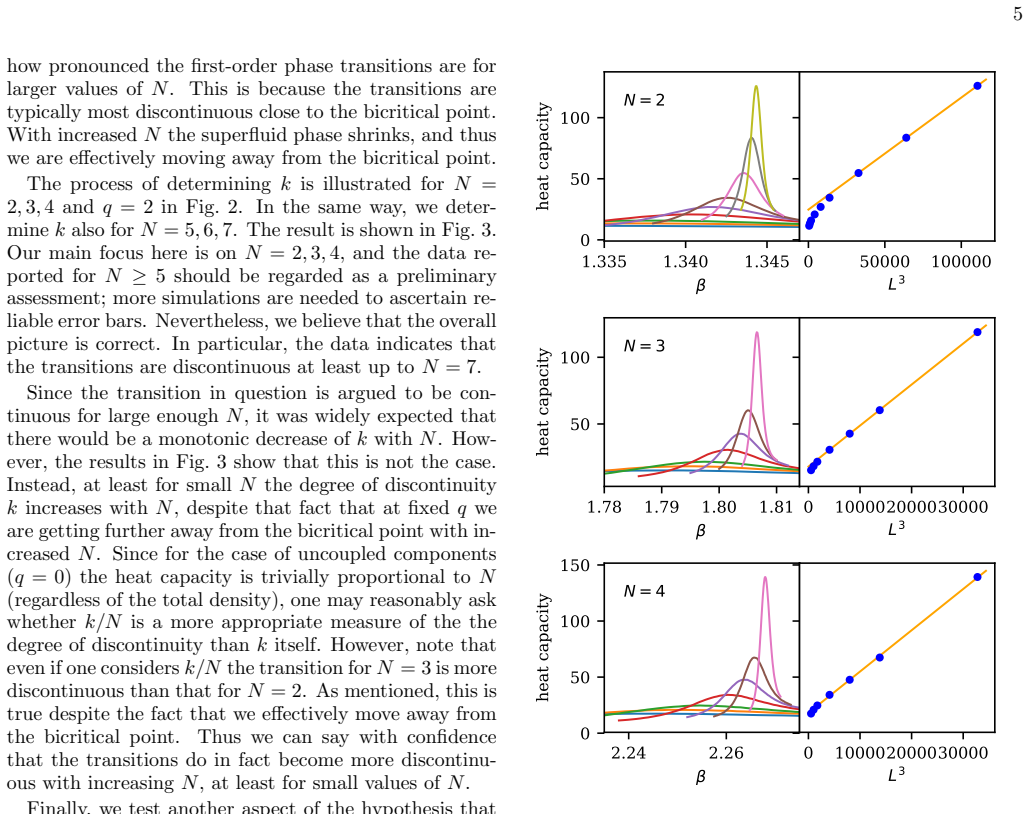
The central object is the U(1)^N lattice London model, N equal-amplitude complex fields on a three-dimensional cubic lattice coupled to a non-compact U(1) gauge field, whose vortices are labeled by tuples of winding numbers; composite vortices with winding in every component carry finite energy per length, while fractional vortices are logarithmically confined. The argument is carried by two numerical diagnostics: the dual stiffness and helicity modulus, whose finite-size crossings locate the charged and neutral transitions, and the finite-size scaling of the heat-capacity maximum, cmax = $kL^{3}$ + m, whose asymptotic slope k measures the latent-heat strength of a first-order transition. Bimodality of energy histograms that sharpens with system size identifies discontinuous transitions, and the duality mapping to directed loops supplies the physical mechanism: composite loops act as bound states of charged strings and attract via van der Waals-type forces.
What would settle it
Run the same q=2 simulations for N=5,6,7 on larger lattices (L=40,48,64) and check whether the heat-capacity maximum continues to grow linearly with $L^{3}$ at the same fitted slope and whether energy histograms remain bimodal; if the growth flattens or the histograms become unimodal, the first-order claim for those N fails.
Extended reading notes
Core claim
The central claim is that the direct, fully ordered to fully disordered transition in the U(1)^N lattice London model is first order at least up to N=7, contradicting the expectation, based on renormalization-group studies, that transitions become continuous once N is large. At fixed charge q=2, the fitted slope k of the heat-capacity maximum versus $L^{3}$ increases with N up to N=4 and then decreases, so the first-order character does not monotonically weaken with more components. For N>2, at sufficiently large coupling the superconducting and superfluid transitions split, producing a phase with composite order in phase differences only; for N=3 and N=4 the neutral transition from that composite-order phase to the disordered state is also first order, as evidenced by progressively bimodal energy distributions. The paper interprets these results through a duality in which the relevant proliferating objects are composite directed vortex loops, whose van der Waals-type attraction can drive discontinuous transitions.
Load-bearing premise
The claim that the transition is first order up to N=7 rests on assuming that for each N the heat-capacity maximum over the simulated sizes (L up to 32) already follows the asymptotic first-order scaling cmax ~ $kL^{3}$ + m; for N=5,6,7 the paper itself says more simulations are needed for reliable error bars.
Editorial extensions
If this is right
- If the claim holds, no U(1)^N lattice London model with N between 2 and 7 has a continuous direct ordering transition at q=2, so the search for continuous transitions must focus on larger N or different symmetry groups.
- The increasing k with N up to N=4 means adding components initially makes the transition more abrupt, not less, so early renormalization-group intuition about large-N continuity does not apply at small N.
- For N>2 and large coupling, a composite-order superfluid phase exists that cannot be interpreted as real-space pairing; its transition to the disordered state is first order for N=3 and N=4.
- The van der Waals-type mechanism predicts first-order behavior whenever proliferation of composite directed loops drives a transition, so other transitions involving composite vortices should also be discontinuous.
- The saturation of the charged transition temperature and the shrinking of the composite-order phase with N give quantitative targets for locating a possible continuous transition at higher N.
Reading between the lines
- I infer that the downturn in k after N=4 may be a finite-size artifact rather than a physical approach to a continuous transition, since the paper's own error bars for N>=5 are preliminary; larger lattices would distinguish these.
- If van der Waals-type attraction between composite loops is the true driver, then varying the loop interaction range through Josephson or other short-range couplings should move the tricritical point in a predictable way, a test the paper does not perform.
- A natural extension would be to fix the distance from the bicritical point rather than fixing q, since the paper's fixed-q comparison underestimates discontinuity for larger N; this could reveal whether the nonmonotonic trend persists.
- The composite-order phase for N>2, with non-conserved counterflow, may have observable consequences for multicomponent superconductors, such as specific-heat signatures or fluctuation regimes, that go beyond what the paper computes.
Signed reviews
Editorial analysis
A structured set of objections, weighed in public.
Referee Report
Summary. The paper studies the 3D U(1)^N lattice London model with equal-density components by Monte Carlo simulation, using dual stiffness, helicity moduli, energy histograms, and finite-size scaling of the specific-heat peak. For N = 2, 3, 4 it maps phase diagrams and identifies, at large coupling, a split between the neutral and charged transitions and an intermediate phase with only composite (phase-difference) order. The main quantitative claim is that the direct ordered-to-disordered transition is first order at least up to N = 7, with a discontinuity strength k that first increases (up to N = 4) and then decreases. The paper also claims that the transition from the composite-order phase to the disordered phase is first order for N = 3, 4, based on bimodal energy histograms, and it proposes a duality-based van der Waals interaction mechanism as the origin of the first-order behavior.
Significance. If the results hold, the paper provides a nontrivial counterpoint to large-N renormalization-group expectations: the direct U(1)^N transition becomes more discontinuous with N for small N, rather than less, and it identifies a distinctive composite-order superfluid regime for N > 2. The numerical methodology is standard and direct, with parallel tempering, Ferrenberg-Swendsen reweighting, and bootstrap error estimation; these are appropriate tools for the problem. However, the part of the central claim that extends to N = 5, 6, 7 is explicitly labeled preliminary by the authors and is not backed by an independent first-order diagnostic, so the headline conclusion currently exceeds the evidence. The van der Waals mechanism is a clearly labeled conjecture and is not used to produce any fitted quantity, which is appropriate.
major comments (4)
- [Section IV, Fig. 3] The statement that the direct transition is first order 'at least up to N = 7' is not supported by the evidence presented for N = 5, 6, 7. The text in Section IV explicitly describes these data as a 'preliminary assessment' and notes that 'more simulations are needed to ascertain reliable error bars.' The only diagnostic reported for these N is the fitted slope k in c_max = kL^3 + m over lattice sizes up to L = 32. For a weak first-order transition, the asymptotic L^3 scaling of c_max sets in only for L much larger than the correlation length; for a continuous transition with strong finite-size corrections, a positive slope over a finite L window can mimic the same signature. No independent first-order diagnostic (bimodal energy histogram, Binder energy cumulant, latent-heat estimate, or interface tension) is provided for N >= 5. I therefore regard the N >= 5 part of the headline claim as unestablished; the authors should either add the missing data and diagnostics or explicitly restrict the central claim to N <= 4.
- [Section III.C and Fig. 2] For the claimed quantitative trend, the slope k is estimated from very few system sizes: for N = 3 and 4, only the four largest sizes in the range L = 8-32 (namely L = 16, 20, 24, 32) are used, and for N = 2 only three sizes (L = 32, 40, 48). Figure 3 shows k without error bars, and the statement in the Fig. 2 caption that errors are smaller than symbol sizes does not quantify the uncertainty in the fitted slopes. Because the increasing-then-decreasing trend of k(N) is a central result, the authors should report bootstrap or fitting uncertainties on k and verify that the fitted value is stable when the number of fitted points and the lower L cutoff are varied.
- [Section V] The conclusion states that 'the phase transition is first order up to N = 7', which is stronger than the abstract's 'suggest' and inconsistent with the preliminary-status caveat in Section IV. The sentence 'for 5<N<7 we do not observe the same growing degree of discontinuity' is also unclear; as written it refers only to N = 6. The abstract, the results section, and the conclusion should be brought into agreement on how much of the N >= 5 claim is established.
- [Section IV, Fig. 4] The claim that all neutral transitions for N = 3 and N = 4 show bimodal energy distributions is supported in the paper by a single illustrative histogram (N = 3, q = 6). Since the discontinuity of the composite-order-to-disordered transition is a central new result, the authors should either show the corresponding histograms or a summary statistic (e.g., a Binder energy cumulant minimum that deepens with L) for all the neutral transitions in the phase diagrams.
minor comments (6)
- [Section III.B] There is a typo in the sentence 'From this is follows that Lρ is a universal quantity': the quantity that should scale as 1/L at a continuous superfluid transition is the helicity modulus Υ, so the text should read 'LΥ' rather than 'Lρ'.
- [Abstract/Introduction and Conclusion] The phrase 'neutral and changed sectors' should be 'neutral and charged sectors', and 'Ablelian' in the conclusion should be 'Abelian'.
- [Section V] The expression 'for 5<N<7' should be 'for N = 5, 6, 7' or 'for 5 ≤ N ≤ 7' to match the intended range of component numbers.
- [Fig. 3] The figure should include error bars on the plotted values of k, or an explicit statement that the uncertainties are smaller than the symbol size.
- [Section III.B] The derivation of the helicity modulus is delegated to a concurrently published paper; including the final explicit expression for Υ in terms of derivatives of the lattice Hamiltonian would make the present manuscript self-contained.
- [Fig. 1] The phase diagrams in Fig. 1 are shown only for N = 2, 3, 4; statements in the text about the behavior for larger N should be clearly separated from the data shown in the figure.
Circularity Check
No significant circularity: the conclusions are direct Monte Carlo measurements with clearly stated diagnostics.
full rationale
The paper's central claims rest on direct numerical measurements rather than on fitted inputs disguised as predictions. The order of the transition is assessed from standard observables: the dual stiffness L*rho for locating superconducting transitions, the helicity modulus for superfluid transitions, bimodal energy histograms for discontinuous transitions, and the finite-size scaling of the heat-capacity maximum c_max = kL^3 + m. The parameter k is defined as the fitted asymptotic slope of c_max and is used as a diagnostic of discontinuity strength; it is not fitted to one subset of data and then presented as a prediction of a closely related quantity. The paper also explicitly cautions that the N=5-7 data are a 'preliminary assessment' and that 'more simulations are needed to ascertain reliable error bars,' which is a statistical-evidence concern rather than a circularity. The van der Waals-type interaction statement is introduced via duality as a conjecture and is not used to produce any numerical result. Self-citations, including Ref. 23 on van der Waals forces and Refs. 34-35 for vortex notation and duality, provide background and interpretation, but the load-bearing numerical evidence is self-contained Monte Carlo data. No equation in the derivation chain reduces by construction to its own inputs, and no fitted parameter is renamed as a prediction. Accordingly, the circularity score is 0.
Assumptions & free parameters
assumptions (5)
- domain assumption The lattice London model (Eq. 4) with the given normalization faithfully represents the continuum model (Eq. 1) for the studied temperatures and couplings.
- standard math The duality mapping of Refs. [5,6,35] correctly relates the statistical mechanics of directed vortex loops to interacting loop gases, including the van der Waals interpretation.
- standard math The finite-size scaling of the heat capacity maximum c_max = kL^3 + m for first-order transitions (Ref. 38) applies for the system sizes considered.
- domain assumption The single-temperature observables (dual stiffness, helicity modulus) correctly locate the two transitions in the presence of a first-order transition.
- domain assumption The identification of the superfluid phase for N>2 via the effective Hamiltonian (Eq. 12) assumes the phase differences are the only relevant low-energy degrees of freedom.
Cite this review
Pith. "Pith review of Phase transitions and composite order in $\mathrm{U}(1)^N$ lattice London models." pith.science (2026). https://pith.science/paper/5ZGXRH3T
@misc{pith2026190810850,
  author       = {Pith},
  title        = {Pith review of: Phase transitions and composite order in $\mathrmU(1)^N$ lattice London models},
  year         = {2026},
  howpublished = {\url{https://pith.science/paper/5ZGXRH3T}},
  note         = {Machine review of arXiv:1908.10850}
}
abstract
The phase diagrams and the nature of the phase transitions in multicomponent gauge theories with an Abelian gauge field are important topics with various physical applications. While an early renormalization-group-based study indicated that the direct transition from a fully ordered to a fully disordered state is continuous for $N = 1$ and $N > 183$, recently it was demonstrated that the transition is discontinuous for $N = 2$. We quantitatively study the dependence on $N$ of the degree of discontinuity of this transition. Our results suggest that the transition is discontinuous at least up to $N = 7$. Furthermore, we demonstrate that, at increased coupling strength, the phase transitions of the neutral and charged sectors of the model split, which for $N > 2$ yields a new phase with composite order. The transition from the composite-order phase to the fully disordered phase is then also discontinuous, at least for $N = 3$ and $N = 4$. Via a duality argument, this indicates that van der Waals-type interaction between directed loops may be responsible for the discontinuous phase transitions in these models.
Figures


Figures from the paper (1 more)

Reference graph
Works this paper leans on
-
[1]
author author V. L. \ Ginzburg \ and\ author L. D. \ Landau ,\ @noop journal journal Zh. Eksp. Teor. Fiz. \ volume 20 ,\ pages 1064 ( year 1950 ) NoStop
work page 1950
-
[2]
author author J. Bardeen , author L. N. \ Cooper , \ and\ author J. R. \ Schrieffer ,\ 10.1103/PhysRev.108.1175 journal journal Phys. Rev. \ volume 108 ,\ pages 1175 ( year 1957 ) NoStop
-
[3]
author author S. Coleman \ and\ author E. Weinberg ,\ 10.1103/PhysRevD.7.1888 journal journal Phys. Rev. D \ volume 7 ,\ pages 1888 ( year 1973 ) NoStop
-
[4]
author author B. I. \ Halperin , author T. C. \ Lubensky , \ and\ author S.-k. \ Ma ,\ 10.1103/PhysRevLett.32.292 journal journal Phys. Rev. Lett. \ volume 32 ,\ pages 292 ( year 1974 ) NoStop
-
[5]
author author M. E. \ Peskin ,\ 10.1016/0003-4916(78)90252-X journal journal Annals of Physics \ volume 113 ,\ pages 122 ( year 1978 ) NoStop
-
[6]
author author C. Dasgupta \ and\ author B. Halperin ,\ 10.1103/PhysRevLett.47.1556 journal journal Phys. Rev. Lett. \ volume 47 ,\ pages 1556 ( year 1981 ) NoStop
-
[7]
author author A. K. \ Nguyen \ and\ author A. Sudb ,\ 10.1103/PhysRevB.57.3123 journal journal Phys. Rev. B \ volume 57 ,\ pages 3123 ( year 1998 ) NoStop
-
[8]
author author H. Kleinert ,\ 10.1007/BF02754760 journal journal Lettere al Nuovo Cimento (1971-1985) \ volume 35 ,\ pages 405 ( year 1982 ) NoStop
Show all 37 references
-
[9]
Bartholomew ,\ 10.1103/PhysRevB.28.5378 journal journal Phys
author author J. Bartholomew ,\ 10.1103/PhysRevB.28.5378 journal journal Phys. Rev. B \ volume 28 ,\ pages 5378 ( year 1983 ) NoStop
1983 doi
-
[10]
author author I. F. \ Herbut \ and\ author Z. Te s s anovi c \' c ,\ 10.1103/PhysRevLett.76.4588 journal journal Phys. Rev. Lett. \ volume 76 ,\ pages 4588 ( year 1996 ) NoStop
1996 doi
-
[11]
Mo , author J
author author S. Mo , author J. Hove , \ and\ author A. Sudb ,\ 10.1103/PhysRevB.65.104501 journal journal Phys. Rev. B \ volume 65 ,\ pages 104501 ( year 2002 ) NoStop
2002 doi
-
[13]
Senthil , author A
author author T. Senthil , author A. Vishwanath , author L. Balents , author S. Sachdev , \ and\ author M. P. A. \ Fisher ,\ 10.1126/science.1091806 journal journal Science \ volume 303 ,\ pages 1490 ( year 2004 a ) NoStop
2004 doi
-
[14]
Senthil , author L
author author T. Senthil , author L. Balents , author S. Sachdev , author A. Vishwanath , \ and\ author M. P. A. \ Fisher ,\ 10.1103/PhysRevB.70.144407 journal journal Phys. Rev. B \ volume 70 ,\ pages 144407 ( year 2004 b ) NoStop
2004 doi
-
[15]
Chen , author Y
author author K. Chen , author Y. Huang , author Y. Deng , author A. Kuklov , author N. Prokof'ev , \ and\ author B. Svistunov ,\ @noop journal journal Physical review letters \ volume 110 ,\ pages 185701 ( year 2013 ) NoStop
2013
-
[16]
Kuklov , author N
author author A. Kuklov , author N. Prokof'ev , \ and\ author B. Svistunov ,\ @noop title Ginzburg-landau-wilson aspect of deconfined criticality , \ ( year 2005 ),\ http://arxiv.org/abs/arXiv:cond-mat/0501052 arXiv:cond-mat/0501052 NoStop
2005 arXiv
-
[17]
Kuklov , author N
author author A. Kuklov , author N. Prokof'ev , author B. Svistunov , \ and\ author M. Troyer ,\ 10.1016/j.aop.2006.04.007 journal journal Annals of Physics \ volume 321 ,\ pages 1602 ( year 2006 ) ,\ note july 2006 Special Issue NoStop
2006 doi
-
[18]
Herland , author E
author author E. Herland , author E. Babaev , \ and\ author A. Sudb ,\ 10.1103/PhysRevB.82.134511 journal journal Phys. Rev. B \ volume 82 ,\ pages 134511 ( year 2010 ) NoStop
2010 doi
-
[19]
author author O. I. \ Motrunich \ and\ author A. Vishwanath ,\ https://arxiv.org/abs/0805.1494 journal journal arXiv \ ( year 2008 ) ,\ http://arxiv.org/abs/0805.1494v1 0805.1494v1 NoStop
2008 arXiv
-
[20]
author author A. B. \ Kuklov , author M. Matsumoto , author N. V. \ Prokof'ev , author B. V. \ Svistunov , \ and\ author M. Troyer ,\ 10.1103/PhysRevLett.101.050405 journal journal Phys. Rev. Lett. \ volume 101 ,\ pages 050405 ( year 2008 a ) NoStop
-
[21]
Kuklov , author M
author author A. Kuklov , author M. Matsumoto , author N. Prokof'ev , author B. Svistunov , \ and\ author M. Troyer ,\ https://arxiv.org/abs/0805.2578v1 journal journal arXiv \ ( year 2008 b ) ,\ http://arxiv.org/abs/0805.2578v1 0805.2578v1 NoStop
2008 arXiv
-
[22]
author author E. V. \ Herland , author T. A. \ Bojesen , author E. Babaev , \ and\ author A. Sudb ,\ 10.1103/PhysRevB.87.134503 journal journal Phys. Rev. B \ volume 87 ,\ pages 134503 ( year 2013 ) NoStop
2013 doi
-
[23]
author author K. A. H. \ Sellin \ and\ author E. Babaev ,\ 10.1103/PhysRevB.93.054524 journal journal Phys. Rev. B \ volume 93 ,\ pages 054524 ( year 2016 ) NoStop
2016 doi
-
[24]
author author P. N. \ Galteland \ and\ author A. Sudb ,\ @noop journal journal Physical Review B \ volume 94 ,\ pages 054518 ( year 2016 ) NoStop
2016
-
[25]
Meier , author E
author author H. Meier , author E. Babaev , \ and\ author M. Wallin ,\ 10.1103/PhysRevB.91.094508 journal journal Phys. Rev. B \ volume 91 ,\ pages 094508 ( year 2015 ) NoStop
2015 doi
-
[26]
Fejos \ and\ author T
author author G. Fejos \ and\ author T. Hatsuda ,\ 10.1103/PhysRevD.93.121701 journal journal Phys. Rev. D \ volume 93 ,\ pages 121701 ( year 2016 ) NoStop
2016 doi
-
[27]
Fejos \ and\ author T
author author G. Fejos \ and\ author T. Hatsuda ,\ https://arxiv.org/abs/1705.07333 journal journal arXiv \ ( year 2017 ) ,\ http://arxiv.org/abs/1705.07333v1 1705.07333v1 NoStop
2017 arXiv
-
[28]
author author F. S. \ Nogueira \ and\ author A. Sudb ,\ @noop journal journal EPL (Europhysics Letters) \ volume 104 ,\ pages 56004 ( year 2013 ) NoStop
2013
-
[29]
Ihrig , author N
author author B. Ihrig , author N. Zerf , author P. Marquard , author I. F. \ Herbut , \ and\ author M. M. \ Scherer ,\ @noop journal journal arXiv preprint arXiv:1907.08140 \ ( year 2019 ) NoStop
1907 arXiv
-
[30]
Gorbenko , author S
author author V. Gorbenko , author S. Rychkov , \ and\ author B. Zan ,\ @noop journal journal Journal of High Energy Physics \ volume 2018 ,\ pages 108 ( year 2018 ) NoStop
2018
-
[31]
Babaev ,\ @noop title Phase diagram of planar U(1) U(1) superconductor
author author E. Babaev ,\ @noop title Phase diagram of planar U(1) U(1) superconductor . Condensation of vortices with fractional flux and a superfluid state , \ ( year 2004 ),\ http://arxiv.org/abs/cond-mat/0201547 cond-mat/0201547 NoStop
2004 arXiv
-
[32]
Babaev , author A
author author E. Babaev , author A. Sudb , \ and\ author N. Ashcroft ,\ @noop journal journal Nature \ volume 431 ,\ pages 666 ( year 2004 ) NoStop
2004
-
[33]
Sm rgrav , author E
author author E. Sm rgrav , author E. Babaev , author J. Smiseth , \ and\ author A. Sudb ,\ @noop journal journal Physical review letters \ volume 95 ,\ pages 135301 ( year 2005 ) NoStop
2005
-
[34]
Babaev ,\ 10.1103/PhysRevLett.89.067001 journal journal Phys
author author E. Babaev ,\ 10.1103/PhysRevLett.89.067001 journal journal Phys. Rev. Lett. \ volume 89 ,\ pages 067001 ( year 2002 ) NoStop
2002 doi
-
[35]
Svistunov , author E
author author B. Svistunov , author E. Babaev , \ and\ author N. Prokofev ,\ @noop title Superfluid States of Matter \ ( publisher CRC Press ,\ year 2015 ) NoStop
2015
-
[36]
author author A. M. \ Ferrenberg \ and\ author R. H. \ Swendsen ,\ 10.1103/PhysRevLett.61.2635 journal journal Phys. Rev. Lett. \ volume 61 ,\ pages 2635 ( year 1988 ) NoStop
1988 doi
-
[37]
Carlstr\"om \ and\ author E
author author J. Carlstr\"om \ and\ author E. Babaev ,\ 10.1103/PhysRevB.91.140504 journal journal Phys. Rev. B \ volume 91 ,\ pages 140504 ( year 2015 ) NoStop
2015 doi
-
[38]
author author M. S. S. \ Challa , author D. P. \ Landau , \ and\ author K. Binder ,\ 10.1103/PhysRevB.34.1841 journal journal Phys. Rev. B \ volume 34 ,\ pages 1841 ( year 1986 ) NoStop
1986 doi
Reviewed August 14, 2026 · model on record in the stance chip above.
Discussion (0). Continue with ORCID to comment.