Detector-Conditioned Source-Space Nulls and Null-Mask Loss in a Programmable Two-Slit Interferometer
Pith reviewed 2026-06-29 04:51 UTC · model grok-4.3
The pith
In a time-reversed Afshar setup, source-space nulls obey standard complementarity via detector-conditioned response.
A machine-rendered reading of the paper's core claim, the machinery that carries it, and where it could break.
Core claim
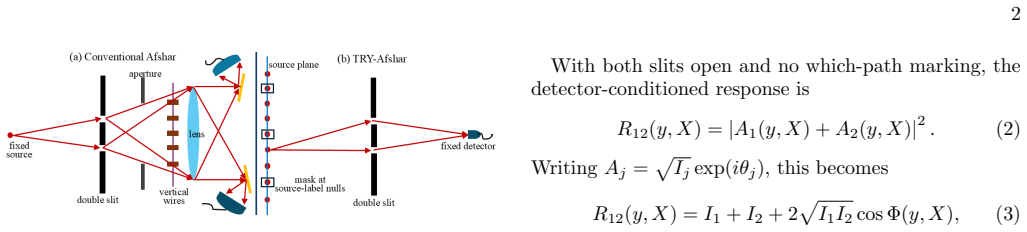
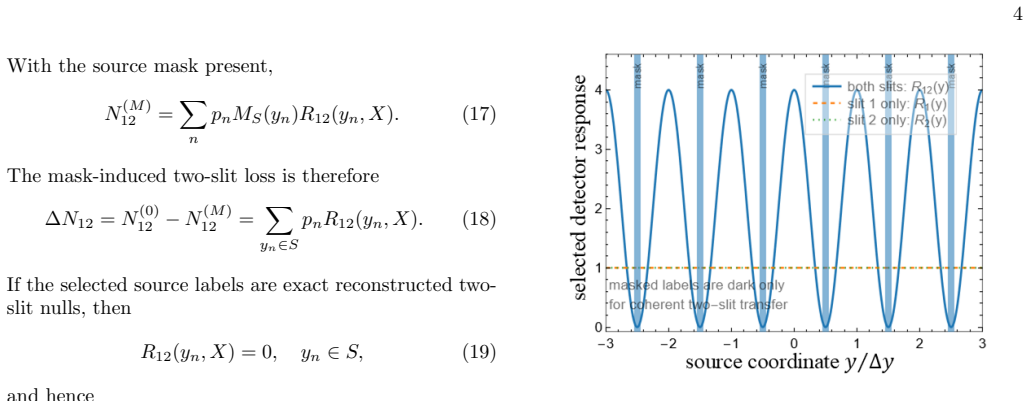
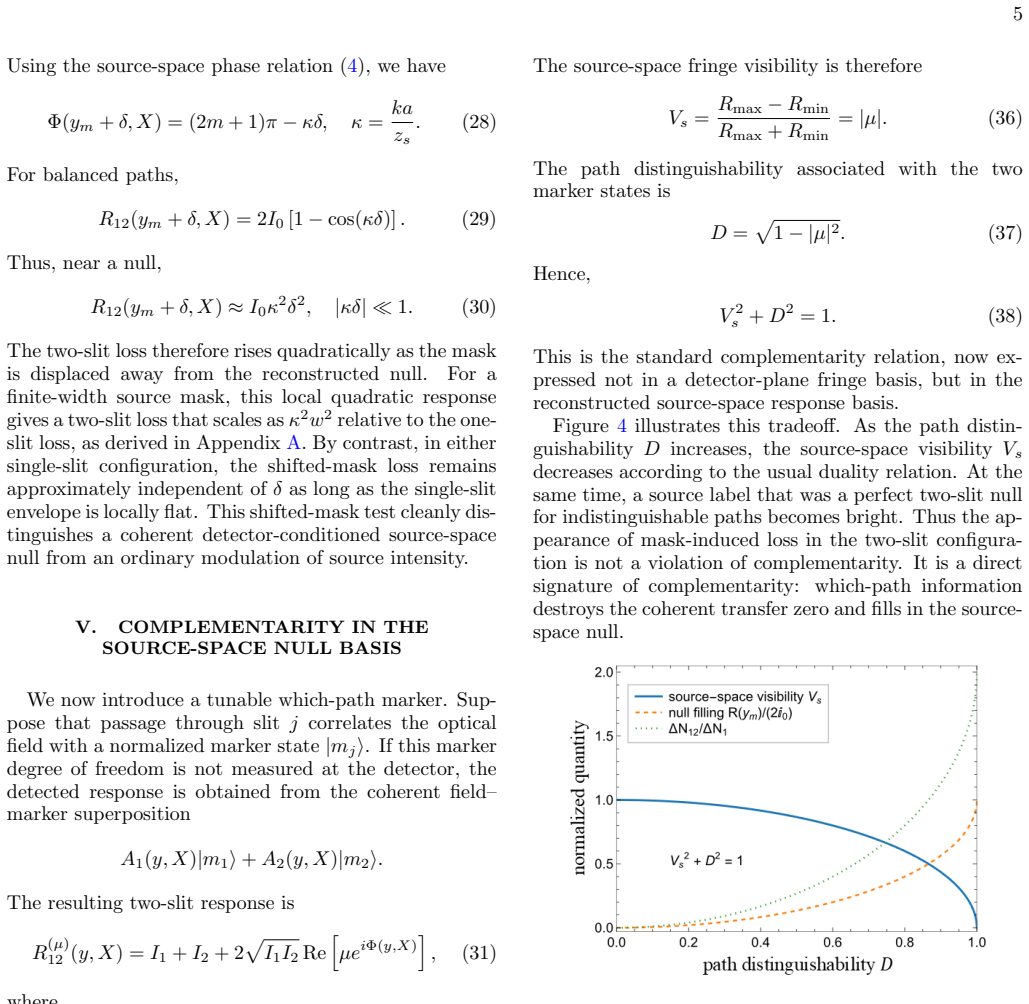
A point-addressable source scanned in a double-slit interferometer produces a detector-conditioned response pattern rather than a spatial intensity fringe. Source-space nulls occur where the coherent two-slit amplitude to the selected detector vanishes. A mask placed at such a null is transparent to that detector with both slits open, yet blocks transmission when either slit acts alone. The source-space visibility and path distinguishability satisfy V^2 + D^2 = 1, so complementarity holds. The new feature is detector-conditioned response-function transparency in the reconstructed source basis.
What carries the argument
Detector-conditioned source-space null condition derived from the scalar Fresnel model, which identifies source labels where the transfer amplitude to a fixed detector cancels and defines the associated null-mask loss.
If this is right
- Source-space visibility and path distinguishability satisfy the standard duality relation.
- No violation of complementarity is implied by the reciprocal geometry.
- The null-mask loss evolves under a tunable which-path marker.
- The configuration allows a programmable test of detector-conditioned transparency.
Where Pith is reading between the lines
- This reciprocal setup could be implemented with programmable spatial light modulators to scan sources without physical movement.
- The idea extends naturally to multi-slit or more complex interferometers where response functions can be conditioned on detector choice.
- It raises the question of whether similar conditioned nulls appear in quantum versions with entangled sources.
Load-bearing premise
The scalar Fresnel model captures the essential propagation physics and remains valid for point-by-point source scanning while coherence between slits is preserved.
What would settle it
Measure the detector response while scanning a coherent point source across the input plane of a double-slit setup and check whether null positions match the predicted source labels where the two-slit amplitude sums to zero, with the mask effect appearing only for the combined paths.
Figures
read the original abstract
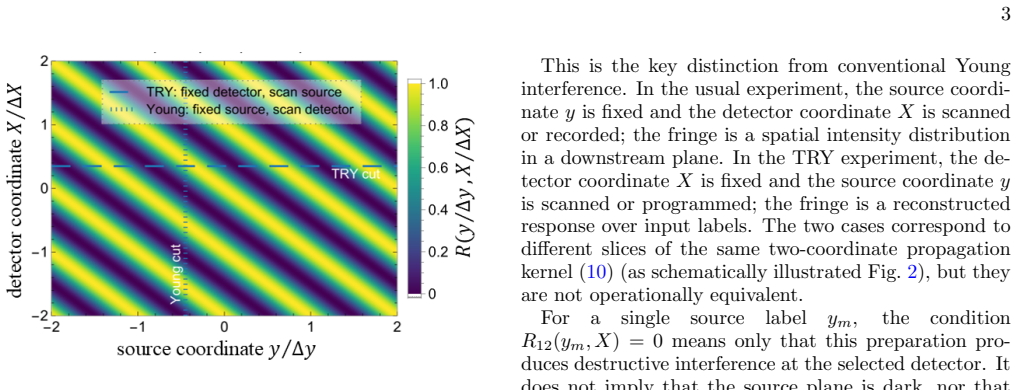
Afshar's double-slit experiment probes wave--particle complementarity by placing a wire grid at the dark fringes of a downstream interference pattern while retaining an imaging basis that appears to preserve which-path information. Here we propose and analyze a time-reversed Young--Afshar configuration in which the corresponding null test is transferred from the downstream field plane to the source-label plane of a time-reversed Young interferometer. In this reciprocal geometry, a point-addressable source illuminates a double slit, while the detector remains fixed. The observed fringe is therefore not a single-shot spatial intensity pattern, but a detector-conditioned response reconstructed by scanning the source coordinate. Consequently, a null in this pattern is not a node of a freely propagating field; it is a source label for which the coherent two-slit transfer amplitude to the selected detector vanishes. A mask placed at such source-plane labels is invisible to that detector when both slits are open, yet becomes visible when either slit is opened alone. We develop the scalar Fresnel model, derive the source-space null condition, introduce a detector-conditioned null-mask loss, and examine how this loss evolves under a tunable which-path marker. The source-space visibility and path distinguishability satisfy the standard duality relation, so no violation of complementarity is implied. The essential new feature is instead a reciprocal, detector-conditioned form of complementarity: Afshar's field-space transparency is replaced by response-function transparency in a reconstructed source basis.
Editorial analysis
A structured set of objections, weighed in public.
Referee Report
Summary. The manuscript analyzes a time-reversed Young-Afshar interferometer in which a point-addressable source scans the input while a detector is held fixed. Using a scalar Fresnel propagator, the authors derive conditions under which the coherent two-slit transfer amplitude to the selected detector vanishes, yielding nulls in the reconstructed source-space response. They introduce a detector-conditioned null-mask loss and track its evolution under a tunable which-path marker. The source-space visibility and path distinguishability obey the standard duality relation; the claimed novelty is a reciprocal, detector-conditioned form of complementarity in which source-label transparency replaces Afshar's field-space transparency.
Significance. If the Fresnel derivation is robust, the work supplies a reciprocal perspective on complementarity that is directly relevant to programmable interferometers and detector-conditioned measurements. The parameter-free construction of the null condition from the Fresnel transfer amplitude and the explicit tracking of the null-mask loss under the which-path marker are strengths that make the central claim falsifiable in principle.
major comments (1)
- [Derivation of the source-space null condition] The derivation of the source-space null condition (the vanishing of the coherent two-slit transfer amplitude) rests on the scalar Fresnel propagator remaining accurate when the source coordinate is scanned point-by-point while inter-slit coherence is preserved. The manuscript does not examine whether wavefront-curvature changes, coherence-length variations, or polarization mixing under this scanning protocol shift or destroy the predicted null locations; without such justification the claimed source-label transparency and the evolution of the null-mask loss cannot be taken as established.
Simulated Author's Rebuttal
We thank the referee for their constructive assessment and for highlighting the need to justify the scalar Fresnel model under source scanning. We address the single major comment below and have incorporated a clarifying discussion in the revised manuscript.
read point-by-point responses
-
Referee: The derivation of the source-space null condition (the vanishing of the coherent two-slit transfer amplitude) rests on the scalar Fresnel propagator remaining accurate when the source coordinate is scanned point-by-point while inter-slit coherence is preserved. The manuscript does not examine whether wavefront-curvature changes, coherence-length variations, or polarization mixing under this scanning protocol shift or destroy the predicted null locations; without such justification the claimed source-label transparency and the evolution of the null-mask loss cannot be taken as established.
Authors: We agree that an explicit statement on the regime of validity is warranted. Within the scalar monochromatic Fresnel framework adopted throughout the manuscript, the source scan is performed at fixed propagation distance and wavelength, with inter-slit coherence imposed by construction; the paraxial condition ensures that first-order wavefront-curvature corrections remain negligible for the displacements considered. Coherence-length variations and polarization mixing lie outside the scalar model and are not included. In the revision we have added a dedicated paragraph in Section II that states these assumptions and notes that a vector treatment would be required to assess polarization effects. The source-space null condition and null-mask loss therefore remain rigorously defined inside the stated model; the duality relation is unaffected. revision: partial
Circularity Check
No significant circularity; derivation self-contained under Fresnel model
full rationale
The paper develops the scalar Fresnel model and derives the source-space null condition from the coherent two-slit transfer amplitude to a fixed detector. The source-space visibility and path distinguishability are stated to satisfy the standard duality relation from prior literature, without redefinition inside the paper's equations. The detector-conditioned null-mask loss is constructed directly from the Fresnel transfer amplitude. No load-bearing step reduces by construction to a fitted parameter, self-citation chain, or ansatz smuggled via citation; the central claim remains independent of its inputs once the Fresnel propagator is assumed.
Axiom & Free-Parameter Ledger
axioms (1)
- domain assumption Scalar Fresnel diffraction integral accurately describes the coherent transfer amplitude from source coordinate through the two slits to the fixed detector.
Reference graph
Works this paper leans on
-
[1]
Scan the source coordinateyand record the two-slit responseR 12(y, X)
-
[2]
Identify the reconstructed dark source labelsS= {ym}for the selected detector
-
[3]
Apply a physical or programmable source-plane mask that suppresses the labels inS
-
[4]
Measure the detector loss with both slits open and then with each slit open individually
-
[5]
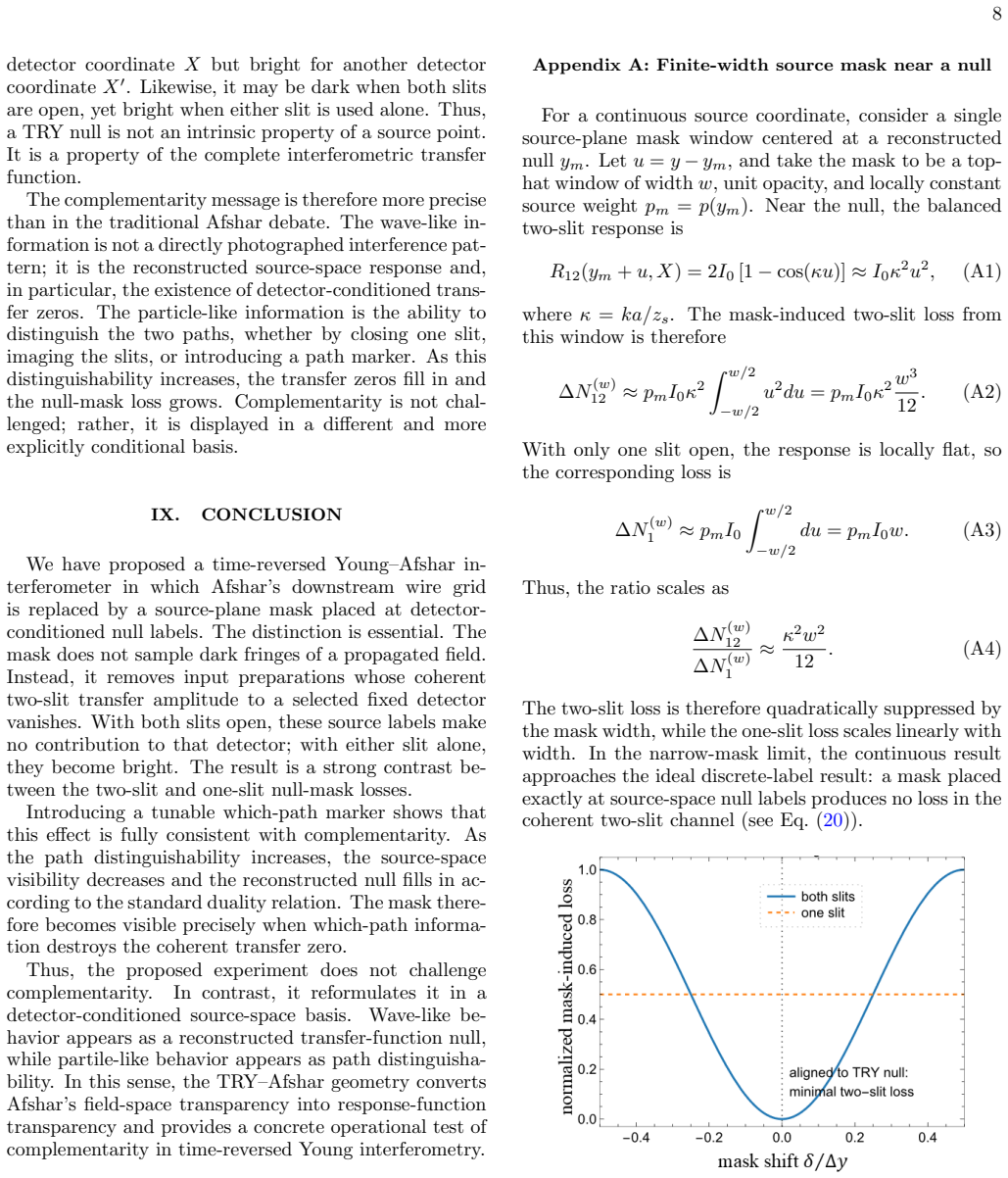
Shift the mask by a controlled displacementδand verify that the two-slit loss rises away from the null according to the predicted modulation (Eq. (29))
-
[6]
dark labels
Introduce a tunable which-path marker, for exam- ple by rotating the polarization in one slit path, and measure the corresponding filling of the source- space null (Eq. (39)). A single-photon version can be realized either by at- tenuating a coherent source or by using heralded pho- tons. In a heralded implementation, the idler photon may label or gate th...
-
[7]
Young, I
T. Young, I. The Bakerian lecture: Experiments and cal- culation relative to physical optics,Philos. Trans. R. Soc. 94, 1–16 (1804)
-
[8]
G. I. Taylor, Interference fringes with feeble light,Prof. Cam. Phil. Soc.15, 114–115 (1909)
1909
-
[9]
W. K. Wooters and W. H. Zurek, Complementarity in the double-slit experiment: Quantum nonseparability and a quantitative statement of Bohr’s principle,Phys. Rev. D 19, 473–484 (1979)
1979
-
[10]
Bartell, Complementarity in the double-slit experi- ment: On simple realizable systems for observing inter- mediate particle-wave behavior,Phys
L. Bartell, Complementarity in the double-slit experi- ment: On simple realizable systems for observing inter- mediate particle-wave behavior,Phys. Rev. D21, 1698– 1699 (1980)
1980
-
[11]
Mittelstaedt, A
P. Mittelstaedt, A. Prieur, and R. Schieder, Unsharp particle-wave duality in a photon split-beam experiment, Found. Phys.17, 891—903 (1987)
1987
-
[12]
Greenberger and A
D.M. Greenberger and A. Yasin, Simultaneous wave and particle knowledge in a neutron interferometer,Phys. Lett. A128, 391—394 (1988)
1988
-
[13]
M. O. Scully, B. G. Englert, and H. Walther, Quantum optical tests of complementarity,Nature351, 111–116 (1991)
1991
-
[14]
Storey, S
P. Storey, S. Tan, M. Collect, and D. Walls, Path detec- tion and the uncertainty principle,Nature367, 626–628 (1994)
1994
-
[15]
Jaeger, A
G. Jaeger, A. Shimony, and L. Vaidman, Two inter- ferometric complementarities,Phys. Rev. A51, 54–67 (1995)
1995
-
[16]
M. S. Chapman, T. D. Hammond, A. Lenef, J. Schmied- mayer, R. A. Rubenstein, E. Smith, and D. E. Pritchard, Photon scattering from atoms in an atom interferome- ter: Coherence lost and regained,Phys. Rev. Lett.75, 3783—3787 (1995)
1995
-
[17]
Englert, Fringe visibility and which-way informa- tion: An inequality, Phys
B.-G. Englert, Fringe visibility and which-way informa- tion: An inequality, Phys. Rev. Lett.77, 2154-2157 (1996)
1996
-
[18]
Zeilinger, Experiment and the foundations of quantum physics,Rev
A. Zeilinger, Experiment and the foundations of quantum physics,Rev. Mod. Phys.71, S288–S297 (1999)
1999
-
[19]
Y.-H. Kim, R. Yu, S. P. Kulik, Y.-H. Shih, and M. O. Scully, A delayed choice quantum eraser,Phys. Rev. Lett. 84, 1–5 (2000)
2000
-
[20]
S. P. Walborn, M. O. Terra Cunha, S. P´ adua, and C. H. Monken, Double-slit quantum eraser,Phys. Rev. A65, 033818 (2002)
2002
-
[21]
H. F. Schouten, N. Kuzmin, G. Dubois, T. D. Visser, G. Gbur, P. F. A. Alkemade, H. Blok, G. W, ’t Hooft, D. Lenstra, and E. R. Eliel, Plasmon-assisted two-slit transmission: Young’s experiment revisited,Phys. Rev. Lett.94, 053901 (2005)
2005
-
[22]
R. Mir, J. S. Lundeen, M. W. Mitchell, A. M. Stein- berg, J. L. Garretson, and H. M. Wiseman, A double- slit ‘which-way’ experiment on the complementarity- uncertainty debate,New J. Phys.9, 287 (2007)
2007
-
[23]
Kocsis, B
S. Kocsis, B. Braverman, S. Ravets, M. J. Stevens, R. P. Mirin, L. K. Shalm, and A. M. Steinberg, Observing the average trajectories of single photons in a two-slit interferometer,Science332, 1170–1173 (2011)
2011
-
[24]
Menzel, D
R. Menzel, D. Puhlmann, A. Heuer, and W. P. Schle- ich, Wave-particle dualism and complementarity unrav- eled by a different mode,Proc. Natl. Acad. Sci. U.S.A. 109, 9314–9319 (2012)
2012
-
[25]
B. E. Y. Svensson, Pedagogical review of quantum mea- surement theory with an emphasis on weak measure- ments,Quanta2, 18—49 (2013)
2013
-
[26]
Kolenderski, C
P. Kolenderski, C. Scarcella, K. D. Johnsen, D. R. Hamel, C. Holloway, L. K. Shalm, S. Tisa, A. Tosi, K. J. Resch, and T. Jennewein, Time-resolved double-slit experiment with entangled photons,Sci. Rep.4, 4685 (2014)
2014
-
[27]
Aharonov, E
Y. Aharonov, E. Cohen, F. Colombo, T. Landsberger, I. Sabadini, D. C. Struppa, and J. Tollasken, Finally mak- ing sense of the double-slit experiment,Proc. Natl. Acad. Sci. U.S.A.114, 6480–6485 (2017)
2017
-
[28]
Y. Xiao, H. M. Wiseman, J.-S. Xu, Y. Kedem, C.-F. Li, and G.-C. Guo, Observing momentum disturbance in double-slit ‘which-way’ measurements,Sci. Adv.6, eaay9547 (2020)
2020
-
[29]
Fedoseev, H
V. Fedoseev, H. Lin, Y.-K. Lu, Y. K. Lee, J. Lyu, and W. Ketterle, Coherent and incoherent light scattering by single-atom wave packets,Phys. Rev. Lett.135, 043601 (2025)
2025
-
[30]
S. S. Afshar, Violation of the principle of complemen- tarity, and its implications,Proc. SPIE5866, 229–244 (2005)
2005
-
[31]
S. S. Afshar, Violation of Bohr’s complementarity: One slit or both?,AIP Conference Proc.810, 294–299 (2006)
2006
-
[32]
S. S. Afshar, E. Flores, K. F. McDonald, and E. Knoesel, Paradox in wave-particle duality,Found. Phys.37, 295– 305 (2007)
2007
-
[33]
Steuernagel, Afshar’s experiment does not show a vi- olation of complementarity,Found
O. Steuernagel, Afshar’s experiment does not show a vi- olation of complementarity,Found. Phys.37, 1370–1385 (2007)
2007
-
[34]
Jacques, N
V. Jacques, N. D. Lai, A. Dr´ eau, D. Zheng, D. Chauvat, F. Treussart, P. Grangier, and J.-F. Roch, Illustration of quantum complementarity using single photons interfer- ing on a grating,New J. Phys.10, 123009 (2008)
2008
-
[35]
R. E. Kastner, On visibility in the Afshar two-slit exper- iment,Found. Phys.39, 1139—1144 (2009)
2009
-
[36]
E. V. Flores and J. M. De Tata, Complementarity para- 10 dox solved: Surprising consequences,Found. Phys.40, 1574—1583 (2010)
2010
-
[37]
Wen, Time-reversed Young’s experiment: Determinis- tic, diffractionless second-order interference effect,Opt
J. Wen, Time-reversed Young’s experiment: Determinis- tic, diffractionless second-order interference effect,Opt. Commun.597, 132612 (2025)
2025
-
[38]
Wen, Hybrid second-order coherence in a time- reversed Young’s experiment (2026)
J. Wen, Hybrid second-order coherence in a time- reversed Young’s experiment (2026). doi: 10.1364/opti- caopen.31198534
-
[39]
J. Wen, From random fringes to deterministic response: Statistical foundations of time-reversed Young interfer- ometry, arXiv:2604.23797 (2026)
work page internal anchor Pith review Pith/arXiv arXiv 2026
-
[40]
Entropic Reciprocity in Time-Reversed Young Interferometry
J. Wen, Entropic reciprocity in time-reversed Young in- terferometry, arXiv:2605.01052 (2026)
work page internal anchor Pith review Pith/arXiv arXiv 2026
discussion (0)
Sign in with ORCID, Apple, or X to comment. Anyone can read and Pith papers without signing in.