RaLMPH: Reliability-aware Learning for Multi-Pathologist Harmonization in Whole-Slide Image Classification
Pith reviewed 2026-06-27 04:30 UTC · model grok-4.3
The pith
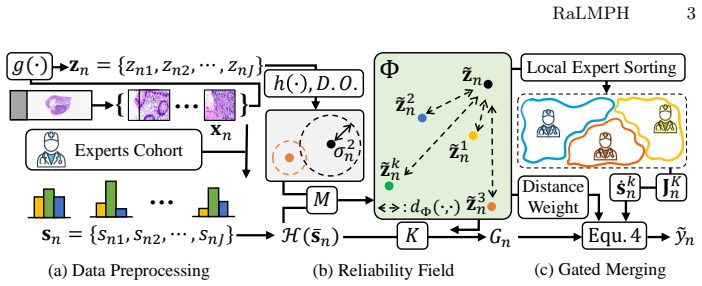
RaLMPH reconciles differing pathologist labels on whole-slide images by building a reliability field from local feature neighborhoods and expert entropy.
A machine-rendered reading of the paper's core claim, the machinery that carries it, and where it could break.
Core claim
RaLMPH introduces a reliability field that jointly models local neighborhood structure in WSI feature space and expert uncertainty (entropy), enabling per-sample identification of trustworthy reference neighborhoods for local annotator ranking and adaptive gating to fuse labels conditioned on local reliability; experiments show this yields higher performance than existing global-reliability or single-instance methods on both clinical six-pathologist WSI data and simulated benchmarks.
What carries the argument
The reliability field, which jointly encodes local neighborhood structure in WSI feature space and expert uncertainty entropy to locate trustworthy reference neighborhoods for per-sample annotator ranking.
If this is right
- Local per-sample annotator ranking produces reconciled labels that improve downstream MIL slide classification accuracy.
- The reliability field allows adaptive fusion that conditions label weighting on both spatial context and uncertainty.
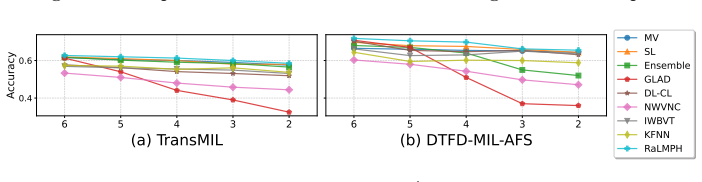
- Performance gains appear on both real clinical data with six pathologists and on controlled simulated disagreement benchmarks.
- The framework avoids the single-instance assumptions that limit prior label-refinement methods in MIL settings.
Where Pith is reading between the lines
- The same reliability-field construction could be tested on other multi-expert MIL tasks such as video or 3D medical volumes.
- If the local-neighborhood assumption holds across institutions, the method might reduce the frequency of pathologist consensus meetings.
- Extending the entropy term to model systematic biases between pathologists could further tighten the reconciled labels.
Load-bearing premise
That jointly modeling local neighborhood structure in WSI feature space and expert uncertainty entropy is sufficient to identify trustworthy reference neighborhoods for per-sample annotator ranking.
What would settle it
On a held-out multi-pathologist WSI dataset, a version of RaLMPH that replaces the local reliability field with global annotator scores or random neighborhood selection shows no accuracy gain over standard MIL or existing multi-annotator baselines.
Figures


read the original abstract
Multiple Instance Learning (MIL) is a standard paradigm for Whole-Slide Image (WSI) analysis and has achieved strong results in computational pathology. However, most MIL pipelines assume a single "gold" label per slide, which conflicts with clinical practice where substantial inter-pathologist variability is common. Existing multi-annotator learning and label-refinement methods typically estimate global annotator reliability or rely on single-instance assumptions, making them poorly suited to MIL and to localized diagnostic contexts where experts disagree. We propose RaLMPH (Reliability-aware Learning for Multi-Pathologist Harmonization), a MIL-based label reconciliation framework for WSIs annotated by multiple pathologists. RaLMPH introduces a reliability field that jointly models (i) local neighborhood structure in WSI feature space and (ii) expert uncertainty (entropy), enabling per-sample identification of trustworthy reference neighborhoods. Leveraging this field, RaLMPH performs sample-wise local annotator ranking to select reliable opinions per slide and applies an adaptive gating mechanism to fuse labels conditioned on local reliability. Experiments on a clinical WSI dataset with labels from six pathologists, as well as controlled simulated benchmarks, show that RaLMPH consistently outperforms existing approaches. Further analyses clarify how our reliability-aware mechanism improves label reconciliation and downstream MIL performance.
Editorial analysis
A structured set of objections, weighed in public.
Referee Report
Summary. The paper proposes RaLMPH, a multiple instance learning (MIL) framework for reconciling labels from multiple pathologists on whole-slide images (WSIs). It constructs a reliability field that jointly captures local neighborhood structure in WSI feature space and per-expert uncertainty (via entropy) to identify trustworthy reference neighborhoods, enabling sample-wise local annotator ranking and an adaptive gating mechanism for label fusion. Experiments on a clinical WSI dataset annotated by six pathologists plus controlled simulated benchmarks are reported to show consistent outperformance over prior multi-annotator and label-refinement methods.
Significance. If the empirical claims hold, the work addresses a practically important gap in computational pathology: moving beyond global annotator reliability or single-instance assumptions to localized, reliability-aware reconciliation within the MIL paradigm. This could improve robustness of downstream slide-level classifiers when inter-pathologist disagreement is spatially varying. The joint neighborhood-plus-entropy construction is a concrete technical contribution that may be reusable in other multi-rater settings.
major comments (1)
- [Abstract] Abstract: The central claim that 'RaLMPH consistently outperforms existing approaches' is stated without any accompanying metrics, baseline names, statistical tests, ablation results, or dataset sizes. This absence prevents verification of the empirical support for the method's advantage and is load-bearing for the paper's contribution.
Simulated Author's Rebuttal
We thank the referee for their careful reading and for highlighting the need for greater specificity in the abstract. We agree that the current abstract would be strengthened by including concrete metrics, baseline names, and dataset details to better substantiate the performance claims.
read point-by-point responses
-
Referee: [Abstract] Abstract: The central claim that 'RaLMPH consistently outperforms existing approaches' is stated without any accompanying metrics, baseline names, statistical tests, ablation results, or dataset sizes. This absence prevents verification of the empirical support for the method's advantage and is load-bearing for the paper's contribution.
Authors: We agree that the abstract as written provides only a high-level summary of the results. In the revised manuscript we will expand the final sentence of the abstract to report the primary quantitative improvements (e.g., accuracy or AUC gains), explicitly name the main baselines compared against, state the sizes of both the clinical dataset (number of WSIs and pathologists) and the simulated benchmarks, and reference the statistical tests used to support the “consistently outperforms” claim. These additions will be kept within abstract length limits while directly addressing the referee’s concern. revision: yes
Circularity Check
No significant circularity detected
full rationale
The abstract and description present RaLMPH as a MIL-based framework that constructs a reliability field from local neighborhood structure in feature space plus expert entropy, then applies local ranking and adaptive gating for label fusion. No equations, derivations, or self-citations are supplied that would allow any claimed prediction or result to reduce by construction to its own fitted inputs or prior outputs. The central performance claims rest on empirical evaluation against external clinical and simulated datasets, which are independently falsifiable and do not exhibit self-definitional, fitted-input-renamed-as-prediction, or self-citation-load-bearing patterns within the given text.
Axiom & Free-Parameter Ledger
Reference graph
Works this paper leans on
-
[1]
Database2022, baac093 (2022)
Brancati, N., Anniciello, A.M., Pati, P., Riccio, D., Scognamiglio, G., Jaume, G., De Pietro, G., Di Bonito, M., Foncubierta, A., Botti, G., et al.: Bracs: A dataset for breast carcinoma subtyping in h&e histology images. Database2022, baac093 (2022)
2022
-
[2]
Pathologist88, 18– 27 (2023)
Bychkov, A., Schubert, M.: Constant demand, patchy supply. Pathologist88, 18– 27 (2023)
2023
-
[3]
In:ProceedingsoftheAAAIConferenceonArtificialIntelligence.vol.35,pp.5832– 5840 (2021)
Chu, Z., Ma, J., Wang, H.: Learning from crowds by modeling common confusions. In:ProceedingsoftheAAAIConferenceonArtificialIntelligence.vol.35,pp.5832– 5840 (2021)
2021
-
[4]
IEEE Transactions on Big Data (2025)
Douze, M., Guzhva, A., Deng, C., Johnson, J., Szilvasy, G., Mazaré, P.E., Lomeli, M., Hosseini, L., Jégou, H.: The faiss library. IEEE Transactions on Big Data (2025)
2025
-
[5]
bmj357(2017)
Elmore, J.G., Barnhill, R.L., Elder, D.E., Longton, G.M., Pepe, M.S., Reisch, L.M., Carney, P.A., Titus, L.J., Nelson, H.D., Onega, T., et al.: Pathologists’ diagnosis of invasive melanoma and melanocytic proliferations: observer accuracy and repro- ducibility study. bmj357(2017)
2017
-
[6]
Jama313(11), 1122–1132 (2015)
Elmore, J.G., Longton, G.M., Carney, P.A., Geller, B.M., Onega, T., Tosteson, A.N., Nelson, H.D., Pepe, M.S., Allison, K.H., Schnitt, S.J., et al.: Diagnostic con- cordance among pathologists interpreting breast biopsy specimens. Jama313(11), 1122–1132 (2015)
2015
-
[7]
Gadermayr, M., Tschuchnig, M.: Multiple instance learning for digital pathology: A reviewofthestate-of-the-art,limitations&futurepotential.ComputerizedMedical Imaging and Graphics112, 102337 (2024)
2024
-
[8]
Guan, M., Gulshan, V., Dai, A., Hinton, G.: Who said what: Modeling individual labelersimprovesclassification.In:ProceedingsoftheAAAIconferenceonartificial intelligence. vol. 32 (2018)
2018
-
[9]
learning in pathology
Jaume, G., Vaidya, A.J., Zhang, A., Song, A.H., Chen, R.J., Sahai, S., Mo, D., Madrigal, E., Le, L.P., Faisal, M.: Multistain pretraining for slide representation 10 Hong et al. learning in pathology. In: European Conference on Computer Vision. Springer (2024)
2024
-
[10]
IEEE Transactions on Neural Networks and Learning Systems33(11), 6558–6568 (2021)
Jiang,L.,Zhang,H.,Tao,F.,Li,C.:Learningfromcrowdswithmultiplenoisylabel distribution propagation. IEEE Transactions on Neural Networks and Learning Systems33(11), 6558–6568 (2021)
2021
-
[11]
Adam: A Method for Stochastic Optimization
Kingma, D.P.: Adam: A method for stochastic optimization. arXiv preprint arXiv:1412.6980 (2014)
work page internal anchor Pith review Pith/arXiv arXiv 2014
-
[12]
Histopathology69(3), 441–449 (2016)
Kweldam, C.F., Nieboer, D., Algaba, F., Amin, M.B., Berney, D.M., Billis, A., Bostwick, D.G., Bubendorf, L., Cheng, L., Compérat, E., et al.: Gleason grade 4 prostate adenocarcinoma patterns: an interobserver agreement study among geni- tourinary pathologists. Histopathology69(3), 441–449 (2016)
2016
-
[13]
ACM Transactions on Knowledge Discovery from Data17(7), 1–18 (2023)
Li, H., Jiang, L., Xue, S.: Neighborhood weighted voting-based noise correction for crowdsourcing. ACM Transactions on Knowledge Discovery from Data17(7), 1–18 (2023)
2023
-
[14]
Nature Medicine30, 863–874 (2024)
Lu, M.Y., Chen, B., Williamson, D.F., Chen, R.J., Liang, I., Ding, T., Jaume, G., Odintsov, I., Le, L.P., Gerber, G., et al.: A visual-language foundation model for computational pathology. Nature Medicine30, 863–874 (2024)
2024
-
[15]
Journal of machine learn- ing research9(Nov), 2579–2605 (2008)
Maaten, L.v.d., Hinton, G.: Visualizing data using t-sne. Journal of machine learn- ing research9(Nov), 2579–2605 (2008)
2008
-
[16]
Human pathology32(4), 368–378 (2001)
Montgomery, E., Bronner, M.P., Goldblum, J.R., Greenson, J.K., Haber, M.M., Hart, J., Lamps, L.W., Lauwers, G.Y., Lazenby, A.J., Lewin, D.N., et al.: Re- producibility of the diagnosis of dysplasia in barrett esophagus: a reaffirmation. Human pathology32(4), 368–378 (2001)
2001
-
[17]
Auto- matica11(285-296), 23–27 (1975)
Otsu, N., et al.: A threshold selection method from gray-level histograms. Auto- matica11(285-296), 23–27 (1975)
1975
-
[18]
In: 2025 IEEE/CVF Winter Conference on Applications of Computer Vision (WACV)
Park, H., Hong, S., Song, C., Kim, J., Yi, M.Y.: Uncertainty-based data-wise label smoothing for calibrating multiple instance learning in histopathology image clas- sification. In: 2025 IEEE/CVF Winter Conference on Applications of Computer Vision (WACV). pp. 599–608. IEEE (2025)
2025
-
[19]
In: Proceedings of the AAAI conference on artificial intelligence
Rodrigues, F., Pereira, F.: Deep learning from crowds. In: Proceedings of the AAAI conference on artificial intelligence. vol. 32 (2018)
2018
-
[20]
Advances in neural information processing systems34, 2136–2147 (2021)
Shao, Z., Bian, H., Chen, Y., Wang, Y., Zhang, J., Ji, X., et al.: Transmil: Trans- former based correlated multiple instance learning for whole slide image classifica- tion. Advances in neural information processing systems34, 2136–2147 (2021)
2021
-
[21]
In: Proceedings of the 14th ACM SIGKDD international conference on Knowledge discovery and data mining
Sheng, V.S., Provost, F., Ipeirotis, P.G.: Get another label? improving data quality and data mining using multiple, noisy labelers. In: Proceedings of the 14th ACM SIGKDD international conference on Knowledge discovery and data mining. pp. 614–622 (2008)
2008
-
[22]
Expert Systems with Applications117, 103–111 (2019)
Sudharshan, P., Petitjean, C., Spanhol, F., Oliveira, L.E., Heutte, L., Honeine, P.: Multiple instance learning for histopathological breast cancer image classification. Expert Systems with Applications117, 103–111 (2019)
2019
-
[23]
Journal of Artificial Intelligence Research72, 1385–1470 (2021)
Uma, A.N., Fornaciari, T., Hovy, D., Paun, S., Plank, B., Poesio, M.: Learning from disagreement: A survey. Journal of Artificial Intelligence Research72, 1385–1470 (2021)
2021
-
[24]
In: Proceedings of the Annual Symposium on Computer Ap- plication in Medical Care
Van Ginneken, A., Van der Lei, J.: Understanding differential diagnostic disagree- ment in pathology. In: Proceedings of the Annual Symposium on Computer Ap- plication in Medical Care. p. 99 (1991)
1991
-
[25]
Advances in neural information processing systems22(2009) RaLMPH 11
Whitehill, J., Wu, T.f., Bergsma, J., Movellan, J., Ruvolo, P.: Whose vote should count more: Optimal integration of labels from labelers of unknown expertise. Advances in neural information processing systems22(2009) RaLMPH 11
2009
-
[26]
Frontiers in Oncology p
Xu, F., Zhu, C., Tang, W., Wang, Y., Zhang, Y., Li, J., Jiang, H., Shi, Z., Liu, J., Jin, M.: Predicting axillary lymph node metastasis in early breast cancer using deep learning on primary tumor biopsy slides. Frontiers in Oncology p. 4133 (2021)
2021
-
[27]
In: Proceedings of the IEEE/CVF conference on computer vision and pattern recognition
Zhang, H., Meng, Y., Zhao, Y., Qiao, Y., Yang, X., Coupland, S.E., Zheng, Y.: Dtfd-mil: Double-tier feature distillation multiple instance learning for histopathol- ogy whole slide image classification. In: Proceedings of the IEEE/CVF conference on computer vision and pattern recognition. pp. 18802–18812 (2022)
2022
-
[28]
IEEE Transactions on Medical Imaging (2024)
Zhang, J., Wang, G., Kalra, M.K., Yan, P.: Disease-informed adaptation of vision- language models. IEEE Transactions on Medical Imaging (2024)
2024
-
[29]
Advances in Neural Information Processing Systems37, 85722–85741 (2024)
Zhang, W., Jiang, L., Li, C.: Iwbvt: Instance weighting-based bias-variance trade- off for crowdsourcing. Advances in Neural Information Processing Systems37, 85722–85741 (2024)
2024
-
[30]
Advances in Neural Information Processing Systems37, 116493–116512 (2024)
Zhang, W., Jiang, L., Li, C.: Kfnn: K-free nearest neighbor for crowdsourcing. Advances in Neural Information Processing Systems37, 116493–116512 (2024)
2024
-
[31]
Information Fusion p
Zhang, Y., Gao, Z., He, K., Li, C., Mao, R.: From patches to wsis: A systematic review of deep multiple instance learning in computational pathology. Information Fusion p. 103027 (2025)
2025
-
[32]
Advances in neural information processing systems25(2012)
Zhou, D., Basu, S., Mao, Y., Platt, J.: Learning from the wisdom of crowds by minimax entropy. Advances in neural information processing systems25(2012)
2012
discussion (0)
Sign in with ORCID, Apple, or X to comment. Anyone can read and Pith papers without signing in.