mCGCNN: A Dual-Stream Crystal Graph Convolutional Neural Network for the Efficient Prediction of Magnetic Properties of Crystalline Materials
Pith reviewed 2026-06-30 01:20 UTC · model grok-4.3
The pith
mCGCNN augments crystal graphs with a dedicated magnetic subgraph using angle-aware message passing on metal-ligand-metal paths to improve total magnetic moment prediction.
A machine-rendered reading of the paper's core claim, the machinery that carries it, and where it could break.
Core claim
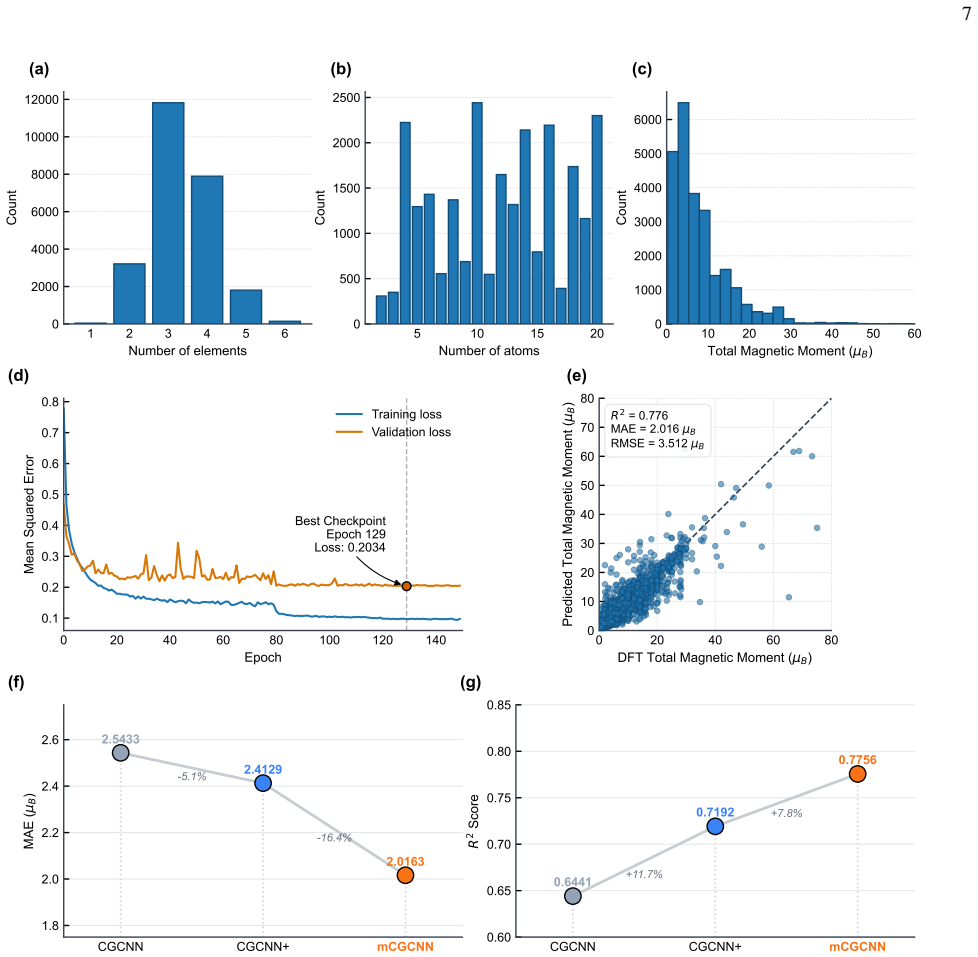
mCGCNN improves total magnetic moment prediction from a CGCNN test MAE of 2.54 μB to 2.02 μB and raises the test R² from 0.644 to 0.776 by augmenting the structural graph with a magnetic subgraph that performs angle-aware message passing on metal-ligand-metal exchange-path descriptors, layer-wise cross-coupling, and magnetic-sublattice pooling.
What carries the argument
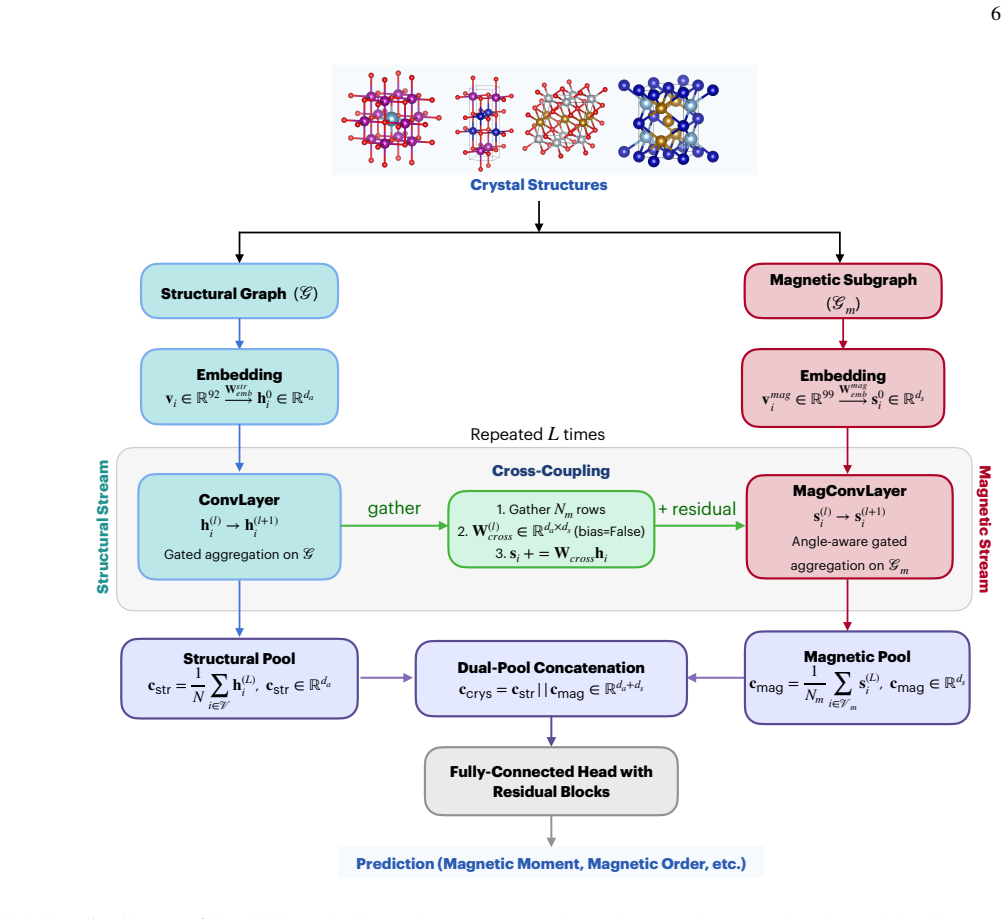
The magnetic subgraph that performs angle-aware message passing over magnetic centers using metal-ligand-metal exchange-path descriptors, combined with layer-wise cross-coupling to the full crystal graph and separate magnetic-sublattice pooling.
If this is right
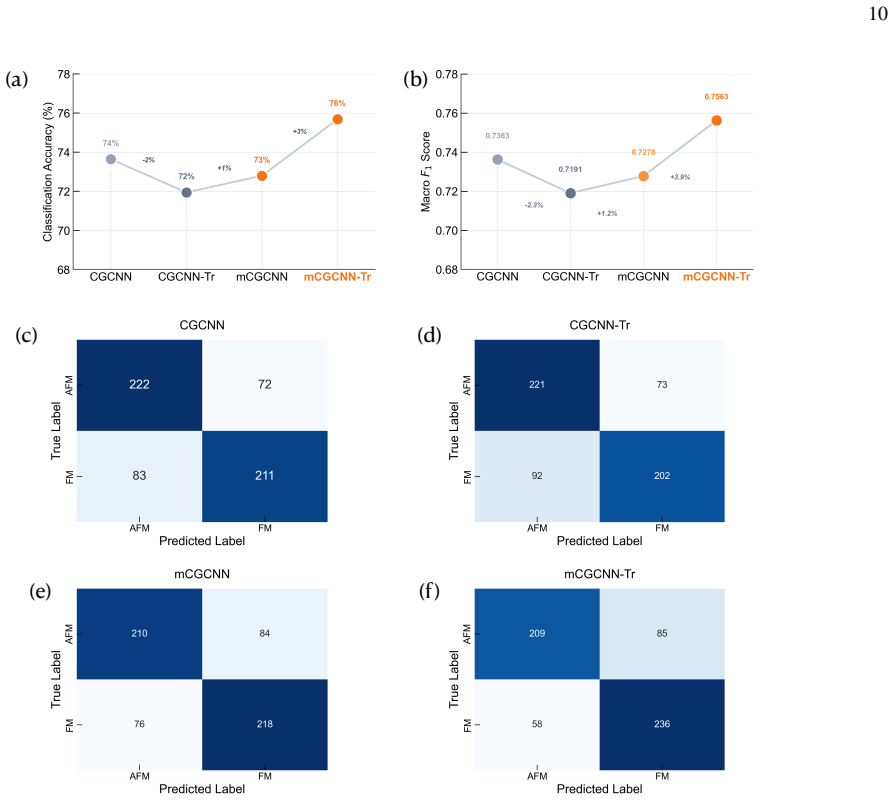
- Pretraining the magnetic representation on moment regression improves subsequent ferromagnetic versus antiferromagnetic classification accuracy.
- Directly encoding exchange geometry supplies a physically motivated route to predictive magnetic-materials models.
- The dual-stream design outperforms both the base CGCNN and an enhanced CGCNN readout baseline on the same spin-polarized DFT benchmark.
Where Pith is reading between the lines
- The same exchange-path descriptors could be reused to regress other magnetic quantities such as ordering temperatures once suitable labels become available.
- Replacing the DFT labels with experimental moment measurements would test whether the learned representations remain predictive outside the training distribution.
- The cross-coupling mechanism might transfer to other multi-scale crystal properties where one subgraph encodes a subset of atoms selected by a physical criterion.
Load-bearing premise
The dedicated magnetic subgraph and its angle-aware descriptors on exchange paths actually capture ligand-mediated interactions that a single homogeneous graph misses.
What would settle it
Retraining the identical architecture on the same dataset after ablating either the magnetic stream or the angle-aware descriptors and observing whether performance falls back to the baseline CGCNN MAE of 2.54 μB and R² of 0.644.
Figures
read the original abstract
Magnetic order in crystals is governed by moment-carrying sublattices and ligand-mediated exchange pathways, yet standard crystal graph neural networks treat all atoms homogeneously and encode bonds primarily through pair distances. We propose mCGCNN, a magnetism-aware crystal graph network that augments the full structural graph with a dedicated magnetic subgraph. The magnetic stream performs angle-aware message passing over magnetic centers using metal-ligand-metal exchange-path descriptors motivated by Goodenough-Kanamori-Anderson physics, while layer-wise cross-coupling transfers structural and ligand-field information from the full crystal graph. A separate magnetic-sublattice pooling operation prevents the magnetic interaction from being diluted by nonmagnetic atoms. Benchmarked on a curated Materials Project spin-polarized DFT data, mCGCNN improves total magnetic moment prediction from a CGCNN test MAE of 2.54~$\mu_B$ to 2.02~$\mu_B$, outperforming a strengthened CGCNN readout baseline and raising the test $R^2$ from 0.644 to 0.776. When pretrained on moment regression, the same magnetic representation improves ferromagnetic/antiferromagnetic classification. The results demonstrate that incorporating exchange geometry directly into graph architectures provides a physically grounded route to predictive models of magnetic materials.
Editorial analysis
A structured set of objections, weighed in public.
Referee Report
Summary. The paper proposes mCGCNN, a dual-stream crystal graph convolutional neural network that augments the standard crystal graph with a dedicated magnetic subgraph. The magnetic stream performs angle-aware message passing over metal-ligand-metal exchange-path descriptors motivated by Goodenough-Kanamori-Anderson physics, incorporates layer-wise cross-coupling from the full structural graph, and uses a separate magnetic-sublattice pooling operation. Benchmarked on curated Materials Project spin-polarized DFT data, mCGCNN reports improving total magnetic moment prediction from CGCNN test MAE of 2.54 μB to 2.02 μB and R² from 0.644 to 0.776, while also benefiting ferromagnetic/antiferromagnetic classification after pretraining on moment regression.
Significance. If the performance gains are reproducible and attributable to the proposed architecture, the work provides a physically grounded extension of crystal graph networks that explicitly models ligand-mediated exchange pathways, which standard homogeneous graphs overlook. This could improve predictive modeling for magnetic materials and demonstrates value in incorporating domain-specific descriptors like metal-ligand-metal angles into GNN message passing.
major comments (2)
- [Abstract] Abstract: The central claim that the dual-stream architecture (magnetic subgraph, angle-aware message passing on exchange-path descriptors, cross-coupling, and magnetic-sublattice pooling) captures ligand-mediated exchange pathways missed by homogeneous CGCNN is load-bearing for the reported MAE drop of 0.52 μB and R² increase, yet no ablation experiments isolate the contribution of the magnetic stream versus the new pooling operation or other modifications.
- [Methods] Methods/Results: The manuscript provides no details on data curation criteria, train/validation/test splits, the exact implementation and strengthening of the CGCNN baseline, hyperparameter choices, optimizer settings, or any post-hoc decisions, preventing verification that the reported test MAE (2.02 μB) and R² (0.776) values are robustly supported.
minor comments (1)
- [Abstract] Abstract: The phrase 'a curated Materials Project spin-polarized DFT data' should specify the number of structures, curation filters (e.g., magnetic atom thresholds), and any filtering for convergence or stability to allow readers to assess dataset scope.
Simulated Author's Rebuttal
We thank the referee for the detailed and constructive report. The two major comments identify important gaps in experimental validation and reproducibility. We address each below and will revise the manuscript to incorporate the requested information and experiments.
read point-by-point responses
-
Referee: [Abstract] Abstract: The central claim that the dual-stream architecture (magnetic subgraph, angle-aware message passing on exchange-path descriptors, cross-coupling, and magnetic-sublattice pooling) captures ligand-mediated exchange pathways missed by homogeneous CGCNN is load-bearing for the reported MAE drop of 0.52 μB and R² increase, yet no ablation experiments isolate the contribution of the magnetic stream versus the new pooling operation or other modifications.
Authors: We agree that ablation studies are required to isolate the contribution of each proposed component. In the revised manuscript we will add a dedicated ablation table that systematically removes (i) the magnetic subgraph and angle-aware message passing, (ii) the layer-wise cross-coupling, and (iii) the magnetic-sublattice pooling operation, while keeping all other architectural choices fixed. This will quantify the performance drop attributable to each element and directly test the central claim. revision: yes
-
Referee: [Methods] Methods/Results: The manuscript provides no details on data curation criteria, train/validation/test splits, the exact implementation and strengthening of the CGCNN baseline, hyperparameter choices, optimizer settings, or any post-hoc decisions, preventing verification that the reported test MAE (2.02 μB) and R² (0.776) values are robustly supported.
Authors: We acknowledge that the current manuscript lacks the necessary methodological transparency. The revised version will include an expanded Methods section (and supplementary tables) that specify: (1) the exact Materials Project query criteria and filtering steps used to curate the spin-polarized DFT dataset, (2) the train/validation/test split ratios and any stratification by magnetic ordering or composition, (3) the precise modifications made to the original CGCNN implementation to create the strengthened baseline, (4) all hyperparameter values, optimizer settings, learning-rate schedules, and early-stopping criteria, and (5) any post-hoc decisions such as model selection or ensemble averaging. These additions will enable full reproduction of the reported metrics. revision: yes
Circularity Check
No circularity; empirical benchmark on external DFT data stands independently
full rationale
The paper proposes mCGCNN as an architectural augmentation to CGCNN (dual-stream graph with magnetic subgraph, angle-aware message passing on metal-ligand-metal descriptors, cross-coupling, and magnetic-sublattice pooling) and reports an empirical MAE improvement (2.54 → 2.02 μB) plus R² gain on a held-out subset of Materials Project spin-polarized DFT calculations. No derivation chain, equation, or claim reduces the reported performance delta to a quantity defined inside the paper itself (no fitted parameter renamed as prediction, no self-definitional loop, no load-bearing self-citation of a uniqueness theorem). The motivation from Goodenough-Kanamori-Anderson rules is stated as physical inspiration for the descriptor choice, not as a mathematical reduction. The result is therefore self-contained against the external benchmark and receives score 0.
Axiom & Free-Parameter Ledger
free parameters (1)
- neural network weights and biases across both streams
axioms (1)
- domain assumption Goodenough-Kanamori-Anderson rules correctly describe the dominant magnetic exchange pathways in the target materials
Reference graph
Works this paper leans on
-
[1]
A formal characterisation of the structural limitations of CGCNN for magnetic property prediction, grounded in the physics of exchange interactions
-
[2]
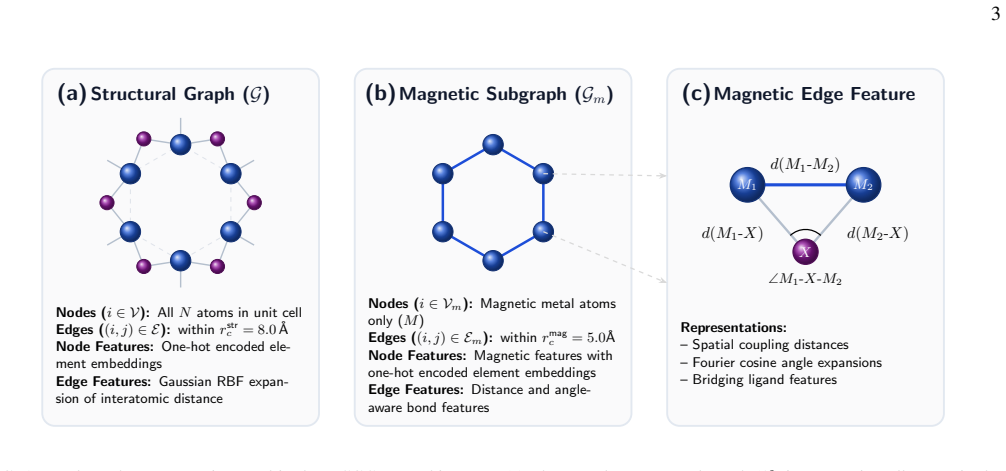
The mCGCNN architecture: a dual-stream graph con- volutional network with a dedicated magnetic subgraph stream, angle-aware M–X–M bond features, a layer- wise cross-coupling mechanism, and a complementary magnetic sublattice pooling operation
-
[3]
Empirical demonstration on the Materials Project mag- netic moment dataset that mCGCNN improves over standard CGCNN for magnetic moment regression, with the improvement growing as a function of train- ing set size
-
[4]
The remainder of this paper is organised as follows
Demonstration of improved FM/AFM classification ac- curacy relative to standard CGCNN, showing that the architectural changes encode physically meaningful in- formation about magnetic ordering. The remainder of this paper is organised as follows. Sec- tion II describes the mCGCNN architecture in detail, includ- ing graph construction, dual-stream message ...
-
[5]
Node Feature Embedding Each atomiin the structural graph is described by a raw feature vectorv i ∈R d0 encoding its group number, period number, electronegativity, covalent radius, number of valence electrons, first ionization energy, electron affinity, block, and atomic volume, following the original CGCNN atom initial- ization. For the magnetic nodes in...
-
[6]
At each layerℓ∈ {0,1,
Coupled Message Passing The two streams are advanced in lockstep forLconvolu- tional layers. At each layerℓ∈ {0,1, . . . ,L−1}, three sequen- tial operations are performed. a. Step 1 — Structural convolution (all atoms).For each atomiand structural neighbourj∈N(i), the message vector is the concatenation of the two atom feature vectors and the bond featur...
-
[7]
(bias=False) 3. Nm W(l) cross∈ℝda×ds si+=Wcrosshi MagConvLayer Angle-aware gated aggregation on s(l) i→s(l+1) i 𝒢m Cross-Coupling gather + residual Structural Stream Magnetic Stream Repeated timesL FIG. 2. Overall architecture of the mCGCNN. The Structural stream processes the complete crystal structures through convolutional layers to generate a pooled s...
2000
-
[8]
Xie and J
T. Xie and J. C. Grossman, Crystal graph convolutional neural networks for an accurate and interpretable prediction of mate- rial properties, Physical Review Letters120, 145301 (2018)
2018
-
[9]
A. Jain, S. P. Ong, G. Hautier, W. Chen, W. D. Richards, S. Dacek, S. Cholia, D. Gunter, D. Skinner, G. Ceder,et al., Commentary: The materials project: A materials genome ap- proach to accelerating materials innovation, APL materials1 (2013)
2013
-
[10]
M. K. Horton, P. Huck, R. X. Yang, J. M. Munro, S. Dwarak- nath, A. M. Ganose, R. S. Kingsbury, M. Wen, J. X. Shen, T. S. Mathis, A. D. Kaplan, K. Berket, J. Riebesell, J. George, A. S. Rosen, E. W. C. Spotte-Smith, M. J. McDermott, O. A. Cohen, A. Dunn, M. C. Kuner, G.-M. Rignanese, G. Petretto, D. Waro- quiers, S. M. Griffin, J. B. Neaton, D. C. Chrzan,...
2025
-
[11]
Curtarolo, W
S. Curtarolo, W. Setyawan, G. L. W. Hart, M. Jahnatek, R. V . Chepulskii, R. H. Taylor, S. Wang, J. Xue, K. Yang, O. Levy, M. J. Mehl, H. T. Stokes, D. O. Demchenko, and D. Morgan, AFLOW: An automatic framework for high-throughput materi- als discovery, Computational Materials Science58, 218 (2012)
2012
-
[12]
C. W. Park and C. Wolverton, Developing an improved crystal graph convolutional neural network framework for accelerated materials discovery, Phys. Rev. Mater.4, 063801 (2020)
2020
-
[13]
C. Chen, W. Ye, Y . Zuo, C. Zheng, and S. P. Ong, Graph networks as a universal machine learning framework for molecules and crystals, Chemistry of Materials31, 3564 (2019), https://doi.org/10.1021/acs.chemmater.9b01294
-
[14]
Choudhary and B
K. Choudhary and B. DeCost, Atomistic line graph neural net- work for improved materials property predictions, npj Compu- tational Materials7, 185 (2021)
2021
-
[15]
J. Gasteiger, J. Groß, and S. G ¨unnemann, Directional message passing for molecular graphs, arXiv preprint arXiv:2003.03123 (2020)
arXiv 2003
-
[16]
K. T. Schutt, H. E. Sauceda, P.-J. Kindermans, A. Tkatchenko, and K.-R. M ¨uller, Schnet – a deep learning architecture for molecules and materials, The Journal of Chemical Physics148, 241722 (2018)
2018
-
[17]
K. T. Sch ¨utt, O. T. Unke, and M. Gastegger, Equivariant mes- sage passing for the prediction of tensorial properties and molecular spectra (2021), arXiv:2102.03150 [cs.LG]
arXiv 2021
-
[18]
K. Das, B. Samanta, P. Goyal, S.-C. Lee, S. Bhattacharjee, and N. Ganguly, Crysxpp: An explainable property predictor for crystalline materials, npj Computational Materials8, 43 (2022)
2022
-
[19]
J. B. Goodenough, An interpretation of the magnetic properties of the perovskite-type mixed crystals la1- xsrxcoo3-λ, Journal of Physics and chemistry of Solids6, 287 (1958)
1958
-
[20]
Kanamori, Superexchange interaction and symmetry proper- ties of electron orbitals, Journal of Physics and Chemistry of Solids10, 87 (1959)
J. Kanamori, Superexchange interaction and symmetry proper- ties of electron orbitals, Journal of Physics and Chemistry of Solids10, 87 (1959)
1959
-
[21]
P. W. Anderson, Antiferromagnetism. theory of superexchange interaction, Physical Review79, 350 (1950)
1950
-
[22]
S. P. Ong, W. D. Richards, A. Jain, G. Hautier, M. Kocher, S. Cholia, D. Gunter, V . L. Chevrier, K. A. Persson, and G. Ceder, Python materials genomics (pymatgen): A robust, open-source python library for materials analysis, Computa- tional Materials Science68, 314 (2013)
2013
-
[23]
Kresse and J
G. Kresse and J. Furthm”uller, Efficient iterative schemes for ab initio total-energy calculations using a plane-wave basis set, Physical Review B54, 11169 (1996)
1996
-
[24]
L. Wang, T. Maxisch, and G. Ceder, Oxidation energies of tran- sition metal oxides within the GGA+U framework, Physical Review B73, 195107 (2006)
2006
discussion (0)
Sign in with ORCID, Apple, or X to comment. Anyone can read and Pith papers without signing in.