Fermionic Hamiltonian engineering with local control
Pith reviewed 2026-06-27 03:34 UTC · model grok-4.3
The pith
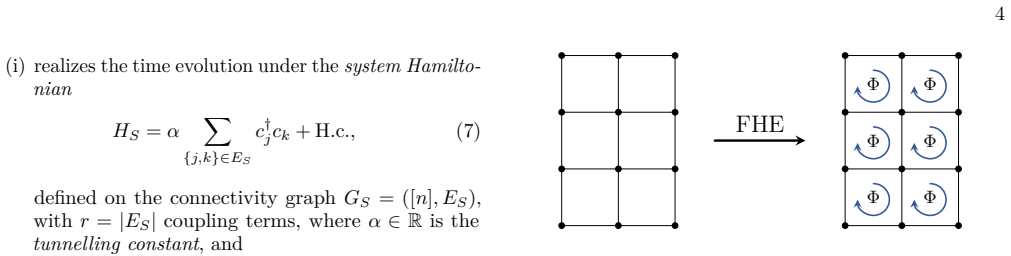
Conjugating system evolution with local fermionic unitaries realizes arbitrary complex tunnelling coefficients limited only by connectivity.
A machine-rendered reading of the paper's core claim, the machinery that carries it, and where it could break.
Core claim
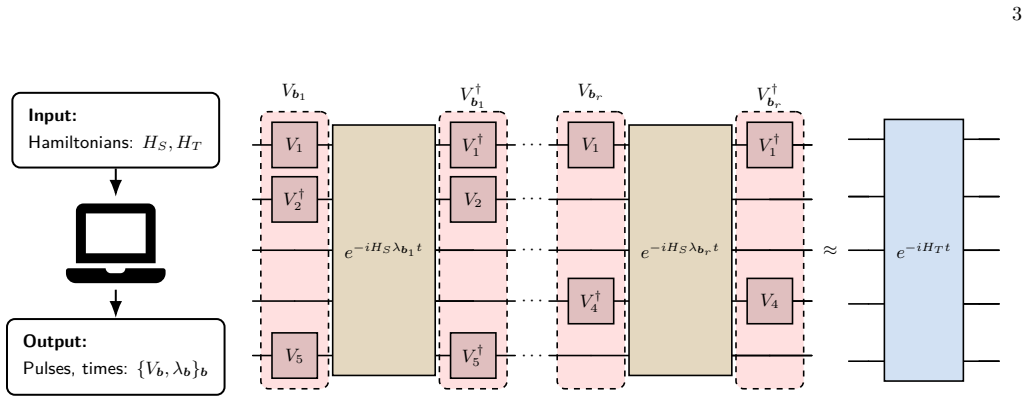
By conjugating free evolution under the system Hamiltonian with sequences of experimentally feasible local fermionic unitaries obtained via a linear program, the method realizes effective time evolution under a broad class of target Hamiltonians, including those with arbitrary complex tunnelling coefficients constrained only by the connectivity of the system Hamiltonian.
What carries the argument
The linear program that determines the sequences of local fermionic unitaries and free-evolution times to achieve the desired conjugation of the system Hamiltonian into the target Hamiltonian.
If this is right
- Arbitrary complex tunnelling coefficients become accessible on any connected fermionic lattice.
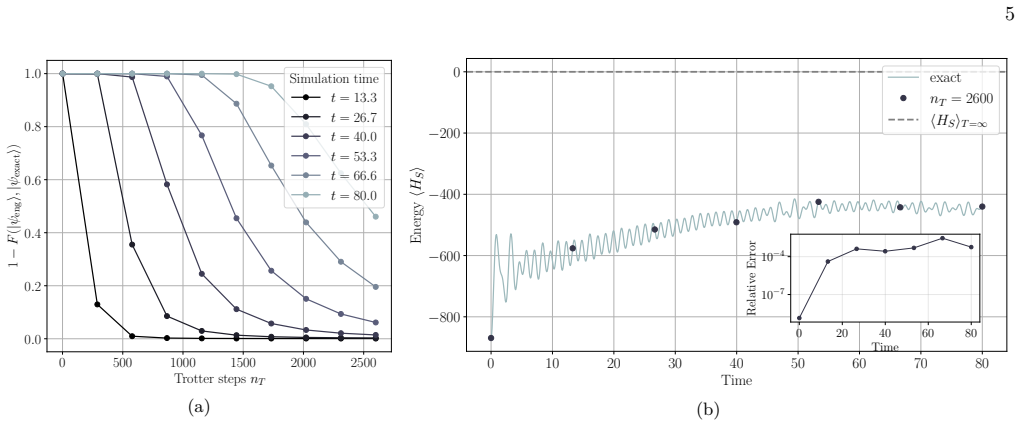
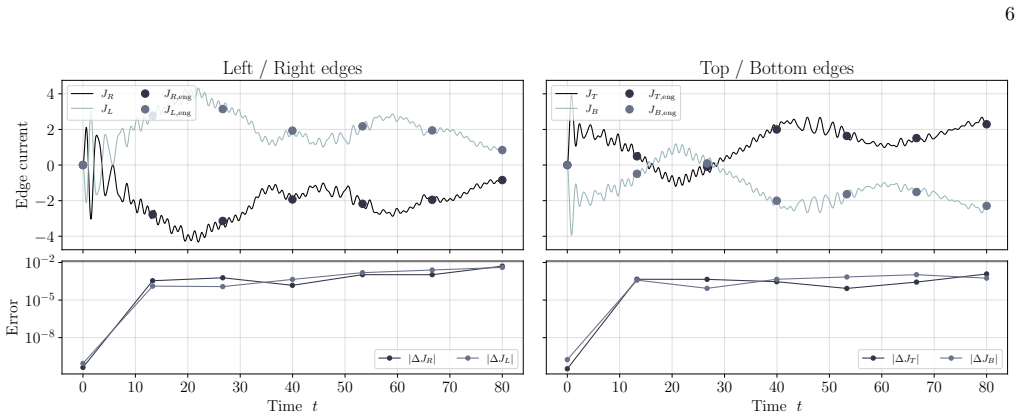
- The dynamics of the non-interacting Harper-Hofstadter model on a 1088-mode lattice can be engineered.
- An interacting Fermi-Hubbard chain with complex tunnelling coefficients can be simulated.
- The method provides intrinsic robustness to finite-pulse-time errors.
- The approach avoids continuous energy absorption inherent to Floquet engineering.
Where Pith is reading between the lines
- This could allow simulation of topological phases or other models requiring complex hoppings on hardware with limited native interactions.
- The linear programming approach might be adapted to optimize for minimal sequence length or robustness to noise.
- Similar techniques could apply to bosonic or spin systems with appropriate local controls.
Load-bearing premise
The local fermionic unitaries are experimentally feasible on the target hardware and the linear program returns sequences that exactly reproduce the desired target dynamics in the ideal-pulse limit.
What would settle it
An experiment where the measured dynamics under the engineered sequence deviate significantly from the predicted target Hamiltonian evolution, such as incorrect tunnelling phases or amplitudes.
Figures

read the original abstract
Quantum simulators enable the exploration of complex quantum phenomena in condensed-matter systems by reproducing their dynamics on controllable quantum devices. However, experimental constraints often restrict the class of Hamiltonians that can be realized natively. Hamiltonian engineering addresses this limitation by expanding the set of accessible target Hamiltonians from a fixed system Hamiltonian defined by the hardware. We introduce a new framework for fermionic Hamiltonian engineering based on conjugating free evolution under the system Hamiltonian with sequences of experimentally feasible local fermionic unitaries. The required sequences and free-evolution times are obtained efficiently via a linear program. By interleaving system evolution with these local unitaries, our method realizes effective time evolution under a broad class of target Hamiltonians, with intrinsic robustness to finite-pulse-time errors. In particular, we demonstrate that arbitrary complex tunnelling coefficients can be realized, constrained only by the connectivity of the underlying system Hamiltonian. We illustrate this capability by engineering the dynamics of the non-interacting Harper-Hofstadter model on a 1088-mode lattice and an interacting Fermi-Hubbard chain with complex tunnelling coefficients. By construction, our approach avoids the continuous energy absorption inherent to Floquet engineering.
Editorial analysis
A structured set of objections, weighed in public.
Referee Report
Summary. The paper presents a framework for fermionic Hamiltonian engineering that interleaves free evolution under a fixed native system Hamiltonian with sequences of local fermionic unitaries. Sequences and evolution times are obtained via linear programming; the approach is claimed to realize arbitrary complex tunnelling amplitudes (subject only to the underlying connectivity) with built-in robustness to finite pulse duration. Demonstrations are given for the non-interacting Harper-Hofstadter model on a 1088-mode lattice and for an interacting Fermi-Hubbard chain with complex hoppings; the method is positioned as avoiding the continuous driving and heating issues of Floquet engineering.
Significance. If the central claim holds, the work supplies an efficient, constructive route to a wide class of fermionic target Hamiltonians on hardware whose native interactions are limited to a fixed graph. The use of a linear program for sequence synthesis, the explicit large-scale lattice demonstration, and the avoidance of Floquet heating are concrete strengths that would make the technique immediately relevant to current quantum-simulation platforms.
major comments (2)
- [Abstract, §1] Abstract and §1: the assertion that 'arbitrary complex tunnelling coefficients can be realized, constrained only by the connectivity' is load-bearing for the paper's main contribution, yet the manuscript only verifies LP feasibility for the Harper-Hofstadter lattice and the 1D Hubbard chain. No general proof of feasibility for every complex coefficient set allowed by connectivity, nor an exhaustive search for infeasible counter-examples, is provided; this leaves the 'arbitrary' claim unsupported beyond the two specific models.
- [§3] §3 (linear-programming formulation): the reduction of the engineering task to an LP is presented as always returning a solution when the target lies within the connectivity graph, but the manuscript supplies no analytic argument or numerical stress-test confirming that the constraint matrix remains full rank or that the feasible set is non-empty for arbitrary complex phases and amplitudes. This directly affects the claim that only connectivity, not the LP itself, limits realizability.
minor comments (2)
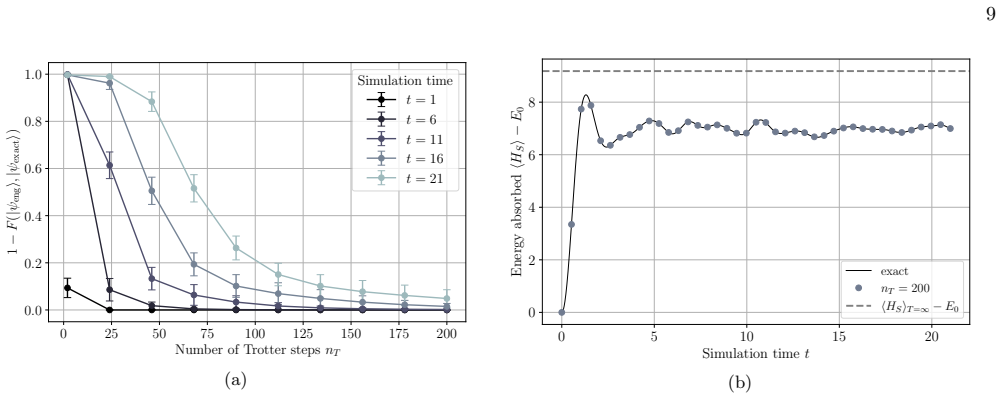
- [Figures 3-4] Figure captions and axis labels in the 1088-mode lattice results should explicitly state the pulse-duration error model used to demonstrate robustness.
- [§4] The manuscript would benefit from a short table comparing the number of LP variables and constraints for the two demonstration systems.
Simulated Author's Rebuttal
We are grateful to the referee for their thorough review and positive assessment of the significance of our work. We address the major comments regarding the generality of our claims in the point-by-point responses below. We will make revisions to clarify and strengthen the presentation of our results.
read point-by-point responses
-
Referee: [Abstract, §1] Abstract and §1: the assertion that 'arbitrary complex tunnelling coefficients can be realized, constrained only by the connectivity' is load-bearing for the paper's main contribution, yet the manuscript only verifies LP feasibility for the Harper-Hofstadter lattice and the 1D Hubbard chain. No general proof of feasibility for every complex coefficient set allowed by connectivity, nor an exhaustive search for infeasible counter-examples, is provided; this leaves the 'arbitrary' claim unsupported beyond the two specific models.
Authors: We agree that the claim of arbitrariness would benefit from a more rigorous justification. The linear programming approach is formulated in a way that is independent of the specific target Hamiltonian, relying only on the ability to apply local unitaries and the connectivity for the free evolution. To address this, we will revise the abstract and introduction to temper the language slightly if necessary, and add a section or appendix with additional numerical experiments on random target coefficients for small lattices to demonstrate feasibility beyond the two examples. We believe this will support the claim without requiring a full analytic proof at this stage. revision: yes
-
Referee: [§3] §3 (linear-programming formulation): the reduction of the engineering task to an LP is presented as always returning a solution when the target lies within the connectivity graph, but the manuscript supplies no analytic argument or numerical stress-test confirming that the constraint matrix remains full rank or that the feasible set is non-empty for arbitrary complex phases and amplitudes. This directly affects the claim that only connectivity, not the LP itself, limits realizability.
Authors: The referee correctly notes the absence of an analytic argument for the non-emptiness of the feasible set. The LP is set up with variables corresponding to the durations of free evolution segments and the parameters of the local unitaries, with linear constraints derived from matching the effective Hamiltonian terms. While we do not have a proof that the matrix is always full rank, the structure of the problem suggests that the local controls provide sufficient degrees of freedom to achieve any complex coefficient consistent with connectivity. In the revision, we will include numerical stress-tests, such as solving the LP for numerous random complex targets on small graphs, to empirically confirm that solutions are found whenever the target respects the connectivity. revision: yes
Circularity Check
No circularity; constructive LP method is externally solved
full rationale
The paper derives target dynamics by solving a linear program for sequences of local fermionic unitaries interleaved with free evolution under the native Hamiltonian. This LP is an external numerical solver whose feasibility is asserted for the demonstrated cases (Harper-Hofstadter lattice, 1D Hubbard chain) without defining the target coefficients in terms of the same fitted data or reducing any claim to a self-citation chain. The central statement that realizable tunnelling is constrained only by connectivity follows from the method's construction rather than from re-labeling inputs as outputs. No load-bearing step collapses by definition or by internal fitting.
Axiom & Free-Parameter Ledger
axioms (2)
- domain assumption Local fermionic unitaries can be implemented experimentally on the hardware
- domain assumption The linear program finds sequences whose interleaved evolution reproduces the target Hamiltonian
Reference graph
Works this paper leans on
-
[1]
We illustrate this by calculating the pulses necessary to en- gineer artificial gauge fields on a triangular lattice with a degenerate ground state [36]
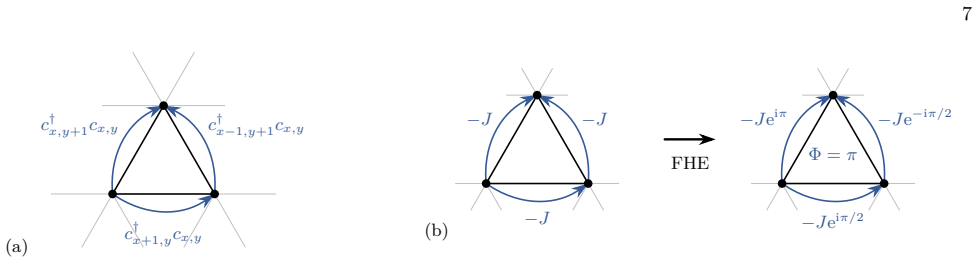
Artificial gauge fields on a triangular lattice In certain cases, it is possible to bypass theLP, and construct the required pulse sequence analytically. We illustrate this by calculating the pulses necessary to en- gineer artificial gauge fields on a triangular lattice with a degenerate ground state [36]. We consider a quadratic system Hamiltonian on a t...
-
[2]
) +U ∑ j nj↑nj↓
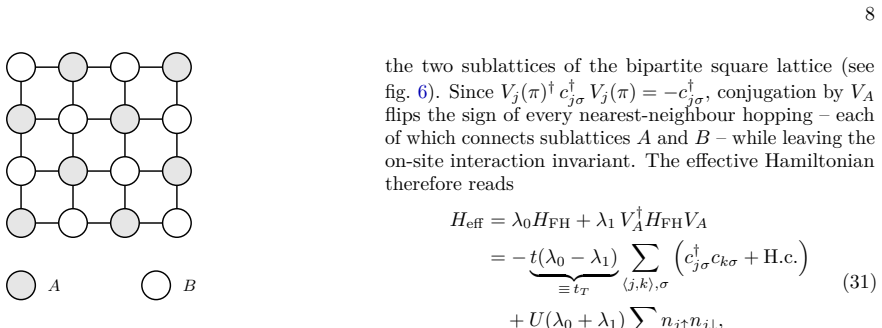
TuningU/tin the Fermi–Hubbard model As a first application of our method to interacting Hamiltonians, we consider tuning theU/t ratio of the Fermi–Hubbard model on a 2D square lattice with nearest- neighbour tunnelling, HFH =−t ∑ ⟨j,k⟩,σ∈{↑,↓} ( c† jσckσ+ H.c. ) +U ∑ j nj↑nj↓. (30) We take the pulse sequence{1,VA}with evolution times {λ0,λ1}, whereVA := ∏...
-
[3]
turned off
Artificial gauge fields in the 1D Fermi–Hubbard chain We now consider the task of simulating artificial gauge fields in an interacting system. To this end, we consider a one-dimensional Fermi–Hubbard system Hamiltonian where, for concreteness, the uniform tunnelling coefficient is set to one, HS = ∑ j∈[L−1],σ ( c† j+1,σcj,σ+ H.c. ) +US ∑ j nj↑nj↓. (33) Us...
-
[4]
I. M. Georgescu, S. Ashhab, and F. Nori, Quantum Simulation, Reviews of Modern Physics86, 153 (2014), arXiv:1308.6253 [quant-ph]
Pith/arXiv arXiv 2014
-
[5]
D. P. Arovas, E. Berg, S. A. Kivelson, and S. Raghu, The hubbard model, Annual Review of Condensed Matter Physics13, 239 (2022)
2022
-
[6]
M. Qin, T. Schäfer, S. Andergassen, P. Corboz, and E. Gull, The Hubbard Model: A Computational Per- spective, Annual Review of Condensed Matter Physics 13, 275 (2022)
2022
-
[7]
N. R. Cooper, J. Dalibard, and I. B. Spielman, Topological Bands for Ultracold Atoms, Reviews of Modern Physics 91, 015005 (2019), arXiv:1803.00249 [cond-mat]
Pith/arXiv arXiv 2019
-
[8]
McArdle, S
S. McArdle, S. Endo, A. Aspuru-Guzik, S. C. Benjamin, and X. Yuan, Quantum computational chemistry, Rev. Mod. Phys.92, 015003 (2020)
2020
-
[9]
Bauer, S
B. Bauer, S. Bravyi, M. Motta, and G. K.-L. Chan, Quantum Algorithms for Quantum Chemistry and Quantum Materials Science, Chemical Reviews120, 12685 (2020). 17
2020
-
[10]
Troyer and U.-J
M. Troyer and U.-J. Wiese, Computational Complex- ity and Fundamental Limitations to Fermionic Quantum Monte Carlo Simulations, Physical Review Letters94, 170201 (2005)
2005
-
[11]
Bloch, J
I. Bloch, J. Dalibard, and S. Nascimbène, Quantum sim- ulations with ultracold quantum gases, Nature Physics8, 267 (2012)
2012
-
[12]
Altman, K
E. Altman, K. R. Brown, G. Carleo, L. D. Carr, E. Demler, C. Chin, B. DeMarco, S. E. Economou, M. A. Eriksson, K.-M. C. Fu, M. Greiner, K. R. Hazzard, R. G. Hulet, A. J. Kollár, B. L. Lev, M. D. Lukin, R. Ma, X. Mi, S. Misra, C. Monroe, K. Murch, Z. Nazario, K.-K. Ni, A. C. Potter, P. Roushan, M. Saffman, M. Schleier-Smith, I. Siddiqi, R. Simmonds, M. Sin...
2021
-
[13]
A. J. Daley, I. Bloch, C. Kokail, S. Flannigan, N. Pearson, M. Troyer, and P. Zoller, Practical quantum advantage in quantum simulation, Nature607, 667 (2022)
2022
-
[14]
S. Flannigan, N. Pearson, G. H. Low, A. Buyskikh, I. Bloch, P. Zoller, M. Troyer, and A. J. Daley, Propaga- tion of errors and quantitative quantum simulation with quantum advantage (2022), arXiv:2204.13644 [quant-ph]
arXiv 2022
-
[15]
R. Trivedi, A. F. Rubio, and J. I. Cirac, Quantum advant- age and stability to errors in analogue quantum simulators (2023), arXiv:2212.04924 [quant-ph]
arXiv 2023
-
[16]
M. A. Nielsen, M. J. Bremner, J. L. Dodd, A. M. Childs, and C. M. Dawson, Universal simulation of Hamiltonian dynamics for quantum systems with finite-dimensional state spaces, Phys. Rev. A66, 022317 (2002), arXiv:quant- ph/0109064
arXiv 2002
-
[17]
J.L.Dodd, M.A.Nielsen, M.J.Bremner,andR.T.Thew, Universal quantum computation and simulation using any entangling Hamiltonian and local unitaries, Phys. Rev. A 65, 040301 (2002), arXiv:quant-ph/0106064
Pith/arXiv arXiv 2002
-
[18]
D. W. Leung, I. L. Chuang, F. Yamaguchi, and Y. Yamamoto, Efficient implementation of coupled lo- gic gates for quantum computation, Phys. Rev. A61, 042310 (2000), arXiv:quant-ph/9904100
Pith/arXiv arXiv 2000
-
[19]
D.Leung,Simulationandreversalofn-qubitHamiltonians using Hadamard matrices, Journal of Modern Optics49, 1199 (2002), arXiv:quant-ph/0107041
Pith/arXiv arXiv 2002
-
[20]
D. Hayes, S. T. Flammia, and M. J. Biercuk, Program- mable quantum simulation by dynamic Hamiltonian en- gineering, New Journal of Physics16, 083027 (2014), arXiv:1309.6736 [quant-ph]
Pith/arXiv arXiv 2014
-
[21]
T. Choi, S. Debnath, T. A. Manning, C. Figgatt, Z. X. Gong, L. M. Duan, and C. Monroe, Optimal quantum con- trol of multimode couplings between trapped ion qubits for scalable entanglement, Phys. Rev. Lett.112, 190502 (2014), arXiv:1401.1575 [quant-ph]
Pith/arXiv arXiv 2014
-
[22]
J. Choi, H. Zhou, H. S. Knowles, R. Landig, S. Choi, and M. D. Lukin, Robust dynamic Hamiltonian engineering of many-body spin systems, Phys. Rev. X10, 031002 (2020), arXiv:1907.03771
arXiv 2020
-
[23]
N. Grzesiak, R. Blümel, K. Wright, K. M. Beck, N. C. Pisenti, M. Li, V. Chaplin, J. M. Amini, S. Debnath, J.-S. Chen, and Y. Nam, Efficient arbitrary simultaneously entangling gates on a trapped-ion quantum computer, Nat. Commun.11, 2963 (2020), arXiv:1905.09294
arXiv 2020
- [24]
- [25]
- [26]
-
[27]
Baßler, M
P. Baßler, M. Heinrich, and M. Kliesch, General, Efficient, and Robust Hamiltonian Engineering, PRX Quantum6, 040346 (2025)
2025
-
[28]
H.-Y. Hu, A. M. Gomez, L. Chen, A. Trowbridge, A. J. Goldschmidt, Z. Manchester, F. T. Chong, A. Jaffe, and S. F. Yelin, Universal dynamics with globally controlled analog quantum simulators (2026), arXiv:2508.19075 [quant-ph]
arXiv 2026
-
[29]
T. Esslinger, Fermi-Hubbard physics with atoms in an op- tical lattice, Annual Review of Condensed Matter Physics 1, 129 (2010), arXiv:1007.0012 [cond-mat]
Pith/arXiv arXiv 2010
-
[30]
W. S. Bakr, J. I. Gillen, A. Peng, S. Fölling, and M. Greiner, A quantum gas microscope for detecting single atoms in a Hubbard-regime optical lattice, Nature 462, 74 (2009)
2009
-
[31]
Gross and W
C. Gross and W. S. Bakr, Quantum gas microscopy for single atom and spin detection, Nature Physics17, 1316 (2021)
2021
-
[32]
Barredo, V
D. Barredo, V. Lienhard, S. de Léséleuc, T. Lahaye, and A. Browaeys, Synthetic three-dimensional atomic struc- tures assembled atom by atom, Nature561, 79 (2018)
2018
-
[33]
Bernien, S
H. Bernien, S. Schwartz, A. Keesling, H. Levine, A. Om- ran, H. Pichler, S. Choi, A. S. Zibrov, M. Endres, M. Greiner, V. Vuletić, and M. D. Lukin, Probing many- body dynamics on a 51-atom quantum simulator, Nature 551, 579 (2017)
2017
-
[34]
H. J. Manetsch, G. Nomura, E. Bataille, K. H. Leung, X. Lv, and M. Endres, A tweezer array with 6100 highly coherent atomic qubits (2024), arXiv:2403.12021
Pith/arXiv arXiv 2024
-
[35]
Schuch, M
N. Schuch, M. M. Wolf, F. Verstraete, and J. I. Cirac, En- tropy Scaling and Simulability by Matrix Product States, Physical Review Letters100, 030504 (2008)
2008
-
[36]
U.Schollwoeck,Thedensity-matrixrenormalizationgroup in the age of matrix product states, Annals of Physics 326, 96 (2011), arXiv:1008.3477 [cond-mat]
Pith/arXiv arXiv 2011
-
[37]
A. Eckardt, Atomic quantum gases in periodically driven optical lattices, Reviews of Modern Physics89, 011004 (2017), arXiv:1606.08041 [cond-mat]
Pith/arXiv arXiv 2017
-
[38]
G. M. Nixon, F. N. Ünal, and U. Schneider, Individually tunable tunnelling coefficients in optical lattices using local periodic driving, Quantum Science and Technology 9, 045030 (2024)
2024
-
[39]
J. Struck, M. Weinberg, C. Ölschläger, P. Windpas- singer, J. Simonet, K. Sengstock, R. Höppner, P. Hauke, A. Eckardt, M. Lewenstein, and L. Mathey, Engineer- ing Ising-XY spin models in a triangular lattice via tun- able artificial gauge fields, Nature Physics9, 738 (2013), arXiv:1304.5520 [cond-mat]
Pith/arXiv arXiv 2013
-
[40]
Jotzu, M
G. Jotzu, M. Messer, R. Desbuquois, M. Lebrat, T. Uehlinger, D. Greif, and T. Esslinger, Experimental realization of the topological Haldane model with ul- tracold fermions, Nature515, 237 (2014)
2014
-
[41]
Aidelsburger, M
M. Aidelsburger, M. Atala, S. Nascimbène, S. Trotzky, Y.-A. Chen, and I. Bloch, Experimental Realization of Strong Effective Magnetic Fields in an Optical Lattice, Physical Review Letters107, 255301 (2011). 18
2011
-
[42]
M. Aidelsburger, M. Atala, M. Lohse, J. T. Barreiro, B. Paredes, and I. Bloch, Realization of the Hofstadter Hamiltonian with ultracold atoms in optical lattices, Phys- ical Review Letters111, 185301 (2013), arXiv:1308.0321 [cond-mat]
Pith/arXiv arXiv 2013
-
[43]
Aidelsburger, M
M. Aidelsburger, M. Lohse, C. Schweizer, M. Atala, J. T. Barreiro, S. Nascimbène, N. R. Cooper, I. Bloch, and N. Goldman, Measuring the Chern number of Hofstadter bands with ultracold bosonic atoms, Nature Physics11, 162 (2015)
2015
-
[44]
Miyake, G
H. Miyake, G. A. Siviloglou, C. J. Kennedy, W. C. Burton, and W. Ketterle, Realizing the Harper Hamiltonian with Laser-Assisted Tunneling in Optical Lattices, Physical Review Letters111, 185302 (2013)
2013
-
[45]
Bravyi, Lagrangian representation for fermionic linear optics (2004), arXiv:quant-ph/0404180
S. Bravyi, Lagrangian representation for fermionic linear optics (2004), arXiv:quant-ph/0404180
Pith/arXiv arXiv 2004
-
[46]
R. Jozsa and A. Miyake, Matchgates and classical simula- tion of quantum circuits, Proceedings of the Royal Society A: Mathematical, Physical and Engineering Sciences464, 3089 (2008), arXiv:0804.4050 [quant-ph]
Pith/arXiv arXiv 2008
-
[47]
H. F. Trotter, On the Product of Semi-Groups of Operat- ors, Proceedings of the American Mathematical Society 10, 545 (1959), 2033649
1959
-
[48]
A. M. Childs, Y. Su, M. C. Tran, N. Wiebe, and S. Zhu, A Theory of Trotter Error, Physical Review X11, 011020 (2021), arXiv:1912.08854 [quant-ph]
arXiv 2021
-
[49]
A. M. Dalzell, S. McArdle, M. Berta, P. Bienias, C.- F. Chen, A. Gilyén, C. T. Hann, M. J. Kastoryano, E. T. Khabiboulline, A. Kubica, G. Salton, S. Wang, and F. G. S. L. Brandão, Quantum algorithms: A sur- vey of applications and end-to-end complexities (2023), arXiv:2310.03011 [quant-ph]
arXiv 2023
-
[50]
A. Agrawal, R. Verschueren, S. Diamond, and S. Boyd, A Rewriting System for Convex Optimization Problems (2019), arXiv:1709.04494 [math]
Pith/arXiv arXiv 2019
-
[51]
S. Diamond and S. Boyd, CVXPY: A Python-Embedded Modeling Language for Convex Optimization (2016), arXiv:1603.00943 [math]
Pith/arXiv arXiv 2016
-
[52]
MOSEK ApS, MOSEK Optimizer API for Python 11.1.3 (2026)
2026
-
[53]
Weinberg and M
P. Weinberg and M. Bukov, QuSpin: A Python package for dynamics and exact diagonalisation of quantum many body systems part I: Spin chains, SciPost Physics2, 003 (2017)
2017
-
[54]
Weinberg and M
P. Weinberg and M. Bukov, QuSpin: A Python package for dynamics and exact diagonalisation of quantum many body systems. Part II: Bosons, fermions and higher spins, SciPost Physics7, 020 (2019)
2019
-
[55]
Kum, Fermionic Hamiltonian Engineering with Local Operators: Numerical Code, https://github
Ö. Kum, Fermionic Hamiltonian Engineering with Local Operators: Numerical Code, https://github. com/ozgunkum/fermionic-hamiltonian-engineering (2026), accessed: 2026-06-12
2026
-
[56]
T. Kuwahara, T. Mori, and K. Saito, Floquet-Magnus Theory and Generic Transient Dynamics in Periodically Driven Many-Body Quantum Systems, Annals of Physics 367, 96 (2016), arXiv:1508.05797 [quant-ph]
Pith/arXiv arXiv 2016
-
[57]
C. Chin, R. Grimm, P. Julienne, and E. Tiesinga, Fesh- bach Resonances in Ultracold Gases, Reviews of Modern Physics82, 1225 (2010), arXiv:0812.1496 [cond-mat]
Pith/arXiv arXiv 2010
-
[58]
Banica, Invitation to Hadamard matrices (2024), arXiv:1910.06911 [math.CO]
T. Banica, Invitation to Hadamard matrices (2024), arXiv:1910.06911 [math.CO]
arXiv 2024
-
[59]
Bárány, A generalization of Carathéodory’s theorem, Discrete Mathematics40, 141 (1982)
I. Bárány, A generalization of Carathéodory’s theorem, Discrete Mathematics40, 141 (1982)
1982
-
[60]
D. A. Spielman and S.-H. Teng, Smoothed analysis of algorithms: Why the simplex algorithm usually takes polynomial time, Journal of the ACM51, 385 (2004)
2004
-
[61]
E. Bach and S. Huiberts, Optimal Smoothed Analysis of the Simplex Method (2025), arXiv:2504.04197 [cs]
Pith/arXiv arXiv 2025
-
[62]
Brinkmann, Introduction to average Hamiltonian the- ory
A. Brinkmann, Introduction to average Hamiltonian the- ory. I. Basics, Concepts in Magnetic Resonance Part A 45A, e21414 (2016)
2016
-
[63]
P. C. Moan and J. Niesen, Convergence of the Magnus Series, Foundations of Computational Mathematics8, 291 (2008)
2008
-
[64]
Wendel, A problem in geometric probability., Mathem- atica Scandinavica11, 109 (1962)
J. Wendel, A problem in geometric probability., Mathem- atica Scandinavica11, 109 (1962)
1962
-
[65]
Struck, C
J. Struck, C. Ölschläger, M. Weinberg, P. Hauke, J. Si- monet, A. Eckardt, M. Lewenstein, K. Sengstock, and P. Windpassinger, Tunable Gauge Potential for Neutral and Spinless Particles in Driven Optical Lattices, Physical Review Letters108, 225304 (2012)
2012
-
[66]
J. Surace and L. Tagliacozzo, Fermionic Gaussian states: An introduction to numerical approaches, SciPost Physics Lecture Notes , 54 (2022), arXiv:2111.08343 [quant-ph]
arXiv 2022
-
[67]
V. K. Rohatgi, A. Ben-Israel, and T. N. E. Greville, Gen- eralized Inverses: Theory and Applications, International Statistical Review / Revue Internationale de Statistique 44, 301 (1976), 1403291. 19 1 2 3 α α V2(θ) FHE 1 2 3 αe−iθαeiθ (a) Phase engineering via a local unitary. 1 2 3 α α FHE 1 2 3 β12 β23 (b) Independent tuning of real tunnellings. Figur...
1976
-
[68]
For a comprehensive review of numerical approaches to fermionic quadratic Hamiltonians see [63]
Particle number preserving quadratic Hamiltonians We begin by discussing some of the basics of particle number preserving quadratic Hamiltonians. For a comprehensive review of numerical approaches to fermionic quadratic Hamiltonians see [63]. LetH be a particle number preserving quadratic Hamiltonian withnmodes, i.e. H= ∑ i,j∈[n] hijc† icj (C1) 21 withn×n...
-
[69]
These matrices generate unitaries that act on the smallern-dimensional space vb = e−igb = diag ( e−2πib1/3,e−2πib2/3,...,e−2πibn/3 ) .(C21) In the previous section, eq
Translating FHE into the language of quadratic Hamiltonians A pulseVb is generated by a quadratic Hamiltonian Gb = 2π 3 ∑ j∈[n] bjc† jcj,(C19) so the coefficient matrixgb for the generatorGb is given by gb = 2π 3 diag(b1,...,bn),(C20) 23 whereb j∈T≡{−1,0,1}as before. These matrices generate unitaries that act on the smallern-dimensional space vb = e−igb =...
discussion (0)
Sign in with ORCID, Apple, or X to comment. Anyone can read and Pith papers without signing in.