REVIEW 4 major objections 4 minor 2 cited by
Breaking Event Rumor Detection via Stance-Separated Multi-Agent Debate
T0 review · 4 major / 4 minor · reviewed 2026-08-11 · deepseek-v4-flash
Pith's one-line read Generic LLMs become competitive breaking-event rumor detectors when their reasoning is forced through a stance-separated, pro-con debate with a judge, improving accuracy by up to 12.2 percentage points on the two COVID-19 datasets.
desk verdict S2MAD is a promising zero-shot pipeline for rumor detection, but the debate ablation is invalidated by a table inconsistency and the empirical support is single-run point estimates. read the letter →
The pith
A machine-rendered reading of the paper's core claim, the machinery that carries it, and where it could break.
The reading
What carries the argument
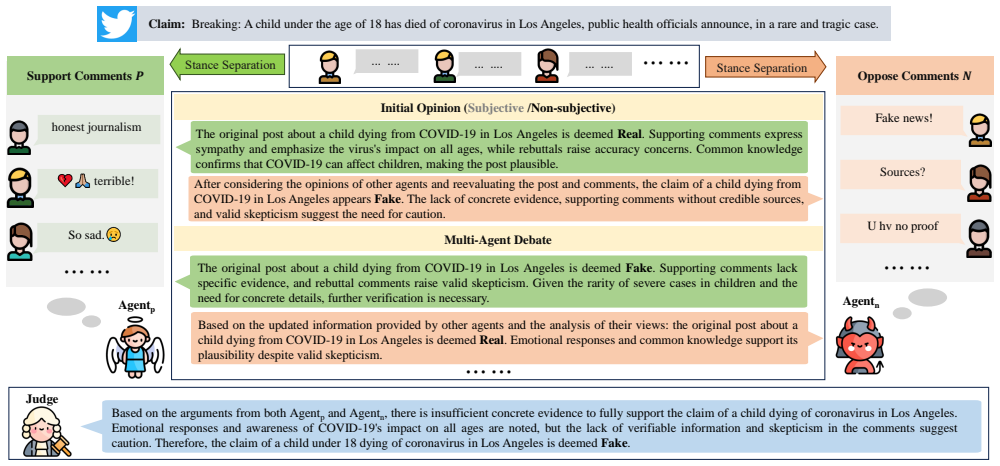
The object that carries the argument is the stance-separated debate loop. A commentary scorer labels each comment with a score in [-1,1]: positive for support of the claim, negative for opposition, and zero for comments that violate common sense; the top-k positives and top-k negatives become the two debaters' private evidence. The claim itself is separately classified as subjective or objective, which selects different initial-opinion prompts, with reasonability and trust-impact checks for subjective posts and support/rebuttal evaluation plus common-sense verification for objective posts. Two debater agents update their verdicts by critically reading each other's previous answer, and a judge agent resolves the cases where the fixed number of rounds ends in disagreement.
What would settle it
Take a sample of comments from the two datasets, have human annotators mark each as supporting, opposing, or off-topic, and compare their labels with the LLM stance scorer: if agreement is low, or if rerunning S2MAD with the scorer's labels replaced by human labels changes accuracy, the stance-separation stage is the fragile link. A second check is to replace stance separation with random comment assignment and measure whether the reported ablation drop of roughly 12 points on Twitter-COVID19 reproduces.
Extended reading notes
Core claim
On the paper's own terms, the central discovery is that the veracity of an unfolding claim can be decided more accurately by forcing two LLM agents to argue from deliberately separated evidence sets than by asking one model to reason over the whole thread. Stance separation converts an undifferentiated comment list into a support set and an oppose set; the support-agent and oppose-agent then generate initial judgments under prompts matched to the claim's subjectivity, exchange rebuttals for a fixed number of rounds, and only invoke a judge when they cannot agree. The reported result is that this structure turns weak zero-shot backbones into systems that outperform not only their vanilla prompts but also trained propagation-graph baselines applied out of domain: on Twitter-COVID19, S2MAD with GPT-3.5 turbo reaches 76.5 percent accuracy versus 73.5 for the strongest prior baseline, and on Weibo-COVID19 it reaches 81.0 percent versus 79.7. Ablations attribute the gain to stance separation, to subjectivity-matched prompts, and to the debate itself, with the debate component alone accounting for a drop of roughly 12 percentage points when removed from the Twitter-COVID19 setting.
Load-bearing premise
The load-bearing premise is that the LLM that scores each comment as supporting, opposing, or nonsensical is reliable enough that the two debaters receive genuinely contrasting evidence; if that scorer is noisy or biased, the debate and judge inherit the distortion.
Editorial extensions
If this is right
- A sudden event with no labeled data can still be handled at inference time: S2MAD outperforms propagation-graph models trained on public datasets and applied directly to the COVID-19 test sets.
- The wrapper transfers across backbones: both tested LLMs improve when the stance-separated debate is added, so the gain is attributed to the structure rather than to one model.
- Every component is load-bearing in the experiments: removing stance separation, dropping either subjectivity-matched prompt, or removing the debate reduces accuracy in the ablation study.
- Early detection is not sacrificed: S2MAD stays competitive with baselines at early checkpoints with few comments, not only with full threads.
- Unresolved debates are the reason for the judge: when the fixed two rounds do not produce consensus, the judge's synthesis supplies the final verdict.
Reading between the lines
- Beyond the paper, the same pro-and-con evidence split could transfer to other low-resource verification tasks, such as fast-breaking health claims, disaster misinformation, or election rumors, whenever an unlabeled comment thread exists.
- Beyond the paper, the judge's written synthesis doubles as a natural explanation artifact; whether that explanation is faithful to the evidence that drove the verdict is a testable question the paper does not explore.
- Beyond the paper, the sensitivity of the reported gains to the scoring model, the number of selected comments k, and the number of debate rounds is still open, since the paper fixes these choices.
- Beyond the paper, the small accuracy change after two debate rounds suggests that an adaptive stopping rule based on debater agreement could cut inference cost; this is a speculation, not a result of the paper.
Signed reviews
Editorial analysis
A structured set of objections, weighed in public.
Referee Report
Summary. The paper proposes S2MAD, a zero-shot pipeline for rumor detection on breaking-event social media. It separates comments into supporting and opposing stance sets using an LLM scorer (glm-3-turbo), classifies each claim as subjective or non-subjective to select a prompt strategy, generates initial opinions for two debater agents, runs up to M debate rounds, and invokes a judge agent if no consensus is reached. The authors evaluate on Twitter-COVID19 and Weibo-COVID19, reporting that S2MAD improves Qwen1.5-7b-chat and GPT-3.5 turbo accuracy and outperforms trained baselines, with additional early-detection experiments.
Significance. If the empirical claims held, S2MAD would be a useful contribution to zero-shot rumor detection in breaking-event scenarios, where labeled data is unavailable. The component design is intuitive and the two-dataset evaluation against several baselines is a reasonable starting point. However, the current evidence does not yet support the central debate-specific claim: the key debate ablation row is internally inconsistent, and the reported gains are single-run point estimates without variance or statistical testing. The paper does not provide code, prompts in a reusable form, or scorer validation, which limits reproducibility.
major comments (4)
- [Table 2 vs. Table 1] The 'w/o Debate' row in Table 2 reports accuracy values of 0.645 on Twitter-COVID19 and 0.737 on Weibo-COVID19, which are exactly the same as the 'Qwen1.5 + S2MAD' row in Table 1, even though Table 2 is explicitly described as using GPT-3.5 turbo. If this is a copy error, the stated 12% and 7.3% drops attributed to removing the debate are not supported; if the experiment was actually run with Qwen1.5, it is not a valid ablation for the GPT-3.5-based full model. The authors must supply the correct GPT-3.5 no-debate numbers, with variance, before the central debate contribution can be assessed.
- [Section 4.4, Figure 2] The maximum number of debate rounds M is set to two after inspecting the accuracy curve on the test sets in Figure 2. This is a post-hoc selection on evaluation data, and because no validation split or confidence intervals are reported, the subsequent results may reflect selection artifacts rather than genuine improvement. The authors should fix M on a held-out validation set or report results across a range of M with error bars and a significance test.
- [Section 3.2, Section 4.2] The stance separation stage depends entirely on glm-3-turbo as an LLM scorer, but the paper provides no validation of this scorer, no agreement statistics against human annotations, and no analysis of how scoring errors propagate to the selected comment sets P and N. The behavior of the 0.0 'not conforming to common sense' category is also not evaluated. Since both debaters receive only this filtered evidence, the reliability of the entire pipeline is not established without such an analysis.
- [Section 4.3, Table 1] All results are single-run point estimates without standard deviations, confidence intervals, or significance tests. The headline improvements (8.0% and 12.2% on Twitter-COVID19; 3.9% and 4.8% on Weibo-COVID19) are differences between point estimates, and the lack of variance reporting is especially problematic because LLM decoding is stochastic even at temperature 0.2. At least a small number of repeated runs with reported variance is needed to support the claimed improvements.
minor comments (4)
- [Section 4.4] The text uses '/o Debate' while Table 2 uses 'w/o Debate'; please correct the typo.
- [Section 4.2, Eq. (2)] The value of k, the number of comments selected per stance set, is never reported, although it is a free parameter in Eq. (2) and the 'w/o Stance' ablation uses a different sampling rule. Please report k and, ideally, include a sensitivity analysis over k.
- [Table 2 caption] The caption for 'w/o Non-Sub/Sub' is ambiguous: it is not clear whether 'w/o Non-Sub' means removing the non-subjective prompt or applying the non-subjective prompt to the entire dataset. Please clarify each ablation row explicitly.
- [Figure 2] Figure 2 would benefit from error bars, a clear definition of 'round 0', and a statement of whether the reported values are averaged over multiple runs.
Circularity Check
No self-citation chain, but the debate-effect ablation is numerically identical to another backbone's full S2MAD and M is selected on the test set; core S2MAD-vs-baseline comparison is still independent.
-
other
[Section 4.4, Table 2 (Effectiveness of Debate) vs Table 1]
"As shown, removing the debate from S2MAD led to a decrease in accuracy of 12% on the Twitter-COVID19 dataset and 7.3% on the Weibo-COVID19 dataset."
The ablation row 'w/o Debate' is reported as 0.645 ACC on Twitter-COVID19 and 0.737 on Weibo-COVID19, exactly matching the 'Qwen1.5 + S2MAD' row in Table 1 (0.645, 0.737). The 12%/7.3% 'debate effect' is therefore computed by subtracting a different backbone's full S2MAD result from GPT-3.5+S2MAD, not by subtracting a GPT-3.5 no-debate control. The claimed causal attribution to 'removing the debate' is an artifact of the table's construction: the comparison reduces to a backbone difference, so the debate component's contribution is not measured by this experiment.
-
fitted input called prediction
[Section 4.4, Debate Rounds (Figure 2)]
"when the number of debate rounds exceeded two, the accuracy of the model on both datasets showed slight fluctuations, and the final performance was similar to that of two rounds of debate. Therefore, we default to conducting two rounds of debate."
The number of debate rounds M is selected by inspecting test-set accuracy on the same Twitter-COVID19 and Weibo-COVID19 datasets that are later used to report the headline improvements in Table 1. The paper then fixes M=2 as a default and presents the resulting test accuracy as evidence of S2MAD's effectiveness. This makes the reported prediction partly dependent on a hyperparameter fitted to the evaluation data; the 'improvement' is not a fully out-of-sample zero-shot result, and the choice of M is converted from a post hoc test-set observation into a design parameter.
full rationale
Strictly, the paper contains no equation-level circularity: the final prediction is not fed back into the stance-scoring or debate equations, and no load-bearing uniqueness theorem or self-citation chain is invoked. The main circularity-adjacent problems are (1) the invalid 'w/o Debate' ablation discussed above, which destroys the direct evidence for the debate component, and (2) the test-set selection of debate rounds M, which inflates the headline numbers. The core S2MAD-versus-baseline comparison in Table 1 remains an external, self-contained empirical claim, and the unvalidated glm-3-turbo stance scorer is a correctness/robustness weakness rather than a circular step. Self-citations (e.g., Liu et al. 2024 for prompt design, Wang et al. 2024a for stance-based comment splitting) are not used as unique mathematical force and do not carry the derivation. Because one load-bearing component claim is invalidated by row identity and another design choice is fit to the test set, but the overall framework is still evaluated against independent baselines, a moderate score is appropriate.
Assumptions & free parameters
free parameters (3)
- k (number of top comments per stance set) =
not reported
- M (maximum debate rounds) =
2
- temperature for LLM decoding =
0.2
assumptions (4)
- domain assumption LLMs can accurately classify comment stance as supporting/opposing and can judge 'common sense' adherence as instructed in Eq. 1's prompt.
- domain assumption Comments that do not conform to common sense carry no signal and should be assigned score 0.0 and excluded.
- domain assumption Subjective vs. objective claim classification improves prompt effectiveness.
- domain assumption The debate process and judge lead to better veracity judgments than a single LLM call.
Cite this review
Pith. "Pith review of Breaking Event Rumor Detection via Stance-Separated Multi-Agent Debate." pith.science (2026). https://pith.science/paper/63RNDQDK
@misc{pith2026241204859,
  author       = {Pith},
  title        = {Pith review of: Breaking Event Rumor Detection via Stance-Separated Multi-Agent Debate},
  year         = {2026},
  howpublished = {\url{https://pith.science/paper/63RNDQDK}},
  note         = {Machine review of arXiv:2412.04859}
}
read the original abstract
The rapid spread of rumors on social media platforms during breaking events severely hinders the dissemination of the truth. Previous studies reveal that the lack of annotated resources hinders the direct detection of unforeseen breaking events not covered in yesterday's news. Leveraging large language models (LLMs) for rumor detection holds significant promise. However, it is challenging for LLMs to provide comprehensive responses to complex or controversial issues due to limited diversity. In this work, we propose the Stance Separated Multi-Agent Debate (S2MAD) to address this issue. Specifically, we firstly introduce Stance Separation, categorizing comments as either supporting or opposing the original claim. Subsequently, claims are classified as subjective or objective, enabling agents to generate reasonable initial viewpoints with different prompt strategies for each type of claim. Debaters then follow specific instructions through multiple rounds of debate to reach a consensus. If a consensus is not reached, a judge agent evaluates the opinions and delivers a final verdict on the claim's veracity. Extensive experiments conducted on two real-world datasets demonstrate that our proposed model outperforms state-of-the-art methods in terms of performance and effectively improves the performance of LLMs in breaking event rumor detection.
Figures


Forward citations
Cited by 2 Pith papers
-
Multi-Agent Debate Strategies: Survey, Taxonomy, and Challenges
A systematic review of 141 papers derives a three-axis taxonomy of multi-agent debate design (participants, interaction, agreement) and shows the field has converged on a narrow default pattern.
-
CortexDebate: Debating Sparsely and Equally for Multi-Agent Debate
CortexDebate prunes the multi-agent debate graph every round using a McKinsey-style trust score per directed link, reporting accuracy gains over full-debate baselines on eight datasets with shorter per-agent contexts.
Reference graph
Works this paper leans on
-
[1]
, " * write output.state after.block = add.period write newline
ENTRY address archivePrefix author booktitle chapter edition editor eid eprint howpublished institution isbn journal key month note number organization pages publisher school series title type volume year label extra.label sort.label short.list INTEGERS output.state before.all mid.sentence after.sentence after.block FUNCTION init.state.consts #0 'before.a...
-
[2]
write newline
" write newline "" before.all 'output.state := FUNCTION n.dashify 't := "" t empty not t #1 #1 substring "-" = t #1 #2 substring "--" = not "--" * t #2 global.max substring 't := t #1 #1 substring "-" = "-" * t #2 global.max substring 't := while if t #1 #1 substring * t #2 global.max substring 't := if while FUNCTION word.in bbl.in capitalize " " * FUNCT...
-
[3]
Bian, T.; Xiao, X.; Xu, T.; Zhao, P.; Huang, W.; Rong, Y.; and Huang, J. 2020. Rumor Detection on Social Media with Bi-Directional Graph Convolutional Networks. In The Thirty-Fourth AAAI Conference on Artificial Intelligence, AAAI 2020, The Thirty-Second Innovative Applications of Artificial Intelligence Conference, IAAI 2020, The Tenth AAAI Symposium on ...
work page 2020
-
[4]
Cai, G.; Wu, H.; and Lv, R. 2014. Rumors detection in Chinese via crowd responses. In Wu, X.; Ester, M.; and Xu, G., eds., 2014 IEEE/ACM International Conference on Advances in Social Networks Analysis and Mining, ASONAM 2014, Beijing, China, August 17-20, 2014 , 912--917. IEEE Computer Society
work page 2014
-
[5]
Chan, C.-M.; Chen, W.; Su, Y.; Yu, J.; Xue, W.; Zhang, S.; Fu, J.; and Liu, Z. 2023. Chateval: Towards better llm-based evaluators through multi-agent debate. ArXiv preprint, abs/2308.07201
arXiv 2023
-
[6]
Cui, W.; and Shang, M. 2023. KAGN: knowledge-powered attention and graph convolutional networks for social media rumor detection. Journal of big Data, 10(1): 45
work page 2023
-
[7]
Du, Y.; Li, S.; Torralba, A.; Tenenbaum, J. B.; and Mordatch, I. 2023. Improving factuality and reasoning in language models through multiagent debate. ArXiv preprint, abs/2305.14325
arXiv 2023
-
[8]
Fang, Y.; Li, M.; Wang, W.; Lin, H.; and Feng, F. 2024. Counterfactual Debating with Preset Stances for Hallucination Elimination of LLMs. ArXiv preprint, abs/2406.11514
arXiv 2024
Show all 41 references
-
[9]
Gong, H.; Ma, H.; Liu, Q.; Wu, S.; and Wang, L. 2024 a . Navigating the Noisy Crowd: Finding Key Information for Claim Verification. ArXiv preprint, abs/2407.12425
2024 arXiv
-
[10]
Gong, H.; Xu, W.; Wu, S.; Liu, Q.; and Wang, L. 2024 b . Heterogeneous Graph Reasoning for Fact Checking over Texts and Tables. In Proceedings of the AAAI Conference on Artificial Intelligence, volume 38, 100--108
2024
-
[11]
Gou, Z.; Shao, Z.; Gong, Y.; Shen, Y.; Yang, Y.; Duan, N.; and Chen, W. 2023. Critic: Large language models can self-correct with tool-interactive critiquing. ArXiv preprint, abs/2305.11738
2023 arXiv
-
[12]
Knapp, R. H. 1944. A psychology of rumor. Public opinion quarterly, 8(1): 22--37
1944
-
[13]
Li, X.; Zhang, Y.; and Malthouse, E. C. 2024. Large Language Model Agent for Fake News Detection. ArXiv preprint, abs/2405.01593
2024 arXiv
-
[14]
Liang, T.; He, Z.; Jiao, W.; Wang, X.; Wang, Y.; Wang, R.; Yang, Y.; Tu, Z.; and Shi, S. 2023. Encouraging divergent thinking in large language models through multi-agent debate. ArXiv preprint, abs/2305.19118
2023 arXiv
-
[15]
Lin, H.; Ma, J.; Chen, L.; Yang, Z.; Cheng, M.; and Guang, C. 2022. Detect Rumors in Microblog Posts for Low-Resource Domains via Adversarial Contrastive Learning. In Findings of the Association for Computational Linguistics: NAACL 2022, 2543--2556. Seattle, United States: Ass...
2022
-
[16]
Lin, H.; Ma, J.; Yang, R.; Yang, Z.; and Cheng, M. 2024. Towards low-resource rumor detection: Unified contrastive transfer with propagation structure. Neurocomputing, 578: 127438
2024
-
[17]
Lin, H.; Yi, P.; Ma, J.; Jiang, H.; Luo, Z.; Shi, S.; and Liu, R. 2023. Zero-shot rumor detection with propagation structure via prompt learning. In Proceedings of the AAAI Conference on Artificial Intelligence, volume 37, 5213--5221
2023
-
[18]
Liu, Q.; Tao, X.; Wu, J.; Wu, S.; and Wang, L. 2024. Can Large Language Models Detect Rumors on Social Media? ArXiv preprint, abs/2402.03916
2024 arXiv
-
[19]
J.; Wong, K.; and Cha, M
Ma, J.; Gao, W.; Mitra, P.; Kwon, S.; Jansen, B. J.; Wong, K.; and Cha, M. 2016. Detecting Rumors from Microblogs with Recurrent Neural Networks. In Kambhampati, S., ed., Proceedings of the Twenty-Fifth International Joint Conference on Artificial Intelligence, IJCAI 2016, New...
2016
-
[20]
Ma, J.; Gao, W.; Wei, Z.; Lu, Y.; and Wong, K. 2015. Detect Rumors Using Time Series of Social Context Information on Microblogging Websites. In Bailey, J.; Moffat, A.; Aggarwal, C. C.; de Rijke, M.; Kumar, R.; Murdock, V.; Sellis, T. K.; and Yu, J. X., eds., Proceedings of th...
2015
-
[21]
Ma, J.; Gao, W.; and Wong, K.-F. 2017. Detect Rumors in Microblog Posts Using Propagation Structure via Kernel Learning. In Proceedings of the 55th Annual Meeting of the Association for Computational Linguistics (Volume 1: Long Papers), 708--717. Vancouver, Canada: Association...
2017
-
[22]
Ma, J.; Gao, W.; and Wong, K.-F. 2018. Rumor Detection on T witter with Tree-structured Recursive Neural Networks. In Proceedings of the 56th Annual Meeting of the Association for Computational Linguistics (Volume 1: Long Papers), 1980--1989. Melbourne, Australia: Association ...
2018
-
[23]
Nam, D.; Macvean, A.; Hellendoorn, V.; Vasilescu, B.; and Myers, B. 2024. Using an llm to help with code understanding. In Proceedings of the IEEE/ACM 46th International Conference on Software Engineering, 1--13
2024
-
[24]
Nan, Q.; Sheng, Q.; Cao, J.; Hu, B.; Wang, D.; and Li, J. 2024. Let Silence Speak: Enhancing Fake News Detection with Generated Comments from Large Language Models. ArXiv preprint, abs/2405.16631
2024 arXiv
-
[25]
Naumzik, C.; and Feuerriegel, S. 2022. Detecting false rumors from retweet dynamics on social media. In Proceedings of the ACM web conference 2022, 2798--2809
2022
-
[26]
R.; Mahajan, A.; Singh, K.; Patil, A.; and Nair, A
Pathak, A. R.; Mahajan, A.; Singh, K.; Patil, A.; and Nair, A. 2020. Analysis of techniques for rumor detection in social media. Procedia Computer Science, 167: 2286--2296
2020
-
[27]
Qourbani, A.; Khodaparast, M.; Othman Yahya, R.; Habibi, M.; Nouralishahi, A.; and Rezaeipanah, A. 2023. Toward rumor detection in social networks using multi-layer autoencoder neural network. Social Network Analysis and Mining, 14(1): 8
2023
-
[28]
Sampson, J.; Morstatter, F.; Wu, L.; and Liu, H. 2016. Leveraging the Implicit Structure within Social Media for Emergent Rumor Detection. In Mukhopadhyay, S.; Zhai, C.; Bertino, E.; Crestani, F.; Mostafa, J.; Tang, J.; Si, L.; Zhou, X.; Chang, Y.; Li, Y.; and Sondhi, P., eds....
2016
-
[29]
Takahashi, T.; and Igata, N. 2012. Rumor detection on twitter. In The 6th International Conference on Soft Computing and Intelligent Systems, and The 13th International Symposium on Advanced Intelligence Systems, 452--457. IEEE
2012
-
[30]
Tao, X.; Wang, L.; Liu, Q.; Wu, S.; and Wang, L. 2024. Semantic Evolvement Enhanced Graph Autoencoder for Rumor Detection. In Proceedings of the ACM on Web Conference 2024, 4150--4159
2024
-
[31]
Wang, B.; Ma, J.; Lin, H.; Yang, Z.; Yang, R.; Tian, Y.; and Chang, Y. 2024 a . Explainable Fake News Detection With Large Language Model via Defense Among Competing Wisdom. In Proceedings of the ACM on Web Conference 2024, 2452--2463
2024
-
[32]
Wang, Q.; Wang, Z.; Su, Y.; Tong, H.; and Song, Y. 2024 b . Rethinking the Bounds of LLM Reasoning: Are Multi-Agent Discussions the Key? ArXiv preprint, abs/2402.18272
2024 arXiv
-
[33]
Wu, J.; Xu, W.; Liu, Q.; Wu, S.; and Wang, L. 2023. Adversarial contrastive learning for evidence-aware fake news detection with graph neural networks. IEEE Transactions on Knowledge and Data Engineering
2023
-
[34]
Wu, Z.; Pi, D.; Chen, J.; Xie, M.; and Cao, J. 2020. Rumor detection based on propagation graph neural network with attention mechanism. Expert systems with applications, 158: 113595
2020
-
[35]
Xu, W.; Wu, J.; Liu, Q.; Wu, S.; and Wang, L. 2022. Evidence-aware fake news detection with graph neural networks. In Proceedings of the ACM web conference 2022, 2501--2510
2022
-
[36]
Yan, Y.; Zheng, P.; and Wang, Y. 2024. Enhancing large language model capabilities for rumor detection with knowledge-powered prompting. Engineering Applications of Artificial Intelligence, 133: 108259
2024
-
[37]
Yang, Z.; Ma, J.; Chen, H.; Lin, H.; Luo, Z.; and Chang, Y. 2022. A Coarse-to-fine Cascaded Evidence-Distillation Neural Network for Explainable Fake News Detection. In Proceedings of the 29th International Conference on Computational Linguistics, 2608--2621. Gyeongju, Republi...
2022
-
[38]
Zhang, H.; Liu, X.; Yang, Q.; Yang, Y.; Qi, F.; Qian, S.; and Xu, C. 2024 a . T3RD: Test-Time Training for Rumor Detection on Social Media. In Proceedings of the ACM on Web Conference 2024, 2407--2416
2024
-
[39]
Zhang, H.; Zhang, W.; Qu, H.; and Liu, J. 2024 b . Enhancing Human-Centered Dynamic Scene Understanding via Multiple LLMs Collaborated Reasoning. ArXiv preprint, abs/2403.10107
2024 arXiv
-
[40]
Zhang, K.; Yu, J.; Shi, H.; Liang, J.; and Zhang, X.-Y. 2023. Rumor detection with diverse counterfactual evidence. In Proceedings of the 29th ACM SIGKDD Conference on Knowledge Discovery and Data Mining, 3321--3331
2023
-
[41]
Zhang, Q.; Zhang, S.; Dong, J.; Xiong, J.; and Cheng, X. 2015. Automatic detection of rumor on social network. In Natural Language Processing and Chinese Computing: 4th CCF Conference, NLPCC 2015, Nanchang, China, October 9-13, 2015, Proceedings 4, 113--122. Springer
2015
Reviewed August 11, 2026 · model on record in the stance chip above.
Discussion (0). Continue with ORCID to comment.