REVIEW 3 major objections 6 minor 21 references
Anomalous quartic term in the expansion of the symmetry energy
T0 review · 3 major / 6 minor · reviewed 2026-08-14 · deepseek-v4-flash
Pith's one-line read The quartic term in the isospin-asymmetry expansion of nuclear matter energy can exceed 1000 MeV at high density, making the standard even-power expansion unreliable.
desk verdict New RMF calculation of the quartic symmetry energy with a σ–δ interaction finds enormous S4 at neutron-star densities, but the effect is probably a near-zero isovector-scalar denominator rather than the non-analyticity the authors suggest. read the letter →
The pith
A machine-rendered reading of the paper's core claim, the machinery that carries it, and where it could break.
The reading
What carries the argument
The central object is the σ-δ scalar meson cross-interaction term L_{σδ} = \tilde g_α σ^α \vec $δ^{2}$, with α = 1 (linear) and α = 2 (quadratic), added to the relativistic mean-field Lagrangian, along with the recursive derivative structure that determines S4. Because the energy density is minimized with respect to the meson fields, the fourth derivative of ε with respect to proton fraction requires field derivatives up to third order, obtained by differentiating the equations of motion (Eqs. 11 and 12). The explicit closed-form expression for S4 (Eq. 21) contains the effective masses, the coupling constants C_δ and C_ρ, and the functions f_δ and f_σ; the anomaly arises from the enhancement of these higher field derivatives when the σ-δ coupling is negative and C_δ is large.
What would settle it
Evaluate the closed-form S4 expression (Eq. 21) at n = 3n0 with g2 = +0.004 and the same $C_δ^{2}$ = 3.5 $fm^{2}$, keeping all other parameters fixed; if S4 no longer exceeds a few MeV, the anomaly depends entirely on the sign of a hand-picked coupling.
Extended reading notes
Core claim
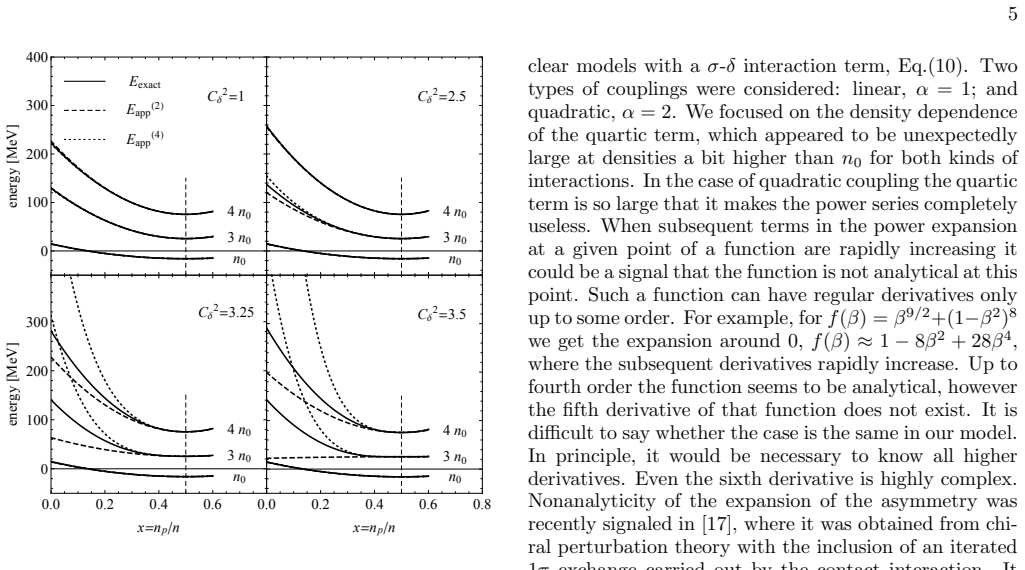
The central claim is that the quartic coefficient S4(n) of the asymmetry expansion, defined by the fourth derivative of energy per particle with respect to proton fraction, can become extraordinarily large in a relativistic mean-field model with a σ-δ scalar meson interaction. With a negative quadratic σ-δ coupling chosen to reproduce a symmetry-energy slope near 50 MeV, S4 grows rapidly with density and at n ≈ 3–4 n0 exceeds 1000 MeV, whereas the linear coupling gives values oscillating between −100 and 100 MeV. The authors verify their analytical expression (Eq. 21) by numerical differentiation of the interpolated energy and show that the truncated expansion fails to reproduce the exact energy of pure neutron matter: the fourth-order correction is larger than the entire symmetry-energy difference. They interpret this as evidence that the energy as a function of (1−2x) may be non-analytic at high density, analogous to a logarithmic term found in chiral effective field theory.
Load-bearing premise
The entire result rests on the assumed σ-δ scalar meson interaction with negative coupling constants g1 = −0.009 $fm^{-1}$ and g2 = −0.004 and a large δ-meson coupling $C_δ^{2}$ = 3.5 $fm^{2}$, values chosen by hand to bring the symmetry-energy slope L near 50 MeV; if this interaction is absent, weaker, or has the opposite sign, the anomalous growth of S4 disappears, and the paper offers no independent evidence for the interaction.
Editorial extensions
If this is right
- In models with a negative quadratic σ-δ coupling, the quartic term S4 at densities of a few times n0 reaches about 10^3 MeV, so the expansion in powers of (1−2x) cannot be truncated at fourth order.
- The parabolic approximation for the symmetry energy becomes inadequate for neutron star interiors in such models, since the energy difference between symmetric and pure neutron matter is not captured by the quadratic term alone.
- If the energy is non-analytic in isospin asymmetry, all coefficients of the even-power expansion beyond some order are ill-defined, and density-dependent quantities such as the core-crust transition density or the URCA threshold could be qualitatively altered.
- The result gives a possible relativistic mean-field counterpart to the logarithmic asymmetry dependence derived in chiral effective field theory, suggesting that non-analytic behavior may be a general feature of dense matter, not an artifact of one framework.
Reading between the lines
- A decisive test would be to compute S4(n) at n = 3n0 in the same model with the quadratic σ-δ coupling set to +0.004 instead of −0.004; if S4 then remains at the few-MeV level, the anomaly is entirely a consequence of the hand-picked sign.
- The paper's reliance on a single negative coupling to bring the symmetry-energy slope L near 50 MeV suggests that independent ab initio constraints on the sign and strength of a σ-δ interaction could settle whether such a term exists in nature.
- If the non-analytic behavior is real, it would discourage the common practice of expanding the equation of state in (1−2x) at high density, pushing the field toward treating the proton fraction as a dynamical variable in neutron star simulations.
Signed reviews
Editorial analysis
A structured set of objections, weighed in public.
Referee Report
Summary. This manuscript studies the density-dependent quartic coefficient S4(n) in the isospin-asymmetry expansion of nuclear-matter energy within a relativistic mean-field model augmented by a σ–δ scalar-meson interaction Lσδ = \tilde gα σ^α δ^2 (α=1,2). The authors derive an analytic expression for S4 (Eq. 21), verify it numerically by polynomial interpolation, and show that for negative couplings g1=-0.009 fm^-1 and g2=-0.004 with Cδ^2 up to 3.5 fm^2, S4 grows dramatically at densities of a few times n0, reaching values above 1000 MeV for α=2. They interpret this as signaling the breakdown of the even-power expansion, possibly due to non-analytic density/proton-fraction dependence, echoing chiral EFT results. They conclude that the parabolic approximation is unreliable in this class of models.
Significance. If the reported behavior is robust, the result is significant because the quartic term is normally neglected in neutron-star applications, and a large S4 would affect the composition, the core-crust transition, and cooling thresholds. The paper's strength is the explicit analytic S4 formula, the numerical cross-check, and the clear demonstration that a specific scalar-meson interaction can change the qualitative behavior of the expansion. However, the conclusion depends on the stability of the mean-field solution and on hand-tuned parameters, so the significance is conditional on the additional analysis requested below.
major comments (3)
- [III, Eq. (19) and Eq. (21)] The central result is not physically meaningful unless the denominator fδ remains strictly positive over the plotted density range. With the fitted negative gα, the term 8 Cδ^2 σ α gα in Eq. (19) is negative and grows with density through σ(n), so fδ decreases from its low-density value. Since Eq. (21) contains inverse powers of fδ up to fδ^-4, a near-zero fδ produces exactly the large S4 values shown in Fig. 1. Moreover, fδ is the curvature of the mean-field energy with respect to the δ field (the inverse static δ propagator), so fδ=0 marks an instability or bifurcation of the uniform solution rather than a breakdown of the Taylor expansion at fixed density. The paper neither evaluates fδ(n) nor checks that the 'exact' solution used in Figs. 2 and 3 remains a local minimum. Please add a quantitative study of fδ(n) for all parameter sets and densities shown, and if fδ becomes small or negative, the central conclusion must be revised.
- [II, Table I, and Fig. 1] The claim that S4 can become anomalously large rests on parameter choices that are not independently constrained. The couplings g1=-0.009 fm^-1, g2=-0.004, and Cδ^2=3.5 fm^2 are selected by hand to move the slope L into the 50 MeV region; no uncertainty or external constraint (e.g., from finite nuclei, PREX, or neutron-star observations) is given. The large-S4 phenomenon disappears for gα ≥ 0 or smaller Cδ. To make the central claim robust, please provide a sensitivity study over the experimentally allowed range of L (the quoted 60 ± 30 MeV) and over gα of both signs, and justify why Cδ^2 = 3.5 is preferred over the other values in Table I.
- [IV, Discussion] The inference from large Taylor coefficients to non-analyticity is not established. A simple pole in the fδ propagator would produce large coefficients while the exact energy remains analytic in x (with the pathology occurring in the density direction, not in x). The illustrative example f(β)=β^{9/2}+(1-β^2)^8 only shows that one can construct a function with large low-order coefficients and a non-analyticity at a high order; it does not provide evidence that the RMF energy has this property. To support the suggestion, the authors should examine the convergence of the expansion more directly, for example by computing higher-order coefficients (S6) or by testing the analyticity of ε(n,x) in x at fixed n. As it stands, the non-analyticity is a speculation, albeit one the authors explicitly qualify.
minor comments (6)
- [II, Eq. (10)] In Eq. (10) and the surrounding text, α denotes both the exponent in σ^α and an index in gα; the relation gα = \tilde gα/(4 gσ^α gδ^2) is introduced without derivation. Please use a different index or define the substitution explicitly.
- [III, Eq. (21)] The typesetting of Eq. (21) makes verification difficult because of unmatched parentheses and line breaks. Please reformat the expression and, if possible, factor it in terms of the physical building blocks fδ, fσ, A, and ns.
- [III, numerical check] The numerical check of Eq. (21) is described in one sentence ('polynomial-interpolated function up to sixth order'). Please specify the grid spacing, the interpolation scheme, and the error estimate, or provide the code used for the check.
- [II, Table I] In Table I, the quoted L values for Cδ^2 = 3.5 (46.8 and 55.2 MeV) are below the central experimental value of 60 MeV. Please explain why these are 'most appropriate' rather than a choice that places L at 60 MeV.
- [III, Figs. 2 and 3] The density labels in Figs. 2 and 3 are not legible in all panels; consider adding curve labels directly or a legend that distinguishes n0, 3n0, and 4n0.
- [III, S4(n0) values] The text states that S4(n0) lies between 0.44 and 0.65 MeV for the linear model and between 0.49 and 0.61 MeV for the quadratic model, but the inset of Fig. 1 does not clearly show all Cδ values; please make the inset comprehensible or list the values in the text.
Circularity Check
No significant circularity: S4 is a computed Taylor coefficient of a stated model, not a fitted target.
full rationale
The quartic term S4 is obtained by taking the fourth derivative of the energy density (16) with respect to proton fraction at x = 1/2, as defined in Eq. (17), and the resulting analytic expression Eq. (21) is verified against a numerical derivative. The isovector couplings are fitted to S2(n0) = 30 MeV and the slope L, not to S4; the high-density behavior of S4 is an output of the model rather than a re-fitting of the quartic coefficient. The sigma-delta interaction (10) is adopted from the authors' prior work [18], but the present paper states the Lagrangian and parameters explicitly, so the central result is conditional on a transparent model assumption rather than on a self-citation that itself contains the target result. Concerns about the denominator fδ in Eq. (19) approaching zero and signaling an instability are physical and numerical issues, not circularity. No step in the derivation reduces by construction to its own input.
Assumptions & free parameters
free parameters (4)
- g_alpha (sigma-delta interaction coupling) =
g1 = -0.009 fm^-1 (alpha=1); g2 = -0.004 (alpha=2)
- C_delta^2 (delta meson coupling) =
1.0, 2.5, 3.25, 3.5 fm^2
- C_rho^2 (rho meson coupling) =
Values in Table I, e.g. 21.3 fm^2 for alpha=1, C_delta^2=3.5 fm^2; 18.4 fm^2 for alpha=2, C_delta^2=3.5 fm^2
- Isoscalar parameters C_sigma^2, C_omega^2, b, c =
11 fm^2, 6.48 fm^2, 0.054, -0.0057
assumptions (4)
- domain assumption The mean-field approximation treats sigma, omega, rho, and delta as classical fields.
- ad hoc to paper The sigma-delta interaction term L_sigma_delta = tilde_g_alpha sigma^alpha delta^2 is part of the Lagrangian.
- domain assumption The energy is Taylor-expandable in (1-2x) at least to fourth order around x=1/2.
- standard math Numerical differentiation after polynomial interpolation up to sixth order is a valid check of Eq. (21).
invented entities (1)
-
sigma-delta scalar meson interaction (sigma^alpha delta^2 coupling)
Cite this review
Pith. "Pith review of Anomalous quartic term in the expansion of the symmetry energy." pith.science (2026). https://pith.science/paper/63ZSTY44
@misc{pith2026190800476,
  author       = {Pith},
  title        = {Pith review of: Anomalous quartic term in the expansion of the symmetry energy},
  year         = {2026},
  howpublished = {\url{https://pith.science/paper/63ZSTY44}},
  note         = {Machine review of arXiv:1908.00476}
}
read the original abstract
The quartic term in the framework of relativistic mean field theory with inclusion of scalar meson interactions is investigated. It is shown that the quartic term in the asymmetric expansion of nuclear matter energy may reach very large values. This makes the even power expansion of asymmetry questionable and suggests possible non-analytic contributions to the energy of matter.
Figures


Reference graph
Works this paper leans on
-
[1]
C. J. Horowitz et al., J. Phys. G 41, 093001 (2014)
work page 2014
-
[2]
A. W. Steiner, Phys. Rev. C 74, 045808 (2006)
work page 2006
-
[3]
J. Xu, L. W. Chen, B. A. Li and H. R. Ma, Astrophys. J. 697, 1549 (2009)
2009
-
[4]
J. Xu, L. W. Chen, B. A. Li and H. R. Ma, Phys. Rev. C 79, 035802 (2009)
work page 2009
-
[5]
W. M. Seif and D. N. Basu, Phys. Rev. C 89, 028801 (2014)
2014
-
[6]
Anomalous quartic term in the expansion of the symmetry energy
indicate that the kinetic energy contribution could be arXiv:1908.00476v1 [nucl-th] 1 Aug 2019 2 much higher. From Eqs. (6) and (7) it can be seen that they scale as n2/3, and at very high densities, typical for a neutron star center, Skin 2 and Skin 4 do not exceed 50 MeV and 3 MeV, respectively. The inclusion of the effective nucleon massm∗ (which decrea...
work page Pith review arXiv 1908
-
[7]
B. J. Cai and B. A. Li, Phys. Rev. C 92, 011601(R) (2015)
work page 2015
-
[8]
C.-H. Lee, T. T. S. Kuo, G. Q. Li and G. E. Brown, Phys. Rev. C 57, 3488 (1998)
work page 1998
Show all 21 references
-
[9]
B. J. Cai and L. W. Chen, Phys. Rev. C 85, 024302 (2012)
2012
-
[10]
L. W. Chen, B. J. Cai, C. M. Ko, B. A. Li, C. Shen and J. Xu, Phys. Rev. C 80, 014322 (2009)
2009
-
[11]
C. Xu, B. A. Li, L. W. Chen and C. M. Ko, Nucl. Phys. A 865, 1 (2011)
2011
-
[12]
J. Pu, Z. Zhang and L. W. Chen, Phys. Rev. C 96, no. 5, 054311 (2017)
2017
-
[13]
Z. W. Liu, Z. Qian, R. Y. Xing, J. R. Niu and B. Y. Sun, Phys. Rev. C 97, 025801 (2018)
2018
-
[14]
Jiang, M
H. Jiang, M. Bao, L. W. Chen, Y. M. Zhao and A. Arima, Phys. Rev. C 90, no. 6, 064303 (2014)
2014
-
[15]
Wang and L
R. Wang and L. W. Chen, Phys. Lett. B 773, 62 (2017)
2017
-
[16]
Nandi and S
R. Nandi and S. Schramm, Phys. Rev. C 94, 025806 (2016)
2016
-
[17]
N. Wan, C. Xu, Z. Ren and J. Liu, Phys. Rev. C 97, 051302(R) (2018)
2018
-
[18]
Kaiser, Phys
N. Kaiser, Phys. Rev. C 91, 065201 (2015)
2015
-
[19]
Zabari, S
N. Zabari, S. Kubis and W. W´ ojcik, Phys. Rev. C 99, 035209 (2019)
2019
-
[20]
Kubis and M
S. Kubis and M. Kutschera, Phys. Lett. B 399, 191 (1997)
1997
-
[21]
Oertel, M
M. Oertel, M. Hempel, T. Kl¨ ahn and S. Typel, Rev. Mod. Phys. 89, 015007 (2017)
2017
Reviewed August 14, 2026 · model on record in the stance chip above.
Discussion (0). Continue with ORCID to comment.