Physics-Aware Auxiliary Losses Improve Out-of-Distribution Generalization of a GNN Synthesizability Filter
Pith reviewed 2026-06-27 10:15 UTC · model grok-4.3
The pith
Adding auxiliary losses for molecular complexity and strain energy improves a GNN's out-of-distribution accuracy on synthesizability prediction.
A machine-rendered reading of the paper's core claim, the machinery that carries it, and where it could break.
Core claim
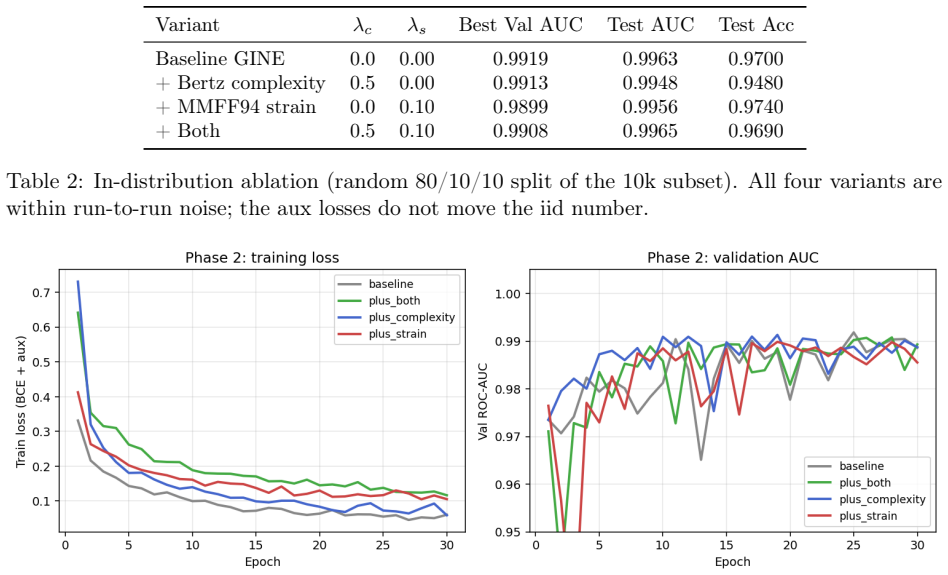
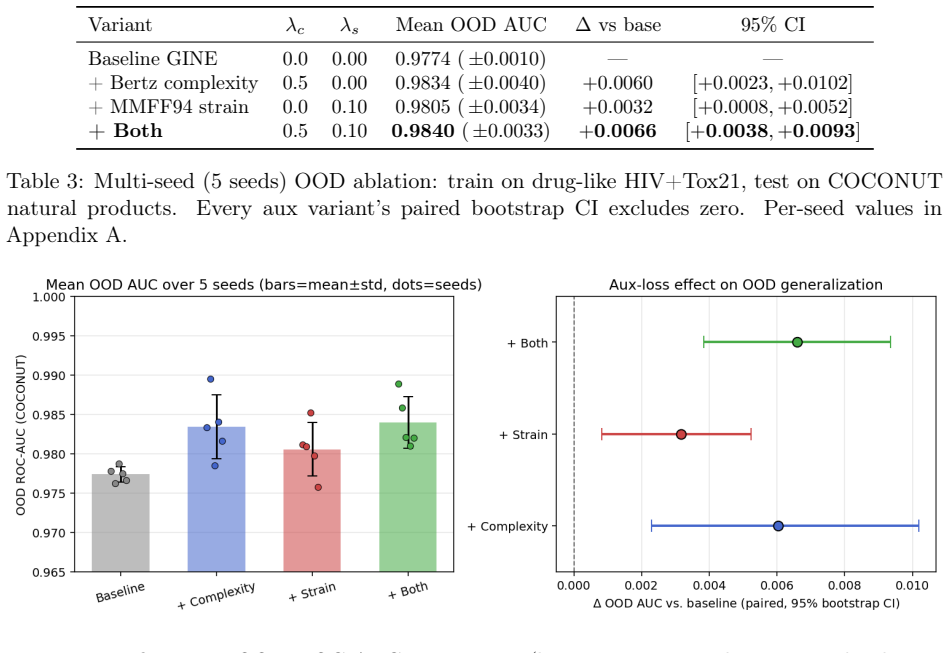
On a 65,177-molecule corpus labeled by SAScore thresholds, all three physics-aware variants give a small but statistically significant OOD improvement over the baseline (mean OOD AUC 0.9774): +complexity Delta = +0.0060 (95% CI [+0.0023, +0.0102]), +strain Delta = +0.0032 ([+0.0008, +0.0052]), +both Delta = +0.0066 ([+0.0038, +0.0093]); every interval excludes zero, and the combination is best. The variants are indistinguishable in-distribution, so the effect is visible only under OOD evaluation.
What carries the argument
Two auxiliary losses added to a GINE backbone: topological complexity regression supervised by the Bertz index, and a strain-energy soft penalty supervised by MMFF94 force-field energy. These supply closed-form physical priors as extra supervision signals during training.
If this is right
- The combination of both auxiliary losses produces the largest OOD gain.
- The auxiliary losses leave in-distribution performance unchanged.
- Single-seed experiments can yield non-monotonic patterns that do not survive multi-seed bootstrap evaluation.
- The effect is modest in absolute size yet detectable with paired confidence intervals.
Where Pith is reading between the lines
- The same auxiliary-loss pattern could be tested on other molecular property tasks that have inexpensive physical or topological priors.
- In a generative drug-discovery loop the small OOD lift might reduce the fraction of proposed molecules that later fail synthesis checks.
- Larger gains might appear if the auxiliary signals were integrated more deeply than as simple regression or penalty terms.
Load-bearing premise
The chosen split that trains on drug-like molecules and tests on natural products is a representative test of out-of-distribution generalization for synthesizability filters.
What would settle it
Repeating the 4-way ablation on a new OOD split that trains on natural products and tests on drug-like molecules and finding that none of the physics-aware variants produce statistically significant AUC gains.
Figures
read the original abstract
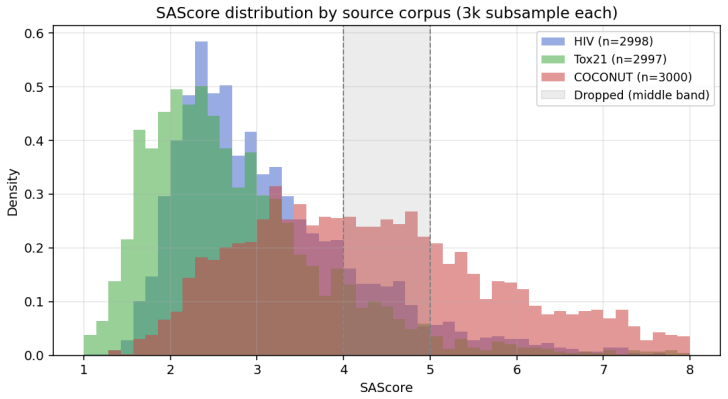
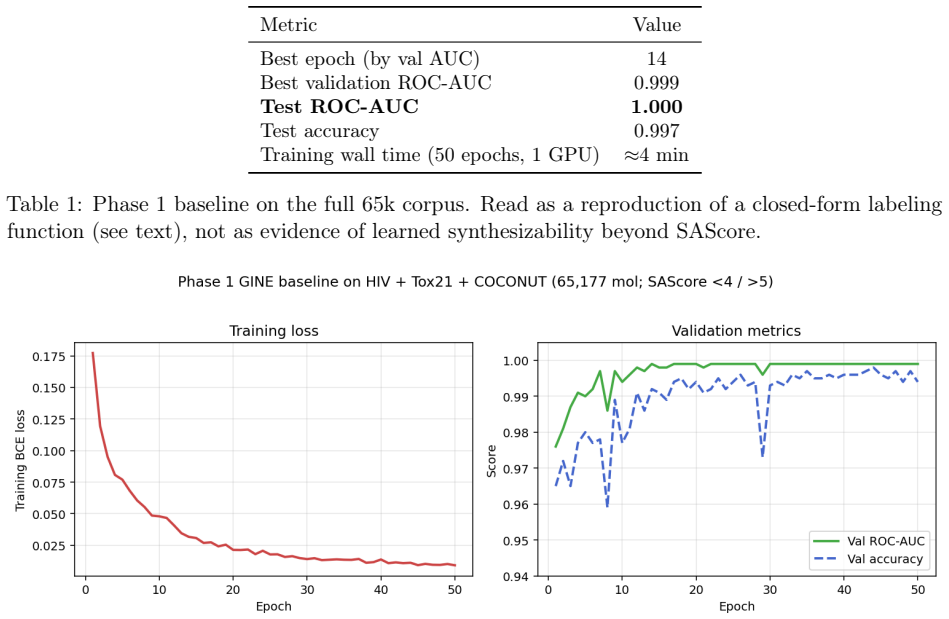
Machine-learning drug-discovery pipelines increasingly rely on generative models that propose molecules far from the data used to train downstream synthesizability filters. Existing filters (SAScore, SCScore, RAscore, DeepSA) are purely statistical and degrade in exactly this out-of-distribution (OOD) regime. We ask whether cheap, closed-form physical priors, used as auxiliary supervision on a graph neural network (GNN), improve OOD generalization. We add two auxiliary losses to a GINE backbone: a topological complexity regression supervised by the Bertz index, and a strain-energy soft penalty supervised by MMFF94 force-field energy. On a 65,177-molecule corpus (HIV, Tox21, COCONUT) labeled by SAScore thresholds we reproduce a strong in-distribution baseline, then evaluate a 4-way ablation (baseline / +complexity / +strain / +both) on a single-source OOD split (train on drug-like HIV+Tox21, test on COCONUT natural products), repeated over 5 seeds with paired bootstrap confidence intervals. All three physics-aware variants give a small but statistically significant OOD improvement over the baseline (mean OOD AUC 0.9774): +complexity Delta = +0.0060 (95% CI [+0.0023, +0.0102]), +strain Delta = +0.0032 ([+0.0008, +0.0052]), +both Delta = +0.0066 ([+0.0038, +0.0093]); every interval excludes zero, and the combination is best. The variants are indistinguishable in-distribution, so the effect is visible only under OOD evaluation. We are explicit that the effects are modest, and we report a cautionary methodological finding: a single-seed version of this experiment produced a qualitatively different (non-monotone) story that did not survive multi-seed evaluation.
Editorial analysis
A structured set of objections, weighed in public.
Referee Report
Summary. The manuscript claims that adding two auxiliary losses to a GINE GNN for binary synthesizability classification—one regressing on the Bertz topological complexity index and one softly penalizing MMFF94 strain energy—yields small but statistically significant OOD AUC gains on a single-source split (train HIV+Tox21 drug-like molecules, test COCONUT natural products). A 4-way ablation (baseline vs. +complexity vs. +strain vs. both) repeated over 5 seeds with paired bootstrap CIs shows deltas of +0.0060, +0.0032, and +0.0066 respectively (all CIs exclude zero), while in-distribution performance remains equivalent; the authors explicitly caution that single-seed runs can produce misleading non-monotonic patterns.
Significance. If the result holds under broader testing, the work demonstrates that inexpensive closed-form physical priors can provide a detectable robustness boost to statistical synthesizability filters precisely in the OOD regime relevant to generative drug-discovery models. The multi-seed design, explicit single-seed caution, and use of external physical targets (Bertz, MMFF94) rather than self-referential supervision are methodological strengths. The modest effect sizes and restriction to one distribution shift, however, constrain immediate practical impact.
major comments (2)
- [Experimental Setup / OOD Evaluation] The OOD claim rests on a single-source split (HIV+Tox21 → COCONUT). While the authors scope the result narrowly and report statistically significant deltas on this split, the representativeness of this particular shift for the broader class of OOD scenarios encountered by synthesizability filters is not tested; additional splits or multi-source OOD protocols would be needed to support the generalization narrative.
- [Methods] Full implementation details (exact GINE architecture, hyper-parameters, loss weighting, SAScore threshold used for labeling, and data preprocessing) are absent from the provided text. This absence makes it impossible to verify the reproduced in-distribution baseline or to assess whether the auxiliary losses interact with any hidden modeling choices.
minor comments (2)
- [Results] The abstract and results section correctly flag the modest effect sizes; adding the corresponding in-distribution AUC values (even if statistically indistinguishable) would help readers quantify how OOD-specific the benefit is.
- [Introduction] Consider citing prior work on auxiliary physical losses in molecular GNNs (e.g., force-field or graph-topology regularizers) to situate the contribution more explicitly.
Simulated Author's Rebuttal
We thank the referee for the constructive review and the recommendation for minor revision. We address the two major comments point by point below.
read point-by-point responses
-
Referee: [Experimental Setup / OOD Evaluation] The OOD claim rests on a single-source split (HIV+Tox21 → COCONUT). While the authors scope the result narrowly and report statistically significant deltas on this split, the representativeness of this particular shift for the broader class of OOD scenarios encountered by synthesizability filters is not tested; additional splits or multi-source OOD protocols would be needed to support the generalization narrative.
Authors: We agree that the evaluation uses only one OOD split and that this limits claims about broader representativeness. The manuscript is explicitly scoped to this single-source shift (drug-like molecules to natural products), which is directly relevant to the generative drug-discovery setting highlighted in the introduction. We already caution readers about the narrow scope and the risk of non-monotonic single-seed results. While additional splits would strengthen a broader generalization narrative, they fall outside the stated scope of the work; the contribution is the demonstration of a detectable, statistically significant auxiliary-loss effect under this specific, practically relevant OOD condition. We therefore do not plan to add further splits in the revision. revision: no
-
Referee: [Methods] Full implementation details (exact GINE architecture, hyper-parameters, loss weighting, SAScore threshold used for labeling, and data preprocessing) are absent from the provided text. This absence makes it impossible to verify the reproduced in-distribution baseline or to assess whether the auxiliary losses interact with any hidden modeling choices.
Authors: We agree that the absence of these details hinders reproducibility. In the revised manuscript we will add a new Methods subsection (or appendix) that specifies the exact GINE architecture, all training hyper-parameters, the loss-weighting coefficients for the auxiliary terms, the SAScore threshold used to create binary labels, and the full data-preprocessing pipeline. revision: yes
Circularity Check
No circularity: purely empirical ablation on external targets
full rationale
The paper reports a standard ML ablation (GINE backbone + optional auxiliary regression/penalty losses) evaluated via repeated multi-seed training and paired bootstrap CIs on a fixed single-source OOD split (HIV+Tox21 train, COCONUT test). Supervision targets (Bertz index, MMFF94 energies) are computed by independent external algorithms on the molecules themselves; they are not derived from the model or fitted to the target metric. No equations, uniqueness theorems, ansatzes, or self-citations appear as load-bearing steps in any derivation chain. The result is a set of statistical deltas on held-out data, fully falsifiable outside the paper's fitted weights.
Axiom & Free-Parameter Ledger
axioms (1)
- domain assumption Bertz index and MMFF94 force-field energies are appropriate physical priors for auxiliary supervision in synthesizability prediction
Reference graph
Works this paper leans on
-
[1]
Batatia, I. et al. (2022). MACE: Higher order equivariant message passing neural networks for fast and accurate force fields.NeurIPS35
2022
-
[2]
Bengio, E. et al. (2021). Flow network based generative models for non-iterative diverse candidate generation.NeurIPS34
2021
-
[3]
Bertz, S.H. (1981). The first general index of molecular complexity.JACS103(12), 3599–3601
1981
-
[4]
Coley, C.W. et al. (2018). SCScore: synthetic complexity learned from a reaction corpus.JCIM58(2), 252–261
2018
-
[5]
Wang, S. et al. (2023). DeepSA: a deep-learning driven predictor of compound synthesis accessibility.J. Cheminform.15, 103
2023
- [6]
-
[7]
Ji, Y. et al. (2023). DrugOOD: Out-of-distribution dataset curator and benchmark for AI-aided drug discovery.AAAI37(7), 8023–8031. arXiv:2201.09637
arXiv 2023
-
[8]
& Schuffenhauer, A
Ertl, P. & Schuffenhauer, A. (2009). Estimation of synthetic accessibility score.J. Cheminform.1(1), 8. 10
2009
-
[9]
Fabian, B. et al. (2020). Molecular representation learning with language models and domain-relevant auxiliary tasks (MolBERT).Machine Learning for Molecules Workshop, NeurIPS. arXiv:2011.13230
arXiv 2020
- [10]
-
[11]
& Coley, C.W
Gao, W. & Coley, C.W. (2020). The synthesizability of molecules proposed by generative models.JCIM 60(12), 5714–5723
2020
-
[12]
Yu, J. et al. (2022). Organic compound synthetic accessibility prediction based on the graph attention mechanism (GASA).JCIM62(12), 2973–2986
2022
-
[13]
Gasteiger, J. et al. (2020). Directional message passing for molecular graphs (DimeNet).ICLR
2020
-
[14]
Genheden, S. et al. (2020). AiZynthFinder.J. Cheminform.12(1), 70
2020
-
[15]
Gómez-Bombarelli, R. et al. (2018). Automatic chemical design using a data-driven continuous represen- tation of molecules.ACS Cent. Sci.4(2), 268–276
2018
-
[16]
Gui, S., Li, X., Wang, L. & Ji, S. (2022). GOOD: A graph out-of-distribution benchmark.NeurIPS Datasets & Benchmarks Track35. arXiv:2206.08452
arXiv 2022
-
[17]
Halgren, T.A. (1996). Merck molecular force field (MMFF94).J. Comput. Chem.17(5-6), 490–519
1996
-
[18]
Hu, W. et al. (2020). Strategies for pre-training graph neural networks.ICLR
2020
-
[19]
Karpatne, A. et al. (2017). Theory-guided data science: A new paradigm for scientific discovery from data.IEEE Trans. Knowl. Data Eng.29(10), 2318–2331
2017
-
[20]
& Zhu, W
Li, H., Wang, X., Zhang, Z. & Zhu, W. (2023). OOD-GNN: Out-of-distribution generalized graph neural network.IEEE Trans. Knowl. Data Eng.35(7), 7328–7340
2023
-
[21]
Raissi, M. et al. (2019). Physics-informed neural networks.J. Comput. Phys.378, 686–707
2019
-
[22]
Schütt, K.T. et al. (2017). SchNet: A continuous-filter convolutional neural network for modeling quantum interactions.NeurIPS30
2017
-
[23]
Sorokina, M. et al. (2021). COCONUT online: Collection of Open Natural Products.J. Cheminform. 13(1), 2
2021
-
[24]
Stokes, J.M. et al. (2020). A deep learning approach to antibiotic discovery.Cell180(4), 688–702
2020
-
[25]
Voršilák, M. et al. (2020). SYBA: Bayesian estimation of synthetic accessibility of organic compounds. J. Cheminform.12, 35
2020
-
[26]
Takamoto, M., Zaverkin, V. & Niepert, M. (2025). Physics-informed weakly supervised learning for interatomic potentials.ICML. arXiv:2408.05215
arXiv 2025
-
[27]
Thakkar, A. et al. (2021). Retrosynthetic accessibility score (RAscore).Chem. Sci.12(9), 3339–3349
2021
-
[28]
Vignac, C. et al. (2023). DiGress: Discrete denoising diffusion for graph generation.ICLR
2023
-
[29]
Yang, K. et al. (2019). Analyzing learned molecular representations.JCIM59(8), 3370–3388. 11 A Per-seed OOD results Table 5 gives the per-seed OOD ROC-AUC behind Table 3. The effect is consistent on average but not unanimous per seed: +complexity is marginally negative on seed 2 (−0.0002) and +strain on seed 4 (−0.0009); +both is positive on all five seed...
2019
discussion (0)
Sign in with ORCID, Apple, or X to comment. Anyone can read and Pith papers without signing in.