On the Faint Early-time Radio and X-ray Emissions in TDE2025aarm
Pith reviewed 2026-06-28 21:13 UTC · model grok-4.3
The pith
The faint radio emission from TDE2025aarm requires a narrowly collimated outflow identified with unbound stellar debris rather than a quasi-spherical disk wind.
A machine-rendered reading of the paper's core claim, the machinery that carries it, and where it could break.
Core claim
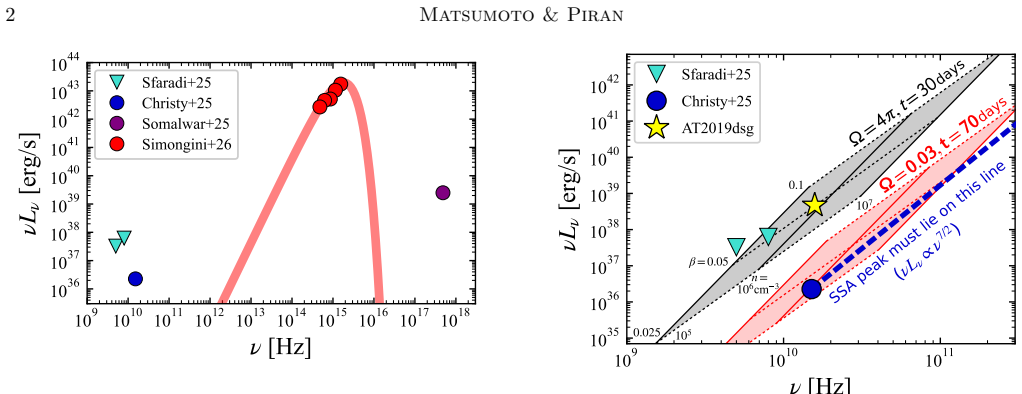
The radio detection at 15 GHz with ∼10^36 erg s^{-1} around 40 days after discovery is inconsistent with synchrotron emission from a quasi-spherical disk wind for reasonable circum-nuclear densities and outflow velocities. Instead, the low luminosity and inferred self-absorbed spectrum imply a narrowly collimated outflow with a solid angle ≲0.1 sr, naturally identified with the unbound stellar debris.
What carries the argument
Synchrotron emission models that compare the predicted radio luminosity and spectrum of a quasi-spherical disk wind against those of a narrowly collimated outflow.
If this is right
- The collimated outflow corresponds to the unbound stellar debris ejected during the tidal disruption.
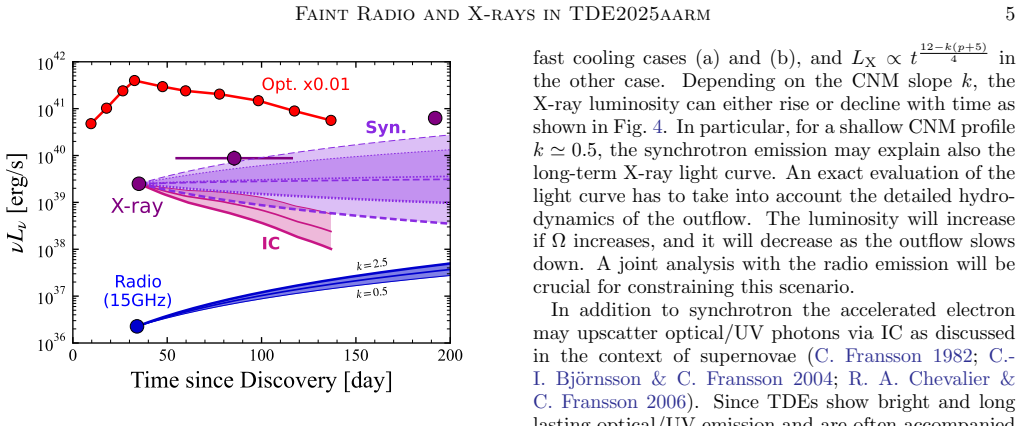
- The same shock that accelerates electrons for the radio emission can produce the observed X-rays through synchrotron radiation or inverse-Compton scattering of optical/UV photons.
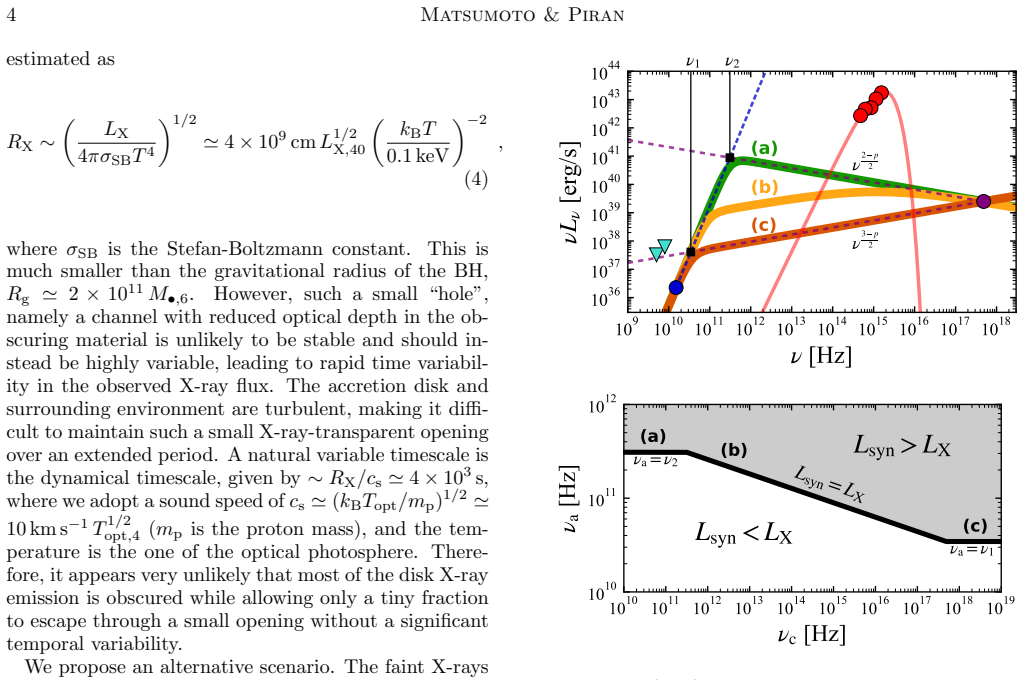
- An interpretation of the X-rays as thermal emission from an obscured disk requires an emitting area too small to remain stable on observed timescales.
- Continued radio and X-ray monitoring will constrain the properties of the unbound debris and the circum-nuclear medium.
Where Pith is reading between the lines
- Radio detections in TDEs can serve as a direct probe of outflow collimation and thus of the geometry of the disrupted star's debris.
- If collimated outflows are common, this could account for the wide range of radio luminosities seen across the TDE population without invoking different densities.
- The shock-based X-ray mechanism predicts a specific time evolution that differs from disk models and can be tested with multi-band light curves.
Load-bearing premise
Circum-nuclear densities and outflow velocities lie in the range that would produce detectable radio emission from a quasi-spherical wind.
What would settle it
A radio observation at similar or later times showing a luminosity and spectral index matching standard spherical-wind synchrotron formulas for densities of 10^3 to 10^6 cm^{-3} and velocities near 0.1c.
Figures
read the original abstract
TDE2025aarm is a nearby tidal disruption event whose early radio and X-ray emissions are exceptionally faint compared with previously observed TDEs. We examine whether these weak signals can be explained within standard outflow and disk-emission scenarios. The radio detection at $15\,\rm GHz$ with $\sim10^{36}\,\rm erg\,s^{-1}$ around $40\,\rm days$ after discovery is inconsistent with synchrotron emission from a quasi-spherical disk wind for reasonable circum-nuclear densities and outflow velocities. Instead, the low luminosity and inferred self-absorbed spectrum imply a narrowly collimated outflow with a solid angle $\lesssim0.1\,\rm sr$, naturally identified with the unbound stellar debris. The X-ray emission is likewise unusually faint, with $L_{\rm X}\sim10^{39-40}\,\rm erg\,s^{-1}$ during the first few months. If interpreted as thermal emission from an obscured accretion disk, the inferred emitting area would correspond to an implausibly small X-ray-transparent region expected to vary on short dynamical timescales that are not observed. Alternatively, the same shock responsible for the radio emission can accelerate relativistic electrons that produce X-rays through synchrotron radiation and/or inverse-Compton scattering of optical/UV photons. Both mechanisms can explain the early faint X-ray emission, although their temporal evolution differs. Continued radio and X-ray monitoring of TDE2025aarm will provide a sensitive probe of the unbound debris, circum-nuclear medium, and high-energy emission mechanisms in optical TDEs.
Editorial analysis
A structured set of objections, weighed in public.
Referee Report
Summary. The manuscript analyzes the faint early radio (~10^36 erg s^{-1} at 15 GHz, t~40 d) and X-ray (L_X~10^{39-40} erg s^{-1}) emissions from TDE2025aarm. It concludes that the radio signal is inconsistent with synchrotron emission from a quasi-spherical disk wind for reasonable circum-nuclear densities and velocities, instead requiring a collimated outflow (solid angle ≲0.1 sr) identified with unbound stellar debris; X-ray emission is discussed as either implausibly small thermal disk emission or non-thermal shock emission via synchrotron or inverse-Compton, with differing temporal predictions.
Significance. If the parameter-space exclusion holds, the result constrains outflow geometry in TDEs and links faint radio to unbound debris, with potential to distinguish emission mechanisms via monitoring. The use of standard synchrotron expressions against observed luminosities provides a direct, non-circular comparison to literature ranges.
major comments (2)
- [radio emission discussion] Radio emission analysis (near abstract and main discussion of 15 GHz detection): the inconsistency with quasi-spherical wind and the derived solid angle ≲0.1 sr rest on the observed L_15GHz lying below the minimum from standard synchrotron formulas (Chevalier 1998 or Nakar & Piran 2011 forms) for any 'reasonable' n and v. No explicit bounds on n, v, ε_B, ε_e, p or a grid of L_radio(n,v) is shown to confirm the exclusion; without this the central claim cannot be verified.
- [abstract and X-ray discussion] Abstract and X-ray section: alternatives (synchrotron or IC from the radio shock) are stated to explain the faint L_X with differing temporal evolution, yet no quantitative light-curve predictions, error propagation, or model curves are provided to demonstrate viability or distinguishability from the thermal-disk alternative.
minor comments (1)
- [abstract] Abstract states X-ray mechanisms 'can explain' the emission but provides no numerical light-curve calculations, weakening the claim of viability.
Simulated Author's Rebuttal
We thank the referee for their thorough review and valuable comments on our manuscript. We address each major comment below and plan to revise the manuscript to strengthen the presentation of our results.
read point-by-point responses
-
Referee: [radio emission discussion] Radio emission analysis (near abstract and main discussion of 15 GHz detection): the inconsistency with quasi-spherical wind and the derived solid angle ≲0.1 sr rest on the observed L_15GHz lying below the minimum from standard synchrotron formulas (Chevalier 1998 or Nakar & Piran 2011 forms) for any 'reasonable' n and v. No explicit bounds on n, v, ε_B, ε_e, p or a grid of L_radio(n,v) is shown to confirm the exclusion; without this the central claim cannot be verified.
Authors: We agree that providing explicit bounds and a parameter grid would make the exclusion more transparent and verifiable. In the revised manuscript, we will add a new figure (or appendix) that shows the minimum expected radio luminosity from a quasi-spherical outflow as a function of circum-nuclear density n and outflow velocity v, for standard microphysical parameters (ε_B = 0.01, ε_e = 0.1, p = 2.5). This will demonstrate that the observed luminosity lies below the predicted minimum for the range of n and v considered reasonable in the TDE literature (n < 10^5 cm^{-3}, v < 0.3c). We will also explicitly list the assumed values and ranges. This addresses the concern directly. revision: yes
-
Referee: [abstract and X-ray discussion] Abstract and X-ray section: alternatives (synchrotron or IC from the radio shock) are stated to explain the faint L_X with differing temporal evolution, yet no quantitative light-curve predictions, error propagation, or model curves are provided to demonstrate viability or distinguishability from the thermal-disk alternative.
Authors: The referee is correct that the X-ray discussion remains qualitative. We will revise the manuscript to include simple analytic estimates for the expected X-ray flux from both synchrotron and inverse-Compton processes, using the shock parameters inferred from the radio emission. We will also note the expected power-law temporal indices for each mechanism to highlight how monitoring can distinguish them. However, a full numerical light-curve model with error propagation would require significant additional work and assumptions not justified for this short paper; we view this as a direction for future study rather than a requirement for the current claims. Thus, we make a partial revision. revision: partial
Circularity Check
No circularity; radio/X-ray comparisons rely on external synchrotron formulas and literature parameters
full rationale
The paper's central claim compares the observed L_15GHz ~10^36 erg s^{-1} at t~40 d against standard synchrotron expressions (Chevalier 1998, Nakar & Piran 2011 forms) using external literature-typical ranges for n, v, ε_B, ε_e. No quantities are fitted to TDE2025aarm data itself, no self-definitional loops appear, and no load-bearing premise reduces to a self-citation chain. The derivation remains self-contained against external benchmarks; the 'reasonable' parameter range is an assumption about plausibility, not a circular reduction.
Axiom & Free-Parameter Ledger
axioms (2)
- standard math Standard synchrotron self-absorption formulas for radio emission from outflows
- domain assumption Circum-nuclear medium has typical densities for galactic centers
Reference graph
Works this paper leans on
-
[1]
Space Science Reviews , author =
Alexander, K. D., van Velzen, S., Horesh, A., & Zauderer, B. A. 2020, SSRv, 216, 81, doi: 10.1007/s11214-020-00702-w Barniol Duran, R., Nakar, E., & Piran, T. 2013, ApJ, 772, 78, doi: 10.1088/0004-637X/772/1/78 Bj¨ ornsson, C.-I., & Fransson, C. 2004, ApJ, 605, 823, doi: 10.1086/382584
-
[2]
Chevalier, R. A. 1998, ApJ, 499, 810, doi: 10.1086/305676
-
[3]
Chevalier, R. A., & Fransson, C. 2006, ApJ, 651, 381, doi: 10.1086/507606
-
[4]
T., Alexander, K
Christy, C. T., Alexander, K. D., Franz, N., et al. 2025, Transient Name Server AstroNote, 315, 1
2025
-
[5]
Miller, M. C. 2018, ApJL, 859, L20, doi: 10.3847/2041-8213/aab429
-
[6]
2025, Transient Name Server AstroNote, 311, 1
Faris, S., Tranin, H., Newsome, M., & Arcavi, I. 2025, Transient Name Server AstroNote, 311, 1
2025
-
[7]
1982, A&A, 111, 140
Fransson, C. 1982, A&A, 111, 140
1982
-
[8]
Annual Review of Astronomy and Astrophysics , author =
Gezari, S. 2021, ARA&A, 59, 21, doi: 10.1146/annurev-astro-111720-030029
-
[9]
Guolo, M., Gezari, S., Yao, Y., et al. 2024, ApJ, 966, 160, doi: 10.3847/1538-4357/ad2f9f
-
[10]
Hills, J. G. 1975, Nature, 254, 295, doi: 10.1038/254295a0
-
[11]
K., Wichern, H., & Charalampopoulos, P
Jaisawal, G. K., Wichern, H., & Charalampopoulos, P. 2026, Transient Name Server AstroNote, 101, 1
2026
-
[12]
Krolik, J., Piran, T., Svirski, G., & Cheng, R. M. 2016, ApJ, 827, 127, doi: 10.3847/0004-637X/827/2/127
-
[13]
2013, MNRAS, 434, 3078, doi: 10.1093/mnras/stt1221 F aint Radio and X-rays in TDE2025aarm7
Kumar, P., Barniol Duran, R., Boˇ snjak,ˇZ., & Piran, T. 2013, MNRAS, 434, 3078, doi: 10.1093/mnras/stt1221 F aint Radio and X-rays in TDE2025aarm7
-
[14]
1997, ApJ, 489, 573, doi: 10.1086/304814
Loeb, A., & Ulmer, A. 1997, ApJ, 489, 573, doi: 10.1086/304814
-
[15]
2020, MNRAS, 492, 686, doi: 10.1093/mnras/stz3405
Lu, W., & Bonnerot, C. 2020, MNRAS, 492, 686, doi: 10.1093/mnras/stz3405
-
[16]
2025, arXiv e-prints, arXiv:2512.21669, doi: 10.48550/arXiv.2512.21669
Matsumoto, T. 2025, arXiv e-prints, arXiv:2512.21669, doi: 10.48550/arXiv.2512.21669
-
[17]
2021, MNRAS, 507, 4196, doi: 10.1093/mnras/stab2418 —
Matsumoto, T., & Piran, T. 2021a, MNRAS, 507, 4196, doi: 10.1093/mnras/stab2418
-
[18]
2021b, MNRAS, 502, 3385, doi: 10.1093/mnras/stab240
Matsumoto, T., & Piran, T. 2021b, MNRAS, 502, 3385, doi: 10.1093/mnras/stab240
-
[19]
2023, MNRAS, 522, 4565, doi: 10.1093/mnras/stad1269
Matsumoto, T., & Piran, T. 2023, MNRAS, 522, 4565, doi: 10.1093/mnras/stad1269
-
[20]
Metzger, B. D. 2022, ApJL, 937, L12, doi: 10.3847/2041-8213/ac90ba
-
[21]
Metzger, B. D., & Stone, N. C. 2016, MNRAS, 461, 948, doi: 10.1093/mnras/stw1394
-
[22]
2025, Transient Name Server AstroNote, 322, 1
Mohrmann, L. 2025, Transient Name Server AstroNote, 322, 1
2025
-
[23]
2025, Transient Name Server Classification Report, 2025-4374, 1 O’Neill, D., Ackley, K., Dyer, M., et al
Newsome, M., Faris, S., Arcavi, I., Dgany, Y., & Gomez, S. 2025, Transient Name Server Classification Report, 2025-4374, 1 O’Neill, D., Ackley, K., Dyer, M., et al. 2025, Transient Name Server Discovery Report, 2025-4156, 1
2025
-
[24]
2025, Transient Name Server AstroNote, 328, 1
Paneque, D., Teshima, M., Kherlakian, M., et al. 2025, Transient Name Server AstroNote, 328, 1
2025
-
[25]
Rees, M. J. 1988, Nature, 333, 523, doi: 10.1038/333523a0
-
[26]
B., & Lightman, A
Rybicki, G. B., & Lightman, A. P. 1979, Radiative processes in astrophysics
1979
-
[27]
1998, ApJL, 497, L17, doi: 10.1086/311269
Sari, R., Piran, T., & Narayan, R. 1998, ApJL, 497, L17, doi: 10.1086/311269
-
[28]
2025, Transient Name Server AstroNote, 313, 1
Sfaradi, I., Hammerstein, E., Chornock, R., et al. 2025, Transient Name Server AstroNote, 313, 1
2025
-
[29]
Early emission characterization of TDE 2025aarm
Becerra, J. 2026, arXiv e-prints, arXiv:2603.20123. https://arxiv.org/abs/2603.20123
work page internal anchor Pith review Pith/arXiv arXiv 2026
-
[30]
2025, Transient Name Server AstroNote, 316, 1
Somalwar, J., Chornock, R., Margutti, R., et al. 2025, Transient Name Server AstroNote, 316, 1
2025
-
[31]
2021, Nature Astronomy, 5, 510, doi: 10.1038/s41550-020-01295-8
Stein, R., Velzen, S. v., Kowalski, M., et al. 2021, Nature Astronomy, 5, 510, doi: 10.1038/s41550-020-01295-8
-
[32]
Strubbe, L. E., & Quataert, E. 2009, MNRAS, 400, 2070, doi: 10.1111/j.1365-2966.2009.15599.x
-
[33]
Thomsen, L. L., Kwan, T. M., Dai, L., et al. 2022, ApJL, 937, L28, doi: 10.3847/2041-8213/ac911f
-
[34]
Yalinewich, A., Steinberg, E., Piran, T., & Krolik, J. H. 2019, MNRAS, 487, 4083, doi: 10.1093/mnras/stz1567
-
[35]
2022, ApJ, 937, 8, doi: 10.3847/1538-4357/ac898a
Yao, Y., Lu, W., Guolo, M., et al. 2022, ApJ, 937, 8, doi: 10.3847/1538-4357/ac898a
discussion (0)
Sign in with ORCID, Apple, or X to comment. Anyone can read and Pith papers without signing in.