REVIEW 4 major objections 5 minor 39 references
A Delay Metric for Video Object Detection: What Average Precision Fails to Tell
T0 review · 4 major / 5 minor · reviewed 2026-08-14 · deepseek-v4-flash
Pith's one-line read Average precision hides detection delay in video object detection
desk verdict mAP really does hide detection delay, and AD is a credible metric to expose it; just don't take the exponential model literally. read the letter →
The pith
A machine-rendered reading of the paper's core claim, the machinery that carries it, and where it could break.
The reading
What carries the argument
The load-bearing object is the AD formula, $\mathrm{AD} = 1 / ((1/R) \sum_r 1/(\bar{D}^*_r + 1)) - 1$, where $\bar{D}^*_r$ is the clipped mean delay to first detection at false-positive ratio $r$. The argument treats each detection as a Bernoulli event with constant probability $p$ per frame, so delay follows a discrete exponential distribution and $p$ is estimated as $1/(\text{mean clipped delay} + 1)$. Averaging $p$ rather than raw delay makes the metric a harmonic-style mean that weights small delays more heavily, preventing a detector with many very late detections from looking good, and the false-positive ratio controls the false-alarm budget so a detector cannot reduce delay by emitting many false positives.
What would settle it
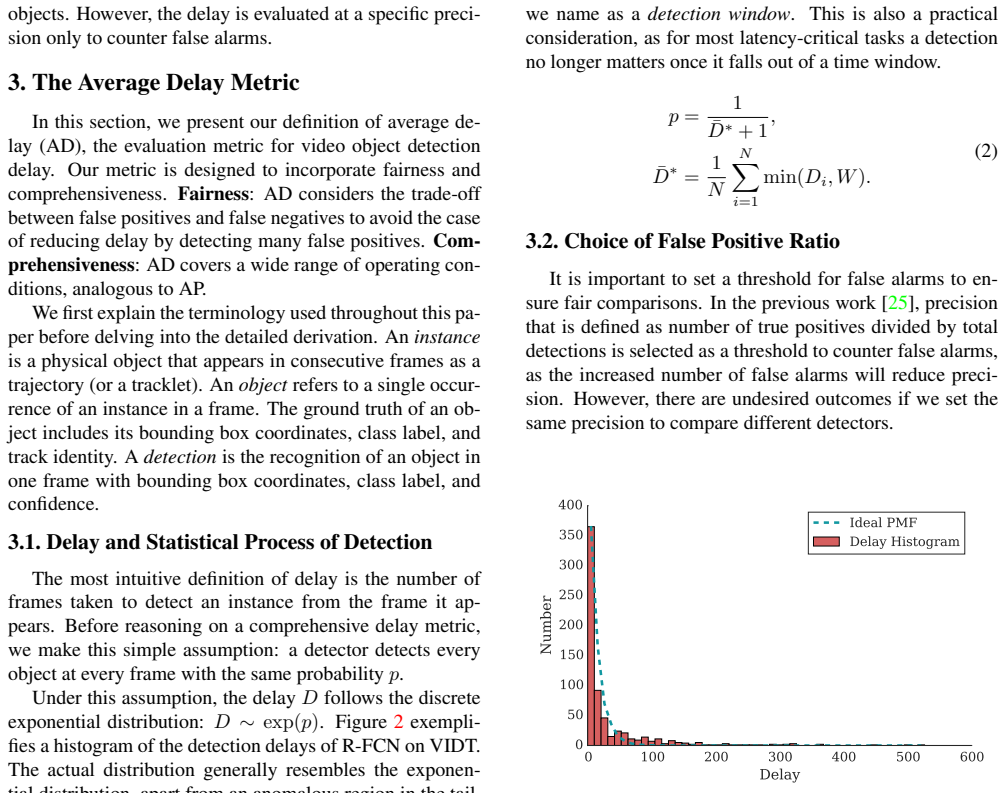
Compare each detector's empirical delay distribution against the fitted discrete exponential model on VIDT, for example by computing the Kaplan-Meier survival curve of first-detection times and testing whether detection probability per frame is constant. The paper's own Figure 7, showing FGFA confidence rising steadily over frames, already suggests the constant-p model fails there; a quantitative test would estimate p(t) and show whether re-ranking detectors by a nonparametric mean delay changes the AD ordering.
Extended reading notes
Core claim
The central claim is that mAP cannot distinguish detectors with different temporal behavior: a detector that recognizes objects only late in their trajectory can match a detector that recognizes them immediately, as long as the total number of true positives over frames is similar. The paper introduces AD as the delay counterpart to AP: for each of six false-positive ratios it measures the clipped mean delay to first detection, converts that mean to a per-frame detection probability under a discrete exponential model, averages those probabilities, and converts back to frames. This design makes AD sensitive to retardation (suppressing early detections) and nearly insensitive to tail boost (raising confidence of late detections), behaviors that mAP, NAB scores, and the CaTDet delay metric do not share. On the VIDT subset, DFF with sparse key frames, FGFA with feature aggregation, and CaTDet all preserve mAP while raising AD relative to frame-by-frame baselines, and the paper interprets this as evidence that temporal information is often used to refine late detections rather than to detect earlier.
Load-bearing premise
The metric's numbers rest on the assumption that on each frame a detector detects an object with the same fixed probability, so delay follows a single exponential distribution; if a detector's per-frame detection probability changes with time since appearance, the reported AD values and rankings may partly reflect that assumption rather than the true temporal behavior.
Editorial extensions
If this is right
- If mAP is retained as the headline accuracy number, video object detection papers should report AD alongside it; a method that improves or preserves mAP while worsening AD is not a strict improvement.
- Latency-critical deployment, such as autonomous vehicle perception, should prefer detectors with low AD even when their mAP is slightly lower, because detections arriving after the decision deadline are effectively useless.
- Methods that aggregate features over many frames (FGFA style) or use sparse key frames (DFF style) should be expected to trade delay for accuracy; the paper's measurements quantify that trade.
- Anchor-scale choices affect delay as well as accuracy: adding small anchor scales improves AD for small instances, so delay evaluation can guide architecture choices beyond mAP.
- AD's class-agnostic aggregation on VIDT means future evaluation datasets for delay should be built to contain instances entering at random times and locations, as VIDT does.
Reading between the lines
- An inference beyond the paper: AD as defined is one summary statistic of the whole delay distribution; a natural extension would be a delay-recall curve or a time-aware precision-recall surface that exposes not just mean delay but the full distribution over instances.
- The paper's exponential assumption is a convenience; a detector whose confidence ramps up gradually, as FGFA visibly does, has time-dependent detection probability, so future work could replace the single p with a time-varying hazard model and still use the same false-positive-ratio framework.
- The paper evaluates established detectors but does not propose a training objective; a testable extension is to train with a delay-aware loss that penalizes late first detections, and check whether AD can be improved without sacrificing mAP.
- Because AD is computed from tracklet-level first detections, it implicitly assumes clean track identities; extending the metric to tracking-by-detection systems with identity switches would require a policy for when a detection belongs to an existing instance.
Signed reviews
Editorial analysis
A structured set of objections, weighed in public.
Referee Report
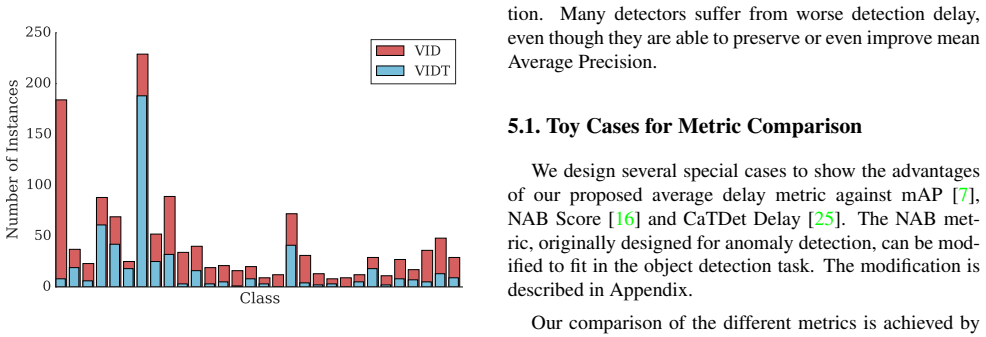
Summary. The paper argues that average precision (AP) is insensitive to the temporal behavior of video object detectors and proposes a new metric, average delay (AD), to measure detection delay. AD is defined in Eq. (3) as a function of per-frame detection probabilities inferred from clipped mean delays, with a detection window W=30 and six false-positive ratios. To support the evaluation, the authors introduce VIDT, a subset of ImageNet VID with multiple tracklets. Experiments with DFF, FGFA, CaTDet, and standard image detectors show that methods can preserve or improve mAP while substantially worsening AD, and the authors conclude that video object detection should be evaluated with a delay metric, especially for latency-critical applications.
Significance. If the main empirical claim holds, the paper makes a useful methodological contribution: it identifies a blind spot in mAP-based video object detection evaluation, releases code and a curated subset (VIDT), and provides a concrete way to quantify algorithmic delay. The toy-case experiments in Table 2 are a nice sanity check of the metric's behavior under controlled manipulations. The central claim, however, rests on AD being a faithful summary of temporal detection behavior, and the paper's own evidence casts doubt on the stochastic model used to derive AD. The contribution is therefore significant but currently not fully validated.
major comments (4)
- [Sec. 3.1, Eqs. (1)-(2), Fig. 7, Table 3] The constant-p, independent-per-frame detection model underlying Eqs. (1)-(2) is contradicted by the paper's own evidence. Table 3 shows off-window percentages roughly double the exponential expectation (e.g., 10.2% vs. 5.3% for R-FCN), and Fig. 7 shows FGFA confidence gradually building over frames rather than appearing with constant probability. Under a time-varying detection probability, the quantity 1/(D*+1) is not a latent detection rate, and Eq. (3) becomes an arbitrary nonlinear weighting of clipped delays. The authors should test whether the reported AD rankings survive a model-free aggregation, for instance mean/median clipped delay, hazard-rate estimates, or time to 50% detection, and report rank correlations. Without such a robustness check, the main conclusion that 'most methods drastically increase detection delay' may be an artifact of the exponential assumption.
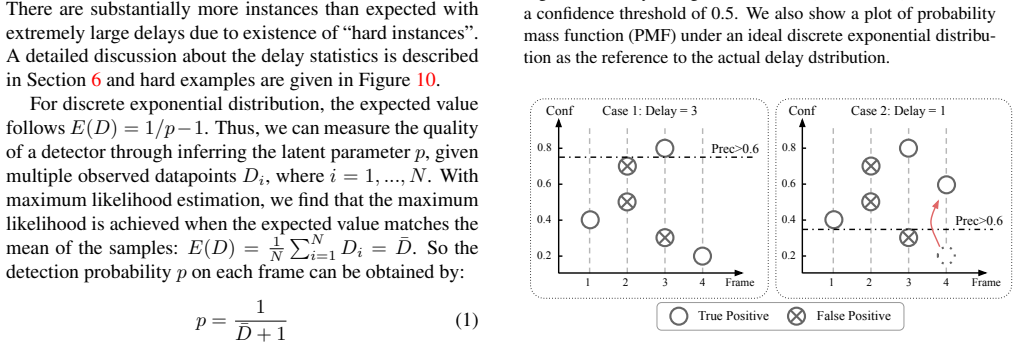
- [Sec. 3.3, Eq. (3)] The two key design choices, W=30 and the FP ratio set {0.1, 0.2, 0.4, 0.8, 1.6, 3.2}, are introduced without justification, yet AD is a function of both. Because the paper's headline comparisons (e.g., R-FCN 9.0 vs. DFF 11.6 vs. FGFA 10.2 in Fig. 6) are point estimates of AD, it is important to show that rankings are stable over reasonable variations in W (e.g., 10, 20, 50, 100) and over alternative FP-ratio grids, including an unweighted average of per-ratio delays. If rankings change, the metric's comparisons are not robust.
- [Sec. 6.4, Table 5] What is called a 'test of significance' is not a significance test. The 3-fold validation reports point estimates only and does not provide variances, confidence intervals, or any p-value for the differences between AD of R-FCN, DFF, and FGFA; moreover, folds are constructed from the dataset and are not independent samples of the underlying video distribution. The alternative dataset VIDT-2017 is a helpful additional check, but it also reports point estimates without uncertainty. The authors should add per-instance bootstrap or paired-difference confidence intervals to establish that the observed AD gaps are unlikely to arise from the small number of instances.
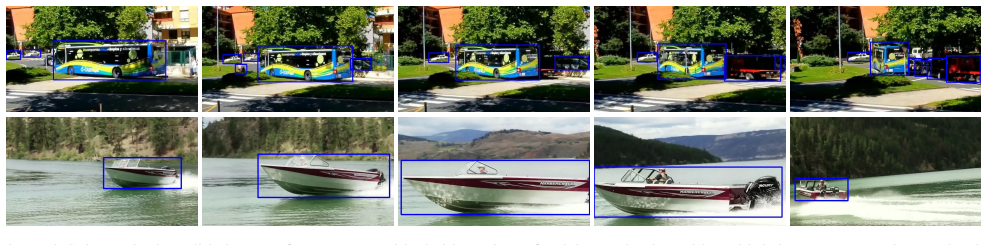
- [Sec. 4.2] The rule that an instance disappearing for more than 10 frames is counted as a new instance is an arbitrary definition that directly affects the measured delay: a detector that recognizes re-appearance quickly will appear to have low delay, while one that does not re-detect will be penalized. Since this threshold is a free parameter of the dataset construction, a sensitivity analysis (e.g., thresholds of 5, 10, 20 frames) is needed to show that the main conclusions do not hinge on this choice.
minor comments (5)
- [Abstract] 'A verage' in the title is a typo; also 'descend' should be 'decent' in the conclusion.
- [Sec. 3.1, Fig. 2] The caption contains a typo: 'delay dstribution' should be 'delay distribution'.
- [Sec. 3.3] In the sentence 'we derive the corresponding AD fom the averaged p', 'fom' should be 'from'.
- [Sec. 3.3, Eq. (3)] The notation ̄D*_r implicitly depends on the window W and the FP ratio r; it would be clearer to write ̄D*_r(W) or define the dependence explicitly.
- [Sec. 2.1] The reference to 'CaTDET [25]' in the background section should be capitalized consistently as 'CaTDet' throughout.
Circularity Check
No significant circularity: AD is a direct transform of measured detection delays, and the AP-insensitivity conclusion is an independent empirical comparison.
full rationale
AD is defined in Eq. 3 from measured per-instance delays: for each false-positive ratio r, D*_r is the clipped mean of frame delays (Eq. 2), converted to p = 1/(D*_r + 1), averaged across r, and mapped back to a delay value. Every quantity entering the final AD is a deterministic function of observed detection times; the only inputs are the manually chosen window W = 30 and six FP ratios. No model parameter is fitted to produce the paper's conclusion, and the central claim (AP is insensitive to delay differences) is an empirical comparison of two independently computed metrics, mAP and AD, on VIDT. The exponential-distribution assumption motivates the reciprocal transform, but it is not load-bearing for the claim: even if the assumption were false, AD would still be a well-defined deterministic summary of clipped mean delays, and the reported rankings would remain computable quantities. The only self-citation of note is CaTDet [25], which is used as a prior delay metric to argue against precision-based false-alarm control and as one baseline detector; the central AP-insensitivity result does not depend on any unverified claim from [25]. No uniqueness theorem is imported, and no known result is renamed. The model-fidelity concerns about heavy tails and gradual confidence buildup are validity questions about whether AD is the right metric, not circularity in the derivation. The paper is therefore self-contained with respect to its main claim, and no circular step is present.
Assumptions & free parameters
free parameters (3)
- Detection window W =
30 frames
- False-positive ratio set =
[0.1, 0.2, 0.4, 0.8, 1.6, 3.2]
- Tracklet split threshold =
10 frames
assumptions (3)
- domain assumption Per-frame detection is modeled as an independent Bernoulli trial with constant probability p for each instance, so delay follows a discrete exponential distribution.
- ad hoc to paper The annotated track identities in VID are correct, and a gap of more than 10 frames defines a new instance for delay measurement.
- domain assumption Comparing detectors at fixed false-positive ratios provides a fair false-alarm control across methods.
Cite this review
Pith. "Pith review of A Delay Metric for Video Object Detection: What Average Precision Fails to Tell." pith.science (2026). https://pith.science/paper/65BYV6CT
@misc{pith2026190806368,
  author       = {Pith},
  title        = {Pith review of: A Delay Metric for Video Object Detection: What Average Precision Fails to Tell},
  year         = {2026},
  howpublished = {\url{https://pith.science/paper/65BYV6CT}},
  note         = {Machine review of arXiv:1908.06368}
}
read the original abstract
Average precision (AP) is a widely used metric to evaluate detection accuracy of image and video object detectors. In this paper, we analyze object detection from videos and point out that AP alone is not sufficient to capture the temporal nature of video object detection. To tackle this problem, we propose a comprehensive metric, average delay (AD), to measure and compare detection delay. To facilitate delay evaluation, we carefully select a subset of ImageNet VID, which we name as ImageNet VIDT with an emphasis on complex trajectories. By extensively evaluating a wide range of detectors on VIDT, we show that most methods drastically increase the detection delay but still preserve AP well. In other words, AP is not sensitive enough to reflect the temporal characteristics of a video object detector. Our results suggest that video object detection methods should be additionally evaluated with a delay metric, particularly for latency-critical applications such as autonomous vehicle perception.
Figures

Figures from the paper (6 more)


Reference graph
Works this paper leans on
-
[1]
https://deepdrive.berkeley.edu/project/low- latency-deep-inference-self-driving-vehicles
Berkeley DeepDrive: Low latency deep inference for self- driving vehicles. https://deepdrive.berkeley.edu/project/low- latency-deep-inference-self-driving-vehicles. 2
-
[2]
Object detection in video with spatiotemporal sampling networks
Gedas Bertasius, Lorenzo Torresani, and Jianbo Shi. Object detection in video with spatiotemporal sampling networks. In ECCV, 2018. 1, 2, 6
work page 2018
-
[3]
Adaptive neural networks for efficient inference
Tolga Bolukbasi, Joseph Wang, Ofer Dekel, and Venkatesh Saligrama. Adaptive neural networks for efficient inference. In ICML, 2017. 6
work page 2017
-
[4]
Optimizing video object detection via a scale-time lattice
Kai Chen, Jiaqi Wang, Shuo Yang, Xingcheng Zhang, Yuan- jun Xiong, Chen Change Loy, and Dahua Lin. Optimizing video object detection via a scale-time lattice. In CVPR,
-
[5]
R-FCN: Object detection via region-based fully convolutional networks
Jifeng Dai, Yi Li, Kaiming He, and Jian Sun. R-FCN: Object detection via region-based fully convolutional networks. In NeurIPS, 2016. 1, 2
work page 2016
-
[6]
ImageNet: A large-scale hierarchical image database
Jia Deng, Wei Dong, Richard Socher, Li-Jia Li, Kai Li, and Li Fei-Fei. ImageNet: A large-scale hierarchical image database. In CVPR, 2009. 1, 2, 4
2009
-
[7]
The pascal visual object classes (VOC) challenge
Mark Everingham, Luc Van Gool, Christopher KI Williams, John Winn, and Andrew Zisserman. The pascal visual object classes (VOC) challenge. IJCV, 2010. 2, 5
work page 2010
-
[8]
Detect to track and track to detect
Christoph Feichtenhofer, Axel Pinz, and Andrew Zisserman. Detect to track and track to detect. In ICCV, 2017. 1, 2
work page 2017
Show all 39 references
-
[9]
Vision meets robotics: The KITTI dataset
Andreas Geiger, Philip Lenz, Christoph Stiller, and Raquel Urtasun. Vision meets robotics: The KITTI dataset. Interna- tional Journal of Robotics Research, 2013. 1, 4
2013
-
[10]
Impression network for video object detection
Congrui Hetang, Hongwei Qin, Shaohui Liu, and Jun- jie Yan. Impression network for video object detection. arXiv:1712.05896, 2017. 5
2017 arXiv
-
[11]
MobileNets: Efficient con- volutional neural networks for mobile vision applications
Andrew G Howard, Menglong Zhu, Bo Chen, Dmitry Kalenichenko, Weijun Wang, Tobias Weyand, Marco An- dreetto, and Hartwig Adam. MobileNets: Efficient con- volutional neural networks for mobile vision applications. arXiv:1704.04861, 2017. 2
2017 arXiv
-
[12]
T-CNN: Tubelets with convolutional neural networks for object detection from videos
Kai Kang, Hongsheng Li, Junjie Yan, Xingyu Zeng, Bin Yang, Tong Xiao, Cong Zhang, Zhe Wang, Ruohui Wang, Xiaogang Wang, et al. T-CNN: Tubelets with convolutional neural networks for object detection from videos. TCSVT,
-
[13]
A discriminative model with multiple temporal scales for action prediction
Yu Kong, Dmitry Kit, and Yun Fu. A discriminative model with multiple temporal scales for action prediction. In ECCV, 2014. 2
2014
-
[14]
Quickest moving object detection
Dong Lao and Ganesh Sundaramoorthi. Quickest moving object detection. arXiv:1605.07369, 2016. 2
2016 arXiv
-
[15]
Minimum delay ob- ject detection from video
Dong Lao and Ganesh Sundaramoorthi. Minimum delay ob- ject detection from video. In Proceedings of the IEEE Inter- national Conference on Computer Vision, pages 5097–5106,
-
[16]
Evaluating real-time anomaly detection algorithms–the numenta anomaly bench- mark
Alexander Lavin and Subutai Ahmad. Evaluating real-time anomaly detection algorithms–the numenta anomaly bench- mark. In ICMLA, 2015. 2, 5
2015
-
[17]
The ar- chitectural implications of autonomous driving: Constraints and acceleration
Shih-Chieh Lin, Yunqi Zhang, Chang-Hong Hsu, Matt Skach, Md E Haque, Lingjia Tang, and Jason Mars. The ar- chitectural implications of autonomous driving: Constraints and acceleration. In ASPLOS, 2018. 2
2018
-
[18]
Focal loss for dense object detection
Tsung-Yi Lin, Priya Goyal, Ross Girshick, Kaiming He, and Piotr Doll´ar. Focal loss for dense object detection. In ICCV,
-
[19]
Microsoft CoCo: Common objects in context
Tsung-Yi Lin, Michael Maire, Serge Belongie, James Hays, Pietro Perona, Deva Ramanan, Piotr Doll´ar, and C Lawrence Zitnick. Microsoft CoCo: Common objects in context. In ECCV, 2014. 1, 2
2014
-
[20]
Mobile video object detec- tion with temporally-aware feature maps
Mason Liu and Menglong Zhu. Mobile video object detec- tion with temporally-aware feature maps. In CVPR, 2018. 1, 2, 6
2018
-
[21]
SSD: Single shot multibox detector
Wei Liu, Dragomir Anguelov, Dumitru Erhan, Christian Szegedy, Scott Reed, Cheng-Yang Fu, and Alexander C Berg. SSD: Single shot multibox detector. In ECCV, 2016. 1, 2
2016
-
[22]
Detect or track: Towards cost-effective video object detec- tion/tracking
Hao Luo, Wenxuan Xie, Xinggang Wang, and Wenjun Zeng. Detect or track: Towards cost-effective video object detec- tion/tracking. In AAAI, 2019. 2, 5
2019
-
[23]
Learning ac- tivity progression in LSTMs for activity detection and early detection
Shugao Ma, Leonid Sigal, and Stan Sclaroff. Learning ac- tivity progression in LSTMs for activity detection and early detection. In CVPR, 2016. 2
2016
-
[24]
Budget-aware activity detection with a recurrent policy network
Behrooz Mahasseni, Xiaodong Yang, Pavlo Molchanov, and Jan Kautz. Budget-aware activity detection with a recurrent policy network. In BMVC, 2018. 2
2018
-
[25]
Catdet: Cascaded tracked detector for efficient object detection from video
Huizi Mao, Taeyoung Kong, and William J Dally. Catdet: Cascaded tracked detector for efficient object detection from video. arXiv preprint arXiv:1810.00434, 2018. 1, 2, 3, 5, 6
2018 arXiv
-
[26]
Towards real-time object detection on embedded systems
Huizi Mao, Song Yao, Tianqi Tang, Boxun Li, Jun Yao, and Yu Wang. Towards real-time object detection on embedded systems. TETC, 2018. 2
2018
-
[27]
Moped: A scalable and low latency object recognition and pose estimation system
Manuel Martinez, Alvaro Collet, and Siddhartha S Srinivasa. Moped: A scalable and low latency object recognition and pose estimation system. In ICRA, 2010. 2
2010
-
[28]
A large- scale benchmark dataset for event recognition in surveillance video
Sangmin Oh, Anthony Hoogs, Amitha Perera, Naresh Cun- toor, Chia-Chih Chen, Jong Taek Lee, Saurajit Mukherjee, JK Aggarwal, Hyungtae Lee, and Larry Davis. A large- scale benchmark dataset for event recognition in surveillance video. In CVPR, 2011. 4
2011
-
[29]
Quickest detection
Vincent Poor and Olympia Hadjiliadis. Quickest detection
-
[30]
YouTube-BoundingBoxes: A large high-precision human-annotated data set for object detection in video
Esteban Real, Jonathon Shlens, Stefano Mazzocchi, Xin Pan, and Vincent Vanhoucke. YouTube-BoundingBoxes: A large high-precision human-annotated data set for object detection in video. In CVPR, 2017. 4
2017
-
[31]
Faster R-CNN: Towards real-time object detection with re- gion proposal networks
Shaoqing Ren, Kaiming He, Ross Girshick, and Jian Sun. Faster R-CNN: Towards real-time object detection with re- gion proposal networks. In NeurIPS, 2015. 1, 2
2015
-
[32]
Encouraging LSTMs to anticipate actions very early
Mohammad Sadegh Aliakbarian, Fatemeh Sadat Saleh, Mathieu Salzmann, Basura Fernando, Lars Petersson, and Lars Andersson. Encouraging LSTMs to anticipate actions very early. In ICCV, 2017. 2
2017
-
[33]
Mul- tilayer and multimodal fusion of deep neural networks for video classification
Xiaodong Yang, Pavlo Molchanov, and Jan Kautz. Mul- tilayer and multimodal fusion of deep neural networks for video classification. In ACM Multimedia, 2016. 2
2016
-
[34]
Making convolutional networks recurrent for visual sequence learn- ing
Xiaodong Yang, Pavlo Molchanov, and Jan Kautz. Making convolutional networks recurrent for visual sequence learn- ing. In CVPR, 2018. 1
2018
-
[35]
STEP: Spatio-temporal pro- gressive learning for video action detection
Xitong Yang, Xiaodong Yang, Ming-Yu Liu, Fanyi Xiao, Larry Davis, and Jan Kautz. STEP: Spatio-temporal pro- gressive learning for video action detection. In CVPR, 2019. 2
2019
-
[36]
BDD100K: A diverse driving video database with scalable annotation tool- ing
Fisher Yu, Wenqi Xian, Yingying Chen, Fangchen Liu, Mike Liao, Vashisht Madhavan, and Trevor Darrell. BDD100K: A diverse driving video database with scalable annotation tool- ing. arXiv:1805.04687, 2018. 4
2018 arXiv
-
[37]
ShuffleNet: An extremely efficient convolutional neural net- work for mobile devices
Xiangyu Zhang, Xinyu Zhou, Mengxiao Lin, and Jian Sun. ShuffleNet: An extremely efficient convolutional neural net- work for mobile devices. In CVPR, 2018. 2
2018
-
[38]
Flow-guided feature aggregation for video object de- tection
Xizhou Zhu, Yujie Wang, Jifeng Dai, Lu Yuan, and Yichen Wei. Flow-guided feature aggregation for video object de- tection. In ICCV, 2017. 1, 6
2017
-
[39]
Deep feature flow for video recognition
Xizhou Zhu, Yuwen Xiong, Jifeng Dai, Lu Yuan, and Yichen Wei. Deep feature flow for video recognition. In CVPR,
Reviewed August 14, 2026 · model on record in the stance chip above.
Discussion (0). Continue with ORCID to comment.